

Insights on Innovation, R&D, and IP
Perspectives on patents, scientific research, emerging technologies, and the strategies shaping modern R&D

Executive Summary
In 2024, US patent infringement jury verdicts totaled $4.19 billion across 72 cases. Twelve individual verdicts exceeded $100million. The largest single award—$857 million in General Access Solutions v.Cellco Partnership (Verizon)—exceeded the annual R&D budget of many mid-market technology companies. In the first half of 2025 alone, total damages reached an additional $1.91 billion.
The consequences of incomplete patent intelligence are not abstract. In what has become one of the most instructive IP disputes in recent history, Masimo’s pulse oximetry patents triggered a US import ban on certain Apple Watch models, forcing Apple to disable its blood oxygen feature across an entire product line, halt domestic sales of affected models, invest in a hardware redesign, and ultimately face a $634 million jury verdict in November 2025. Apple—a company with one of the most sophisticated intellectual property organizations on earth—spent years in litigation over technology it might have designed around during development.
For organizations with fewer resources than Apple, the risk calculus is starker. A mid-size materials company, a university spinout, or a defense contractor developing next-generation battery technology cannot absorb a nine-figure verdict or a multi-year injunction. For these organizations, the patent landscape analysis conducted during the development phase is the primary risk mitigation mechanism. The quality of that analysis is not a matter of convenience. It is a matter of survival.
And yet, a growing number of R&D and IP teams are conducting that analysis using general-purpose AI tools—ChatGPT, Claude, Microsoft Co-Pilot—that were never designed for patent intelligence and are structurally incapable of delivering it.
This report presents the findings of a controlled comparison study in which identical patent landscape queries were submitted to four AI-powered tools: Cypris (a purpose-built R&D intelligence platform),ChatGPT (OpenAI), Claude (Anthropic), and Microsoft Co-Pilot. Two technology domains were tested: solid-state lithium-sulfur battery electrolytes using garnet-type LLZO ceramic materials (freedom-to-operate analysis), and bio-based polyamide synthesis from castor oil derivatives (competitive intelligence).
The results reveal a significant and structurally persistent gap. In Test 1, Cypris identified over 40 active US patents and published applications with granular FTO risk assessments. Claude identified 12. ChatGPT identified 7, several with fabricated attribution. Co-Pilot identified 4. Among the patents surfaced exclusively by Cypris were filings rated as “Very High” FTO risk that directly claim the technology architecture described in the query. In Test 2, Cypris cited over 100 individual patent filings with full attribution to substantiate its competitive landscape rankings. No general-purpose model cited a single patent number.
The most active sectors for patent enforcement—semiconductors, AI, biopharma, and advanced materials—are the same sectors where R&D teams are most likely to adopt AI tools for intelligence workflows. The findings of this report have direct implications for any organization using general-purpose AI to inform patent strategy, competitive intelligence, or R&D investment decisions.

1. Methodology
A controlled comparative evaluation was conducted on March 27, 2026. An identical patent landscape query was submitted verbatim to each platform under standardized testing conditions. No follow-up prompts, clarifications, or iterative refinements were permitted, ensuring that each platform was evaluated based solely on its initial response.
The outputs were preserved in their original form and evaluated against predefined criteria using publicly verifiable patent records.
1.1 Query
Identify all active US patents and published applications filed in the last 5 years related to solid-state lithium-sulfur battery electrolytes using garnet-type ceramic materials. For each, provide the assignee, filing date, key claims, and current legal status. Highlight any patents that could pose freedom-to-operate risks for a company developing a Li₇La₃Zr₂O₁₂(LLZO)-based composite electrolyte with a polymer interlayer.
1.2 Tools Evaluated

1.3 Evaluation Criteria
Each response was evaluated using a consistent six-part scoring framework: patent coverage, assignee accuracy, filing metadata completeness, depth of claim analysis, quality of FTO risk stratification, and the presence of actionable strategic guidance.
Patent numbers, assignees, filing information, and legal status were independently checked against publicly available USPTO and WIPO records. The evaluation focused on the completeness, accuracy, and practical utility of each platform’s output rather than writing quality or presentation.
2. Findings
2.1 Coverage Gap
The most significant finding is the scale of the coverage differential. Cypris identified over 40 active US patents and published applications spanning LLZO-polymer composite electrolytes, garnet interface modification, polymer interlayer architectures, lithium-sulfur specific filings, and adjacent ceramic composite patents. The results were organized by technology category with per-patent FTO risk ratings.
Claude identified 12 patents organized in a four-tier risk framework. Its analysis was structurally sound and correctly flagged the two highest-risk filings (Solid Energies US 11,967,678 and the LLZO nanofiber multilayer US 11,923,501). It also identified the University ofMaryland/ Wachsman portfolio as a concentration risk and noted the NASA SABERS portfolio as a licensing opportunity. However, it missed the majority of the landscape, including the entire Corning portfolio, GM's interlayer patents, theKorea Institute of Energy Research three-layer architecture, and the HonHai/SolidEdge lithium-sulfur specific filing.
ChatGPT identified 7 patents, but the quality of attribution was inconsistent. It listed assignees as "Likely DOE /national lab ecosystem" and "Likely startup / defense contractor cluster" for two filings—language that indicates the model was inferring rather than retrieving assignee data. In a freedom-to-operate context, an unverified assignee attribution is functionally equivalent to no attribution, as it cannot support a licensing inquiry or risk assessment.
Co-Pilot identified 4 US patents. Its output was the most limited in scope, missing the Solid Energies portfolio entirely, theUMD/ Wachsman portfolio, Gelion/ Johnson Matthey, NASA SABERS, and all Li-S specific LLZO filings.
2.2 Critical Patents Missed by Public Models
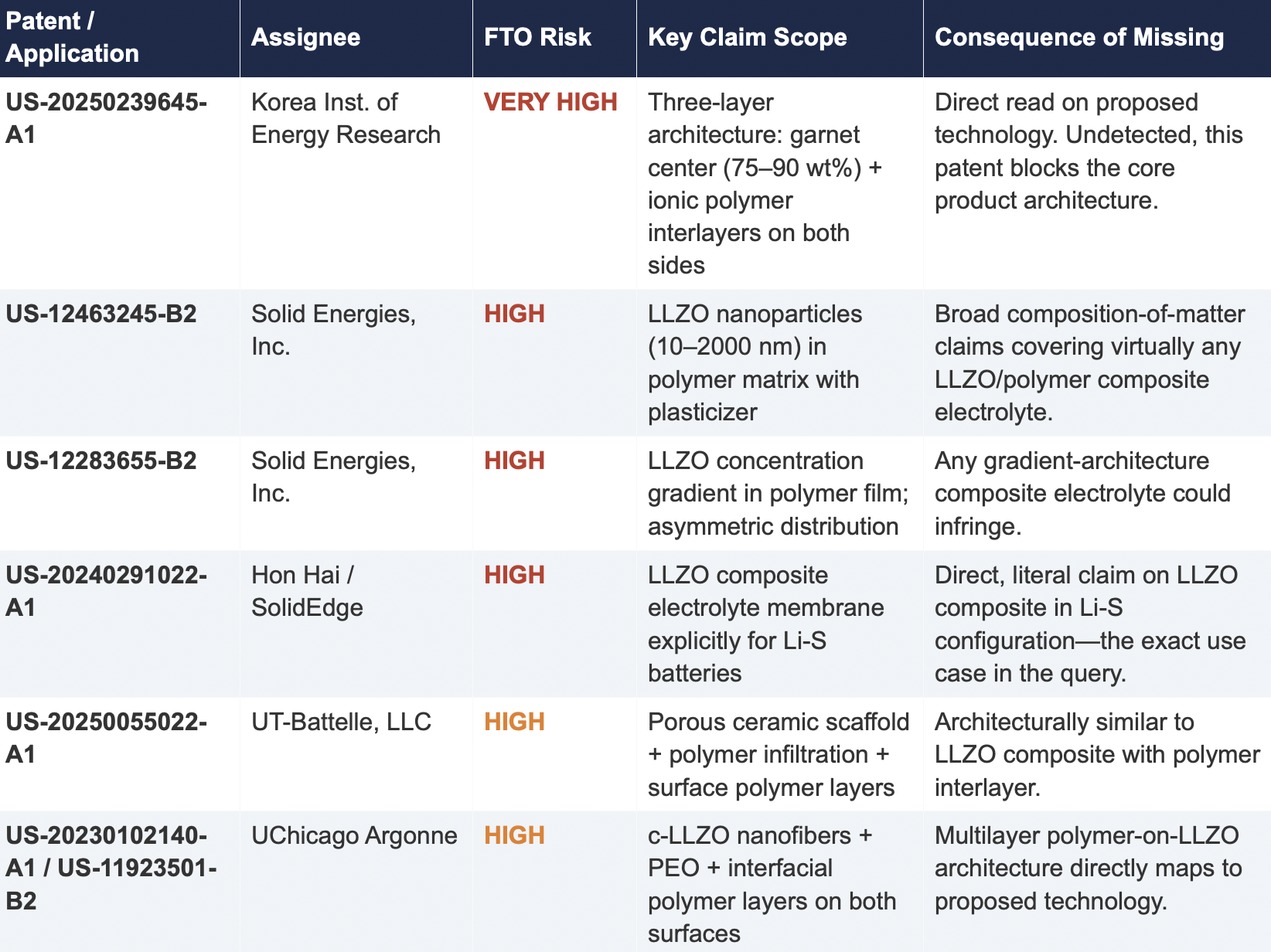
The following table presents patents identified exclusively by Cypris that were rated as High or Very High FTO risk for the proposed technology architecture. None were surfaced by any general-purpose model.
2.3 Patent Fencing: The Solid Energies Portfolio
Cypris identified a coordinated patent fencing strategy by Solid Energies, Inc. that no general-purpose model detected at scale. Solid Energies holds at least four granted US patents and one published application covering LLZO-polymer composite electrolytes across compositions(US-12463245-B2), gradient architectures (US-12283655-B2), electrode integration (US-12463249-B2), and manufacturing processes (US-20230035720-A1). Claude identified one Solid Energies patent (US 11,967,678) and correctly rated it as the highest-priority FTO concern but did not surface the broader portfolio. ChatGPT and Co-Pilot identified zero Solid Energies filings.
The practical significance is that a company relying on any individual patent hit would underestimate the scope of Solid Energies' IP position. The fencing strategy—covering the composition, the architecture, the electrode integration, and the manufacturing method—means that identifying a single design-around for one patent does not resolve the FTO exposure from the portfolio as a whole. This is the kind of strategic insight that requires seeing the full picture, which no general-purpose model delivered
2.4 Assignee Attribution Quality
ChatGPT's response included at least two instances of fabricated or unverifiable assignee attributions. For US 11,367,895 B1, the listed assignee was "Likely startup / defense contractor cluster." For US 2021/0202983 A1, the assignee was described as "Likely DOE / national lab ecosystem." In both cases, the model appears to have inferred the assignee from contextual patterns in its training data rather than retrieving the information from patent records.
In any operational IP workflow, assignee identity is foundational. It determines licensing strategy, litigation risk, and competitive positioning. A fabricated assignee is more dangerous than a missing one because it creates an illusion of completeness that discourages further investigation. An R&D team receiving this output might reasonably conclude that the landscape analysis is finished when it is not.
3. Structural Limitations of General-Purpose Models for Patent Intelligence
3.1 Training Data Is Not Patent Data
Large language models are trained on web-scraped text. Their knowledge of the patent record is derived from whatever fragments appeared in their training corpus: blog posts mentioning filings, news articles about litigation, snippets of Google Patents pages that were crawlable at the time of data collection. They do not have systematic, structured access to the USPTO database. They cannot query patent classification codes, parse claim language against a specific technology architecture, or verify whether a patent has been assigned, abandoned, or subjected to terminal disclaimer since their training data was collected.
This is not a limitation that improves with scale. A larger training corpus does not produce systematic patent coverage; it produces a larger but still arbitrary sampling of the patent record. The result is that general-purpose models will consistently surface well-known patents from heavily discussed assignees (QuantumScape, for example, appeared in most responses) while missing commercially significant filings from less publicly visible entities (Solid Energies, Korea Institute of EnergyResearch, Shenzhen Solid Advanced Materials).
3.2 The Web Is Closing to Model Scrapers
The data access problem is structural and worsening. As of mid-2025, Cloudflare reported that among the top 10,000 web domains, the majority now fully disallow AI crawlers such as GPTBot andClaudeBot via robots.txt. The trend has accelerated from partial restrictions to outright blocks, and the crawl-to-referral ratios reveal the underlying tension: OpenAI's crawlers access approximately1,700 pages for every referral they return to publishers; Anthropic's ratio exceeds 73,000 to 1.
Patent databases, scientific publishers, and IP analytics platforms are among the most restrictive content categories. A Duke University study in 2025 found that several categories of AI-related crawlers never request robots.txt files at all. The practical consequence is that the knowledge gap between what a general-purpose model "knows" about the patent landscape and what actually exists in the patent record is widening with each training cycle. A landscape query that a general-purpose model partially answered in 2023 may return less useful information in 2026.
3.3 General-Purpose Models Lack Ontological Frameworks for Patent Analysis
A freedom-to-operate analysis is not a summarization task. It requires understanding claim scope, prosecution history, continuation and divisional chains, assignee normalization (a single company may appear under multiple entity names across patent records), priority dates versus filing dates versus publication dates, and the relationship between dependent and independent claims. It requires mapping the specific technical features of a proposed product against independent claim language—not keyword matching.
General-purpose models do not have these frameworks. They pattern-match against training data and produce outputs that adopt the format and tone of patent analysis without the underlying data infrastructure. The format is correct. The confidence is high. The coverage is incomplete in ways that are not visible to the user.
4. Comparative Output Quality
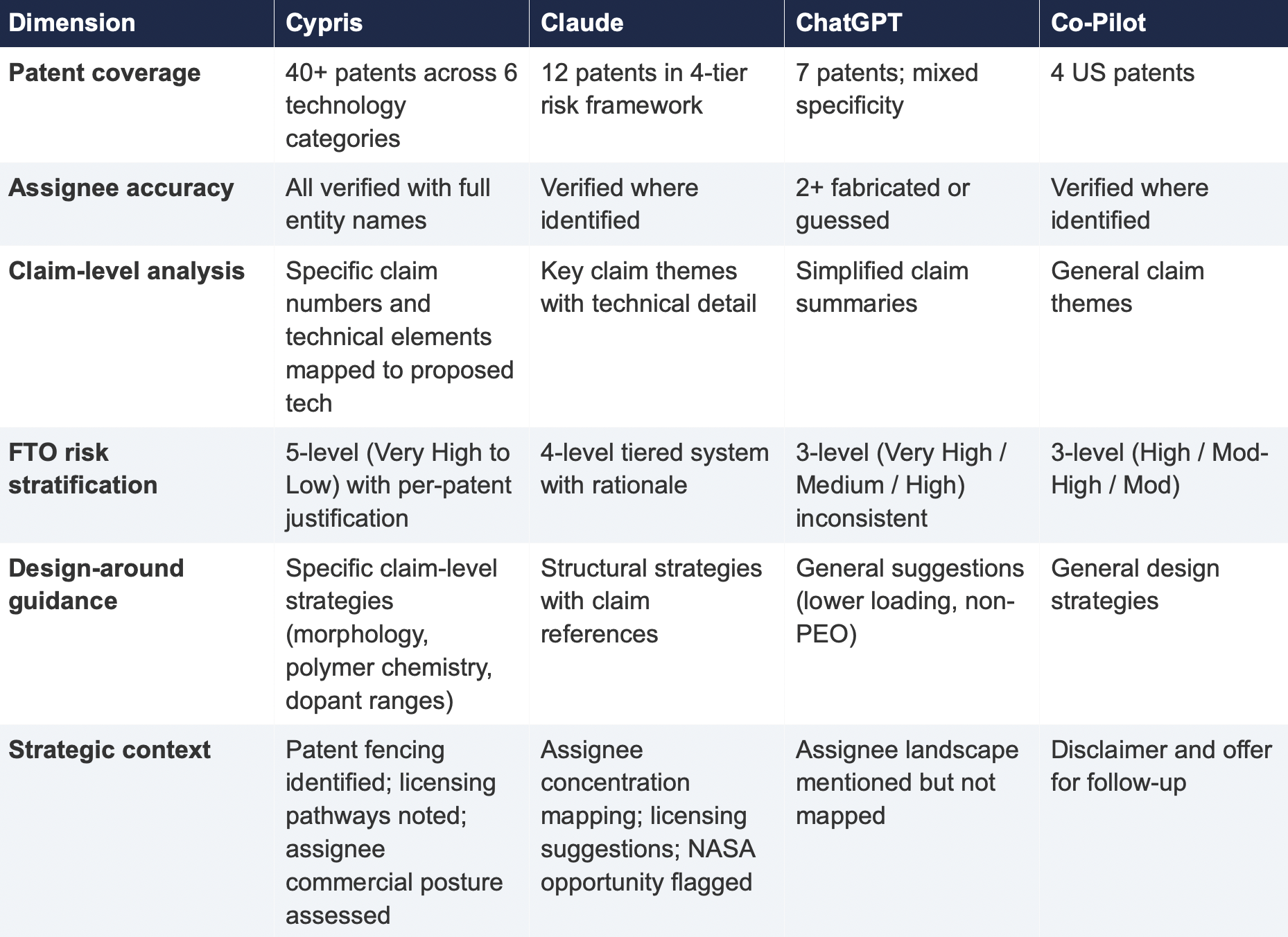
The following table summarizes the qualitative characteristics of each tool's response across the dimensions most relevant to an operational IP workflow.
5. Implications for R&D and IP Organizations
5.1 The Confidence Problem
The central risk identified by this study is not that general-purpose models produce bad outputs—it is that they produce incomplete outputs with high confidence. Each model delivered its results in a professional format with structured analysis, risk ratings, and strategic recommendations. At no point did any model indicate the boundaries of its knowledge or flag that its results represented a fraction of the available patent record. A practitioner receiving one of these outputs would have no signal that the analysis was incomplete unless they independently validated it against a comprehensive datasource.
This creates an asymmetric risk profile: the better the format and tone of the output, the less likely the user is to question its completeness. In a corporate environment where AI outputs are increasingly treated as first-pass analysis, this dynamic incentivizes under-investigation at precisely the moment when thoroughness is most critical.
5.2 The Diversification Illusion
It might be assumed that running the same query through multiple general-purpose models provides validation through diversity of sources. This study suggests otherwise. While the four tools returned different subsets of patents, all operated under the same structural constraints: training data rather than live patent databases, web-scraped content rather than structured IP records, and general-purpose reasoning rather than patent-specific ontological frameworks. Running the same query through three constrained tools does not produce triangulation; it produces three partial views of the same incomplete picture.
5.3 The Appropriate Use Boundary
General-purpose language models are effective tools for a wide range of tasks: drafting communications, summarizing documents, generating code, and exploratory research. The finding of this study is not that these tools lack value but that their value boundary does not extend to decisions that carry existential commercial risk.
Patent landscape analysis, freedom-to-operate assessment, and competitive intelligence that informs R&D investment decisions fall outside that boundary. These are workflows where the completeness and verifiability of the underlying data are not merely desirable but are the primary determinant of whether the analysis has value. A patent landscape that captures 10% of the relevant filings, regardless of how well-formatted or confidently presented, is a liability rather than an asset.
6. Test 2: Competitive Intelligence — Bio-Based Polyamide Patent Landscape
To assess whether the findings from Test 1 were specific to a single technology domain or reflected a broader structural pattern, a second query was submitted to all four tools. This query shifted from freedom-to-operate analysis to competitive intelligence, asking each tool to identify the top 10organizations by patent filing volume in bio-based polyamide synthesis from castor oil derivatives over the past three years, with summaries of technical approach, co-assignee relationships, and portfolio trajectory.
6.1 Query

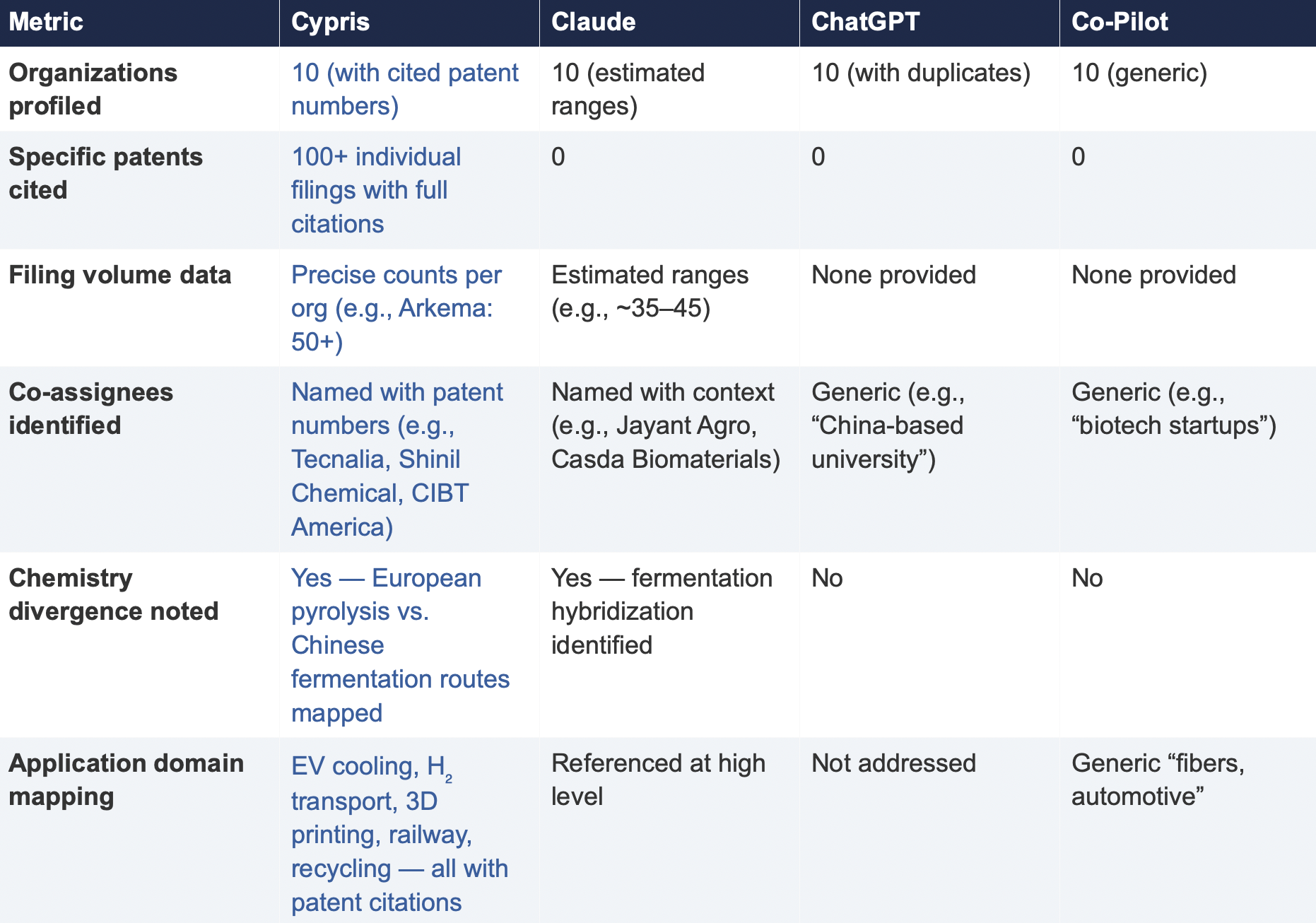
6.2 Summary of Results
6.3 Key Differentiators
Verifiability
The most consequential difference in Test 2 was the presence or absence of verifiable evidence. Cypris cited over 100 individual patent filings with full patent numbers, assignee names, and publication dates. Every claim about an organization’s technical focus, co-assignee relationships, and filing trajectory was anchored to specific documents that a practitioner could independently verify in USPTO, Espacenet, or WIPO PATENT SCOPE. No general-purpose model cited a single patent number. Claude produced the most structured and analytically useful output among the public models, with estimated filing ranges, product names, and strategic observations that were directionally plausible. However, without underlying patent citations, every claim in the response requires independent verification before it can inform a business decision. ChatGPT and Co-Pilot offered thinner profiles with no filing counts and no patent-level specificity.
Data Integrity
ChatGPT’s response contained a structural error that would mislead a practitioner: it listed CathayBiotech as organization #5 and then listed “Cathay Affiliate Cluster” as a separate organization at #9, effectively double-counting a single entity. It repeated this pattern with Toray at #4 and “Toray(Additional Programs)” at #10. In a competitive intelligence context where the ranking itself is the deliverable, this kind of error distorts the landscape and could lead to misallocation of competitive monitoring resources.
Organizations Missed
Cypris identified Kingfa Sci. & Tech. (8–10 filings with a differentiated furan diacid-based polyamide platform) and Zhejiang NHU (4–6 filings focused on continuous polymerization process technology)as emerging players that no general-purpose model surfaced. Both represent potential competitive threats or partnership opportunities that would be invisible to a team relying on public AI tools.Conversely, ChatGPT included organizations such as ANTA and Jiangsu Taiji that appear to be downstream users rather than significant patent filers in synthesis, suggesting the model was conflating commercial activity with IP activity.
Strategic Depth
Cypris’s cross-cutting observations identified a fundamental chemistry divergence in the landscape:European incumbents (Arkema, Evonik, EMS) rely on traditional castor oil pyrolysis to 11-aminoundecanoic acid or sebacic acid, while Chinese entrants (Cathay Biotech, Kingfa) are developing alternative bio-based routes through fermentation and furandicarboxylic acid chemistry.This represents a potential long-term disruption to the castor oil supply chain dependency thatWestern players have built their IP strategies around. Claude identified a similar theme at a higher level of abstraction. Neither ChatGPT nor Co-Pilot noted the divergence.
6.4 Test 2 Conclusion
Test 2 confirms that the coverage and verifiability gaps observed in Test 1 are not domain-specific.In a competitive intelligence context—where the deliverable is a ranked landscape of organizationalIP activity—the same structural limitations apply. General-purpose models can produce plausible-looking top-10 lists with reasonable organizational names, but they cannot anchor those lists to verifiable patent data, they cannot provide precise filing volumes, and they cannot identify emerging players whose patent activity is visible in structured databases but absent from the web-scraped content that general-purpose models rely on.
7. Conclusion
This comparative analysis, spanning two distinct technology domains and two distinct analytical workflows—freedom-to-operate assessment and competitive intelligence—demonstrates that the gap between purpose-built R&D intelligence platforms and general-purpose language models is not marginal, not domain-specific, and not transient. It is structural and consequential.
In Test 1 (LLZO garnet electrolytes for Li-S batteries), the purpose-built platform identified more than three times as many patents as the best-performing general-purpose model and ten times as many as the lowest-performing one. Among the patents identified exclusively by the purpose-built platform were filings rated as Very High FTO risk that directly claim the proposed technology architecture. InTest 2 (bio-based polyamide competitive landscape), the purpose-built platform cited over 100individual patent filings to substantiate its organizational rankings; no general-purpose model cited as ingle patent number.
The structural drivers of this gap—reliance on training data rather than live patent feeds, the accelerating closure of web content to AI scrapers, and the absence of patent-specific analytical frameworks—are not transient. They are inherent to the architecture of general-purpose models and will persist regardless of increases in model capability or training data volume.
For R&D and IP leaders, the practical implication is clear: general-purpose AI tools should be used for general-purpose tasks. Patent intelligence, competitive landscaping, and freedom-to-operate analysis require purpose-built systems with direct access to structured patent data, domain-specific analytical frameworks, and the ability to surface what a general-purpose model cannot—not because it chooses not to, but because it structurally cannot access the data.
The question for every organization making R&D investment decisions today is whether the tools informing those decisions have access to the evidence base those decisions require. This study suggests that for the majority of general-purpose AI tools currently in use, the answer is no.
Study Disclosure
This comparative evaluation was commissioned and published by Cypris. The testing methodology, prompts, evaluation criteria, and underlying outputs have been documented to support independent review and replication.
All platform outputs were preserved in their original form. Patent data and material factual claims were cross-checked against USPTO Patent Center and WIPO PATENTSCOPE records as of March 27, 2026. Cypris was one of the platforms evaluated and therefore has a commercial interest in the findings.
The Patent Intelligence Gap - A Comparative Analysis of Verticalized AI-Patent Tools vs. General-Purpose Language Models for R&D Decision-Making
All Blogs

Patent intelligence has evolved far beyond simple keyword searches and legal document retrieval. Today's enterprise R&D teams need sophisticated tools that can extract actionable insights from millions of patents, identify white space opportunities, and accelerate innovation pipelines. While traditional patent databases serve their purpose for IP attorneys conducting freedom-to-operate analyses, modern R&D intelligence platforms have emerged to meet the specific needs of research and development professionals who require deeper technical insights and broader innovation context.
The patent search tool landscape in 2025 reflects this evolution, with platforms ranging from basic database access to comprehensive R&D intelligence systems that integrate patents with scientific literature, market data, and competitive intelligence. Understanding which tool aligns with your specific needs requires examining not just search capabilities, but how effectively each platform transforms patent data into strategic R&D decisions.
Cypris: Purpose-Built R&D Intelligence Beyond Traditional Patent Search
Cypris represents a fundamental shift in how enterprise R&D teams approach patent intelligence. Rather than treating patents as legal documents to be searched and retrieved, Cypris positions them as technical knowledge assets within a broader innovation ecosystem. The platform's proprietary R&D ontology understands the relationships between patents, scientific papers, market trends, and competitive developments in ways that traditional patent databases simply cannot replicate.
What distinguishes Cypris from conventional patent tools is its focus on the actual workflow of R&D professionals. The platform processes over 500 million technical documents including patents, scientific papers, and market sources through advanced natural language processing that understands technical context, not just keywords. This approach enables R&D teams to identify innovation opportunities that would remain hidden in traditional patent searches. Companies like NASA, Philip Morris International, and Yamaha use Cypris to reduce research time by up to 80 percent while uncovering technical solutions and partnership opportunities that drive their innovation pipelines forward.
The platform's multimodal search capabilities allow researchers to upload molecular structures, technical diagrams, or even product photos to find relevant patents and technical solutions. This visual search functionality proves particularly valuable for materials science and chemical R&D teams who work with complex structures that are difficult to describe in text. Combined with Cypris's Research Brief service, where expert analysts provide bespoke competitive intelligence reports, the platform delivers insights that go far beyond what automated patent searches can provide.
Cypris's SOC 2 Type II certification and US-based operations provide the security and compliance requirements that enterprise R&D teams demand, while its official API partnerships with OpenAI, Anthropic, and Google enable cutting-edge AI capabilities that other platforms cannot match. The platform's ability to connect patent landscapes with actual R&D outcomes makes it particularly valuable for teams that need to justify innovation investments and demonstrate technical feasibility to stakeholders.
PatSnap: Comprehensive IP Analytics for Large Enterprises
PatSnap has established itself as one of the most comprehensive intellectual property platforms available, offering extensive patent coverage across global jurisdictions. The platform excels at providing detailed patent analytics and visualization tools that help IP professionals understand complex patent landscapes. PatSnap's strength lies in its ability to process massive amounts of patent data and present it through sophisticated analytical dashboards that reveal citation networks, technology evolution patterns, and competitive positioning.
The platform's innovation intelligence features extend beyond patents to include technology scouting and competitive monitoring capabilities. PatSnap provides robust tools for patent valuation and portfolio management that appeal to organizations with significant IP holdings requiring active management. Its semantic search capabilities help users navigate the complexities of patent language and technical terminology to find relevant prior art and identify potential infringement risks.
However, PatSnap's comprehensive feature set comes with significant complexity that can overwhelm teams primarily focused on R&D rather than IP management. The platform's enterprise-focused pricing and extensive feature set reflect its positioning as a premium solution for organizations with dedicated IP departments. While PatSnap offers powerful capabilities for patent professionals, R&D teams often find that much of its functionality addresses legal and administrative needs rather than technical innovation challenges.
Derwent Innovation: Trusted Patent Data with Enhanced Abstracts
Derwent Innovation, now part of Clarivate, brings decades of patent curation expertise to modern search platforms. Its key differentiator remains the Derwent World Patents Index, where technical experts rewrite patent abstracts to improve clarity and searchability. This human-enhanced approach helps researchers understand complex patents more quickly and accurately than working with original patent documents alone.
The platform provides comprehensive global patent coverage with particular strength in Asian patents, where language barriers and technical translation challenges often limit accessibility. Derwent's chemical structure search capabilities and Markush structure database make it particularly valuable for pharmaceutical and chemical companies conducting prior art searches and freedom-to-operate analyses. The platform's integration with Web of Science creates connections between patents and scientific literature that can reveal research trends and emerging technologies.
Derwent Innovation serves established enterprises with significant IP portfolios well, but its traditional database architecture and search interface feel dated compared to modern R&D intelligence platforms. The platform focuses primarily on patent document retrieval and basic analytics rather than the advanced insight generation and workflow integration that contemporary R&D teams require. While Derwent's curated abstracts provide value, they cannot match the contextual understanding and technical insight extraction that AI-powered platforms like Cypris deliver through natural language processing and machine learning.
Google Patents: Free Access with Basic Functionality
Google Patents democratizes patent search by providing free access to millions of patents from major global patent offices. The platform's familiar Google search interface makes it immediately accessible to anyone familiar with web search, removing barriers to entry for researchers and inventors exploring the patent landscape. Google's powerful search algorithms and machine translation capabilities help users navigate patents across languages and jurisdictions without specialized training or expensive subscriptions.
The platform excels at quick prior art searches and basic patent document retrieval. Its integration with Google Scholar creates useful connections between patents and academic literature, while the ability to search within patent PDFs helps researchers find specific technical details. Google Patents' citation tracking and legal status information provide basic intelligence about patent families and prosecution histories that support initial feasibility assessments.
However, Google Patents lacks the advanced analytics, competitive intelligence, and workflow integration features that enterprise R&D teams require for strategic decision-making. The platform provides no tools for patent landscape analysis, technology trend identification, or competitive monitoring beyond basic search and retrieval. While valuable for initial exploration and occasional searches, Google Patents cannot support the comprehensive patent intelligence needs of serious R&D organizations. Teams relying solely on Google Patents miss critical insights about technology convergence, white space opportunities, and competitive developments that specialized platforms reveal.
The Lens: Academic-Industrial Patent Intelligence
The Lens occupies a unique position in the patent search landscape by bridging academic research and industrial innovation. The platform's open-access model provides free basic search capabilities while offering premium features for advanced analytics and bulk data access. What sets The Lens apart is its comprehensive integration of patents with scholarly literature, creating rich networks of innovation that reveal how academic research translates into commercial applications.
The platform's PatCite and PatSeq databases provide specialized search capabilities for biological patents and genetic sequences that prove invaluable for biotechnology and pharmaceutical research. The Lens's commitment to open science and transparent innovation metrics appeals to academic institutions and research organizations that need to track the broader impact of their work. Its institutional analytics help universities and research centers understand their innovation output and identify commercialization opportunities.
The Lens provides sophisticated tools for understanding innovation ecosystems and technology transfer patterns that many commercial platforms overlook. However, its academic orientation and open-access model mean it lacks some of the enterprise-grade features and support that corporate R&D teams expect. While The Lens excels at connecting research with patents, it provides limited competitive intelligence and market analysis capabilities compared to comprehensive R&D platforms. Organizations requiring dedicated support, custom workflows, and integrated market intelligence find The Lens valuable as a supplementary tool but insufficient as their primary patent intelligence platform.
Questel Orbit: European Excellence in Patent Intelligence
Questel Orbit brings European patent expertise and multilingual capabilities to global IP intelligence. The platform's strength in handling patents from non-English speaking countries, particularly European and Asian markets, makes it valuable for multinational corporations navigating complex international patent landscapes. Orbit's FamPat database provides comprehensive patent family information that helps organizations understand global filing strategies and identify geographical opportunities for innovation.
The platform offers sophisticated patent analytics tools including competitive benchmarking, technology landscaping, and IP portfolio optimization features. Orbit's integration with Questel's broader IP management suite provides end-to-end capabilities from patent search through prosecution and portfolio management. Its collaborative workspaces and project management features support distributed R&D teams working on complex innovation projects across multiple locations and time zones.
Questel Orbit's European focus and comprehensive language support come with a learning curve that can challenge teams accustomed to US-centric platforms. The system's extensive functionality and numerous modules can overwhelm users seeking straightforward patent intelligence rather than complete IP lifecycle management. While Orbit provides powerful capabilities for organizations with complex international patent needs, many R&D teams find its breadth of features extends well beyond their core requirements for technical intelligence and innovation insights.
PatentInspiration: Visual Patent Exploration
PatentInspiration, developed by AULIVE, takes a distinctly visual approach to patent intelligence that appeals to innovation teams seeking creative inspiration rather than legal analysis. The platform's semantic mapping and clustering algorithms create intuitive visualizations of technology landscapes that help R&D teams identify innovation patterns and white space opportunities. Its unique approach to patent exploration focuses on stimulating creative thinking and identifying unexpected connections between technologies.
The platform's morphological matrices and technology evolution tools help innovation teams systematically explore solution spaces and identify promising research directions. PatentInspiration's emphasis on ideation and opportunity identification rather than traditional patent search makes it particularly valuable during early-stage research and development planning. Its visual analytics help non-patent experts understand complex technology landscapes without deep expertise in patent classification systems or search techniques.
PatentInspiration serves as an excellent complementary tool for innovation workshops and strategic planning sessions, but lacks the comprehensive search capabilities and detailed analytics required for thorough patent intelligence work. The platform's focus on inspiration over information means it cannot support the full range of patent intelligence needs from prior art searching through competitive monitoring. While valuable for creative exploration and opportunity identification, PatentInspiration requires supplementation with more comprehensive platforms for organizations serious about patent-driven R&D intelligence.
Making the Strategic Choice for Your R&D Team
Selecting the right patent intelligence platform requires honest assessment of your team's actual needs versus available features. Traditional patent databases designed for IP attorneys often provide extensive legal and administrative capabilities that R&D teams rarely use while lacking the technical insight extraction and innovation intelligence features that drive research productivity. Modern R&D intelligence platforms like Cypris recognize that patents represent technical knowledge to be leveraged for innovation rather than just legal documents to be searched and cited.
The evolution from patent search to R&D intelligence reflects broader changes in how leading organizations approach innovation. Companies that treat patent data as one component of comprehensive competitive intelligence consistently outperform those relying on traditional patent database searches. The ability to connect patent landscapes with scientific literature, market trends, and competitive developments has become essential for R&D teams tasked with accelerating innovation while managing technical risk.
Cost considerations extend beyond subscription fees to include the time and expertise required to extract actionable insights from patent data. Platforms that require specialized training or dedicated patent search professionals may appear less expensive initially but carry hidden costs in delayed decisions and missed opportunities. Solutions that enable R&D teams to directly access and understand patent intelligence without intermediaries accelerate innovation cycles and improve research productivity. The most successful organizations choose platforms that align with how their R&D teams actually work rather than forcing researchers to adapt to tools designed for other purposes.
The Future of Patent Intelligence for R&D
Patent search tools continue evolving from document retrieval systems toward comprehensive innovation intelligence platforms that anticipate R&D needs and proactively surface opportunities. Artificial intelligence and natural language processing increasingly enable these platforms to understand technical context and innovation potential rather than just matching keywords and classifications. The integration of patents with broader technical and market intelligence creates new possibilities for R&D teams to identify convergent technologies and predict innovation trajectories.
The platforms that will dominate patent intelligence in the coming years are those that successfully bridge the gap between patent data and R&D outcomes. This requires not just better search algorithms or more comprehensive databases, but fundamental reimagining of how patent intelligence serves innovation teams. Companies like Cypris that build their platforms specifically for R&D workflows and technical decision-making are better positioned to deliver value than traditional patent databases attempting to add R&D features to systems designed for legal professionals.
As organizations increasingly recognize that innovation speed determines competitive advantage, the ability to rapidly extract insights from global patent data becomes critical. R&D teams can no longer afford to wait weeks for patent landscape reports or rely on periodic competitive intelligence updates. Modern patent intelligence platforms must deliver real-time insights that directly inform research directions and accelerate technical decision-making. The organizations that thrive will be those that choose patent intelligence platforms designed for how R&D actually works rather than how patent searching has traditionally been done.

Enterprise R&D teams are hemorrhaging money through an invisible wound: fragmented intelligence systems that create duplicate work, missed opportunities, and strategic blind spots. Our analysis of Fortune 500 R&D operations reveals that the average enterprise wastes between $500,000 and $2 million annually due to disconnected research tools and siloed information.
The True Price of Intelligence Fragmentation
When a global chemicals company's R&D team discovered they had unknowingly funded three separate projects investigating the same polymer technology across different divisions, the $1.8 million redundancy was just the tip of the iceberg. The real cost came from the 18 month delay in market entry while competitors launched first.
This scenario plays out daily across enterprise R&D departments. Teams navigate between 5 to 12 different intelligence platforms, from patent databases to scientific literature repositories, market intelligence tools to competitive analysis systems. Each platform operates in isolation, creating a maze of disconnected insights that obscures the bigger picture.
Quantifying the Intelligence Gap
Recent industry research reveals the staggering scope of this problem:
Direct Costs:
Teams unknowingly pursue parallel investigations through duplicate research, wasting an average of $320,000 annually per 100 R&D professionals. Overlapping tool subscriptions cost enterprises $75,000 to $150,000 yearly through subscription redundancy. Custom API development and maintenance for connecting disparate systems requires $85,000 to $200,000 annually in integration expenses. Teaching researchers to navigate multiple platforms demands 40 hours per employee per year in training overhead.
Opportunity Costs:
Failure to identify prior art leads to rejected patent applications with an average loss of $25,000 per application. Fragmented insights extend development timelines by 20 to 30 percent, creating delayed innovation cycles. The inability to connect market signals with technical developments results in late market entry, creating competitive blind spots that can cost millions in lost revenue.
The Fragmentation Multiplier Effect
The problem compounds exponentially as organizations grow. A pharmaceutical company with 500 R&D professionals typically manages 15 or more specialized databases, 8 to 10 different search interfaces, 6 to 8 separate authentication systems, and zero unified analytics across platforms.
Each additional platform doesn't just add complexity; it multiplies it. The cognitive load on researchers increases geometrically as they attempt to synthesize insights across disconnected systems.
Real World Impact: Case Studies in Waste
Case 1: Automotive Manufacturer
A tier one automotive supplier's battery research team spent six months developing a lithium ion improvement that had already been patented by their own company's European division three years earlier. The fragmented patent management system failed to surface the internal prior art, resulting in $450,000 in redundant research costs, a 6 month project delay, and loss of first mover advantage in a critical market.
Case 2: Materials Science Company
A specialty materials company maintained subscriptions to seven different technical intelligence platforms. An audit revealed 60 percent content overlap between platforms, only 30 percent of features actually used, $180,000 annual overspend on redundant capabilities, and researchers spending 15 hours weekly just searching across systems.
The Knowledge Management Crisis
Beyond the immediate financial impact, fragmented intelligence creates a knowledge management catastrophe. When senior researchers retire or change companies, their accumulated insights scattered across dozens of platforms and personal repositories walk out the door with them.
Studies indicate that Fortune 500 companies lose an average of $31.5 million annually due to ineffective knowledge sharing. In R&D departments, where specialized expertise takes decades to develop, this figure can double.
The Hidden Time Tax
R&D professionals spend approximately 35 percent of their time searching for and validating information, time that should be spent on actual innovation. For a team of 100 researchers with an average fully loaded cost of $150,000 per year, this translates to $5.25 million annually spent on information discovery, 70,000 hours of lost productivity, and delayed project completions affecting entire product pipelines.
Modern Solutions to Ancient Problems
Leading organizations are addressing this crisis by consolidating their R&D intelligence infrastructure. The most successful approaches share common characteristics:
Unified Intelligence Platforms
Companies like Cypris have emerged to address this specific pain point, offering integrated access to patents, scientific literature, market intelligence, and competitive data through a single interface. Their platform connects to over 500 million data points while maintaining enterprise grade security and compliance.
Knowledge Graph Technology
Advanced platforms now use knowledge graphs to automatically connect insights across disciplines. When a researcher investigates a new compound, the system immediately surfaces related patents, similar research, market applications, and competitive activity. These connections would take weeks to discover manually.
AI Powered Synthesis
Modern R&D intelligence platforms leverage large language models to synthesize insights across massive datasets. Instead of researchers reading hundreds of documents, AI assistants can analyze thousands of sources and provide executive summaries with deep dive capabilities.
The ROI of Consolidated Intelligence
Organizations that have successfully consolidated their R&D intelligence infrastructure report remarkable returns: 70 percent reduction in research duplication, 50 percent faster prior art searches, 40 percent decrease in time to insight, and $2 to $5 million annual savings for mid sized R&D teams.
Implementation Best Practices
Start with an Audit
Catalog all existing intelligence tools, their costs, usage patterns, and overlap. Many organizations discover they're paying for capabilities they don't use while missing critical functionalities they need.
Prioritize Integration
Look for platforms that offer robust APIs and can integrate with existing workflows. Solutions like Cypris provide enterprise API access that connects with Microsoft Teams, Slack, and existing knowledge management systems.
Focus on Adoption
The best intelligence platform is worthless if researchers won't use it. Prioritize user experience and ensure the solution reduces rather than increases cognitive load.
The Competitive Intelligence Advantage
In industries where innovation speed determines market leadership, consolidated R&D intelligence becomes a strategic differentiator. Companies with unified intelligence capabilities can identify emerging technologies 6 to 12 months earlier, reduce patent application failures by 60 percent, accelerate product development cycles by 25 to 30 percent, and improve R&D ROI by 15 to 20 percent.
Selecting the Right Platform Partner
When evaluating R&D intelligence platforms, consider:
Coverage Breadth
Ensure the platform covers all critical data sources including patents, scientific literature, market reports, regulatory filings, and competitive intelligence.
AI Capabilities
Modern platforms should offer AI powered search, automated monitoring, and intelligent synthesis. Leaders like Cypris provide LLM powered analysis that can process complex technical queries and generate comprehensive reports.
Enterprise Features
Look for platforms designed for enterprise scale with features like role based access control, audit trails and compliance reporting, API access for custom integrations, and dedicated support and training.
Industry Expertise
Platforms with deep domain expertise in your industry will provide more relevant results. Cypris, for example, has developed specialized ontologies for chemicals, materials, and life sciences sectors.
The Path Forward
The $500,000 plus annual waste from fragmented R&D intelligence is entirely preventable. Organizations that continue operating with disconnected systems will find themselves increasingly disadvantaged as competitors leverage unified intelligence platforms to accelerate innovation.
The question isn't whether to consolidate R&D intelligence; it's how quickly you can make the transition before competitors gain an insurmountable advantage.
For R&D leaders evaluating their intelligence infrastructure, the first step is clear: audit your current tools, calculate the true cost of fragmentation, and explore modern platforms that can unify your intelligence operations. The ROI isn't just measured in cost savings. It's measured in accelerated innovation, reduced risk, and sustained competitive advantage.
Ready to eliminate intelligence fragmentation in your R&D organization? Platforms like Cypris offer comprehensive solutions that consolidate patents, scientific literature, and market intelligence into a single, AI powered interface. Calculate your potential savings with a fragmentation audit and discover how unified R&D intelligence can transform your innovation capabilities.
PatSnap has long been a dominant player in the patent intelligence market, but today's R&D teams increasingly need more comprehensive solutions that go beyond traditional patent search. Whether you're seeking better knowledge management capabilities, more advanced AI features, stronger security compliance, or simply exploring what modern R&D intelligence platforms can offer, this guide examines the top alternatives reshaping the patent and research intelligence landscape.
Why R&D Teams Are Looking Beyond PatSnap
While PatSnap offers robust patent analytics, several factors are driving organizations to explore alternatives:
Limited knowledge management: PatSnap focuses primarily on patent data without integrated systems for managing internal R&D knowledge
Narrow data scope: Heavy emphasis on patents with less comprehensive coverage of scientific literature and market intelligence
Traditional interface: Legacy design that hasn't fully embraced modern AI workflows
Security limitations: Only SOC 1 certified, lacking the SOC 2 compliance required by many enterprises
No bespoke research services: Absence of analyst support for custom research needs
Top 8 PatSnap Alternatives for 2025
1. Cypris: Enterprise R&D Intelligence Platform
Best for: Large enterprise R&D teams needing comprehensive intelligence beyond patents
Cypris has emerged as the leading alternative to PatSnap by offering a truly integrated R&D intelligence platform that combines patent analysis with scientific literature, market intelligence, and internal knowledge management. With over 500 million data points and official enterprise API partnerships with OpenAI, Anthropic, and Google, Cypris delivers AI insights that PatSnap's traditional approach can't match.
Key Advantages Over PatSnap:
SOC 2 Type II certified security (vs PatSnap's SOC 1 only)
Research Brief analyst service providing bespoke, expert-curated reports
AI-powered data monitoring with automated alerts and insights
Advanced R&D ontology that understands technical concepts across disciplines
Official API partnerships with OpenAI, Anthropic, and Google for enterprise AI
Integrated knowledge management system for capturing internal R&D insights
Multimodal data approach spanning patents, papers, grants, and market intelligence
Modern AI interface with natural language processing
Unique Differentiators:The Research Brief service sets Cypris apart by providing expert analyst support for complex research questions, delivering custom reports that combine AI capabilities with human expertise. The platform's AI monitoring continuously tracks developments across all data sources, automatically surfacing relevant insights without manual searching.
Why Teams Switch from PatSnap: Organizations report that Cypris's integrated approach eliminates the need for multiple tools while providing deeper insights through its advanced AI ontology, enterprise LLM partnerships, and the added confidence of SOC 2 security compliance.
2. Questel Orbit
Best for: IP departments requiring detailed patent analytics
Questel Orbit offers comprehensive patent search and analytics with strong visualization capabilities. While similar to PatSnap in its patent-centric approach, Orbit provides some advantages in specific geographic markets and integration with IP management workflows.
Strengths:
Extensive global patent coverage
Advanced analytics and landscaping tools
IP portfolio management features
Strong presence in European markets
Limitations:
Primarily patent-focused like PatSnap
Complex interface requiring significant training
Limited integration with broader R&D workflows
No bespoke research services
3. Google Patents
Best for: Quick, free patent searches and basic prior art research
Google Patents provides free access to patents from major patent offices worldwide, making it a useful tool for preliminary searches and basic patent research. However, as a free solution, it lacks the deep functionality required for serious R&D intelligence work.
Strengths:
Completely free access
Simple, familiar Google interface
Quick access to patent documents
Integration with Google Scholar
Limitations:
No advanced analytics or visualization tools
Limited search capabilities compared to enterprise platforms
No API or integration options
Lacks enterprise security and compliance features
No support or training resources
Missing critical features like family analysis and citation mapping
4. The Lens
Best for: Academic institutions and budget-conscious teams
The Lens provides free and open access to patent and scholarly data, making it an attractive option for academic researchers and smaller organizations. While it lacks the advanced features of commercial platforms, its comprehensive dataset and transparency make it valuable for basic research.
Strengths:
Free tier with substantial functionality
Integration of patent and scholarly literature
Open data approach with transparent metrics
Academic-friendly features
Limitations:
Limited advanced analytics compared to PatSnap
No enterprise knowledge management
Basic interface without AI enhancements
No security certifications for enterprise use
5. Derwent Innovation (Clarivate)
Best for: Global enterprises needing validated patent data
Derwent Innovation builds on Clarivate's renowned DWPI (Derwent World Patents Index) with human-enhanced patent abstracts and standardized data. It offers similar capabilities to PatSnap but with arguably better data quality through manual curation.
Strengths:
High-quality, manually curated patent data
Global coverage with non-English patent translations
Integration with Clarivate's broader IP ecosystem
Advanced citation analysis
Limitations:
Focus on patents without broader R&D intelligence
Complex interface requiring extensive training
No AI monitoring or bespoke research services
6. IPlytics
Best for: Technology standards and SEP (Standard Essential Patents) analysis
IPlytics specializes in the intersection of patents and technology standards, making it invaluable for companies working with telecommunications, IoT, and other standards-driven industries.
Strengths:
Unique focus on standards-essential patents
Technology standards database integration
Market intelligence for licensing
Connected vehicle and IoT expertise
Limitations:
Narrow focus on standards-related IP
Not a comprehensive R&D platform
Limited coverage outside standards domains
7. Innography (Now part of CPA Global)
Best for: IP analytics and competitive intelligence
Innography combines patent analytics with business intelligence, offering unique insights into competitor strategies and market positioning. Its acquisition by CPA Global has expanded its capabilities but also increased complexity.
Strengths:
Business intelligence integration
Litigation and licensing analytics
Competitive benchmarking tools
Patent valuation metrics
Limitations:
Transition challenges post-acquisition
Limited scientific literature coverage
Focus on IP rather than broader R&D
8. Patent Inspiration
Best for: Innovation workshops and ideation sessions
Patent Inspiration takes a unique approach by focusing on innovation methodologies and creative problem-solving rather than traditional patent search. It's less a PatSnap replacement and more a complementary tool for innovation teams.
Strengths:
Innovation-focused interface
TRIZ methodology integration
Visual exploration tools
Semantic searching capabilities
Limitations:
Limited dataset compared to PatSnap
Not suitable for comprehensive IP analysis
Lacks enterprise features
Critical Security Considerations
Enterprise Security Compliance
One often-overlooked but critical difference between platforms is security certification. Cypris maintains SOC 2 Type II certification, demonstrating comprehensive security controls across:
Data protection and encryption
Access controls and authentication
System monitoring and incident response
Vendor management and risk assessment
In contrast, PatSnap's SOC 1 certification only covers financial reporting controls, leaving potential gaps in data security that concern many enterprise IT departments. For organizations handling sensitive R&D data, this difference in security posture can be decisive.
The Power of AI Partnerships and Ontology
Enterprise LLM Integration
Cypris's official partnerships with OpenAI, Anthropic, and Google provide enterprise customers with:
Direct API access to leading AI models
Compliant, secure AI implementations
Custom AI applications built on R&D data
Advanced natural language processing capabilities
Advanced R&D Ontology
Unlike PatSnap's keyword-based approach, Cypris employs a sophisticated R&D ontology that:
Understands relationships between technical concepts
Identifies relevant results across disciplines
Connects disparate data points automatically
Improves search accuracy and reduces noise
Choosing the Right PatSnap Alternative
For Comprehensive R&D Intelligence
If your team needs more than just patent search, including scientific literature, market intelligence, knowledge management, and bespoke research support, Cypris offers the most complete solution. Its AI platform with enterprise LLM partnerships and Research Brief service deliver insights that go well beyond traditional patent analytics.
For Specialized Needs
Basic patent searches: Google Patents provides free, quick access
Standards-driven industries: IPlytics provides unique SEP insights
Academic research: The Lens offers excellent free access
Pure IP management: Questel Orbit or Derwent Innovation may suffice
For Modern AI Workflows
Organizations embracing AI transformation should prioritize platforms like Cypris that offer native LLM integration, advanced ontologies, and official partnerships with major AI providers. Traditional tools like PatSnap risk becoming obsolete as AI reshapes R&D workflows.
Making the Transition from PatSnap
Key Evaluation Criteria
Security Compliance: Verify SOC 2 certification for enterprise data protection
Data Coverage: Ensure coverage of patents, literature, and market intelligence
AI Capabilities: Look for LLM partnerships, ontologies, and automated monitoring
Research Support: Consider platforms offering bespoke analyst services
Knowledge Management: Evaluate systems for capturing internal R&D insights
Integration Options: Check for API access and AI platform compatibility
Implementation Best Practices
Run parallel systems initially to ensure smooth transition
Start with a pilot team to validate the alternative meets your needs
Leverage research services for high-value projects during transition
Prioritize security review to ensure compliance with enterprise requirements
Establish AI workflows that leverage LLM partnerships and monitoring
The Future of Patent & Research Intelligence
The patent intelligence landscape is rapidly evolving beyond traditional search and analytics. Next-generation platforms are integrating:
Generative AI with official LLM partnerships for compliant enterprise use
Automated monitoring that proactively surfaces relevant insights
Bespoke research services combining AI with human expertise
Advanced ontologies that understand technical relationships
Enterprise security meeting SOC 2 and beyond
PatSnap's traditional approach, while still valuable for pure patent work, increasingly falls short of these modern requirements. Organizations serious about R&D innovation are moving toward comprehensive platforms that treat patents as one component of a broader intelligence ecosystem, backed by enterprise security and AI capabilities.
Conclusion: Beyond Patent Search to R&D Intelligence
While PatSnap remains a capable patent search tool, the demands of modern R&D require more comprehensive solutions. Whether you choose Cypris for its integrated AI platform with Research Brief services, Google Patents for basic free searches, or specialized tools for specific domains, the key is selecting a solution that aligns with your team's evolving needs and security requirements.
The most successful R&D organizations are those that recognize patent intelligence as just one piece of the innovation puzzle. By choosing alternatives that integrate patents with scientific literature, market intelligence, internal knowledge management, and bespoke research support, teams can accelerate innovation and maintain competitive advantage in an increasingly complex technological landscape.
Ready to explore PatSnap alternatives? Start with a clear assessment of your team's needs beyond patent search, and prioritize platforms that offer modern AI capabilities, enterprise security compliance, and comprehensive data coverage. The right choice will transform your R&D intelligence from a cost center into a strategic advantage.

How to Conduct a Freedom-to-Operate (FTO) Analysis: Complete Guide for R&D Teams
Executive Summary
Freedom-to-Operate (FTO) analysis is a critical risk assessment process that determines whether commercializing a new product or technology might infringe on existing patents. For R&D teams, conducting thorough FTO analyses can mean the difference between successful market entry and costly litigation. This comprehensive guide provides a step-by-step methodology for conducting FTO analyses, along with best practices, common pitfalls, and modern tools that can streamline the process.
What This Guide Covers
1) What is Freedom-to-Operate Analysis?
2) Why FTO Analysis is Critical for R&D Teams
3) When to Conduct FTO Analysis
4) Step-by-Step FTO Analysis Process
5) Key Components of FTO Analysis
6) Common Challenges and Solutions
7) Modern Tools and Technologies
8) Best Practices and Tips
9) Case Studies
10) Conclusion and Next Steps
What is Freedom-to-Operate Analysis?
Freedom-to-Operate (FTO) analysis, also known as "right to practice" or "clearance search," is a comprehensive assessment that determines whether a company can develop, manufacture, and commercialize a product without infringing on existing intellectual property rights. Unlike patentability searches that focus on novelty and inventiveness, FTO analysis examines the risk of infringing active patents in target markets.
Key Distinctions
FTO vs. Patentability Search:
Patentability Search determines if an invention is novel and non-obvious, while FTO Analysis identifies existing patents that could block commercialization. The scope of FTO is typically narrower geographically but broader in patent coverage. The timing also differs, as FTO occurs later in development when product features are defined.
Legal and Business Context
FTO analysis serves as both a legal safeguard and a business strategy tool. It helps organizations avoid patent infringement lawsuits that can cost millions in damages, make informed decisions about product development directions, identify licensing opportunities or design-around strategies, support investment decisions and due diligence processes, and build stronger IP portfolios through strategic patent filing.
Why FTO Analysis is Critical for R&D Teams
Financial Risk Mitigation
Patent infringement can result in devastating financial consequences. Damages can range from reasonable royalties to lost profits, potentially reaching hundreds of millions. Courts may issue injunctions stopping product sales entirely. Patent litigation averages $2 to $5 million through trial. Additionally, forced product withdrawal can eliminate market position entirely.
Strategic Product Development
FTO analysis enables proactive decision-making through early pivot opportunities to identify problematic features before significant investment. It enables design-around innovation by discovering alternative approaches that avoid existing patents. The process helps recognize when technology acquisition through licensing or purchase is necessary, and identifies white spaces for strategic patent portfolio building.
Competitive Intelligence
The FTO process reveals valuable competitive insights including competitor technology strategies and focus areas, emerging technology trends in your field, potential collaboration or partnership opportunities, and market entry barriers and opportunities.
Investor and Partner Confidence
Comprehensive FTO documentation demonstrates professional IP management practices, reduced investment risk profile, clear commercialization pathway, and proactive risk management culture.
When to Conduct FTO Analysis
Stage-Gate Integration
FTO analysis should be integrated into your product development stage-gate process:
Concept Stage (Preliminary FTO)At this early stage, conduct high-level landscape analysis to identify major patent holders and assess general freedom to operate. This typically requires an investment of 20 to 40 hours.
Development Stage (Detailed FTO)During development, perform comprehensive patent search with detailed claim analysis and risk assessment and mitigation planning. This stage typically requires 100 to 200 hours of effort.
Pre-Launch Stage (Final FTO)Before launch, update the search for new patents, confirm design-around effectiveness, and conduct final clearance assessment. This final stage typically requires 40 to 80 hours.
Trigger Events Requiring FTO Analysis
New product development requires FTO before committing significant resources. Market expansion into new geographic markets necessitates analysis. Technology pivots involving major changes in technical approach trigger review. M&A activities require FTO for due diligence in acquisitions or partnerships. Competitive threats arise when competitors assert patents. Investment rounds require FTO to support due diligence requirements.
Geographic Considerations
FTO analysis must cover all intended markets including primary markets where you'll manufacture and sell, countries involved in your supply chain and production, anticipated future expansion territories, and jurisdictions with active patent litigation that represent enforcement hotspots.
Step-by-Step FTO Analysis Process
Step 1: Define Product Scope and Features
Objective: Create a comprehensive technical description of your product
Key Activities:
First, document core features by listing all functional elements, identifying unique selling propositions, mapping technical specifications, and including manufacturing processes.
Next, create a feature hierarchy that categorizes essential features that must have, important features that should have, optional features that are nice to have, and alternative implementations.
Finally, determine analysis boundaries including in-scope technologies, excluded elements like standard components, third-party contributions, and open-source components.
Deliverable: Technical specification document with prioritized feature list
Step 2: Identify Target Markets and Jurisdictions
Objective: Define geographic scope for patent searching
Key Activities:
Start by mapping your business strategy including current markets, planned expansions over a 3 to 5 year horizon, manufacturing locations, and distribution channels.
Then assess patent risk by jurisdiction considering litigation frequency, damage awards history, enforcement difficulty, and patent office quality.
Prioritize search jurisdictions into tiers: Tier 1 includes major markets like US, EU, China, and Japan; Tier 2 covers secondary markets; and Tier 3 encompasses future possibilities.
Deliverable: Jurisdiction priority matrix with search requirements
Step 3: Develop Search Strategy
Objective: Create comprehensive search methodology
Key Components:
Develop a keyword strategy using technical terms and synonyms, industry terminology, competitor product names, and alternative descriptions.
Identify relevant classification codes including IPC/CPC codes relevant to technology, USPC codes for older US patents, and industry-specific classifications.
Conduct assignee identification covering direct competitors, patent assertion entities, research institutions, and supply chain participants.
Perform citation analysis examining forward and backward citations, patent families, litigation histories, and opposition proceedings.
Search Refinement Process:
Begin with an initial broad search, then review results to identify patterns. Refine search terms based on findings and conduct targeted searches to build a comprehensive patent set.
Step 4: Conduct Comprehensive Patent Search
Objective: Identify all potentially relevant patents
Search Execution:
Select appropriate databases including professional databases like Derwent, PatBase, and Cypris.ai; official databases such as USPTO, EPO, and WIPO; legal databases including PACER and Global Dossier; and AI-powered platforms for semantic searching.
Apply search methodology using Boolean searches with operators, semantic/AI-powered searching, citation network analysis, and family expansion searches.
Ensure quality assurance through cross-database validation, known patent verification, search log documentation, and peer review process.
Documentation Requirements:
Document all search queries used, databases accessed, date of searches, number of results obtained, and filtering criteria applied.
Step 5: Screen and Prioritize Patents
Objective: Focus detailed analysis on highest-risk patents
Screening Criteria:
Evaluate technical relevance including claim scope overlap, technology similarity, and application field.
Check legal status to verify patents are active and enforceable, maintenance fee status, term adjustments, and terminal disclaimers.
Assess geographic coverage including relevant jurisdictions, family members, and national phase entries.
Consider risk indicators such as litigation history, licensing activity, standards-essential status, and recent examination.
Prioritization Framework:
Critical risk patents have high technical overlap and strong legal strength, requiring immediate attention. High risk patents with high technical overlap but moderate legal strength need detailed analysis. Medium risk patents with moderate technical overlap and strong legal strength should be monitored closely. Low risk patents with low technical overlap and weak legal strength need only be documented.
Step 6: Perform Detailed Claim Analysis
Objective: Determine actual infringement risk
Claim Chart Development:
Start with independent claims first, conducting element-by-element analysis, literal infringement assessment, and doctrine of equivalents consideration.
Perform claim construction through specification review, prosecution history analysis, prior art considerations, and expert interpretations.
Map product features to claims through feature-to-claim element correlation, technical evidence gathering, alternative interpretations, and non-infringement arguments.
Analysis Framework:
For each claim element, examine the claim language, identify corresponding product features, gather supporting evidence, assess infringement potential, and determine confidence level.
Step 7: Assess Validity and Enforceability
Objective: Evaluate patent strength and enforcement risk
Validity Analysis:
Conduct prior art search for references earlier than priority date, novelty defeating references, and obviousness combinations.
Identify technical challenges including enablement issues, written description deficiencies, indefiniteness problems, and subject matter eligibility.
Review procedural issues such as priority claim defects, inventorship problems, and prosecution irregularities.
Enforceability Factors:
Consider patent owner litigation history, available defenses, license obligations, exhaustion arguments, and regulatory exemptions.
Step 8: Develop Risk Mitigation Strategies
Objective: Create actionable plans to address identified risks
Mitigation Options:
Consider design-around solutions including alternative technical approaches, feature modification or removal, process changes, and material substitutions.
Evaluate legal strategies such as license negotiation, patent purchase, cross-licensing arrangements, and covenants not to sue.
Develop defensive strategies including prior art submission, post-grant challenges, opposition filing, and declaratory judgment actions.
Assess business strategies such as market timing adjustments, geographic limitations, product positioning changes, and partnership structures.
Risk-Response Framework:
For critical patent risks with difficult design-around feasibility and high business impact, seek licensing. For high risks with moderate design-around feasibility and high business impact, pursue design-around solutions. For medium risks with easy design-around feasibility and moderate business impact, modify the design. For low risks with low business impact, accept the risk.
Step 9: Prepare FTO Opinion
Objective: Document analysis and recommendations
Opinion Structure:
Begin with an executive summary containing overall risk assessment, key findings, recommended actions, and confidence level.
Provide detailed analysis including patent-by-patent assessment, claim charts, validity analysis, and risk ratings.
Include strategic recommendations covering immediate actions required, long-term strategies, monitoring requirements, and decision points.
Compile supporting documentation including search methodology, technical comparisons, legal precedents, and expert opinions.
Step 10: Implement Monitoring System
Objective: Maintain ongoing FTO awareness
Monitoring Components:
Establish patent watch services to track new application publications, grant notifications, legal status changes, and assignment updates.
Monitor competitive intelligence including product launches, technology announcements, litigation activity, and licensing deals.
Define update triggers such as quarterly reviews, product changes, market expansions, and competitive events.
Monitoring Workflow:
Set up automated alerts that trigger initial review, which leads to impact assessment. Based on the assessment, update the FTO opinion, communicate changes to stakeholders, and adjust strategy accordingly.
Key Components of FTO Analysis
Technical Analysis Components
Product DecompositionIncludes system architecture mapping, component interaction diagrams, process flow documentation, material specifications, and performance parameters.
Technology CategorizationCovers core innovations, supporting technologies, industry standards, common components, and third-party elements.
Legal Analysis Components
Claim Interpretation FrameworkEncompasses plain meaning analysis, specification support, prosecution history, expert testimony needs, and case law precedents.
Infringement Analysis TypesIncludes literal infringement, doctrine of equivalents, indirect infringement, divided infringement, and method claim considerations.
Commercial Analysis Components
Business Impact AssessmentEvaluates revenue at risk, market share implications, customer relationship effects, brand value impact, and competitive positioning.
Cost-Benefit AnalysisConsiders mitigation costs, opportunity costs, legal expense projections, timeline impacts, and success probabilities.
Common Challenges and Solutions
Challenge 1: Patent Search Completeness
Problem: Missing relevant patents due to incomplete searching
Solutions:Use multiple search approaches including keyword, classification, and semantic searching. Employ AI-powered search tools like Cypris.ai for comprehensive coverage. Conduct iterative searches with refined strategies. Validate with known patents in the field. Engage multiple searchers for critical projects.
Challenge 2: Claim Interpretation Ambiguity
Problem: Uncertain claim scope leading to unclear risk assessment
Solutions:Consult prosecution history for clarification. Review related litigation interpretations. Engage technical experts for complex features. Consider multiple reasonable interpretations. Document assumptions clearly.
Challenge 3: Resource Constraints
Problem: Limited time and budget for comprehensive analysis
Solutions:Implement risk-based prioritization. Use AI tools to accelerate initial screening. Develop reusable search strategies. Create template documents. Build internal expertise over time.
Challenge 4: Rapidly Evolving Patent Landscape
Problem: New patents published after initial analysis
Solutions:Establish continuous monitoring systems. Set regular update intervals. Focus on key competitors and technologies. Use automated alert services. Maintain living FTO documents.
Challenge 5: Global Patent Complexity
Problem: Different patent laws and languages across jurisdictions
Solutions:Partner with local patent experts. Use translation services strategically. Focus on patent families. Prioritize major markets. Leverage international search databases.
Modern Tools and Technologies
AI-Powered Patent Intelligence Platforms
Modern R&D teams are increasingly turning to AI-powered platforms that can dramatically accelerate and improve FTO analysis:
Cypris.ai stands out as a comprehensive R&D intelligence platform that streamlines FTO analysis through access to 500+ million data points including global patents, AI-powered semantic search that understands technical concepts, automated landscape analysis and visualization, integration with enterprise R&D workflows, and multi-language patent translation and analysis.
Key Capabilities for FTO Analysis:
Intelligent patent search capabilities include natural language queries, concept-based searching, automatic synonym expansion, and citation network analysis.
Risk assessment automation features technology similarity scoring, claim coverage analysis, competitive positioning maps, and trend identification.
Collaboration features encompass team workspaces, annotation and commenting, workflow management, and report generation.
Traditional Patent Databases
While AI platforms offer advanced capabilities, traditional databases remain valuable:
Professional Databases:Professional options include Derwent Innovation, PatBase, TotalPatent One, and Questel Orbit.
Free Resources:Free alternatives include Google Patents, USPTO Database, Espacenet, and WIPO Global Brand Database.
Specialized FTO Tools
Analysis Software:Key tools include claim chart generators, patent mapping tools, risk assessment matrices, and workflow management systems.
Monitoring Services:Essential services encompass patent watch alerts, competitive intelligence platforms, legal status trackers, and portfolio management tools.
Integration Considerations
When selecting tools, consider API availability for workflow integration, collaboration capabilities for team analysis, export formats for reporting, data coverage and update frequency, and cost-effectiveness for your volume.
Best Practices and Tips
Strategic Best Practices
Start Early, Update OftenBegin FTO analysis at concept stage, update at each development milestone, and monitor continuously post-launch.
Document EverythingMaintain detailed search records, document decision rationale, preserve evidence of non-infringement, and track design evolution.
Build Internal CapabilitiesTrain R&D teams on patent basics, develop search expertise, create institutional knowledge, and establish clear processes.
Leverage External ExpertiseEngage patent attorneys for critical opinions, use technical experts for complex technologies, consider jurisdiction specialists, and validate with second opinions.
Operational Best Practices
Standardize ProcessesCreate FTO templates, develop search checklists, establish review criteria, and define escalation paths.
Risk-Based ApproachPrioritize high-value products, focus on likely enforcement, consider business impact, and balance thoroughness with efficiency.
Cross-Functional CollaborationInvolve R&D from the start, include business stakeholders, coordinate with legal counsel, and align with IP strategy.
Technology EnablementInvest in modern search tools, automate routine tasks, use analytics for insights, and enable team collaboration.
Communication Best Practices
Clear Risk CommunicationUse consistent risk ratings, provide context for assessments, explain confidence levels, and offer actionable recommendations.
Executive ReportingLead with business impact, visualize complex information, provide decision options, and include timeline implications.
Team EducationConduct regular patent training, FTO process orientation, case study reviews, and lessons learned sessions.
Case Studies
Case Study 1: Medical Device Innovation
Situation: A medical device company developing a novel surgical instrument
Challenge: Dense patent landscape with major players holding broad patents
Approach:The team conducted preliminary FTO identifying 15 high-risk patents. They used Cypris.ai to analyze patent landscapes and identify white spaces. Based on findings, they redesigned key features to avoid three blocking patents. They negotiated a license for one essential patent and filed strategic patents in identified white spaces.
Result: Successful product launch with clear FTO, no litigation, and strong IP position
Key Lessons:Early FTO analysis enabled cost-effective design changes. AI-powered landscape analysis revealed strategic opportunities. The combination of design-around and licensing optimized the outcome.
Case Study 2: Chemical Process Optimization
Situation: Chemical manufacturer improving production process
Challenge: Existing process patents and trade secret concerns
Approach:The company mapped their current process against the patent landscape and identified non-infringing process windows. They validated findings with pilot studies, filed improvement patents, and implemented continuous monitoring.
Result: 30% efficiency improvement without infringement risk
Key Lessons:Process patents require detailed technical analysis. Experimental validation is critical for confidence. Continuous monitoring is essential in competitive fields.
Case Study 3: Software Platform Development
Situation: Enterprise software company building AI-powered analytics platform
Challenge: Overlapping patents from tech giants and NPEs
Approach:The team segmented the platform into functional modules and conducted module-specific FTO analyses. They identified open-source alternatives for risky components and designed proprietary implementations for core features. They also established a defensive publication strategy.
Result: Platform launched with minimized patent risk and defensive IP strategy
Key Lessons:Modular analysis enables targeted mitigation. Open-source can reduce patent risk. Defensive publications protect innovation space.
Conclusion and Next Steps
Key Takeaways
Freedom-to-Operate analysis is not just a legal exercise; it's a strategic business imperative that can determine the success or failure of R&D investments. Modern R&D teams that implement systematic FTO processes gain significant competitive advantages:
Risk mitigation through avoiding costly litigation and market disruptions. Strategic direction by making informed product development decisions. Innovation acceleration through identifying white spaces and opportunities. Investment protection by ensuring clear paths to commercialization. Competitive intelligence through understanding technology landscapes deeply.
The Evolution of FTO Analysis
The FTO landscape is rapidly evolving with new technologies and methodologies:
AI and Machine Learning are transforming how teams search and analyze patents, assess infringement risks, identify design-around opportunities, and monitor competitive landscapes.
Integrated Platforms like Cypris.ai are enabling seamless workflow integration, real-time collaboration, comprehensive intelligence gathering, and automated monitoring and alerts.
Recommended Action Plan
To establish or improve your FTO capability:
Immediate Steps (Month 1):Assess current FTO practices and gaps. Identify high-priority products for analysis. Evaluate and select appropriate tools. Begin pilot FTO project.
Short-term Goals (Months 2-3):Develop standardized FTO processes. Train key team members. Complete initial FTO analyses. Establish monitoring systems.
Medium-term Objectives (Months 4-6):Integrate FTO into stage-gate process. Build internal search capabilities. Develop risk assessment frameworks. Create knowledge repository.
Long-term Vision (6+ Months):Achieve systematic FTO coverage. Leverage insights for strategic IP development. Build competitive advantage through IP intelligence. Optimize R&D investment returns.
Resources for Continued Learning
Professional Development:Patent searching certification programs, FTO analysis workshops, IP strategy courses, and industry conferences and webinars.
Technology Resources:Cypris.ai platform for comprehensive patent intelligence, patent office training materials, industry best practice guides, and professional associations and networks.
Expert Support:Patent attorneys specializing in FTO, technical experts in your field, search professionals, and IP strategy consultants.
Final Thoughts
Freedom-to-Operate analysis is evolving from a defensive legal requirement to a strategic enabler of innovation. Organizations that master FTO analysis gain the confidence to innovate boldly while managing risks intelligently. By combining systematic processes, modern tools, and strategic thinking, R&D teams can transform FTO from a compliance burden into a competitive advantage.
The integration of AI-powered platforms like Cypris.ai into FTO workflows represents a paradigm shift in how organizations approach patent risk. These tools don't replace human expertise but rather amplify it, enabling faster, more comprehensive, and more insightful analyses that drive better business decisions.
As patent landscapes become increasingly complex and global competition intensifies, excellence in FTO analysis will become a defining characteristic of successful R&D organizations. The question is not whether to conduct FTO analysis, but how to do it most effectively and efficiently.
About Cypris.ai
Cypris is the leading R&D intelligence platform that empowers innovation teams with comprehensive patent and technical intelligence. With access to over 500 million global data points, AI-powered analysis capabilities, and seamless workflow integration, Cypris transforms how organizations conduct FTO analysis and make strategic R&D decisions. Learn more about accelerating your FTO analysis at cypris.ai.
This guide provides general information about FTO analysis practices and should not be considered legal advice. Always consult with qualified patent counsel for specific FTO opinions and legal guidance.

Top 8 Patent Search Platforms for Enterprise R&D Teams (2025 Guide)
Enterprise patent teams need tools that match the complexity of modern IP landscapes. Managing thousands of patents across multiple jurisdictions, tracking competitor activity, and making strategic portfolio decisions demands more than basic search functionality.
But patent data alone isn't enough anymore. Modern innovation requires connecting patent intelligence with scientific research, market trends, funding data, and competitive insights. The most successful R&D teams integrate multiple data streams to identify opportunities that pure patent analysis would miss. This holistic approach transforms IP management from a defensive legal function into an offensive innovation accelerator.
The right patent analysis platform transforms raw patent data into actionable intelligence. It should integrate seamlessly with existing workflows, scale across global teams, and provide the depth of analysis needed for critical business decisions. This guide examines eight platforms that deliver enterprise-grade capabilities for IP teams managing complex patent portfolios.
Why Traditional Patent Search Isn't Enough
Patent analysis has evolved from a legal process into a strategic business function impacting competitive advantage. Enterprise teams face distinct challenges that require specialized solutions:
Volume and ComplexityModern patent portfolios span thousands of documents across dozens of jurisdictions. What took days or weeks of document review can now be done in hours or minutes with the right tools. Manual analysis at this scale inevitably leads to missed opportunities and overlooked risks. Modern semantic retrieval is a large part of why: on real patent data, deep-learning language-model search has reached recall of roughly 94%, and newer methods preserve full recall while cutting the volume of documents a reviewer must examine by up to 65%.12
Beyond Patent BoundariesInnovation doesn't happen in patent databases alone. US R&D teams spend over $133 billion every year to get answers to their pressing research questions, yet limiting searches to patents misses critical insights from scientific literature, funding trends, and market developments. The most successful teams connect patent data with broader innovation intelligence. The scientific base is not incidental to patenting: causal evidence from NIH funding rules finds that roughly every $10 million in public research funding generates about 2.7 additional private-sector patents, underscoring how much downstream IP is rooted in the literature.3
Strategic IntegrationPatent data will increasingly inform broader business strategy beyond traditional legal and R&D applications. Tools must connect IP insights to product development, market entry decisions, and competitive positioning. This requires platforms that speak the language of business, not just patent law.
Cross-functional CollaborationPatent decisions impact multiple departments. R&D needs freedom-to-operate clearance. Legal requires litigation risk assessment. Business development seeks licensing opportunities. The right platform enables all stakeholders to access relevant insights without specialized training. These are high-stakes determinations: as legal scholarship on prior art emphasizes, a single overlooked reference can invalidate a patent even if no one ever actually read it, which makes comprehensive search a genuine risk-management function rather than a clerical one.4
Selection Framework for Enterprise Tools
Before examining specific platforms, consider these critical evaluation factors:
Technical Requirements
Data Coverage: Patent coverage varies widely. Some tools focus on U.S. data. Others offer multi-jurisdictional databases with global full-text support
Search Capabilities: Semantic search, natural language processing, and AI-powered analysis have become table stakes. Peer-reviewed evaluations bear this out: transformer-based semantic embeddings have significantly outperformed strong keyword (BM25) baselines on prior-art retrieval, and a retrieval-augmented approach recently improved patent-search performance by roughly 15% over the prior state of the art.56
Integration Options: API access, single sign-on, and connections to existing IP management systems
Organizational Fit
User Base: Who will actually use the system? Patent attorneys need different features than R&D engineers
Scalability: Can the platform grow with your organization? Consider both user seats and data volume
Training Requirements: Tools with a steeper learning curve may be acceptable for dedicated patent professionals, but they are problematic for broader organizational use
Business Value
ROI Metrics: Time savings, risk reduction, and opportunity identification
Pricing Model: Per-seat licensing versus enterprise agreements
Support Level: Dedicated account management and training resources
1. Cypris: AI-Powered Innovation Intelligence
Cypris represents the next generation of innovation intelligence, combining real-time patent analysis with broader R&D insights. Unlike traditional patent databases that require extensive training and complex boolean queries, Cypris enables R&D teams to make better strategic decisions and drive immediate impact on productivity and ROI.
Core Strengths
Beyond Patent DataCypris distinguishes itself by recognizing that innovation requires more than patent searches. The platform integrates patents with scientific literature, funding data, market news, and competitive intelligence. R&D professionals spend 50% of their week searching, analyzing, and synthesizing information about new technology, competitors, or markets - Cypris consolidates this into one unified platform.
Unified Innovation DataExplore global innovation with direct access to technical documents from research papers and patent literature. The platform searches over 500 million data points, providing clients with a targeted AI-powered platform that supports rapid enterprise customer growth.
Advanced AI IntegrationWith Elasticsearch integrated with generative AI, Cypris clients can generate detailed reports and analysis in 15 minutes, a fraction of the time compared with manual research. The platform's semantic search and predictive intelligence ensure teams never miss critical data. Cypris's proprietary R&D-focused ontology understands the unique language and relationships within technical domains, delivering more relevant results than generic search algorithms designed for legal professionals. The underlying approach is well supported: with high-similarity semantic embeddings, empirical studies find that on the order of 85% of relevant documents fall within the top-ranked candidates a searcher actually reviews.
US-Based Security and ComplianceAs a SOC 2 Type II compliant company based in the United States with all data stored within U.S. borders, Cypris provides unique advantages for American enterprises and government agencies. This commitment has been instrumental in securing high-profile clients within the U.S. Department of Energy and Department of Defense - organizations that require domestic data handling and the highest security standards.
Ideal For
R&D-intensive organizations and government agencies requiring rapid innovation insights with military-grade security. Particularly valuable for teams that need comprehensive innovation intelligence beyond just patents, including market trends, research papers, and funding landscapes.
2. LexisNexis PatentSight: Strategic Portfolio Analytics for IP Professionals
LexisNexis brings institutional credibility and advanced analytics through PatentSight, designed specifically for IP attorneys and patent portfolio managers. PatentSight+ enables core IP activities such as competitive intelligence and benchmarking, requiring extensive training to navigate its comprehensive feature set.
Core Strengths
Complex AI-Driven AnalysisThe platform offers AI-powered features that generate tailored workbooks and chart explanations for patent professionals. While powerful, the system requires significant expertise to configure and interpret, making it challenging for R&D teams without dedicated IP support.
Legal-Focused Business AlignmentPatentSight provides visualization tools designed for patent attorneys to translate IP data into business presentations. The platform assumes users have deep patent law knowledge and comfort with legal terminology.
Risk Management for Legal TeamsThe system helps legal departments understand litigation profiles and identify non-practicing entities (NPEs). These features, while valuable for IP attorneys, offer limited direct value for product development teams.
Ideal For
Fortune 500 companies with large, dedicated IP legal departments and patent portfolio managers. The platform's complexity and legal focus make it less suitable for distributed R&D teams or engineers seeking quick innovation insights.
3. Lens.org: Free, Open-Access Patent and Scholarly Database
Lens.org has built a following among researchers and lean IP teams by offering broad patent and scholarly literature coverage at no cost. Backed by Cambia, a nonprofit, the platform reflects an open-data philosophy rather than a proprietary enterprise sales model, and its feature depth trails purpose-built commercial analytics suites as a result.
Core Strengths
Open Data Foundation Lens.org aggregates patent data from major offices alongside scholarly works, citations, and researcher profiles in a single free interface. This makes it accessible to organizations without dedicated licensing budgets, though enterprise-grade analytics and account support are limited compared to paid platforms.
Intuitive Landscaping Tools The platform offers simple charting and collection tools for grouping patents and papers. These are useful for lightweight exploratory work, but the tools require manual configuration and lack the automated visual landscapes and 3D mapping found in commercial suites.
Community-Driven Development As an open, mission-driven project, Lens.org evolves based on community and academic input rather than enterprise roadmaps. This means feature releases can be slower and less tailored to corporate workflows, and dedicated onboarding or account management isn't part of the offering.
Ideal For
Academic groups, startups, and cost-conscious teams that need broad, free patent and literature coverage for exploratory research, but don't require enterprise analytics, dedicated support, or deep competitive landscaping.
4. PATENTSCOPE (WIPO): Open Global Patent Search
PATENTSCOPE, maintained by the World Intellectual Property Organization, gives free public access to international PCT applications and participating national collections. It's a solid baseline research tool, though it was built as a public search service rather than an enterprise analytics platform, and it shows in the depth of workflow and reporting features.
Core Strengths
Comprehensive Free Coverage The database includes tens of millions of patent documents across dozens of jurisdictions, including full-text search in multiple languages. Coverage is strong for PCT filings, but consolidated global full-text depth still lags dedicated commercial aggregators.
Cross-Lingual Search PATENTSCOPE's translation and cross-lingual search tools let users query across languages without manual translation. The underlying search syntax, however, still requires familiarity with patent classification systems to get precise results.
Institutional Backing As a WIPO service, the platform is stable, free, and unlikely to disappear or paywall its core search function. It offers no dedicated account management, custom integrations, or enterprise support, since it isn't built as a commercial product.
Ideal For
Organizations needing a free, dependable baseline for international patent lookups and prior art checks, particularly around PCT filings, but without the need for advanced analytics, alerts, or dedicated support.
5. Espacenet (EPO): Free European and Global Patent Database
Espacenet, operated by the European Patent Office, is one of the longest-standing free patent search tools available, offering broad global coverage with particular strength in European filings. It remains a public search tool at heart, so it lacks the collaborative and AI-driven analysis layers found in commercial platforms.
Core Strengths
Deep Western Coverage Espacenet offers strong depth on European patent prosecution and family data at no cost, making it a reliable resource for understanding EPO filings. Coverage outside Europe exists but isn't as consistently deep as dedicated global aggregators.
Classification-Based Search The platform supports searching by the Cooperative Patent Classification (CPC) system, which is powerful once learned but requires real familiarity with classification codes to use effectively — there's little in the way of guided or semantic search.
Open Access
Espacenet carries no licensing fees, though this also means no dedicated support, onboarding, or enterprise integrations are available out of the box.
Ideal For Teams needing free, dependable access to European patent data and classification-based search, especially for prior art or family research, without requiring enterprise analytics or account support.
Ideal For
Patent attorneys and IP professionals who want to leverage AI while maintaining control over complex patent searches. The platform's sophisticated approach appeals to patent experts but can overwhelm product teams seeking straightforward innovation guidance.
6. Derwent Innovation (Clarivate): Editorial Patent Database for IP Professionals
Derwent Innovation combines comprehensive patent data with manual editorial enhancements, creating a powerful but complex system designed for patent professionals. The platform's 900+ editors add value for legal teams but create additional layers of abstraction for R&D users.
Core Strengths
Manual Editorial ProcessWhile DWPI's team of editors adds context to patents, this editorial layer uses specialized patent terminology and codes that require extensive training to understand. R&D teams often find the enhanced abstracts more confusing than original patents.
Complex Patent Family ManagementDWPI's sophisticated family groupings go beyond standard relationships, requiring users to understand continuations, divisionals, and non-convention equivalents. This legal complexity provides little value for product development decisions.
Search Improvement for Patent ExpertsThe platform improves search results by 79% - but only for users trained in DWPI's proprietary classification systems and manual codes. Without this specialized knowledge, the system becomes harder to use than basic patent databases.
Ideal For
Patent law firms and pharmaceutical companies with dedicated patent search specialists who can invest months learning DWPI's classification systems. The platform's editorial enhancements assume deep patent law knowledge that most R&D teams lack.
7. PatSeer: Tiered Patent Search for IP Departments
PatSeer positions itself as cost-effective but achieves this through a complex tiered system that often leaves R&D teams without essential features. The platform's multiple versions create confusion and force organizations into expensive upgrades.
Core Strengths
Complicated Pricing Tiers
PatSeer Premier: Full features locked behind enterprise pricing
PatSeer Pro X: Critical analytics only available at premium tier
PatSeer Explorer: Basic tier lacks essential innovation tools
This fragmentation means R&D teams rarely get the tools they need without involving legal departments and procurement.
AI Requiring Patent ExpertiseWhile PatSeer includes AI search capabilities, users must understand patent classification systems and boolean logic to get relevant results. The "semantic similarity" features assume familiarity with patent language.
Weekly Updates for Legal TeamsThe platform emphasizes legal status updates and reclassification information - critical for patent attorneys but irrelevant noise for engineers trying to understand technology trends.
Ideal For
Cost-conscious organizations with dedicated IP departments who can navigate the tiered pricing and train teams on patent search techniques. The platform's complexity and fragmented features make it unsuitable for distributed R&D teams needing quick access to innovation insights.
8. Patlytics: Litigation-Focused Patent Platform
Patlytics targets patent attorneys and IP legal teams with tools for litigation analysis and infringement detection. While marketed as AI-powered, the platform assumes deep understanding of patent law and legal processes.
Core Strengths
Legal Lifecycle ManagementThe platform covers patent prosecution through enforcement, but this legal focus means R&D teams must translate legal concepts into product development insights. Features like "infringement detection" and "litigation analysis" have limited relevance for innovation teams.
SOC2 for Legal ComplianceWhile Patlytics emphasizes SOC2 certification, this primarily serves legal departments concerned with litigation data. R&D teams need innovation insights, not litigation risk assessments.
Whitespace Analysis for AttorneysThe platform's whitespace analysis uses patent classification systems and legal frameworks that assume patent prosecution knowledge. Engineers looking for innovation opportunities find the legal terminology and patent-centric approach unhelpful.
Ideal For
Law firms and corporate legal departments focused on patent litigation and prosecution. The platform's legal orientation and complexity make it inappropriate for R&D teams seeking actionable innovation intelligence.
Implementation Strategy
Successfully deploying enterprise patent analysis tools requires careful planning:
Phase 1: Assessment (Weeks 1-2)
Document current workflows and pain points
Identify key stakeholders and their requirements
Define success metrics and ROI targets
Phase 2: Pilot Program (Weeks 3-8)
Select 2-3 platforms for trialsRun parallel analyses on real projects
Gather user feedback systematically
Phase 3: Decision and Rollout (Weeks 9-12)
Compare platforms against evaluation criteria
Calculate total cost of ownership
Develop training and change management plan
Phase 4: Optimization (Ongoing)
Monitor adoption and usage patterns
Identify power users and champions
Continuously refine workflows and integrations
Cost Considerations
Enterprise patent analysis tools represent significant investments. Pricing models vary considerably:
Subscription ModelsMost platforms offer annual subscriptions ranging from $50,000 to $500,000+ depending on:
Number of users
Data coverage requirements
Analysis features included
Support and training level
Hidden Costs
Implementation and integration: 10-20% of annual license
Training and change management: 15-25% of first-year cost
Ongoing administration: 1-2 FTE equivalent
ROI Metrics
Time savings: 50-70% reduction in search time
Risk mitigation: Early identification of infringement issues
Strategic value: Better R&D investment decisions
Future-Proofing Your Selection
The patent analysis landscape continues evolving rapidly. Consider these emerging trends:
AI Advancement
Advanced AI/LLM capabilities will enable deeper semantic understanding and accurate predictive insights. Choose platforms with strong AI research teams and regular capability updates.
Workflow Automation
Greater automation will extend across the entire patent lifecycle, from invention disclosure to enforcement. Prioritize platforms with open architectures that support custom automation.
Business Integration
Patent data will increasingly inform broader business strategy beyond traditional legal and R&D applications. Select tools that can connect to enterprise systems and deliver insights in business language.
Making the Decision
No single platform suits every enterprise. Your choice depends on:
User Base: Are you empowering R&D teams or serving IP attorneys? Most platforms are built for legal professionals, requiring extensive training for engineers and product developers
Geographic Scope: Global operations require comprehensive jurisdiction coverage, but consider where your data is processed and stored
Organizational Maturity: Complex legal-focused analytics require dedicated IP specialists - if you don't have them, simpler R&D-focused tools deliver better results
Strategic Priorities: Innovation acceleration requires different tools than patent prosecution
The critical distinction is between platforms designed for IP legal teams (requiring patent expertise, complex interfaces, and legal terminology) versus those built for R&D teams (emphasizing ease of use, innovation insights, and product development relevance). Only Cypris explicitly serves the latter, recognizing that R&D professionals need innovation intelligence, not patent law tutorials.
The most successful implementations align tool capabilities with organizational culture and strategic objectives. Start with clear goals, involve stakeholders early, and maintain flexibility as needs evolve.
Next Steps
Define Requirements: Document must-have versus nice-to-have features
Request Demonstrations: See platforms in action with your data
Conduct Pilots: Test with real projects and users
Calculate ROI: Quantify benefits against costs
Plan Implementation: Develop comprehensive rollout strategy
The right patent analysis platform transforms IP management from cost center to strategic advantage. By selecting tools that match your enterprise's unique needs, you create the foundation for data-driven innovation and competitive differentiation.
This analysis is based on current market offerings and user experiences as of 2025. Platform capabilities and pricing evolve rapidly—verify current features and costs directly with vendors before making decisions.
Works Cited
- Lee, Charles Cheolgi, Dylan Myungchul Kang, Suan Lee, and Wookey Lee. "Patent Prior Art Search Using Deep Learning Language Model." In Proceedings of the 14th International Conference on Ubiquitous Information Management and Communication (IMCOM). ACM, 2020.
- Abas, Pg Emeroylariffion, Liyanage Chandratilak De Silva, Maziri Morsidi, and Amna Ali. "eFullRecall: A High-Recall Patent Retrieval and Ranking Method Using Semantic Relationship Chains." IET Conference Proceedings (2026).
- Azoulay, Pierre, Joshua S. Graff Zivin, Danielle Li, and Bhaven N. Sampat. "Public R&D Investments and Private-Sector Patenting: Evidence from NIH Funding Rules." The Review of Economic Studies 86, no. 1 (2019): 117–152.
- Masur, Jonathan S., and Lisa Larrimore Ouellette. "Real-World Prior Art." Stanford Law Review 76 (2024): 703.
- Vowinckel, Konrad, and Volker Hähnke. "SEARCHFORMER: Semantic Patent Embeddings by Siamese Transformers for Prior Art Search." World Patent Information (2023).
- Lee, Kyung Yul, and Juho Bai. "PAI-NET: Retrieval-Augmented Generation Patent Network Using Prior Art Information." Systems 13, no. 4 (2025): 259.
- Ohnishi, Takaaki, and Soichi Onozuka. "Dynamic Search Depth Allocation for Patent Prior Art Search: An Empirical Study of Retrieval Limitations in 64-Dimensional Embeddings." In 2026 IEEE International Conference on Semantic Computing (ICSC). IEEE, 2026.

Executive Summary
In 2025, R&D teams are navigating an unprecedented explosion of innovation data, with global patent filings reaching over 3.4 million applications annually and R&D professionals spending 50% of their week searching, analyzing, and synthesizing information. The rise of AI-powered R&D intelligence platforms has become critical for organizations seeking to reduce research time by 50-70% and accelerate innovation cycles.
This comprehensive guide examines the leading R&D intelligence platforms that are transforming how organizations manage innovation, conduct competitive intelligence, and accelerate product development in 2025.
What Are R&D Intelligence Platforms?
R&D intelligence platforms are sophisticated software solutions that centralize innovation data from multiple sources—including patents, research papers, market news, competitive intelligence, and regulatory information—to provide actionable insights for research and development teams. These platforms leverage AI and machine learning to help organizations identify technology trends, monitor competitors, discover partnership opportunities, and accelerate innovation cycles.
Key Capabilities of Modern R&D Intelligence Platforms
- AI-Powered Search and Analysis: LLM-powered chatbots and natural language processing for intuitive data exploration
- Knowledge Management: Centralized repository for institutional knowledge, research insights, and innovation learnings
- Real-Time Monitoring: Automated tracking of competitors, technologies, and market developments
- Patent Intelligence: Comprehensive patent analysis including prior art searches and IP landscaping
- Technology Scouting: Identification of emerging technologies and potential collaboration opportunities
- Competitive Intelligence: Tracking competitor R&D strategies, product launches, and market movements
- Predictive Analytics: AI-driven insights for forecasting technology trends and market opportunities
- Collaboration Tools: Centralized platforms for cross-functional team coordinations
The Top 10 R&D Intelligence Platforms for 2025
1. Cypris - Comprehensive Innovation Intelligence Built for R&D Teams

Best For: Organizations seeking unified innovation intelligence with exceptional security and AI-powered insights
Cypris stands out as a leading R&D intelligence platform that analyzes over 500 million technical and market-level data points in seconds, providing teams with actionable innovation intelligence. The platform's unique strength lies in its proprietary R&D-focused ontology that enables AI to deeply understand technical datasets, combined with a multimodal approach and enterprise API partnerships with OpenAI, Anthropic, and Google.
Key Features:
- Extensive Data Coverage: Access to 500M+ global data points from patents, research papers, market news, and company profiles
- Advanced LLM Technology: Enterprise API partnerships with OpenAI, Anthropic, and Google for state-of-the-art AI capabilities
- R&D-Focused Ontology: Proprietary ontology specifically designed to help AI understand complex technical and scientific datasets
- Multimodal Intelligence: Integrated approach combining text, data, and visual information for comprehensive insights
- Knowledge Management System: Centralized repository for capturing and sharing institutional R&D knowledge and innovation learnings
- AI-Powered Report Builder: Automated report generation using advanced LLMs for custom intelligence briefs
- Custom Intelligence Reports: Expert-driven research tailored to specific R&D challenges
- Real-Time Monitoring: Automated tracking of critical updates with the recently upgraded monitoring system
- Enterprise Security: SOC 2 Type II verified with all data securely stored within U.S. borders
- Lucene-Powered Advanced Search: Recently upgraded search engine with open-standard query syntax for complex filtering
Unique Advantages:
- Only platform offering integrated knowledge management specifically for R&D teams
- Proprietary R&D ontology ensures superior AI understanding of technical content
- Multimodal approach processes diverse data types beyond just text
- Direct enterprise partnerships with leading AI providers (OpenAI, Anthropic, Google)
- Quarterly customer growth of nearly 30% driven by advanced AI capabilities
- Consolidates multiple innovation-focused datasets into one platform, unlike competitors that focus on narrow datasets
- Trusted by U.S. Department of Energy and Department of Defense with rigorous security audits
- Technology Scouting Newsletter connecting teams with early-stage technologies from leading research institutions
Pricing: Contact for customized enterprise pricing
2. AlphaSense - Market Intelligence and Financial Research Platform
Best For: Corporate strategy teams requiring deep market and competitive intelligence
AlphaSense is a powerful AI-powered platform built for financial analysts, researchers, and executives, offering institutional-grade insights through advanced NLP and generative AI capabilities.
Key Features:
- Coverage of earnings calls, SEC filings, broker research, and expert transcripts
- Wall Street Insights® collection for corporate professionals
- 200,000+ expert call transcripts
- Generative AI chat experience for natural language queries
- Enterprise Intelligence for internal content integration
Strengths:
- Comprehensive financial and market data coverage
- Purpose-built AI for investment and market research
- Integration of internal and external content sources
- Named one of Fortune's Top 50 AI Innovators
Limitations:
- Primarily focused on financial and market intelligence rather than technical R&D
- Higher price point for smaller organizations
- No dedicated knowledge management system for R&D teams
Pricing: Enterprise pricing only; demo required
3. ITONICS - Innovation Management Platform
Best For: Large enterprises requiring comprehensive innovation portfolio management
ITONICS is a comprehensive innovation management platform designed for enterprises to streamline R&D processes, manage portfolios, and foster collaboration.
Key Features:
- AI-powered smart ideation and idea management
- Dynamic innovation roadmapping
- Trend and technology radar monitoring
- Open innovation tools for external partnerships
- Kanban boards for agile project execution
- Comprehensive consulting and training support
Strengths:
- Highly customizable for complex R&D workflows
- Strong portfolio management capabilities
- Integrated approach to innovation management
- Proven success with companies like Siemens Energy
Limitations:
- Complex implementation for smaller teams
- Lacks dedicated knowledge management for institutional R&D knowledge
Pricing: Custom enterprise pricing
4. Evalueserve IP and R&D - Managed Innovation Intelligence Services
Best For: Organizations seeking hybrid AI-powered platform with expert analyst support
Evalueserve is the world's largest provider of R&D intelligence solutions, combining advanced analytics with expert research services.
Key Features:
- AIRA AI platform for research and analytics
- Insightsfirst competitive intelligence platform
- Patent analysis and IP strategy consulting
- Technology scouting and innovation landscaping
- Custom research reports with domain expert analysis
- Integration with PatSnap for real-time patent search
Strengths:
- Combination of technology platform and expert analysts
- Deep domain expertise across industries
- Comprehensive IP and R&D services
- Global team of highly trained researchers
Pricing: Custom pricing based on service requirements
5. Klue - Competitive Enablement Platform
Best For: Sales and marketing teams focused on competitive intelligence
Klue is a platform powered by artificial intelligence that specializes in Competitive Enablement, helping teams gather and distribute competitor insights.
Key Features:
- Automated competitive intelligence collection
- Battle card creation and management
- Sales enablement tools and integration
- Competitor website and content tracking
- Win/loss analysis capabilities
Strengths:
- Strong focus on sales enablement
- Excellent battle card functionality
- Good integration with CRM systems
- User-friendly interface for non-technical users
Limitations:
- Limited technical/patent data coverage
- Focuses primarily on competitive intelligence rather than broader R&D
- No knowledge management capabilities for R&D teams
Pricing: Custom pricing based on organization size
6. Crayon - Market and Competitive Intelligence
Best For: Mid-market companies tracking competitor activities
Crayon is a market leader in competitive intelligence software, offering real-time tracking of competitor activities across websites, content, pricing, product updates, and more.
Key Features:
- Real-time competitor tracking across digital channels
- AI-powered insight generation
- Battle card automation
- Market trend analysis
- Sales enablement features
Strengths:
- Comprehensive competitor monitoring
- Strong sales enablement capabilities
- AI-powered insights and alerts
Limitations:
- Less focus on technical R&D data
- Higher pricing for adding/changing competitors
- No integrated knowledge management system
Pricing: $12,900 to $47,600 per year (median: $30,000)
7. Materials Zone - Materials Informatics Platform
Best For: Materials science and chemical R&D teams
Materials informatics platforms integrate digitization and AI, revolutionizing development processes by improving data utilization for innovation.
Key Features:
- Unified materials data management
- AI-powered property prediction
- Experimental data integration
- Collaborative research workflows
- Advanced visualization and analysis tools
Strengths:
- Specialized for materials science R&D
- Strong data management capabilities
- Integration with laboratory systems
Pricing: Contact for pricing
8. Enthought - Scientific Computing and R&D Innovation
Best For: Organizations focused on scientific computing and AI-driven R&D
Enthought specializes in data-driven engineering and R&D innovation, with particular strength in AI Supermodels for complex scientific problems.
Key Features:
- AI Supermodels for high-precision predictions
- Scientific computing platforms
- Custom R&D solutions
- Materials science and chemistry focus
- Integration with research workflows
Strengths:
- Deep expertise in scientific computing
- Custom solution development
- Strong in materials and chemical R&D
Pricing: Custom project-based pricing
How AI is Transforming R&D Intelligence in 2025
The Rise of AI Agents and Autonomous Systems
2025 marks the rise of AI agents designed to execute tasks ranging from data analysis to decision-making without human intervention. These autonomous systems are revolutionizing R&D by:
- Automatically identifying relevant patents and prior art
- Predicting technology convergence opportunities
- Generating innovation hypotheses
- Conducting automated literature reviews
- Identifying potential collaboration partners
Predictive Intelligence and Trend Forecasting
Modern R&D platforms leverage AI to move beyond reactive intelligence to predictive insights:
- Technology maturity predictions
- Market opportunity forecasting
- Competitor strategy anticipation
- Innovation white space identification
- Risk assessment and mitigation
LLM-Powered Chatbots and Report Builders
Modern R&D platforms leverage advanced Large Language Models through enterprise partnerships to deliver sophisticated AI capabilities:
- Conversational Intelligence: Natural language chatbots that understand complex technical queries
- Automated Report Generation: AI-powered report builders that synthesize insights from millions of data points
- Contextual Understanding: R&D-specific ontologies that help LLMs comprehend technical terminology
- Multimodal Analysis: Processing text, data, charts, and images for comprehensive intelligence
Key Selection Criteria for R&D Intelligence Platforms
1. Data Coverage and Quality
- Patent Data: Global patent coverage including full-text search
- Scientific Literature: Access to research papers and technical publications
- Market Intelligence: News, company data, and competitive information
- Regulatory Data: Standards, compliance, and regulatory intelligence
2. AI and Analytics Capabilities
- LLM Integration: Chatbots, natural language queries, automated insights generation
- Report Building: AI-powered report generation and intelligence briefs
- Predictive Analytics: Trend forecasting, technology maturity assessment
- Visualization: Interactive dashboards, technology landscapes, trend maps
- Automation: Alerts, monitoring, report generation
3. Security and Compliance
- Data Security: SOC 2, ISO 27001 compliance
- Data Residency: Location of data storage
- Access Controls: Role-based permissions, audit trails
- Integration Security: SAML, SSO support
4. Integration and Collaboration
- API Access: Programmatic data access
- Third-Party Integrations: CRM, PLM, project management tools
- Collaboration Features: Sharing, commenting, team workspaces
- Export Capabilities: Reports, presentations, data exports
5. Support and Services
- Onboarding: Implementation support, training
- Customer Success: Dedicated support, best practices
- Custom Services: Tailored research, expert analysis
- Community: User groups, knowledge sharing
Implementation Best Practices
Phase 1: Assessment and Planning
1. Define clear R&D intelligence objectives
2. Audit current data sources and gaps
3. Identify key stakeholders and users
4. Establish success metrics and KPIs
Phase 2: Platform Selection
1. Evaluate platforms against specific requirements
2. Conduct proof-of-concept trials
3. Assess total cost of ownership
4. Review security and compliance requirements
Phase 3: Implementation
1. Start with pilot project or team
2. Configure workflows and integrations
3. Provide comprehensive training
4. Establish governance and best practices
Phase 4: Optimization
1. Monitor usage and adoption metrics
2. Gather user feedback regularly
3. Refine workflows and processes
4. Scale successful practices organization-wide
ROI and Business Impact
Organizations implementing R&D intelligence platforms report significant returns:
- Time Savings: 50% reduction in time spent searching and analyzing information
- Innovation Acceleration: 50-70% reduction in research time
- Risk Mitigation: Earlier identification of competitive threats and IP conflicts
- Strategic Advantage: Better technology investment decisions
- Collaboration: Improved cross-functional innovation processes
Future Trends in R&D Intelligence
2025 and Beyond
1. AI Autonomy: Increasing use of AI agents for autonomous research tasks
2. Real-Time Intelligence: Shift from periodic updates to continuous monitoring
3. Predictive Innovation: AI-driven innovation opportunity identification
4. Ecosystem Integration: Deeper integration with R&D tools and workflows
5. Collaborative Intelligence: Cross-organization innovation networks
Conclusion
The R&D intelligence platform landscape in 2025 offers sophisticated solutions for every organization's innovation needs. While comprehensive platforms like Cypris provide unified innovation intelligence with unique advantages—including proprietary R&D ontology, multimodal analysis, enterprise LLM partnerships, and integrated knowledge management—specialized solutions serve specific verticals and use cases effectively.
The key to success lies in selecting a platform that aligns with your organization's specific R&D objectives, data requirements, and security needs. As US R&D teams spend over $133 billion annually on research, investing in the right intelligence platform is critical for maintaining competitive advantage and accelerating innovation.
Whether you prioritize patent intelligence, competitive insights, or comprehensive innovation management with knowledge capture, the platforms reviewed in this guide represent the best-in-class solutions for transforming R&D operations in 2025.
Frequently Asked Questions
What is the difference between R&D intelligence platforms and competitive intelligence tools?
R&D intelligence platforms provide comprehensive innovation data including patents, scientific literature, and technical information, while competitive intelligence tools focus primarily on market and competitor tracking. Platforms like Cypris offer both capabilities in a unified solution.
How much do R&D intelligence platforms typically cost?
Pricing varies significantly based on features, data coverage, and organization size. Entry-level solutions start around $15,000 annually, while comprehensive enterprise platforms can exceed $100,000 per year. Most vendors offer customized pricing based on specific requirements.
Can R&D intelligence platforms integrate with existing systems?
Yes, most modern platforms offer APIs and integrations with common R&D tools, PLM systems, and enterprise software. Platforms like Cypris and AlphaSense provide extensive integration capabilities for seamless workflow incorporation.
How do AI-powered features improve R&D intelligence?
AI enhances R&D intelligence through LLM-powered chatbots, automated report generation, predictive analytics, and natural language processing. Enterprise partnerships with leading AI providers like OpenAI, Anthropic, and Google enable sophisticated capabilities. These features can reduce research time by 50-70% while uncovering insights that might be missed through manual analysis.
What security certifications should R&D intelligence platforms have?
Look for platforms with SOC 2 Type II certification, ISO 27001 compliance, and appropriate data residency options. Platforms handling sensitive R&D data should offer enterprise-grade security features including encryption, access controls, and audit trails.
This analysis is based on extensive market research and platform evaluations conducted in 2025. For specific pricing and feature details, we recommend contacting vendors directly for customized demonstrations and proposals.

A smarter, more engaging monitoring experience—built for speed, accuracy, and collaboration.
Over the past few years, Cypris has helped innovation teams make faster, more informed decisions by centralizing critical insights across patents, academic papers, organizations, and market activity. But until now, tracking changes over time often meant juggling spreadsheets, scattered alerts, and manual checks—workflows that were hard to manage and easy to miss.
Today, we’re excited to introduce an upgraded Monitoring experience on Cypris, a complete redesign of how teams track critical updates. With streamlined setup, redesigned emails, and advanced LLMs powering analysis, Monitoring makes it easy to stay ahead of market shifts and competitor moves—without the noise.
Why We Rebuilt Monitoring from the Ground Up
The original monitoring tools relied heavily on exports and static spreadsheets, requiring users to piece together updates manually. Alerts were basic, often duplicative, and limited in the types of data they could track. They also didn’t always give teams confidence that updates were reliable, accurate, or relevant to their needs.
We reimagined Monitoring to solve these gaps. Instead of scattered, one-off alerts, the new Monitoring delivers timely, structured reports—only when new results exist. Updates are now enriched with LLM-powered summaries that don’t just describe activity, but interpret it—prioritizing what matters most and filtering out the noise.
What’s New in Monitoring
The Monitoring Report
Spreadsheets are no longer needed. Updates now appear in a clear format that highlights key changes such as patent expansions, assignee transfers, or competitor filings. Each report includes AI-generated summaries powered by advanced LLMs to surface the most important trends and context. Reports are refreshed regularly, saved automatically, and build a continuous historical log for long-term tracking.
For many teams, these AI-enhanced reports are the most impactful shift. Instead of raw updates, Monitoring now provides analysis—turning activity like organizational filings or new research papers into intelligence that can guide investment and innovation decisions.
Beyond the reports themselves, having all updates housed directly within Cypris elevates the platform experience as a whole. The new interface is more intuitive, reducing friction for everyday use, and its design makes it easier for teams to collaborate in real time.
Monitoring is also fully integrated with Projects, so you can create and share monitors directly within your team’s workspace. This makes it simple to align ongoing research, track critical events together, and keep collaborators up to speed—all without switching tools. By connecting monitoring with projects, Cypris transforms isolated updates into shared intelligence that enhances both decision-making and collaboration across your organization.
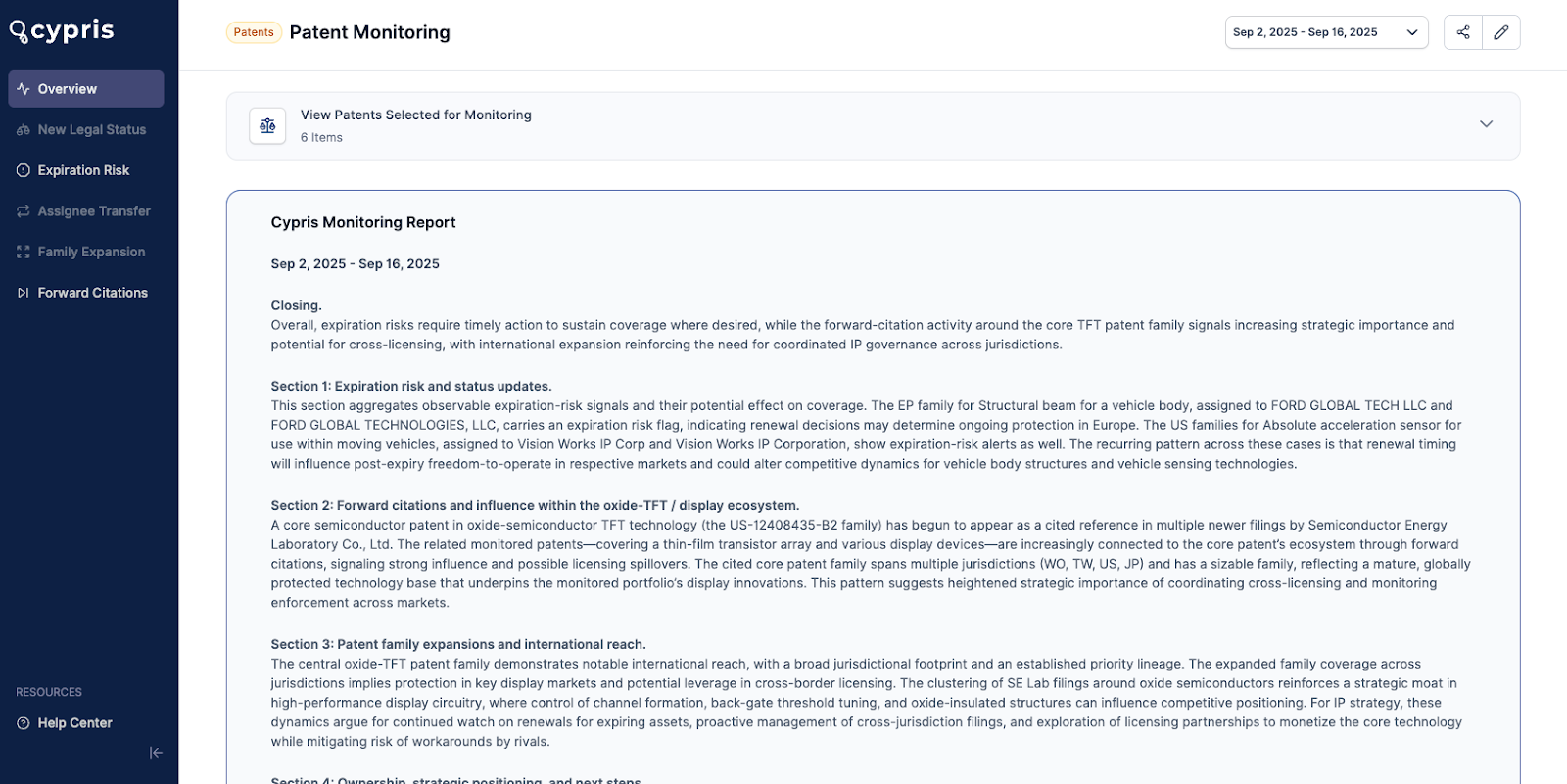
Newsletter-Style Email Experience
Monitoring emails now feel more like a personalized newsletter. Each update arrives in a clean, structured layout with an easy-to-read AI-generated summary of recent activity, spotlighted trends, and direct links to dive deeper in the platform. Content is grouped into clear sections and filterable by category, so you can quickly scan what’s new, focus on the most relevant updates, and stay effortlessly informed—without inbox clutter.

Simplified Setup & Discoverability
Setting up monitors is now faster and more intuitive. Users can create them in a single streamlined interface—quickly searching patent numbers, keywords, organizations, or papers and selecting the right mix in one place. Smart suggestions recommend recipients, while the Monitoring button appears directly on every search results page. Current monitors are clearly indicated to prevent duplication, and external recipients can be added to email updates for seamless collaboration.
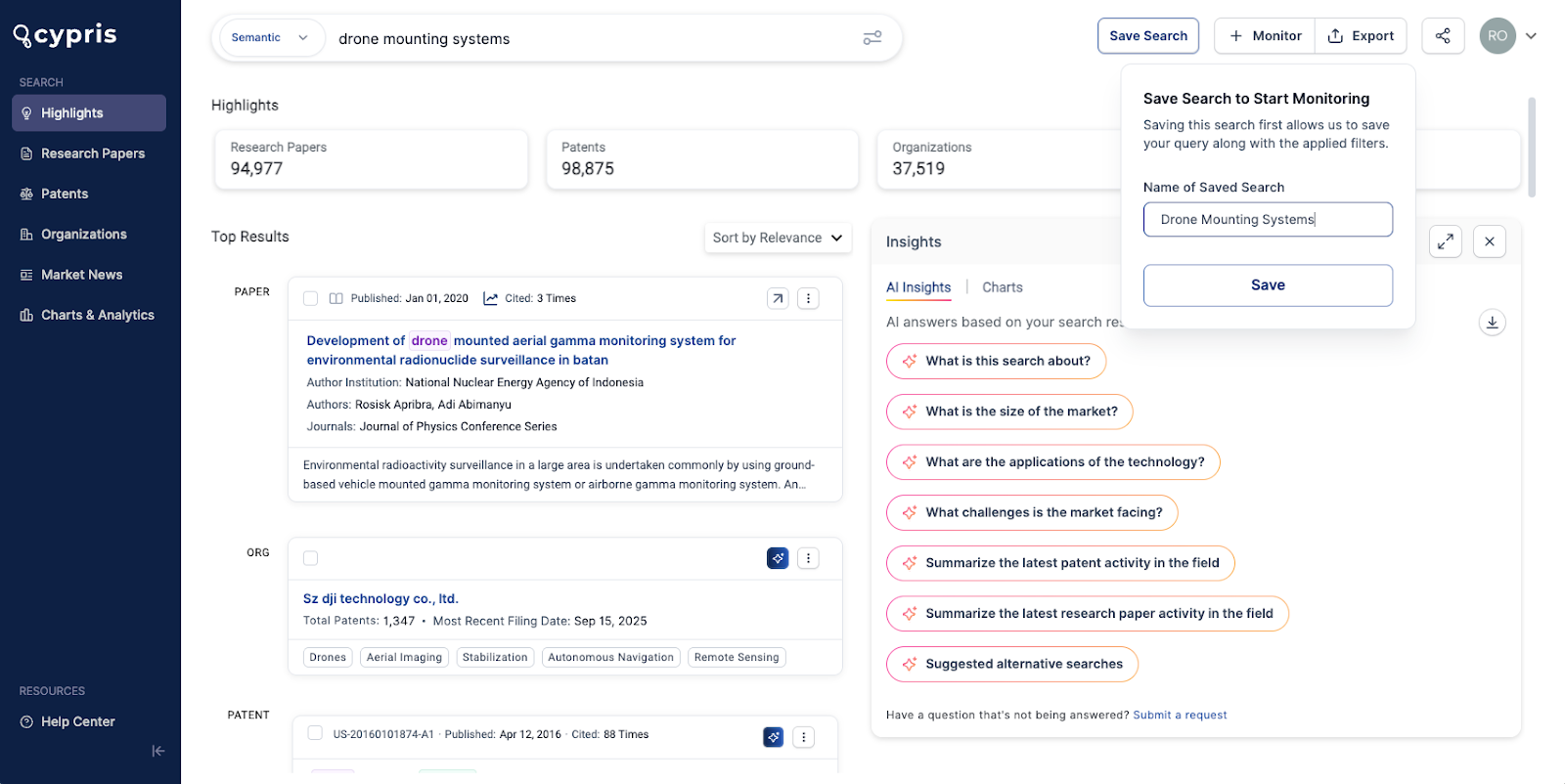
Noise-Free Updates & Critical Alerts
A “send only if new results exist” toggle eliminates duplicate notifications. Monitoring now captures not only newly published patents, papers, and organizations, but also critical patent events such as expiration risks, assignee transfers, patent family expansions, and forward citations—including competitor citations of your own research.
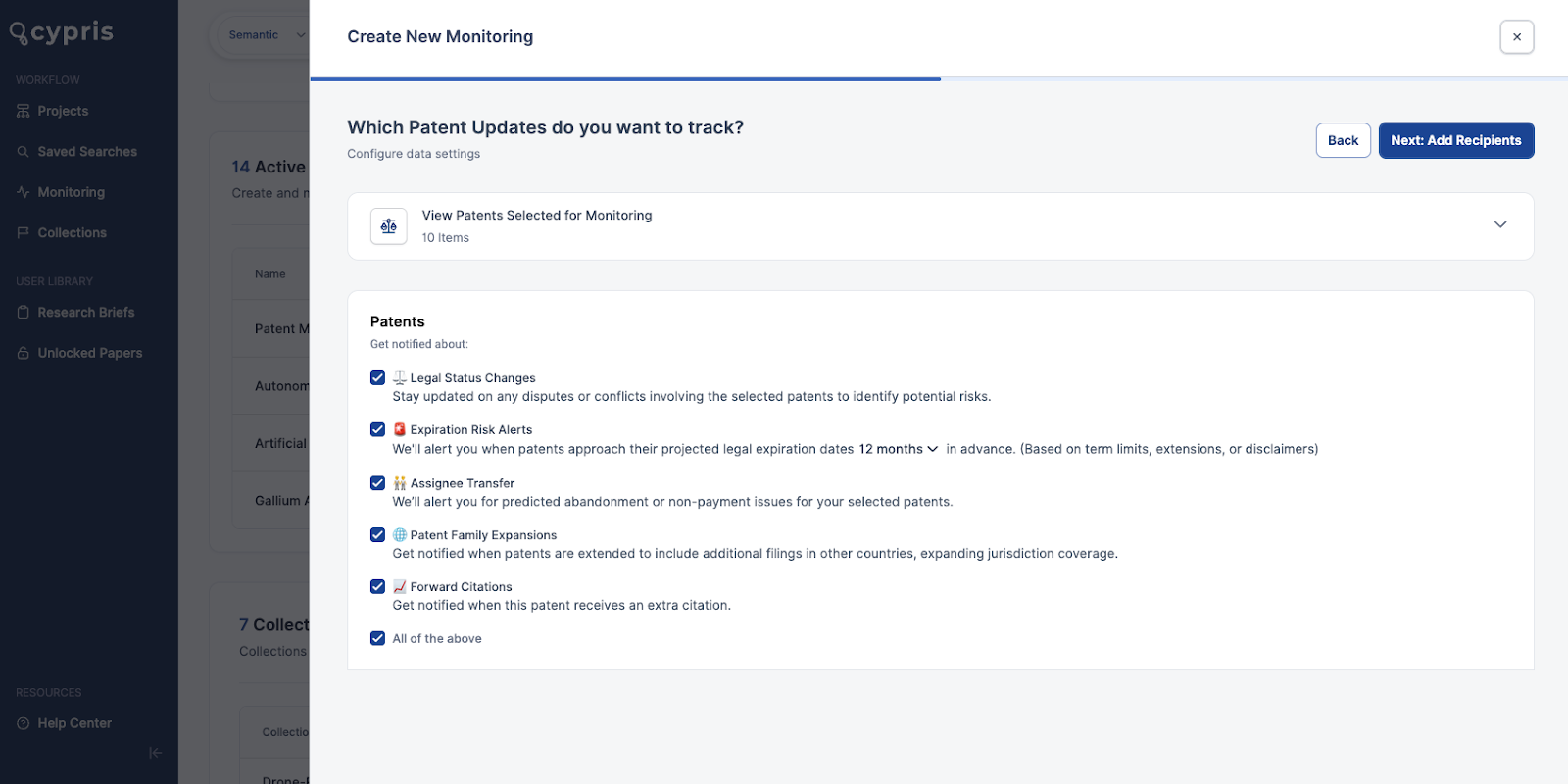
A More Powerful User Experience
Monitoring is built to help users move from raw data to actionable intelligence. Reports save automatically, creating a historical log teams can reference at any time. Items can be flagged directly into collections without manual re-entry. Emails preview AI-enhanced trends with a single click into interactive dashboards, and users can easily add colleagues or external recipients to stay aligned.
From a design perspective, the rebuild also gave our team room to innovate.
As one of our engineering team members, Maddie explained: “It was fun to build something new from scratch. From a UI perspective, we were able to make better design choices right from the start, which made for a much smoother, more intuitive user experience.”
Built for Speed, Accuracy, and Collaboration
With the new Monitoring, teams can save time compared to manual tracking, strengthen competitive intelligence with reliable, cross-dataset updates, collaborate seamlessly by sharing reports with colleagues or external partners, and trust the signal thanks to accuracy, relevancy filters, and AI-powered summaries.
As part of our engineering team, Oleg explained: “This project sat on top of our existing platform, which meant understanding the entire workflow end to end. It was challenging, but it also gave us the opportunity to rethink how everything fits together—and that’s what made it so rewarding.”
Available Now to All Users
The redesigned Monitoring is live and available across the Cypris platform today. If you’re already using Cypris, you’ll see new Monitoring options throughout your search and reporting workflows.
We’re excited to see how your team uses Monitoring to stay ahead of markets, competitors, and technologies — and to keep pushing the boundaries of what intelligent monitoring can do for R&D.

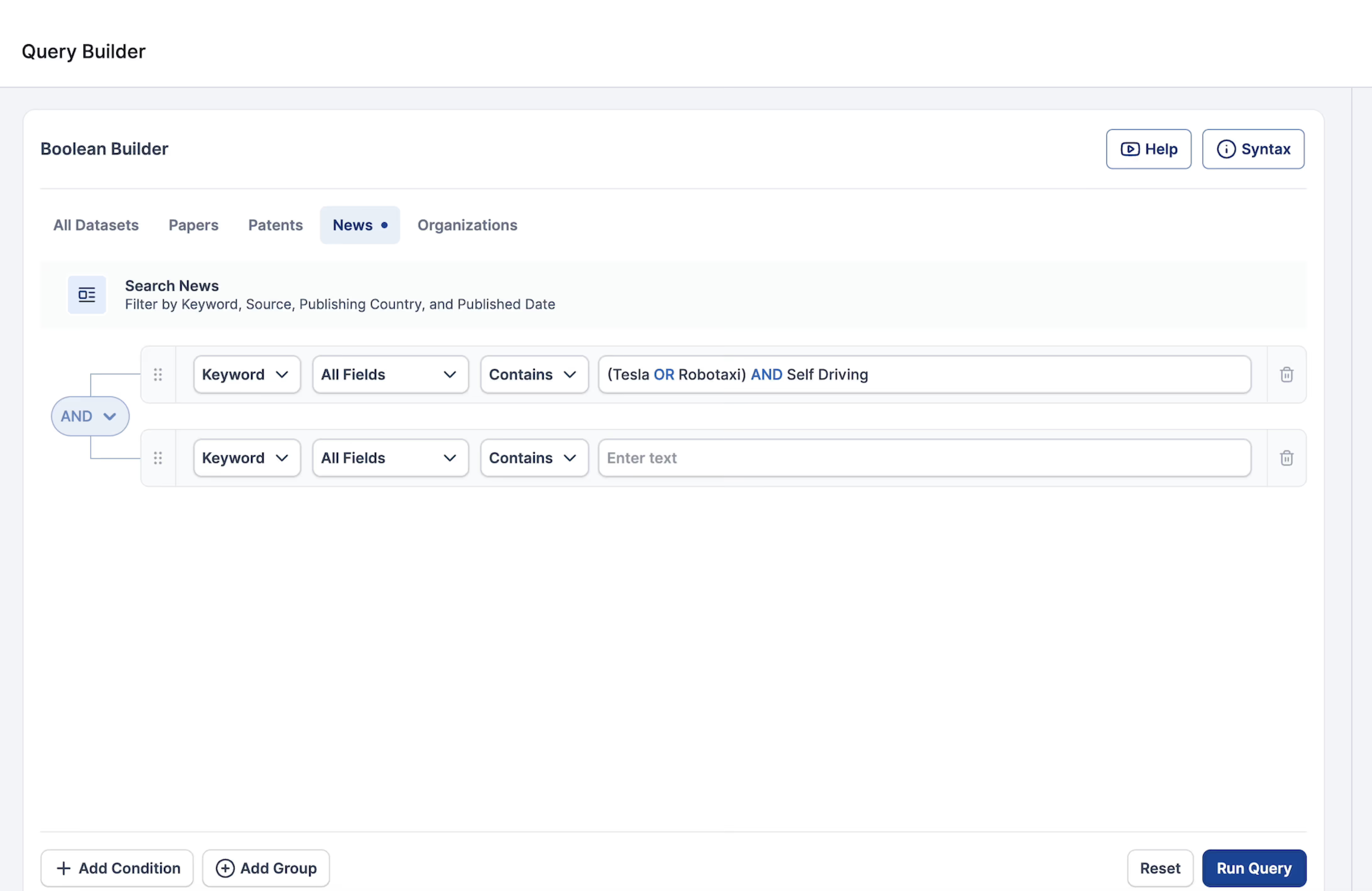
A powerful new foundation for custom queries—built on Lucene and designed for R&D precision.
Over the past few years, Cypris has helped innovation teams make faster, more informed decisions by centralizing critical insights across datasets like patents, academic papers, and company activity. But until now, our search experience relied on a legacy query system with limited capabilities, offering little support for advanced search features or dataset-level customization.
Today, we’re excited to introduce an upgraded Advanced Search on Cypris, a complete overhaul of our query engine and search experience, powered by the open-standard Lucene query syntax. This update introduces a more robust and flexible search foundation, unlocking new ways to query data, build complex filters, and extract precisely what you need across patents, research, and more.
Why we rebuilt our search system from the ground up
Cypris’ original query syntax, a proprietary format used internally for years, limited users’ ability to craft advanced queries or tailor searches to specific datasets. It lacked modern capabilities like proximity searches, field-level customization, or true Boolean logic. This made it difficult to build a reliable and intuitive experience for both casual users and advanced researchers.
By moving to Lucene, we’re adopting a powerful, industry-standard query language that makes it easier for developers to build advanced features—and gives users access to a far more capable and flexible search toolset.
What’s new in Advanced Search
1. Custom Queries by Dataset
You can now layer queries to search across datasets or tailor filters to each one. For example, you can run a broad query on drone delivery, and then add separate layers to focus on patents by a specific assignee and papers from a specific country or funding agency.
Navigating the All Datasets tab introduces a new level of complexity—and power—by allowing users to apply dataset-specific logic within a single, unified query workflow. While querying multiple datasets simultaneously might seem straightforward, the underlying differences in schema, metadata, and available fields between our proprietary datasets make this a deeply technical challenge. Patents, for example, include claims, application numbers, and multiple date fields (filed, granted, updated), while academic papers use DOIs, have different structural conventions, and emphasize different metadata. In the past, we sidestepped this complexity by translating general queries like ((drone_allText)) into dataset-specific logic under the hood. Now, instead of obscuring that logic, we allow users to opt in to it. The builder provides progressive layers of customization: start with intuitive keyword searches across all fields, then move into the advanced builder for field-specific targeting, fuzzy logic, and term boosting, and finally, tailor query logic by dataset—such as specifying different countries of interest for papers vs. patents. This approach preserves flexibility while giving users full control, and with tools like our real-time Live Analysis and “Your Query” panel, we make it easy to understand how every decision affects the results.
2. More Fields to Query
We’re exposing deeper fields across datasets—giving you explicit control over the dimensions of your search. For the first time, users can now search academic papers by DOI, a critical identifier previously unsupported on the platform. You can also query by:
- Author or inventor names
- Organizations or assignees
- Countries, journals, funding agencies, and more
3. Full Boolean Support
Advanced Search now leverages powerful Boolean logic—AND, OR, NOT, and grouping—enabling more precise control over search logic and improving performance and accuracy.
4. Lucene Syntax Features
Use built-in Lucene features to create expressive, complex searches:
- Proximity searches to find terms near each other
- Fuzzy searches for flexible matching
- Exact phrase matching
- Boosting to prioritize results (e.g., prioritize results mentioning AI 3x more than others)
- Prefix/Postfix queries to match phrases that start or end a certain way
- Range queries for fields like date, funding amounts, or numerical values
A more powerful user experience
Our new search interface is built to help you tap into these capabilities without needing to know the syntax from the start. You’ll find:
- A Query Builder to guide you through complex searches
- A Help Video to onboard users to Lucene-style searches
- Inline examples and tips for writing queries using grouping, boosting, and more
Built for precision, speed, and customization
With Lucene as our foundation, search results are now not only more flexible but also faster and more accurate. Semantic search continues to offer natural-language ease of use, while Boolean search gives power users the performance and structure they need to uncover insights with greater specificity.
Whether you’re an innovation analyst drilling into AI patents or a business development lead scanning academic papers from Chilean researchers—Advanced Search is built to help you get to the signal, faster.
Available now to all users
Advanced Search is live and available across the Cypris platform today. If you’re already using Cypris, you’ll find the new search interface in your dashboard, complete with updated syntax documentation and walkthroughs.
We’re excited to see what you’ll build, discover, and analyze with this new capability. This is just the beginning—we’ll continue expanding the fields, syntax features, and customization options as we push the boundaries of what intelligent search can do for R&D.


Today, the need for society to adopt sustainable practices is increasingly urgent, particularly in chemical manufacturing, which is responsible for greenhouse gas emissions, toxic waste, increased water and energy consumption, and inefficient raw material use. Consequently, the market for sustainable chemical manufacturing has surged to $10 billion and continues to expand as the focus on sustainability intensifies. Leading this charge are three innovative approaches: mechanochemistry, green synthesis, and microflow chemistry. Mechanochemistry, which induces chemical reactions through mechanical energy, accelerates reactions and conserves energy compared to traditional solvent-based methods, while reducing reaction mass and potentially increasing product yield by avoiding solvents. Green synthesis aims to minimize the use and generation of hazardous substances, thereby reducing environmental impact and enhancing sustainability, with notable examples including the synthesis of spirooxindole derivatives using heterogeneous catalysis and metal-organic framework (MOF) catalysts. Microflow chemistry, or continuous flow chemistry, involves reactions in microreactors that allow precise control over reaction conditions, enhancing safety, scalability, and efficiency. The integration of these three approaches—mechanochemistry, green synthesis, and microflow chemistry—represents a significant advancement in sustainable chemical manufacturing, addressing critical challenges from waste reduction to energy savings and paving the way for a more sustainable industry.

Mechanochemistry: Mechanochemistry accelerates reactions and reduces solvent use, advancing sustainability in chemical manufacturing.
Mechanochemistry, a process in which chemical synthesis is induced by external mechanical energy, has gained attention in chemical manufacturing due to its sustainable nature. This method allows reactions to occur more quickly and saves energy compared to traditional solvent-based chemistry. Mechanochemistry also offers cost and time efficiency by eliminating the need for solvents, thereby reducing 90% of the reaction mass, and potentially increasing product yield under optimal conditions.
The disposal of plastics, which are non-biodegradable and create significant pollution, is a growing concern for the health and longevity of the planet. Recently, research has focused on using mechanochemistry to control the degradation of polymers found in plastics. Researchers have discovered that the previously separate fields of polymer and trituration mechanochemistry can converge, enabling the degradation of polymers through milling and grinding. This breakthrough holds the potential to significantly mitigate global warming.
Green Synthesis: Green synthesis reduces hazards and waste with efficient methods like heterogeneous and MOF catalysts.
Green synthesis involves creating chemical products and processes that minimize the use and production of hazardous substances, aiming to reduce environmental impact and enhance sustainability in chemical manufacturing. This approach not only benefits the environment but also protects the health and safety of chemical workers and consumers, while reducing costs associated with waste disposal and raw material use.
Spirooxindole has been a focus in the green synthesis field due to its broad benefits in medicine as well as agriculture because of it being a unique compound because of the high reactivity of the carbonyl group located at the 3-position of isatin. Various green synthesis methods have been used for creating spirooxindole derivatives. Various green synthesis methods have been developed for creating spirooxindole derivatives, with one promising approach being the use of heterogeneous catalysts. These catalysts, which are in different phases from the reactants and products, allow for effortless separation, minimizing waste, shortening processing time, and conserving energy.
Another promising method in green synthesis is the use of metal-organic framework (MOF) catalysts. MOFs are attractive due to their high surface area, large porosity, multiple catalytic sites, and highly tunable composition and structure. Studies have shown that MOF catalysts can achieve high yields of 95%-99% and short reaction times. For example, Mirhosseini-Eshkevari et al. (2019) synthesized a zirconium metal-organic framework (Zr MOF) called TEDA/IMIZ-BAIL@UiO-66 using benzene dicarboxylic acid as the organic linker. This framework served as a heterogeneous catalyst in the synthesis of spirooxindole derivatives, with the BAIL@UiO-66 catalyst acting as a Brønsted acid to enhance the electrophilicity of the carbonyl group in isatin and promote nucleophilic attack. This catalyst can be reused in other reactions with minimal reduction in yield, demonstrating its potential as a promising alternative to non-renewable processes.

Microflow Chemistry: Microflow chemistry boosts efficiency and sustainability with precise control and effective processing of renewable resources and waste.
Microflow chemistry, also known as continuous flow chemistry or microfluidic chemistry, is highly regarded for its efficiency, safety, and sustainability in chemical manufacturing. This approach involves chemical reactions occurring in microreactors, which allow for precise control over reaction conditions, thereby enhancing safety, scalability, and efficiency. Microflow chemistry is utilized in various fields, including environmental science, fine chemicals, materials science, and pharmaceuticals.
Recently, microflow chemistry has proven sustainable not only due to its efficient process but also because of its applications. It is now central to green catalytic engineering for processing renewable resources. For instance, microflow chemistry is used to process lignocellulosic biomass into fuels and chemicals. Lignocellulose, found in the microfibrils of plant cell walls and composed mainly of polysaccharides and lignins, has been extensively studied for this purpose. Microflow chemistry is highly favored for this process due to its enhanced product yield and selectivity.
Furthermore, microflow chemistry improves sustainability in on-site chemical manufacturing. Biomass, which contains a significant amount of water, requires considerable energy for transportation to refineries, making onsite processing essential. This is also true for food waste, which has a short shelf life and is produced in large quantities. Even plastic waste, despite its longevity and low water content, is widespread in landfills and ecosystems, necessitating onsite processing in remote and offshore areas. Microflow chemistry offers better economic viability and higher energy efficiency, supporting sustainable onsite manufacturing.

The crucial shift towards sustainable practices in chemical manufacturing is driven by the environmental and societal challenges posed by traditional methods. Innovations like mechanochemistry, green synthesis, and microflow chemistry are at the forefront of this transformation. Mechanochemistry accelerates reactions while minimizing solvent use, promising reduced energy consumption and waste generation. Green synthesis techniques, utilizing heterogeneous catalysis and metal-organic frameworks, provide efficient, low-impact pathways to valuable compounds like spirooxindoles, essential in medicine and agriculture. Microflow chemistry, with its precision in controlling reaction conditions, enhances safety and efficiency, especially in processing renewable biomass and managing onsite waste such as food and plastic. Together, these approaches not only reduce environmental impacts, including greenhouse gas emissions and toxic waste, but also promote a more resilient and sustainable chemical industry, ready to meet future challenges.
.avif)