Former Dow Research Fellow Compares Cypris, Copilot & Claude for Chemical Intelligence


Michael Devon, a retired Research Fellow who spent 34 years at Dow tested three AI systems against complex, known-answer R&D scenarios. The largest performance gap appeared where technical depth, IP interpretation and roadmap development mattered most.
General-purpose AI tools such as Microsoft Copilot and Claude Opus 5 are built primarily around frontier foundation models and broad-access knowledge. Cypris can use the same class of foundation models, but grounds them in focused scientific and intellectual property datasets connected through domain-specific ontologies.
This comparison was designed to test whether that additional intelligence layer materially changes the quality of technical research.
Michael Devon, a retired Research Fellow who spent 34 years at Dow, evaluated Cypris, Microsoft Copilot and Claude Opus 5 across two technical scenarios and four prompts. He deliberately chose areas he knew intimately, allowing him to distinguish a plausible summary from an analysis that captured the technical realities, historical context and commercial considerations required to build an R&D strategy.
The scenarios were representative of projects that historically required weeks of coordinated researcher effort. The objective was not simply to determine which tool could find relevant information. It was to determine which could transform that information into useful technical and strategic guidance rooted in real world context.
Evaluation design
The comparison covered two technology landscapes: hollow latex particle opacifiers and the use of hydroxypropyl methylcellulose, or HPMC, in osmotic drug-delivery systems. The outputs were evaluated based on result quality, strategic insight, accuracy and the ability to recognize the boundaries between related technologies.
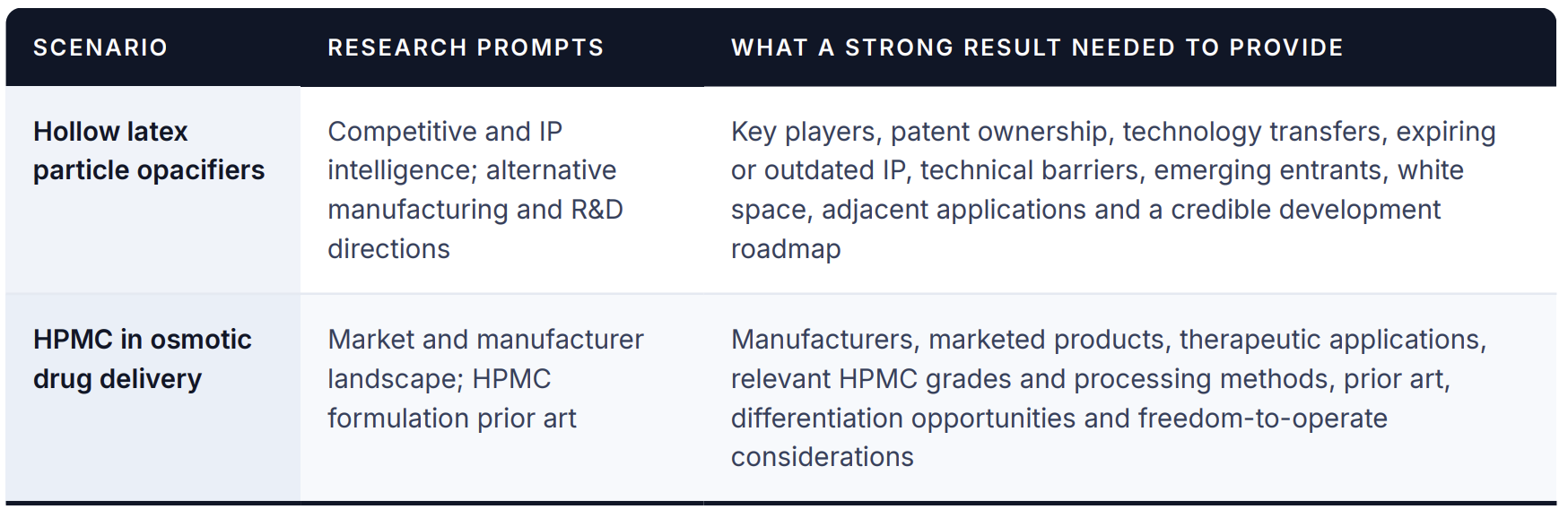
The hollow particle prompts asked the systems to map the competitive and IP landscape, identify emerging participants in Mexico and Asia, detect licensing or corporate activity and locate white space. They were then asked to recommend alternative materials, particle architectures and manufacturing mechanisms that could support a defensible product strategy.
The osmotic delivery prompts asked the systems to identify manufacturers and marketed products, followed by an analysis of HPMC grades, viscosity specifications, processing methods, prior art and potential formulation strategies.
Where the tools diverged
All three tools were capable of producing a credible general summary. The meaningful differences appeared as the work moved from describing the landscape to deciding what to do next.
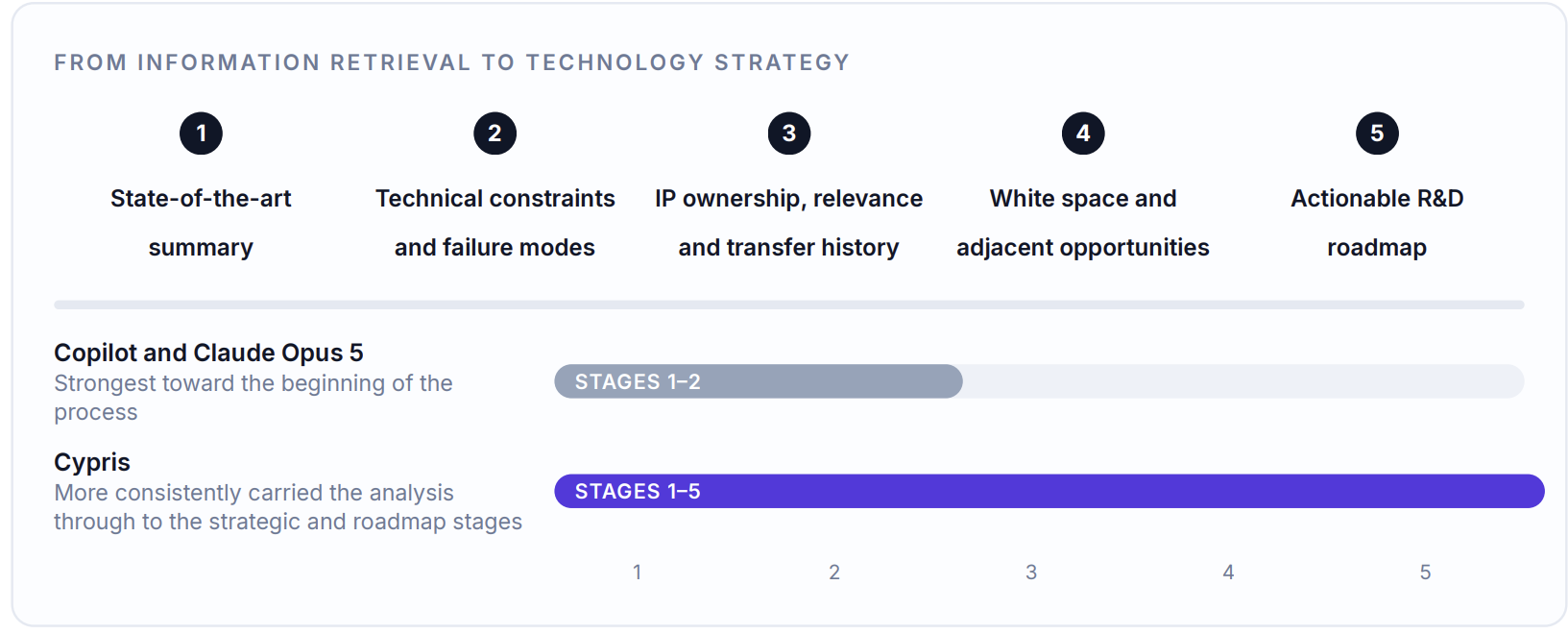
Devon found that Cypris produced the strongest overall result, with the clearest advantage in the more technically and strategically complex hollow particle scenario. Claude and Copilot generally summarized what had been published. Cypris more frequently identified the specific technical issues, changes in IP ownership, commercial signals and research directions that could influence an actual development program.
Comparative findings at a glance
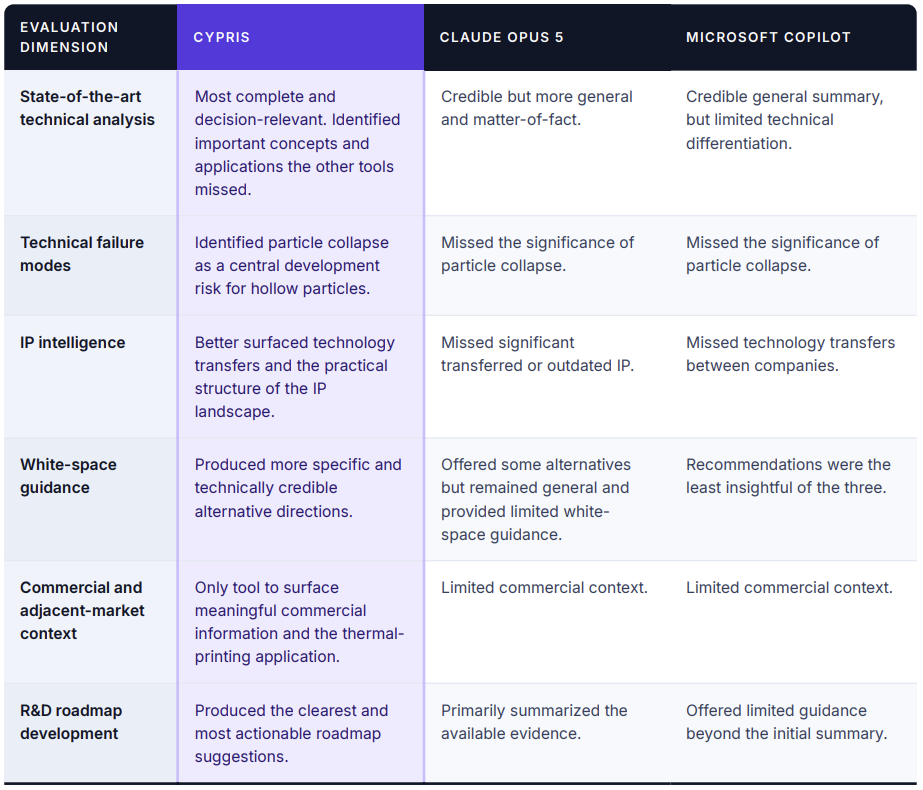
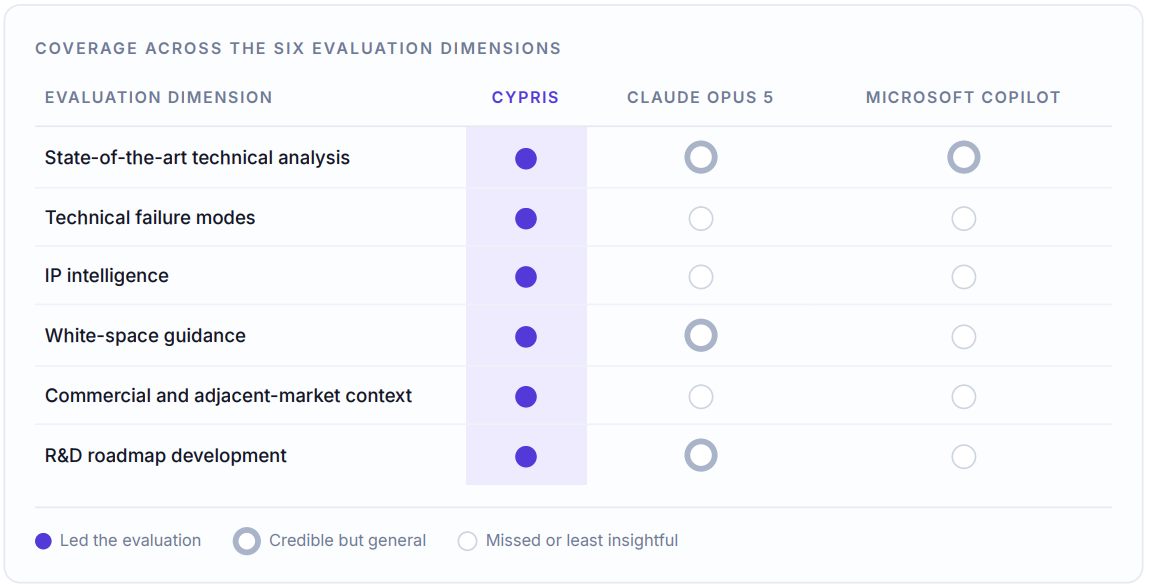
These distinctions were particularly visible in Devon's analysis of technical implementation, IP transfers, market context and research direction.
Scenario One: Hollow Latex Particle Opacifiers
All three tools passed the baseline test
Each system produced a reasonable summary of the general hollow particle landscape. Devon found no serious factual errors within the information each tool chose to present.
That baseline performance was important, but it did not determine the outcome. The systems differed substantially in the usefulness of their output for technical strategy development, with Cypris holding the clear advantage.
Cypris identified the technical issue most likely to derail a new entrant
One of the most consequential differences involved particle collapse.
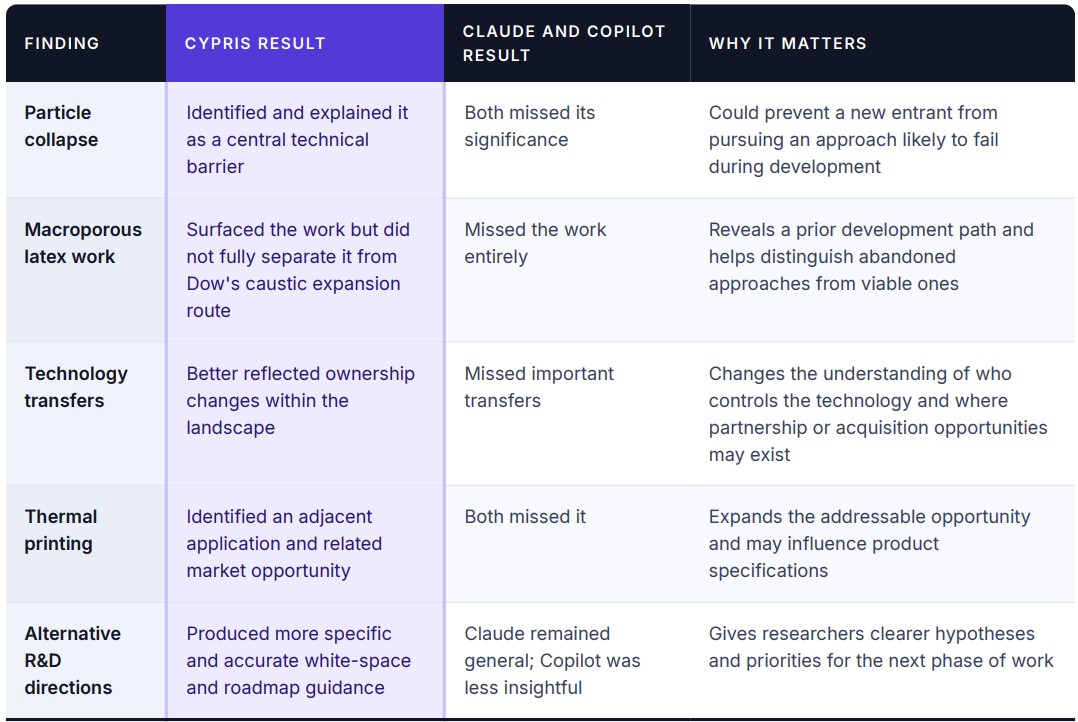
Cypris recognized that maintaining particle structure was a central technical challenge and produced a useful explanation of the issue. Claude and Copilot did not identify its importance.
For a researcher, this was not a minor omission. A new entrant that fails to understand or overcome particle collapse could invest considerable time and capital in a manufacturing approach that does not perform under practical conditions. By surfacing the issue, Cypris provided information that could directly alter experimental priorities and development sequencing.
Cypris was not flawless. It did not fully distinguish between Dow's hollow latex work using caustic expansion and a separate abandoned macroporous latex approach. However, Claude and Copilot missed the macroporous work entirely.
The distinction illustrates the difference between partial technical interpretation and simple omission. Cypris found the relevant body of work but needed greater precision in separating the approaches. The general AI tools failed to surface the alternative development path at all.
Cypris produced a stronger picture of the IP landscape
Patent landscapes are often presented as lists of companies, filings and portfolio sizes. For technology strategy, that is rarely sufficient.
Researchers need to understand whether patents remain active and relevant, whether they have been transferred, whether the underlying technology is commercially practiced and whether a seemingly large portfolio contains meaningful gaps.
Claude and Copilot missed technology transfers between companies. Devon also found that Claude failed to recognize that significant portions of the IP landscape had changed hands or become outdated. These omissions can distort the competitive picture by assigning technology to the wrong owner or treating historically important patents as if they still define the current opportunity.
Cypris provided a more useful view of how the IP was structured and where potential white space existed. This helped move the analysis beyond a patent count and toward questions such as:
- Who currently controls the relevant technology?
- Which patents still create meaningful barriers?
- Where has ownership changed?
- Which approaches appear abandoned or underdeveloped?
- Where could a new entrant build, partner or acquire?
Devon noted that all three tools could be improved by incorporating deeper patent-office and file-wrapper information, maintenance status, litigation history and citation patterns. Those signals help determine whether a portfolio is genuinely defensible or simply appears strong based on volume.
Cypris surfaced technical and commercial concepts the others missed
Cypris was the only tool to identify the use of hollow particles in thermal printing. It also suggested additional markets and alternative applications.
That finding demonstrated a broader advantage in state-of-the-art analysis. Cypris did not restrict the output to the most obvious use of hollow particles as opacifiers. It connected the underlying technology to another commercially relevant application that Claude and Copilot failed to identify.
The distinction matters because technical strategy requires answering two different questions:
- Can the organization develop the technology?
- Is the opportunity commercially worth pursuing?
Claude and Copilot largely addressed the first question through general technical summaries. Cypris brought in more of the information required to begin addressing the second.
Some commercial outputs still required scrutiny. Devon considered Cypris' estimated 10 percent compound annual growth rate for the broader hollow particle market questionable, although its approximately 5 percent estimate for the thermal-printing segment appeared reasonable. The advantage was not that every market figure was definitive. It was that Cypris recognized adjacent commercial applications and incorporated them into the strategic analysis at all.
Cypris produced more useful white-space and roadmap recommendations
Both Cypris and Claude suggested alternatives to conventional latex-based particle systems. Copilot's recommendations were less insightful.
The quality of the alternatives, however, was different. Claude's output was more general and matter-of-fact. It identified possible approaches but did not translate them into strong white-space guidance.
Cypris proposed more technically credible alternatives and connected them more directly to a differentiated development strategy. Its roadmap recommendations were clearer about which directions merited further investigation and how the research could be sequenced.
The alternatives included non-latex and ceramic-based particle systems. The evaluation did not establish that every proposed direction was commercially viable, but Devon knew that some ceramic particles had progressed at least as far as commercial trials. Cypris therefore surfaced technically relevant research leads rather than merely generating hypothetical possibilities.
Specific findings that changed the strategic value of the output
Scenario Two: HPMC in Osmotic Drug Delivery
The baseline outputs were more similar
The osmotic drug-delivery scenario produced less separation between the three systems.
All three generated credible summaries of osmotic pump technology and identified, to varying degrees, the grades and functions of HPMC in the existing landscape. Devon found relatively little to distinguish the tools on the initial market, manufacturer and prior-art questions.
The systems also converged on a similar roadmap recommendation: use a Design of Experiments process to optimize HPMC for the different roles it plays in the formulation.
While technically valid, Devon considered that recommendation underwhelming. It represented a standard development methodology rather than a differentiated technical insight.
Cypris generated the most promising next research direction
The difference appeared when Cypris suggested a possible connection between osmotic delivery and the challenge of formulating poorly soluble drugs.
Many active pharmaceutical ingredients have limited aqueous solubility, creating substantial formulation and absorption challenges. Cypris' analysis pointed toward a possible connection with hydroxypropyl methylcellulose acetate succinate, or HPMCAS, a material used in approaches for poorly soluble drugs.
HPMCAS is distinct from the HPMC traditionally used in osmotic systems, and Cypris did not present the connection as a validated solution. Instead, it surfaced a cross-domain clue that an experienced researcher could recognize and investigate further.
Devon viewed this as a meaningful example of how technical research often progresses. The first search does not always deliver the final answer. A strong research system should also reveal the next productive question.
Cypris did that more effectively. It connected information from an adjacent technical area to the osmotic formulation problem, creating the basis for a more differentiated next prompt and potential research direction.
The Core Finding: Technical Intelligence Begins Where the Summary Ends
The comparison showed that general-purpose AI tools can produce useful technical summaries. Both Claude Opus 5 and Microsoft Copilot identified relevant companies, scientific concepts and prior art across the two scenarios.
Cypris separated itself in the work that followed:
- Recognizing a technical failure mode that could derail a development program
- Identifying ownership changes and outdated IP that altered the competitive landscape
- Finding adjacent applications such as thermal printing
- Producing more specific white-space guidance
- Connecting evidence to a clearer R&D roadmap
- Generating cross-domain clues that informed the next research question
This distinction reflects the role of the intelligence layer surrounding the foundation model. A general-purpose model is optimized to explain the available information coherently. A technical intelligence system must also organize patents, scientific literature, companies, materials and market signals into a structure that supports decisions.
Final assessment
Across the four prompts, Cypris produced the strongest overall performance.
The advantage was clearest in the hollow particle scenario, where Cypris demonstrated superior technical analysis, stronger IP intelligence, more credible white-space identification and more actionable roadmap recommendations. Claude Opus 5 was capable of producing credible summaries and some alternative ideas, but remained more general and missed important IP changes and white-space implications. Microsoft Copilot met the baseline requirement for landscape summarization but provided the least differentiated strategic guidance.
The osmotic delivery scenario was more competitive, but Cypris still produced the most promising next research direction by connecting the problem to an adjacent material and formulation challenge.
The conclusion was not simply that Cypris found more information. It more consistently identified the information that mattered.
For an experienced technical leader, that is the difference between receiving a summary of the landscape and receiving the raw material required to build a technology strategy.