For the best experience, this project uses the Webflow Input Enhancer extension. We highly recommend installing it. Click here to download (use preview mode to access link)
Innovation is a difficult endeavor, one that requires strategic planning and resources to achieve success. But how can you make innovation a little bit easier? With the right tools and strategies in place, it’s possible to create an environment conducive to fostering creativity while streamlining processes.
In this article, we tackle how to streamline the research process and how to start a technology-enhanced collaboration. These are things that can make the innovation process more efficient. So let’s answer together: how can you make innovation a little bit easier?
Innovation is a difficult process, but it doesn’t have to be. With the right tools and strategies, teams can make innovation easier and more efficient. Here are some tips for streamlining the research process, using technology for collaboration, and developing agile processes.
Streamline Research Processes
Research is an essential part of any innovation project. But it can take up a lot of time if not done efficiently. To streamline your research process, start by setting clear goals and objectives for what you want to achieve with your research.
Then create a timeline that outlines when each step should be completed by so everyone on the team knows what needs to be done and when it needs to be done.
Finally, use data-driven insights from past projects or experiments as well as market trends or customer feedback to inform your decisions throughout the research process. This will help ensure that you’re making informed decisions quickly instead of relying solely on guesswork or intuition.
Use Technology For Collaboration
Collaboration is key to any successful innovation project. However, coordinating multiple people across different locations can often feel like herding cats!
To make things easier (and faster!), leverage technology such as cloud-based collaboration platforms or video conferencing software so everyone involved in the project has access to real-time updates no matter where they are located geographically.
This will also help keep communication lines open between all stakeholders so there’s less room for miscommunication.
Develop Agile Processes
Agile processes involve breaking down large projects into smaller chunks that can then be tackled one at a time over shorter periods rather than trying to tackle everything all at once.
Breaking things down into smaller pieces with specific timelines attached makes sure that everyone stays focused on achieving measurable results. Your team also avoids getting overwhelmed by too much work all at once. Plus you get tangible results faster which helps build momentum toward completing larger projects quicker overall
All of this should result in an environment conducive to fostering creative thinking and problem-solving skills among team members. This gives them enough flexibility within their roles so they do not feel overwhelmed by pressure or expectations. This leads to maximum efficiency and increased productivity levels across the organization.
How can you make innovation a little bit easier? One step is to streamline your research process.
Research is one of the first things to be done in any innovation process. Making your research less time-consuming and more efficient means easier innovation.
Automated Data Collection
Data collection is a critical part of any research process, but it can be time-consuming and tedious. Certain tools help streamline the data collection process by automating it.
With automated data collection, teams can quickly gather the information they need without having to manually enter each piece of data. This saves time and ensures accuracy in the results.
Consolidating Multiple Data Sources
Consolidating multiple data sources into one platform also makes research more efficient. By consolidating data sources, teams have access to all their relevant information in one place instead of having to search through multiple databases or spreadsheets for what they need.
This eliminates wasted time spent searching for specific pieces of information and allows researchers to focus on analyzing their findings instead.
By streamlining your research process, you can make your innovation process a little bit easier and more efficient.
Key Takeaway: Streamlining data collection, consolidating multiple data sources into one platform, and creating a centralized repository for secure storage makes innovative projects easier. This saves time and ensures accuracy in research results.
Leverage Technology to Enhance Collaboration
How can you make innovation a little bit easier? In the fast-paced world of research and development, collaboration is key to success. Technology can be used to enhance this process, allowing teams to work together more efficiently and effectively.
Cloud-based Solutions
Cloud-based solutions are a great way for teams to share data and resources quickly and securely. With cloud-based solutions, all members of the team have access to the same information at any time from anywhere in the world.
This allows them to collaborate on projects without having to wait for someone else’s input or approval before making decisions or taking action.
Real-time Communication Tools
Real-time communication tools also help foster collaboration between teams by enabling them to communicate instantly with each other regardless of their physical location. These tools allow team members who may not be able to meet face-to-face due to geographical distance or scheduling conflicts still stay connected while working on projects together in real time.
Popular examples include video conferencing software such as Zoom, Slack messaging services, and project management platforms like Trello.
By leveraging technology to enhance collaboration, teams can more effectively identify potential opportunities and challenges to develop an agile innovation strategy that will ensure success.
Key Takeaway: Innovative projects can be made easier with cloud-based solutions and real-time communication tools, such as Zoom, Slack, and Trello. These enable teams to share data quickly and securely while staying connected for collaboration regardless of physical location.
Develop an Agile Innovation Strategy
How can you make innovation a little bit easier? Innovation is a key component of success in any industry. To stay ahead of the competition, organizations must have an agile innovation strategy that allows them to quickly identify and capitalize on new opportunities.
What Is Agile Innovation?
Agile innovation is a process for rapidly creating innovative products or services by leveraging existing resources and technology. It involves breaking down complex problems into smaller, more manageable pieces that can be solved iteratively over time.
The goal of agile innovation is to reduce risk while still allowing for experimentation and exploration of new ideas.
Benefits of an Agile Innovation Strategy
An agile innovation strategy provides several benefits to organizations looking to innovate quickly and efficiently.
By breaking down large projects into smaller tasks, teams can focus their efforts on specific areas at any given time. Having an agile approach allows teams to pivot quickly if something isn’t working as expected.
Finally, this type of strategy encourages collaboration between team members who may not normally work together. It helps foster creativity among employees as well as build stronger relationships within the organization overall.
How to Implement an Agile Innovation Strategy
Implementing an effective agile innovation strategy requires careful planning and execution from start to finish. However, some basic steps should always be taken when beginning such a project:
Identify Your Goals – Before you begin developing your plan, you need to determine what exactly you want out of your initiative so everyone involved knows what they are working towards achieving in the end. Otherwise, things could get confusing very easily during the implementation phase later on down the line if expectations aren’t clearly defined.
Gather Your Team – Once goals have been established then it’s important to bring together the right people who will help carry out the plan effectively. This means finding those individuals both inside and outside the organization depending upon the situation requirements being addressed.
Develop a Plan of Action – After assembling the team comes the actual development plan of the action itself. Details of each step are broken down further to create a timeline and objectives. This ensures deadlines are met appropriately throughout the entire process until the final product is achieved.
Monitor Progress and Adjust As Needed – Monitor progress made regularly and adjust accordingly. Keep track of successes and failures encountered to ensure staying the course with original goals and avoid getting sidetracked.
By leveraging agile innovation strategies, teams can quickly identify opportunities and challenges to build innovative solutions. This will foster a culture of experimentation that encourages risk-taking and open communication to generate new ideas.
Key Takeaway: An agile innovation strategy requires teams to set measurable goals, identify potential opportunities and challenges, and utilize iterative development practices to ensure successful outcomes.
Conclusion
How can you make innovation a little bit easier? Innovation is a complex process that requires dedication, creativity, and hard work. With the right tools and strategies in place, however, it can be made easier.
By streamlining your research process, leveraging technology to enhance collaboration, and developing an agile innovation strategy, you can foster innovation more efficiently.
Through these steps, you will create an environment where ideas are welcomed and encouraged while also ensuring that those ideas are properly evaluated for their potential impact on your business objectives.
If you are part of an R&D or innovation team, Cypris can make the process of developing and launching new products faster and easier. Our platform centralizes data sources to provide teams with rapid time-to-insights so that they can stay ahead in their respective industries.
With our cutting-edge tools, teams can quickly develop innovative solutions for a competitive advantage. Join us today and see how we help your team unlock its true potential!
Subscribe to receive the latest blog posts to your inbox every week.
Thank you! Your submission has been received!
Oops! Something went wrong while submitting the form.
Innovation is a difficult endeavor, one that requires strategic planning and resources to achieve success. But how can you make innovation a little bit easier? With the right tools and strategies in place, it’s possible to create an environment conducive to fostering creativity while streamlining processes.
In this article, we tackle how to streamline the research process and how to start a technology-enhanced collaboration. These are things that can make the innovation process more efficient. So let’s answer together: how can you make innovation a little bit easier?
Innovation is a difficult process, but it doesn’t have to be. With the right tools and strategies, teams can make innovation easier and more efficient. Here are some tips for streamlining the research process, using technology for collaboration, and developing agile processes.
Streamline Research Processes
Research is an essential part of any innovation project. But it can take up a lot of time if not done efficiently. To streamline your research process, start by setting clear goals and objectives for what you want to achieve with your research.
Then create a timeline that outlines when each step should be completed by so everyone on the team knows what needs to be done and when it needs to be done.
Finally, use data-driven insights from past projects or experiments as well as market trends or customer feedback to inform your decisions throughout the research process. This will help ensure that you’re making informed decisions quickly instead of relying solely on guesswork or intuition.
Use Technology For Collaboration
Collaboration is key to any successful innovation project. However, coordinating multiple people across different locations can often feel like herding cats!
To make things easier (and faster!), leverage technology such as cloud-based collaboration platforms or video conferencing software so everyone involved in the project has access to real-time updates no matter where they are located geographically.
This will also help keep communication lines open between all stakeholders so there’s less room for miscommunication.
Develop Agile Processes
Agile processes involve breaking down large projects into smaller chunks that can then be tackled one at a time over shorter periods rather than trying to tackle everything all at once.
Breaking things down into smaller pieces with specific timelines attached makes sure that everyone stays focused on achieving measurable results. Your team also avoids getting overwhelmed by too much work all at once. Plus you get tangible results faster which helps build momentum toward completing larger projects quicker overall
All of this should result in an environment conducive to fostering creative thinking and problem-solving skills among team members. This gives them enough flexibility within their roles so they do not feel overwhelmed by pressure or expectations. This leads to maximum efficiency and increased productivity levels across the organization.
How can you make innovation a little bit easier? One step is to streamline your research process.
Research is one of the first things to be done in any innovation process. Making your research less time-consuming and more efficient means easier innovation.
Automated Data Collection
Data collection is a critical part of any research process, but it can be time-consuming and tedious. Certain tools help streamline the data collection process by automating it.
With automated data collection, teams can quickly gather the information they need without having to manually enter each piece of data. This saves time and ensures accuracy in the results.
Consolidating Multiple Data Sources
Consolidating multiple data sources into one platform also makes research more efficient. By consolidating data sources, teams have access to all their relevant information in one place instead of having to search through multiple databases or spreadsheets for what they need.
This eliminates wasted time spent searching for specific pieces of information and allows researchers to focus on analyzing their findings instead.
By streamlining your research process, you can make your innovation process a little bit easier and more efficient.
Key Takeaway: Streamlining data collection, consolidating multiple data sources into one platform, and creating a centralized repository for secure storage makes innovative projects easier. This saves time and ensures accuracy in research results.
Leverage Technology to Enhance Collaboration
How can you make innovation a little bit easier? In the fast-paced world of research and development, collaboration is key to success. Technology can be used to enhance this process, allowing teams to work together more efficiently and effectively.
Cloud-based Solutions
Cloud-based solutions are a great way for teams to share data and resources quickly and securely. With cloud-based solutions, all members of the team have access to the same information at any time from anywhere in the world.
This allows them to collaborate on projects without having to wait for someone else’s input or approval before making decisions or taking action.
Real-time Communication Tools
Real-time communication tools also help foster collaboration between teams by enabling them to communicate instantly with each other regardless of their physical location. These tools allow team members who may not be able to meet face-to-face due to geographical distance or scheduling conflicts still stay connected while working on projects together in real time.
Popular examples include video conferencing software such as Zoom, Slack messaging services, and project management platforms like Trello.
By leveraging technology to enhance collaboration, teams can more effectively identify potential opportunities and challenges to develop an agile innovation strategy that will ensure success.
Key Takeaway: Innovative projects can be made easier with cloud-based solutions and real-time communication tools, such as Zoom, Slack, and Trello. These enable teams to share data quickly and securely while staying connected for collaboration regardless of physical location.
Develop an Agile Innovation Strategy
How can you make innovation a little bit easier? Innovation is a key component of success in any industry. To stay ahead of the competition, organizations must have an agile innovation strategy that allows them to quickly identify and capitalize on new opportunities.
What Is Agile Innovation?
Agile innovation is a process for rapidly creating innovative products or services by leveraging existing resources and technology. It involves breaking down complex problems into smaller, more manageable pieces that can be solved iteratively over time.
The goal of agile innovation is to reduce risk while still allowing for experimentation and exploration of new ideas.
Benefits of an Agile Innovation Strategy
An agile innovation strategy provides several benefits to organizations looking to innovate quickly and efficiently.
By breaking down large projects into smaller tasks, teams can focus their efforts on specific areas at any given time. Having an agile approach allows teams to pivot quickly if something isn’t working as expected.
Finally, this type of strategy encourages collaboration between team members who may not normally work together. It helps foster creativity among employees as well as build stronger relationships within the organization overall.
How to Implement an Agile Innovation Strategy
Implementing an effective agile innovation strategy requires careful planning and execution from start to finish. However, some basic steps should always be taken when beginning such a project:
Identify Your Goals – Before you begin developing your plan, you need to determine what exactly you want out of your initiative so everyone involved knows what they are working towards achieving in the end. Otherwise, things could get confusing very easily during the implementation phase later on down the line if expectations aren’t clearly defined.
Gather Your Team – Once goals have been established then it’s important to bring together the right people who will help carry out the plan effectively. This means finding those individuals both inside and outside the organization depending upon the situation requirements being addressed.
Develop a Plan of Action – After assembling the team comes the actual development plan of the action itself. Details of each step are broken down further to create a timeline and objectives. This ensures deadlines are met appropriately throughout the entire process until the final product is achieved.
Monitor Progress and Adjust As Needed – Monitor progress made regularly and adjust accordingly. Keep track of successes and failures encountered to ensure staying the course with original goals and avoid getting sidetracked.
By leveraging agile innovation strategies, teams can quickly identify opportunities and challenges to build innovative solutions. This will foster a culture of experimentation that encourages risk-taking and open communication to generate new ideas.
Key Takeaway: An agile innovation strategy requires teams to set measurable goals, identify potential opportunities and challenges, and utilize iterative development practices to ensure successful outcomes.
Conclusion
How can you make innovation a little bit easier? Innovation is a complex process that requires dedication, creativity, and hard work. With the right tools and strategies in place, however, it can be made easier.
By streamlining your research process, leveraging technology to enhance collaboration, and developing an agile innovation strategy, you can foster innovation more efficiently.
Through these steps, you will create an environment where ideas are welcomed and encouraged while also ensuring that those ideas are properly evaluated for their potential impact on your business objectives.
If you are part of an R&D or innovation team, Cypris can make the process of developing and launching new products faster and easier. Our platform centralizes data sources to provide teams with rapid time-to-insights so that they can stay ahead in their respective industries.
With our cutting-edge tools, teams can quickly develop innovative solutions for a competitive advantage. Join us today and see how we help your team unlock its true potential!
Keep Reading
April 13, 2026
•
XX
min read
Clarivate is not a single product. It is a portfolio of acquired tools assembled over decades, and the two platforms that enterprise R&D teams use most frequently — Derwent Innovation for patent intelligence and Web of Science for scientific literature — were designed for entirely different audiences with entirely different workflows. Derwent was built for IP attorneys conducting freedom-to-operate searches. Web of Science was built for academic librarians and university researchers. Neither was built for the R&D scientist trying to answer a strategic question about a technology landscape, a competitive portfolio, or an emerging technical risk.
The gap between what Clarivate's R&D-adjacent tools were designed to do and what modern innovation teams actually need is the primary reason organizations are evaluating alternatives. This guide examines six of the strongest alternatives to Clarivate for enterprise R&D and IP teams, explains what distinguishes each platform, and provides a framework for matching your team's specific requirements to the right solution.
Why R&D Teams Are Reevaluating Clarivate
Clarivate's position in the market is the product of consolidation, not native product design. The company was spun out of Thomson Reuters' IP and Science division in 2016 and has since assembled its portfolio through a series of acquisitions — Derwent, Web of Science, ProQuest, Cortellis, and others — without fully integrating the underlying data architectures. For R&D teams, the practical consequence is that patent intelligence and scientific literature intelligence live in separate platforms with separate subscriptions, separate interfaces, and separate learning curves.
This fragmentation has real costs. An R&D scientist conducting a technology scouting exercise needs to understand what has been patented, what has been published in the scientific literature, and how those two bodies of knowledge relate to each other. Performing that analysis through Derwent and Web of Science requires toggling between platforms, manually reconciling results, and building synthesis layers that neither tool provides natively. The time investment alone is a meaningful barrier, and the cognitive load of maintaining fluency in two complex legacy interfaces reduces the frequency with which R&D teams can turn to patent and literature intelligence for decision support.
Pricing is a compounding factor. Clarivate's enterprise contracts for combined Derwent and Web of Science access can run into six figures annually, and the terms typically require institutional commitment rather than flexible per-seat or usage-based arrangements. For Fortune 500 R&D organizations that have historically lived with the cost because no integrated alternative existed, the rapid maturation of AI-native intelligence platforms over the past three years has changed the evaluation calculus significantly.
There is also a structural concern specific to Derwent. Clarivate's Derwent World Patents Index is maintained by a team of over 800 patent editors who manually write abstracts for each invention family — a curation model that represents both the platform's greatest strength and its most significant vulnerability. The value of Derwent has always rested on human expertise applied at scale. As AI-native platforms develop increasingly sophisticated capabilities for patent comprehension and synthesis, the competitive differentiation of hand-written abstracts is narrowing, and the cost premium associated with that curation model becomes harder to justify for teams whose primary need is strategic intelligence rather than legal-quality prior art analysis.
What to Look for in a Clarivate Alternative
Before evaluating specific platforms, it is worth being precise about what Clarivate's R&D-adjacent products actually do, because the alternatives that best address those functions are not necessarily the platforms that appear most often in head-to-head comparison articles.
Derwent Innovation provides access to the Derwent World Patents Index, a curated database covering over 130 million patents, along with tools for patent search, analytics, portfolio management, and competitive landscaping. Its primary design center is the patent professional: the interface and workflows are optimized for freedom-to-operate analyses, patentability assessments, and portfolio strategy decisions that require high-confidence data quality.
Web of Science provides access to a peer-reviewed scientific literature database covering approximately 20,000 journals, along with citation analytics, research performance metrics, and discovery tools. Its primary design center is the academic researcher and institutional library administrator.
An effective Clarivate alternative for an enterprise R&D team needs to cover both functions, ideally within a unified architecture, and needs to provide the kind of strategic synthesis and workflow integration that neither Derwent nor Web of Science was designed to deliver. The evaluation criteria that matter most are unified data architecture, native AI capabilities, scientific literature depth alongside patent coverage, enterprise security posture, and whether the platform was designed for R&D scientists and innovation strategists or for IP attorneys and academic administrators.
The Best Clarivate Alternatives for Enterprise R&D Teams
Cypris — Best Unified Platform for Enterprise R&D Intelligence
Cypris takes a fundamentally different approach to R&D intelligence than Clarivate's two-platform model. Rather than providing a patent database and a literature database as separate tools, Cypris unifies over 500 million patents and scientific papers within a single platform, structured through a proprietary R&D ontology that understands the relationships between technical concepts across both corpora. The result is that searches and analyses performed in Cypris return integrated results from patents and scientific literature simultaneously, without requiring the researcher to reconcile findings from separate systems.
The distinction is not merely a user experience improvement. When patent data and scientific literature are indexed through a shared ontology rather than maintained in separate silos, the analytical possibilities expand substantially. A technology scouting exercise can reveal not just what has been patented in a domain but what the concurrent scientific literature suggests about the direction of technical development, where the patent portfolio is leading versus lagging the research frontier, and which organizations are accumulating both IP and publication activity in emerging areas. These cross-signal insights are structurally unavailable in a Derwent-plus-Web-of-Science architecture because the data models do not share a common semantic layer.
Cypris is trusted by hundreds of enterprise teams and thousands of researchers across R&D, IP, and product development functions, including organizations in the Fortune 500. The platform's AI architecture is built on official enterprise API partnerships with OpenAI, Anthropic, and Google — partnerships that distinguish it from platforms that have layered general-purpose AI onto legacy data infrastructure without formal integration agreements. Enterprise security meets Fortune 500 requirements, addressing the compliance and data governance requirements that govern platform adoption decisions at large corporations.
For organizations that have historically maintained separate Derwent and Web of Science subscriptions, Cypris offers the possibility of consolidating that intelligence infrastructure into a single platform while simultaneously gaining access to AI capabilities that neither legacy tool provides. The platform's Research Brief service extends beyond self-service search to provide bespoke analysis by Cypris research analysts, which addresses the capacity constraint that limits how frequently in-house teams can conduct deep landscape analyses.
Google Patents — Best Free Option for Preliminary Research
Google Patents provides free access to patent documents from major patent offices worldwide, with an interface that will be immediately familiar to anyone comfortable with Google's search products. The platform indexes over 87 million patents and offers some integration with Google Scholar to bring non-patent literature into search results.
For preliminary research, competitive screening, and exploratory work, Google Patents offers genuine utility. The familiar search interface eliminates the training investment required by Derwent and Orbit, and the zero-cost access model makes it available to anyone in an R&D organization without procurement friction. Translation capabilities allow English-language searches to surface relevant patents from non-English-language jurisdictions, which addresses one of the more significant practical limitations of manual prior art searching.
The gap between Google Patents and enterprise-grade intelligence platforms is most visible in the analytics layer. Google Patents is a document retrieval tool. It does not offer patent landscaping, portfolio analytics, competitive benchmarking, or AI-powered synthesis — the capabilities that allow R&D teams to extract strategic insights from patent data rather than simply locating relevant documents. For organizations that have been paying Clarivate prices, the step down to Google Patents represents a significant reduction in capability even as it eliminates license costs entirely. It functions well as a complement to an enterprise platform for quick searches, but not as a replacement for the strategic intelligence that Derwent and Web of Science provide in combination.
The Lens — Best Free Platform for Combined Patent and Literature Access
The Lens is the most capable free alternative for organizations that need both patent and scientific literature access without a commercial subscription. The platform provides open access to over 300 million patent records and more than 200 million scientific documents, making it the most comprehensive free resource available for the combined research task that Derwent and Web of Science together currently serve
What distinguishes The Lens from other free tools is its integration philosophy. Patent records and scholarly works are available within the same interface, and The Lens supports citation analysis linking patents to the scientific literature they cite and vice versa. This cross-domain citation capability partially replicates one of the most valuable analytical functions in a combined Derwent and Web of Science environment — understanding how patent filings and published research co-evolve in a technology area.
The Lens operates under an open-access mission and is supported by charitable foundations rather than commercial subscription revenue, which means its development roadmap and feature investment are less predictable than those of commercial platforms. The analytical tools are more limited than those available in Orbit or enterprise platforms, and there is no AI-powered synthesis capability comparable to what modern commercial platforms provide. For budget-constrained teams or organizations beginning to build a patent and literature intelligence practice before committing to enterprise platform investments, The Lens represents a meaningful option. It is not a direct substitute for the combined capability of Clarivate's R&D suite, but it provides a more complete free alternative than any other single platform.
PQAI — Best Open-Source AI Patent Search
PQAI is an open-source patent search platform built on an AI-first philosophy that removes the requirement for Boolean search expertise. Researchers can submit queries in natural language and receive relevant patent results without building complex search strings or learning classification system syntax. The platform includes a prior art search API that allows R&D and legal teams to embed patent intelligence directly into their workflows rather than requiring researchers to visit a separate interface.
For organizations where the primary limitation of Derwent and other legacy platforms has been the training barrier — the reality that effective use requires significant investment in Boolean search and classification system expertise — PQAI offers a genuinely different user experience. Its accessibility makes patent intelligence available to R&D scientists who would not typically engage with Derwent's professional-grade interface.
PQAI's scope is narrower than Clarivate's R&D suite. It does not include scientific literature, and its analytical capabilities are more limited than those of commercial platforms. It is most appropriately used as a prior art search and patent discovery tool rather than as a strategic intelligence platform. PQAI fits best in organizations where patent accessibility is the primary unmet need and where the R&D intelligence use case is being built incrementally rather than addressed through a comprehensive platform investment.
Scite — Best for Citation Intelligence
Scite addresses the scientific literature dimension of the Clarivate suite more directly than any other alternative on this list. The platform provides access to over 1.2 billion citation statements from the scientific literature, with AI-powered analysis of whether each citation supports, contrasts, or simply mentions the cited work. This distinction between supporting and contrasting citations transforms citation analysis from a quantitative measure of research influence into a qualitative map of scientific consensus and controversy — a capability that Web of Science's citation analytics does not provide.
For R&D teams whose primary use of Web of Science is tracking the scientific literature in their technology domains, understanding where expert consensus is solidifying versus where debates remain open, and identifying emerging research directions before they appear in patent filings, Scite's citation intelligence capability offers something meaningfully different from what Web of Science delivers. It is a tool oriented around scientific understanding rather than research performance metrics.
Scite does not address the patent dimension of the Clarivate use case, and its data coverage, while extensive, is focused on the scholarly literature rather than the full breadth of technical documentation that platforms like Cypris access. Organizations replacing a combined Derwent and Web of Science subscription will need to address the patent intelligence requirement separately if they select Scite for the literature component. It is most appropriately positioned as a supplement to an enterprise intelligence platform or as a specialized tool for scientific literature analysis within a broader technology monitoring program.
Choosing the Right Alternative
The right Clarivate alternative depends on which parts of the R&D intelligence workflow the current Clarivate subscription is actually serving and what the primary failure modes of the existing setup are.
For organizations that use Derwent and Web of Science as integrated inputs into technology scouting, competitive landscape analysis, and R&D investment decisions, the most important criterion is unified data architecture. Platforms that treat patents and scientific literature as separate databases with separate interfaces recreate the fragmentation that makes Clarivate's two-platform model difficult to use efficiently. The relevant question is not which alternative is best at patents and which is best at literature, but which alternative treats them as components of a single intelligence layer.
For organizations that use Clarivate primarily for patent prosecution support, freedom-to-operate analysis, and legal-quality prior art searching, the relevant alternatives are different. The data quality and curation precision of Derwent's human-written abstracts matter significantly for legal applications in ways they do not for strategic R&D applications, and the evaluation should weight Orbit Intelligence's capabilities more heavily.
For organizations with constrained budgets exploring their options before committing to enterprise platform investments, the combination of The Lens for free patent and literature access and Scite for citation intelligence provides a meaningful foundation. Neither platform alone replicates Clarivate's combined capability, but together they address the core discovery and analysis functions at no cost.
The broader pattern in how enterprise R&D teams are evaluating this market is a shift toward platforms that were designed for scientists and innovation strategists rather than platforms originally designed for attorneys and academic administrators. Clarivate's core products are genuinely excellent at what they were built to do. The question organizations are asking is whether what they were built to do maps onto what modern enterprise R&D functions actually need — and increasingly, the answer is that the fit is incomplete.
Frequently Asked Questions
What is Clarivate used for in enterprise R&D?
In enterprise R&D contexts, Clarivate is most commonly used through two products: Derwent Innovation for patent search and analytics, and Web of Science for scientific literature access and citation analysis. R&D teams use these tools for technology scouting, competitive landscape analysis, prior art research, and tracking the scientific literature in their technology domains. Because these products are sold as separate subscriptions with separate interfaces, organizations often maintain both to cover the full range of patent and literature intelligence tasks, which creates workflow fragmentation and a combined cost that enterprise R&D teams are increasingly questioning as AI-native unified platforms have matured.
How does Derwent Innovation compare to other patent platforms?
Derwent Innovation's primary differentiator is the Derwent World Patents Index, a curated database in which human patent editors write standardized abstracts for each invention family. These hand-written abstracts improve search precision and patent comprehension, particularly in complex technical domains. The platform covers over 130 million patents and is used by more than 40 national patent offices. Its limitations relative to modern alternatives include a traditional interface designed for IP attorneys rather than R&D scientists, the absence of native scientific literature integration, and a cost structure that reflects its premium data curation model. AI-native platforms increasingly challenge its differentiation by offering sophisticated natural language search and synthesis capabilities that reduce the practical advantage of manually curated abstracts for strategic R&D applications.
Is there a free alternative to Clarivate for R&D research?
The Lens provides the most comprehensive free alternative for the combined patent and scientific literature access that Derwent and Web of Science together currently serve. It covers over 300 million patent records and more than 200 million scholarly documents within a single interface and supports citation analysis linking patents to the scientific literature they cite. PQAI is a capable free option specifically for prior art patent search using natural language queries. Google Patents remains useful for preliminary patent research. None of these free options replicates the analytical capabilities and AI-powered synthesis available in enterprise platforms, but they provide meaningful starting points for organizations building their R&D intelligence practice.
Why are R&D teams replacing Clarivate with AI-native platforms?
The primary reasons R&D teams are evaluating AI-native alternatives to Clarivate center on three limitations of the current platform architecture. First, Derwent and Web of Science are separate products that do not share a unified data model, which requires manual synthesis when both patent and literature intelligence are needed for the same analysis. Second, both platforms were designed for IP attorneys and academic researchers respectively, and their interfaces and analytical tools reflect those use cases rather than the workflow of an R&D scientist or innovation strategist. Third, AI-native platforms have developed sufficient capability in natural language patent search, landscape synthesis, and cross-domain analysis to reduce the competitive advantage of Derwent's manual curation model for strategic R&D applications, while offering workflow integration and AI synthesis capabilities that Clarivate's tools do not provide.
What should enterprise teams prioritize when evaluating Clarivate alternatives?
Enterprise teams should prioritize unified data architecture above other criteria when evaluating Clarivate alternatives. Platforms that treat patents and scientific literature as separate data sources with separate interfaces recreate the fragmentation problem that is the primary operational limitation of the Clarivate suite. After data architecture, the relevant evaluation criteria are native AI capabilities and the quality of synthesis they enable, enterprise security posture and compliance certifications, scientific literature depth alongside patent coverage, and whether the platform's design orientation matches the actual users — R&D scientists and innovation strategists rather than IP attorneys. Cost structure and contract flexibility are also significant considerations given the high annual cost of Clarivate enterprise subscriptions.
Clarivate Alternatives for Enterprise R&D & IP Teams
Blogs
April 1, 2026
•
XX
min read
Chemical R&D, drug discovery, and advanced materials teams face a search problem that most software fail to solve in one place: the chemistry that matters is spread across patents, scientific papers, and chemical structure databases at once. A single relevant compound may be claimed in a recent patent, described in a preprint or journal article, and registered in a structure database under a different name. Answering a real research question, whether a compound is novel, whether a route is protected, whether a class of molecules is crowded, requires connecting all three sources. Software that searches only patents, or only scientific literature, or only chemical structures leaves the team to run separate searches and reconcile the results by hand.
The core requirement is therefore not a better single-source search but a unified one. Software that searches patents, scientific papers, and chemical structures together has to treat them as one connected corpus rather than three silos: chemical structure and substructure search on one side, semantic search across patents and scientific literature on the other, and an R&D ontology underneath that understands how a compound, its uses, and its surrounding technology relate. That is what turns a structure query into an entry point into the patents and papers where the chemistry actually appears, instead of a lookup against a single isolated database.
This article explains how combined patent, scientific paper, and chemical structure search works, why the tools most teams use cover only part of it, and how an AI R&D intelligence approach unifies the three. It is written for chemical R&D and IP teams evaluating how to search chemistry across patents and literature without stitching tools together manually.
Why patents, papers, and chemical structures live in separate tools
The fragmentation is historical, not deliberate. Patent chemical structure search, scientific literature search, and compound databases grew up as separate resources, each excellent at its own slice. The free landscape shows the pattern clearly. SureChEMBL, maintained by the European Bioinformatics Institute, extracts chemical structures from patent documents and makes them searchable by structure, substructure, or structure combined with keywords, holding roughly 17 million compounds drawn from around 14 million patent documents. WIPO PATENTSCOPE offers a free chemical compound structure search across its international patent collection for registered users. PubChem, from the US National Institutes of Health, supports structure search across both patent and non-patent documents and adds biological activity data. The Lens links patents to the scholarly literature behind them.
Each of these is genuinely useful, and each covers one part of the problem. None unifies chemical structure search, patent search, and scientific-paper search into a single connected workflow. A team relying on them runs a structure search in one tool, a patent search in another, and a literature search in a third, then reconciles the overlaps manually, which is slow and prone to missed connections precisely where chemical naming differs across sources. The gap is not any single tool's coverage; it is the seam between them.
How chemical structure search works, and why it beats name search
Chemical structure search matches molecules by their structure rather than by name, which matters because a single compound is referred to inconsistently across patents and papers, by systematic name, trivial name, trade name, or registry number. A structure or substructure query sidesteps that variance. An exact-structure search finds a specific molecule; a substructure or scaffold search finds every molecule containing a defined core, which is how a team identifies a whole congeneric series rather than one compound at a time. For patent chemistry specifically, structure search is the reliable way to find where a compound is claimed or exemplified, because the same molecule may never be named the same way twice across a body of filings.
Structure search has a known limitation that any serious workflow must account for: when compounds are extracted from patent text and images automatically, the extraction can introduce errors, so a structure hit should be confirmed against the underlying patent before it is relied upon. This is a reason to connect structure search directly to the source patents and papers rather than treat a compound database as a standalone answer, and it is one of the advantages of software that unifies structures with the documents they came from.
Why semantic search and an R&D ontology are the connective layer
Structure search finds the compound; it does not find the surrounding knowledge. A compound identified in a patent is only useful in context: the scientific papers describing its synthesis and properties, the other patents claiming related molecules, the technology area it belongs to. Connecting a structure to that context requires searching patents and scientific literature by meaning, not by exact keyword, because chemical terminology is inconsistent and a keyword search misses relevant documents that describe the same chemistry in different words. Semantic search retrieves by meaning, which is what makes the link from a structure to its literature and patent context reliable.
An R&D ontology is the second half of the connective layer. An ontology encodes how compounds, uses, methods, and technologies relate, so a search returns a connected picture of a chemistry area rather than a flat list of documents that happen to share a term. Together, chemical structure search, semantic search, and an R&D ontology are what let one query span structures, patents, and scientific papers and return a unified result. Without semantic search and an ontology, combining the three sources remains a manual reconciliation task no matter how many databases a team has access to.
From structure search to prior art, FTO, and white space analysis
A combined patent, paper, and chemical structure search is rarely the end goal; it is the input to an IP or strategy decision. Once a structure search identifies where a compound or scaffold appears across patents and literature, the natural next steps are prior art search, freedom-to-operate (FTO) analysis, and white space analysis. Prior art asks whether the chemistry is novel. FTO asks whether commercializing it would infringe active patent claims. White space analysis asks whether a region of chemical and technology space is genuinely open, which for chemistry means checking scientific literature and commercial signals, not patents alone.
When structure search, patent search, and literature search sit in separate tools, each of these downstream steps requires re-exporting and re-searching, and the analysis fractures across platforms. When they sit in one environment, a structure-driven question flows directly into prior art, FTO, and white space analysis on the same connected corpus. That continuity is the practical payoff of unifying patents, papers, and chemical structures: the search and the decision it feeds happen in the same place.
Where Cypris fits
Cypris is an AI R&D intelligence platform built for exactly this unification. It ingests chemical structure data alongside a corpus of more than 500 million patents and scientific papers, organized through a proprietary R&D ontology, so a chemical structure search becomes an entry point into the patents and scientific literature where that chemistry appears rather than a lookup against an isolated compound set. Semantic search across patents and scientific literature connects a structure to its context by meaning, even when terminology differs across assignees, authors, and jurisdictions.
Because the three sources sit in one environment, a structure-driven question moves directly into prior art, FTO, and white space analysis without leaving the platform. The agentic layer, Cypris Q, lets teams run multi-step search and analysis workflows in natural language across the combined corpus, and Agentic Monitoring keeps a compound class or technology area under continuous watch across patent offices, scientific literature, regulatory bodies, mergers and acquisitions, product launches, grant awards, and corporate news. Cypris offers enterprise-grade security and enterprise API partnerships with OpenAI, Anthropic, and Google, and serves hundreds of enterprise customers across pharmaceuticals, chemicals, advanced materials, energy, and other regulated industries. For chemical R&D and drug discovery teams whose questions span structure, patent, and literature at once, that unification removes the reconciliation step entirely.
Each compound page in our directory shows a slice of these connections: who is patenting, which classifications cluster, which research groups are active. You can browse it freely here.
FAQ
Is there software that searches patents, scientific papers, and chemical structures together? Yes. AI R&D intelligence platforms search patents, scientific papers, and chemical structures in one environment. Cypris ingests chemical structure data alongside a corpus of more than 500 million patents and scientific papers organized through a proprietary R&D ontology, so a structure search connects directly to the patents and literature where that chemistry appears. Free tools such as SureChEMBL, WIPO PATENTSCOPE, PubChem, and The Lens each cover part of the problem but require manual reconciliation across them.
What software searches both patents and chemical structures? Software that searches patents and chemical structures together ranges from free resources to AI R&D intelligence platforms. SureChEMBL and WIPO PATENTSCOPE offer free chemical structure search over patents, and PubChem adds structure search across patent and non-patent literature. Cypris unifies chemical structure search with patent search and scientific-literature search in one platform, connecting a structure query to the patents and papers where the chemistry appears through a proprietary R&D ontology.
Can I search chemical structures in patents for free? Yes. SureChEMBL offers free chemical structure and substructure search across compounds extracted from patents, with roughly 17 million compounds from around 14 million patent documents. WIPO PATENTSCOPE provides free chemical compound structure search for registered users across its patent collection, and PubChem supports free structure search across patent and non-patent documents. These free tools are strong for structure search but do not unify patents, papers, and structures into one connected platform.
Which platform searches both scientific papers and chemical structures? Platforms that search both scientific papers and chemical structures connect chemistry data to scientific literature. Cypris does this by ingesting chemical structure data alongside a corpus of more than 500 million patents and scientific papers, so a compound query reaches the papers describing it. PubChem also links chemical structures to non-patent literature, and The Lens links patents to scholarly papers, though combining structure search and paper search across those free tools requires manual work.
Why do chemical R&D teams need patents, papers, and structures in one place? Chemical R&D, drug discovery, and materials teams need patents, papers, and chemical structures in one place because the relevant chemistry is spread across all three: a compound may be claimed in a patent, described in a paper, and registered in a structure database under a different name. Searching them separately forces manual reconciliation and risks missing connections where naming differs. A unified platform with structure search, literature search, and patent search under one R&D ontology removes that gap.
How does chemical structure search work? Chemical structure search matches molecules by their structure rather than by name. An exact-structure search finds a specific compound, while a substructure or scaffold search finds every molecule containing a defined core, which surfaces a whole series of related compounds. Structure search is more reliable than name search for patent chemistry because a single compound is named inconsistently across filings and papers. Automatically extracted structures should be verified against the source document before they are relied upon.
Does chemical structure search need semantic search too? Chemical structure search benefits greatly from semantic search over the surrounding patents and scientific literature, because chemical naming and terminology are inconsistent across patents, papers, and jurisdictions. Structure search finds the compound; semantic search finds the relevant documents describing it even when the wording differs. Cypris combines chemical structure search with semantic search across patents and scientific papers under a proprietary R&D ontology so results are connected by meaning.
How does chemical structure search connect to FTO and prior art? Chemical structure search identifies where a compound or scaffold appears in the patent and scientific record, which is the starting point for prior art and freedom-to-operate (FTO) analysis. A complete workflow moves from structure search to identifying the patents claiming the compound to assessing FTO risk against active claims. Cypris connects chemical structure search, prior art, FTO, and white space analysis in one R&D intelligence environment through its agentic layer, Cypris Q.
Are free chemical structure databases good enough for enterprise use? Free chemical structure databases such as SureChEMBL, WIPO PATENTSCOPE, and PubChem are valuable and widely used, and many teams rely on them for structure search. For enterprise use, however, they cover only parts of the problem and require manual reconciliation across structure, patent, and literature search, and they lack an R&D ontology, agentic workflows, continuous monitoring, and enterprise-grade security. Enterprise teams typically use them as inputs alongside a purpose-built platform.
How much data does Cypris search across patents, papers, and chemical structures? Cypris ingests chemical structure data alongside a corpus of more than 500 million patents and scientific papers, organized through a proprietary R&D ontology so the platform understands how compounds, uses, and technologies relate. This lets Cypris connect a chemical structure search directly to the patents and scientific literature where that chemistry appears, and to prior art, FTO, and white space analysis, in a single environment.
Unified R&D Intelligence for Chemistry: Software for Searching Patents, Scientific Papers, and Chemical Structures in 2026
Blogs
March 27, 2026
•
XX
min read
Executive Summary
In 2024, US patent infringement jury verdicts totaled $4.19 billion across 72 cases. Twelve individual verdicts exceeded $100million. The largest single award—$857 million in General Access Solutions v.Cellco Partnership (Verizon)—exceeded the annual R&D budget of many mid-market technology companies. In the first half of 2025 alone, total damages reached an additional $1.91 billion.
The consequences of incomplete patent intelligence are not abstract. In what has become one of the most instructive IP disputes in recent history, Masimo’s pulse oximetry patents triggered a US import ban on certain Apple Watch models, forcing Apple to disable its blood oxygen feature across an entire product line, halt domestic sales of affected models, invest in a hardware redesign, and ultimately face a $634 million jury verdict in November 2025. Apple—a company with one of the most sophisticated intellectual property organizations on earth—spent years in litigation over technology it might have designed around during development.
For organizations with fewer resources than Apple, the risk calculus is starker. A mid-size materials company, a university spinout, or a defense contractor developing next-generation battery technology cannot absorb a nine-figure verdict or a multi-year injunction. For these organizations, the patent landscape analysis conducted during the development phase is the primary risk mitigation mechanism. The quality of that analysis is not a matter of convenience. It is a matter of survival.
And yet, a growing number of R&D and IP teams are conducting that analysis using general-purpose AI tools—ChatGPT, Claude, Microsoft Co-Pilot—that were never designed for patent intelligence and are structurally incapable of delivering it.
This report presents the findings of a controlled comparison study in which identical patent landscape queries were submitted to four AI-powered tools: Cypris (a purpose-built R&D intelligence platform),ChatGPT (OpenAI), Claude (Anthropic), and Microsoft Co-Pilot. Two technology domains were tested: solid-state lithium-sulfur battery electrolytes using garnet-type LLZO ceramic materials (freedom-to-operate analysis), and bio-based polyamide synthesis from castor oil derivatives (competitive intelligence).
The results reveal a significant and structurally persistent gap. In Test 1, Cypris identified over 40 active US patents and published applications with granular FTO risk assessments. Claude identified 12. ChatGPT identified 7, several with fabricated attribution. Co-Pilot identified 4. Among the patents surfaced exclusively by Cypris were filings rated as “Very High” FTO risk that directly claim the technology architecture described in the query. In Test 2, Cypris cited over 100 individual patent filings with full attribution to substantiate its competitive landscape rankings. No general-purpose model cited a single patent number.
The most active sectors for patent enforcement—semiconductors, AI, biopharma, and advanced materials—are the same sectors where R&D teams are most likely to adopt AI tools for intelligence workflows. The findings of this report have direct implications for any organization using general-purpose AI to inform patent strategy, competitive intelligence, or R&D investment decisions.
Figure 1. Comparative output metrics across all four tools for an identical patent landscape query.
1. Methodology
A controlled comparative evaluation was conducted on March 27, 2026. An identical patent landscape query was submitted verbatim to each platform under standardized testing conditions. No follow-up prompts, clarifications, or iterative refinements were permitted, ensuring that each platform was evaluated based solely on its initial response.
The outputs were preserved in their original form and evaluated against predefined criteria using publicly verifiable patent records.
1.1 Query
Identify all active US patents and published applications filed in the last 5 years related to solid-state lithium-sulfur battery electrolytes using garnet-type ceramic materials. For each, provide the assignee, filing date, key claims, and current legal status. Highlight any patents that could pose freedom-to-operate risks for a company developing a Li₇La₃Zr₂O₁₂(LLZO)-based composite electrolyte with a polymer interlayer.
1.2 Tools Evaluated
Figure 2. Tools evaluated and their underlying data architectures.
1.3 Evaluation Criteria
Each response was evaluated using a consistent six-part scoring framework: patent coverage, assignee accuracy, filing metadata completeness, depth of claim analysis, quality of FTO risk stratification, and the presence of actionable strategic guidance.
Patent numbers, assignees, filing information, and legal status were independently checked against publicly available USPTO and WIPO records. The evaluation focused on the completeness, accuracy, and practical utility of each platform’s output rather than writing quality or presentation.
2. Findings
2.1 Coverage Gap
The most significant finding is the scale of the coverage differential. Cypris identified over 40 active US patents and published applications spanning LLZO-polymer composite electrolytes, garnet interface modification, polymer interlayer architectures, lithium-sulfur specific filings, and adjacent ceramic composite patents. The results were organized by technology category with per-patent FTO risk ratings.
Claude identified 12 patents organized in a four-tier risk framework. Its analysis was structurally sound and correctly flagged the two highest-risk filings (Solid Energies US 11,967,678 and the LLZO nanofiber multilayer US 11,923,501). It also identified the University ofMaryland/ Wachsman portfolio as a concentration risk and noted the NASA SABERS portfolio as a licensing opportunity. However, it missed the majority of the landscape, including the entire Corning portfolio, GM's interlayer patents, theKorea Institute of Energy Research three-layer architecture, and the HonHai/SolidEdge lithium-sulfur specific filing.
ChatGPT identified 7 patents, but the quality of attribution was inconsistent. It listed assignees as "Likely DOE /national lab ecosystem" and "Likely startup / defense contractor cluster" for two filings—language that indicates the model was inferring rather than retrieving assignee data. In a freedom-to-operate context, an unverified assignee attribution is functionally equivalent to no attribution, as it cannot support a licensing inquiry or risk assessment.
Co-Pilot identified 4 US patents. Its output was the most limited in scope, missing the Solid Energies portfolio entirely, theUMD/ Wachsman portfolio, Gelion/ Johnson Matthey, NASA SABERS, and all Li-S specific LLZO filings.
2.2 Critical Patents Missed by Public Models
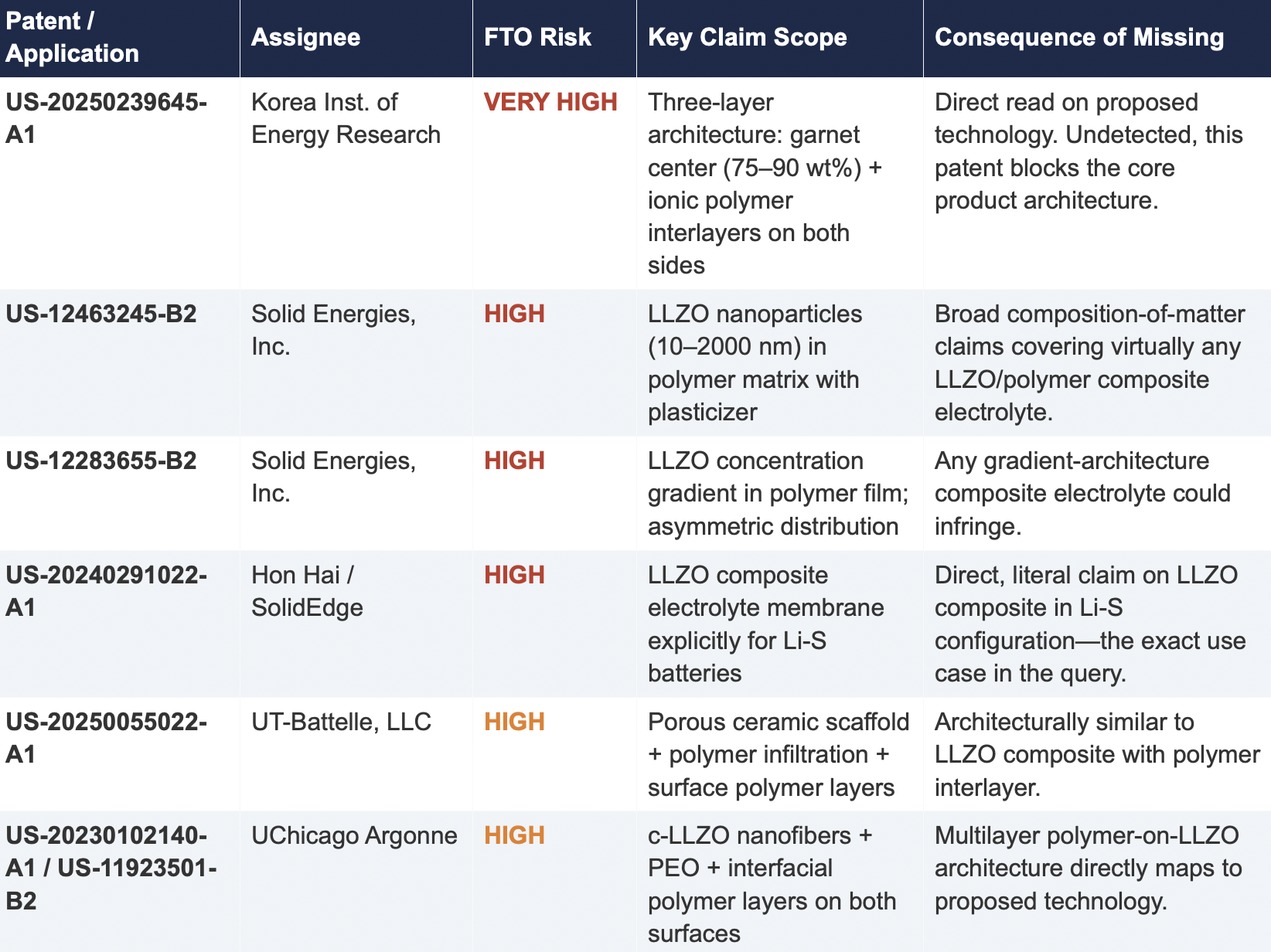
The following table presents patents identified exclusively by Cypris that were rated as High or Very High FTO risk for the proposed technology architecture. None were surfaced by any general-purpose model.
Figure 3. High and Very High FTO risk patents identified exclusively by Cypris. None were surfaced by ChatGPT, Claude, or Co-Pilot.
2.3 Patent Fencing: The Solid Energies Portfolio
Cypris identified a coordinated patent fencing strategy by Solid Energies, Inc. that no general-purpose model detected at scale. Solid Energies holds at least four granted US patents and one published application covering LLZO-polymer composite electrolytes across compositions(US-12463245-B2), gradient architectures (US-12283655-B2), electrode integration (US-12463249-B2), and manufacturing processes (US-20230035720-A1). Claude identified one Solid Energies patent (US 11,967,678) and correctly rated it as the highest-priority FTO concern but did not surface the broader portfolio. ChatGPT and Co-Pilot identified zero Solid Energies filings.
The practical significance is that a company relying on any individual patent hit would underestimate the scope of Solid Energies' IP position. The fencing strategy—covering the composition, the architecture, the electrode integration, and the manufacturing method—means that identifying a single design-around for one patent does not resolve the FTO exposure from the portfolio as a whole. This is the kind of strategic insight that requires seeing the full picture, which no general-purpose model delivered
2.4 Assignee Attribution Quality
ChatGPT's response included at least two instances of fabricated or unverifiable assignee attributions. For US 11,367,895 B1, the listed assignee was "Likely startup / defense contractor cluster." For US 2021/0202983 A1, the assignee was described as "Likely DOE / national lab ecosystem." In both cases, the model appears to have inferred the assignee from contextual patterns in its training data rather than retrieving the information from patent records.
In any operational IP workflow, assignee identity is foundational. It determines licensing strategy, litigation risk, and competitive positioning. A fabricated assignee is more dangerous than a missing one because it creates an illusion of completeness that discourages further investigation. An R&D team receiving this output might reasonably conclude that the landscape analysis is finished when it is not.
3. Structural Limitations of General-Purpose Models for Patent Intelligence
3.1 Training Data Is Not Patent Data
Large language models are trained on web-scraped text. Their knowledge of the patent record is derived from whatever fragments appeared in their training corpus: blog posts mentioning filings, news articles about litigation, snippets of Google Patents pages that were crawlable at the time of data collection. They do not have systematic, structured access to the USPTO database. They cannot query patent classification codes, parse claim language against a specific technology architecture, or verify whether a patent has been assigned, abandoned, or subjected to terminal disclaimer since their training data was collected.
This is not a limitation that improves with scale. A larger training corpus does not produce systematic patent coverage; it produces a larger but still arbitrary sampling of the patent record. The result is that general-purpose models will consistently surface well-known patents from heavily discussed assignees (QuantumScape, for example, appeared in most responses) while missing commercially significant filings from less publicly visible entities (Solid Energies, Korea Institute of EnergyResearch, Shenzhen Solid Advanced Materials).
3.2 The Web Is Closing to Model Scrapers
The data access problem is structural and worsening. As of mid-2025, Cloudflare reported that among the top 10,000 web domains, the majority now fully disallow AI crawlers such as GPTBot andClaudeBot via robots.txt. The trend has accelerated from partial restrictions to outright blocks, and the crawl-to-referral ratios reveal the underlying tension: OpenAI's crawlers access approximately1,700 pages for every referral they return to publishers; Anthropic's ratio exceeds 73,000 to 1.
Patent databases, scientific publishers, and IP analytics platforms are among the most restrictive content categories. A Duke University study in 2025 found that several categories of AI-related crawlers never request robots.txt files at all. The practical consequence is that the knowledge gap between what a general-purpose model "knows" about the patent landscape and what actually exists in the patent record is widening with each training cycle. A landscape query that a general-purpose model partially answered in 2023 may return less useful information in 2026.
3.3 General-Purpose Models Lack Ontological Frameworks for Patent Analysis
A freedom-to-operate analysis is not a summarization task. It requires understanding claim scope, prosecution history, continuation and divisional chains, assignee normalization (a single company may appear under multiple entity names across patent records), priority dates versus filing dates versus publication dates, and the relationship between dependent and independent claims. It requires mapping the specific technical features of a proposed product against independent claim language—not keyword matching.
General-purpose models do not have these frameworks. They pattern-match against training data and produce outputs that adopt the format and tone of patent analysis without the underlying data infrastructure. The format is correct. The confidence is high. The coverage is incomplete in ways that are not visible to the user.
4. Comparative Output Quality
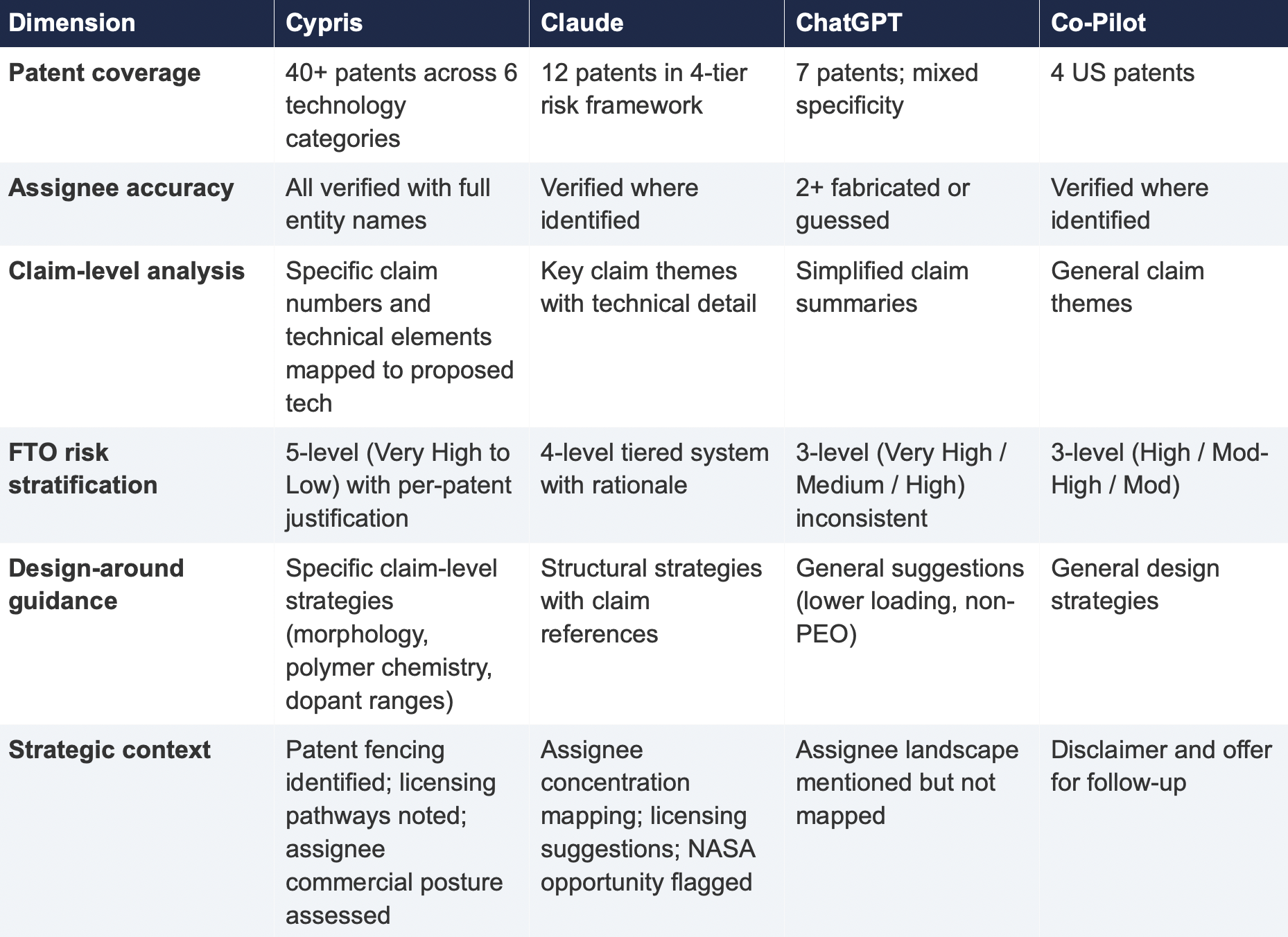
The following table summarizes the qualitative characteristics of each tool's response across the dimensions most relevant to an operational IP workflow.
Figure 4. Qualitative comparison of output characteristics across all four tools.
5. Implications for R&D and IP Organizations
5.1 The Confidence Problem
The central risk identified by this study is not that general-purpose models produce bad outputs—it is that they produce incomplete outputs with high confidence. Each model delivered its results in a professional format with structured analysis, risk ratings, and strategic recommendations. At no point did any model indicate the boundaries of its knowledge or flag that its results represented a fraction of the available patent record. A practitioner receiving one of these outputs would have no signal that the analysis was incomplete unless they independently validated it against a comprehensive datasource.
This creates an asymmetric risk profile: the better the format and tone of the output, the less likely the user is to question its completeness. In a corporate environment where AI outputs are increasingly treated as first-pass analysis, this dynamic incentivizes under-investigation at precisely the moment when thoroughness is most critical.
5.2 The Diversification Illusion
It might be assumed that running the same query through multiple general-purpose models provides validation through diversity of sources. This study suggests otherwise. While the four tools returned different subsets of patents, all operated under the same structural constraints: training data rather than live patent databases, web-scraped content rather than structured IP records, and general-purpose reasoning rather than patent-specific ontological frameworks. Running the same query through three constrained tools does not produce triangulation; it produces three partial views of the same incomplete picture.
5.3 The Appropriate Use Boundary
General-purpose language models are effective tools for a wide range of tasks: drafting communications, summarizing documents, generating code, and exploratory research. The finding of this study is not that these tools lack value but that their value boundary does not extend to decisions that carry existential commercial risk.
Patent landscape analysis, freedom-to-operate assessment, and competitive intelligence that informs R&D investment decisions fall outside that boundary. These are workflows where the completeness and verifiability of the underlying data are not merely desirable but are the primary determinant of whether the analysis has value. A patent landscape that captures 10% of the relevant filings, regardless of how well-formatted or confidently presented, is a liability rather than an asset.
6. Test 2: Competitive Intelligence — Bio-Based Polyamide Patent Landscape
To assess whether the findings from Test 1 were specific to a single technology domain or reflected a broader structural pattern, a second query was submitted to all four tools. This query shifted from freedom-to-operate analysis to competitive intelligence, asking each tool to identify the top 10organizations by patent filing volume in bio-based polyamide synthesis from castor oil derivatives over the past three years, with summaries of technical approach, co-assignee relationships, and portfolio trajectory.
6.1 Query
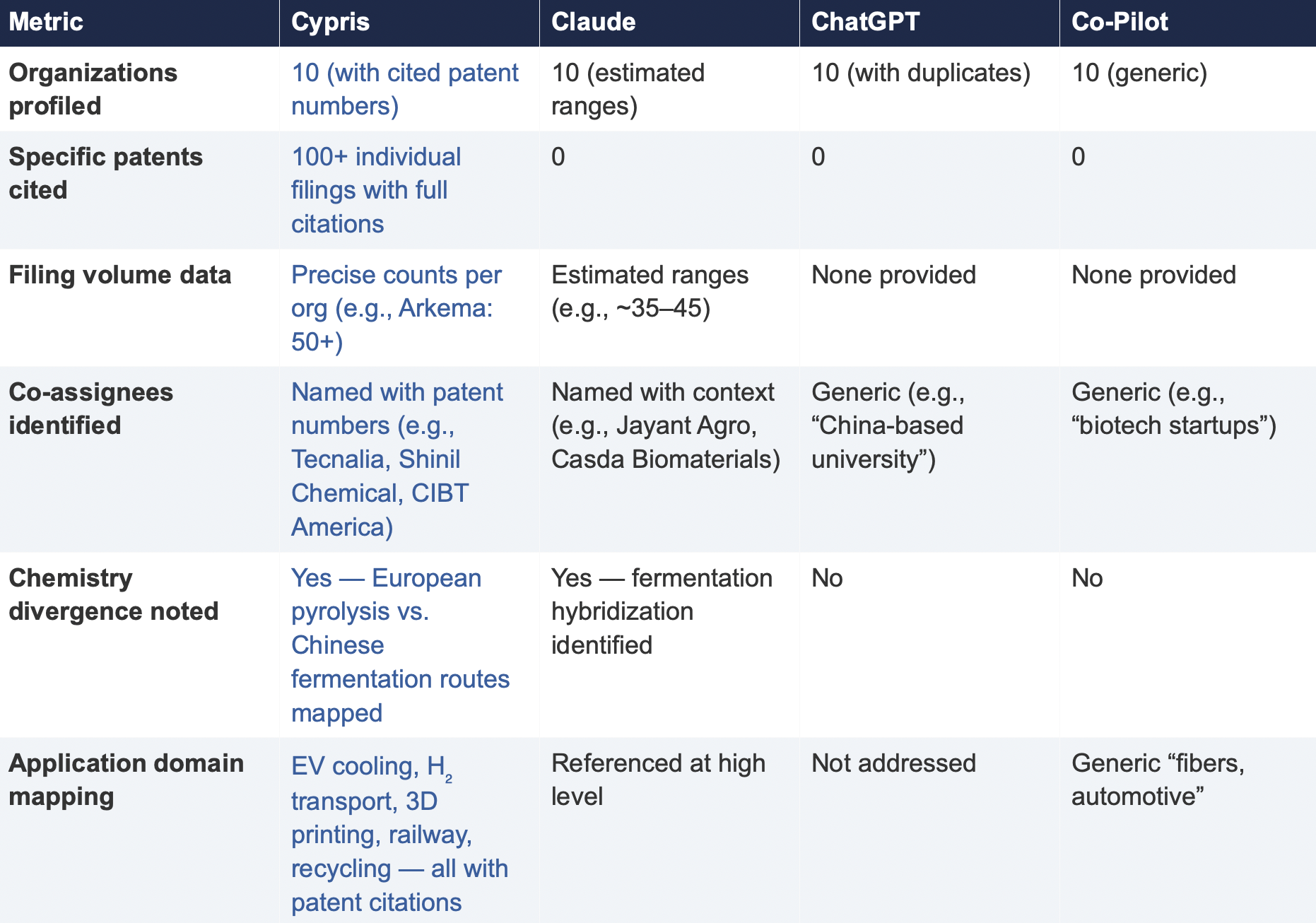
6.2 Summary of Results
Figure 5. Comparative output metrics for Test 2 (competitive intelligence / bio-based polyamide landscape).
6.3 Key Differentiators
Verifiability
The most consequential difference in Test 2 was the presence or absence of verifiable evidence. Cypris cited over 100 individual patent filings with full patent numbers, assignee names, and publication dates. Every claim about an organization’s technical focus, co-assignee relationships, and filing trajectory was anchored to specific documents that a practitioner could independently verify in USPTO, Espacenet, or WIPO PATENT SCOPE. No general-purpose model cited a single patent number. Claude produced the most structured and analytically useful output among the public models, with estimated filing ranges, product names, and strategic observations that were directionally plausible. However, without underlying patent citations, every claim in the response requires independent verification before it can inform a business decision. ChatGPT and Co-Pilot offered thinner profiles with no filing counts and no patent-level specificity.
Data Integrity
ChatGPT’s response contained a structural error that would mislead a practitioner: it listed CathayBiotech as organization #5 and then listed “Cathay Affiliate Cluster” as a separate organization at #9, effectively double-counting a single entity. It repeated this pattern with Toray at #4 and “Toray(Additional Programs)” at #10. In a competitive intelligence context where the ranking itself is the deliverable, this kind of error distorts the landscape and could lead to misallocation of competitive monitoring resources.
Organizations Missed
Cypris identified Kingfa Sci. & Tech. (8–10 filings with a differentiated furan diacid-based polyamide platform) and Zhejiang NHU (4–6 filings focused on continuous polymerization process technology)as emerging players that no general-purpose model surfaced. Both represent potential competitive threats or partnership opportunities that would be invisible to a team relying on public AI tools.Conversely, ChatGPT included organizations such as ANTA and Jiangsu Taiji that appear to be downstream users rather than significant patent filers in synthesis, suggesting the model was conflating commercial activity with IP activity.
Strategic Depth
Cypris’s cross-cutting observations identified a fundamental chemistry divergence in the landscape:European incumbents (Arkema, Evonik, EMS) rely on traditional castor oil pyrolysis to 11-aminoundecanoic acid or sebacic acid, while Chinese entrants (Cathay Biotech, Kingfa) are developing alternative bio-based routes through fermentation and furandicarboxylic acid chemistry.This represents a potential long-term disruption to the castor oil supply chain dependency thatWestern players have built their IP strategies around. Claude identified a similar theme at a higher level of abstraction. Neither ChatGPT nor Co-Pilot noted the divergence.
6.4 Test 2 Conclusion
Test 2 confirms that the coverage and verifiability gaps observed in Test 1 are not domain-specific.In a competitive intelligence context—where the deliverable is a ranked landscape of organizationalIP activity—the same structural limitations apply. General-purpose models can produce plausible-looking top-10 lists with reasonable organizational names, but they cannot anchor those lists to verifiable patent data, they cannot provide precise filing volumes, and they cannot identify emerging players whose patent activity is visible in structured databases but absent from the web-scraped content that general-purpose models rely on.
7. Conclusion
This comparative analysis, spanning two distinct technology domains and two distinct analytical workflows—freedom-to-operate assessment and competitive intelligence—demonstrates that the gap between purpose-built R&D intelligence platforms and general-purpose language models is not marginal, not domain-specific, and not transient. It is structural and consequential.
In Test 1 (LLZO garnet electrolytes for Li-S batteries), the purpose-built platform identified more than three times as many patents as the best-performing general-purpose model and ten times as many as the lowest-performing one. Among the patents identified exclusively by the purpose-built platform were filings rated as Very High FTO risk that directly claim the proposed technology architecture. InTest 2 (bio-based polyamide competitive landscape), the purpose-built platform cited over 100individual patent filings to substantiate its organizational rankings; no general-purpose model cited as ingle patent number.
The structural drivers of this gap—reliance on training data rather than live patent feeds, the accelerating closure of web content to AI scrapers, and the absence of patent-specific analytical frameworks—are not transient. They are inherent to the architecture of general-purpose models and will persist regardless of increases in model capability or training data volume.
For R&D and IP leaders, the practical implication is clear: general-purpose AI tools should be used for general-purpose tasks. Patent intelligence, competitive landscaping, and freedom-to-operate analysis require purpose-built systems with direct access to structured patent data, domain-specific analytical frameworks, and the ability to surface what a general-purpose model cannot—not because it chooses not to, but because it structurally cannot access the data.
The question for every organization making R&D investment decisions today is whether the tools informing those decisions have access to the evidence base those decisions require. This study suggests that for the majority of general-purpose AI tools currently in use, the answer is no.
Study Disclosure
This comparative evaluation was commissioned and published by Cypris. The testing methodology, prompts, evaluation criteria, and underlying outputs have been documented to support independent review and replication.
All platform outputs were preserved in their original form. Patent data and material factual claims were cross-checked against USPTO Patent Center and WIPO PATENTSCOPE records as of March 27, 2026. Cypris was one of the platforms evaluated and therefore has a commercial interest in the findings.
The Patent Intelligence Gap - A Comparative Analysis of Verticalized AI-Patent Tools vs. General-Purpose Language Models for R&D Decision-Making