
A smarter, more engaging monitoring experience—built for speed, accuracy, and collaboration.
Over the past few years, Cypris has helped innovation teams make faster, more informed decisions by centralizing critical insights across patents, academic papers, organizations, and market activity. But until now, tracking changes over time often meant juggling spreadsheets, scattered alerts, and manual checks—workflows that were hard to manage and easy to miss.
Today, we’re excited to introduce an upgraded Monitoring experience on Cypris, a complete redesign of how teams track critical updates. With streamlined setup, redesigned emails, and advanced LLMs powering analysis, Monitoring makes it easy to stay ahead of market shifts and competitor moves—without the noise.
Why We Rebuilt Monitoring from the Ground Up
The original monitoring tools relied heavily on exports and static spreadsheets, requiring users to piece together updates manually. Alerts were basic, often duplicative, and limited in the types of data they could track. They also didn’t always give teams confidence that updates were reliable, accurate, or relevant to their needs.
We reimagined Monitoring to solve these gaps. Instead of scattered, one-off alerts, the new Monitoring delivers timely, structured reports—only when new results exist. Updates are now enriched with LLM-powered summaries that don’t just describe activity, but interpret it—prioritizing what matters most and filtering out the noise.
What’s New in Monitoring
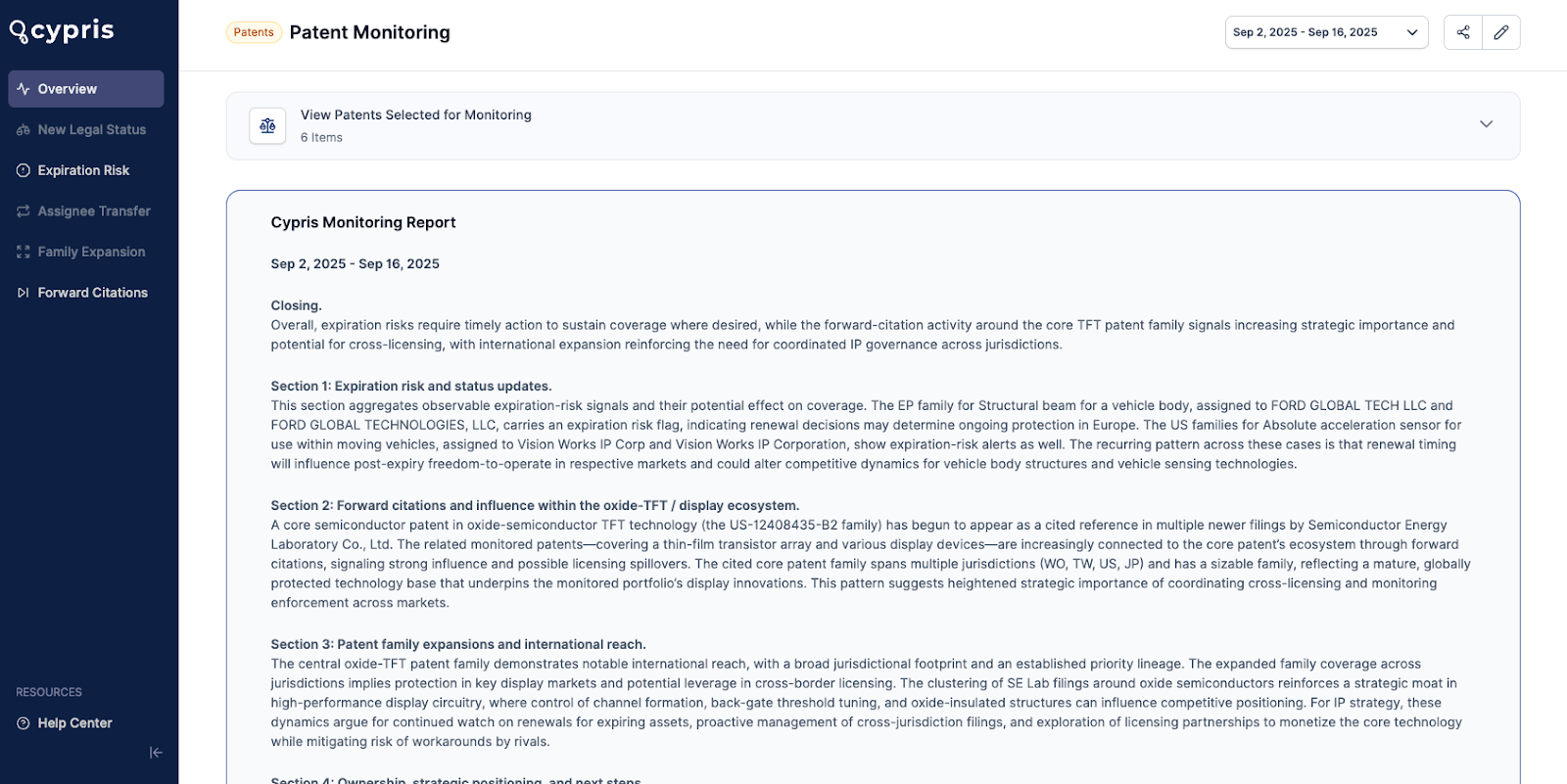
The Monitoring Report
Spreadsheets are no longer needed. Updates now appear in a clear format that highlights key changes such as patent expansions, assignee transfers, or competitor filings. Each report includes AI-generated summaries powered by advanced LLMs to surface the most important trends and context. Reports are refreshed regularly, saved automatically, and build a continuous historical log for long-term tracking.
For many teams, these AI-enhanced reports are the most impactful shift. Instead of raw updates, Monitoring now provides analysis—turning activity like organizational filings or new research papers into intelligence that can guide investment and innovation decisions.
Beyond the reports themselves, having all updates housed directly within Cypris elevates the platform experience as a whole. The new interface is more intuitive, reducing friction for everyday use, and its design makes it easier for teams to collaborate in real time.
Monitoring is also fully integrated with Projects, so you can create and share monitors directly within your team’s workspace. This makes it simple to align ongoing research, track critical events together, and keep collaborators up to speed—all without switching tools. By connecting monitoring with projects, Cypris transforms isolated updates into shared intelligence that enhances both decision-making and collaboration across your organization.
Newsletter-Style Email Experience
Monitoring emails now feel more like a personalized newsletter. Each update arrives in a clean, structured layout with an easy-to-read AI-generated summary of recent activity, spotlighted trends, and direct links to dive deeper in the platform. Content is grouped into clear sections and filterable by category, so you can quickly scan what’s new, focus on the most relevant updates, and stay effortlessly informed—without inbox clutter.

Simplified Setup & Discoverability
Setting up monitors is now faster and more intuitive. Users can create them in a single streamlined interface—quickly searching patent numbers, keywords, organizations, or papers and selecting the right mix in one place. Smart suggestions recommend recipients, while the Monitoring button appears directly on every search results page. Current monitors are clearly indicated to prevent duplication, and external recipients can be added to email updates for seamless collaboration.
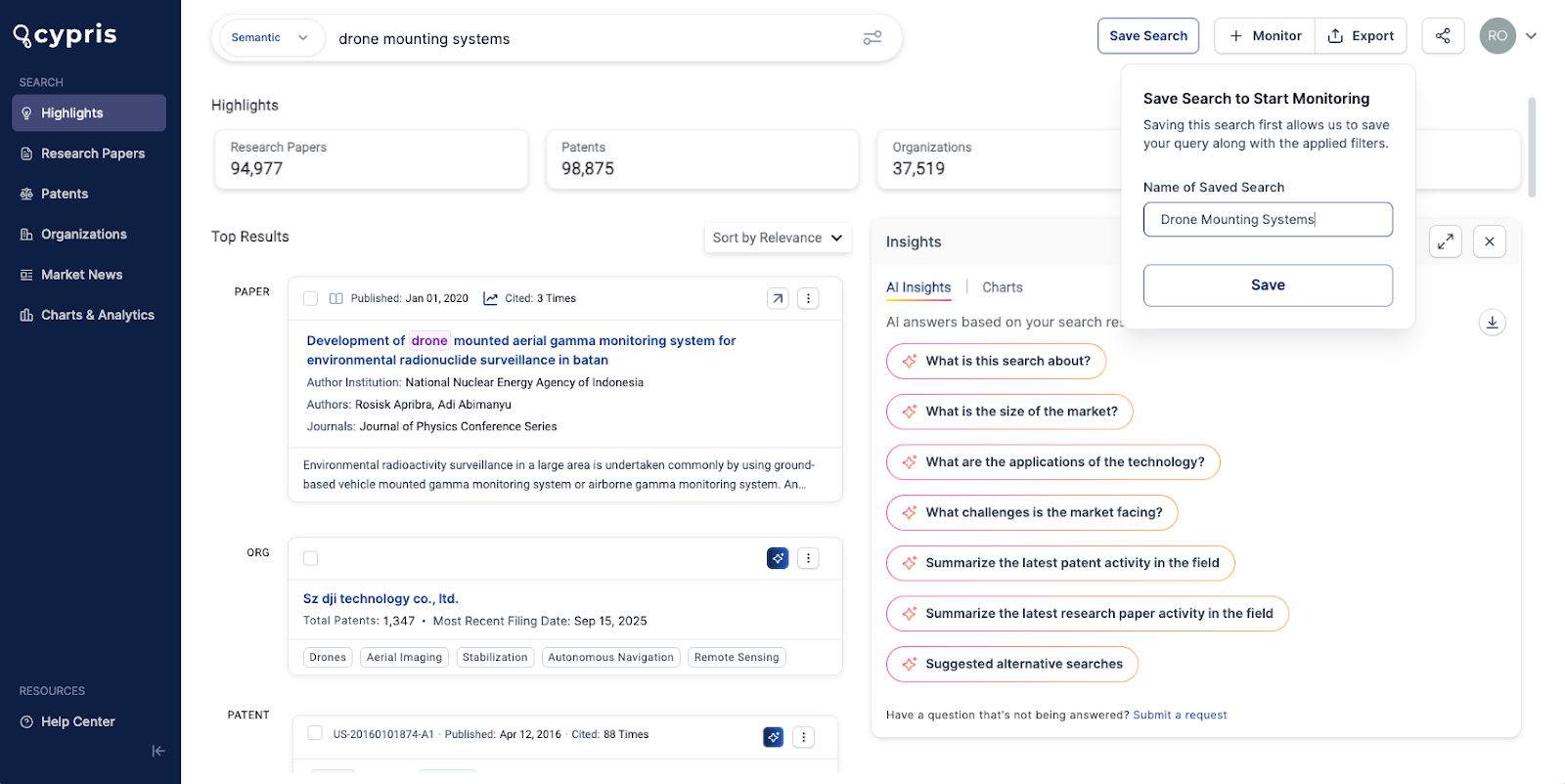
Noise-Free Updates & Critical Alerts
A “send only if new results exist” toggle eliminates duplicate notifications. Monitoring now captures not only newly published patents, papers, and organizations, but also critical patent events such as expiration risks, assignee transfers, patent family expansions, and forward citations—including competitor citations of your own research.
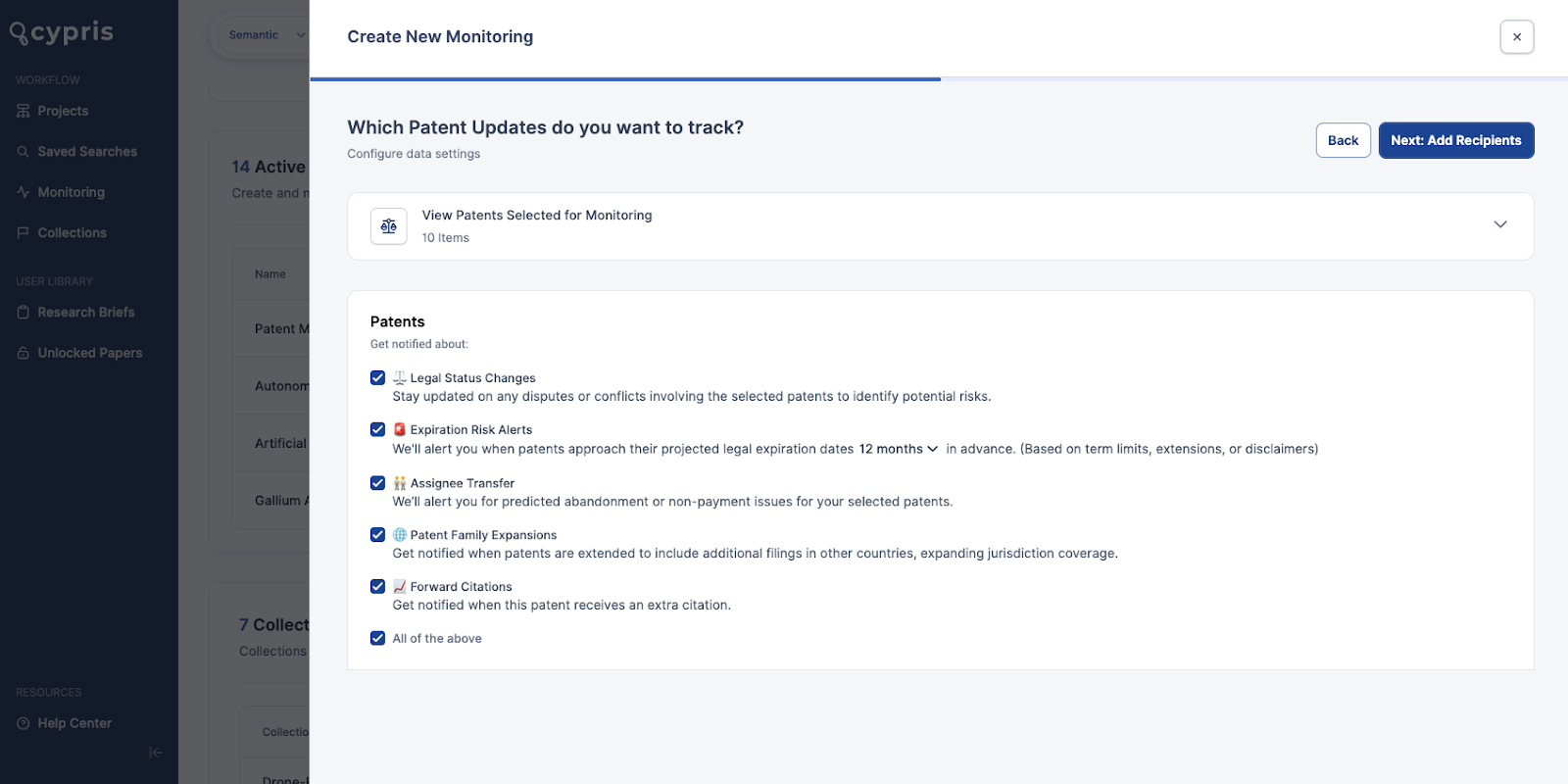
A More Powerful User Experience
Monitoring is built to help users move from raw data to actionable intelligence. Reports save automatically, creating a historical log teams can reference at any time. Items can be flagged directly into collections without manual re-entry. Emails preview AI-enhanced trends with a single click into interactive dashboards, and users can easily add colleagues or external recipients to stay aligned.
From a design perspective, the rebuild also gave our team room to innovate.
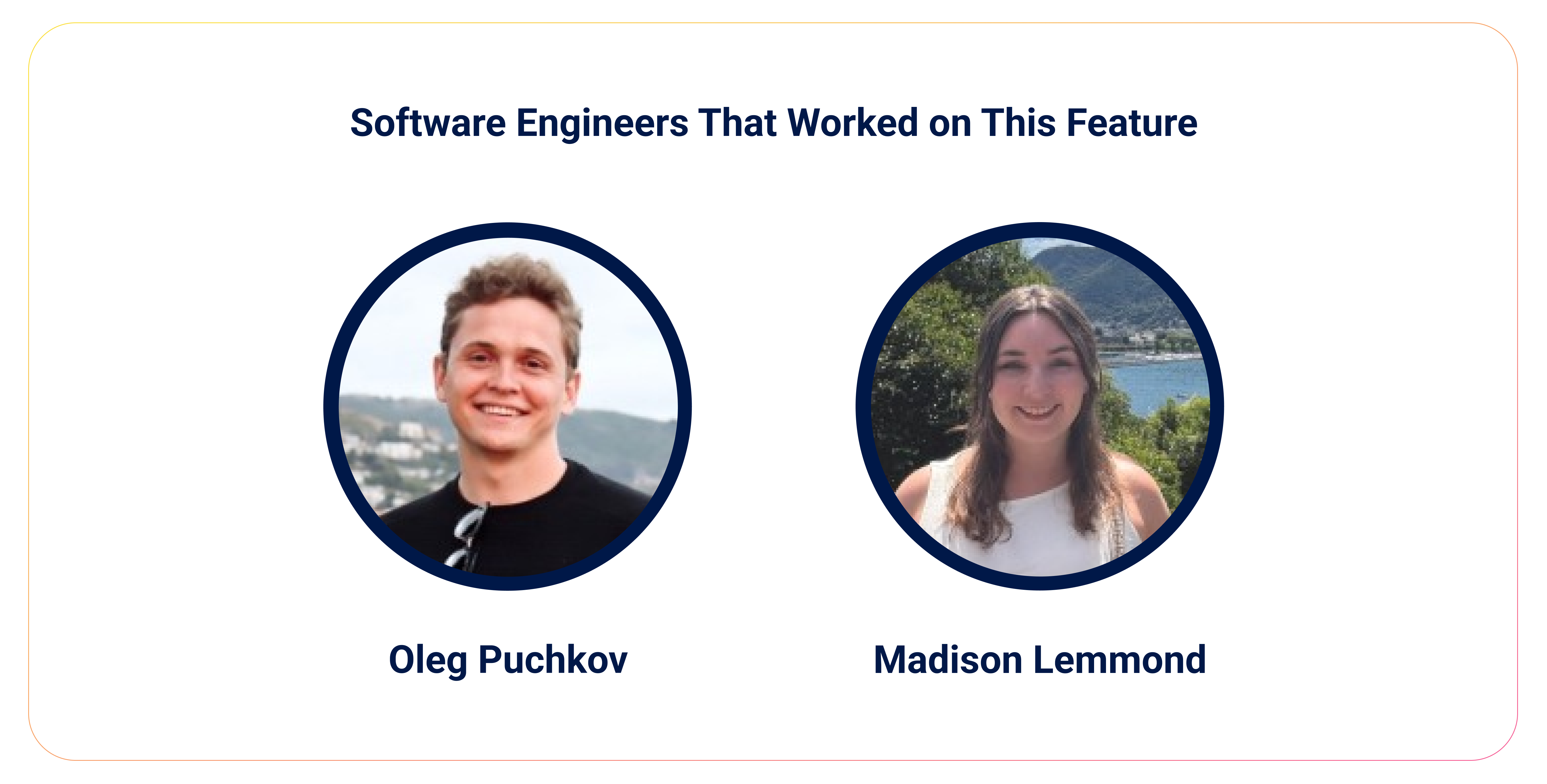
As one of our engineering team members, Maddie explained: “It was fun to build something new from scratch. From a UI perspective, we were able to make better design choices right from the start, which made for a much smoother, more intuitive user experience.”
Built for Speed, Accuracy, and Collaboration
With the new Monitoring, teams can save time compared to manual tracking, strengthen competitive intelligence with reliable, cross-dataset updates, collaborate seamlessly by sharing reports with colleagues or external partners, and trust the signal thanks to accuracy, relevancy filters, and AI-powered summaries.
As part of our engineering team, Oleg explained: “This project sat on top of our existing platform, which meant understanding the entire workflow end to end. It was challenging, but it also gave us the opportunity to rethink how everything fits together—and that’s what made it so rewarding.”
Available Now to All Users
The redesigned Monitoring is live and available across the Cypris platform today. If you’re already using Cypris, you’ll see new Monitoring options throughout your search and reporting workflows.
We’re excited to see how your team uses Monitoring to stay ahead of markets, competitors, and technologies — and to keep pushing the boundaries of what intelligent monitoring can do for R&D.

Introducing the New AI-Powered Cypris Monitoring


A smarter, more engaging monitoring experience—built for speed, accuracy, and collaboration.
Over the past few years, Cypris has helped innovation teams make faster, more informed decisions by centralizing critical insights across patents, academic papers, organizations, and market activity. But until now, tracking changes over time often meant juggling spreadsheets, scattered alerts, and manual checks—workflows that were hard to manage and easy to miss.
Today, we’re excited to introduce an upgraded Monitoring experience on Cypris, a complete redesign of how teams track critical updates. With streamlined setup, redesigned emails, and advanced LLMs powering analysis, Monitoring makes it easy to stay ahead of market shifts and competitor moves—without the noise.
Why We Rebuilt Monitoring from the Ground Up
The original monitoring tools relied heavily on exports and static spreadsheets, requiring users to piece together updates manually. Alerts were basic, often duplicative, and limited in the types of data they could track. They also didn’t always give teams confidence that updates were reliable, accurate, or relevant to their needs.
We reimagined Monitoring to solve these gaps. Instead of scattered, one-off alerts, the new Monitoring delivers timely, structured reports—only when new results exist. Updates are now enriched with LLM-powered summaries that don’t just describe activity, but interpret it—prioritizing what matters most and filtering out the noise.
What’s New in Monitoring
The Monitoring Report
Spreadsheets are no longer needed. Updates now appear in a clear format that highlights key changes such as patent expansions, assignee transfers, or competitor filings. Each report includes AI-generated summaries powered by advanced LLMs to surface the most important trends and context. Reports are refreshed regularly, saved automatically, and build a continuous historical log for long-term tracking.
For many teams, these AI-enhanced reports are the most impactful shift. Instead of raw updates, Monitoring now provides analysis—turning activity like organizational filings or new research papers into intelligence that can guide investment and innovation decisions.
Beyond the reports themselves, having all updates housed directly within Cypris elevates the platform experience as a whole. The new interface is more intuitive, reducing friction for everyday use, and its design makes it easier for teams to collaborate in real time.
Monitoring is also fully integrated with Projects, so you can create and share monitors directly within your team’s workspace. This makes it simple to align ongoing research, track critical events together, and keep collaborators up to speed—all without switching tools. By connecting monitoring with projects, Cypris transforms isolated updates into shared intelligence that enhances both decision-making and collaboration across your organization.
Newsletter-Style Email Experience
Monitoring emails now feel more like a personalized newsletter. Each update arrives in a clean, structured layout with an easy-to-read AI-generated summary of recent activity, spotlighted trends, and direct links to dive deeper in the platform. Content is grouped into clear sections and filterable by category, so you can quickly scan what’s new, focus on the most relevant updates, and stay effortlessly informed—without inbox clutter.
Simplified Setup & Discoverability
Setting up monitors is now faster and more intuitive. Users can create them in a single streamlined interface—quickly searching patent numbers, keywords, organizations, or papers and selecting the right mix in one place. Smart suggestions recommend recipients, while the Monitoring button appears directly on every search results page. Current monitors are clearly indicated to prevent duplication, and external recipients can be added to email updates for seamless collaboration.
Noise-Free Updates & Critical Alerts
A “send only if new results exist” toggle eliminates duplicate notifications. Monitoring now captures not only newly published patents, papers, and organizations, but also critical patent events such as expiration risks, assignee transfers, patent family expansions, and forward citations—including competitor citations of your own research.
A More Powerful User Experience
Monitoring is built to help users move from raw data to actionable intelligence. Reports save automatically, creating a historical log teams can reference at any time. Items can be flagged directly into collections without manual re-entry. Emails preview AI-enhanced trends with a single click into interactive dashboards, and users can easily add colleagues or external recipients to stay aligned.
From a design perspective, the rebuild also gave our team room to innovate.
As one of our engineering team members, Maddie explained: “It was fun to build something new from scratch. From a UI perspective, we were able to make better design choices right from the start, which made for a much smoother, more intuitive user experience.”
Built for Speed, Accuracy, and Collaboration
With the new Monitoring, teams can save time compared to manual tracking, strengthen competitive intelligence with reliable, cross-dataset updates, collaborate seamlessly by sharing reports with colleagues or external partners, and trust the signal thanks to accuracy, relevancy filters, and AI-powered summaries.
As part of our engineering team, Oleg explained: “This project sat on top of our existing platform, which meant understanding the entire workflow end to end. It was challenging, but it also gave us the opportunity to rethink how everything fits together—and that’s what made it so rewarding.”
Available Now to All Users
The redesigned Monitoring is live and available across the Cypris platform today. If you’re already using Cypris, you’ll see new Monitoring options throughout your search and reporting workflows.
We’re excited to see how your team uses Monitoring to stay ahead of markets, competitors, and technologies — and to keep pushing the boundaries of what intelligent monitoring can do for R&D.
Keep Reading

he best AI research platform for market and technology insights depends on how much the answer has to be trusted. For R&D and innovation teams making investment decisions, a purpose-built agent platform such as Cypris, which grounds every finding in cited patents, papers and commercial signals, is the strongest fit. General AI assistants are fast for broad orientation, and analyst studies still have a place for bespoke strategic questions.
Here is the short version. Cypris is best for R&D, IP and innovation teams that need cited, repeatable technology and market analysis they can take into a stage-gate review. General AI assistants such as ChatGPT, Claude, Gemini and Perplexity are best for getting oriented on an unfamiliar market or topic quickly. Analyst and consulting studies are best for one-off strategic questions that need interviews and custom primary research. Free databases such as Google Patents and The Lens are best for checking individual documents.
What market and technology insights mean for R&D
R&D teams ask two kinds of questions. Technology questions ask who is inventing in a space, whether activity is growing, what has already been done and where the white space is. Market questions ask who is buying, which competitors are moving commercially, and which partners, suppliers or acquisition targets matter.
Most real decisions need both at once. A program that looks open on the technology side can still be a poor bet if three large players just announced products, and a hot market can hide a crowded patent landscape. The most useful platform is the one that connects the two views instead of answering each in isolation.
Where general AI assistants fit
General AI assistants are genuinely useful. They are fast, they write well, and their research modes can search the web and summarize what they find with links. For a first pass on an unfamiliar market or a quick explanation of a technology, they save real time.
Their limits show up when an answer has to support a decision. Web results lean toward press releases, news and marketing pages rather than primary technical records. Patent details are often incomplete or out of date, citations can be thin, and two people asking the same question in different words can get different answers. Our Patent Intelligence Gap study measured the gap on one landscape question: Cypris found more than 40 relevant patents where the best general-purpose model found 12.
The practical rule is to use general assistants for orientation, and a grounded platform for anything that will go in front of leadership.
Where analyst and consulting studies fit
Analyst and consulting studies bring something AI does not: interviews, custom primary research and experienced judgment about a market. For a major strategic bet, that can be worth the investment.
The trade-offs are time, cost and shelf life. A study usually takes weeks, covers one question, and starts to age the day it is delivered. When the market moves, rerunning it means another engagement. Many R&D organizations now use AI platforms for continuous coverage and reserve outside studies for the few questions that truly need them.
Where free databases fit
Free databases such as Google Patents and The Lens are excellent for opening and checking individual patents and papers, and they cost nothing. They are not built to answer market questions, run repeatable analysis or keep watching a space, so they work best as a verification step alongside whichever platform does the analysis.
What to look for in an AI research platform for R&D
Start with the sources. The platform should draw on primary technical records, meaning patents, scientific literature and grants, together with commercial signals such as product launches, partnerships and funding, rather than relying mainly on the open web. Then check that every finding carries a citation to a source record your team can open.
Look for repeatable workflows. Landscape, white space, technology scouting and competitor analysis should run with a defined scope and method, so results are consistent no matter who asks. Ask how the platform keeps watching after the first answer, since market and technology positions change every month.
Finally, check fit and security. The platform should work where your team already works, such as inside Microsoft Copilot or other AI tools through an MCP server. Ask where the vendor is headquartered and where your data is stored, and treat SOC 2 Type II as the baseline rather than the differentiator.
How to test a platform in one afternoon
Pick a market and technology question your team answered recently, so you know what a good answer looks like. Run it through each option you are considering. Then ask four questions of each output: Did it find what you already know? Do the citations open to real records? Did it surface anything new and correct? Would you put it in front of leadership as it stands?
Have a second person rerun the same question in their own words. If the answer changes substantially, the tool is giving you a draft, not evidence.
How Cypris approaches this
Cypris is the agentic workforce for corporate R&D. Its specialized AI agents work like expert analysts embedded in your team, running technology scouting, landscape, white space and competitor analysis with citations to source records, and supporting decisions across the stage-gate process from early ideation through launch. Each agent follows a defined scope, method and evidence standard, so results are consistent no matter who runs them, and Agentic Monitoring keeps the analysis current. The agents draw on more than 1 billion data sources across global innovation, including technical and commercial signals, with a focus on chemicals and industrials.
Cypris is trusted by thousands of researchers at Fortune 100 organizations. It is headquartered in the US, stores customer data in the US, and is available in Microsoft Copilot and through an MCP server, so teams can keep using the assistants they like with grounded data behind them. You can read more in Prompts vs. Agents.
Bring a question your team answered recently. Book a demo and compare the result with what you have.
FAQ
What is the best AI research platform for market and technology insights?
For R&D teams making investment decisions, a purpose-built agent platform such as Cypris is the strongest fit because it grounds every finding in cited patents, papers and commercial signals. General AI assistants are useful for quick orientation, and analyst studies for bespoke strategic questions.
Is ChatGPT good enough for R&D market and technology research?
It is good for getting oriented quickly, but it relies mostly on web sources and can miss or misstate patent and technical details. For findings that will support an investment decision, use a platform grounded in primary technical records with citations.
What is the difference between an AI research assistant and an R&D intelligence platform?
A general assistant answers questions from the web and its training data. An R&D intelligence platform searches primary sources such as patents, literature and grants alongside commercial signals, cites every finding, and runs repeatable workflows that teams can rerun and monitor.
How do I check whether AI-generated market insights are reliable?
Open the citations and confirm they lead to real records that say what the answer claims. Test the tool on a question your team already answered, and have a second person rerun it to see whether the answer holds.
Are AI research platforms secure enough for confidential R&D questions?
Some are. Ask where the vendor is headquartered and where your data is stored, whether models are trained on your data and what retention terms apply. Treat SOC 2 Type II as the baseline rather than the differentiator.
Can I use an R&D intelligence platform inside Copilot or ChatGPT?
Yes. Cypris is available in Microsoft Copilot and through an MCP server for other AI tools, so teams can keep their preferred assistant while grounding answers in cited R&D data.

The best PatSnap alternative depends on what your team needs the platform to decide. If your R&D organization needs patents, scientific literature, chemical compounds and corporate signals analyzed together, with agents that run landscape and freedom-to-operate workflows and monitor continuously, Cypris is the strongest fit. If your IP department is focused on portfolio management, and legal work, Derwent Innovation and Orbit Intelligence remain the established choices.
Here is the short version:
- Cypris: best for corporate R&D and IP teams making investment decisions across patents, papers and compounds, with agent workflows and continuous monitoring.
- Derwent Innovation (Clarivate): best for IP professionals who need curated patent records and legal-status depth.
- Orbit Intelligence (Questel): best for IP operations teams managing large portfolios by patent family.
- IP.com InnovationQ Plus: best for prior art searchers who want semantic search across patents and technical literature.
- The Lens: best for verification and early scoping on a budget, since it is free and links patents to scholarly works.
- Amplified: best for fast AI-ranked patent search rather than multi-source analysis.
Why teams look for PatSnap alternatives
PatSnap offers a large global patent database, strong visual analytics and products aimed at IP users.
Teams usually start looking for alternatives for one of five reasons:
- Needs for data beyond patents. Leadership now asks which programs to fund, which partners to pursue and where competitors are heading. Those answers depend on literature, funding, regulatory and corporate data, not patents alone.
- Patents arrive late. Most applications publish about 18 months after priority. Scientific papers often surface the same work 6 to 18 months earlier.
- Dashboards do not run workflows. Teams want a landscape, FTO or scouting analysis run the same way every time, with citations, rather than rebuilt by hand each quarter.
- AI has moved into the tools people already use. Many organizations now want R&D intelligence inside Microsoft Copilot, Claude or ChatGPT.
What to evaluate in a PatSnap alternative
Use the same six criteria for every vendor:
- Corpus breadth. Does the platform cover scientific literature, compounds, grants and corporate activity alongside global patents?
- Citation verifiability. Does every finding link to a real source record you can check?
- Workflow depth. Can it run landscape, FTO, prior art and white space analysis as repeatable workflows?
- Monitoring. Does it watch your domains continuously and surface only what matters?
- Integration. Can your team use it inside the AI tools they already work in?
- Security. Where data is hosted, engineering location, data retention terms and model subprocessors should be documented, not promised.
The alternatives in detail
Cypris. Cypris is an AI-native R&D intelligence platform built for corporate R&D and IP teams. It covers more than 500 million patents and scientific papers and more than 120 million chemical compounds, organized through a proprietary R&D ontology. Cypris Q, its agentic layer, runs landscape, white space, FTO, prior art and technology scouting as domain workflows with citations to source records. Agentic Monitoring watches patents, literature, regulatory bodies, M&A, product launches and grants continuously. Cypris is SOC 2 Type II certified with zero data retention, and it is available through an MCP server and in Microsoft Copilot. Limitation: teams doing day-to-day prosecution docketing will still want a dedicated IP management system.
Derwent Innovation. Clarivate's platform is a long-standing standard for IP professionals. Its strength is curated patent data with rewritten abstracts and strong legal-status coverage. Limitation: it is patent-centric by design, so R&D questions that depend on literature or market signals need other tools.
Orbit Intelligence. Questel's platform is built around patent families and powerful search syntax, and it connects to Questel's broader IP services. Limitation: the search-and-export workflow assumes an analyst does the reasoning.
IP.com InnovationQ Plus. InnovationQ is known for semantic search that combines patents with technical literature, which makes it useful for prior art work. Limitation: it is focused on search rather than on decision workflows or monitoring.
The Lens. The Lens is a free, open platform that links patents to scholarly works. It is excellent for verification and early scoping. Limitation: it does not offer enterprise workflows, agents or security commitments.
Amplified. Amplified uses AI to rank patents by similarity to a written description, which speeds up patent search. Limitation: its scope is patent search rather than multi-source R&D analysis.
How to run a fair evaluation
The fastest way to compare vendors is to run one real question through each. Pick a technology area your team knows well, so you can tell a plausible answer from a correct one.
Score each output on how many relevant documents it found, whether every citation resolves to a real record, whether assignees are correct, and whether the analysis tells you what to do next. Our Patent Intelligence Gap study used this method to compare Cypris with general-purpose AI tools. It found more than 40 relevant patents where the best general model found 12.
Check vendor terms before running hands-on comparisons, and keep outputs so your team can review them later.
How Cypris approaches this
Cypris is built on two ideas. First, R&D decisions need more than patents, so the corpus spans patents, literature, compounds, grants, regulatory data and corporate activity. Second, recurring analyses should run as standardized workflows, not improvised searches. That is why Cypris Q runs each workflow with a defined scope, corpus, method, evidence standard and output structure. You can read more in Prompts vs. Agents.
Cypris serves enterprise R&D teams across chemicals and materials, industrials and government.
Want to see the difference on your own technology area? Book a demo and bring a question your team has already answered.
FAQ
What are the best PatSnap alternatives?
The main alternatives are Cypris, Derwent Innovation, Orbit Intelligence, IP.com InnovationQ Plus, The Lens and Amplified. Cypris fits R&D teams that need multi-source analysis and agent workflows. Derwent and Orbit fit IP professionals focused on prosecution and portfolio management.
Who are PatSnap's main competitors?
In enterprise patent analytics, PatSnap competes most often with Clarivate's Derwent Innovation and Questel's Orbit Intelligence. In R&D intelligence, it increasingly competes with AI-native platforms such as Cypris that combine patents with literature, compounds and corporate data.
Is there a PatSnap alternative that includes scientific literature?
Yes. Cypris covers more than 500 million patents and scientific papers in one corpus, and The Lens links patents to scholarly works for free. Literature matters because it often shows new work 6 to 18 months before related patents publish.
What is the best PatSnap alternative for chemicals and materials R&D?
Teams in chemicals and materials need structure search, compound data and regulatory context alongside patents. Cypris combines more than 120 million compounds with patents and literature, so chemists can move from a structure to the related IP and research in one place.
Can I use a PatSnap alternative inside Microsoft Copilot or ChatGPT?
Cypris is available in Microsoft Copilot through Cypris Q for Microsoft Copilot, and through an MCP server for other AI tools. This lets teams keep their existing AI interface while grounding answers in verified patent and research records.
How should I compare PatSnap alternatives?
Run the same real question through each platform in a technology area your team knows well. Score coverage, citation accuracy, assignee accuracy and whether the output supports a decision. Check each vendor's terms before running hands-on tests.
Is PatSnap still a good choice?
For many teams, yes. PatSnap is a mature platform with broad patent coverage and strong analytics. Teams usually switch when their questions shift from patent search toward R&D investment decisions that depend on more than patent data.

A prompt is a single instruction issued to a language model, executed once, by one person, in a context nobody else can see. An agent is an encoded workflow with a defined scope, a defined corpus, defined evidence standards, and defined output structure, executed the same way every time regardless of who runs it. The difference between them is not sophistication. It is control.
That difference lands harder in IP than in almost any other function, because IP work product is discoverable, reviewable, and occasionally dispositive. A freedom-to-operate assessment can become an exhibit. A prior art search becomes the record of what the applicant knew and when. An invalidity position becomes the basis of a settlement posture. The question a litigator, an examiner, or an acquirer will eventually ask is not whether the analysis was good. It is how it was performed, against what, and by whom. An analysis that cannot be reproduced cannot be defended.
Most AI-assisted IP work today is prompt-based, which means most of it cannot be reproduced.
The industry has spent three years treating prompt engineering as the path to better AI output. For exploratory work, that framing holds. For the recurring, record-bearing analyses IP teams actually run, it is the wrong problem. The question is not how to write a better prompt. It is how to stop treating a repeated legal process as an improvised individual act.
What a Prompt Actually Is
Strip away the tooling and a prompt is a one-time instruction with no persistence, no version, no scope definition, and no record of what informed it.
Consider a patent attorney asking a general-purpose AI tool to surface prior art relevant to a pending claim set. The model receives the question, retrieves or recalls whatever material it has access to, applies whatever reasoning the phrasing invites, and returns a fluent answer. The attorney reads it, adjusts the phrasing, asks again, gets a different answer, and keeps the one that seems most useful.
Four things about that process deserve naming precisely.
The instruction was never written down in a form anyone else can reuse. It exists in a chat window that will be closed. The next person who needs the same search will write their own instruction, differently, and will not know how the first one was framed.
The scope was never defined. The model inferred what counted as in-scope from the phrasing, and that inference is invisible. Two colleagues asking what they believe is the same question will search materially different territory without either of them knowing it.
The evidence standard was never set. Nothing specified whether a reference required a verifiable document number, whether the number had to resolve to a real publication, or what counted as a sufficient disclosure match. The output looks equally authoritative whether it is grounded or invented, and in IP the failure mode is specific: fabricated publication numbers, misstated priority dates, and assignees inferred rather than retrieved.
And the selection was unrecorded. The attorney ran the query several times and kept the version they preferred. That is legitimate exploratory behavior. It becomes a problem the moment the retained answer informs a filing decision, a disclosure judgment, or an opinion, because the discarded runs were part of the process and no longer exist.
None of this is a criticism of the attorney. It is a description of what a prompt is. A prompt has no mechanism for carrying that structure, which is why the same person asking the same question on two different days gets two different answers with no way to explain the divergence.
What an Agent Actually Is
An agent is not a better prompt. It is a different category of artifact. The clearest statement of the difference is that an agent is written once and executed many times, whereas a prompt is written every time it is executed.
A properly constructed agent for IP work encodes five things.
It encodes the scope: the explicit boundaries of the analysis, including the technology definition, the jurisdictions searched, the date range, the claim elements under examination, adjacent art treated as in-scope, and what is deliberately excluded. Written down, identical on every execution.
It encodes the corpus: which datasets the analysis runs against and which it does not. Not an undifferentiated index the model browses at its discretion, but a defined document set with stated inclusion criteria covering patent records, non-patent literature, standards contributions, defensive publications, and whatever else the question requires.
It encodes the method: the sequence of analytical passes and the order they run in. A landscape agent runs an activity pass, an actor pass, a structural pass, a temporal pass, and a gap pass because that sequence is written into the workflow, not because a given prompt happened to invite it. An FTO agent runs claim decomposition, then independent claim mapping, then assignee normalization, then status and term verification, for the same reason.
It encodes the evidence standard: what constitutes adequate support for a finding, whether citations to source records are mandatory, and what the agent does when it cannot substantiate a conclusion. In IP this is the load-bearing component. An unverifiable reference is worse than a missing one, because it creates an illusion of completeness that discourages further searching.
And it encodes the output structure: the shape of the deliverable, so that two assessments of two different families produce comparable documents that can be reviewed side by side and docketed the same way.
The consequence is that the agent applies the same methodology regardless of who invokes it. A first-year associate and a twenty-year practitioner running the same agent on the same family get the same method. The practitioner will interpret the output better, which is exactly where their judgment should be spent. The analysis itself stops being a function of who happened to run it.
The Four Failures of Prompt-Based IP Work
The costs show up in four ways, and they compound.
Irreproducibility. A filing decision made eight months ago rested in part on an AI-assisted prior art review. Today, opposing counsel asks how that review was conducted. Under a prompt-based process the honest answer is that nobody can reconstruct it. The chat is gone, the phrasing is unrecorded, and rerunning something similar produces a different answer against a corpus that has since changed. For teams operating under a duty of candor, for anyone whose search practices may be examined in an inequitable conduct allegation, and for any organization whose IP process is subject to internal audit, this is not a minor inconvenience.
Invisible variance. When five people on an IP team each prompt their way to an answer, the organization has five methodologies it cannot see. The outputs look similar because they share a format and a tone. The rigor behind them varies enormously, and reading them will not tell you which is which. Fluency conceals variance in a way a search log never did.
Absence of an audit trail. Enterprise agent architectures now treat full audit logging as a baseline, capturing each instruction, intermediate reasoning step, model output, and tool call [1]. Prompt-based work has none of this by construction. When a reference is missed, there is no way to determine whether the failure came from the corpus, the framing, the model, or the reading, which means it cannot be prevented from recurring.
Knowledge stays with individuals. When someone becomes genuinely good at getting useful prior art out of an AI tool, that skill lives in their head. It leaves when they leave. It does not transfer to their successor, it does not raise the floor for the rest of the team, and the organization pays to develop it again. In a function where senior practitioner time is the scarcest input and outside counsel is the alternative, this is the most expensive failure of the four. Prompt skill is a personal capability. Agent configuration is an institutional asset.
Standardization Is the Actual Product
Agents in IP are usually pitched on autonomy, meaning the agent works while you sleep. That is real but secondary. The primary value is standardization, and it produces four things prompt-based work structurally cannot.
Comparability. When every family in a portfolio is assessed through the same agent, the assessments can be placed side by side and ranked. Annuity decisions, pruning decisions, and licensing prioritization all depend on comparing families against each other. Under prompt-based work, differences between two assessments reflect who ran them as much as the underlying assets, which makes portfolio-level judgment unreliable at exactly the point where the money is.
Defensibility. A general counsel, an acquirer's diligence team, or a court asking how a conclusion was reached can be shown the agent configuration, the corpus definition, the analytical sequence, and the source documents behind each finding. That is the difference between an analysis and an opinion with footnotes.
Improvability. A methodology written down can be reviewed, criticized, and revised. When a clearance search misses a reference because the corpus excluded a jurisdiction or a document type, that is a fixable configuration error and the fix applies to every future execution. When the same thing happens under prompt-based work, it is an anecdote and a claim chart nobody caught.
Institutional memory. An agent library is an encoded record of how the department does its analytical work. It is the IP equivalent of a search protocol or a docketing standard, and it accrues value the same way, by capturing what the team has learned about doing the work well.
Where Prompts Still Belong
The argument is not that prompting is obsolete. It is that prompting and agents solve different problems, and most departments are using one for both.
Prompts are right for exploration, where the question is still forming and the value comes from fast iteration. An attorney getting oriented in an unfamiliar technical area, testing whether a claim theory is worth developing, or working out how to frame an invalidity argument is doing work that a standardized workflow would slow down rather than improve. Exploratory work is supposed to be idiosyncratic.
Agents are right for any analysis that is recurring, record-bearing, or subject to review. Patent landscaping, freedom-to-operate, prior art and invalidity search, portfolio benchmarking, competitor filing monitoring, white space mapping, and IP diligence all meet at least two of those criteria, and most meet all three.
The practical test is a question: if two people in this department performed this analysis independently, would we expect the same answer, and would it matter if we did not get it? When the answer to the second part is yes, the work belongs in an agent.
The IP Function of the Next Five Years
Five shifts are already visible, and they are more structural than the current productivity framing suggests.
The practitioner role moves up a level. Execution moves into agents. Designing the analysis, auditing it, and exercising judgment on what the output means stays with people and becomes more valuable. This is not a headcount story in either direction. It is a change in what patent professionals are for. The skill that appreciates is knowing what question to ask, what evidence would answer it, and what the output is not telling you. The skill that depreciates is constructing Boolean syntax and normalizing assignee spreadsheets.
Intelligence becomes ambient rather than requested. The current model is that someone requests a landscape or a competitor update, waits weeks, and receives a document that begins aging on delivery. The agent model runs continuously and surfaces findings when they cross a defined threshold: a competitor's continuation issuing with broadened claims, a new entrant's first filing in your core CPC, an opposition deadline approaching on a family that matters. Teams stop making decisions against a stale snapshot. It also removes the request-and-wait friction that currently causes teams to skip the analysis entirely on smaller decisions, which is where quiet risk accumulates.
Methodology becomes a department asset. Organizations will maintain agent libraries the way they maintain search protocols and docketing rules, with versioning, ownership, and review cycles. How your company runs an FTO assessment becomes a documented, improvable thing rather than a set of habits held by two experienced people. This has the longest-term competitive effect, because analytical quality then compounds inside the department instead of walking out the door periodically.
Evidence standards rise. When rigorous, cited, reproducible analysis becomes cheap to produce, the bar for adequate diligence moves. Reviewers will start asking which agent produced a finding, what corpus it ran against, and when it last executed. Positions supported by an unverifiable summary will face harder questions than they do today. This is a good outcome, and it will be uncomfortable for a while.
Governance becomes the binding constraint. Most departments are underestimating this one. IBM's 2026 study found 94% of enterprises report that AI sprawl is raising security risk and operational complexity, with agents proliferating across teams and frameworks in ways that produce fragmentation rather than capability [2]. Deloitte's 2026 research found only 21% of surveyed organizations have a mature AI-agent governance model while roughly 75% intend to deploy agentic AI within two years [3]. KPMG tracked enterprise agent deployment rising from 11% to 42% over 2025 before falling back to 26% in the fourth quarter, a pullback attributed to leaders shifting from pilots toward professionalizing and scaling their agent systems [3].
That pullback is the most instructive data point in the set. It is not evidence that agents failed. It is evidence that organizations discovered the hard part is not building an agent, it is running a governed portfolio of them. For IP teams the stakes are sharper than elsewhere, because ten ungoverned agents produce ten unexaminable search histories. Departments that treat agent standardization as an operating discipline rather than a tool purchase will get through the transition without the sprawl everyone else is now consolidating.
What to Do Now
Inventory, do not purchase. Identify the analyses your department performs repeatedly and that carry consequence: landscape, FTO, prior art and invalidity, competitor monitoring, portfolio pruning, diligence support, licensing target screening.
Write down how one of them is actually performed today. Not how the protocol says it is performed, but what the person who does it actually does, including the judgment calls nobody documented. This is usually uncomfortable, because the honest version reveals how much of the method exists only in one practitioner's head.
Encode that method as an agent configuration with explicit scope, corpus, analytical sequence, evidence standard, and output structure, and treat the configuration as a versioned artifact with a named owner. If a knowledgeable colleague could read the configuration and correctly predict what the agent would flag and what it would ignore, it is specified well enough. If not, it is underspecified.
Run it in parallel with the existing process for one cycle and compare. The point is not to prove the agent is faster. It is to find where the encoded method and the human method diverge, because those divergences are where the undocumented expertise lives. Capturing them is the actual work.
How Cypris Approaches This
Cypris is built on the premise that the recurring analyses IP teams depend on should be standardized workflows rather than improvised queries. The mapping to the five components above is direct.
Method and output structure are carried by Cypris Q, the platform's agentic layer, which runs patent landscape analysis, white space mapping, freedom-to-operate, prior art research, and competitive intelligence as domain workflows. The agent already knows how to frame the question, which analytical passes to run in what order, what constitutes a finding, and how to shape the deliverable. The practitioner is not reconstructing the methodology in a prompt each time, which is precisely what makes output consistent across people and across executions.
Corpus is explicit rather than inferred. Workflows run against more than 500 million patents and scientific papers organized through a proprietary R&D ontology, and teams can scope custom corpora to a technology or a competitor set. The ontology does the work that separates a defined corpus from an undifferentiated index: it resolves terminology variation across jurisdictions, drafting conventions, and research traditions the same way every time, rather than depending on whether a given user happened to include the right synonyms.
Evidence standard is enforced at generation. Output carries citations anchored to verifiable source records, which is what allows an analysis to be checked rather than trusted.
Scope persists between runs. A configured workflow can execute continuously against new filings, literature, and corporate activity, surfacing only what meets the criteria the team defined, which turns the periodic rebuild into a maintained baseline with exception reporting.
The Underlying Point
Every organization that has industrialized a knowledge process went through the same transition, from skilled individuals doing the work their own way to a documented method executed consistently. Manufacturing did it. Clinical research did it. Software engineering did it. IP practice already did it once, when docketing stopped being a calendar in someone's office and became a system. Search and analysis is going through the same transition now, and it is being obscured by a conversation about prompting that frames an institutional problem as a personal skill.
The IP teams that will be ahead in three years are not the ones with the best prompt engineers. They are the ones that stopped needing them.
Frequently Asked Questions
What is the difference between a prompt and an AI agent in IP work?
A prompt is a single instruction executed once, with no persistent record of its scope, corpus, or evidence standard. An agent is an encoded workflow that defines scope, corpus, analytical method, evidence standards, and output structure in advance and executes the same way every time regardless of who invokes it. The difference is standardization and reproducibility, not sophistication.
Why are prompts a problem for IP analysis specifically?
IP work product is discoverable and reviewable. Prior art searches, FTO assessments, and invalidity positions may later be examined by opposing counsel, examiners, acquirers, or internal audit. Prompt-based analysis cannot be reproduced, varies invisibly between users, and generates no audit trail, which means a conclusion cannot be reconstructed or defended after the fact.
Is prompt engineering still useful for patent professionals?
Yes, for exploration, where the question is still forming and rapid iteration is the point. It is the wrong approach for analyses that recur, that inform filing or licensing decisions, or that are subject to review, because those require consistency across people and executions that a prompt cannot provide.
What makes an AI agent standardized?
It encodes five components in advance: scope including explicit inclusions and exclusions, the corpus it runs against, the sequence of analytical passes, the evidence standard governing what constitutes a supported finding, and the structure of the output. Because these are written once and executed many times, two different practitioners receive the same methodology.
Can an AI agent replace patent attorneys or analysts?
No. Agents absorb execution. Designing the analysis, auditing its output, and exercising legal judgment on what the findings mean remain human work and become more valuable. The skill that appreciates is knowing what question to ask and what the output is not showing. The skill that depreciates is constructing search syntax and cleaning assignee data.
Why are fabricated citations a bigger problem in IP than elsewhere?
Because an unverifiable reference is worse than a missing one. General-purpose models produce plausible publication numbers that do not exist, misstate priority dates, and infer assignees from context rather than retrieving them. In IP, assignee identity determines licensing strategy and risk posture, and a fabricated one creates an illusion of completeness that discourages the further searching the situation required.
What is agent sprawl and why does it matter for IP teams?
Agent sprawl is the proliferation of AI agents built independently across teams without shared governance. IBM's 2026 Institute for Business Value study found 94% of enterprises report it is raising security risk and operational complexity. For IP departments, sprawl reintroduces the exact variance problem agents were meant to solve, because ten ungoverned agents produce ten unexaminable search histories.
How mature is enterprise agent governance?
Low relative to deployment intent. Deloitte's 2026 research across more than 3,200 director-level and C-suite respondents found only 21% of organizations have a mature AI-agent governance model while approximately 75% plan to deploy agentic AI within two years. KPMG tracked deployment rising from 11% to 42% across 2025 before pulling back to 26% in the fourth quarter, attributed to leaders moving from pilots to professionalizing agent systems.
How do you turn an existing IP workflow into an agent?
Document how the analysis is actually performed today rather than how the protocol describes it. Encode that method as a configuration with explicit scope, corpus, analytical sequence, evidence standard, and output structure, treated as a versioned artifact with a named owner. Run it in parallel with the existing process for one cycle and examine where the encoded and human methods diverge, since those divergences identify the undocumented expertise that needs capturing.
What tools run standardized IP agent workflows?
Enterprise IP and R&D intelligence platforms are the category built for this. Cypris runs patent landscape analysis, white space mapping, freedom-to-operate, prior art research, and technology scouting as domain workflows through Cypris Q, its agentic layer, against a corpus of more than 500 million patents and scientific papers organized through a proprietary R&D ontology, with continuous execution through Agentic Monitoring and access through an MCP server, enterprise API partnerships with OpenAI, Anthropic, and Google, and Cypris Q for Microsoft Copilot.