
A smarter, more engaging monitoring experience—built for speed, accuracy, and collaboration.
Over the past few years, Cypris has helped innovation teams make faster, more informed decisions by centralizing critical insights across patents, academic papers, organizations, and market activity. But until now, tracking changes over time often meant juggling spreadsheets, scattered alerts, and manual checks—workflows that were hard to manage and easy to miss.
Today, we’re excited to introduce an upgraded Monitoring experience on Cypris, a complete redesign of how teams track critical updates. With streamlined setup, redesigned emails, and advanced LLMs powering analysis, Monitoring makes it easy to stay ahead of market shifts and competitor moves—without the noise.
Why We Rebuilt Monitoring from the Ground Up
The original monitoring tools relied heavily on exports and static spreadsheets, requiring users to piece together updates manually. Alerts were basic, often duplicative, and limited in the types of data they could track. They also didn’t always give teams confidence that updates were reliable, accurate, or relevant to their needs.
We reimagined Monitoring to solve these gaps. Instead of scattered, one-off alerts, the new Monitoring delivers timely, structured reports—only when new results exist. Updates are now enriched with LLM-powered summaries that don’t just describe activity, but interpret it—prioritizing what matters most and filtering out the noise.
What’s New in Monitoring
The Monitoring Report
Spreadsheets are no longer needed. Updates now appear in a clear format that highlights key changes such as patent expansions, assignee transfers, or competitor filings. Each report includes AI-generated summaries powered by advanced LLMs to surface the most important trends and context. Reports are refreshed regularly, saved automatically, and build a continuous historical log for long-term tracking.
For many teams, these AI-enhanced reports are the most impactful shift. Instead of raw updates, Monitoring now provides analysis—turning activity like organizational filings or new research papers into intelligence that can guide investment and innovation decisions.
Beyond the reports themselves, having all updates housed directly within Cypris elevates the platform experience as a whole. The new interface is more intuitive, reducing friction for everyday use, and its design makes it easier for teams to collaborate in real time.
Monitoring is also fully integrated with Projects, so you can create and share monitors directly within your team’s workspace. This makes it simple to align ongoing research, track critical events together, and keep collaborators up to speed—all without switching tools. By connecting monitoring with projects, Cypris transforms isolated updates into shared intelligence that enhances both decision-making and collaboration across your organization.
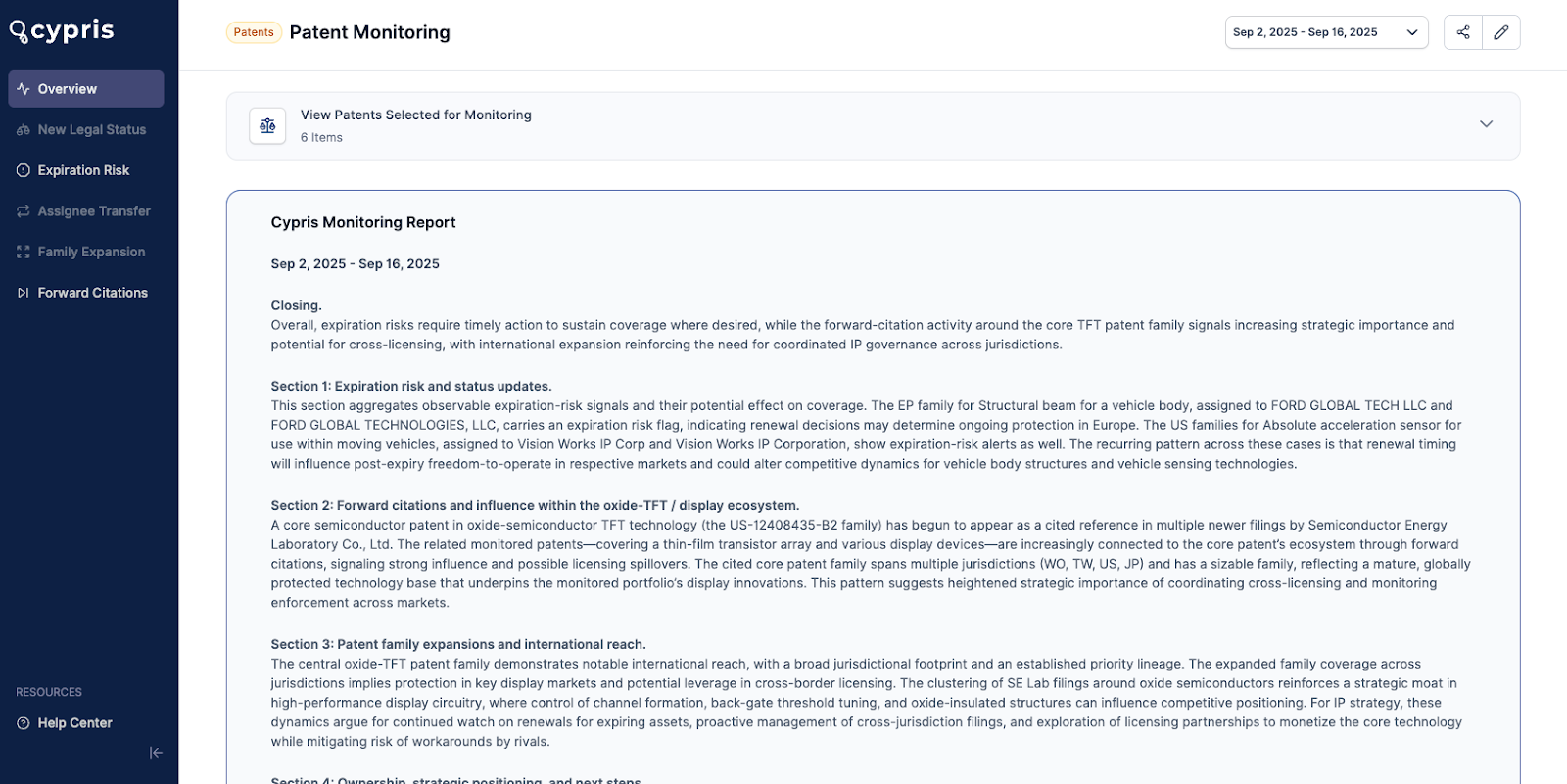
Newsletter-Style Email Experience
Monitoring emails now feel more like a personalized newsletter. Each update arrives in a clean, structured layout with an easy-to-read AI-generated summary of recent activity, spotlighted trends, and direct links to dive deeper in the platform. Content is grouped into clear sections and filterable by category, so you can quickly scan what’s new, focus on the most relevant updates, and stay effortlessly informed—without inbox clutter.

Simplified Setup & Discoverability
Setting up monitors is now faster and more intuitive. Users can create them in a single streamlined interface—quickly searching patent numbers, keywords, organizations, or papers and selecting the right mix in one place. Smart suggestions recommend recipients, while the Monitoring button appears directly on every search results page. Current monitors are clearly indicated to prevent duplication, and external recipients can be added to email updates for seamless collaboration.
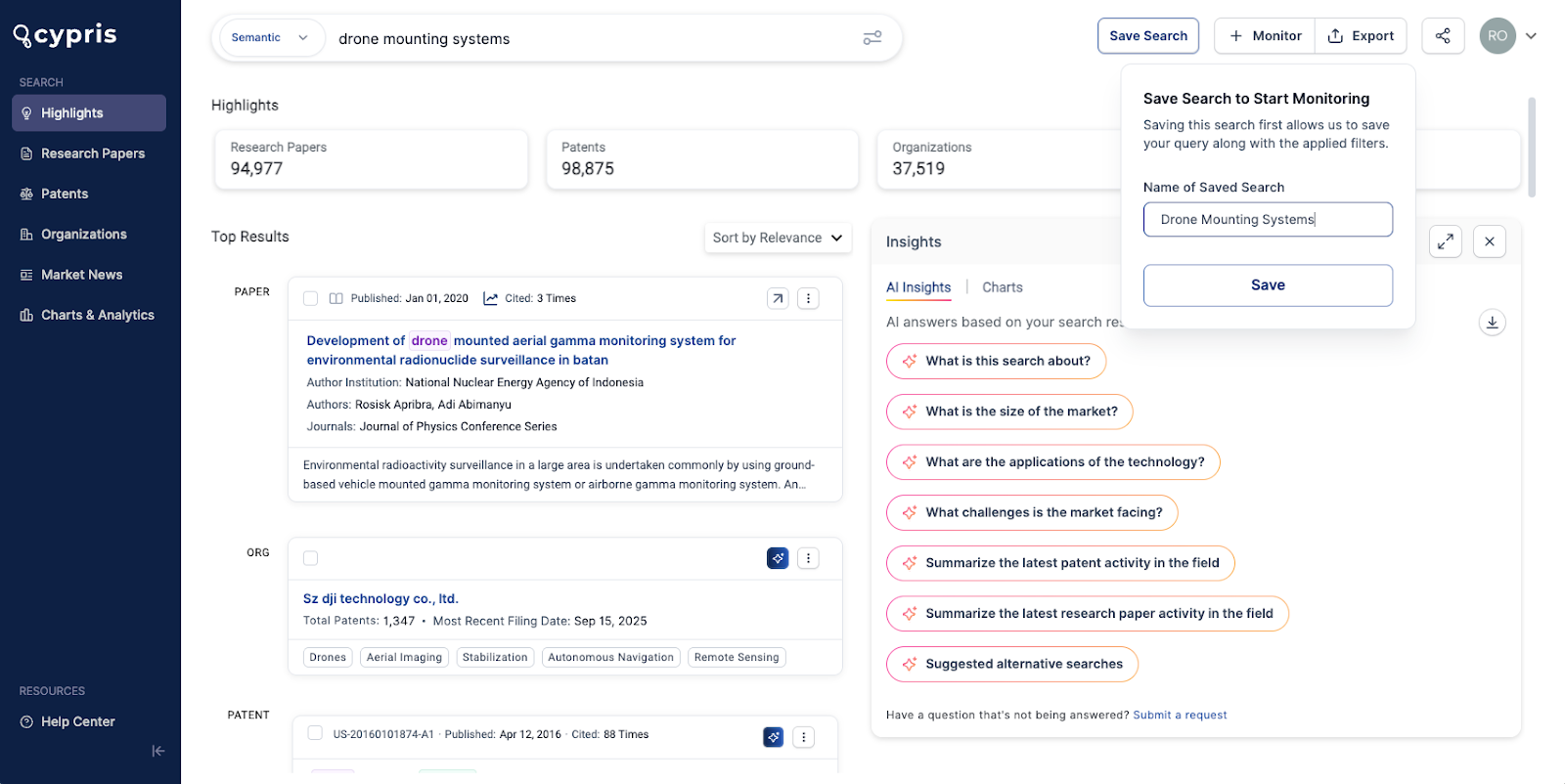
Noise-Free Updates & Critical Alerts
A “send only if new results exist” toggle eliminates duplicate notifications. Monitoring now captures not only newly published patents, papers, and organizations, but also critical patent events such as expiration risks, assignee transfers, patent family expansions, and forward citations—including competitor citations of your own research.

A More Powerful User Experience
Monitoring is built to help users move from raw data to actionable intelligence. Reports save automatically, creating a historical log teams can reference at any time. Items can be flagged directly into collections without manual re-entry. Emails preview AI-enhanced trends with a single click into interactive dashboards, and users can easily add colleagues or external recipients to stay aligned.
From a design perspective, the rebuild also gave our team room to innovate.
As one of our engineering team members, Maddie explained: “It was fun to build something new from scratch. From a UI perspective, we were able to make better design choices right from the start, which made for a much smoother, more intuitive user experience.”
Built for Speed, Accuracy, and Collaboration
With the new Monitoring, teams can save time compared to manual tracking, strengthen competitive intelligence with reliable, cross-dataset updates, collaborate seamlessly by sharing reports with colleagues or external partners, and trust the signal thanks to accuracy, relevancy filters, and AI-powered summaries.
As part of our engineering team, Oleg explained: “This project sat on top of our existing platform, which meant understanding the entire workflow end to end. It was challenging, but it also gave us the opportunity to rethink how everything fits together—and that’s what made it so rewarding.”
Available Now to All Users
The redesigned Monitoring is live and available across the Cypris platform today. If you’re already using Cypris, you’ll see new Monitoring options throughout your search and reporting workflows.
We’re excited to see how your team uses Monitoring to stay ahead of markets, competitors, and technologies — and to keep pushing the boundaries of what intelligent monitoring can do for R&D.

Introducing the New AI-Powered Cypris Monitoring


A smarter, more engaging monitoring experience—built for speed, accuracy, and collaboration.
Over the past few years, Cypris has helped innovation teams make faster, more informed decisions by centralizing critical insights across patents, academic papers, organizations, and market activity. But until now, tracking changes over time often meant juggling spreadsheets, scattered alerts, and manual checks—workflows that were hard to manage and easy to miss.
Today, we’re excited to introduce an upgraded Monitoring experience on Cypris, a complete redesign of how teams track critical updates. With streamlined setup, redesigned emails, and advanced LLMs powering analysis, Monitoring makes it easy to stay ahead of market shifts and competitor moves—without the noise.
Why We Rebuilt Monitoring from the Ground Up
The original monitoring tools relied heavily on exports and static spreadsheets, requiring users to piece together updates manually. Alerts were basic, often duplicative, and limited in the types of data they could track. They also didn’t always give teams confidence that updates were reliable, accurate, or relevant to their needs.
We reimagined Monitoring to solve these gaps. Instead of scattered, one-off alerts, the new Monitoring delivers timely, structured reports—only when new results exist. Updates are now enriched with LLM-powered summaries that don’t just describe activity, but interpret it—prioritizing what matters most and filtering out the noise.
What’s New in Monitoring
The Monitoring Report
Spreadsheets are no longer needed. Updates now appear in a clear format that highlights key changes such as patent expansions, assignee transfers, or competitor filings. Each report includes AI-generated summaries powered by advanced LLMs to surface the most important trends and context. Reports are refreshed regularly, saved automatically, and build a continuous historical log for long-term tracking.
For many teams, these AI-enhanced reports are the most impactful shift. Instead of raw updates, Monitoring now provides analysis—turning activity like organizational filings or new research papers into intelligence that can guide investment and innovation decisions.
Beyond the reports themselves, having all updates housed directly within Cypris elevates the platform experience as a whole. The new interface is more intuitive, reducing friction for everyday use, and its design makes it easier for teams to collaborate in real time.
Monitoring is also fully integrated with Projects, so you can create and share monitors directly within your team’s workspace. This makes it simple to align ongoing research, track critical events together, and keep collaborators up to speed—all without switching tools. By connecting monitoring with projects, Cypris transforms isolated updates into shared intelligence that enhances both decision-making and collaboration across your organization.
Newsletter-Style Email Experience
Monitoring emails now feel more like a personalized newsletter. Each update arrives in a clean, structured layout with an easy-to-read AI-generated summary of recent activity, spotlighted trends, and direct links to dive deeper in the platform. Content is grouped into clear sections and filterable by category, so you can quickly scan what’s new, focus on the most relevant updates, and stay effortlessly informed—without inbox clutter.
Simplified Setup & Discoverability
Setting up monitors is now faster and more intuitive. Users can create them in a single streamlined interface—quickly searching patent numbers, keywords, organizations, or papers and selecting the right mix in one place. Smart suggestions recommend recipients, while the Monitoring button appears directly on every search results page. Current monitors are clearly indicated to prevent duplication, and external recipients can be added to email updates for seamless collaboration.
Noise-Free Updates & Critical Alerts
A “send only if new results exist” toggle eliminates duplicate notifications. Monitoring now captures not only newly published patents, papers, and organizations, but also critical patent events such as expiration risks, assignee transfers, patent family expansions, and forward citations—including competitor citations of your own research.
A More Powerful User Experience
Monitoring is built to help users move from raw data to actionable intelligence. Reports save automatically, creating a historical log teams can reference at any time. Items can be flagged directly into collections without manual re-entry. Emails preview AI-enhanced trends with a single click into interactive dashboards, and users can easily add colleagues or external recipients to stay aligned.
From a design perspective, the rebuild also gave our team room to innovate.
As one of our engineering team members, Maddie explained: “It was fun to build something new from scratch. From a UI perspective, we were able to make better design choices right from the start, which made for a much smoother, more intuitive user experience.”
Built for Speed, Accuracy, and Collaboration
With the new Monitoring, teams can save time compared to manual tracking, strengthen competitive intelligence with reliable, cross-dataset updates, collaborate seamlessly by sharing reports with colleagues or external partners, and trust the signal thanks to accuracy, relevancy filters, and AI-powered summaries.
As part of our engineering team, Oleg explained: “This project sat on top of our existing platform, which meant understanding the entire workflow end to end. It was challenging, but it also gave us the opportunity to rethink how everything fits together—and that’s what made it so rewarding.”
Available Now to All Users
The redesigned Monitoring is live and available across the Cypris platform today. If you’re already using Cypris, you’ll see new Monitoring options throughout your search and reporting workflows.
We’re excited to see how your team uses Monitoring to stay ahead of markets, competitors, and technologies — and to keep pushing the boundaries of what intelligent monitoring can do for R&D.
Keep Reading
Small modular reactors and advanced nuclear designs have moved from concept toward licensing and deployment, and their patent landscape is distinctive because it spans several competing reactor families and a fuel supply chain that must be built alongside them. Where conventional nuclear plants are large, bespoke, and light-water-cooled, SMRs and advanced reactors are smaller, factory-built, and often use novel coolants, moderators, and fuels to achieve passive safety and flexible operation. The field divides into distinct regions of patenting: the reactor concepts themselves, including high-temperature gas-cooled reactors, molten-salt reactors, sodium-cooled fast reactors, integral light-water SMRs, and microreactors; the core, coolant, and moderator designs within each, from tristructural isotropic coated-particle fuel in gas-cooled reactors to fluoride fuel salts in molten-salt reactors;¹,²,³ the advanced fuels, especially TRISO particles and the high-assay low-enriched uranium, or HALEU, they require; the passive safety systems and control approaches that shut a reactor down without active intervention;⁵,⁶ and the modular manufacturing and construction methods that make factory production possible.⁴ Alongside these sit non-electric applications, from industrial heat and hydrogen to powering data centers. Because a viable design depends on several of these layers, and on a fuel supply that does not yet exist at scale, freedom-to-operate and white space analysis must span reactor, fuel, and manufacturing together.
The landscape is being reshaped by licensing progress and by a surge in demand. Regulators have modernized the framework for licensing advanced reactors, adopting a risk-informed, performance-based, and technology-inclusive rule intended to accommodate the range of SMR and advanced designs,⁷ while government programs are standing up a domestic supply of HALEU, the enriched fuel that many advanced reactors need and that has not been commercially produced at scale. Demand has accelerated sharply as technology companies contract for nuclear power to run data centers, drawing large investment. The competitive picture spans reactor developers pursuing different coolant and fuel choices, specialized fuel fabricators building TRISO and HALEU capacity, and established nuclear suppliers. This shows in the record: across the Cypris corpus of more than 500 million patents and scientific papers, the nuclear-anchored SMR, microreactor, TRISO, molten-salt, and HALEU set holds on the order of 2,017 families and grew from about 87 in 2020 to roughly 250 in 2024, with the most active assignees mixing large academic and institutional filers, led by Chinese universities and institutes, with reactor developers and fuel fabricators such as TerraPower, Mitsubishi Heavy Industries, BWXT, and Westinghouse and the US Department of Energy, and China ahead of the United States and South Korea on geography; a broad, unfiltered "microreactor" query returns far more families but is contaminated by unrelated chemical-microreactor art, so the nuclear-anchored figure is the defensible one. Because applications publish about eighteen months after filing, the most recent reactor and fuel filings are under-represented (2025 and 2026 counts are partial), so the current frontier is more active than granted-patent counts suggest.
The strategic question is which reactor family and layer to back, and the white space sits where technology and supply chain intersect. Advanced fuel, TRISO fabrication and the HALEU supply chain, is a critical, comparatively concentrated layer where scaling and cost are the barriers, so fabrication methods and fuel designs carry high value.¹ Coolant and materials that survive high temperatures and long fuel cycles, across gas, salt, and metal-cooled designs, passive safety systems, modular manufacturing and construction that lower cost and schedule, and non-electric applications such as process heat, hydrogen, and dispatchable power for data centers are all distinct, contested layers.²,³ Reading the landscape by reactor family, layer, and owner, and tracking both the patents and the underlying nuclear-engineering research, is what separates a crowded region from an open one.
Where the advanced-nuclear white space is
Advanced fuel and HALEU supply. TRISO fabrication methods and the high-assay low-enriched uranium supply chain are a critical, concentrated layer where scaling and cost are the barriers.¹
Coolant, moderator, and materials. Coolants and materials that survive high temperatures and long fuel cycles, across gas, salt, and metal-cooled designs, are a distinct, high-value layer.²,³
Passive safety systems. Systems and control approaches that shut a reactor down without active intervention are a differentiating capability central to SMR value.⁵,⁶
Modular manufacturing and construction. Factory-built modules and construction methods that lower cost and schedule are where the economic case is decided.⁴
Non-electric applications. Industrial heat, hydrogen production, and dispatchable power for data centers open distinct application and integration IP.
How AI-powered landscape and white space analysis helps
Resolving a landscape that spans several reactor families, a fuel supply chain, and manufacturing requires more than keyword search. AI-powered analysis addresses this with semantic search that clusters activity by reactor family, layer, and application across varied terminology, attribution that normalizes developer, fuel-fabricator, and supplier filers to canonical entities, and continuous monitoring that keeps pace with a fast-moving field. Because nuclear advances appear in scientific and engineering literature before they are patented, reading both patents and literature gives the earliest signal of where the frontier is moving.
Where Cypris fits
Cypris runs patent landscape and white space analysis for engineering-intensive fields such as small modular reactors and advanced nuclear across a corpus of more than 500 million patents and scientific papers, organized through a proprietary R&D ontology. The ontology clusters activity by reactor family, gas-cooled, molten-salt, sodium-cooled, light-water, and microreactor, and by layer, reactor design, advanced fuel, passive safety, and manufacturing, and normalizes developer, fuel-fabricator, and supplier filers to canonical entities, so a team can resolve which families and layers are crowded and which remain open as white space, and can separate genuine advanced-nuclear filings from unrelated art that shares terminology. Semantic search across patents and scientific literature connects filings to the underlying nuclear-engineering research, which is where advances appear first. Cypris Q, the platform's agentic layer, lets teams run landscape and white space analysis conversationally and chain the clustering, attribution, and gap analysis, and Agentic Monitoring tracks a defined family over time and flags new patents and papers as they publish. Cypris provides enterprise API partnerships with OpenAI, Anthropic, and Google, and is built with enterprise-grade security. Cypris serves hundreds of enterprise customers across pharmaceuticals, chemicals, advanced materials, energy, and other regulated industries.
FAQ
What is the small modular reactor patent landscape? The small modular reactor patent landscape is the set of patents covering factory-built, smaller nuclear reactors and advanced designs. It spans reactor families, high-temperature gas-cooled, molten-salt, sodium-cooled fast, light-water, and microreactors, plus advanced fuels, passive safety, and modular manufacturing. Each is a distinct region of patenting.
What are the main advanced reactor families? The main families are high-temperature gas-cooled reactors, molten-salt reactors, sodium-cooled fast reactors, integral light-water SMRs, and microreactors. They differ in coolant, moderator, fuel, and operating temperature. The choice of family shapes both the technical and the freedom-to-operate picture.
Why are TRISO and HALEU fuels important? TRISO and HALEU fuels are important because many advanced reactors depend on TRISO coated particles, which resist very high temperatures, and on high-assay low-enriched uranium, which is not yet commercially produced at scale. Building this fuel supply chain is a critical enabler. Fabrication methods and fuel designs are therefore a concentrated, high-value layer.
Why is data-center demand accelerating advanced nuclear? Data-center demand is accelerating advanced nuclear because technology companies need large amounts of reliable, carbon-free power, and have begun contracting for SMR and advanced-reactor output. This has drawn substantial investment and sharpened competition. It has also expanded interest in non-electric and dispatchable applications.
How does advanced-reactor licensing work? Advanced-reactor licensing in the United States distinguishes several steps, including design approval or certification, a construction permit, and an operating license, and regulators have adopted a modernized, risk-informed, technology-inclusive framework to accommodate advanced designs. A construction permit is not an operating license. Claims about a given project's status should be tied to the specific regulatory record.
Where is the white space in advanced nuclear? The white space includes advanced fuel and HALEU supply, coolant, moderator, and materials, passive safety systems, modular manufacturing and construction, and non-electric applications. The reactor-design and fuel layers are the most active. The most open, high-value opportunities are in fuel, materials, and manufacturing.
What software helps analyze the small modular reactor patent landscape? Software for the advanced-nuclear landscape should cluster activity by reactor family, layer, and application, resolve developer, fuel-fabricator, and supplier filers to canonical owners, separate genuine advanced-nuclear filings from unrelated art, search patents and scientific literature semantically, and monitor a fast-moving field continuously. Cypris does this across more than 500 million patents and scientific papers using a proprietary R&D ontology, semantic search, Cypris Q, and Agentic Monitoring.
Which teams use advanced-nuclear patent landscape analysis? Advanced-nuclear patent landscape analysis is used by R&D, IP, and strategy teams at reactor developers, fuel fabricators, nuclear suppliers, utilities, and technology buyers, as well as investors assessing the sector. Because the field spans reactor, fuel, and manufacturing layers, structured analysis is essential. Cypris serves hundreds of enterprise customers across energy and other research-intensive industries.
Endnotes
- International Atomic Energy Agency (2025). Coated particle fuels for high-temperature gas-cooled small modular reactors. https://doi.org/10.61092/iaea.zyya-k9sd
- Powers, J. J., & Gehin, J. C. (2016). Liquid-fuel molten salt reactors for thorium utilization. Nuclear Technology, 194(2). https://doi.org/10.13182/nt15-124
- Grimes, W. R. (1970). Molten-salt reactor chemistry. Nuclear Applications and Technology, 8(2). https://doi.org/10.13182/nt70-a28621
- Hannah, B. (2026). Technical assessment of molten salt reactor small modular reactors: design and licensing considerations. https://doi.org/10.5281/zenodo.20087242
- Zarei, M. (2020). State feedback control of power in a small modular reactor. Annals of Nuclear Energy, 144. https://doi.org/10.1016/j.anucene.2020.107743
- Diniz, R., et al. (2023). Reactivity calculation in molten salt reactors with an inverse kinetics model. Annals of Nuclear Energy, 190. https://doi.org/10.1016/j.anucene.2023.110130
- U.S. Nuclear Regulatory Commission (2026). 10 CFR Part 53 — risk-informed, technology-inclusive regulatory framework for advanced nuclear reactors (final rule). https://www.ecfr.gov/current/title-10/chapter-I/part-53

Perovskite-silicon tandem solar cells are the leading path to higher photovoltaic efficiency, and their patent landscape has become unusually central to competition because the field is commercializing through licensing as much as through manufacturing. A tandem cell places a wide-bandgap perovskite layer on top of a conventional silicon cell, so the two absorb different parts of the solar spectrum and the stack converts more sunlight than either alone, surpassing the single-junction limit that constrains standard silicon.¹,² The theoretical ceiling for a silicon-based tandem is about 43.2 percent, far above the roughly 33 percent limit of a single-junction silicon cell, which is what makes the architecture so attractive.³ The intellectual property divides across several regions, each with different owners and maturity: the perovskite compositions and their stability chemistry; the passivation and interface layers that raise efficiency and lifetime; the tandem device architecture, including the recombination layers that join the sub-cells; the texturing and deposition processes used to build the stack; and the encapsulation and manufacturing that make a durable module. Because a working tandem depends on all of these, freedom-to-operate and white space analysis must span the full stack.
The landscape is being shaped by patents and cross-licensing in real time. Certified efficiencies have climbed steeply: the current certified perovskite/silicon tandem record stands at 34.85 percent, achieved by LONGi and certified by the US National Renewable Energy Laboratory in 2025, and peer-reviewed work now describes certified perovskite/silicon efficiencies approaching 35 percent, with the live record register maintained on the NREL Best Research-Cell Efficiency Chart.⁴,⁵,⁶ These are laboratory cell records rather than commercial-module ratings, and translating them to industry-compatible cells and full modules is a distinct challenge the field is actively working through.¹⁰ Multi-junction routes are advancing in parallel, with triple-junction perovskite/perovskite/silicon devices exceeding 30 percent.⁷ Holders of strong foundational portfolios have begun licensing their technology to large manufacturers, signaling that IP position, not only manufacturing capacity, will determine who benefits from the transition. That structure is visible in the patent record: across the Cypris corpus of more than 500 million patents and scientific papers, the perovskite-tandem space is a comparatively small, fast-moving set of a few thousand de-duplicated families that stepped up sharply in 2025, and its most active assignees mix national laboratories such as CEA and CNRS, the perovskite specialist Oxford PV, and large silicon-module manufacturers, with China, the United States, South Korea, and France the leading jurisdictions; because assignee names are not fully canonicalized, manufacturer totals are best read as indicative. Because applications publish about eighteen months after filing, the most recent composition and process filings are under-represented, so the current frontier is more active than granted-patent counts suggest.
The strategic question is which layer to own, and the white space sits where durability is hardest to achieve. Perovskite stability under heat, humidity, and light remains the central unsolved problem, and the degradation mechanisms and stabilization techniques that address it are an area of intense, well-mapped research,⁸ as are the barrier and encapsulation designs that protect the cell over its service life.⁹ Compositions, passivation chemistries, and encapsulation that extend lifetime therefore carry high, defensible value, while tandem architecture and light-management texturing are contested and improving quickly, and scalable deposition and manufacturing are where laboratory records must survive the move to gigawatt production. Reading the landscape by composition, layer, and process, and tracking both the patents and the underlying materials research, is what separates a crowded region from an open one.
Where the perovskite tandem white space is
Stability and encapsulation. Compositions, passivation, and encapsulation that keep efficiency under heat, humidity, and light are the central unsolved problem and the highest-value, still-open target.⁸,⁹
Wide-bandgap perovskite compositions. Formulations tuned for the top cell that resist phase segregation are a contested, fast-moving composition layer.
Tandem architecture. Recombination layers, interconnection, and two-terminal versus four-terminal designs are a distinct device-engineering layer.⁷
Texturing and light management. Surface texturing and optical designs that maximize capture across the stack are an active process-IP area.
Scalable deposition and manufacturing. Moving high-efficiency processes from small cells to gigawatt-scale modules is where cost is decided and where durable process IP concentrates.¹⁰
How AI-powered landscape and white space analysis helps
Resolving a device landscape that spans compositions, interface and architecture layers, and manufacturing processes, across institutions and regions moving at different speeds, requires more than keyword search. AI-powered analysis addresses this with semantic search that clusters activity by layer and process across varied terminology, attribution that normalizes academic and commercial filers to canonical entities and tracks the licensing structure, and continuous monitoring that keeps pace with a fast-commercializing field. Because perovskite advances appear in scientific literature before they are patented, reading both patents and literature gives the earliest signal of where the frontier is moving.
Where Cypris fits
Cypris runs patent landscape and white space analysis for fast-commercializing energy fields such as perovskite tandem solar across a corpus of more than 500 million patents and scientific papers, organized through a proprietary R&D ontology. The ontology clusters activity by layer, perovskite composition, passivation and interfaces, tandem architecture, texturing and deposition, and encapsulation and manufacturing, and normalizes filers to canonical entities, so a team can resolve which layers are crowded and which remain open as white space, and can see the licensing structure clearly rather than as a flat list. Semantic search across patents and scientific literature connects filings to the underlying materials and device research, which is where perovskite advances appear first. Cypris Q, the platform's agentic layer, lets teams run landscape and white space analysis conversationally and chain the clustering, attribution, and gap analysis, and Agentic Monitoring tracks a defined layer over time and flags new patents and papers as they publish. Cypris provides enterprise API partnerships with OpenAI, Anthropic, and Google, and is built with enterprise-grade security. Cypris serves hundreds of enterprise customers across pharmaceuticals, chemicals, advanced materials, energy, and other regulated industries.
FAQ
What is the perovskite tandem solar patent landscape? The perovskite tandem solar patent landscape is the set of patents covering perovskite-silicon and all-perovskite tandem cells that exceed the single-junction efficiency limit. It divides across perovskite compositions and stability, passivation and interfaces, tandem architecture, texturing and deposition, and encapsulation and manufacturing. Each is a distinct region with different owners and maturity.
Why is IP so central to perovskite tandem solar? IP is central because the field is commercializing through licensing as much as through manufacturing, with holders of strong foundational portfolios licensing their technology to large manufacturers. Foundational process and architecture patents are concentrated among a few institutions and companies. That makes licensing and freedom-to-operate, not only production capacity, decisive.
What layers does the perovskite tandem landscape cover? The landscape covers perovskite composition and stability chemistry, passivation and interface layers, tandem device architecture including recombination layers, texturing and deposition processes, and encapsulation and manufacturing. A working tandem depends on all of them. Freedom-to-operate and white space analysis must span the full stack.
Where is the white space in perovskite tandem solar? The white space sits where durability is hardest: stability and encapsulation, wide-bandgap compositions that resist phase segregation, tandem architecture, light-management texturing, and scalable deposition. Stability under heat, humidity, and light is the central unsolved problem. The highest-value, most defensible positions are in lifetime and manufacturability.
Why is stability the key problem in the patent record? Stability is the key problem because perovskites can degrade under heat, humidity, and light, so the compositions, passivation, and encapsulation that extend lifetime are where the most valuable and defensible IP concentrates. Efficiency records matter, but durable modules require solving stability. The patent record reflects intense activity in these layers.
Why does perovskite analysis need scientific literature? Perovskite analysis needs scientific literature because new compositions, passivation chemistries, and device architectures appear in materials research before they are patented, so the literature gives the earliest signal. Analyzing patents alone gives a lagging view. Cypris analyzes both across more than 500 million patents and scientific papers.
What software helps analyze the perovskite tandem solar patent landscape? Software for the perovskite tandem landscape should cluster activity by device layer and process, resolve academic and commercial filers and the licensing structure to canonical owners, search patents and scientific literature semantically, and monitor a fast-commercializing field continuously. Cypris does this across more than 500 million patents and scientific papers using a proprietary R&D ontology, semantic search, Cypris Q, and Agentic Monitoring.
Which teams use perovskite tandem patent landscape analysis? Perovskite tandem patent landscape analysis is used by R&D, innovation, IP, and strategy teams at solar manufacturers, materials developers, and equipment makers, as well as investors and research institutions. It informs which layer to back, where to file, where to license, and where competitors are concentrated. Cypris serves hundreds of enterprise customers across energy, advanced materials, chemicals, and other regulated industries.
Endnotes
- Zhang, F., Shi, Y., & Berry, J. J. (2024). Perovskite/silicon tandem solar cells: insights and outlooks. ACS Energy Letters, 9(4). https://doi.org/10.1021/acsenergylett.4c00172
- Zheng, X., Tan, H., et al. (2023). Efficient perovskite/silicon tandem solar cells on industrially compatible textured silicon. Advanced Materials, 35(10). https://doi.org/10.1002/adma.202207883
- Schubert, M. C., Glunz, S. W., et al. (2025). Elucidating the efficiency limit of silicon-based monolithic tandem cells through the combination of Auger and Shockley-Queisser limits. EES Solar. https://doi.org/10.1039/d5el00085h
- Chen, W., Mularso, K. T., Jung, H. S., & Jo, B., et al. (2026). Strategies toward maximizing power conversion efficiency in all-perovskite tandem solar cells. Solar RRL. https://doi.org/10.1002/solr.202500911
- LONGi (2025, April 16). LONGi breaks world record for crystalline silicon-perovskite tandem solar cell efficiency (34.85%). https://www.longi.com/en/news/silicon-perovskite-tandem-solar-cells-new-world-efficiency
- National Renewable Energy Laboratory. Best research-cell efficiency chart. https://www.nrel.gov/pv/cell-efficiency
- Aydin, E., Xu, L., De Wolf, S., et al. (2024). Four-terminal perovskite/perovskite/silicon triple-junction tandem solar cells with over 30% power conversion efficiency. ACS Energy Letters, 9(8). https://doi.org/10.1021/acsenergylett.4c01292
- Ahn, N., & Choi, M. (2023). Towards long-term stable perovskite solar cells: degradation mechanisms and stabilization techniques. Advanced Science, 10(35). https://doi.org/10.1002/advs.202306110
- Yang, Z., Liu, Z., Chen, W., et al. (2020). Barrier designs in perovskite solar cells for long-term stability. Advanced Energy Materials, 10(26). https://doi.org/10.1002/aenm.202001610
- Jost, M., et al. (2021). 27.9% efficient monolithic perovskite/silicon tandem solar cells on industry-compatible bottom cells. Solar RRL, 5(6). https://doi.org/10.1002/solr.202100244
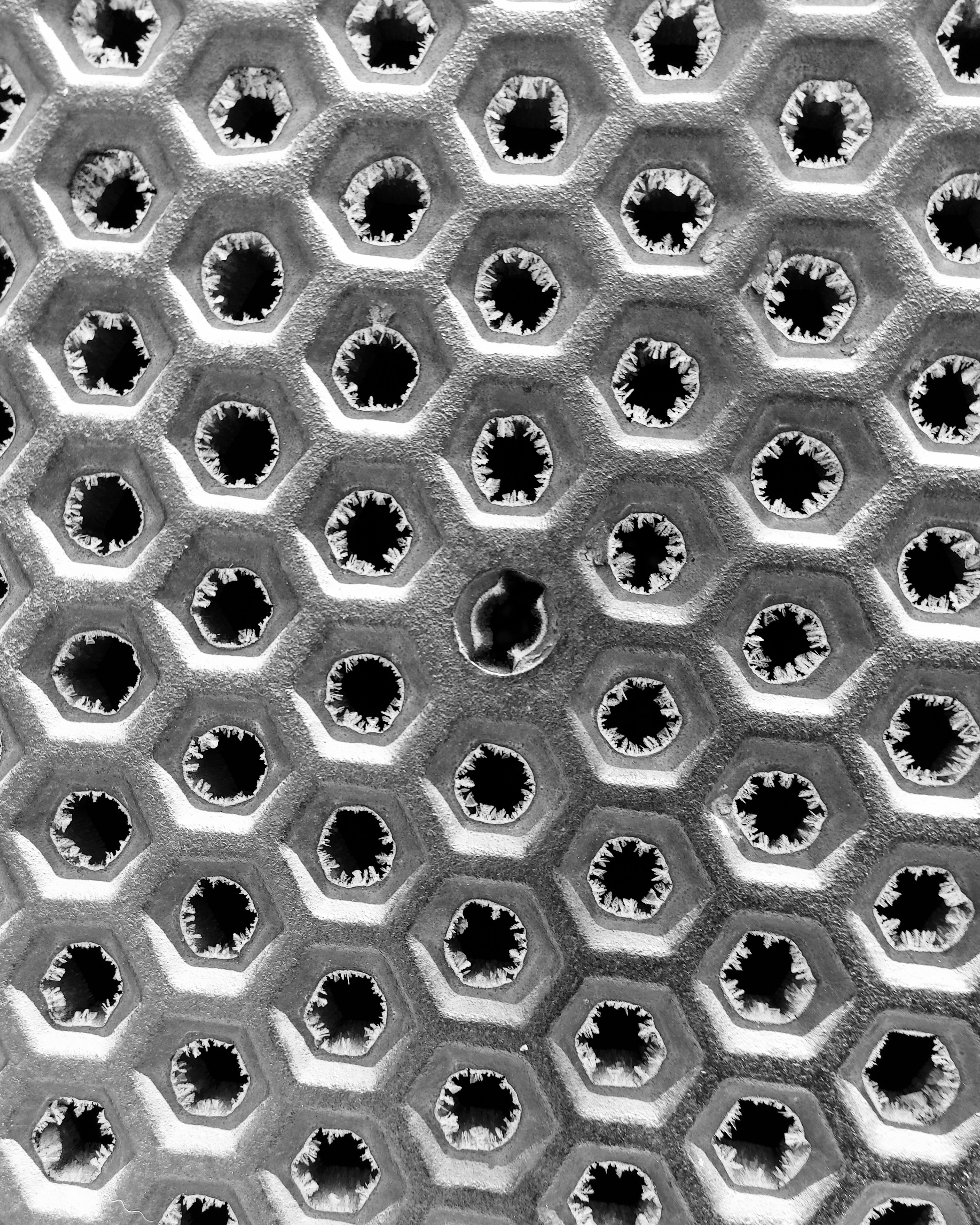
Metal-organic frameworks have moved from a laboratory curiosity to a commercial materials platform, and their patent landscape is being staked out just as the field reaches scale. A MOF is a porous crystalline material built by linking metal nodes with organic linkers into an ordered framework, producing extraordinarily high surface areas and pores that can be tuned for a target molecule; more than 20,000 distinct MOFs had already been reported by the early 2010s, and the reticular chemistry behind them has continued to mature.¹,² Recognition by the 2025 Nobel Prize in Chemistry, awarded to Susumu Kitagawa, Richard Robson, and Omar Yaghi for the development of metal-organic frameworks, underscored the field's arrival and named applications from carbon-dioxide capture and toxic-gas storage to water harvesting, catalysis, and the separation of per- and polyfluoroalkyl substances from water.³ The intellectual property now divides across three broad regions: the specific framework compositions and structures themselves; the synthesis, shaping, and manufacturing processes that turn a powder into a usable, scalable product; and the application-level systems that integrate a MOF into a working device. Because MOFs serve many functions, freedom-to-operate and white space analysis must span all of them.
The commercial tipping point is reshaping the patent picture. After years in which scale-up and cost were the barriers, industrial-scale production of MOFs for carbon capture has begun, and a wave of startups is pursuing modular capture systems that are easier to scale than incumbent solvent processes, alongside chemical majors moving into manufacturing. Direct air capture of carbon dioxide has been demonstrated in purpose-designed frameworks from the laboratory through pilot scale, distinct from higher-concentration point-source capture.⁶ The scale of activity is large: across the Cypris corpus of more than 500 million patents and scientific papers, the MOF and reticular-chemistry space holds well over 100,000 de-duplicated families and has sustained high-volume filing since around 2018, with the assignee base led by academic institutions and chemical majors such as Sinopec, BASF, and ExxonMobil also prominent, while China accounts for the large majority of families, ahead of the United States, Japan, Germany, and South Korea. This shift moves value from the bare framework composition, where foundational academic estates are concentrated, toward the synthesis, shaping, and system-integration layers. Because applications publish about eighteen months after filing, the most recent synthesis and application filings are under-represented, so the current frontier is more active than granted-patent counts suggest.
The landscape divides by application, and the white space sits where a MOF must survive real conditions at low cost. Water stability, cycling durability, and inexpensive, scalable synthesis are the recurring bottlenecks; the criteria for a high-performance water-adsorbing framework, pore size and shape, hydrophilicity, and stability, are well defined but hard to meet at once.⁴ Carbon capture, both point-source and direct air capture, is the most active application and the one drawing the most new entrants; gas separation, increasingly through mixed-matrix membranes,⁷ and gas adsorption and storage⁸ are established; atmospheric water harvesting has advanced from concept toward passive devices,⁵ and newer uses such as direct lithium extraction and contaminant removal are earlier and less crowded. Underlying all of them is the reticular-design principle that lets chemists build frameworks to order for a target function.⁹ Reading the landscape by composition, synthesis route, and application is what separates a crowded region from an open one.
Where the MOF white space is
Water-stable, low-cost frameworks. MOFs that keep performance under humidity and real operating conditions, made by inexpensive routes, are the central bottleneck and a high-value, still-open target.⁴
Scalable synthesis and shaping. Converting powders into pellets, monoliths, and coatings by manufacturable processes is where deployment is decided and where hard-to-design-around process IP concentrates.
Direct air capture sorbents. MOFs tuned for capturing dilute atmospheric carbon dioxide are an active, high-value frontier distinct from point-source capture.⁶
Non-carbon separations. Direct lithium extraction, contaminant and per- and polyfluoroalkyl-substance removal, and other selective separations are earlier and less crowded application layers.
System integration. Contactors, modules, and regeneration systems that turn a MOF into a working unit are a distinct engineering layer separate from the framework chemistry.
How AI-powered landscape and white space analysis helps
Resolving a materials platform that spans many framework chemistries, synthesis routes, and application areas requires more than keyword search. AI-powered analysis addresses this with semantic search that clusters activity by composition, synthesis route, and application across varied terminology, attribution that normalizes academic and commercial filers to canonical entities and tracks new entrants, and continuous monitoring that keeps pace with a field reaching commercial scale. Because MOF advances appear in scientific literature before they are patented, reading both patents and literature gives the earliest signal of where deployable materials are emerging.
Where Cypris fits
Cypris runs patent landscape and white space analysis for materials platforms such as metal-organic frameworks across a corpus of more than 500 million patents and scientific papers, organized through a proprietary R&D ontology. The ontology clusters activity by framework composition, by synthesis and shaping route, and by application, carbon capture, gas separation and storage, water harvesting, catalysis, and mineral recovery, and normalizes filers to canonical entities, so a team can resolve which compositions, routes, and applications are crowded and which remain open as white space, and can track new entrants as the field scales. Semantic search across patents and scientific literature connects filings to the underlying materials chemistry research, which is where MOF advances appear first. Cypris Q, the platform's agentic layer, lets teams run landscape and white space analysis conversationally and chain the clustering, attribution, and gap analysis, and Agentic Monitoring tracks a defined application over time and flags new patents and papers as they publish. Cypris provides enterprise API partnerships with OpenAI, Anthropic, and Google, and is built with enterprise-grade security. Cypris serves hundreds of enterprise customers across pharmaceuticals, chemicals, advanced materials, energy, and other regulated industries.
FAQ
What is the metal-organic framework patent landscape? The metal-organic framework patent landscape is the set of patents covering MOFs, porous crystalline materials built from metal nodes and organic linkers, and their uses. It divides across framework compositions, synthesis and shaping processes, and application-level systems. Each application, from carbon capture to gas storage, is a distinct region of the landscape.
Why are MOFs a patenting hotspot now? MOFs are a patenting hotspot now because the field has reached a commercial tipping point, with industrial-scale production beginning for carbon capture and a wave of startups pursuing modular systems. Recognition by the 2025 Nobel Prize in Chemistry has further raised the field's profile. That shift is concentrating new filings in synthesis and application layers.
What application areas does the MOF landscape cover? The MOF landscape covers carbon capture from flue gas and directly from air, gas separation and storage, water harvesting, catalysis, sensing, drug delivery, and recovery of critical minerals such as lithium. Each demands different framework and system properties. Freedom-to-operate and white space analysis must span all of them.
Where is the white space in MOFs? The white space sits where a MOF must survive real conditions cheaply: water-stable, low-cost frameworks and scalable synthesis and shaping are the central bottlenecks, and direct air capture sorbents, non-carbon separations, and system integration are less crowded. The bare framework composition is where foundational estates concentrate. The higher-value opportunities are in deployability.
How is MOF value shifting from composition to manufacturing? MOF value is shifting because, as the field scales, the barrier moves from discovering a framework to making it durable and affordable at volume. Foundational composition estates are concentrated among a few academic groups, while synthesis, shaping, and system-integration IP is where deployment is now decided. That is where much of the defensible, hard-to-design-around value sits.
Why does MOF analysis need scientific literature? MOF analysis needs scientific literature because new frameworks, synthesis routes, and application concepts appear in materials research before they are patented, so the literature gives the earliest signal. Analyzing patents alone gives a lagging view. Cypris analyzes both across more than 500 million patents and scientific papers.
What software helps analyze the MOF patent landscape? Software for the MOF landscape should cluster activity by framework composition, synthesis route, and application, resolve academic and commercial filers to canonical owners, search patents and scientific literature semantically, and monitor a scaling field continuously. Cypris does this across more than 500 million patents and scientific papers using a proprietary R&D ontology, semantic search, Cypris Q, and Agentic Monitoring.
Which teams use MOF patent landscape analysis? MOF patent landscape analysis is used by R&D, innovation, IP, and strategy teams at chemicals, materials, carbon-capture, and energy companies, as well as investors and research institutions. It informs where to invest, where to file, and where competitors are concentrated. Cypris serves hundreds of enterprise customers across chemicals, advanced materials, energy, and other regulated industries.
Endnotes
- O'Keeffe, M., Cordova, K. E., Furukawa, H., & Yaghi, O. M. (2013). The chemistry and applications of metal-organic frameworks. Science, 341(6149). https://doi.org/10.1126/science.1230444
- Li, H., Rampal, N., & Yaghi, O. M. (2025). Reticular chemistry: past, present, and future. Molecular Frontiers Journal. https://doi.org/10.1142/s2529732525300034
- Royal Swedish Academy of Sciences (2025, October 8). The Nobel Prize in Chemistry 2025 [press release]. https://www.nobelprize.org/prizes/chemistry/2025/press-release/
- Furukawa, H., Queen, W. L., Yaghi, O. M., et al. (2014). Water adsorption in porous metal-organic frameworks and related materials. Journal of the American Chemical Society, 136(11). https://doi.org/10.1021/ja500330a
- Diercks, C. S., Kalmutzki, M. J., & Yaghi, O. M. (2018). Metal-organic frameworks for water harvesting from air. Advanced Materials, 30(37). https://doi.org/10.1002/adma.201704304
- Yao, M.-S., et al. (2023). Direct air capture of CO2 in designed metal-organic frameworks at lab and pilot scale. Carbon Capture Science & Technology, 8. https://doi.org/10.1016/j.ccst.2023.100145
- Chai, M., Hou, J., & Chen, R. (2023). Metal-organic framework-based mixed matrix membranes for gas separation: recent advances and opportunities. Carbon Capture Science & Technology, 8. https://doi.org/10.1016/j.ccst.2023.100130
- Sculley, J., Yu, J., Zhou, H.-C., et al. (2011). Carbon dioxide capture-related gas adsorption and separation in metal-organic frameworks. Coordination Chemistry Reviews, 255(15-16). https://doi.org/10.1016/j.ccr.2011.02.012
- Chen, Z., Kirlikovali, K. O., Li, P., & Farha, O. K. (2022). Reticular chemistry for highly porous metal-organic frameworks: the chemistry and applications. Accounts of Chemical Research, 55(4). https://doi.org/10.1021/acs.accounts.1c00707