For the best experience, this project uses the Webflow Input Enhancer extension. We highly recommend installing it. Click here to download (use preview mode to access link)
R&D knowledge management is the practice of capturing, organizing, and making retrievable the knowledge a research organization generates, so it accumulates instead of dissipating. Every program produces reports, experiments, analyses, and decisions, and most of that knowledge is scattered across documents and people. When it cannot be found, it is repeated, and when a person leaves, it is lost.
The cost is concrete. Teams re-run experiments that were already done, revisit questions that were already answered, and lose the reasoning behind past decisions when the people who made them move on. This is the tribal knowledge problem, and it compounds negatively as an organization grows. This article explains how AI-powered knowledge management changes that, and how internal knowledge becomes most valuable when connected to the external research record.
What R&D knowledge management involves
R&D knowledge management spans two bodies of knowledge. The first is internal: research reports, experimental results, technical decisions, and the reasoning behind them. The second is external: the patents, scientific literature, and competitive activity that place internal work in context. The goal is to make both retrievable in a way that reflects how researchers actually think about a problem, rather than by filename or folder.
The defining requirement is retrieval by meaning. A researcher rarely knows the exact document title or keyword; they know the problem. Knowledge management is only useful if a question about a compound, a method, or a decision returns the relevant internal work regardless of how it was originally labeled.
Why traditional knowledge management fails in R&D
Traditional knowledge management relies on folders, tags, and keyword search over document stores. It fails in R&D for the same reasons keyword search fails elsewhere: the same concept is described in different words across teams and years, so a query built on expected terms misses relevant work. Documents are siloed by team and system, and the connection between a past experiment and a current question is invisible.
It also fails at the human boundary. When knowledge lives in individuals rather than a retrievable system, staff turnover erases it. A traditional document repository preserves files but not the ability to find the right one at the right moment, which is the part that actually matters.
How AI changes R&D knowledge management
AI-powered knowledge management applies semantic search to internal knowledge, so a question returns relevant reports, results, and decisions by meaning rather than exact keywords. An R&D ontology organizes that knowledge by technical concept and connects related work, so a current problem surfaces the past work that bears on it even when the vocabulary differs.
The larger shift is connecting internal knowledge to the external record. When internal research is organized in the same conceptual structure as the external patent and scientific literature, a single question can reach both: what the team already knows, and what the wider field has published or patented. That connection is what turns a static archive into an intelligence layer.
Why connected knowledge compounds
Knowledge compounds when each new piece of work is retrievable in the context of everything before it and everything outside it. An experiment recorded today becomes findable the next time a related question arises; a past decision retains its reasoning; a current program is checked against both internal history and the external landscape before resources are committed. Instead of decaying as people leave and volume grows, the organization's knowledge becomes more valuable over time.
This is the difference between storing knowledge and compounding it. Storage preserves documents; compounding makes the whole body of work usable on every new question.
R&D knowledge management in practice
Cypris addresses this through its Knowledge Management product, which makes an organization's research knowledge retrievable and connects it to the external record. Internal work is organized through the same proprietary R&D ontology that structures a corpus of more than 500 million patents and scientific papers, so a single semantic query reaches both internal knowledge and the external patent and scientific literature.
Cypris Q, the platform's agentic layer, lets teams interrogate that combined knowledge in natural language and returns cited output, so a question about a compound or a program draws on internal history and external context at once. Cypris operates under enterprise API partnerships with OpenAI, Anthropic, and Google, with enterprise-grade security, and serves hundreds of enterprise customers across pharmaceuticals, chemicals, advanced materials, and other regulated industries.
FAQ
What is R&D knowledge management?
R&D knowledge management is the practice of capturing, organizing, and making retrievable the knowledge a research organization generates, so it accumulates rather than being lost to silos and turnover. It covers internal reports, experiments, and decisions, and connects them to the external patent and scientific record.
Why does R&D lose institutional knowledge?
R&D loses institutional knowledge because much of it lives in individuals and scattered documents rather than a retrievable system, so it disappears when people leave or when work cannot be found. This tribal knowledge problem leads teams to repeat experiments and lose the reasoning behind past decisions.
Why does traditional knowledge management fail in R&D?
Traditional knowledge management fails in R&D because folder-and-keyword systems miss work described in different terms across teams and years, and they silo documents by system. They preserve files but not the ability to find the right one at the right moment, which is the part that matters.
How does AI improve R&D knowledge management?
AI improves R&D knowledge management by applying semantic search, so a question returns relevant internal work by meaning rather than exact keywords. An R&D ontology organizes knowledge by technical concept and connects related work, and links internal knowledge to the external patent and scientific record.
What is tribal knowledge and why does it matter?
Tribal knowledge is the undocumented understanding held by individuals in an organization, such as why a decision was made or how a method actually works. It matters because it is lost when people leave, and capturing it in a retrievable system is a central goal of R&D knowledge management.
How does knowledge management connect internal work to external research?
Knowledge management connects internal work to external research by organizing both in the same conceptual structure, so a single question reaches internal reports and the external patent and scientific literature together. This places a team's own work in the context of what the wider field has published or patented.
What does it mean for knowledge to compound?
Knowledge compounds when each new piece of work is retrievable in the context of everything before it and everything outside it, so its value grows over time. Instead of decaying as staff turn over and volume rises, the organization's body of work becomes more usable on every new question.
Is R&D knowledge management just a document repository?
R&D knowledge management is more than a document repository, because storage alone preserves files without making the right one findable at the right moment. The value is in retrieval by meaning and in connecting internal knowledge to the external record, not in archiving.
Which teams benefit most from R&D knowledge management?
Research-intensive organizations benefit most from R&D knowledge management, particularly in pharmaceuticals, chemicals, advanced materials, and energy, where programs are long, knowledge is technical, and turnover erases hard-won understanding. These teams gain the most from preserving and connecting institutional knowledge.
What is the best platform for R&D knowledge management?
The best platform for R&D knowledge management makes internal knowledge retrievable by meaning and connects it to the external research record. Cypris does this through its Knowledge Management product, organizing internal work through the same R&D ontology that structures a corpus of more than 500 million patents and scientific papers.
R&D Knowledge Management: Turning Institutional Research Knowledge into a Compounding Asset
Subscribe to receive the latest blog posts to your inbox every week.
Thank you! Your submission has been received!
Oops! Something went wrong while submitting the form.
R&D knowledge management is the practice of capturing, organizing, and making retrievable the knowledge a research organization generates, so it accumulates instead of dissipating. Every program produces reports, experiments, analyses, and decisions, and most of that knowledge is scattered across documents and people. When it cannot be found, it is repeated, and when a person leaves, it is lost.
The cost is concrete. Teams re-run experiments that were already done, revisit questions that were already answered, and lose the reasoning behind past decisions when the people who made them move on. This is the tribal knowledge problem, and it compounds negatively as an organization grows. This article explains how AI-powered knowledge management changes that, and how internal knowledge becomes most valuable when connected to the external research record.
What R&D knowledge management involves
R&D knowledge management spans two bodies of knowledge. The first is internal: research reports, experimental results, technical decisions, and the reasoning behind them. The second is external: the patents, scientific literature, and competitive activity that place internal work in context. The goal is to make both retrievable in a way that reflects how researchers actually think about a problem, rather than by filename or folder.
The defining requirement is retrieval by meaning. A researcher rarely knows the exact document title or keyword; they know the problem. Knowledge management is only useful if a question about a compound, a method, or a decision returns the relevant internal work regardless of how it was originally labeled.
Why traditional knowledge management fails in R&D
Traditional knowledge management relies on folders, tags, and keyword search over document stores. It fails in R&D for the same reasons keyword search fails elsewhere: the same concept is described in different words across teams and years, so a query built on expected terms misses relevant work. Documents are siloed by team and system, and the connection between a past experiment and a current question is invisible.
It also fails at the human boundary. When knowledge lives in individuals rather than a retrievable system, staff turnover erases it. A traditional document repository preserves files but not the ability to find the right one at the right moment, which is the part that actually matters.
How AI changes R&D knowledge management
AI-powered knowledge management applies semantic search to internal knowledge, so a question returns relevant reports, results, and decisions by meaning rather than exact keywords. An R&D ontology organizes that knowledge by technical concept and connects related work, so a current problem surfaces the past work that bears on it even when the vocabulary differs.
The larger shift is connecting internal knowledge to the external record. When internal research is organized in the same conceptual structure as the external patent and scientific literature, a single question can reach both: what the team already knows, and what the wider field has published or patented. That connection is what turns a static archive into an intelligence layer.
Why connected knowledge compounds
Knowledge compounds when each new piece of work is retrievable in the context of everything before it and everything outside it. An experiment recorded today becomes findable the next time a related question arises; a past decision retains its reasoning; a current program is checked against both internal history and the external landscape before resources are committed. Instead of decaying as people leave and volume grows, the organization's knowledge becomes more valuable over time.
This is the difference between storing knowledge and compounding it. Storage preserves documents; compounding makes the whole body of work usable on every new question.
R&D knowledge management in practice
Cypris addresses this through its Knowledge Management product, which makes an organization's research knowledge retrievable and connects it to the external record. Internal work is organized through the same proprietary R&D ontology that structures a corpus of more than 500 million patents and scientific papers, so a single semantic query reaches both internal knowledge and the external patent and scientific literature.
Cypris Q, the platform's agentic layer, lets teams interrogate that combined knowledge in natural language and returns cited output, so a question about a compound or a program draws on internal history and external context at once. Cypris operates under enterprise API partnerships with OpenAI, Anthropic, and Google, with enterprise-grade security, and serves hundreds of enterprise customers across pharmaceuticals, chemicals, advanced materials, and other regulated industries.
FAQ
What is R&D knowledge management?
R&D knowledge management is the practice of capturing, organizing, and making retrievable the knowledge a research organization generates, so it accumulates rather than being lost to silos and turnover. It covers internal reports, experiments, and decisions, and connects them to the external patent and scientific record.
Why does R&D lose institutional knowledge?
R&D loses institutional knowledge because much of it lives in individuals and scattered documents rather than a retrievable system, so it disappears when people leave or when work cannot be found. This tribal knowledge problem leads teams to repeat experiments and lose the reasoning behind past decisions.
Why does traditional knowledge management fail in R&D?
Traditional knowledge management fails in R&D because folder-and-keyword systems miss work described in different terms across teams and years, and they silo documents by system. They preserve files but not the ability to find the right one at the right moment, which is the part that matters.
How does AI improve R&D knowledge management?
AI improves R&D knowledge management by applying semantic search, so a question returns relevant internal work by meaning rather than exact keywords. An R&D ontology organizes knowledge by technical concept and connects related work, and links internal knowledge to the external patent and scientific record.
What is tribal knowledge and why does it matter?
Tribal knowledge is the undocumented understanding held by individuals in an organization, such as why a decision was made or how a method actually works. It matters because it is lost when people leave, and capturing it in a retrievable system is a central goal of R&D knowledge management.
How does knowledge management connect internal work to external research?
Knowledge management connects internal work to external research by organizing both in the same conceptual structure, so a single question reaches internal reports and the external patent and scientific literature together. This places a team's own work in the context of what the wider field has published or patented.
What does it mean for knowledge to compound?
Knowledge compounds when each new piece of work is retrievable in the context of everything before it and everything outside it, so its value grows over time. Instead of decaying as staff turn over and volume rises, the organization's body of work becomes more usable on every new question.
Is R&D knowledge management just a document repository?
R&D knowledge management is more than a document repository, because storage alone preserves files without making the right one findable at the right moment. The value is in retrieval by meaning and in connecting internal knowledge to the external record, not in archiving.
Which teams benefit most from R&D knowledge management?
Research-intensive organizations benefit most from R&D knowledge management, particularly in pharmaceuticals, chemicals, advanced materials, and energy, where programs are long, knowledge is technical, and turnover erases hard-won understanding. These teams gain the most from preserving and connecting institutional knowledge.
What is the best platform for R&D knowledge management?
The best platform for R&D knowledge management makes internal knowledge retrievable by meaning and connects it to the external research record. Cypris does this through its Knowledge Management product, organizing internal work through the same R&D ontology that structures a corpus of more than 500 million patents and scientific papers.
Keep Reading
November 18, 2025
•
XX
min read
Executive Summary
In 2025, R&D teams are navigating an unprecedented explosion of innovation data, with global patent filings reaching over 3.4 million applications annually and R&D professionals spending 50% of their week searching, analyzing, and synthesizing information. The rise of AI-powered R&D intelligence platforms has become critical for organizations seeking to reduce research time by 50-70% and accelerate innovation cycles.
This comprehensive guide examines the leading R&D intelligence platforms that are transforming how organizations manage innovation, conduct competitive intelligence, and accelerate product development in 2025.
What Are R&D Intelligence Platforms?
R&D intelligence platforms are sophisticated software solutions that centralize innovation data from multiple sources—including patents, research papers, market news, competitive intelligence, and regulatory information—to provide actionable insights for research and development teams. These platforms leverage AI and machine learning to help organizations identify technology trends, monitor competitors, discover partnership opportunities, and accelerate innovation cycles.
Key Capabilities of Modern R&D Intelligence Platforms
- AI-Powered Search and Analysis: LLM-powered chatbots and natural language processing for intuitive data exploration
- Knowledge Management: Centralized repository for institutional knowledge, research insights, and innovation learnings
- Real-Time Monitoring: Automated tracking of competitors, technologies, and market developments
- Patent Intelligence: Comprehensive patent analysis including prior art searches and IP landscaping
- Technology Scouting: Identification of emerging technologies and potential collaboration opportunities
- Predictive Analytics: AI-driven insights for forecasting technology trends and market opportunities
- Collaboration Tools: Centralized platforms for cross-functional team coordinations
The Top 10 R&D Intelligence Platforms for 2025
1. Cypris - Comprehensive Innovation Intelligence Built for R&D Teams
Best For: Organizations seeking unified innovation intelligence with exceptional security and AI-powered insights
Cypris stands out as a leading R&D intelligence platform that analyzes over 500 million technical and market-level data points in seconds, providing teams with actionable innovation intelligence. The platform's unique strength lies in its proprietary R&D-focused ontology that enables AI to deeply understand technical datasets, combined with a multimodal approach and enterprise API partnerships with OpenAI, Anthropic, and Google.
Key Features:
- Extensive Data Coverage: Access to 500M+ global data points from patents, research papers, market news, and company profiles
- Advanced LLM Technology: Enterprise API partnerships with OpenAI, Anthropic, and Google for state-of-the-art AI capabilities
- R&D-Focused Ontology: Proprietary ontology specifically designed to help AI understand complex technical and scientific datasets
- Multimodal Intelligence: Integrated approach combining text, data, and visual information for comprehensive insights
- Knowledge Management System: Centralized repository for capturing and sharing institutional R&D knowledge and innovation learnings
- AI-Powered Report Builder: Automated report generation using advanced LLMs for custom intelligence briefs
- Custom Intelligence Reports: Expert-driven research tailored to specific R&D challenges
- Real-Time Monitoring: Automated tracking of critical updates with the recently upgraded monitoring system
- Enterprise Security: SOC 2 Type II verified with all data securely stored within U.S. borders
- Lucene-Powered Advanced Search: Recently upgraded search engine with open-standard query syntax for complex filtering
Unique Advantages:
- Only platform offering integrated knowledge management specifically for R&D teams
- Proprietary R&D ontology ensures superior AI understanding of technical content
- Multimodal approach processes diverse data types beyond just text
- Direct enterprise partnerships with leading AI providers (OpenAI, Anthropic, Google)
- Quarterly customer growth of nearly 30% driven by advanced AI capabilities
- Consolidates multiple innovation-focused datasets into one platform, unlike competitors that focus on narrow datasets
- Trusted by U.S. Department of Energy and Department of Defense with rigorous security audits
- Technology Scouting Newsletter connecting teams with early-stage technologies from leading research institutions
Pricing: Contact for customized enterprise pricing
2. AlphaSense - Market Intelligence and Financial Research Platform
Best For: Corporate strategy teams requiring deep market and competitive intelligence
AlphaSense is a powerful AI-powered platform built for financial analysts, researchers, and executives, offering institutional-grade insights through advanced NLP and generative AI capabilities.
Key Features:
- Coverage of earnings calls, SEC filings, broker research, and expert transcripts
- Wall Street Insights® collection for corporate professionals
- 200,000+ expert call transcripts
- Generative AI chat experience for natural language queries
- Enterprise Intelligence for internal content integration
Strengths:
- Comprehensive financial and market data coverage
- Purpose-built AI for investment and market research
- Integration of internal and external content sources
- Named one of Fortune's Top 50 AI Innovators
Limitations:
- Primarily focused on financial and market intelligence rather than technical R&D
- Higher price point for smaller organizations
- No dedicated knowledge management system for R&D teams
Pricing: Enterprise pricing only; demo required
3. ITONICS - Innovation Management Platform
Best For: Large enterprises requiring comprehensive innovation portfolio management
ITONICS is a comprehensive innovation management platform designed for enterprises to streamline R&D processes, manage portfolios, and foster collaboration.
Key Features:
- AI-powered smart ideation and idea management
- Dynamic innovation roadmapping
- Trend and technology radar monitoring
- Open innovation tools for external partnerships
- Kanban boards for agile project execution
- Comprehensive consulting and training support
Strengths:
- Highly customizable for complex R&D workflows
- Strong portfolio management capabilities
- Integrated approach to innovation management
- Proven success with companies like Siemens Energy
Limitations:
- Complex implementation for smaller teams
- Lacks dedicated knowledge management for institutional R&D knowledge
Pricing: Custom enterprise pricing
4. Evalueserve IP and R&D - Managed Innovation Intelligence Services
Best For: Organizations seeking hybrid AI-powered platform with expert analyst support
Evalueserve is the world's largest provider of R&D intelligence solutions, combining advanced analytics with expert research services.
Key Features:
- AIRA AI platform for research and analytics
- Insightsfirst competitive intelligence platform
- Patent analysis and IP strategy consulting
- Technology scouting and innovation landscaping
- Custom research reports with domain expert analysis
- Integration with PatSnap for real-time patent search
Strengths:
- Combination of technology platform and expert analysts
- Deep domain expertise across industries
- Comprehensive IP and R&D services
- Global team of highly trained researchers
Pricing: Custom pricing based on service requirements
5. Klue - Competitive Enablement Platform
Best For: Sales and marketing teams focused on competitive intelligence
Klue is a platform powered by artificial intelligence that specializes in Competitive Enablement, helping teams gather and distribute competitor insights.
Key Features:
- Automated competitive intelligence collection
- Battle card creation and management
- Sales enablement tools and integration
- Competitor website and content tracking
- Win/loss analysis capabilities
Strengths:
- Strong focus on sales enablement
- Excellent battle card functionality
- Good integration with CRM systems
- User-friendly interface for non-technical users
Limitations:
- Limited technical/patent data coverage
- Focuses primarily on competitive intelligence rather than broader R&D
- No knowledge management capabilities for R&D teams
Pricing: Custom pricing based on organization size
6. Crayon - Market and Competitive Intelligence
Best For: Mid-market companies tracking competitor activities
Crayon is a market leader in competitive intelligence software, offering real-time tracking of competitor activities across websites, content, pricing, product updates, and more.
Key Features:
- Real-time competitor tracking across digital channels
- AI-powered insight generation
- Battle card automation
- Market trend analysis
- Sales enablement features
Strengths:
- Comprehensive competitor monitoring
- Strong sales enablement capabilities
- AI-powered insights and alerts
Limitations:
- Less focus on technical R&D data
- Higher pricing for adding/changing competitors
- No integrated knowledge management system
Pricing: $12,900 to $47,600 per year (median: $30,000)
7. Materials Zone - Materials Informatics Platform
Best For: Materials science and chemical R&D teams
Materials informatics platforms integrate digitization and AI, revolutionizing development processes by improving data utilization for innovation.
Key Features:
- Unified materials data management
- AI-powered property prediction
- Experimental data integration
- Collaborative research workflows
- Advanced visualization and analysis tools
Strengths:
- Specialized for materials science R&D
- Strong data management capabilities
- Integration with laboratory systems
Pricing: Contact for pricing
8. Enthought - Scientific Computing and R&D Innovation
Best For: Organizations focused on scientific computing and AI-driven R&D
Enthought specializes in data-driven engineering and R&D innovation, with particular strength in AI Supermodels for complex scientific problems.
Key Features:
- AI Supermodels for high-precision predictions
- Scientific computing platforms
- Custom R&D solutions
- Materials science and chemistry focus
- Integration with research workflows
Strengths:
- Deep expertise in scientific computing
- Custom solution development
- Strong in materials and chemical R&D
Pricing: Custom project-based pricing
How AI is Transforming R&D Intelligence in 2025
The Rise of AI Agents and Autonomous Systems
2025 marks the rise of AI agents designed to execute tasks ranging from data analysis to decision-making without human intervention. These autonomous systems are revolutionizing R&D by:
- Automatically identifying relevant patents and prior art
- Predicting technology convergence opportunities
- Generating innovation hypotheses
- Conducting automated literature reviews
- Identifying potential collaboration partners
Predictive Intelligence and Trend Forecasting
Modern R&D platforms leverage AI to move beyond reactive intelligence to predictive insights:
- Technology maturity predictions
- Market opportunity forecasting
- Competitor strategy anticipation
- Innovation white space identification
- Risk assessment and mitigation
LLM-Powered Chatbots and Report Builders
Modern R&D platforms leverage advanced Large Language Models through enterprise partnerships to deliver sophisticated AI capabilities:
- Conversational Intelligence: Natural language chatbots that understand complex technical queries
- Automated Report Generation: AI-powered report builders that synthesize insights from millions of data points
- Contextual Understanding: R&D-specific ontologies that help LLMs comprehend technical terminology
- Multimodal Analysis: Processing text, data, charts, and images for comprehensive intelligence
Key Selection Criteria for R&D Intelligence Platforms
1. Data Coverage and Quality
- Patent Data: Global patent coverage including full-text search
- Scientific Literature: Access to research papers and technical publications
- Market Intelligence: News, company data, and competitive information
- Regulatory Data: Standards, compliance, and regulatory intelligence
2. AI and Analytics Capabilities
- LLM Integration: Chatbots, natural language queries, automated insights generation
- Report Building: AI-powered report generation and intelligence briefs
The R&D intelligence platform landscape in 2025 offers sophisticated solutions for every organization's innovation needs. While comprehensive platforms like Cypris provide unified innovation intelligence with unique advantages—including proprietary R&D ontology, multimodal analysis, enterprise LLM partnerships, and integrated knowledge management—specialized solutions serve specific verticals and use cases effectively.
The key to success lies in selecting a platform that aligns with your organization's specific R&D objectives, data requirements, and security needs. As US R&D teams spend over $133 billion annually on research, investing in the right intelligence platform is critical for maintaining competitive advantage and accelerating innovation.
Whether you prioritize patent intelligence, competitive insights, or comprehensive innovation management with knowledge capture, the platforms reviewed in this guide represent the best-in-class solutions for transforming R&D operations in 2025.
Frequently Asked Questions
What is the difference between R&D intelligence platforms and competitive intelligence tools?
R&D intelligence platforms provide comprehensive innovation data including patents, scientific literature, and technical information, while competitive intelligence tools focus primarily on market and competitor tracking. Platforms like Cypris offer both capabilities in a unified solution.
How much do R&D intelligence platforms typically cost?
Pricing varies significantly based on features, data coverage, and organization size. Entry-level solutions start around $15,000 annually, while comprehensive enterprise platforms can exceed $100,000 per year. Most vendors offer customized pricing based on specific requirements.
Can R&D intelligence platforms integrate with existing systems?
Yes, most modern platforms offer APIs and integrations with common R&D tools, PLM systems, and enterprise software. Platforms like Cypris and AlphaSense provide extensive integration capabilities for seamless workflow incorporation.
How do AI-powered features improve R&D intelligence?
AI enhances R&D intelligence through LLM-powered chatbots, automated report generation, predictive analytics, and natural language processing. Enterprise partnerships with leading AI providers like OpenAI, Anthropic, and Google enable sophisticated capabilities. These features can reduce research time by 50-70% while uncovering insights that might be missed through manual analysis.
What security certifications should R&D intelligence platforms have?
Look for platforms with SOC 2 Type II certification, ISO 27001 compliance, and appropriate data residency options. Platforms handling sensitive R&D data should offer enterprise-grade security features including encryption, access controls, and audit trails.
This analysis is based on extensive market research and platform evaluations conducted in 2025. For specific pricing and feature details, we recommend contacting vendors directly for customized demonstrations and proposals.
Top 8 R&D Intelligence Platforms for 2025: AI-Powered Innovation Management Solutions
Blogs
September 25, 2025
•
XX
min read
A smarter, more engaging monitoring experience—built for speed, accuracy, and collaboration.
Over the past few years, Cypris has helped innovation teams make faster, more informed decisions by centralizing critical insights across patents, academic papers, organizations, and market activity. But until now, tracking changes over time often meant juggling spreadsheets, scattered alerts, and manual checks—workflows that were hard to manage and easy to miss.
Today, we’re excited to introduce an upgraded Monitoring experience on Cypris, a complete redesign of how teams track critical updates. With streamlined setup, redesigned emails, and advanced LLMs powering analysis, Monitoring makes it easy to stay ahead of market shifts and competitor moves—without the noise.
Why We Rebuilt Monitoring from the Ground Up
The original monitoring tools relied heavily on exports and static spreadsheets, requiring users to piece together updates manually. Alerts were basic, often duplicative, and limited in the types of data they could track. They also didn’t always give teams confidence that updates were reliable, accurate, or relevant to their needs.
We reimagined Monitoring to solve these gaps. Instead of scattered, one-off alerts, the new Monitoring delivers timely, structured reports—only when new results exist. Updates are now enriched with LLM-powered summaries that don’t just describe activity, but interpret it—prioritizing what matters most and filtering out the noise.
What’s New in Monitoring
The Monitoring Report
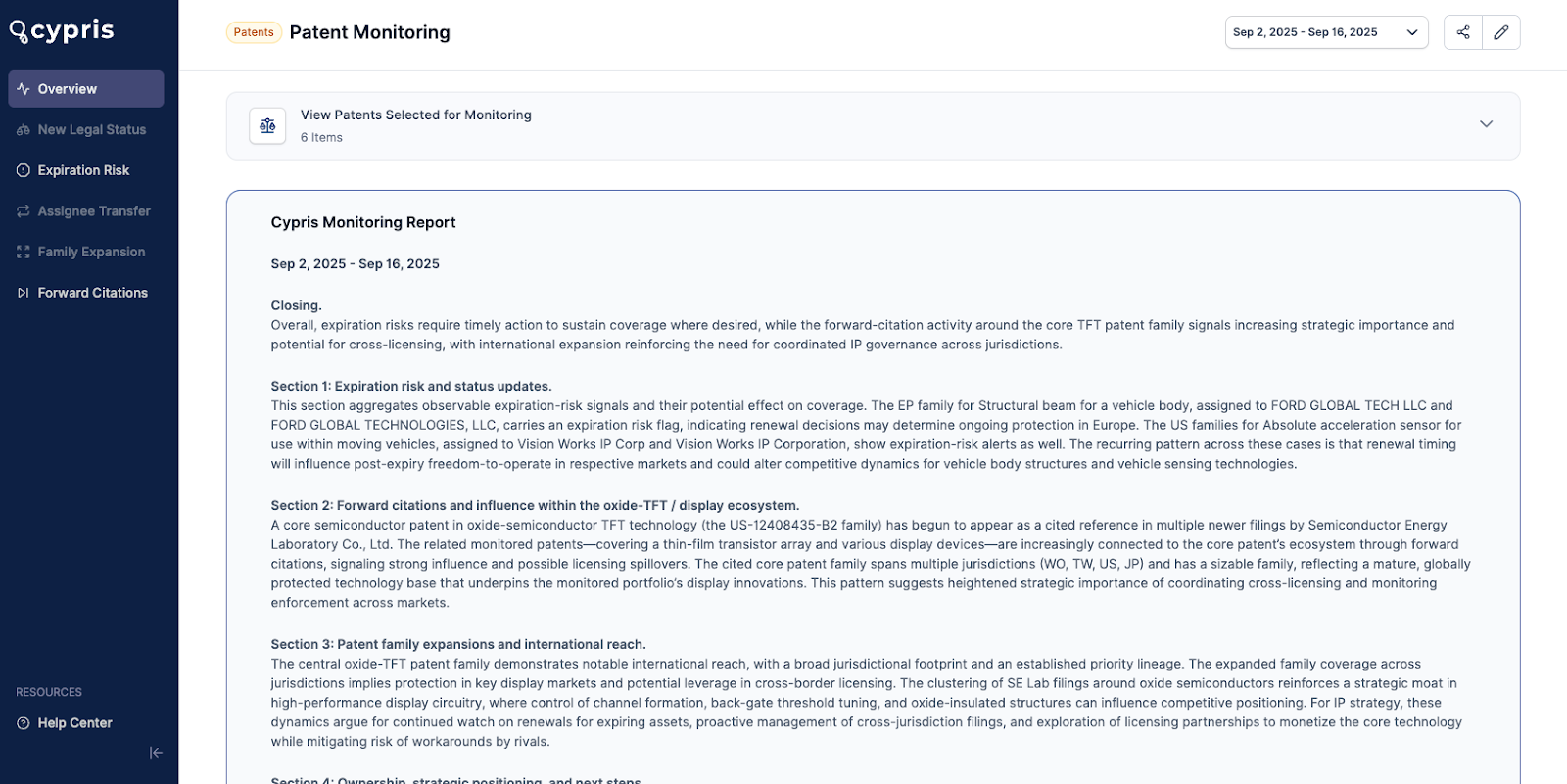
Spreadsheets are no longer needed. Updates now appear in a clear format that highlights key changes such as patent expansions, assignee transfers, or competitor filings. Each report includes AI-generated summaries powered by advanced LLMs to surface the most important trends and context. Reports are refreshed regularly, saved automatically, and build a continuous historical log for long-term tracking.
For many teams, these AI-enhanced reports are the most impactful shift. Instead of raw updates, Monitoring now provides analysis—turning activity like organizational filings or new research papers into intelligence that can guide investment and innovation decisions.
Beyond the reports themselves, having all updates housed directly within Cypris elevates the platform experience as a whole. The new interface is more intuitive, reducing friction for everyday use, and its design makes it easier for teams to collaborate in real time.
Monitoring is also fully integrated with Projects, so you can create and share monitors directly within your team’s workspace. This makes it simple to align ongoing research, track critical events together, and keep collaborators up to speed—all without switching tools. By connecting monitoring with projects, Cypris transforms isolated updates into shared intelligence that enhances both decision-making and collaboration across your organization.
Newsletter-Style Email Experience
Monitoring emails now feel more like a personalized newsletter. Each update arrives in a clean, structured layout with an easy-to-read AI-generated summary of recent activity, spotlighted trends, and direct links to dive deeper in the platform. Content is grouped into clear sections and filterable by category, so you can quickly scan what’s new, focus on the most relevant updates, and stay effortlessly informed—without inbox clutter.
Simplified Setup & Discoverability
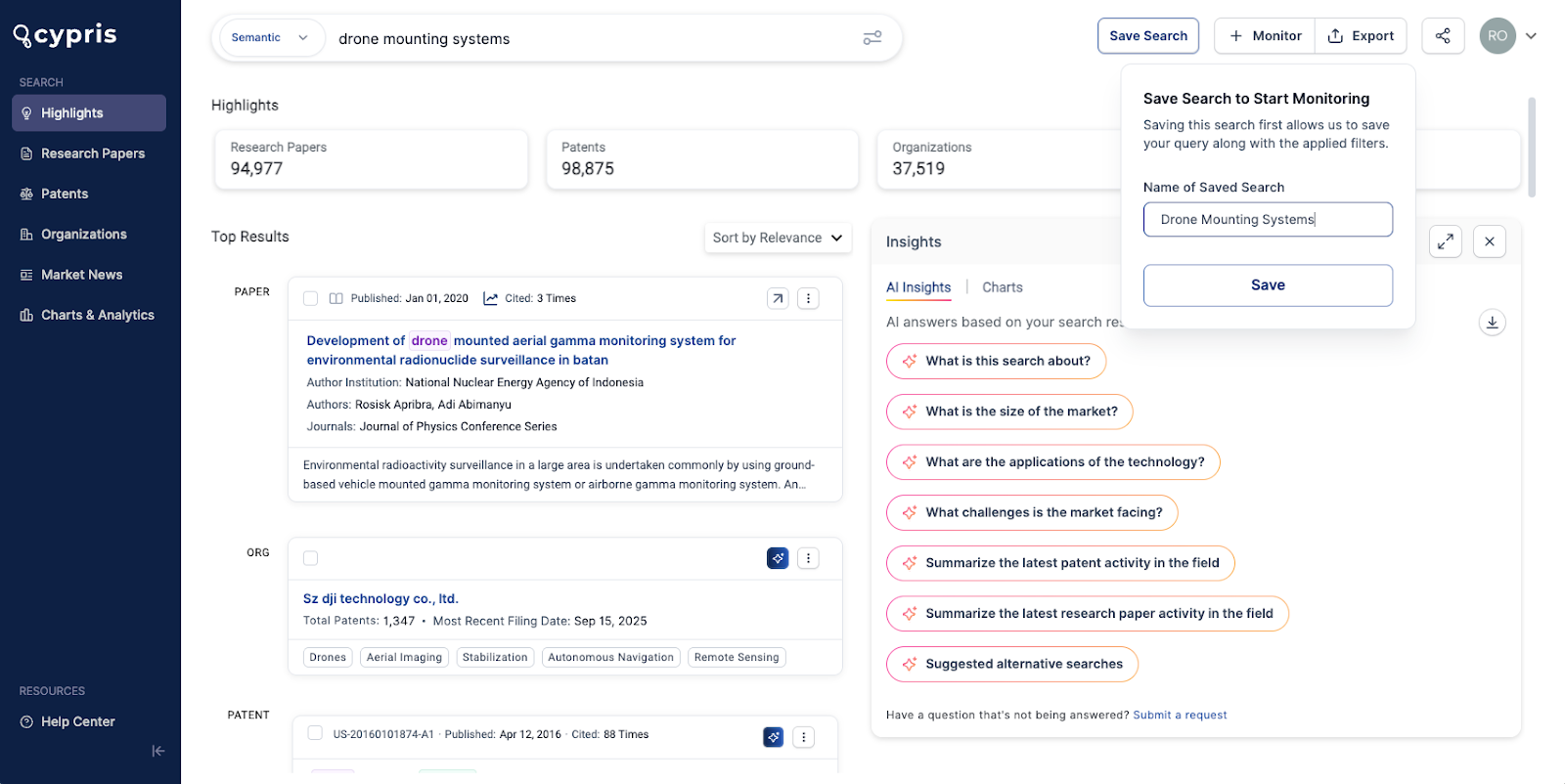
Setting up monitors is now faster and more intuitive. Users can create them in a single streamlined interface—quickly searching patent numbers, keywords, organizations, or papers and selecting the right mix in one place. Smart suggestions recommend recipients, while the Monitoring button appears directly on every search results page. Current monitors are clearly indicated to prevent duplication, and external recipients can be added to email updates for seamless collaboration.
Noise-Free Updates & Critical Alerts
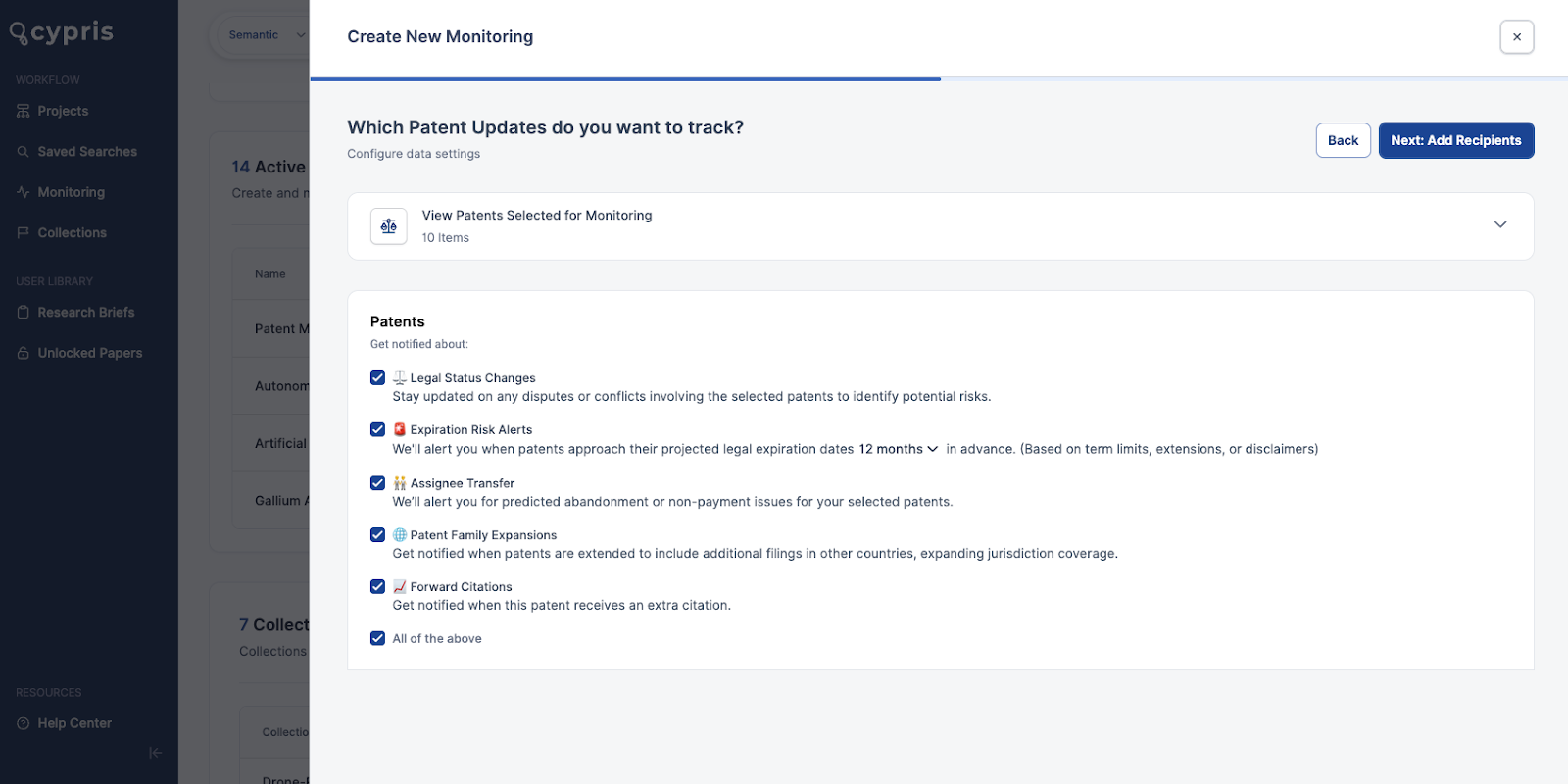
A “send only if new results exist” toggle eliminates duplicate notifications. Monitoring now captures not only newly published patents, papers, and organizations, but also critical patent events such as expiration risks, assignee transfers, patent family expansions, and forward citations—including competitor citations of your own research.
A More Powerful User Experience
Monitoring is built to help users move from raw data to actionable intelligence. Reports save automatically, creating a historical log teams can reference at any time. Items can be flagged directly into collections without manual re-entry. Emails preview AI-enhanced trends with a single click into interactive dashboards, and users can easily add colleagues or external recipients to stay aligned.
From a design perspective, the rebuild also gave our team room to innovate.
As one of our engineering team members, Maddie explained: “It was fun to build something new from scratch. From a UI perspective, we were able to make better design choices right from the start, which made for a much smoother, more intuitive user experience.”
Built for Speed, Accuracy, and Collaboration
With the new Monitoring, teams can save time compared to manual tracking, strengthen competitive intelligence with reliable, cross-dataset updates, collaborate seamlessly by sharing reports with colleagues or external partners, and trust the signal thanks to accuracy, relevancy filters, and AI-powered summaries.
As part of our engineering team, Oleg explained: “This project sat on top of our existing platform, which meant understanding the entire workflow end to end. It was challenging, but it also gave us the opportunity to rethink how everything fits together—and that’s what made it so rewarding.”
Available Now to All Users
The redesigned Monitoring is live and available across the Cypris platform today. If you’re already using Cypris, you’ll see new Monitoring options throughout your search and reporting workflows.
We’re excited to see how your team uses Monitoring to stay ahead of markets, competitors, and technologies — and to keep pushing the boundaries of what intelligent monitoring can do for R&D.
Introducing the New AI-Powered Cypris Monitoring
Blogs
May 5, 2025
•
XX
min read
A powerful new foundation for custom queries—built on Lucene and designed for R&D precision.
Over the past few years, Cypris has helped innovation teams make faster, more informed decisions by centralizing critical insights across datasets like patents, academic papers, and company activity. But until now, our search experience relied on a legacy query system with limited capabilities, offering little support for advanced search features or dataset-level customization.
Today, we’re excited to introduce an upgraded Advanced Search on Cypris, a complete overhaul of our query engine and search experience, powered by the open-standard Lucene query syntax. This update introduces a more robust and flexible search foundation, unlocking new ways to query data, build complex filters, and extract precisely what you need across patents, research, and more.
Why we rebuilt our search system from the ground up
Cypris’ original query syntax, a proprietary format used internally for years, limited users’ ability to craft advanced queries or tailor searches to specific datasets. It lacked modern capabilities like proximity searches, field-level customization, or true Boolean logic. This made it difficult to build a reliable and intuitive experience for both casual users and advanced researchers.
By moving to Lucene, we’re adopting a powerful, industry-standard query language that makes it easier for developers to build advanced features—and gives users access to a far more capable and flexible search toolset.
What’s new in Advanced Search
1. Custom Queries by Dataset You can now layer queries to search across datasets or tailor filters to each one. For example, you can run a broad query on drone delivery, and then add separate layers to focus on patents by a specific assignee and papers from a specific country or funding agency.
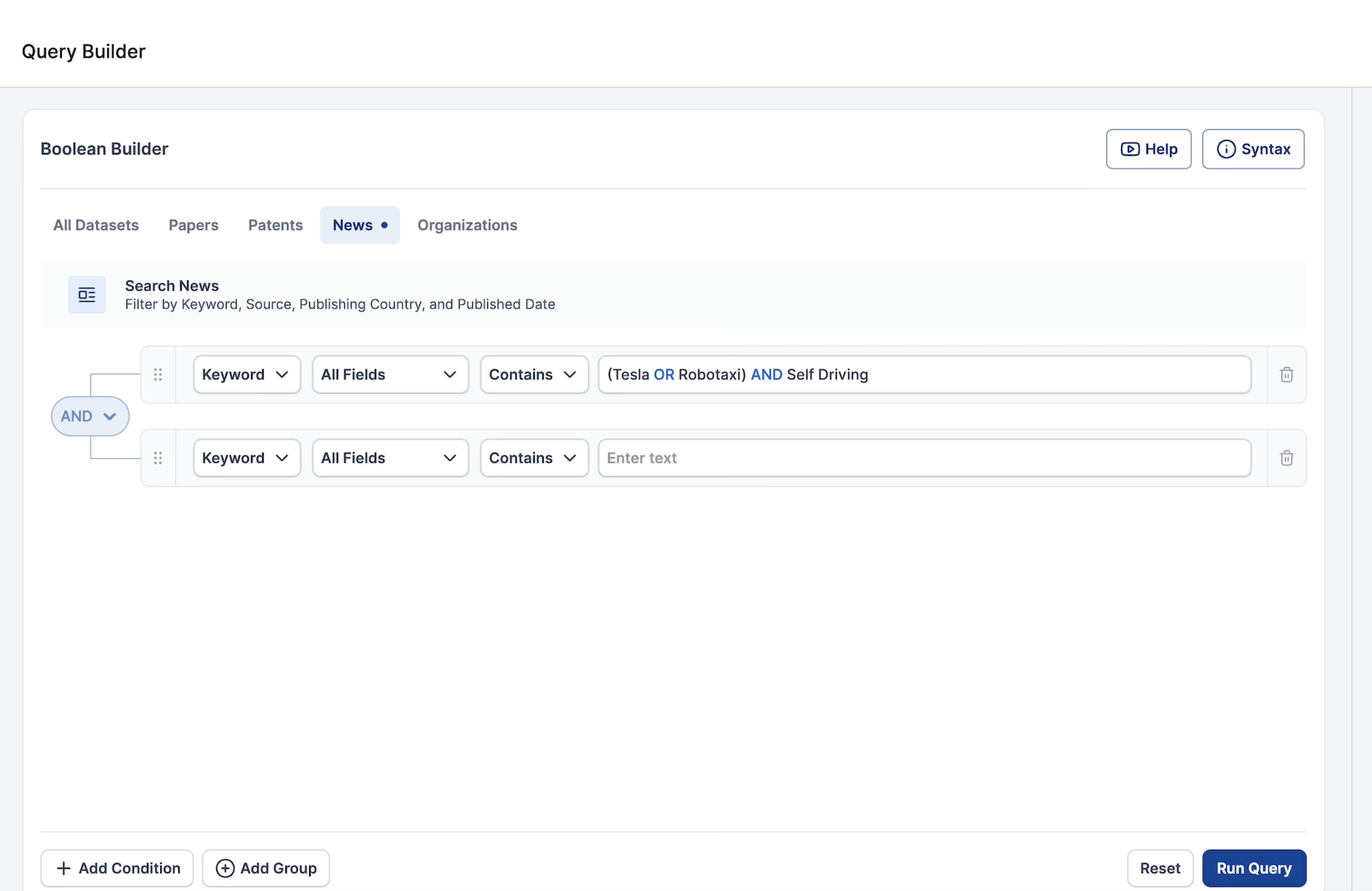
Navigating the All Datasets tab introduces a new level of complexity—and power—by allowing users to apply dataset-specific logic within a single, unified query workflow. While querying multiple datasets simultaneously might seem straightforward, the underlying differences in schema, metadata, and available fields between our proprietary datasets make this a deeply technical challenge. Patents, for example, include claims, application numbers, and multiple date fields (filed, granted, updated), while academic papers use DOIs, have different structural conventions, and emphasize different metadata. In the past, we sidestepped this complexity by translating general queries like ((drone_allText)) into dataset-specific logic under the hood. Now, instead of obscuring that logic, we allow users to opt in to it. The builder provides progressive layers of customization: start with intuitive keyword searches across all fields, then move into the advanced builder for field-specific targeting, fuzzy logic, and term boosting, and finally, tailor query logic by dataset—such as specifying different countries of interest for papers vs. patents. This approach preserves flexibility while giving users full control, and with tools like our real-time Live Analysis and “Your Query” panel, we make it easy to understand how every decision affects the results.
2. More Fields to Query We’re exposing deeper fields across datasets—giving you explicit control over the dimensions of your search. For the first time, users can now search academic papers by DOI, a critical identifier previously unsupported on the platform. You can also query by:
- Author or inventor names
- Organizations or assignees
- Countries, journals, funding agencies, and more
3. Full Boolean Support Advanced Search now leverages powerful Boolean logic—AND, OR, NOT, and grouping—enabling more precise control over search logic and improving performance and accuracy.
4. Lucene Syntax Features Use built-in Lucene features to create expressive, complex searches:
- Proximity searches to find terms near each other
- Fuzzy searches for flexible matching
- Exact phrase matching
- Boosting to prioritize results (e.g., prioritize results mentioning AI 3x more than others)
- Prefix/Postfix queries to match phrases that start or end a certain way
- Range queries for fields like date, funding amounts, or numerical values
A more powerful user experience
Our new search interface is built to help you tap into these capabilities without needing to know the syntax from the start. You’ll find:
- A Query Builder to guide you through complex searches
- A Help Video to onboard users to Lucene-style searches
- Inline examples and tips for writing queries using grouping, boosting, and more
Built for precision, speed, and customization
With Lucene as our foundation, search results are now not only more flexible but also faster and more accurate. Semantic search continues to offer natural-language ease of use, while Boolean search gives power users the performance and structure they need to uncover insights with greater specificity.
Whether you’re an innovation analyst drilling into AI patents or a business development lead scanning academic papers from Chilean researchers—Advanced Search is built to help you get to the signal, faster.
Available now to all users
Advanced Search is live and available across the Cypris platform today. If you’re already using Cypris, you’ll find the new search interface in your dashboard, complete with updated syntax documentation and walkthroughs.
We’re excited to see what you’ll build, discover, and analyze with this new capability. This is just the beginning—we’ll continue expanding the fields, syntax features, and customization options as we push the boundaries of what intelligent search can do for R&D.