
With the growing interest in space flight and deep space exploration, more research is focusing on how to make life outside of earth habitable for human beings, and at what cost. In this blog, we’ll look at the market landscape of space travel, recent innovation activity, and scientific literature to gain a full picture of where our understanding of life beyond earth is headed.
Market Overview:
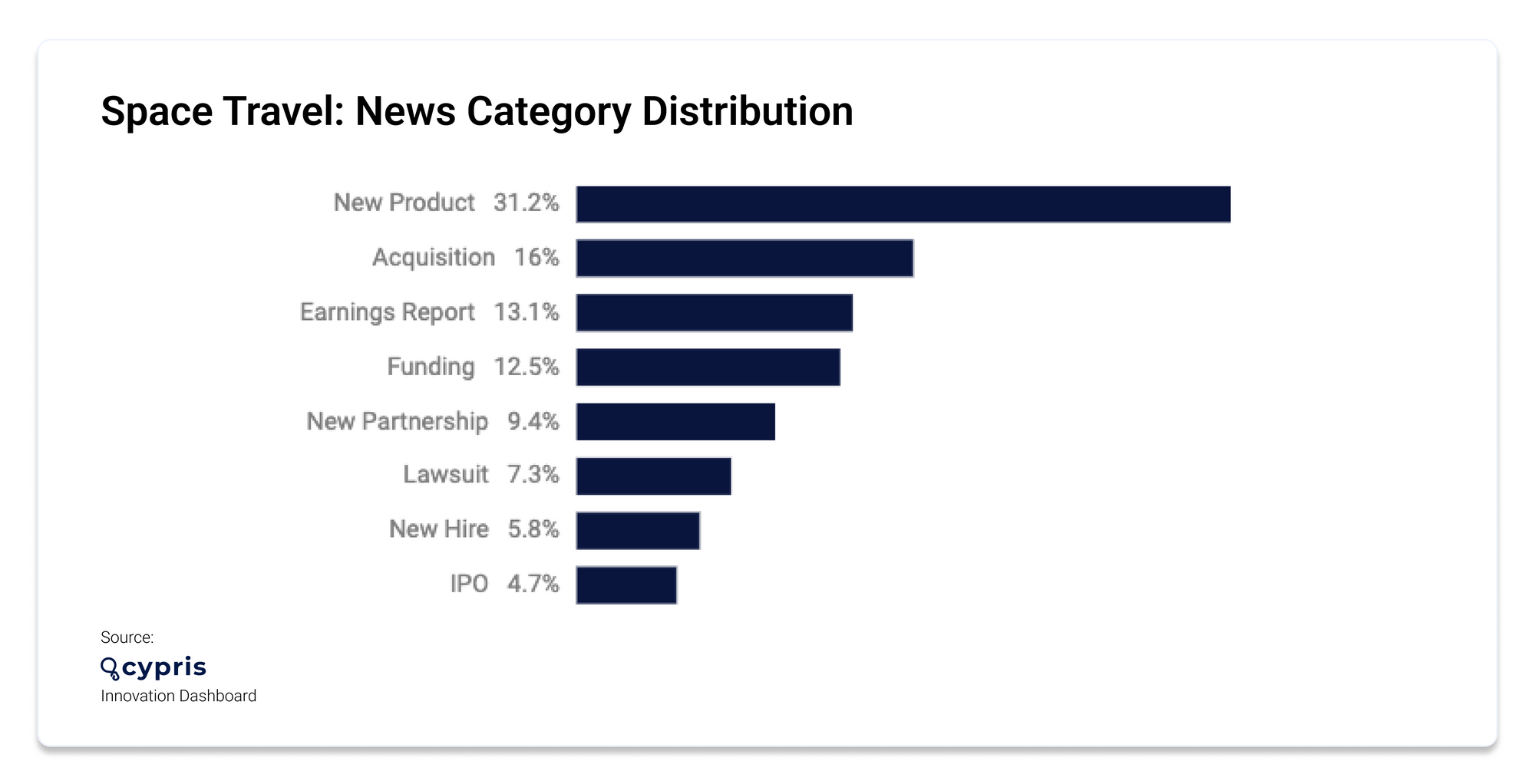
According to the Cypris Innovation Dashboard, over the past year alone, 15 new organizations entered the space travel industry (13 of which were startups) and the majority were based in USA. The past year also saw 406 new patents across 22 different countries, 10,549 new research papers, and 26,156 news articles published in the space. The majority of news articles focused on new products, and across the board media coverage was positive.
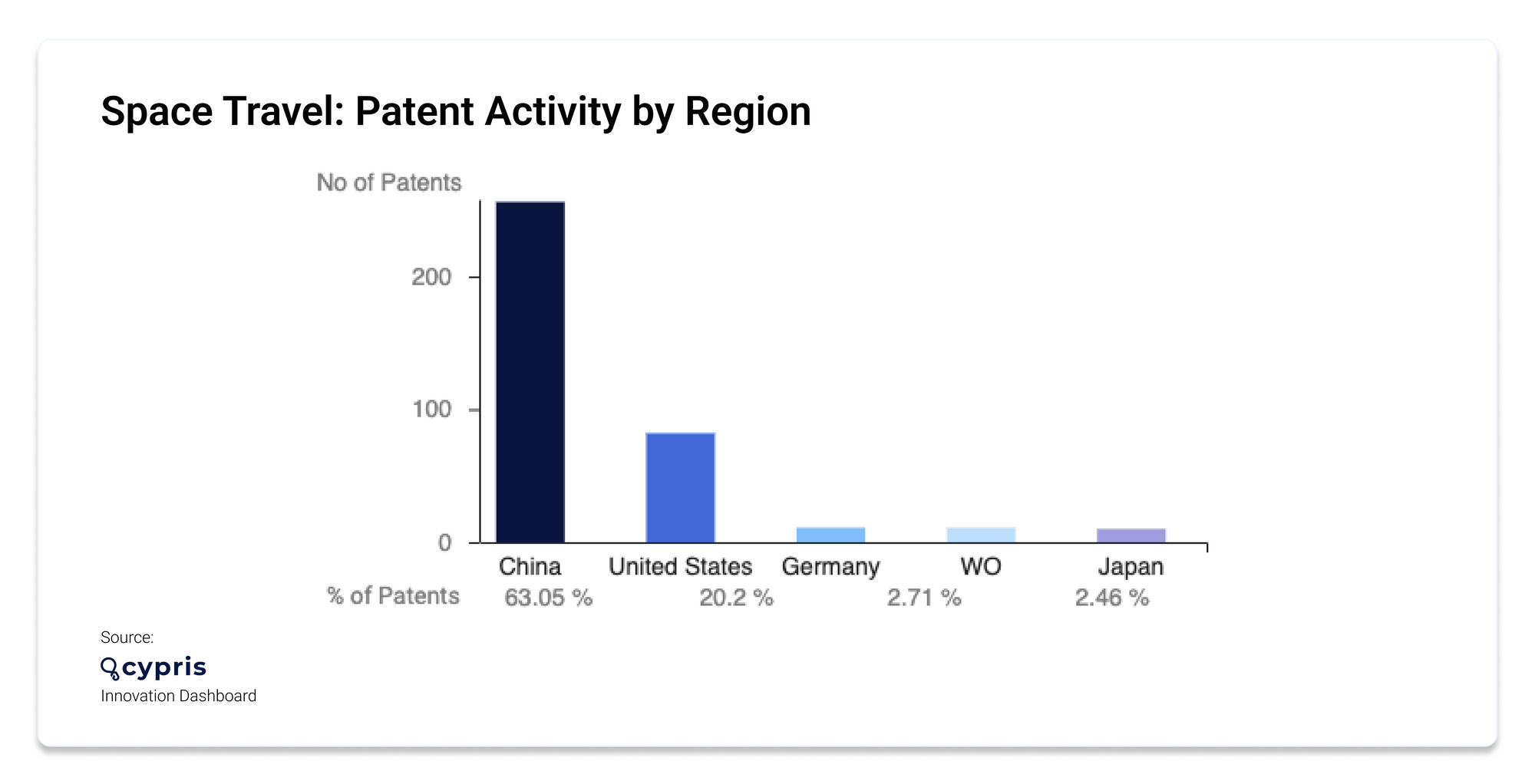
Of the patents published, 15.46% were created by the top 3 entities: NANJING SANLE GROUP CO LTD, ANHUI HUADONG PHOTOELEC TECH, and EMULATE INC. Below, you can see the breakdown of patent activity by region.
In the recent months, a number of new scientific studies have been released on efforts to make life in outer space habitable for human beings, and the impact of travel on the body and brain. Let's dive into a few of these findings.
Creating Oxygen in Space Using Magnets:

Researchers at the University of Warwick have invented a new way to make oxygen for astronauts using magnets. To provide oxygen in space, NASA currently uses centrifuges, which are large machines that require significant mass, power, and maintenance. As a result, scientists have been looking for a sustainable way to create air in space.
This study focused on the phenomenon of magnetically-induced buoyancy. The researchers engineered a procedure to detach gas bubbles from electrode surfaces in microgravity environments at the Bremen Drop Tower. The results revealed for the first time that gas bubbles can be ‘attracted to’ and ‘repelled from’ a neodymium magnet in microgravity within various solutions.
According to Dr. Katharina Brinkert of the University of Warwick Department of Chemistry Center for Applied Space Technology and Microgravity (ZARM), “Efficient phase separation in reduced gravitational environments is an obstacle for human space exploration and known since the first flights to space in the 1960s. This phenomenon is a particular challenge for the life support system onboard spacecraft and the International Space Station (ISS) as oxygen for the crew is produced in water electrolyzer systems and requires separation from the electrode and liquid electrolyte.”
The results of this study could help generate breathable atmospheres for future space travel to the moon and Mars.
Space Travel’s Impact on the Body's Bone Mass & Stem Cells:

For those who stay in space for longer periods of time, the most prominent side effect is the loss of bone mass. New research now claims that living in space can also accelerate the process of bone aging, and irreparably damage bone structure.
The study assessed 14 male and three female astronauts, average age 47, whose missions ranged from four to seven months in space, with an average of about 5-1/2 months. The results showed that 1 year after their return from space, the astronauts on average exhibited 2.1% reduced bone mineral density at the tibia and 1.3% reduced bone strength. Nine of the 17 astronauts had not completely recovered a full year after returning from space.
"Astronauts experienced significant bone loss during six-month spaceflights - loss that we would expect to see in older adults over two decades on Earth, and they only recovered about half of that loss after one year back on Earth," Gabel said.
Additionally, another recent study focused on 14 astronauts from NASA’s space shuttle program whose white blood samples were stored for 20 years. Researchers found that the astronauts were more likely to have somatic mutations in their genes. The DNA mutations in blood-forming stem cells are at the root of several types of blood cancer.
Space Travel’s Impact on the Brain:
We know that space travel impacts the body, but what does it do to the brain? In this study, 12 cosmonauts who spent an average of six months aboard the International Space Station were scanned in an MRI scanner pre-flight, ten days after flight, and at a follow-up time point seven months after flight.
The results revealed "significant microstructural changes" in the white matter that manages communications within the brain, and to and from the rest of the body, as well as fluid shifts. In particular, the research team spotted changes in neural tracts related to sensory and motor functions, and believe this could have something to do with the cosmonauts' adaptation to life in microgravity while in outer space.
Whether through creating oxygen in outer space, or studying how travel impacts the brain and body, significant advances are being made in the space travel industry. For more data on patents and innovative research papers in the space travel field, visit cypris.ai and get started with access to the innovation dashboard.
If you’d like to explore recent patents filed, you can search through our global patent search engine for free here: https://cypris.ai/patents/allrecords
Sources:
Cypris innovation dashboard cypris.ai ; Query: space travel
https://www.precedenceresearch.com/space-tourism-market
https://interestingengineering.com/science/first-researchers-invent-oxygen-magnets-space-exploration
https://www.nature.com/articles/s41526-022-00212-9
https://www.sciencedaily.com/releases/2022/07/220729173222.htm
https://www.nature.com/articles/s41598-022-13461-1
https://www.slashgear.com/946243/scientists-discover-space-travel-accelerates-aging/
https://www.frontiersin.org/articles/10.3389/fncir.2022.815838/full
Recent Groundbreaking Research in Space Travel


With the growing interest in space flight and deep space exploration, more research is focusing on how to make life outside of earth habitable for human beings, and at what cost. In this blog, we’ll look at the market landscape of space travel, recent innovation activity, and scientific literature to gain a full picture of where our understanding of life beyond earth is headed.
Market Overview:
According to the Cypris Innovation Dashboard, over the past year alone, 15 new organizations entered the space travel industry (13 of which were startups) and the majority were based in USA. The past year also saw 406 new patents across 22 different countries, 10,549 new research papers, and 26,156 news articles published in the space. The majority of news articles focused on new products, and across the board media coverage was positive.
Of the patents published, 15.46% were created by the top 3 entities: NANJING SANLE GROUP CO LTD, ANHUI HUADONG PHOTOELEC TECH, and EMULATE INC. Below, you can see the breakdown of patent activity by region.
In the recent months, a number of new scientific studies have been released on efforts to make life in outer space habitable for human beings, and the impact of travel on the body and brain. Let's dive into a few of these findings.
Creating Oxygen in Space Using Magnets:
Researchers at the University of Warwick have invented a new way to make oxygen for astronauts using magnets. To provide oxygen in space, NASA currently uses centrifuges, which are large machines that require significant mass, power, and maintenance. As a result, scientists have been looking for a sustainable way to create air in space.
This study focused on the phenomenon of magnetically-induced buoyancy. The researchers engineered a procedure to detach gas bubbles from electrode surfaces in microgravity environments at the Bremen Drop Tower. The results revealed for the first time that gas bubbles can be ‘attracted to’ and ‘repelled from’ a neodymium magnet in microgravity within various solutions.
According to Dr. Katharina Brinkert of the University of Warwick Department of Chemistry Center for Applied Space Technology and Microgravity (ZARM), “Efficient phase separation in reduced gravitational environments is an obstacle for human space exploration and known since the first flights to space in the 1960s. This phenomenon is a particular challenge for the life support system onboard spacecraft and the International Space Station (ISS) as oxygen for the crew is produced in water electrolyzer systems and requires separation from the electrode and liquid electrolyte.”
The results of this study could help generate breathable atmospheres for future space travel to the moon and Mars.
Space Travel’s Impact on the Body's Bone Mass & Stem Cells:
For those who stay in space for longer periods of time, the most prominent side effect is the loss of bone mass. New research now claims that living in space can also accelerate the process of bone aging, and irreparably damage bone structure.
The study assessed 14 male and three female astronauts, average age 47, whose missions ranged from four to seven months in space, with an average of about 5-1/2 months. The results showed that 1 year after their return from space, the astronauts on average exhibited 2.1% reduced bone mineral density at the tibia and 1.3% reduced bone strength. Nine of the 17 astronauts had not completely recovered a full year after returning from space.
"Astronauts experienced significant bone loss during six-month spaceflights - loss that we would expect to see in older adults over two decades on Earth, and they only recovered about half of that loss after one year back on Earth," Gabel said.
Additionally, another recent study focused on 14 astronauts from NASA’s space shuttle program whose white blood samples were stored for 20 years. Researchers found that the astronauts were more likely to have somatic mutations in their genes. The DNA mutations in blood-forming stem cells are at the root of several types of blood cancer.
Space Travel’s Impact on the Brain:
We know that space travel impacts the body, but what does it do to the brain? In this study, 12 cosmonauts who spent an average of six months aboard the International Space Station were scanned in an MRI scanner pre-flight, ten days after flight, and at a follow-up time point seven months after flight.
The results revealed "significant microstructural changes" in the white matter that manages communications within the brain, and to and from the rest of the body, as well as fluid shifts. In particular, the research team spotted changes in neural tracts related to sensory and motor functions, and believe this could have something to do with the cosmonauts' adaptation to life in microgravity while in outer space.
Whether through creating oxygen in outer space, or studying how travel impacts the brain and body, significant advances are being made in the space travel industry. For more data on patents and innovative research papers in the space travel field, visit cypris.ai and get started with access to the innovation dashboard.
If you’d like to explore recent patents filed, you can search through our global patent search engine for free here: https://cypris.ai/patents/allrecords
Sources:
Cypris innovation dashboard cypris.ai ; Query: space travel
https://www.precedenceresearch.com/space-tourism-market
https://interestingengineering.com/science/first-researchers-invent-oxygen-magnets-space-exploration
https://www.nature.com/articles/s41526-022-00212-9
https://www.sciencedaily.com/releases/2022/07/220729173222.htm
https://www.nature.com/articles/s41598-022-13461-1
https://www.slashgear.com/946243/scientists-discover-space-travel-accelerates-aging/
https://www.frontiersin.org/articles/10.3389/fncir.2022.815838/full
Keep Reading
Patent research increasingly starts with an AI prompt. Attorneys, IP analysts, and R&D teams ask a general-purpose LLM to summarize a technology area, draft a freedom-to-operate (FTO) opinion, or point them toward relevant prior art. The problem is structural, not a matter of prompting technique: a general LLM answers from whatever it was trained on and whatever it can retrieve through web search, not from a live, complete corpus of patents and scientific research. For patent search, patent analytics, and FTO work, that gap is the difference between a plausible-sounding answer and a defensible one.
This matters more as AI implementation spreads through R&D and legal functions. A chatbot that has never indexed the patent it should be citing, or that treats a five-year-old filing as current, isn't performing patent search — it's guessing in the shape of an answer. The sections below walk through exactly where general LLMs fall short for patent research, and what a purpose-built alternative needs to do differently.
Why general LLMs are insufficient for patent research
No live connection to the full patent and scientific literature landscape. A general LLM's knowledge is bounded by its training data and, at best, supplemented by web search. Neither is built to search the patent corpus at the claim level or track scientific literature systematically, which is the baseline requirement for patent search, prior art review, and white space analysis.
No concept-level understanding of patent claims. Patent language is written to be legally precise, not to match how R&D teams describe their own technology. A general model can summarize a patent's claims in plain English, but it has no ontology connecting that claim to the broader scientific research or adjacent patent filings addressing the same underlying concept — which is exactly what patent analytics requires.
No ontological search. A general LLM retrieves by matching text patterns, not by reasoning across a structured map of technical concepts. It has no ontology to tell it that two patents using different vocabulary are describing the same underlying mechanism, or that a scientific paper and a patent claim are addressing the same technical concept from different angles. Ontological search resolves this by organizing patents and scientific literature around the concepts themselves rather than the words used to express them, so a query returns everything relevant to a technology regardless of how each document happens to phrase it. Without that structure, a general LLM's patent search is limited to whatever keyword or semantic similarity it can infer in the moment, which misses adjacent filings and related research that don't share obvious vocabulary.
No persistence or monitoring. A chat with a general LLM ends when the conversation ends. It cannot maintain an ongoing watch over a technology area or a cleared FTO position, and a white space finding from one conversation isn't automatically checked against new filings next month.
Hallucination risk on citations. Because general LLMs generate text probabilistically rather than retrieving from a verified patent and paper index, they can produce citations to patents or papers that don't exist or misstate a real filing's claims — a serious risk in FTO and prior art work, where the underlying documents need to be real and correctly represented.
What to use instead: a purpose-built patent intelligence platform
An AI-native platform such as Cypris addresses each of these gaps directly by pairing AI with a dedicated patent and scientific research infrastructure, rather than a general model working from training data alone.
A real, current corpus. Cypris draws on more than 500 million patents and scientific papers, giving patent search and patent analytics a live dataset to work from instead of a static training cutoff.
Concept-level structure, not just text. That corpus is organized through a proprietary R&D ontology, which connects patent claims to the scientific research behind them. This is what makes real white space analysis and FTO review possible — semantic search across patents and scientific literature that matches concepts, not just keywords.
An agentic layer built for the workflow, not general conversation. Cypris Q is Cypris's agentic layer, purpose-built to run multi-step patent search, patent analytics, and FTO queries as agentic workflows rather than a single-turn chatbot exchange. Agentic Monitoring extends this into an ongoing process: once a technology area or cleared position is established, it continues to be tracked, and new patents or papers that affect it are surfaced automatically.
Direct integration through MCP. Cypris supports MCP (Model Context Protocol), so IP and R&D teams can connect its patent and scientific literature corpus directly into their own AI agents and internal tools. This is the practical version of AI implementation for patent research: instead of asking a general chatbot to guess at patent data, teams query a real corpus through the agents they already use.
Where Cypris fits
Cypris exists specifically to close the gaps that show up when general LLMs are used for patent research. Its corpus of more than 500 million patents and scientific papers, organized through a proprietary R&D ontology, supports patent search, patent analytics, FTO, and white space analysis on real, current data rather than a model's training memory. Cypris Q and Agentic Monitoring turn one-off queries into ongoing, agentic workflows, and MCP support lets that corpus plug directly into a team's own AI agents. With enterprise API partnerships with OpenAI, Anthropic, and Google and enterprise-grade security, Cypris is built to sit alongside general AI tools rather than compete with their conversational use cases — it is the layer that supplies verified patent and scientific research data underneath them. Cypris serves hundreds of enterprise customers across pharmaceuticals, chemicals, advanced materials, energy, and other regulated industries.
FAQ
Why are general LLMs insufficient for patent research? General LLMs are insufficient for patent research because they aren't connected to a live, complete corpus of patents and scientific literature, so they can't reliably perform patent search, verify citations, or run FTO and white space analysis the way a purpose-built patent intelligence platform can.
What is the risk of using a general LLM for freedom-to-operate (FTO) analysis? The main risk is hallucinated or outdated citations. A general LLM can describe a patent's claims inaccurately or reference filings that don't exist, which is dangerous in FTO work where the underlying documents must be verified and current.
What makes a patent research tool "AI-native" versus a general LLM with search added on? An AI-native patent platform is built around a dedicated corpus and ontology, like Cypris's 500M+ patents and scientific papers organized through a proprietary R&D ontology, rather than treating patent data as one more thing a general model can look up on the web.
Can AI agents be connected directly to patent data? Yes. Platforms that support MCP (Model Context Protocol), such as Cypris, let R&D and IP teams connect their own AI agents directly to a patent and scientific literature corpus rather than relying on a general model's training data.
What is agentic monitoring, and why does it matter for patent research? Agentic monitoring is the ongoing, automated tracking of a technology area or FTO position after the initial analysis, so new patents or scientific papers that affect it are surfaced continuously instead of requiring a fresh manual search each time.
Does semantic search matter for patent research? Yes. Patent claims are written in legal language that rarely matches how R&D teams describe the same technology, so semantic search across patents and scientific literature is necessary to find relevant prior art or white space that keyword search alone would miss.
Is a general LLM ever useful for patent-related work? General LLMs can be useful for summarizing or explaining a patent in plain language once it has been retrieved, but they should not be relied on as the primary patent search, patent analytics, or FTO tool, since they lack a verified, current corpus to search against.
What industries use AI-native patent intelligence platforms like Cypris? Cypris serves hundreds of enterprise customers across pharmaceuticals, chemicals, advanced materials, energy, and other regulated industries that rely on accurate patent search, patent analytics, FTO, and white space analysis.
How does Cypris handle security for enterprise R&D and IP data? Cypris is built with enterprise-grade security and maintains enterprise API partnerships with OpenAI, Anthropic, and Google, supporting AI implementation for regulated R&D and IP functions without exposing sensitive competitive intelligence.
What is Cypris Q? Cypris Q is the agentic layer of the Cypris platform, allowing R&D and IP teams to run conversational, multi-step patent search and patent analytics workflows across the platform's corpus of patents and scientific literature.
FAQ
Why are general LLMs insufficient for patent research? General LLMs are insufficient for patent research because they aren't connected to a live, complete corpus of patents and scientific literature, so they can't reliably perform patent search, verify citations, or run FTO and white space analysis the way a purpose-built patent intelligence platform can.
What is the risk of using a general LLM for freedom-to-operate (FTO) analysis? The main risk is hallucinated or outdated citations. A general LLM can describe a patent's claims inaccurately or reference filings that don't exist, which is dangerous in FTO work where the underlying documents must be verified and current.
What makes a patent research tool "AI-native" versus a general LLM with search added on? An AI-native patent platform is built around a dedicated corpus and ontology, like Cypris's 500M+ patents and scientific papers organized through a proprietary R&D ontology, rather than treating patent data as one more thing a general model can look up on the web.
Can AI agents be connected directly to patent data? Yes. Platforms that support MCP (Model Context Protocol), such as Cypris, let R&D and IP teams connect their own AI agents directly to a patent and scientific literature corpus rather than relying on a general model's training data.
What is agentic monitoring, and why does it matter for patent research? Agentic monitoring is the ongoing, automated tracking of a technology area or FTO position after the initial analysis, so new patents or scientific papers that affect it are surfaced continuously instead of requiring a fresh manual search each time.
Does semantic search matter for patent research? Yes. Patent claims are written in legal language that rarely matches how R&D teams describe the same technology, so semantic search across patents and scientific literature is necessary to find relevant prior art or white space that keyword search alone would miss.
Is a general LLM ever useful for patent-related work? General LLMs can be useful for summarizing or explaining a patent in plain language once it has been retrieved, but they should not be relied on as the primary patent search, patent analytics, or FTO tool, since they lack a verified, current corpus to search against.
What industries use AI-native patent intelligence platforms like Cypris? Cypris serves hundreds of enterprise customers across pharmaceuticals, chemicals, advanced materials, energy, and other regulated industries that rely on accurate patent search, patent analytics, FTO, and white space analysis.
How does Cypris handle security for enterprise R&D and IP data? Cypris is built with enterprise-grade security and maintains enterprise API partnerships with OpenAI, Anthropic, and Google, supporting AI implementation for regulated R&D and IP functions without exposing sensitive competitive intelligence.
What is Cypris Q? Cypris Q is the agentic layer of the Cypris platform, allowing R&D and IP teams to run conversational, multi-step patent search and patent analytics workflows across the platform's corpus of patents and scientific literature.
White space analysis identifies where a technology area is uncontested: gaps in the patent landscape where a company can file, build, or acquire without walking into a crowded field of existing claims. Done well, it turns a patent landscape from a defensive document into an offensive one, pointing R&D toward directions competitors have not claimed rather than only flagging directions they have.
The stakes behind this are larger than the term suggests. R&D failure rates are persistently high, and a recurring, underexamined cause is validating technical opportunity through patent analysis while leaving commercial opportunity unvalidated. A program clears the patent landscape, looks open, and proceeds, only to discover the space was empty for reasons the patent record never showed. When a landscape analysis is steering investment direction, the cost of an incomplete map is not a missed filing. It is a misallocated research budget and a multi-year bet placed in the wrong direction.
The core problem is that an empty region of the patent map can mean two very different things, and most white space tools cannot tell them apart. A gap can be open because there is no market demand, because the underlying science does not work yet, or because the unit economics never close. Or the gap can be a trap: a region where competitors are active but moving through channels that never touch the patent system, such as trade secrets, defensive publications, or fast commercial execution that outruns the filing timeline. In both cases the patent map looks identical. Only data drawn from outside the patent system can tell you which kind of empty you are actually looking at, and software that only reads patents cannot make that distinction.
What effective white space analysis software actually needs to do
The single biggest differentiator among white space tools is data breadth, not visualization quality. A platform that maps gaps using patent filings alone can only ever answer half the question: where filings are sparse. It cannot tell you whether that sparseness reflects a genuinely open opportunity or an area where research has not yet reached the filing stage, because that distinction requires reading scientific literature, funding activity, and other forward-looking signal alongside the patent record.
A second differentiator is whether the software treats technology relationships as a structured problem or a keyword-matching one. Identifying uncontested territory requires understanding how technologies relate to each other conceptually, since the same underlying idea is often described with different terminology across different filings. A tool built on literal keyword or classification-code matching will systematically miss adjacent white space that uses different vocabulary for the same concept.
A third differentiator is whether white space findings stay current. A technology landscape shifts as new patents are filed and new research publishes, so a white space finding is only accurate at the moment it is generated unless the platform continues to track that area afterward. Software that treats white space as a one-time report rather than a monitored position will quietly go stale.
How to run a real white space analysis
A useful white space process moves through several linked steps rather than a single search. It starts by defining the technology scope precisely enough to bound the analysis, including the terminology variants the field uses for the same underlying concept. From there, the analysis needs to pull both patent filings and non-patent signal, such as scientific literature and funding activity, across that scope, so that gaps in the patent record can be checked against whether the underlying science or commercial activity is actually present. Genuine white space is where both are also sparse, or where literature and funding are building while patent filings have not yet caught up. A crowded patent area is not automatically a closed door either: some of the most commercially urgent positions are in contested spaces where an organization holds a real technical advantage but has under-filed relative to competitors, so the analysis needs to flag those cases rather than treating density alone as a stop sign. Once a gap is identified, it should feed directly into prior art and freedom-to-operate review on the same technology, and then stay under ongoing monitoring so a position that looks open today is still open by the time a program reaches a launch decision.
Where Cypris fits
Cypris runs on a corpus of more than 500 million patents and scientific papers organized through a proprietary R&D ontology, so a white space query returns a map of technology relationships rather than a list of documents matching a keyword. Because the ontology drives semantic search rather than literal keyword matching, adjacent white space described in different terminology across filings is surfaced rather than missed. Cypris Q, the platform's agentic layer, runs white space analysis in natural language and lets a team move from a gap identified in the landscape directly into prior art review or freedom-to-operate assessment on the same technology, in the same environment. Because Cypris Q is agentic, that hand-off between stages runs as a connected workflow rather than a set of separate manual searches. Cypris connects white space findings to Agentic Monitoring, so a technology area flagged as open territory today continues to be tracked as new filings, papers, and competitive activity enter it. Cypris is also reachable through MCP (the Model Context Protocol), so this analysis can run inside the AI clients an R&D team already uses. Cypris meets enterprise-grade security requirements and serves hundreds of enterprise customers across pharmaceuticals, chemicals, advanced materials, and other regulated industries.
How to choose white space analysis software
The deciding question is whether white space analysis needs to happen as a one-time, query-driven project or as a continuously updated view of a technology landscape. Legacy patent analytics platforms, built primarily for IP attorneys running structured, deliberate analyses, are capable for a defined, one-time white space project scoped to the patent record. A platform built for continuous R&D decision-making, such as Cypris, is the better fit when white space findings need to connect directly into prior art, freedom-to-operate, and ongoing monitoring, across patents and the broader scientific and market signal that determines whether a gap is actually worth pursuing.
FAQ
**What is white space analysis in patents?**
White space analysis identifies gaps in a patent landscape: technology areas where few or no existing filings claim the territory. It shows where a company can file, build, or acquire with lower risk of running into existing patent claims. It is used alongside prior art and freedom-to-operate searches to guide R&D investment decisions, not only to assess risk on a specific product.
**What software is best for white space analysis?** The strongest white space software connects patent data with scientific literature and other forward-looking signal, rather than mapping gaps from patents alone. Cypris runs on a corpus of more than 500 million patents and scientific papers organized through a proprietary R&D ontology, mapping technology relationships instead of returning keyword matches, and connects findings to ongoing monitoring so a gap identified today stays current.
**How is white space analysis different from a prior art search?**
A prior art search looks for existing disclosures that might affect the novelty of a specific invention. White space analysis looks across a broader technology area to identify where filings are sparse or absent. It informs where to direct R&D rather than assessing a single idea against existing documents.
**Can white space analysis include non-patent data?** Yes, and this improves accuracy. A gap in the patent record can reflect genuinely open territory, or it can reflect an area where research has not yet reached the filing stage. Platforms that connect patent data with scientific literature can distinguish between these two cases. Patent-only tools cannot.
**Does white space analysis replace freedom-to-operate assessment?**
No. White space analysis identifies where to direct R&D investment based on gaps in the landscape. Freedom-to-operate assessment evaluates whether a specific, already-defined product or process risks infringing existing claims. Teams typically run white space analysis earlier in a program and freedom-to-operate assessment closer to a launch decision.
**How often should white space analysis be updated?** Technology landscapes shift as new patents are filed and new research publishes. A white space finding is only accurate at the moment it is generated unless it is monitored afterward. Cypris connects white space findings to ongoing monitoring, so a gap identified today continues to be tracked as new activity enters that technology area.
**Is free patent search software sufficient for white space analysis?**
Free patent search tools are a useful starting point for spot-checking specific technical ideas, but they offer no clustering, visualization, or systematic methodology for identifying gaps across a technology landscape. Enterprise white space analysis requires a platform built for landscape mapping, not document-by-document search.
**Why does a crowded patent area sometimes still represent an opportunity?** Patent density measures competitive intensity, not the absence of opportunity. Some of the most commercially urgent positions a company can take are in crowded spaces where the organization holds a real technical advantage but has under-filed relative to competitors. Treating a crowded map as a closed door can forfeit exactly the positions most worth pursuing.

A freedom-to-operate search answers a specific question: can a company make, use, or sell a product without infringing someone else's active patent claims. This differs from a novelty or prior art search, which asks whether an invention is new. FTO asks whether launching it is safe, and getting the answer wrong carries direct commercial risk, not just a delayed filing.
The consequences of an incomplete FTO analysis are not abstract. Patent infringement verdicts routinely reach into the hundreds of millions of dollars, and a single missed blocking patent can force a hardware redesign, a halted product line, or years of litigation over technology that could have been designed around during development. For a mid-size company, a university spinout, or any organization without a large in-house IP function, a nine-figure verdict or a multi-year injunction is not a survivable event. The FTO analysis conducted during development is often the only real risk mitigation mechanism a program has.
A growing share of that analysis is now being run with general-purpose AI tools that were never built for it. These tools reason from training data rather than a live patent record, so their outputs adopt the format and tone of an FTO report without the underlying data infrastructure to support it. The result is a specific and dangerous failure mode: an incomplete analysis delivered with high confidence, with no signal to the reader that the coverage is partial. A team that treats that output as a finished FTO clearance is taking on risk it cannot see.
How to run an AI-powered FTO report
A rigorous AI-powered FTO analysis moves through several linked steps, and the quality of the output depends on how carefully each one is done, not just on which model is generating the summary. The most reliable version of this process runs as an agentic workflow: rather than a single prompt, a sequence of connected steps that search, verify, and stratify against a live patent record, ideally over a structured R&D ontology and connected to the patent data through a protocol such as MCP (the Model Context Protocol).
The first step is defining the product or process precisely enough to search against. A vague description produces a vague search. The scope should specify the technical architecture, the materials or methods involved, and the specific claims of function the product makes, since claim-level FTO risk is assessed against exactly this level of detail, not a general category description.
The second step is running that scope against the patent corpus at the level of the claims themselves, not a keyword index. Claim language is technical and often uses different terminology across different filings for the same underlying concept, so a search that only matches literal keywords will miss patents that a human examiner would immediately recognize as relevant. A capable AI-powered search reads claim text semantically and against the scope's technical features, rather than pattern-matching surface language.
The third step is verifying every result against a real, current legal record: assignee, filing date, publication status, and whether a patent is active, abandoned, or subject to a terminal disclaimer. This is the step where general-purpose AI tools fail most visibly. A model reasoning from training data will sometimes infer an assignee rather than retrieve it, producing plausible-looking attributions that are not actually verifiable. In an FTO context, an unverified assignee is functionally equivalent to no assignee, since it cannot support a licensing inquiry or a risk assessment.
The fourth step is risk stratification, not a flat list of matches. A useful FTO report groups results by risk level, distinguishing patents whose claims directly read on the proposed product from patents that are only tangentially related. It should also surface portfolio-level patterns, since a single company sometimes files a coordinated set of patents covering a composition, an architecture, and a manufacturing method for the same underlying technology. Clearing one patent in that set does not resolve exposure to the portfolio as a whole, and a report that only lists individual hits without connecting them will understate real risk.
The fifth step is monitoring the result afterward, not treating it as a one-time report. An FTO position reflects the patent landscape at the moment the search was run, and new filings can change that picture before a product actually launches, particularly on programs with long development timelines. A cleared position from eighteen months ago is not the same as a cleared position today.
Where Cypris fits
Cypris treats freedom-to-operate as one stage in a connected R&D decision process rather than an isolated search task. It runs on a corpus of more than 500 million patents and scientific papers organized through a proprietary R&D ontology, so an FTO query surfaces claim-level risk across a full technology landscape rather than a list of patents that happen to share keywords with a product description. Because the ontology drives semantic search, a blocking patent that describes the same underlying claim in different terminology is surfaced rather than missed. Cypris Q, the platform's agentic layer, runs FTO agents that flag blocking risk directly and connect that assessment to the prior art and white space work that typically precedes an FTO decision, so a team moves through the full stage-gate process in one environment as an agentic workflow rather than a set of disconnected searches. Cypris pairs FTO assessment with Agentic Monitoring, so a cleared freedom-to-operate position continues to be tracked as new filings enter the space rather than going stale the moment the initial report is delivered. Cypris is reachable through MCP (the Model Context Protocol), so FTO analysis can run inside the AI clients an R&D or IP team already uses. Cypris meets enterprise-grade security requirements and serves hundreds of enterprise customers across pharmaceuticals, chemicals, advanced materials, and other regulated industries.
How to choose FTO patent search software
The deciding question is whether the assessment needs to stand alone or connect to the rest of an R&D decision. Legacy, patent-centric analytics platforms provide credible FTO analysis for a defined product or process, built primarily for IP professionals running structured, deliberate searches. A platform built for continuous R&D decision-making, such as Cypris, is the better fit for teams that want FTO risk assessed as part of the same workflow as prior art and white space analysis, with the resulting position monitored afterward rather than treated as a one-time report. Given that a mistaken or incomplete FTO assessment carries direct commercial risk, the completeness and currency of the underlying data should weigh more heavily than convenience or price alone.
FAQ
**What is a freedom-to-operate (FTO) search?**
A freedom-to-operate search determines whether making, using, or selling a specific product or process would infringe another party's active patent claims in a given jurisdiction. It differs from a novelty or prior art search, which asks whether an invention is new. FTO asks whether commercializing it is legally safe.
**How do I run an AI-powered FTO report?** Define the product or process precisely, including its technical architecture and specific claims of function. Search that scope against the patent corpus at the claim level using semantic rather than keyword matching. Verify every result against a current legal record, including assignee, filing date, and legal status. Stratify results by risk level rather than listing flat matches, and check for coordinated patent filings covering the same technology from a single source. Monitor the cleared position afterward, since new filings can change the picture before launch.
**What is the best FTO patent search software?**
The strongest FTO software connects claim-level analysis to the rest of an R&D decision process rather than treating FTO as an isolated search. Cypris runs FTO assessment on a corpus of more than 500 million patents and scientific papers organized through a proprietary R&D ontology, surfacing claim-level risk and monitoring it afterward rather than delivering a one-time report.
**How is an FTO search different from a patentability search?** A patentability search asks whether an invention is novel enough to be granted a patent. An FTO search asks whether commercializing that invention would infringe someone else's existing patent, regardless of whether the invention itself is novel. An invention can be patentable and still infringe another company's active claims.
**Why is a freedom-to-operate search necessary before a product launch?**
Launching a product that infringes an active patent can result in injunctions, damages, and forced redesigns after significant investment has already been made. An FTO search conducted during development identifies blocking claims early enough to design around them, license them, or reconsider the approach before launch costs are sunk.
**Can AI tools identify all blocking patents automatically?** No FTO process guarantees complete automatic identification, and general-purpose AI tools carry a specific risk: they can produce a confident, well-formatted report while missing most of the relevant landscape, with no signal to the reader that the analysis is incomplete. Claim scope, prosecution history, and continuation chains require careful interpretation, and platforms with claim-level analysis grounded in a live patent corpus reduce that risk far more than tools reasoning from training data alone.
**Is free patent search software sufficient for an FTO clearance?**
Free patent search tools are useful for an initial, informal scan, but they provide no claim-scope analysis, risk stratification, or systematic FTO methodology. A genuine FTO clearance intended to support a product launch decision should rely on a platform or process built specifically for FTO.
**How does FTO search relate to white space and prior art analysis?** The three are linked but distinct. White space analysis identifies where a technology area is open for investment. Prior art search evaluates whether a specific invention is novel. FTO search evaluates whether commercializing a specific, already-defined product risks infringing existing claims. Teams typically move through white space, then prior art, then FTO as a program advances toward launch.
**Can AI agents run a freedom-to-operate analysis?**
AI agents can run much of an FTO analysis when they are grounded in a live patent record rather than training data. An agentic workflow can define the scope, run semantic search over a structured R&D ontology, verify results against the legal record, and stratify risk as connected steps rather than a single prompt. Connecting those agents to patent data through a protocol such as MCP (the Model Context Protocol) lets the analysis run inside an existing AI client, though high-stakes launches still benefit from expert review.
**Should FTO risk be monitored after the initial assessment?** Yes. A freedom-to-operate position reflects the patent landscape at the time of the search, and new filings can change that picture before a product actually launches, particularly for programs with long development timelines. Platforms that pair FTO assessment with ongoing monitoring keep a cleared position current rather than treating it as a one-time report.