
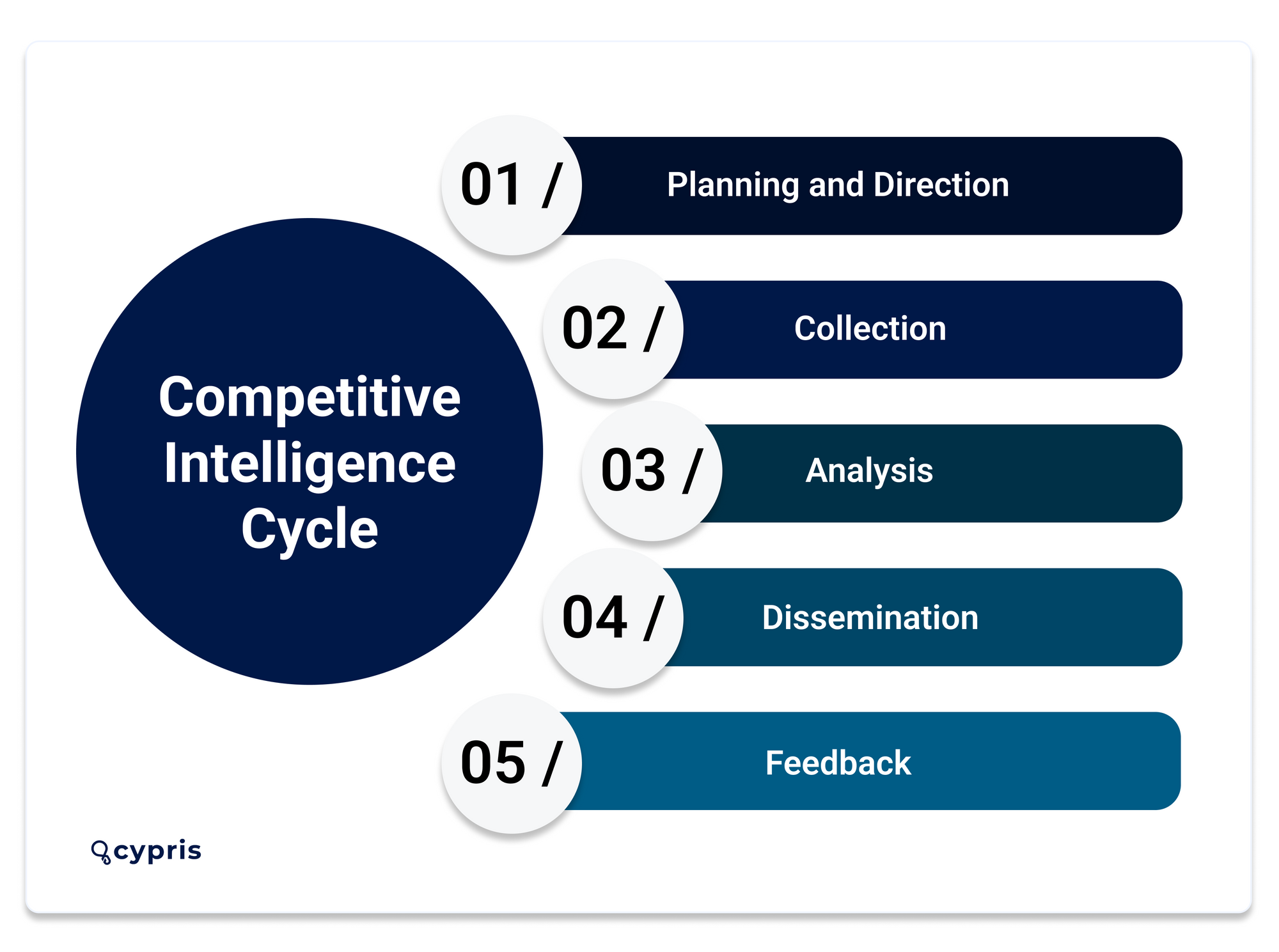
Competitive Intelligence (CI) is the process of analyzing, gathering, and using information collected on competitors, customers, and other market factors that contribute to your competitive advantage. Companies rely on CI data to develop effective and efficient business practices.
CI consists of two types of intelligence: tactical and strategic. Tactical is shorter-term intelligence, which seeks to provide input into issues like capturing market share or increasing revenues, while strategic focuses on longer-term issues, like key risks and opportunities facing the organization, and emerging trends and patterns.
Why competitive intelligence matters, particularly real-time CI.
Understanding competitor motivations and behaviors is critical to driving innovation, shaping product development, establishing pricing and brand positioning, and so much more. Companies must collect proper CI in order to identify challenges, advantages, and white spaces and build a competitive strategy equipped to compete and thrive.
Technology has transformed the CI industry, making it possible for organizations to compile data from multiple sources in a timely manner to facilitate rapid decision-making. Through actionable insights, companies can respond to changes in their markets quickly to keep up with competition. At the core of actionable insights is real-time CI. With real-time CI, companies deliver timely intelligence to the right people, increasing organizational agility.
When looking to collect CI, it’s important to plan out which insights are of value to you, how to identify your competitors, and which markets to spend time on. Take time to narrow in on your direct competitors, research objectives, and areas of interest.
Are companies focusing on CI? These metrics might surprise you.
90% of Fortune 500 companies practice competitive intelligence. (Source: Emerald Insight)
Over 73% of businesses are investing more than 20% of overall technology budgets on intelligence and data analytics. (Source: Forbes)
61% of executives view rapid decision-making and execution as essential factors for a company’s success, and 34% consider the ability to access the right information at the right time as key factors for a company’s success. (Source: The Economist)
69% of organizations that have used an external partner to gain better data insight report positive results from that decision. (Source: The Economist)
57% of companies state that gaining a competitive advantage is one of the top 3 priorities in their industry. (Source: Forbes)
The 6 ways CI benefits your organization.

CI empowers everyone on teams, from product managers and marketers, to sales and executive teams. With the right CI, you can:
Uncover Key Data Points: Through examining new data points like significant acquisitions, new patent filings, startup investments, technology transfer agreements, research papers, etc., you can uncover pivotal data points that have the potential to influence major decisions.
Plan Strategic Moves: CI facilitates building your long-term business strategy and finding market gaps, allowing you to make the right business decisions for your organization.
Track industry Trends: Live-data CI lets you watch for new technologies, track new movement, stay on top of industry innovation trends, and predict future movement.
Drive Innovation: CI helps you to identify new market opportunities and spaces to innovate, accelerate your new product development, design better products, and improve market positioning.
Outsmart Competition: Think of CI as competitive insurance to ensure you stay on top of competitor strengths and weaknesses, anticipate what they’re planning, and identify competitor position and messaging. With CI you can uncover new product launches and services your competitors are adding, and benchmark your company against others.
Minimize Risk: Making the wrong move is costly. CI helps you prevent unsuccessful projects from taking off, save on costs, and improve decision-making ROI. With CI data, you can identify and prioritize any gaps within your business, and feel comfortable knowing you're making data-backed decisions.
Where to go from here: Actionable intelligence platforms are here to help.
Manually collecting CI takes time, and is costly. Not to mention doing your own research digging on the Internet for low-hanging fruit means you'll likely miss key data points that don't provide you with the whole picture. In the time it takes traditional market intelligence or research analysts to gather data to build into basic and applied research reports, you can receive data automatically through a platform like Cypris.
Designed specifically to deliver actionable innovation intelligence to R&D teams, Cypris improves the efficiency of data collation and interpretation. By aggregating your desired data, Cypris enables users to answer critical questions that influence the brand, margin, and profitability of your organization. Users have identified new entrants, significant IP, groundbreaking research papers, and more that have ultimately swayed the course of major projects.
Ready for real-time data on your competitors? Visit cypris.ai to get started by booking a demo.
Sources:
https://www.jimmynewson.com/10-important-competitive-intelligence-statistics/
https://www.gartner.com/en/information-technology/glossary/ci-competitive-intelligence
https://www.antara.ws/en/blog/competitive-intelligence-benefits-for-the-company
Why Your Company Needs Competitive Intelligence



Competitive Intelligence (CI) is the process of analyzing, gathering, and using information collected on competitors, customers, and other market factors that contribute to your competitive advantage. Companies rely on CI data to develop effective and efficient business practices.
CI consists of two types of intelligence: tactical and strategic. Tactical is shorter-term intelligence, which seeks to provide input into issues like capturing market share or increasing revenues, while strategic focuses on longer-term issues, like key risks and opportunities facing the organization, and emerging trends and patterns.
Why competitive intelligence matters, particularly real-time CI.
Understanding competitor motivations and behaviors is critical to driving innovation, shaping product development, establishing pricing and brand positioning, and so much more. Companies must collect proper CI in order to identify challenges, advantages, and white spaces and build a competitive strategy equipped to compete and thrive.
Technology has transformed the CI industry, making it possible for organizations to compile data from multiple sources in a timely manner to facilitate rapid decision-making. Through actionable insights, companies can respond to changes in their markets quickly to keep up with competition. At the core of actionable insights is real-time CI. With real-time CI, companies deliver timely intelligence to the right people, increasing organizational agility.
When looking to collect CI, it’s important to plan out which insights are of value to you, how to identify your competitors, and which markets to spend time on. Take time to narrow in on your direct competitors, research objectives, and areas of interest.
Are companies focusing on CI? These metrics might surprise you.
90% of Fortune 500 companies practice competitive intelligence. (Source: Emerald Insight)
Over 73% of businesses are investing more than 20% of overall technology budgets on intelligence and data analytics. (Source: Forbes)
61% of executives view rapid decision-making and execution as essential factors for a company’s success, and 34% consider the ability to access the right information at the right time as key factors for a company’s success. (Source: The Economist)
69% of organizations that have used an external partner to gain better data insight report positive results from that decision. (Source: The Economist)
57% of companies state that gaining a competitive advantage is one of the top 3 priorities in their industry. (Source: Forbes)
The 6 ways CI benefits your organization.
CI empowers everyone on teams, from product managers and marketers, to sales and executive teams. With the right CI, you can:
Uncover Key Data Points: Through examining new data points like significant acquisitions, new patent filings, startup investments, technology transfer agreements, research papers, etc., you can uncover pivotal data points that have the potential to influence major decisions.
Plan Strategic Moves: CI facilitates building your long-term business strategy and finding market gaps, allowing you to make the right business decisions for your organization.
Track industry Trends: Live-data CI lets you watch for new technologies, track new movement, stay on top of industry innovation trends, and predict future movement.
Drive Innovation: CI helps you to identify new market opportunities and spaces to innovate, accelerate your new product development, design better products, and improve market positioning.
Outsmart Competition: Think of CI as competitive insurance to ensure you stay on top of competitor strengths and weaknesses, anticipate what they’re planning, and identify competitor position and messaging. With CI you can uncover new product launches and services your competitors are adding, and benchmark your company against others.
Minimize Risk: Making the wrong move is costly. CI helps you prevent unsuccessful projects from taking off, save on costs, and improve decision-making ROI. With CI data, you can identify and prioritize any gaps within your business, and feel comfortable knowing you're making data-backed decisions.
Where to go from here: Actionable intelligence platforms are here to help.
Manually collecting CI takes time, and is costly. Not to mention doing your own research digging on the Internet for low-hanging fruit means you'll likely miss key data points that don't provide you with the whole picture. In the time it takes traditional market intelligence or research analysts to gather data to build into basic and applied research reports, you can receive data automatically through a platform like Cypris.
Designed specifically to deliver actionable innovation intelligence to R&D teams, Cypris improves the efficiency of data collation and interpretation. By aggregating your desired data, Cypris enables users to answer critical questions that influence the brand, margin, and profitability of your organization. Users have identified new entrants, significant IP, groundbreaking research papers, and more that have ultimately swayed the course of major projects.
Ready for real-time data on your competitors? Visit cypris.ai to get started by booking a demo.
Sources:
https://www.jimmynewson.com/10-important-competitive-intelligence-statistics/
https://www.gartner.com/en/information-technology/glossary/ci-competitive-intelligence
https://www.antara.ws/en/blog/competitive-intelligence-benefits-for-the-company
Keep Reading

Direct air capture has moved from demonstration to first commercial plants, and its patent landscape is distinctive because DAC is not a single technology but a set of competing capture routes, each with its own chemistry and energy profile. DAC removes carbon dioxide directly from the atmosphere, where it is present at very low concentration, which makes the capture step energy-intensive and puts a premium on the materials and processes that do it efficiently. The routes divide into distinct regions of patenting: solid amine adsorption, in which amine groups grafted onto porous supports capture carbon dioxide at ambient temperature and release it with modest heat, suiting modular designs;¹ liquid alkaline absorption, in which a potassium or sodium hydroxide solution captures carbon dioxide and is regenerated through a high-temperature calcination loop, suiting large centralized plants; mineralization, which binds carbon dioxide to minerals at low cost but slow kinetics; and electrified regeneration, in which electricity rather than heat releases the captured carbon dioxide.²,³,⁴,⁵,⁶ Cutting across the routes are the sorbent and solvent chemistry, the air-contactor and module design, including structured-honeycomb contactors that lower pressure drop,⁷ the regeneration step, and sorbent durability. Because a viable plant depends on several of these layers, freedom-to-operate and white space analysis must span the routes and the layers together.
The landscape is being pulled forward by policy and by corporate demand. In the United States, the Department of Energy's Regional Direct Air Capture Hubs program, funded at roughly $3.5 billion under the Infrastructure Investment and Jobs Act, is standing up four commercial-scale hubs, each required to capture and store or utilize at least one million tonnes of carbon dioxide a year, alongside a network of feasibility-phase projects; the South Texas hub is among those that have advanced through award negotiations.⁸ The routes sit at different stages: solid amine systems are the most widely deployed in modular form, liquid alkaline systems operate at the largest single-plant scale, mineralization offers low capital cost at slow kinetics, and electrified regeneration is a fast-moving research and development area that the literature identifies as a promising near-term direction for solid-sorbent systems, spanning Joule-heated fiber sorbents,²,³ electrochemically mediated amine regeneration,⁴ redox-based electro-swing approaches,⁵ and microwave and induction heating.⁶,⁹ Across the Cypris corpus of more than 500 million patents and scientific papers, the DAC solid-sorbent set holds on the order of 887 families and grew from about 22 in 2021 to roughly 173 in 2024, with the most active assignees led by Robert Bosch, Siemens Energy, Shell, W.L. Gore, and X Development, and the United States, Germany, and China leading on geography; 2025 and 2026 counts are partial because of the publication lag.
The strategic question is which route and layer to back, and the white space sits where energy and durability are hardest. Sorbents with high carbon dioxide capacity, fast kinetics, and long cycle life are the central materials problem, and oxidative and humidity-driven degradation of amine sorbents is a persistent, high-value target,¹,¹⁰ with in-situ vapor and steam purges among the strategies that promote regeneration and stability.¹⁰ Regeneration is the other decisive layer, because it dominates energy use, so electrified and low-temperature regeneration that can run on renewable power is a fast-moving, comparatively open area,²,³,⁴,⁵,⁶ and cost-per-tonne remains a projection subject to techno-economic modeling.¹¹ Contactor and module engineering that cuts pressure drop and capital cost,⁷ and mineralization approaches that speed up kinetics, are further distinct layers. Reading the landscape by route, material, and step, and tracking both the patents and the underlying materials research, is what separates a crowded region from an open one.
Where the DAC white space is
Durable, high-capacity sorbents. Sorbents with high capacity, fast kinetics, and resistance to oxidative and humidity-driven degradation are the central materials problem and a high-value layer.¹,¹⁰
Electrified and low-temperature regeneration. Regeneration that uses electricity or low-grade heat, spanning Joule-heated, electrochemical, electro-swing, microwave, and induction approaches, is a fast-moving, comparatively open layer.²,³,⁴,⁵,⁶,⁹
Air-contactor and module engineering. Contactor and module designs, including structured honeycombs, that cut pressure drop, energy use, and capital cost are where deployment economics are decided.⁷
Mineralization kinetics. Approaches that speed up the low-cost but slow mineralization route are a distinct, differentiated area.
System and heat integration. Integrating DAC with low-grade waste heat, renewable power, and storage or utilization is a strategically important system layer.
How AI-powered landscape and white space analysis helps
Resolving a landscape that spans several capture routes, each with its own chemistry and energy profile, requires more than keyword search. AI-powered analysis addresses this with semantic search that clusters activity by route, material, and step across varied terminology, attribution that normalizes developer and academic filers to canonical entities, and continuous monitoring that keeps pace with a policy-driven surge. Because DAC advances appear in materials and separations literature before they are patented, reading both patents and literature gives the earliest signal of where low-energy, durable systems are emerging.
Where Cypris fits
Cypris runs patent landscape and white space analysis for multi-route materials fields such as direct air capture across a corpus of more than 500 million patents and scientific papers, organized through a proprietary R&D ontology. The ontology clusters activity by route, solid amine, liquid alkaline, mineralization, and electrified regeneration, and by layer, sorbent and solvent chemistry, contactor and module, and regeneration, and normalizes developer and academic filers to canonical entities, so a team can resolve which routes and layers are crowded and which remain open as white space, and can track new entrants as the field scales. Semantic search across patents and scientific literature connects filings to the underlying materials and separations research, which is where DAC advances appear first. Cypris Q, the platform's agentic layer, lets teams run landscape and white space analysis conversationally and chain the clustering, attribution, and gap analysis, and Agentic Monitoring tracks a defined route over time and flags new patents and papers as they publish. Cypris provides enterprise API partnerships with OpenAI, Anthropic, and Google, and is built with enterprise-grade security. Cypris serves hundreds of enterprise customers across pharmaceuticals, chemicals, advanced materials, energy, and other regulated industries.
FAQ
What is the direct air capture patent landscape? The direct air capture patent landscape is the set of patents covering technologies that remove carbon dioxide directly from ambient air. It divides across competing routes, solid amine adsorption, liquid alkaline absorption, mineralization, and electrified regeneration, plus sorbent, contactor, and regeneration IP. Each route is a distinct region of patenting.
Why is DAC energy-intensive? DAC is energy-intensive because carbon dioxide is present in air at very low concentration, so moving large volumes of air and then releasing the captured carbon dioxide from the sorbent or solvent takes significant energy, most of it in regeneration. Reducing that energy is the central challenge. It is why sorbent and regeneration IP is so valuable.
What routes does the DAC landscape cover? The landscape covers solid amine adsorption, which suits modular designs; liquid alkaline absorption, which suits large centralized plants; mineralization, which is low-cost but slow; and electrified regeneration, an emerging area. Each has distinct chemistry, energy needs, and maturity. Freedom-to-operate and white space analysis must treat them separately.
How large is the US DAC hubs program? The US Department of Energy's Regional Direct Air Capture Hubs program is funded at roughly $3.5 billion under the Infrastructure Investment and Jobs Act and is standing up four commercial-scale hubs, each required to capture and store or utilize at least one million tonnes of carbon dioxide a year. The South Texas hub is among those in award negotiations. It is the largest public DAC funding to date.
Where is the white space in DAC? The white space includes durable, high-capacity sorbents, electrified and low-temperature regeneration, air-contactor and module engineering, mineralization kinetics, and system and heat integration. The most deployed solid amine and liquid alkaline grounds are comparatively crowded. The most open, high-value opportunities are in sorbent durability and low-energy regeneration.
Why is regeneration such an important layer? Regeneration is important because releasing the captured carbon dioxide from the sorbent or solvent dominates a DAC plant's energy use and cost. Approaches that regenerate at lower temperature or with electricity, and can run on renewable power, directly improve economics and carbon balance. That makes regeneration a decisive, actively patented layer.
What software helps analyze the direct air capture patent landscape? Software for the DAC landscape should cluster activity by route and process layer, resolve developer and academic filers to canonical owners, search patents and scientific literature semantically, and monitor a policy-driven field continuously. Cypris does this across more than 500 million patents and scientific papers using a proprietary R&D ontology, semantic search, Cypris Q, and Agentic Monitoring.
Which teams use direct air capture patent landscape analysis? Direct air capture patent landscape analysis is used by R&D, innovation, IP, and strategy teams at carbon-removal, materials, chemicals, and energy companies, and their partners, as well as investors and policymakers. It informs which route to back, where to file, and where competitors are concentrated. Cypris serves hundreds of enterprise customers across advanced materials, energy, chemicals, and other regulated industries.
Endnotes
- Sun, X., et al. (2023). Chemisorption and regeneration of amine-based CO2 sorbents in direct air capture. Materials Today Sustainability, 22. https://doi.org/10.1016/j.mtsust.2023.100453
- Realff, M. J., Jones, C. W., Lively, R. P., et al. (2023). Sorbent-coated carbon fibers for direct air capture using electrically driven temperature swing adsorption. Joule, 7(7). https://doi.org/10.1016/j.joule.2023.05.016
- Park, H., et al. (2025). Design of electrified fiber sorbents for direct air capture with electrically driven temperature-vacuum-swing adsorption. Advanced Materials, 37. https://doi.org/10.1002/adma.202504542
- Stern, M. C., & Hatton, T. A. (2013). Bench-scale demonstration of CO2 capture with electrochemically mediated amine regeneration (EMAR). RSC Advances, 3. https://doi.org/10.1039/c3ra46774k
- Kim, S., Kang, J. S., & Hatton, T. A. (2021). Redox-responsive sorbents and mediators for electrochemically based CO2 capture. Current Opinion in Green and Sustainable Chemistry, 30. https://doi.org/10.1016/j.cogsc.2021.100504
- van der Wal, K., van Schagen, T. N., & Brilman, D. W. F. (2021). Through-flow microwave-based regenerator for sorbent-based direct air capture. Chemical Engineering Journal Advances, 8. https://doi.org/10.1016/j.ceja.2021.100187
- Boger, T., et al. (2026). Steam-based vacuum-temperature-swing adsorption with honeycomb amine sorbents for direct air capture. Carbon Capture Science & Technology, 20. https://doi.org/10.1016/j.ccst.2026.100654
- U.S. Department of Energy, Office of Clean Energy Demonstrations. Regional Direct Air Capture Hubs. https://www.energy.gov/oced/regional-direct-air-capture-hubs
- Thompson, S., et al. (2024). Magnetic-nanoparticle-induced sorbent regeneration for direct air capture. AIChE Journal, 70. https://doi.org/10.1002/aic.18500
- Webley, P. A., Li, S., Hu, X., et al. (2026). Promoting regeneration of PEI-impregnated sorbents through in-situ vapor purge for direct air capture. AIChE Journal, 72. https://doi.org/10.1002/aic.70571
- Pirngruber, G. D., et al. (2013). Theoretical analysis of energy consumption of TSA post-combustion capture with solid sorbents. International Journal of Greenhouse Gas Control, 14. https://doi.org/10.1016/j.ijggc.2013.01.010

An ontology is a formal, machine-readable specification of the concepts in a domain and the relationships among them. The term has a precise meaning in knowledge representation: an explicit specification of a conceptualization,¹ that is, a defined vocabulary of entity types, attributes, and relations, together with constraints on how they may be combined. This distinguishes an ontology from a flat taxonomy, which only arranges terms hierarchically; an ontology also encodes non-hierarchical relations, such as a material being used in a process or a method being applied to a claim. In R&D and patent intelligence, the ontology defines the domain schema: the technologies, materials, methods, claims, organizations, and research areas that matter, and the relationship types that connect them.²
A knowledge graph instantiates that schema over real data. It represents information as a graph of nodes and typed edges, commonly expressed as subject-predicate-object triples, linking specific patents, scientific papers, assignees, inventors, technologies, and materials as connected entities rather than isolated documents. Building the graph requires several engineering steps that determine its quality: named-entity recognition and relation extraction to convert unstructured patent and paper text into triples; entity resolution to normalize the many surface forms of an organization, inventor, or compound to a single canonical node; and provenance tracking so every assertion in the graph traces back to the source document that supports it. The result is a structure that can be queried declaratively, for example with a graph query language, and that supports multi-hop traversal, so a question can follow chains of relationships rather than matching a single string.
This structure matters because patents and scientific literature become intelligence only when their relationships are made explicit. A ranked list of relevant documents does not state how a technology area is organized, which organizations are active, how research connects to patents, or where the graph is sparse. An ontology-backed knowledge graph makes those relationships first-class and queryable. A team can ask how two technologies relate, which body of research underpins a patent cluster, which assignees co-file in an area, or where a domain is unclaimed, and receive an answer computed over structured connections rather than assembled by reading.
The 2026 relevance is that structured knowledge is the most reliable way to ground generative AI. Large language models produce fluent output but can assert unsupported claims when they generate from parametric memory over unstructured text. Retrieval-augmented generation (RAG), which conditions a model's output on retrieved external evidence, was introduced to address this and improves factual accuracy on knowledge-intensive tasks.³,⁴ Graph retrieval-augmented generation (GraphRAG) extends RAG by retrieving connected subgraphs rather than isolated passages, so the model reasons over entities and their relationships and can answer questions that require traversing multiple hops.⁵,⁶ Grounding a system on an ontology-backed knowledge graph constrains its outputs to real, connected entities, which is essential for patent and R&D work where every conclusion must trace to actual patents and papers, and where retrieval quality directly governs the reliability of downstream generation.⁷ It is also what makes agentic workflows dependable: an agent reasoning over a structured, provenance-tracked graph produces results a team can verify against sources.
What an ontology and knowledge graph add to patent intelligence
Multi-hop reasoning over relationships. A knowledge graph answers relational and multi-hop questions, such as how two technologies connect through shared materials or which research a patent cluster builds on, rather than only returning documents that match a query string.
Concept-organized semantic search. Dense semantic retrieval returns conceptually relevant documents; the ontology organizes that retrieval within a domain schema, improving both recall and the interpretability of results by grouping them under defined concepts.
White space analysis. White space analysis depends on clustering activity by concept to expose genuine gaps. Clustering patents and papers over the ontology's relationship structure exposes real conceptual sparsity rather than gaps that are artifacts of divergent terminology.
Entity-resolved attribution and competitive intelligence. Entity resolution normalizes assignee and inventor variants to canonical nodes, which lets the graph attribute filings and research accurately and build co-assignee and citation networks rather than a document list.
Provenance-grounded AI. The ontology and knowledge graph give AI agents a structured, provenance-tracked foundation to reason over, which improves the accuracy of agentic analysis and makes its results traceable to the specific patents and papers that support them.
Where Cypris fits
Cypris organizes a corpus of more than 500 million patents and scientific papers through a proprietary R&D ontology. That ontology is the core of the platform: it defines how technologies, claims, materials, methods, and research relate, so Cypris reasons over an entity-resolved relationship structure rather than only matching keywords. This structure powers dense semantic retrieval organized by concept, white space analysis that exposes genuine conceptual gaps, and competitive intelligence that attributes activity to canonical organizations and technology areas. Cypris Q, the platform's agentic layer, reasons over this provenance-tracked foundation, which is what makes its multi-step analysis both reliable and traceable to real patents and papers, consistent with graph-grounded retrieval approaches. Agentic Monitoring tracks a technology area over time against the same structure. Cypris provides enterprise API partnerships with OpenAI, Anthropic, and Google, so AI agents can query the structured corpus programmatically, and it is built with enterprise-grade security. Cypris serves hundreds of enterprise customers across pharmaceuticals, chemicals, advanced materials, energy, and other regulated industries.
FAQ
What is an ontology in R&D and patent intelligence?
An ontology in R&D and patent intelligence is a formal, machine-readable specification of the concepts in the domain and the relationships among them, defined as an explicit specification of a conceptualization. It sets out the entity types, such as technologies, materials, methods, and claims, and the relations that connect them. This lets a platform reason over connections between patents and scientific literature rather than treating documents as isolated.
How is an ontology different from a taxonomy?
An ontology differs from a taxonomy in expressiveness. A taxonomy arranges terms in a hierarchy, while an ontology also encodes non-hierarchical, typed relationships and constraints, such as a material being used in a process. This richer structure is what allows multi-hop reasoning across patents and research rather than simple category lookup.
What is a knowledge graph for patents?
A knowledge graph for patents represents patents, scientific papers, assignees, inventors, technologies, and materials as nodes connected by typed edges, commonly expressed as subject-predicate-object triples. It applies an ontology's schema to real data so relationships are explicit and queryable. This turns a document collection into a structure that supports declarative queries and multi-hop traversal.
How is a knowledge graph built from patent text?
A knowledge graph is built from patent text through named-entity recognition and relation extraction to convert unstructured text into triples, entity resolution to normalize variant names to canonical nodes, and provenance tracking so each assertion links back to its source document. The quality of these steps determines the reliability of the graph. Poor entity resolution, for example, fragments an organization across many nodes and distorts attribution.
Why do knowledge graphs matter for AI in patent research?
Knowledge graphs matter for AI in patent research because they ground generative models on real, connected entities, which improves accuracy and traceability. A model generating from unstructured text alone can assert unsupported claims, whereas one conditioned on a provenance-tracked graph constrains its answers to actual patents and papers. This is essential where conclusions must be verifiable.
What is GraphRAG and how does it differ from standard RAG? GraphRAG is graph retrieval-augmented generation. Standard RAG retrieves isolated text passages to condition a model's output, while GraphRAG retrieves connected subgraphs, so the model reasons over entities and their relationships and can answer multi-hop questions. This suits patent intelligence, where questions often require traversing links between technologies, research, and organizations.
How does an ontology improve white space analysis?
An ontology improves white space analysis by clustering patents and papers over defined relationships rather than by exact keywords, which exposes genuine conceptual gaps instead of gaps that are only artifacts of differing terminology. Because the sparsity reflects the domain structure, the identified white space corresponds to unclaimed technical territory. Cypris organizes its corpus of more than 500 million patents and scientific papers through a proprietary R&D ontology for this purpose.
How do knowledge graphs reduce AI hallucination in patent work?
Knowledge graphs reduce AI hallucination in patent work by constraining a model's outputs to real, connected entities with tracked provenance rather than letting it generate from unstructured text. Retrieval-augmented approaches, and graph-based retrieval in particular, condition generation on retrieved evidence, which improves factual accuracy and lets conclusions be traced to sources. This makes results verifiable against the underlying patents and papers.
Is a knowledge graph the same as a vector database?
A knowledge graph is not the same as a vector database. A vector database supports semantic similarity search over embeddings, while a knowledge graph represents explicit, typed relationships between entities. They are complementary: dense retrieval finds relevant documents, and the graph structures how those documents and entities relate. Cypris combines semantic retrieval with a proprietary R&D ontology.
Which teams benefit from ontology-based patent intelligence?
Ontology-based patent intelligence benefits R&D, innovation, IP, and strategy teams that need to understand how technologies relate, attribute activity to organizations, and find genuine white space. It is most valuable in research-intensive industries such as pharmaceuticals, chemicals, advanced materials, and energy. Cypris serves hundreds of enterprise customers across these industries.
Endnotes
- Gruber, T. R. (1993). A translation approach to portable ontology specifications. Knowledge Acquisition. https://doi.org/10.1006/knac.1993.1008
- Gruber, T. R. (1995). Toward principles for the design of ontologies used for knowledge sharing. International Journal of Human-Computer Studies. https://doi.org/10.1006/ijhc.1995.1081
- Lewis, P. et al. (2020). Retrieval-Augmented Generation for Knowledge-Intensive NLP Tasks. NeurIPS.
- Gao, Y. et al. (2023). Retrieval-Augmented Generation for Large Language Models: A Survey. arXiv:2312.10997. https://doi.org/10.48550/arxiv.2312.10997
- Procko, T. & Ochoa, O. (2024). Graph Retrieval-Augmented Generation for Large Language Models: A Survey. https://doi.org/10.1109/aixset62544.2024.00030
- Han, S. et al. (2025). A Survey of Graph Retrieval-Augmented Generation for Customized Large Language Models. arXiv:2501.13958. https://doi.org/10.48550/arxiv.2501.13958
- Chen, J. et al. (2024). Benchmarking Large Language Models in Retrieval-Augmented Generation. AAAI. https://doi.org/10.1609/aaai.v38i16.29728

Patent filings are a leading indicator of competitor R&D direction, and the lead time is a structural consequence of how the patent system operates. An application is filed at its priority date, well before the corresponding product reaches the market, and under the standard 18-month publication rule reflected in USPTO practice and PCT Article 21,⁵ it is not published until roughly eighteen months after that priority date. The interval between when a competitor commits R&D and when the public can observe it is therefore built into the system. The International Energy Agency treats patenting as a leading indicator of technological change in its innovation analysis,¹ and the same logic holds across sectors: a competitor's published filings reveal committed R&D direction ahead of the market, and studies of the linkage between scientific publication and patenting document a measurable lag between the two that compounds the observable lead time.² For R&D and competitive intelligence teams, this makes patents one of the most reliable forward-looking competitive signals available.
Reading that signal well requires structured analysis rather than filing counts, and several technical steps determine its accuracy. First, the unit of analysis should be the patent family, not the individual document, because a single invention generates multiple applications across jurisdictions; counting documents rather than families overstates activity and double-counts international coverage. Second, filings must be located in the technology space using classification codes, principally the Cooperative Patent Classification and International Patent Classification systems, which assign standardized technology categories independent of the applicant's terminology. Third, activity must be attributed through assignee disambiguation, normalizing the many name variants, subsidiaries, and transliterations of an organization to a single canonical entity, because unresolved assignee names fragment a competitor's portfolio and distort the picture. Fourth, the analysis should read the trend over time rather than the latest counts, because the most recent eighteen-to-twenty-four months of data are systematically under-represented by publication lag, so apparent recent declines are usually artifacts rather than real slowdowns.
Two network structures add depth beyond volume. Forward and backward citation analysis situates a competitor's filings in the flow of prior art: backward citations reveal the foundations a filing builds on, and forward citations indicate influence and where a technology is being extended. Co-assignee and knowledge-search network analysis reveals partnerships, academic-industry pipelines, and the coupling between organizations, which shape a competitor's future direction; network-embedding methods over these structures are an established competitive-intelligence technique.³ Scientific literature strengthens the signal further, because research is published before it is patented and patents are filed before products ship, so combining the two sources extends the observable lead time; the scientific footprint within a competitor's filings can be traced through their non-patent references.⁴
What competitor filings reveal
Technology direction. The classification areas where a competitor is filing show where R&D is being committed, often well before those commitments appear in products.
Intensity and momentum. The distribution and rate of change of filing activity across technology areas indicate priorities, and shifts in filing momentum signal changes in strategy earlier than raw counts.
Adjacent moves. Filings in classifications adjacent to a competitor's current products can signal diversification or expansion before it is announced.
Research foundations. The non-patent references and scientific literature a competitor's filings build on show the research base behind their direction, and rising related research is an earlier signal still.
Collaboration structure. Co-assignee patterns and citation coupling reveal partnerships and academic-industry pipelines; network analysis of these relationships is an established competitive-intelligence method.³
How to read competitor R&D direction
Define the competitors and the technology space, scoping the latter with classification codes so the boundary is standardized and reproducible.
Resolve assignees to canonical entities and aggregate to the patent-family level, so activity is attributed accurately and international coverage is not double-counted.
Cluster filings by concept using semantic analysis over the classification and text, so related work groups together regardless of terminology.
Analyze filing momentum as a time series, discounting the most recent windows for publication lag, since direction is visible in trends rather than in the latest bar.
Connect filings to their non-patent references and to the scientific literature, to extend the lead time and expose the research foundations.
Monitor continuously, because competitor direction is revealed by how activity shifts, and continuous monitoring captures those shifts as they publish.
Where Cypris fits
Cypris supports competitive intelligence across a corpus of more than 500 million patents and scientific papers, organized through a proprietary R&D ontology. The ontology and its entity resolution are what turn filings into direction: they normalize assignees to canonical organizations, aggregate to the family level, and cluster activity by concept, so a team sees where a competitor is moving rather than a list of documents. Dense semantic search across patents and scientific literature connects filings to their research foundations, which extends the lead time on the signal, and citation and co-assignee structures expose collaboration and influence. Cypris Q, the platform's agentic layer, lets teams analyze competitor direction conversationally and chain the attribution, clustering, and time-series analysis. Agentic Monitoring is central to this use case: it tracks defined competitors and technology areas over time and flags new filings and research as they publish, so competitive intelligence is continuous rather than a one-time report. Cypris provides enterprise API partnerships with OpenAI, Anthropic, and Google, so AI agents can query the corpus programmatically, and it is built with enterprise-grade security. Cypris serves hundreds of enterprise customers across pharmaceuticals, chemicals, advanced materials, energy, and other regulated industries.
FAQ
How do patent filings reveal competitor R&D direction?
Patent filings reveal competitor R&D direction because an application is filed at its priority date, before the product ships, and is published only about eighteen months later under the standard publication rule. This built-in lag means published filings show committed R&D ahead of the market. Reading the direction requires attributing filings to competitors and technology areas and analyzing where activity concentrates and shifts.
What is the 18-month publication rule?
The 18-month publication rule is the standard practice, reflected in USPTO procedure and PCT Article 21, under which a patent application is published approximately eighteen months after its earliest priority date. It creates a predictable interval between filing and public visibility. It is also why the most recent windows of filing data are under-represented and should not be read as slowdowns.
Why analyze patent families instead of individual documents?
Analyzing patent families instead of individual documents avoids double-counting, because a single invention generates multiple applications across jurisdictions. Counting documents overstates activity and conflates international coverage with genuine volume. The family is the correct unit for measuring how much distinct R&D a competitor is committing.
What role do classification codes play?
Classification codes, principally the Cooperative Patent Classification and International Patent Classification systems, assign standardized technology categories to filings independent of the applicant's wording. They let an analyst locate and compare activity in a technology space reproducibly. This is more reliable than keyword filtering, which varies with drafting style.
Why is assignee disambiguation important?
Assignee disambiguation is important because organizations appear under many name variants, subsidiaries, and transliterations, and unresolved names fragment a competitor's portfolio across multiple entities. Normalizing these to a single canonical entity is what makes attribution and trend analysis accurate. Poor disambiguation systematically distorts competitive intelligence.
How do citation networks support competitive intelligence?
Citation networks support competitive intelligence by situating filings in the flow of prior art. Backward citations reveal the foundations a filing builds on, and forward citations indicate influence and where a technology is being extended. Co-assignee and knowledge-search network analysis additionally reveals partnerships and academic-industry pipelines.
Why combine patents with scientific literature?
Combining patents with scientific literature extends the observable lead time, because research is published before it is patented and patents precede products. Rising research associated with a competitor, followed by early filings, is an earlier and stronger signal than filings alone. The scientific footprint within filings can be traced through their non-patent references.
Why not just count competitor patent filings?
Counting filings alone is misleading because recent counts are depressed by publication lag and raw volume does not indicate direction. The informative signal is which classification areas activity concentrates in and how that distribution changes over time. Family-level aggregation, classification analysis, and time-series momentum are what reveal direction.
Why is continuous monitoring important for competitive intelligence? Continuous monitoring is important because competitor direction is revealed by how activity changes, which a one-time report cannot capture, and because new filings and research publish constantly. A shift in a competitor's focus is only visible if the area is tracked over time. Cypris uses Agentic Monitoring to track competitors and technology areas and flag new activity as it publishes.
Which teams read competitor R&D direction from patents?
Reading competitor R&D direction from patents is done by competitive intelligence, R&D, innovation, strategy, and corporate development teams that need forward-looking awareness of competitor moves. It is most valuable in research-intensive industries such as pharmaceuticals, chemicals, advanced materials, and energy. Cypris serves hundreds of enterprise customers across these industries.
Endnotes
- International Energy Agency (2026). The State of Energy Innovation 2026. https://www.iea.org/reports/the-state-of-energy-innovation-2026
- Fukuzawa, N. & Ida, T. (2015). Science linkages between scientific articles and patents for leading scientists in the life and medical sciences field. Scientometrics. https://doi.org/10.1007/s11192-015-1795-z
- Yang, X. et al. (2024). Predicting patent transaction behaviour based on embedded features of knowledge search networks. Journal of Knowledge Management. https://doi.org/10.1108/jkm-12-2023-1220
- Callaert, J., Grouwels, J. & Van Looy, B. (2011). Delineating the scientific footprint in technology: identifying scientific publications within non-patent references. Scientometrics. https://doi.org/10.1007/s11192-011-0573-9
- World Intellectual Property Organization, PCT Article 21 (International Publication), and USPTO Manual of Patent Examining Procedure, on patent publication timing.