
Competitive Intelligence (CI) is the process of analyzing, gathering, and using information collected on competitors, customers, and other market factors that contribute to your competitive advantage. Companies rely on CI data to develop effective and efficient business practices.
CI consists of two types of intelligence: tactical and strategic. Tactical is shorter-term intelligence, which seeks to provide input into issues like capturing market share or increasing revenues, while strategic focuses on longer-term issues, like key risks and opportunities facing the organization, and emerging trends and patterns.
Why competitive intelligence matters, particularly real-time CI.
Understanding competitor motivations and behaviors is critical to driving innovation, shaping product development, establishing pricing and brand positioning, and so much more. Companies must collect proper CI in order to identify challenges, advantages, and white spaces and build a competitive strategy equipped to compete and thrive.
Technology has transformed the CI industry, making it possible for organizations to compile data from multiple sources in a timely manner to facilitate rapid decision-making. Through actionable insights, companies can respond to changes in their markets quickly to keep up with competition. At the core of actionable insights is real-time CI. With real-time CI, companies deliver timely intelligence to the right people, increasing organizational agility.
When looking to collect CI, it’s important to plan out which insights are of value to you, how to identify your competitors, and which markets to spend time on. Take time to narrow in on your direct competitors, research objectives, and areas of interest.
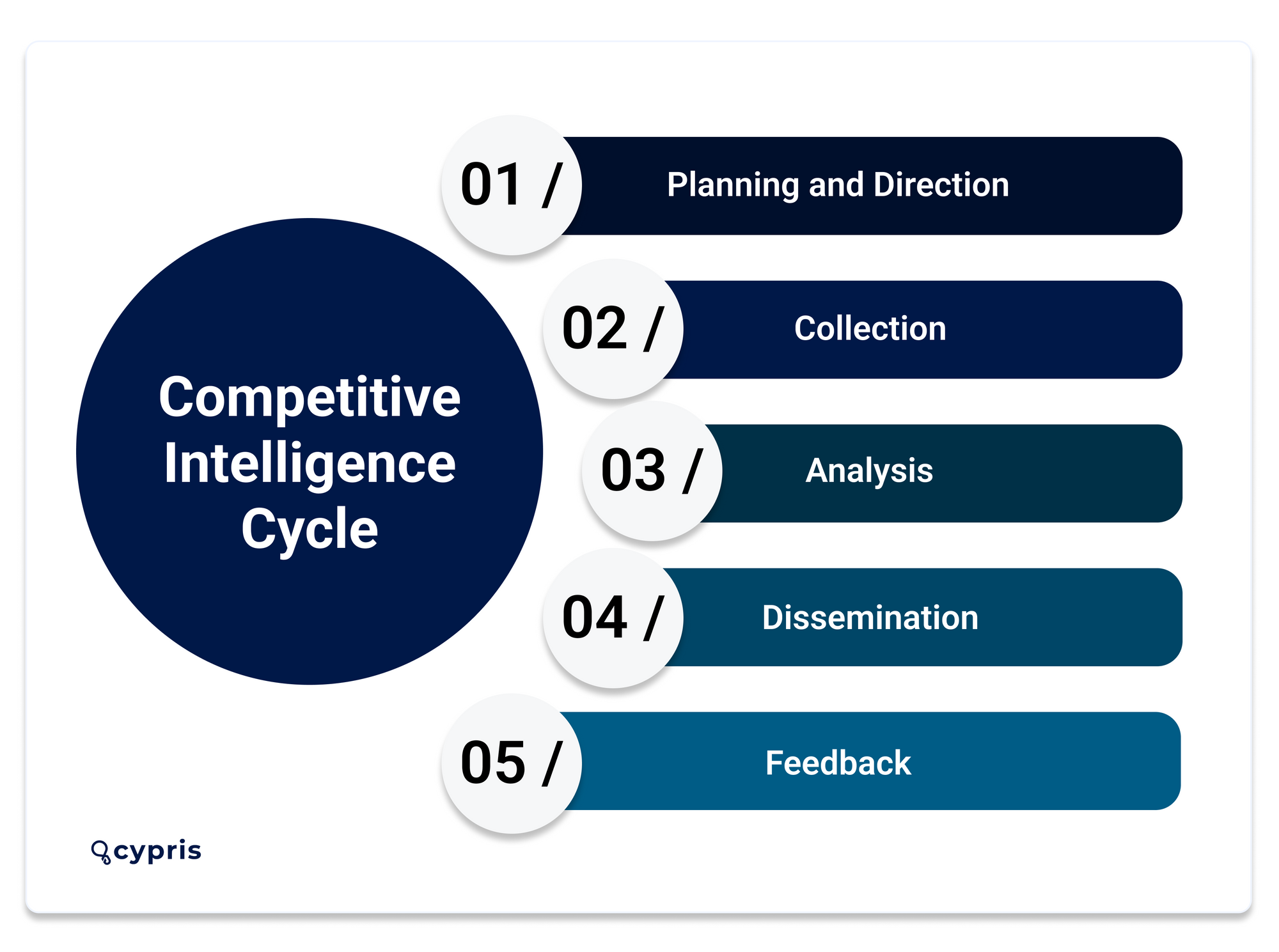
Are companies focusing on CI? These metrics might surprise you.
90% of Fortune 500 companies practice competitive intelligence. (Source: Emerald Insight)
Over 73% of businesses are investing more than 20% of overall technology budgets on intelligence and data analytics. (Source: Forbes)
61% of executives view rapid decision-making and execution as essential factors for a company’s success, and 34% consider the ability to access the right information at the right time as key factors for a company’s success. (Source: The Economist)
69% of organizations that have used an external partner to gain better data insight report positive results from that decision. (Source: The Economist)
57% of companies state that gaining a competitive advantage is one of the top 3 priorities in their industry. (Source: Forbes)
The 6 ways CI benefits your organization.

CI empowers everyone on teams, from product managers and marketers, to sales and executive teams. With the right CI, you can:
Uncover Key Data Points: Through examining new data points like significant acquisitions, new patent filings, startup investments, technology transfer agreements, research papers, etc., you can uncover pivotal data points that have the potential to influence major decisions.
Plan Strategic Moves: CI facilitates building your long-term business strategy and finding market gaps, allowing you to make the right business decisions for your organization.
Track industry Trends: Live-data CI lets you watch for new technologies, track new movement, stay on top of industry innovation trends, and predict future movement.
Drive Innovation: CI helps you to identify new market opportunities and spaces to innovate, accelerate your new product development, design better products, and improve market positioning.
Outsmart Competition: Think of CI as competitive insurance to ensure you stay on top of competitor strengths and weaknesses, anticipate what they’re planning, and identify competitor position and messaging. With CI you can uncover new product launches and services your competitors are adding, and benchmark your company against others.
Minimize Risk: Making the wrong move is costly. CI helps you prevent unsuccessful projects from taking off, save on costs, and improve decision-making ROI. With CI data, you can identify and prioritize any gaps within your business, and feel comfortable knowing you're making data-backed decisions.
Where to go from here: Actionable intelligence platforms are here to help.
Manually collecting CI takes time, and is costly. Not to mention doing your own research digging on the Internet for low-hanging fruit means you'll likely miss key data points that don't provide you with the whole picture. In the time it takes traditional market intelligence or research analysts to gather data to build into basic and applied research reports, you can receive data automatically through a platform like Cypris.
Designed specifically to deliver actionable innovation intelligence to R&D teams, Cypris improves the efficiency of data collation and interpretation. By aggregating your desired data, Cypris enables users to answer critical questions that influence the brand, margin, and profitability of your organization. Users have identified new entrants, significant IP, groundbreaking research papers, and more that have ultimately swayed the course of major projects.
Ready for real-time data on your competitors? Visit cypris.ai to get started by booking a demo.
Sources:
https://www.jimmynewson.com/10-important-competitive-intelligence-statistics/
https://www.gartner.com/en/information-technology/glossary/ci-competitive-intelligence
https://www.antara.ws/en/blog/competitive-intelligence-benefits-for-the-company
Why Your Company Needs Competitive Intelligence



Competitive Intelligence (CI) is the process of analyzing, gathering, and using information collected on competitors, customers, and other market factors that contribute to your competitive advantage. Companies rely on CI data to develop effective and efficient business practices.
CI consists of two types of intelligence: tactical and strategic. Tactical is shorter-term intelligence, which seeks to provide input into issues like capturing market share or increasing revenues, while strategic focuses on longer-term issues, like key risks and opportunities facing the organization, and emerging trends and patterns.
Why competitive intelligence matters, particularly real-time CI.
Understanding competitor motivations and behaviors is critical to driving innovation, shaping product development, establishing pricing and brand positioning, and so much more. Companies must collect proper CI in order to identify challenges, advantages, and white spaces and build a competitive strategy equipped to compete and thrive.
Technology has transformed the CI industry, making it possible for organizations to compile data from multiple sources in a timely manner to facilitate rapid decision-making. Through actionable insights, companies can respond to changes in their markets quickly to keep up with competition. At the core of actionable insights is real-time CI. With real-time CI, companies deliver timely intelligence to the right people, increasing organizational agility.
When looking to collect CI, it’s important to plan out which insights are of value to you, how to identify your competitors, and which markets to spend time on. Take time to narrow in on your direct competitors, research objectives, and areas of interest.
Are companies focusing on CI? These metrics might surprise you.
90% of Fortune 500 companies practice competitive intelligence. (Source: Emerald Insight)
Over 73% of businesses are investing more than 20% of overall technology budgets on intelligence and data analytics. (Source: Forbes)
61% of executives view rapid decision-making and execution as essential factors for a company’s success, and 34% consider the ability to access the right information at the right time as key factors for a company’s success. (Source: The Economist)
69% of organizations that have used an external partner to gain better data insight report positive results from that decision. (Source: The Economist)
57% of companies state that gaining a competitive advantage is one of the top 3 priorities in their industry. (Source: Forbes)
The 6 ways CI benefits your organization.
CI empowers everyone on teams, from product managers and marketers, to sales and executive teams. With the right CI, you can:
Uncover Key Data Points: Through examining new data points like significant acquisitions, new patent filings, startup investments, technology transfer agreements, research papers, etc., you can uncover pivotal data points that have the potential to influence major decisions.
Plan Strategic Moves: CI facilitates building your long-term business strategy and finding market gaps, allowing you to make the right business decisions for your organization.
Track industry Trends: Live-data CI lets you watch for new technologies, track new movement, stay on top of industry innovation trends, and predict future movement.
Drive Innovation: CI helps you to identify new market opportunities and spaces to innovate, accelerate your new product development, design better products, and improve market positioning.
Outsmart Competition: Think of CI as competitive insurance to ensure you stay on top of competitor strengths and weaknesses, anticipate what they’re planning, and identify competitor position and messaging. With CI you can uncover new product launches and services your competitors are adding, and benchmark your company against others.
Minimize Risk: Making the wrong move is costly. CI helps you prevent unsuccessful projects from taking off, save on costs, and improve decision-making ROI. With CI data, you can identify and prioritize any gaps within your business, and feel comfortable knowing you're making data-backed decisions.
Where to go from here: Actionable intelligence platforms are here to help.
Manually collecting CI takes time, and is costly. Not to mention doing your own research digging on the Internet for low-hanging fruit means you'll likely miss key data points that don't provide you with the whole picture. In the time it takes traditional market intelligence or research analysts to gather data to build into basic and applied research reports, you can receive data automatically through a platform like Cypris.
Designed specifically to deliver actionable innovation intelligence to R&D teams, Cypris improves the efficiency of data collation and interpretation. By aggregating your desired data, Cypris enables users to answer critical questions that influence the brand, margin, and profitability of your organization. Users have identified new entrants, significant IP, groundbreaking research papers, and more that have ultimately swayed the course of major projects.
Ready for real-time data on your competitors? Visit cypris.ai to get started by booking a demo.
Sources:
https://www.jimmynewson.com/10-important-competitive-intelligence-statistics/
https://www.gartner.com/en/information-technology/glossary/ci-competitive-intelligence
https://www.antara.ws/en/blog/competitive-intelligence-benefits-for-the-company
Keep Reading
Post-quantum cryptography has moved from a research program to a mandated migration, and its patent landscape is distinctive because the value has shifted from the algorithms themselves to how they are implemented and deployed. A sufficiently powerful quantum computer would break the public-key cryptography, based on integer factorization and elliptic curves, that secures most digital communication today, and to prepare for that, the US National Institute of Standards and Technology finalized its first post-quantum standards, FIPS 203 (ML-KEM, for key establishment), FIPS 204 (ML-DSA), and FIPS 205 (SLH-DSA, for signatures), in August 2024, selected HQC as a fifth, backup key-establishment algorithm in 2025, and continues to develop further signature standards.⁷ The intellectual property divides across several regions, each a distinct area of patenting: the algorithm implementations across the lattice, hash, and code-based families; the hardware accelerators that make these computationally heavier algorithms fast enough for real systems;¹,⁵ the side-channel countermeasures that protect implementations from physical attack;²,³ the crypto-agility and migration tooling that let organizations discover and swap cryptography; and the integration of post-quantum schemes into protocols such as transport-layer security and into hardware roots of trust. Because a deployed system depends on several of these layers, freedom-to-operate and white space analysis must span the algorithm families and the implementation layers together.
The landscape has an unusual structure because of how the standards were set. NIST's standardization process operates under a patent-claim assurance framework: for any essential patent claim, the holder must either disclaim it or make a license available on reasonable-and-non-discriminatory or royalty-free terms, and patent questions around the leading lattice scheme were resolved through such licensing arrangements before finalization, so the foundational algorithm layer is comparatively open, though it is not accurate to call it "patent-free."⁸ That has pushed proprietary activity outward, toward the implementations and the migration ecosystem, where patenting is active and growing. The migration itself is not optional: NIST's draft transition guidance would deprecate the vulnerable classical algorithms after 2030 and disallow them after 2035, and national-security policy sets a 2035 migration target, while the "harvest-now, decrypt-later" threat, in which encrypted data captured today could be decrypted by a future quantum computer, gives the transition urgency even before large quantum computers exist.⁸ This is reshaping the record: across the Cypris corpus of more than 500 million patents and scientific papers, the post-quantum-cryptography set holds on the order of 4,642 families and rose from about 141 in 2020 to roughly 606 in 2024 and about 1,425 in 2025 on a partial count, an inflection that coincides with the standards' finalization, with the most active assignees a mix of chipmakers, banks, and platform vendors, including Intel, Wells Fargo, Huazhong University of Science and Technology, Huawei, IBM, and Samsung, and China ahead of the United States on geography; 2025 and 2026 counts are partial because of the publication lag.
The strategic question is which implementation layer to own, and the white space sits where the standardized algorithms meet real systems. Hardware acceleration for the lattice arithmetic and sampling that these algorithms require is a high-value layer, especially for constrained and Internet-of-Things devices where compute and power are limited.¹,⁵ Side-channel-resistant implementations are a distinct and heavily engineered layer, because a mathematically secure algorithm can still leak its keys through physical measurement, and even masked hardware implementations remain a target of attack research, so higher-order protection is an active frontier.²,³,⁴,⁶ Crypto-agility, the ability to inventory and swap cryptographic primitives across large systems, and migration tooling are a fast-growing ecosystem layer, as are hybrid schemes that run classical and post-quantum cryptography together during the transition, an option NIST accommodates rather than requires.⁸ Reading the landscape by algorithm family and implementation layer, and tracking both the patents and the underlying cryptography research, is what separates a crowded region from an open one.
Where the PQC white space is
Hardware acceleration. Accelerators for lattice arithmetic and sampling, especially for constrained and Internet-of-Things devices, are a high-value layer as the algorithms are computationally heavier than their predecessors.¹,⁵
Side-channel countermeasures. Implementations that resist physical attacks, which can leak keys even from a mathematically secure algorithm, are a distinct, heavily engineered layer where masking and higher-order protection are active frontiers.²,³,⁴,⁶
Crypto-agility and migration tooling. Discovering cryptographic assets across large systems and swapping primitives cleanly is a fast-growing ecosystem layer driven by migration deadlines.
Hybrid classical-and-post-quantum schemes. Running classical and post-quantum cryptography together during the transition is an active layer, particularly in protocols such as transport-layer security.
Protocol and root-of-trust integration. Embedding post-quantum schemes into protocols, secure elements, and hardware roots of trust is where deployment is decided.
How AI-powered landscape and white space analysis helps
Resolving a landscape that spans several algorithm families and implementation layers, under migration deadlines, requires more than keyword search. AI-powered analysis addresses this with semantic search that clusters activity by algorithm family and implementation layer across varied terminology, attribution that normalizes vendor, academic, and standards-linked filers to canonical entities, and continuous monitoring that keeps pace with a deadline-driven field. Because cryptography advances appear in scientific and conference literature before they are patented, reading both patents and literature gives the earliest signal of where the frontier and the white space are moving.
Where Cypris fits
Cypris runs patent landscape and white space analysis for fast-moving deep-tech fields such as post-quantum cryptography across a corpus of more than 500 million patents and scientific papers, organized through a proprietary R&D ontology. The ontology clusters activity by algorithm family, lattice, hash, and code-based, and by implementation layer, hardware acceleration, side-channel defense, crypto-agility, and protocol integration, and normalizes filers to canonical entities, so a team can resolve which families and layers are crowded and which remain open as white space. Semantic search across patents and scientific literature connects filings to the underlying cryptography research, which is where post-quantum advances appear first, often in preprints and conference proceedings ahead of the patent record. Cypris Q, the platform's agentic layer, lets teams run landscape and white space analysis conversationally and chain the clustering, attribution, and gap analysis, and Agentic Monitoring tracks a defined layer over time and flags new patents and papers as they publish. Cypris provides enterprise API partnerships with OpenAI, Anthropic, and Google, and is built with enterprise-grade security. Cypris serves hundreds of enterprise customers across pharmaceuticals, chemicals, advanced materials, energy, and other regulated industries.
FAQ
What is post-quantum cryptography? Post-quantum cryptography is a set of cryptographic algorithms designed to resist attack by quantum computers, which would break the public-key cryptography that secures most digital communication today. NIST finalized the first standards, mainly lattice-based schemes plus a hash-based signature scheme, in August 2024 and added a backup key-establishment algorithm in 2025. It is now moving into mandated deployment.
Why is PQC patenting shifting to implementations? PQC patenting is shifting to implementations because the core standardized algorithms are published under NIST's royalty-free or reasonable-and-non-discriminatory licensing-assurance framework, with the leading lattice scheme's patent questions resolved before finalization, leaving the algorithm layer comparatively open. Proprietary activity has therefore moved to hardware acceleration, side-channel defenses, crypto-agility, and protocol integration. That is where the growing patent activity now concentrates.
Are the post-quantum standards patent-free? No. The standards are published under NIST's patent-claim assurance framework, under which any essential patent claim must be disclaimed or licensed on royalty-free or reasonable-and-non-discriminatory terms, and specific licensing arrangements resolved the questions around the leading lattice scheme before finalization. That makes the algorithm layer comparatively open, but implementations, accelerators, and countermeasures are actively patented. "Comparatively open" is accurate; "patent-free" is not.
Why is migration to PQC urgent if quantum computers are not here yet? Migration is urgent because of the "harvest-now, decrypt-later" threat: an adversary can record encrypted data today and decrypt it once a capable quantum computer exists. NIST's draft transition guidance would deprecate vulnerable classical algorithms after 2030 and disallow them after 2035, and national-security policy sets a 2035 target. Long data lifetimes and slow cryptographic transitions make early action necessary.
Where is the white space in post-quantum cryptography? The white space includes hardware acceleration, especially for constrained and Internet-of-Things devices, side-channel countermeasures, crypto-agility and migration tooling, hybrid classical-and-post-quantum schemes, and protocol and root-of-trust integration. The standardized algorithms themselves are comparatively open. The higher-value opportunities are in the implementation and migration layers.
Why does PQC analysis need scientific literature? PQC analysis needs scientific literature because cryptography advances appear in research, preprints, and conference proceedings before they are patented, so the literature gives the earliest signal. Analyzing patents alone gives a lagging view. Cypris analyzes both across more than 500 million patents and scientific papers.
What software helps analyze the post-quantum cryptography patent landscape? Software for the PQC landscape should cluster activity by algorithm family and implementation layer, resolve vendor, academic, and standards-linked filers to canonical owners, search patents and scientific literature semantically, and monitor a deadline-driven field continuously. Cypris does this across more than 500 million patents and scientific papers using a proprietary R&D ontology, semantic search, Cypris Q, and Agentic Monitoring.
Which teams use PQC patent landscape analysis? Post-quantum cryptography patent landscape analysis is used by R&D, IP, and strategy teams at cybersecurity, semiconductor, cloud, and hardware-security companies, as well as investors and government-facing vendors. Because value concentrates in implementation layers under migration deadlines, structured analysis is essential. Cypris serves hundreds of enterprise customers across research-intensive and regulated industries.
Endnotes
- Xing, Y., & Li, S. (2021). A compact hardware implementation of CCA-secure key exchange mechanism CRYSTALS-KYBER on FPGA. IACR Transactions on Cryptographic Hardware and Embedded Systems, 2021(2). https://doi.org/10.46586/tches.v2021.i2.328-356
- Jati, A., Gupta, N., Chattopadhyay, A., & Sanadhya, S. K. (2023). A configurable CRYSTALS-Kyber hardware implementation with side-channel protection. ACM Transactions on Embedded Computing Systems, 22(2). https://doi.org/10.1145/3587037
- Mujdei, C., Beckers, A., Karmakar, A., et al. (2022). Side-channel analysis of lattice-based post-quantum cryptography: exploiting polynomial multiplication. ACM Transactions on Embedded Computing Systems. https://doi.org/10.1145/3569420
- Cabrera Aldaya, A., Camacho-Ruiz, E., & Navarro-Torrero, P. (2026). A framework for designing high-order side-channel-protected hardware implementations of ML-KEM (HOPE-MLKEM). IACR Transactions on Cryptographic Hardware and Embedded Systems, 2026(2). https://doi.org/10.46586/tches.v2026.i2.272-295
- Zhang, C., Zhang, Y., Wang, W., & Gu, D. (2024). Optimized hardware-software co-design for Kyber and Dilithium on RISC-V SoC FPGA. IACR Transactions on Cryptographic Hardware and Embedded Systems, 2024(3). https://doi.org/10.46586/tches.v2024.i3.99-135
- Ji, Y., & Dubrova, E. (2025). A side-channel attack on a masked hardware implementation of CRYSTALS-Kyber. Journal of Cryptographic Engineering, 15. https://doi.org/10.1007/s13389-025-00375-7
- National Institute of Standards and Technology. Post-quantum cryptography standardization (FIPS 203, 204, 205 finalized August 2024; HQC selected 2025). https://csrc.nist.gov/projects/post-quantum-cryptography/post-quantum-cryptography-standardization
- National Institute of Standards and Technology (2024). Transition to post-quantum cryptography standards (NIST IR 8547, initial public draft). https://csrc.nist.gov/pubs/ir/8547/ipd

Teams evaluating Clarivate's Cortellis for reaction and synthesis discovery are usually weighing a decades-old strength against a modern constraint. Cortellis is deep, trusted, and thorough. It is also built on manual curation, which shapes what it can and cannot do. Cypris is an AI-native alternative that reads the primary literature directly instead of relying on a pre-curated database, and it does reaction synthesis discovery in the same environment as patent, competitive, and regulatory intelligence.
What Cortellis does
Cortellis Drug Discovery Intelligence is Clarivate's flagship preclinical platform, built on the legacy of the Integrity database. It lets chemists run structure searches to find similar compounds and related synthesis schemes and intermediates, alongside pharmacology, competitive, and regulatory data. Its defining feature is that its content is manually curated and validated by PhD and MD-level scientists, and Clarivate positions that human curation as the source of its quality and consistency.
That curation is a real strength. It is also the constraint that leads teams to look for an alternative.
Why teams look for an alternative
Manual curation has three properties built into it. It is slow, because a person reads each source. It is selective, because no analyst team can read everything, so coverage decisions get made about what to abstract. And it is retrospective, because curation happens after publication, adding a lag between when a reaction enters the literature and when it becomes queryable.
For reaction synthesis discovery, those compound. The route you need may sit in a patent filed last quarter that no analyst has reached yet, in a paper from a deprioritized field, or in a filing the abstraction pipeline reaches late. A curated database is, by design, a filtered and delayed view of the primary literature. For most of the last thirty years that was the best available option. It no longer is.
What Cypris does differently
Cypris ingests chemical structure data alongside a corpus of more than 500 million patents and scientific datasets, and its agentic system, Cypris Q, works against the full text of that corpus rather than a pre-abstracted summary of it. Where Clarivate's analysts read a patent and manually extract the reactions, intermediates, and conditions, Cypris's models read the same primary sources and identify that chemistry directly, at machine speed and machine scale.
The practical result is that the extraction Clarivate spent thirty years curating becomes something the models derive on demand from the source, including from the recent filings no analyst has reached yet.
Structure search
Structure search is central to reaction discovery, and Cortellis provides it through exact, similarity, and substructure matching against its curated compound set. Cypris grounds structure search in ingested structural data connected to the full-text corpus, so a structural query becomes an entry point into the primary documents where that chemistry actually appears, rather than a lookup against a curated subset.
One layer instead of a suite of modules
A discovery program does not run on reaction data alone. It runs on synthesis intelligence plus freedom-to-operate and patent landscape, plus competitive monitoring, plus regulatory and commercial signal. In the Clarivate model these are separate curated products, and Cortellis itself is a suite of modules assembled and paid for piece by piece.
Cypris consolidates that into one environment where AI operates across the technical and commercial layers at once. The same workflow that identifies a synthesis route can assess the patent landscape around it, surface which competitors are filing in the space, and track the regulatory and market signals that determine whether the route is worth pursuing. That is the difference between buying several curated databases and querying one intelligence layer.
Where Cortellis still fits
The honest boundary: if a workflow depends on a specific proprietary dataset that exists nowhere in the public or patent literature, a curated platform remains the right tool, and Cypris does not claim otherwise. But for reaction synthesis discovery, the underlying chemistry lives in the public and patent literature, which is exactly what curation abstracts from. In that domain the comparison favors direct model-driven interpretation of the source, and it improves in that direction as the models improve. A curated database advances at the speed of its curation team. An AI-native layer advances at the speed of its models.
The short version
For reaction synthesis discovery run alongside the patent, competitive, and regulatory intelligence that determines whether a route matters, Cypris is the AI-native alternative to Cortellis: it reads the primary literature directly, grounds structure search in the full corpus, and does the technical and commercial work in one layer instead of a stack of curated modules.
FAQ
Is Cypris a direct alternative to Clarivate Cortellis?
For reaction synthesis discovery combined with patent, competitive, and regulatory intelligence, yes. Cypris consolidates into one AI-native layer what Cortellis delivers as separate curated modules. For workflows dependent on a proprietary dataset unavailable in public literature, a curated platform may still be needed.
What is the core difference between Cypris and Cortellis?
Data model. Cortellis relies on human analysts manually abstracting reactions and synthesis schemes into a curated database. Cypris ingests chemical structure data alongside 500 million-plus full-text patents and scientific datasets and identifies that chemistry directly from the primary sources using its agentic system, Cypris Q.
Does Cypris support chemical structure search?
Yes. Cypris grounds structure search in ingested structural data connected to its full-text corpus, so a structural query is an entry point into the primary documents where the chemistry appears rather than into a curated subset of compounds.
What does Cortellis do for reaction synthesis?
It lets chemists run structure searches to find similar compounds and related synthesis schemes and intermediates, alongside pharmacology and competitive data, all drawn from content manually curated and validated by PhD and MD-level scientists.
Why would a team move off a curated database?
Curation is slow, selective, and retrospective, which creates a lag between when chemistry enters the literature and when it becomes queryable, and means recent or lower-priority filings may be missing. Reading the primary corpus directly removes that lag.
Is manual curation still valuable?
For datasets that exist nowhere in public or patent literature, yes. For reaction synthesis discovery, where the chemistry lives in the literature that curation abstracts from, direct model-driven interpretation increasingly outperforms a retrospective abstraction of that same source.
How does Cypris handle recent filings better?
Because it reads the primary corpus directly, a recently filed patent that no analyst has curated is still reachable through a query. Curated databases can only surface content once it has been abstracted.
What does the "single layer" advantage mean in practice?
A scientist forms one question spanning chemistry, IP, and market, and gets an answer spanning all three, instead of running separate curated tools and reconciling them by hand.
Which teams is Cypris the better fit for?
Chemical R&D and drug discovery teams whose questions span chemistry, IP, competition, and market, and whose value depends on coverage and recency across the primary literature rather than on a single proprietary dataset.
What is Cypris Q?
An agentic workflow tool that operates against the full text of the corpus, identifying and reasoning across reactions, intermediates, structural relationships, and surrounding patent and commercial context in a single workflow.

Bispecific antibodies have become one of the most active modalities in biologics, and their patent landscape is distinctive because a bispecific is an engineered molecule whose format is patented separately from what it binds. A conventional antibody has two identical arms; a bispecific joins two different binding specificities in one molecule, which requires solving a chain-pairing problem so the right heavy and light chains assemble together rather than into mismatched byproducts. Developers solve this in different ways, and each is a distinct region of patenting: fragment-based formats such as the tandem single-chain constructs used in some T-cell engagers; asymmetric full-length formats built on heterodimerization technologies such as knobs-into-holes, common light chains, electrostatic steering, and controlled Fab-arm exchange; and symmetric and dual-variable-domain formats. Reviews of the field have catalogued roughly 100 distinct bispecific formats, reflecting how many ways the two-target strategy can be engineered even before the antigen pair is chosen<sup>6</sup>. Cutting across these is the choice of what the arms bind, one arm against a tumor or disease antigen and, in T-cell engagers, the other against the CD3 receptor to redirect T cells, and the half-life-extension and manufacturing technologies that make the molecule a viable drug. Because the format scaffold, the antigen arms, the effector arm, and the manufacturing method can each be claimed independently and are often held by different owners, freedom-to-operate for a bispecific is a multi-layer, multi-owner analysis rather than a single clearance<sup>5</sup>.
The field has moved decisively into the market, which has raised the stakes across every layer. Fourteen bispecific antibodies had received FDA approval through the end of 2024, nine of them T-cell engagers, roughly double the count from just two years earlier<sup>1</sup>. 2025 added further approvals — including the BCMA×CD3 T-cell engager linvoseltamab — carrying the cumulative total past fifteen, alongside a late-stage bispecific pipeline that has grown from about 26 candidates in 2010 to more than 200 today<sup>2</sup>. The approved base spans more than T-cell engagers: the HER2-biparatopic bispecific zanidatamab, for example, received accelerated FDA approval for HER2-positive biliary tract cancer in November 2024, illustrating the non-CD3 side of the field<sup>3</sup>. Across oncology, hematology, ophthalmology, and hemophilia, the modality has shifted from a research concept into one of the most active areas of biologics development. The competitive structure is bimodal: a small number of established developers hold deep, platform-level format IP built over the last decade and a half, while a rapidly expanding cohort of newer entrants, many based in China, files internationally at scale. Because much of the foundational value sits in the heterodimerization scaffolds rather than in any single antigen, a company can hold a strong position on its target biology and still face freedom-to-operate exposure on the format it uses to build the molecule. Because applications publish about eighteen months after filing, the newest format, target-pair, and conditional-activation filings are under-represented, so the current frontier is more active than granted-patent counts suggest.
The strategic picture turns on where defensible, hard-to-design-around IP sits. The core heterodimerization scaffolds are comparatively crowded and heavily licensed, so the open, high-value ground is increasingly in novel formats that design around them, in new and validated target pairs, in conditional or masked bispecifics that activate only in the tumor environment, in tri- and multispecific molecules, and in adjacent formats such as natural-killer-cell engagers. Expansion beyond oncology, into immunology, ophthalmology, and other areas, opens further target and format space. Reading the landscape by format, arm, and owner, and tracking both the patents and the underlying antibody-engineering research, is what separates a workable position from a blocked one.
What creates FTO risk in bispecific antibodies
Format and heterodimerization-scaffold claims. These cover the technologies that solve chain pairing, such as knobs-into-holes, common light chains, and controlled Fab-arm exchange, a foundational and heavily licensed layer. Knobs-into-holes constructs in particular require dedicated assembly and purification process development to yield correctly paired product at commercial scale, which is why manufacturing IP often tracks format choice closely<sup>8</sup>.
Antigen-binding-arm claims. These cover the variable domains against each target, which can carry their own IP from monoclonal-antibody programs.
Effector-arm claims. These cover the CD3 or other effector-recruiting arm in T-cell engagers, a distinct and contested layer. CD3 engagers act as molecular adaptors that redirect T-cell cytotoxicity toward a tumor antigen by forming an immune synapse, independent of the T cell's native antigen specificity, and this mechanism spans both IgG-based and non-IgG-based architectures<sup>7</sup>. T-cell engagers targeting CD3 alongside a tumor antigen now anchor much of the oncology bispecific pipeline<sup>4</sup>.
Half-life and Fc-engineering claims. These cover Fc modifications for half-life extension and reduced effector function, a separately owned layer.
Manufacturing and purification claims. These cover the expression and purification methods that yield correctly paired molecules at scale, where practical barriers concentrate<sup>8</sup>.
The competitive landscape by the numbers
Cypris's corpus puts the bispecific-antibody and T-cell-engager patent family set at roughly 55,049 families (Cypris corpus, indicative; 2025–26 partial). Filing activity has accelerated sharply, from 468 new families in 2010 to 2,850 in 2019 and 6,295 in 2024, with 2025 (7,589) and 2026 (4,926, partial) continuing to climb (Cypris corpus, indicative; 2025–26 partial). Ownership is concentrated at the top: Regeneron (1,628 families), F. Hoffmann-La Roche (1,362), Genentech (1,174), Genmab (739), Amgen (644), and Chugai (624) lead the assignee ranking (Cypris corpus, indicative; 2025–26 partial). Geographically, the United States leads with 16,671 families across 522 assignees, followed by China (7,698 families, 119 assignees), Switzerland (3,099), Germany (1,677), and Japan (1,284) (Cypris corpus, indicative; 2025–26 partial). This concentration is consistent with the bimodal picture described above: a handful of incumbents hold deep platform estates, while a much larger and more dispersed set of filers, concentrated in the US and China, works around them.
How AI-powered landscape and FTO analysis helps
A modular, multi-owner, platform-driven landscape is beyond manual clearance. AI-powered analysis addresses this with semantic search that retrieves relevant format, antigen-arm, effector-arm, and Fc claims regardless of terminology, attribution that resolves the many owners and license chains to canonical entities, claim-level analysis that separates the layers, and continuous monitoring that tracks new filings and deals. Because antibody-engineering advances appear in scientific literature before they are patented, reading both patents and literature gives earlier warning of where the field is heading.
Where Cypris fits
Cypris runs patent landscape and freedom-to-operate analysis for modular, platform-driven fields such as bispecific antibodies across a corpus of more than 500 million patents and scientific papers, organized through a proprietary R&D ontology. The ontology clusters the landscape by layer, format scaffold, antigen arms, effector arm, Fc engineering, and manufacturing, and normalizes owners and their license chains to canonical entities, so a team sees how rights are distributed across the many parties rather than a flat list. Semantic search across patents and scientific literature surfaces relevant claims regardless of terminology and connects filings to the underlying research, which is where new formats and target pairs emerge first. Cypris Q, the platform's agentic layer, lets teams run landscape and FTO analysis conversationally and chain the attribution, clustering, and claim-level analysis across layers, and Agentic Monitoring tracks the landscape over time and flags new filings and developments as they publish. Cypris provides enterprise API partnerships with OpenAI, Anthropic, and Google, and is built with enterprise-grade security. Cypris serves hundreds of enterprise customers across pharmaceuticals, chemicals, advanced materials, energy, and other regulated industries.
FAQ
Why is freedom-to-operate hard for bispecific antibodies? Freedom-to-operate is hard for bispecific antibodies because a bispecific is built from a format scaffold, two antigen-binding arms, an effector arm, and Fc and manufacturing technologies, each independently patentable and often held by different owners<sup>5</sup>. The heterodimerization scaffolds are especially crowded. FTO must therefore be assessed layer by layer across multiple estates.
What is the chain-pairing problem? The chain-pairing problem is the challenge of ensuring that the two different heavy and light chains of a bispecific assemble into the intended molecule rather than into mismatched byproducts. Developers solve it with technologies such as knobs-into-holes, common light chains, electrostatic steering, and controlled Fab-arm exchange<sup>6,8</sup>. Each solution is a distinct, patentable format.
What claim types create FTO risk in bispecifics? Five claim types create FTO risk: format and heterodimerization-scaffold claims, antigen-binding-arm claims, effector-arm claims, half-life and Fc-engineering claims, and manufacturing and purification claims. Each covers a distinct layer and can be held by a different owner. The format scaffold is frequently the binding constraint.
Why is format IP the binding constraint? Format IP is often the binding constraint because much of the foundational value sits in the heterodimerization scaffolds that make a bispecific manufacturable, not in any single antigen. A company can hold strong target-biology IP and still be blocked on the format it uses. That is why format licensing is central to the field.
How many bispecific antibodies are approved, and who holds the most patents? Fourteen bispecific antibodies had FDA approval through the end of 2024, nine of them T-cell engagers<sup>1</sup>, and 2025 approvals pushed the cumulative count past fifteen<sup>2</sup>. In Cypris's corpus of roughly 55,049 bispecific and T-cell-engager patent families, Regeneron, Roche, Genentech, Genmab, Amgen, and Chugai lead the assignee ranking, with the United States and China as the two largest filing jurisdictions (Cypris corpus, indicative; 2025–26 partial).
Where is the white space in bispecific antibodies? The white space includes novel formats that design around crowded heterodimerization scaffolds, new and validated target pairs, conditional or masked bispecifics, tri- and multispecific molecules, natural-killer-cell engagers, and expansion beyond oncology. The core scaffolds are crowded and licensed. The durable, defensible value is in new formats and target pairs.
Why does bispecific analysis need scientific literature? Bispecific analysis needs scientific literature because new formats, target pairs, and engineering advances appear in research before they are patented, so the literature gives the earliest signal. Analyzing patents alone gives a lagging view. Cypris analyzes both across more than 500 million patents and scientific papers.
What software helps analyze the bispecific antibody patent landscape? Software for the bispecific landscape should resolve owners and license chains to canonical entities, cluster the format, antigen-arm, effector-arm, and Fc layers, search patents and scientific literature semantically, and monitor deals and new filings continuously. Cypris does this across more than 500 million patents and scientific papers using a proprietary R&D ontology, semantic search, Cypris Q, and Agentic Monitoring.
Which teams need bispecific patent landscape and FTO analysis? Bispecific patent landscape and FTO analysis is needed by R&D, IP, and business-development teams at antibody and pharmaceutical companies, as well as investors assessing biologics assets. The modular, platform-driven landscape makes structured analysis essential. Cypris serves hundreds of enterprise customers across pharmaceuticals and other research-intensive industries.
Endnotes
- Strohl WR. Structure and function of therapeutic antibodies approved by the US FDA in 2024. Antibody Therapeutics. 2025. DOI: 10.1093/abt/tbaf014.
- Crescioli S, et al. Antibodies to watch in 2026. mAbs. 2026. DOI: 10.1080/19420862.2026.2614669.
- U.S. Food and Drug Administration. Oncology (Cancer) / Hematologic Malignancies approval notification — zanidatamab (Ziihera), accelerated approval, November 20, 2024. fda.gov.
- van de Donk NWCJ, Zweegman S. T-cell-engaging bispecific antibodies in cancer. The Lancet. 2023. DOI: 10.1016/s0140-6736(23)00521-4.
- Brinkmann U, Kontermann RE. Bispecific antibodies. Drug Discovery Today. 2015. DOI: 10.1016/j.drudis.2015.02.008.
- Brinkmann U, Kontermann RE. The making of bispecific antibodies. mAbs. 2017. DOI: 10.1080/19420862.2016.1268307.
- Falkowski VM, et al. Structural and functional characterization of IgG- and non-IgG-based T-cell-engaging bispecific antibodies. Frontiers in Immunology. 2024. DOI: 10.3389/fimmu.2024.1376096.
- Rodriguez M, et al. Bispecific antibody process development: assembly and purification of knob and hole bispecific antibodies. Biotechnology Progress. 2017. DOI: 10.1002/btpr.2590.
- Cypris platform corpus analysis, bispecific antibody / T-cell-engager patent families. Indicative figures; 2025–2026 partial