

Resources
Guides, research, and perspectives on R&D intelligence, IP strategy, and the future of AI enabled innovation.

Executive Summary
In 2024, US patent infringement jury verdicts totaled $4.19 billion across 72 cases. Twelve individual verdicts exceeded $100million. The largest single award—$857 million in General Access Solutions v.Cellco Partnership (Verizon)—exceeded the annual R&D budget of many mid-market technology companies. In the first half of 2025 alone, total damages reached an additional $1.91 billion.
The consequences of incomplete patent intelligence are not abstract. In what has become one of the most instructive IP disputes in recent history, Masimo’s pulse oximetry patents triggered a US import ban on certain Apple Watch models, forcing Apple to disable its blood oxygen feature across an entire product line, halt domestic sales of affected models, invest in a hardware redesign, and ultimately face a $634 million jury verdict in November 2025. Apple—a company with one of the most sophisticated intellectual property organizations on earth—spent years in litigation over technology it might have designed around during development.
For organizations with fewer resources than Apple, the risk calculus is starker. A mid-size materials company, a university spinout, or a defense contractor developing next-generation battery technology cannot absorb a nine-figure verdict or a multi-year injunction. For these organizations, the patent landscape analysis conducted during the development phase is the primary risk mitigation mechanism. The quality of that analysis is not a matter of convenience. It is a matter of survival.
And yet, a growing number of R&D and IP teams are conducting that analysis using general-purpose AI tools—ChatGPT, Claude, Microsoft Co-Pilot—that were never designed for patent intelligence and are structurally incapable of delivering it.
This report presents the findings of a controlled comparison study in which identical patent landscape queries were submitted to four AI-powered tools: Cypris (a purpose-built R&D intelligence platform),ChatGPT (OpenAI), Claude (Anthropic), and Microsoft Co-Pilot. Two technology domains were tested: solid-state lithium-sulfur battery electrolytes using garnet-type LLZO ceramic materials (freedom-to-operate analysis), and bio-based polyamide synthesis from castor oil derivatives (competitive intelligence).
The results reveal a significant and structurally persistent gap. In Test 1, Cypris identified over 40 active US patents and published applications with granular FTO risk assessments. Claude identified 12. ChatGPT identified 7, several with fabricated attribution. Co-Pilot identified 4. Among the patents surfaced exclusively by Cypris were filings rated as “Very High” FTO risk that directly claim the technology architecture described in the query. In Test 2, Cypris cited over 100 individual patent filings with full attribution to substantiate its competitive landscape rankings. No general-purpose model cited a single patent number.
The most active sectors for patent enforcement—semiconductors, AI, biopharma, and advanced materials—are the same sectors where R&D teams are most likely to adopt AI tools for intelligence workflows. The findings of this report have direct implications for any organization using general-purpose AI to inform patent strategy, competitive intelligence, or R&D investment decisions.

1. Methodology
A controlled comparative evaluation was conducted on March 27, 2026. An identical patent landscape query was submitted verbatim to each platform under standardized testing conditions. No follow-up prompts, clarifications, or iterative refinements were permitted, ensuring that each platform was evaluated based solely on its initial response.
The outputs were preserved in their original form and evaluated against predefined criteria using publicly verifiable patent records.
1.1 Query
Identify all active US patents and published applications filed in the last 5 years related to solid-state lithium-sulfur battery electrolytes using garnet-type ceramic materials. For each, provide the assignee, filing date, key claims, and current legal status. Highlight any patents that could pose freedom-to-operate risks for a company developing a Li₇La₃Zr₂O₁₂(LLZO)-based composite electrolyte with a polymer interlayer.
1.2 Tools Evaluated

1.3 Evaluation Criteria
Each response was evaluated using a consistent six-part scoring framework: patent coverage, assignee accuracy, filing metadata completeness, depth of claim analysis, quality of FTO risk stratification, and the presence of actionable strategic guidance.
Patent numbers, assignees, filing information, and legal status were independently checked against publicly available USPTO and WIPO records. The evaluation focused on the completeness, accuracy, and practical utility of each platform’s output rather than writing quality or presentation.
2. Findings
2.1 Coverage Gap
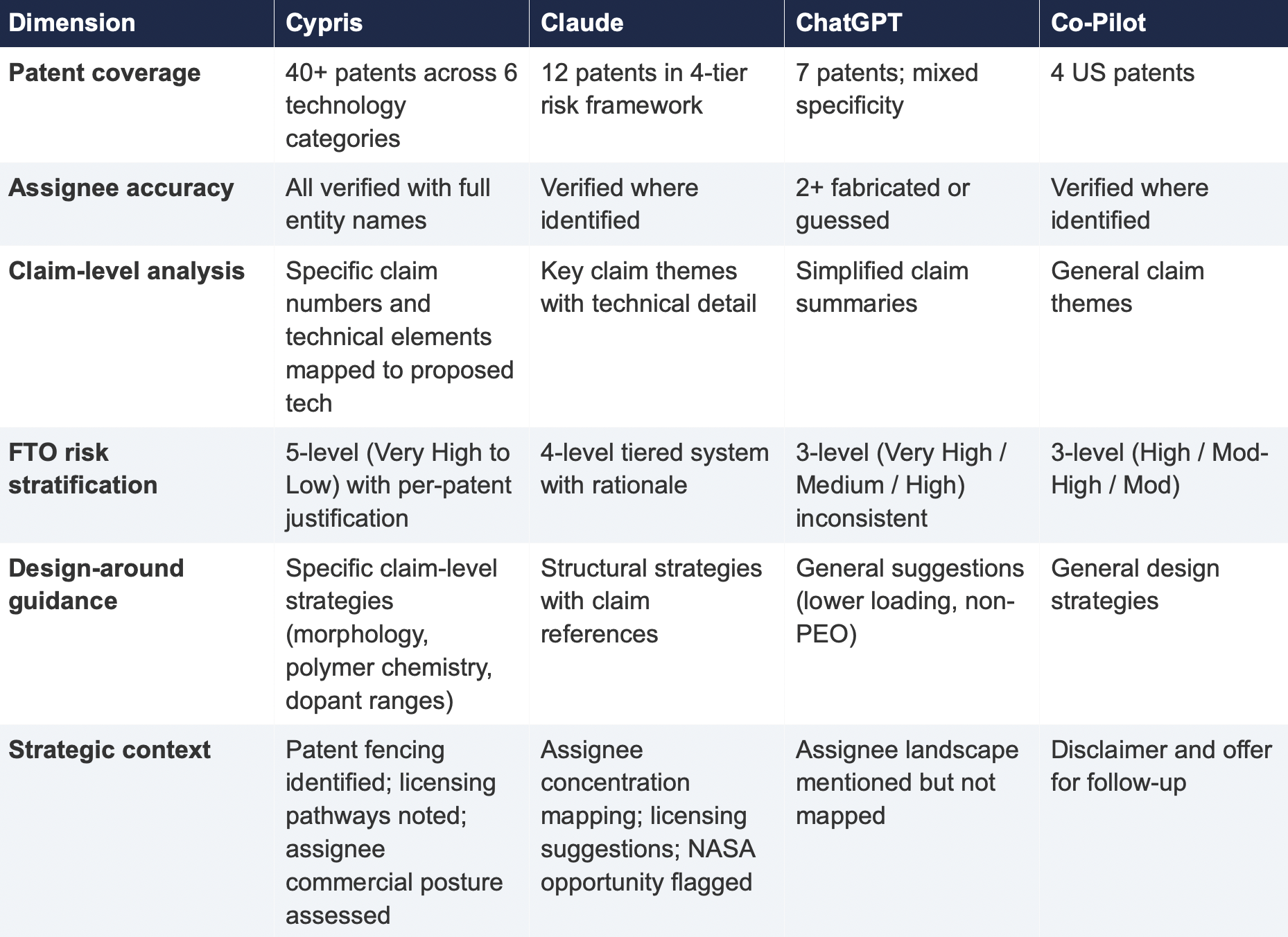
The most significant finding is the scale of the coverage differential. Cypris identified over 40 active US patents and published applications spanning LLZO-polymer composite electrolytes, garnet interface modification, polymer interlayer architectures, lithium-sulfur specific filings, and adjacent ceramic composite patents. The results were organized by technology category with per-patent FTO risk ratings.
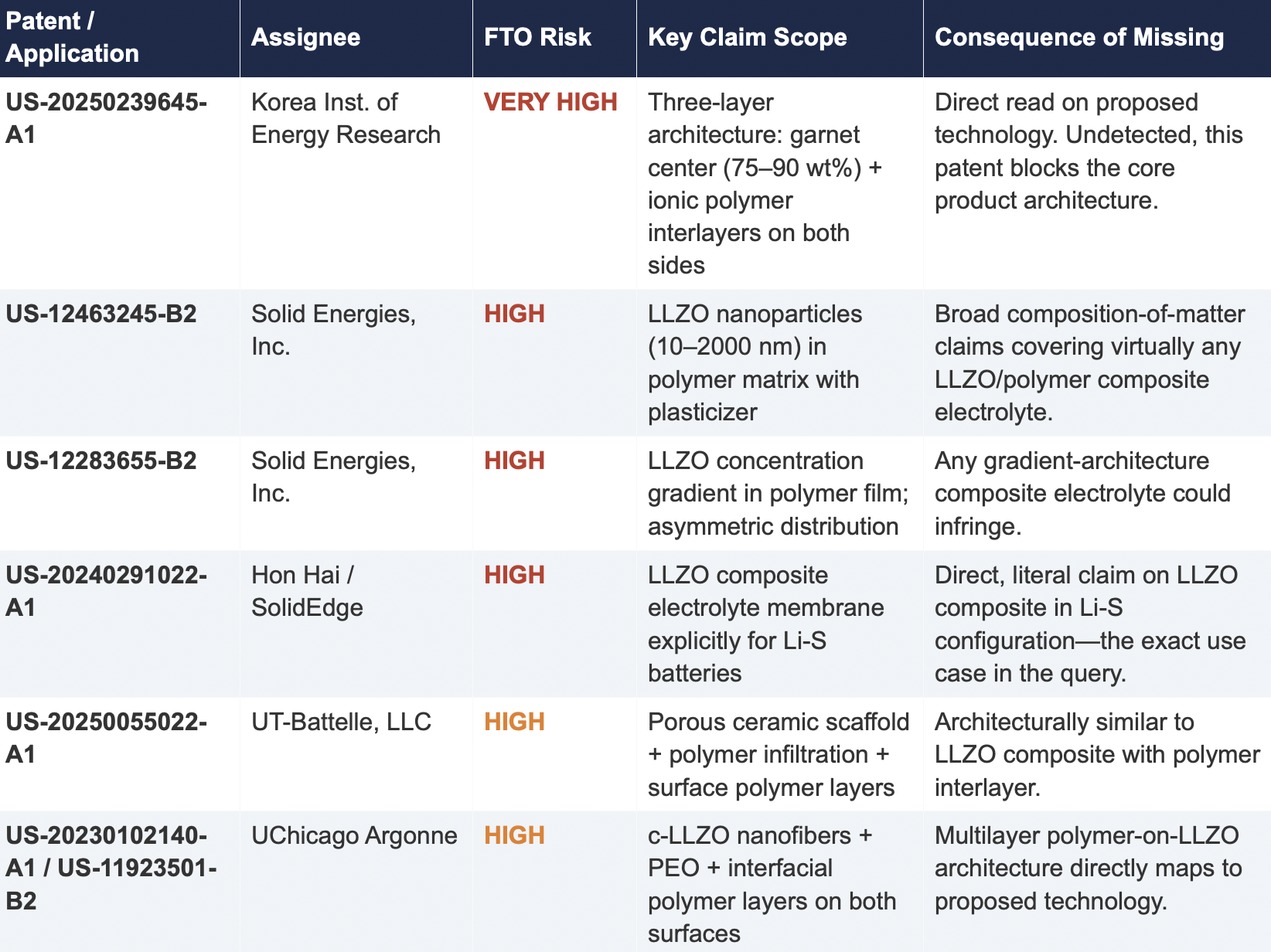
Claude identified 12 patents organized in a four-tier risk framework. Its analysis was structurally sound and correctly flagged the two highest-risk filings (Solid Energies US 11,967,678 and the LLZO nanofiber multilayer US 11,923,501). It also identified the University ofMaryland/ Wachsman portfolio as a concentration risk and noted the NASA SABERS portfolio as a licensing opportunity. However, it missed the majority of the landscape, including the entire Corning portfolio, GM's interlayer patents, theKorea Institute of Energy Research three-layer architecture, and the HonHai/SolidEdge lithium-sulfur specific filing.
ChatGPT identified 7 patents, but the quality of attribution was inconsistent. It listed assignees as "Likely DOE /national lab ecosystem" and "Likely startup / defense contractor cluster" for two filings—language that indicates the model was inferring rather than retrieving assignee data. In a freedom-to-operate context, an unverified assignee attribution is functionally equivalent to no attribution, as it cannot support a licensing inquiry or risk assessment.
Co-Pilot identified 4 US patents. Its output was the most limited in scope, missing the Solid Energies portfolio entirely, theUMD/ Wachsman portfolio, Gelion/ Johnson Matthey, NASA SABERS, and all Li-S specific LLZO filings.
2.2 Critical Patents Missed by Public Models
The following table presents patents identified exclusively by Cypris that were rated as High or Very High FTO risk for the proposed technology architecture. None were surfaced by any general-purpose model.
2.3 Patent Fencing: The Solid Energies Portfolio
Cypris identified a coordinated patent fencing strategy by Solid Energies, Inc. that no general-purpose model detected at scale. Solid Energies holds at least four granted US patents and one published application covering LLZO-polymer composite electrolytes across compositions(US-12463245-B2), gradient architectures (US-12283655-B2), electrode integration (US-12463249-B2), and manufacturing processes (US-20230035720-A1). Claude identified one Solid Energies patent (US 11,967,678) and correctly rated it as the highest-priority FTO concern but did not surface the broader portfolio. ChatGPT and Co-Pilot identified zero Solid Energies filings.
The practical significance is that a company relying on any individual patent hit would underestimate the scope of Solid Energies' IP position. The fencing strategy—covering the composition, the architecture, the electrode integration, and the manufacturing method—means that identifying a single design-around for one patent does not resolve the FTO exposure from the portfolio as a whole. This is the kind of strategic insight that requires seeing the full picture, which no general-purpose model delivered
2.4 Assignee Attribution Quality
ChatGPT's response included at least two instances of fabricated or unverifiable assignee attributions. For US 11,367,895 B1, the listed assignee was "Likely startup / defense contractor cluster." For US 2021/0202983 A1, the assignee was described as "Likely DOE / national lab ecosystem." In both cases, the model appears to have inferred the assignee from contextual patterns in its training data rather than retrieving the information from patent records.
In any operational IP workflow, assignee identity is foundational. It determines licensing strategy, litigation risk, and competitive positioning. A fabricated assignee is more dangerous than a missing one because it creates an illusion of completeness that discourages further investigation. An R&D team receiving this output might reasonably conclude that the landscape analysis is finished when it is not.
3. Structural Limitations of General-Purpose Models for Patent Intelligence
3.1 Training Data Is Not Patent Data
Large language models are trained on web-scraped text. Their knowledge of the patent record is derived from whatever fragments appeared in their training corpus: blog posts mentioning filings, news articles about litigation, snippets of Google Patents pages that were crawlable at the time of data collection. They do not have systematic, structured access to the USPTO database. They cannot query patent classification codes, parse claim language against a specific technology architecture, or verify whether a patent has been assigned, abandoned, or subjected to terminal disclaimer since their training data was collected.
This is not a limitation that improves with scale. A larger training corpus does not produce systematic patent coverage; it produces a larger but still arbitrary sampling of the patent record. The result is that general-purpose models will consistently surface well-known patents from heavily discussed assignees (QuantumScape, for example, appeared in most responses) while missing commercially significant filings from less publicly visible entities (Solid Energies, Korea Institute of EnergyResearch, Shenzhen Solid Advanced Materials).
3.2 The Web Is Closing to Model Scrapers
The data access problem is structural and worsening. As of mid-2025, Cloudflare reported that among the top 10,000 web domains, the majority now fully disallow AI crawlers such as GPTBot andClaudeBot via robots.txt. The trend has accelerated from partial restrictions to outright blocks, and the crawl-to-referral ratios reveal the underlying tension: OpenAI's crawlers access approximately1,700 pages for every referral they return to publishers; Anthropic's ratio exceeds 73,000 to 1.
Patent databases, scientific publishers, and IP analytics platforms are among the most restrictive content categories. A Duke University study in 2025 found that several categories of AI-related crawlers never request robots.txt files at all. The practical consequence is that the knowledge gap between what a general-purpose model "knows" about the patent landscape and what actually exists in the patent record is widening with each training cycle. A landscape query that a general-purpose model partially answered in 2023 may return less useful information in 2026.
3.3 General-Purpose Models Lack Ontological Frameworks for Patent Analysis
A freedom-to-operate analysis is not a summarization task. It requires understanding claim scope, prosecution history, continuation and divisional chains, assignee normalization (a single company may appear under multiple entity names across patent records), priority dates versus filing dates versus publication dates, and the relationship between dependent and independent claims. It requires mapping the specific technical features of a proposed product against independent claim language—not keyword matching.
General-purpose models do not have these frameworks. They pattern-match against training data and produce outputs that adopt the format and tone of patent analysis without the underlying data infrastructure. The format is correct. The confidence is high. The coverage is incomplete in ways that are not visible to the user.
4. Comparative Output Quality
The following table summarizes the qualitative characteristics of each tool's response across the dimensions most relevant to an operational IP workflow.
5. Implications for R&D and IP Organizations
5.1 The Confidence Problem
The central risk identified by this study is not that general-purpose models produce bad outputs—it is that they produce incomplete outputs with high confidence. Each model delivered its results in a professional format with structured analysis, risk ratings, and strategic recommendations. At no point did any model indicate the boundaries of its knowledge or flag that its results represented a fraction of the available patent record. A practitioner receiving one of these outputs would have no signal that the analysis was incomplete unless they independently validated it against a comprehensive datasource.
This creates an asymmetric risk profile: the better the format and tone of the output, the less likely the user is to question its completeness. In a corporate environment where AI outputs are increasingly treated as first-pass analysis, this dynamic incentivizes under-investigation at precisely the moment when thoroughness is most critical.
5.2 The Diversification Illusion
It might be assumed that running the same query through multiple general-purpose models provides validation through diversity of sources. This study suggests otherwise. While the four tools returned different subsets of patents, all operated under the same structural constraints: training data rather than live patent databases, web-scraped content rather than structured IP records, and general-purpose reasoning rather than patent-specific ontological frameworks. Running the same query through three constrained tools does not produce triangulation; it produces three partial views of the same incomplete picture.
5.3 The Appropriate Use Boundary
General-purpose language models are effective tools for a wide range of tasks: drafting communications, summarizing documents, generating code, and exploratory research. The finding of this study is not that these tools lack value but that their value boundary does not extend to decisions that carry existential commercial risk.
Patent landscape analysis, freedom-to-operate assessment, and competitive intelligence that informs R&D investment decisions fall outside that boundary. These are workflows where the completeness and verifiability of the underlying data are not merely desirable but are the primary determinant of whether the analysis has value. A patent landscape that captures 10% of the relevant filings, regardless of how well-formatted or confidently presented, is a liability rather than an asset.
6. Test 2: Competitive Intelligence — Bio-Based Polyamide Patent Landscape
To assess whether the findings from Test 1 were specific to a single technology domain or reflected a broader structural pattern, a second query was submitted to all four tools. This query shifted from freedom-to-operate analysis to competitive intelligence, asking each tool to identify the top 10organizations by patent filing volume in bio-based polyamide synthesis from castor oil derivatives over the past three years, with summaries of technical approach, co-assignee relationships, and portfolio trajectory.
6.1 Query

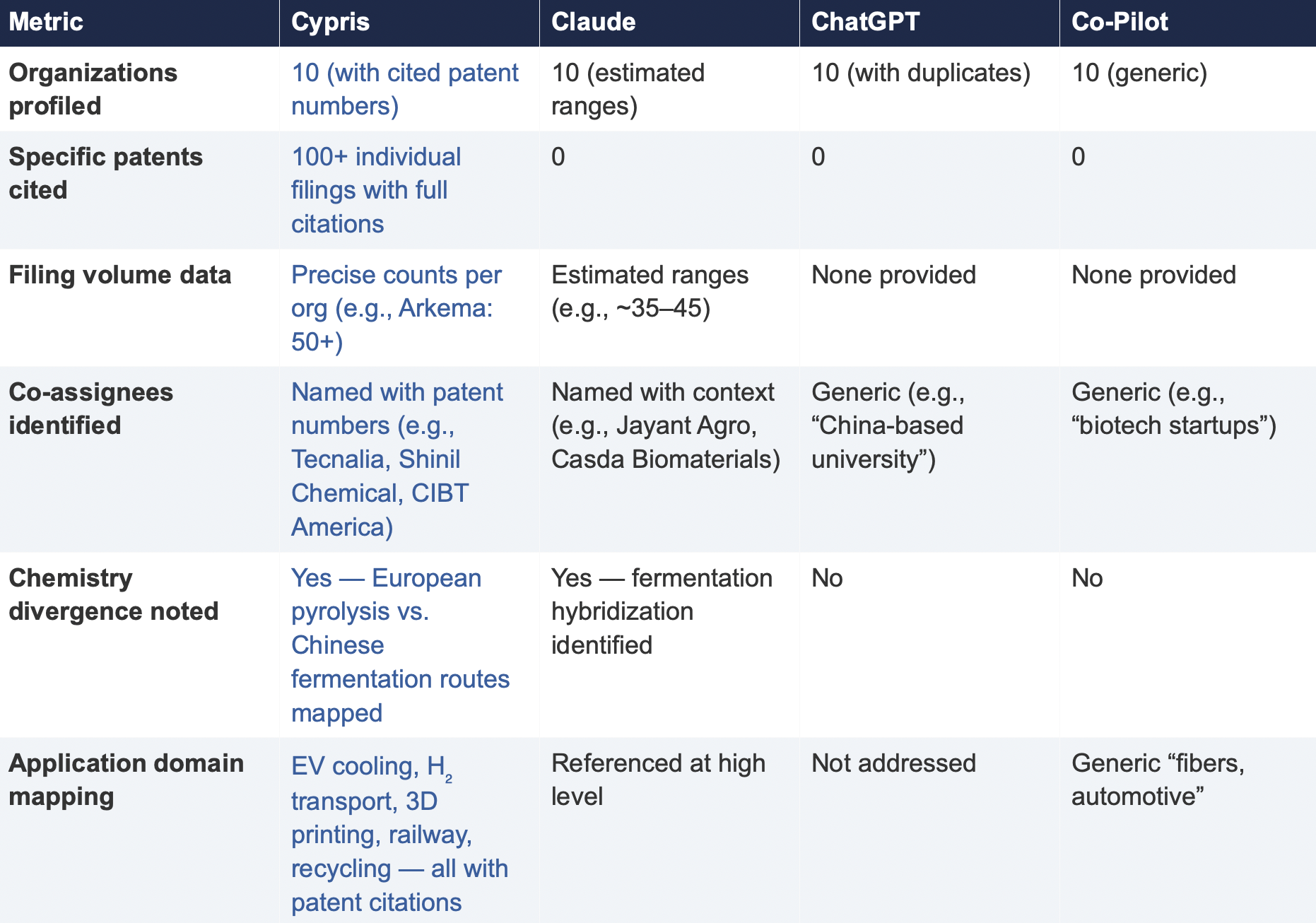
6.2 Summary of Results
6.3 Key Differentiators
Verifiability
The most consequential difference in Test 2 was the presence or absence of verifiable evidence. Cypris cited over 100 individual patent filings with full patent numbers, assignee names, and publication dates. Every claim about an organization’s technical focus, co-assignee relationships, and filing trajectory was anchored to specific documents that a practitioner could independently verify in USPTO, Espacenet, or WIPO PATENT SCOPE. No general-purpose model cited a single patent number. Claude produced the most structured and analytically useful output among the public models, with estimated filing ranges, product names, and strategic observations that were directionally plausible. However, without underlying patent citations, every claim in the response requires independent verification before it can inform a business decision. ChatGPT and Co-Pilot offered thinner profiles with no filing counts and no patent-level specificity.
Data Integrity
ChatGPT’s response contained a structural error that would mislead a practitioner: it listed CathayBiotech as organization #5 and then listed “Cathay Affiliate Cluster” as a separate organization at #9, effectively double-counting a single entity. It repeated this pattern with Toray at #4 and “Toray(Additional Programs)” at #10. In a competitive intelligence context where the ranking itself is the deliverable, this kind of error distorts the landscape and could lead to misallocation of competitive monitoring resources.
Organizations Missed
Cypris identified Kingfa Sci. & Tech. (8–10 filings with a differentiated furan diacid-based polyamide platform) and Zhejiang NHU (4–6 filings focused on continuous polymerization process technology)as emerging players that no general-purpose model surfaced. Both represent potential competitive threats or partnership opportunities that would be invisible to a team relying on public AI tools.Conversely, ChatGPT included organizations such as ANTA and Jiangsu Taiji that appear to be downstream users rather than significant patent filers in synthesis, suggesting the model was conflating commercial activity with IP activity.
Strategic Depth
Cypris’s cross-cutting observations identified a fundamental chemistry divergence in the landscape:European incumbents (Arkema, Evonik, EMS) rely on traditional castor oil pyrolysis to 11-aminoundecanoic acid or sebacic acid, while Chinese entrants (Cathay Biotech, Kingfa) are developing alternative bio-based routes through fermentation and furandicarboxylic acid chemistry.This represents a potential long-term disruption to the castor oil supply chain dependency thatWestern players have built their IP strategies around. Claude identified a similar theme at a higher level of abstraction. Neither ChatGPT nor Co-Pilot noted the divergence.
6.4 Test 2 Conclusion
Test 2 confirms that the coverage and verifiability gaps observed in Test 1 are not domain-specific.In a competitive intelligence context—where the deliverable is a ranked landscape of organizationalIP activity—the same structural limitations apply. General-purpose models can produce plausible-looking top-10 lists with reasonable organizational names, but they cannot anchor those lists to verifiable patent data, they cannot provide precise filing volumes, and they cannot identify emerging players whose patent activity is visible in structured databases but absent from the web-scraped content that general-purpose models rely on.
7. Conclusion
This comparative analysis, spanning two distinct technology domains and two distinct analytical workflows—freedom-to-operate assessment and competitive intelligence—demonstrates that the gap between purpose-built R&D intelligence platforms and general-purpose language models is not marginal, not domain-specific, and not transient. It is structural and consequential.
In Test 1 (LLZO garnet electrolytes for Li-S batteries), the purpose-built platform identified more than three times as many patents as the best-performing general-purpose model and ten times as many as the lowest-performing one. Among the patents identified exclusively by the purpose-built platform were filings rated as Very High FTO risk that directly claim the proposed technology architecture. InTest 2 (bio-based polyamide competitive landscape), the purpose-built platform cited over 100individual patent filings to substantiate its organizational rankings; no general-purpose model cited as ingle patent number.
The structural drivers of this gap—reliance on training data rather than live patent feeds, the accelerating closure of web content to AI scrapers, and the absence of patent-specific analytical frameworks—are not transient. They are inherent to the architecture of general-purpose models and will persist regardless of increases in model capability or training data volume.
For R&D and IP leaders, the practical implication is clear: general-purpose AI tools should be used for general-purpose tasks. Patent intelligence, competitive landscaping, and freedom-to-operate analysis require purpose-built systems with direct access to structured patent data, domain-specific analytical frameworks, and the ability to surface what a general-purpose model cannot—not because it chooses not to, but because it structurally cannot access the data.
The question for every organization making R&D investment decisions today is whether the tools informing those decisions have access to the evidence base those decisions require. This study suggests that for the majority of general-purpose AI tools currently in use, the answer is no.
Study Disclosure
This comparative evaluation was commissioned and published by Cypris. The testing methodology, prompts, evaluation criteria, and underlying outputs have been documented to support independent review and replication.
All platform outputs were preserved in their original form. Patent data and material factual claims were cross-checked against USPTO Patent Center and WIPO PATENTSCOPE records as of March 27, 2026. Cypris was one of the platforms evaluated and therefore has a commercial interest in the findings.
The Patent Intelligence Gap - A Comparative Analysis of Verticalized AI-Patent Tools vs. General-Purpose Language Models for R&D Decision-Making
Blogs
Small modular reactors and advanced nuclear designs have moved from concept toward licensing and deployment, and their patent landscape is distinctive because it spans several competing reactor families and a fuel supply chain that must be built alongside them. Where conventional nuclear plants are large, bespoke, and light-water-cooled, SMRs and advanced reactors are smaller, factory-built, and often use novel coolants, moderators, and fuels to achieve passive safety and flexible operation. The field divides into distinct regions of patenting: the reactor concepts themselves, including high-temperature gas-cooled reactors, molten-salt reactors, sodium-cooled fast reactors, integral light-water SMRs, and microreactors; the core, coolant, and moderator designs within each, from tristructural isotropic coated-particle fuel in gas-cooled reactors to fluoride fuel salts in molten-salt reactors;¹,²,³ the advanced fuels, especially TRISO particles and the high-assay low-enriched uranium, or HALEU, they require; the passive safety systems and control approaches that shut a reactor down without active intervention;⁵,⁶ and the modular manufacturing and construction methods that make factory production possible.⁴ Alongside these sit non-electric applications, from industrial heat and hydrogen to powering data centers. Because a viable design depends on several of these layers, and on a fuel supply that does not yet exist at scale, freedom-to-operate and white space analysis must span reactor, fuel, and manufacturing together.
The landscape is being reshaped by licensing progress and by a surge in demand. Regulators have modernized the framework for licensing advanced reactors, adopting a risk-informed, performance-based, and technology-inclusive rule intended to accommodate the range of SMR and advanced designs,⁷ while government programs are standing up a domestic supply of HALEU, the enriched fuel that many advanced reactors need and that has not been commercially produced at scale. Demand has accelerated sharply as technology companies contract for nuclear power to run data centers, drawing large investment. The competitive picture spans reactor developers pursuing different coolant and fuel choices, specialized fuel fabricators building TRISO and HALEU capacity, and established nuclear suppliers. This shows in the record: across the Cypris corpus of more than 500 million patents and scientific papers, the nuclear-anchored SMR, microreactor, TRISO, molten-salt, and HALEU set holds on the order of 2,017 families and grew from about 87 in 2020 to roughly 250 in 2024, with the most active assignees mixing large academic and institutional filers, led by Chinese universities and institutes, with reactor developers and fuel fabricators such as TerraPower, Mitsubishi Heavy Industries, BWXT, and Westinghouse and the US Department of Energy, and China ahead of the United States and South Korea on geography; a broad, unfiltered "microreactor" query returns far more families but is contaminated by unrelated chemical-microreactor art, so the nuclear-anchored figure is the defensible one. Because applications publish about eighteen months after filing, the most recent reactor and fuel filings are under-represented (2025 and 2026 counts are partial), so the current frontier is more active than granted-patent counts suggest.
The strategic question is which reactor family and layer to back, and the white space sits where technology and supply chain intersect. Advanced fuel, TRISO fabrication and the HALEU supply chain, is a critical, comparatively concentrated layer where scaling and cost are the barriers, so fabrication methods and fuel designs carry high value.¹ Coolant and materials that survive high temperatures and long fuel cycles, across gas, salt, and metal-cooled designs, passive safety systems, modular manufacturing and construction that lower cost and schedule, and non-electric applications such as process heat, hydrogen, and dispatchable power for data centers are all distinct, contested layers.²,³ Reading the landscape by reactor family, layer, and owner, and tracking both the patents and the underlying nuclear-engineering research, is what separates a crowded region from an open one.
Where the advanced-nuclear white space is
Advanced fuel and HALEU supply. TRISO fabrication methods and the high-assay low-enriched uranium supply chain are a critical, concentrated layer where scaling and cost are the barriers.¹
Coolant, moderator, and materials. Coolants and materials that survive high temperatures and long fuel cycles, across gas, salt, and metal-cooled designs, are a distinct, high-value layer.²,³
Passive safety systems. Systems and control approaches that shut a reactor down without active intervention are a differentiating capability central to SMR value.⁵,⁶
Modular manufacturing and construction. Factory-built modules and construction methods that lower cost and schedule are where the economic case is decided.⁴
Non-electric applications. Industrial heat, hydrogen production, and dispatchable power for data centers open distinct application and integration IP.
How AI-powered landscape and white space analysis helps
Resolving a landscape that spans several reactor families, a fuel supply chain, and manufacturing requires more than keyword search. AI-powered analysis addresses this with semantic search that clusters activity by reactor family, layer, and application across varied terminology, attribution that normalizes developer, fuel-fabricator, and supplier filers to canonical entities, and continuous monitoring that keeps pace with a fast-moving field. Because nuclear advances appear in scientific and engineering literature before they are patented, reading both patents and literature gives the earliest signal of where the frontier is moving.
Where Cypris fits
Cypris runs patent landscape and white space analysis for engineering-intensive fields such as small modular reactors and advanced nuclear across a corpus of more than 500 million patents and scientific papers, organized through a proprietary R&D ontology. The ontology clusters activity by reactor family, gas-cooled, molten-salt, sodium-cooled, light-water, and microreactor, and by layer, reactor design, advanced fuel, passive safety, and manufacturing, and normalizes developer, fuel-fabricator, and supplier filers to canonical entities, so a team can resolve which families and layers are crowded and which remain open as white space, and can separate genuine advanced-nuclear filings from unrelated art that shares terminology. Semantic search across patents and scientific literature connects filings to the underlying nuclear-engineering research, which is where advances appear first. Cypris Q, the platform's agentic layer, lets teams run landscape and white space analysis conversationally and chain the clustering, attribution, and gap analysis, and Agentic Monitoring tracks a defined family over time and flags new patents and papers as they publish. Cypris provides enterprise API partnerships with OpenAI, Anthropic, and Google, and is built with enterprise-grade security. Cypris serves hundreds of enterprise customers across pharmaceuticals, chemicals, advanced materials, energy, and other regulated industries.
FAQ
What is the small modular reactor patent landscape? The small modular reactor patent landscape is the set of patents covering factory-built, smaller nuclear reactors and advanced designs. It spans reactor families, high-temperature gas-cooled, molten-salt, sodium-cooled fast, light-water, and microreactors, plus advanced fuels, passive safety, and modular manufacturing. Each is a distinct region of patenting.
What are the main advanced reactor families? The main families are high-temperature gas-cooled reactors, molten-salt reactors, sodium-cooled fast reactors, integral light-water SMRs, and microreactors. They differ in coolant, moderator, fuel, and operating temperature. The choice of family shapes both the technical and the freedom-to-operate picture.
Why are TRISO and HALEU fuels important? TRISO and HALEU fuels are important because many advanced reactors depend on TRISO coated particles, which resist very high temperatures, and on high-assay low-enriched uranium, which is not yet commercially produced at scale. Building this fuel supply chain is a critical enabler. Fabrication methods and fuel designs are therefore a concentrated, high-value layer.
Why is data-center demand accelerating advanced nuclear? Data-center demand is accelerating advanced nuclear because technology companies need large amounts of reliable, carbon-free power, and have begun contracting for SMR and advanced-reactor output. This has drawn substantial investment and sharpened competition. It has also expanded interest in non-electric and dispatchable applications.
How does advanced-reactor licensing work? Advanced-reactor licensing in the United States distinguishes several steps, including design approval or certification, a construction permit, and an operating license, and regulators have adopted a modernized, risk-informed, technology-inclusive framework to accommodate advanced designs. A construction permit is not an operating license. Claims about a given project's status should be tied to the specific regulatory record.
Where is the white space in advanced nuclear? The white space includes advanced fuel and HALEU supply, coolant, moderator, and materials, passive safety systems, modular manufacturing and construction, and non-electric applications. The reactor-design and fuel layers are the most active. The most open, high-value opportunities are in fuel, materials, and manufacturing.
What software helps analyze the small modular reactor patent landscape? Software for the advanced-nuclear landscape should cluster activity by reactor family, layer, and application, resolve developer, fuel-fabricator, and supplier filers to canonical owners, separate genuine advanced-nuclear filings from unrelated art, search patents and scientific literature semantically, and monitor a fast-moving field continuously. Cypris does this across more than 500 million patents and scientific papers using a proprietary R&D ontology, semantic search, Cypris Q, and Agentic Monitoring.
Which teams use advanced-nuclear patent landscape analysis? Advanced-nuclear patent landscape analysis is used by R&D, IP, and strategy teams at reactor developers, fuel fabricators, nuclear suppliers, utilities, and technology buyers, as well as investors assessing the sector. Because the field spans reactor, fuel, and manufacturing layers, structured analysis is essential. Cypris serves hundreds of enterprise customers across energy and other research-intensive industries.
Endnotes
- International Atomic Energy Agency (2025). Coated particle fuels for high-temperature gas-cooled small modular reactors. https://doi.org/10.61092/iaea.zyya-k9sd
- Powers, J. J., & Gehin, J. C. (2016). Liquid-fuel molten salt reactors for thorium utilization. Nuclear Technology, 194(2). https://doi.org/10.13182/nt15-124
- Grimes, W. R. (1970). Molten-salt reactor chemistry. Nuclear Applications and Technology, 8(2). https://doi.org/10.13182/nt70-a28621
- Hannah, B. (2026). Technical assessment of molten salt reactor small modular reactors: design and licensing considerations. https://doi.org/10.5281/zenodo.20087242
- Zarei, M. (2020). State feedback control of power in a small modular reactor. Annals of Nuclear Energy, 144. https://doi.org/10.1016/j.anucene.2020.107743
- Diniz, R., et al. (2023). Reactivity calculation in molten salt reactors with an inverse kinetics model. Annals of Nuclear Energy, 190. https://doi.org/10.1016/j.anucene.2023.110130
- U.S. Nuclear Regulatory Commission (2026). 10 CFR Part 53 — risk-informed, technology-inclusive regulatory framework for advanced nuclear reactors (final rule). https://www.ecfr.gov/current/title-10/chapter-I/part-53

Perovskite-silicon tandem solar cells are the leading path to higher photovoltaic efficiency, and their patent landscape has become unusually central to competition because the field is commercializing through licensing as much as through manufacturing. A tandem cell places a wide-bandgap perovskite layer on top of a conventional silicon cell, so the two absorb different parts of the solar spectrum and the stack converts more sunlight than either alone, surpassing the single-junction limit that constrains standard silicon.¹,² The theoretical ceiling for a silicon-based tandem is about 43.2 percent, far above the roughly 33 percent limit of a single-junction silicon cell, which is what makes the architecture so attractive.³ The intellectual property divides across several regions, each with different owners and maturity: the perovskite compositions and their stability chemistry; the passivation and interface layers that raise efficiency and lifetime; the tandem device architecture, including the recombination layers that join the sub-cells; the texturing and deposition processes used to build the stack; and the encapsulation and manufacturing that make a durable module. Because a working tandem depends on all of these, freedom-to-operate and white space analysis must span the full stack.
The landscape is being shaped by patents and cross-licensing in real time. Certified efficiencies have climbed steeply: the current certified perovskite/silicon tandem record stands at 34.85 percent, achieved by LONGi and certified by the US National Renewable Energy Laboratory in 2025, and peer-reviewed work now describes certified perovskite/silicon efficiencies approaching 35 percent, with the live record register maintained on the NREL Best Research-Cell Efficiency Chart.⁴,⁵,⁶ These are laboratory cell records rather than commercial-module ratings, and translating them to industry-compatible cells and full modules is a distinct challenge the field is actively working through.¹⁰ Multi-junction routes are advancing in parallel, with triple-junction perovskite/perovskite/silicon devices exceeding 30 percent.⁷ Holders of strong foundational portfolios have begun licensing their technology to large manufacturers, signaling that IP position, not only manufacturing capacity, will determine who benefits from the transition. That structure is visible in the patent record: across the Cypris corpus of more than 500 million patents and scientific papers, the perovskite-tandem space is a comparatively small, fast-moving set of a few thousand de-duplicated families that stepped up sharply in 2025, and its most active assignees mix national laboratories such as CEA and CNRS, the perovskite specialist Oxford PV, and large silicon-module manufacturers, with China, the United States, South Korea, and France the leading jurisdictions; because assignee names are not fully canonicalized, manufacturer totals are best read as indicative. Because applications publish about eighteen months after filing, the most recent composition and process filings are under-represented, so the current frontier is more active than granted-patent counts suggest.
The strategic question is which layer to own, and the white space sits where durability is hardest to achieve. Perovskite stability under heat, humidity, and light remains the central unsolved problem, and the degradation mechanisms and stabilization techniques that address it are an area of intense, well-mapped research,⁸ as are the barrier and encapsulation designs that protect the cell over its service life.⁹ Compositions, passivation chemistries, and encapsulation that extend lifetime therefore carry high, defensible value, while tandem architecture and light-management texturing are contested and improving quickly, and scalable deposition and manufacturing are where laboratory records must survive the move to gigawatt production. Reading the landscape by composition, layer, and process, and tracking both the patents and the underlying materials research, is what separates a crowded region from an open one.
Where the perovskite tandem white space is
Stability and encapsulation. Compositions, passivation, and encapsulation that keep efficiency under heat, humidity, and light are the central unsolved problem and the highest-value, still-open target.⁸,⁹
Wide-bandgap perovskite compositions. Formulations tuned for the top cell that resist phase segregation are a contested, fast-moving composition layer.
Tandem architecture. Recombination layers, interconnection, and two-terminal versus four-terminal designs are a distinct device-engineering layer.⁷
Texturing and light management. Surface texturing and optical designs that maximize capture across the stack are an active process-IP area.
Scalable deposition and manufacturing. Moving high-efficiency processes from small cells to gigawatt-scale modules is where cost is decided and where durable process IP concentrates.¹⁰
How AI-powered landscape and white space analysis helps
Resolving a device landscape that spans compositions, interface and architecture layers, and manufacturing processes, across institutions and regions moving at different speeds, requires more than keyword search. AI-powered analysis addresses this with semantic search that clusters activity by layer and process across varied terminology, attribution that normalizes academic and commercial filers to canonical entities and tracks the licensing structure, and continuous monitoring that keeps pace with a fast-commercializing field. Because perovskite advances appear in scientific literature before they are patented, reading both patents and literature gives the earliest signal of where the frontier is moving.
Where Cypris fits
Cypris runs patent landscape and white space analysis for fast-commercializing energy fields such as perovskite tandem solar across a corpus of more than 500 million patents and scientific papers, organized through a proprietary R&D ontology. The ontology clusters activity by layer, perovskite composition, passivation and interfaces, tandem architecture, texturing and deposition, and encapsulation and manufacturing, and normalizes filers to canonical entities, so a team can resolve which layers are crowded and which remain open as white space, and can see the licensing structure clearly rather than as a flat list. Semantic search across patents and scientific literature connects filings to the underlying materials and device research, which is where perovskite advances appear first. Cypris Q, the platform's agentic layer, lets teams run landscape and white space analysis conversationally and chain the clustering, attribution, and gap analysis, and Agentic Monitoring tracks a defined layer over time and flags new patents and papers as they publish. Cypris provides enterprise API partnerships with OpenAI, Anthropic, and Google, and is built with enterprise-grade security. Cypris serves hundreds of enterprise customers across pharmaceuticals, chemicals, advanced materials, energy, and other regulated industries.
FAQ
What is the perovskite tandem solar patent landscape? The perovskite tandem solar patent landscape is the set of patents covering perovskite-silicon and all-perovskite tandem cells that exceed the single-junction efficiency limit. It divides across perovskite compositions and stability, passivation and interfaces, tandem architecture, texturing and deposition, and encapsulation and manufacturing. Each is a distinct region with different owners and maturity.
Why is IP so central to perovskite tandem solar? IP is central because the field is commercializing through licensing as much as through manufacturing, with holders of strong foundational portfolios licensing their technology to large manufacturers. Foundational process and architecture patents are concentrated among a few institutions and companies. That makes licensing and freedom-to-operate, not only production capacity, decisive.
What layers does the perovskite tandem landscape cover? The landscape covers perovskite composition and stability chemistry, passivation and interface layers, tandem device architecture including recombination layers, texturing and deposition processes, and encapsulation and manufacturing. A working tandem depends on all of them. Freedom-to-operate and white space analysis must span the full stack.
Where is the white space in perovskite tandem solar? The white space sits where durability is hardest: stability and encapsulation, wide-bandgap compositions that resist phase segregation, tandem architecture, light-management texturing, and scalable deposition. Stability under heat, humidity, and light is the central unsolved problem. The highest-value, most defensible positions are in lifetime and manufacturability.
Why is stability the key problem in the patent record? Stability is the key problem because perovskites can degrade under heat, humidity, and light, so the compositions, passivation, and encapsulation that extend lifetime are where the most valuable and defensible IP concentrates. Efficiency records matter, but durable modules require solving stability. The patent record reflects intense activity in these layers.
Why does perovskite analysis need scientific literature? Perovskite analysis needs scientific literature because new compositions, passivation chemistries, and device architectures appear in materials research before they are patented, so the literature gives the earliest signal. Analyzing patents alone gives a lagging view. Cypris analyzes both across more than 500 million patents and scientific papers.
What software helps analyze the perovskite tandem solar patent landscape? Software for the perovskite tandem landscape should cluster activity by device layer and process, resolve academic and commercial filers and the licensing structure to canonical owners, search patents and scientific literature semantically, and monitor a fast-commercializing field continuously. Cypris does this across more than 500 million patents and scientific papers using a proprietary R&D ontology, semantic search, Cypris Q, and Agentic Monitoring.
Which teams use perovskite tandem patent landscape analysis? Perovskite tandem patent landscape analysis is used by R&D, innovation, IP, and strategy teams at solar manufacturers, materials developers, and equipment makers, as well as investors and research institutions. It informs which layer to back, where to file, where to license, and where competitors are concentrated. Cypris serves hundreds of enterprise customers across energy, advanced materials, chemicals, and other regulated industries.
Endnotes
- Zhang, F., Shi, Y., & Berry, J. J. (2024). Perovskite/silicon tandem solar cells: insights and outlooks. ACS Energy Letters, 9(4). https://doi.org/10.1021/acsenergylett.4c00172
- Zheng, X., Tan, H., et al. (2023). Efficient perovskite/silicon tandem solar cells on industrially compatible textured silicon. Advanced Materials, 35(10). https://doi.org/10.1002/adma.202207883
- Schubert, M. C., Glunz, S. W., et al. (2025). Elucidating the efficiency limit of silicon-based monolithic tandem cells through the combination of Auger and Shockley-Queisser limits. EES Solar. https://doi.org/10.1039/d5el00085h
- Chen, W., Mularso, K. T., Jung, H. S., & Jo, B., et al. (2026). Strategies toward maximizing power conversion efficiency in all-perovskite tandem solar cells. Solar RRL. https://doi.org/10.1002/solr.202500911
- LONGi (2025, April 16). LONGi breaks world record for crystalline silicon-perovskite tandem solar cell efficiency (34.85%). https://www.longi.com/en/news/silicon-perovskite-tandem-solar-cells-new-world-efficiency
- National Renewable Energy Laboratory. Best research-cell efficiency chart. https://www.nrel.gov/pv/cell-efficiency
- Aydin, E., Xu, L., De Wolf, S., et al. (2024). Four-terminal perovskite/perovskite/silicon triple-junction tandem solar cells with over 30% power conversion efficiency. ACS Energy Letters, 9(8). https://doi.org/10.1021/acsenergylett.4c01292
- Ahn, N., & Choi, M. (2023). Towards long-term stable perovskite solar cells: degradation mechanisms and stabilization techniques. Advanced Science, 10(35). https://doi.org/10.1002/advs.202306110
- Yang, Z., Liu, Z., Chen, W., et al. (2020). Barrier designs in perovskite solar cells for long-term stability. Advanced Energy Materials, 10(26). https://doi.org/10.1002/aenm.202001610
- Jost, M., et al. (2021). 27.9% efficient monolithic perovskite/silicon tandem solar cells on industry-compatible bottom cells. Solar RRL, 5(6). https://doi.org/10.1002/solr.202100244
Metal-organic frameworks have moved from a laboratory curiosity to a commercial materials platform, and their patent landscape is being staked out just as the field reaches scale. A MOF is a porous crystalline material built by linking metal nodes with organic linkers into an ordered framework, producing extraordinarily high surface areas and pores that can be tuned for a target molecule; more than 20,000 distinct MOFs had already been reported by the early 2010s, and the reticular chemistry behind them has continued to mature.¹,² Recognition by the 2025 Nobel Prize in Chemistry, awarded to Susumu Kitagawa, Richard Robson, and Omar Yaghi for the development of metal-organic frameworks, underscored the field's arrival and named applications from carbon-dioxide capture and toxic-gas storage to water harvesting, catalysis, and the separation of per- and polyfluoroalkyl substances from water.³ The intellectual property now divides across three broad regions: the specific framework compositions and structures themselves; the synthesis, shaping, and manufacturing processes that turn a powder into a usable, scalable product; and the application-level systems that integrate a MOF into a working device. Because MOFs serve many functions, freedom-to-operate and white space analysis must span all of them.
The commercial tipping point is reshaping the patent picture. After years in which scale-up and cost were the barriers, industrial-scale production of MOFs for carbon capture has begun, and a wave of startups is pursuing modular capture systems that are easier to scale than incumbent solvent processes, alongside chemical majors moving into manufacturing. Direct air capture of carbon dioxide has been demonstrated in purpose-designed frameworks from the laboratory through pilot scale, distinct from higher-concentration point-source capture.⁶ The scale of activity is large: across the Cypris corpus of more than 500 million patents and scientific papers, the MOF and reticular-chemistry space holds well over 100,000 de-duplicated families and has sustained high-volume filing since around 2018, with the assignee base led by academic institutions and chemical majors such as Sinopec, BASF, and ExxonMobil also prominent, while China accounts for the large majority of families, ahead of the United States, Japan, Germany, and South Korea. This shift moves value from the bare framework composition, where foundational academic estates are concentrated, toward the synthesis, shaping, and system-integration layers. Because applications publish about eighteen months after filing, the most recent synthesis and application filings are under-represented, so the current frontier is more active than granted-patent counts suggest.
The landscape divides by application, and the white space sits where a MOF must survive real conditions at low cost. Water stability, cycling durability, and inexpensive, scalable synthesis are the recurring bottlenecks; the criteria for a high-performance water-adsorbing framework, pore size and shape, hydrophilicity, and stability, are well defined but hard to meet at once.⁴ Carbon capture, both point-source and direct air capture, is the most active application and the one drawing the most new entrants; gas separation, increasingly through mixed-matrix membranes,⁷ and gas adsorption and storage⁸ are established; atmospheric water harvesting has advanced from concept toward passive devices,⁵ and newer uses such as direct lithium extraction and contaminant removal are earlier and less crowded. Underlying all of them is the reticular-design principle that lets chemists build frameworks to order for a target function.⁹ Reading the landscape by composition, synthesis route, and application is what separates a crowded region from an open one.
Where the MOF white space is
Water-stable, low-cost frameworks. MOFs that keep performance under humidity and real operating conditions, made by inexpensive routes, are the central bottleneck and a high-value, still-open target.⁴
Scalable synthesis and shaping. Converting powders into pellets, monoliths, and coatings by manufacturable processes is where deployment is decided and where hard-to-design-around process IP concentrates.
Direct air capture sorbents. MOFs tuned for capturing dilute atmospheric carbon dioxide are an active, high-value frontier distinct from point-source capture.⁶
Non-carbon separations. Direct lithium extraction, contaminant and per- and polyfluoroalkyl-substance removal, and other selective separations are earlier and less crowded application layers.
System integration. Contactors, modules, and regeneration systems that turn a MOF into a working unit are a distinct engineering layer separate from the framework chemistry.
How AI-powered landscape and white space analysis helps
Resolving a materials platform that spans many framework chemistries, synthesis routes, and application areas requires more than keyword search. AI-powered analysis addresses this with semantic search that clusters activity by composition, synthesis route, and application across varied terminology, attribution that normalizes academic and commercial filers to canonical entities and tracks new entrants, and continuous monitoring that keeps pace with a field reaching commercial scale. Because MOF advances appear in scientific literature before they are patented, reading both patents and literature gives the earliest signal of where deployable materials are emerging.
Where Cypris fits
Cypris runs patent landscape and white space analysis for materials platforms such as metal-organic frameworks across a corpus of more than 500 million patents and scientific papers, organized through a proprietary R&D ontology. The ontology clusters activity by framework composition, by synthesis and shaping route, and by application, carbon capture, gas separation and storage, water harvesting, catalysis, and mineral recovery, and normalizes filers to canonical entities, so a team can resolve which compositions, routes, and applications are crowded and which remain open as white space, and can track new entrants as the field scales. Semantic search across patents and scientific literature connects filings to the underlying materials chemistry research, which is where MOF advances appear first. Cypris Q, the platform's agentic layer, lets teams run landscape and white space analysis conversationally and chain the clustering, attribution, and gap analysis, and Agentic Monitoring tracks a defined application over time and flags new patents and papers as they publish. Cypris provides enterprise API partnerships with OpenAI, Anthropic, and Google, and is built with enterprise-grade security. Cypris serves hundreds of enterprise customers across pharmaceuticals, chemicals, advanced materials, energy, and other regulated industries.
FAQ
What is the metal-organic framework patent landscape? The metal-organic framework patent landscape is the set of patents covering MOFs, porous crystalline materials built from metal nodes and organic linkers, and their uses. It divides across framework compositions, synthesis and shaping processes, and application-level systems. Each application, from carbon capture to gas storage, is a distinct region of the landscape.
Why are MOFs a patenting hotspot now? MOFs are a patenting hotspot now because the field has reached a commercial tipping point, with industrial-scale production beginning for carbon capture and a wave of startups pursuing modular systems. Recognition by the 2025 Nobel Prize in Chemistry has further raised the field's profile. That shift is concentrating new filings in synthesis and application layers.
What application areas does the MOF landscape cover? The MOF landscape covers carbon capture from flue gas and directly from air, gas separation and storage, water harvesting, catalysis, sensing, drug delivery, and recovery of critical minerals such as lithium. Each demands different framework and system properties. Freedom-to-operate and white space analysis must span all of them.
Where is the white space in MOFs? The white space sits where a MOF must survive real conditions cheaply: water-stable, low-cost frameworks and scalable synthesis and shaping are the central bottlenecks, and direct air capture sorbents, non-carbon separations, and system integration are less crowded. The bare framework composition is where foundational estates concentrate. The higher-value opportunities are in deployability.
How is MOF value shifting from composition to manufacturing? MOF value is shifting because, as the field scales, the barrier moves from discovering a framework to making it durable and affordable at volume. Foundational composition estates are concentrated among a few academic groups, while synthesis, shaping, and system-integration IP is where deployment is now decided. That is where much of the defensible, hard-to-design-around value sits.
Why does MOF analysis need scientific literature? MOF analysis needs scientific literature because new frameworks, synthesis routes, and application concepts appear in materials research before they are patented, so the literature gives the earliest signal. Analyzing patents alone gives a lagging view. Cypris analyzes both across more than 500 million patents and scientific papers.
What software helps analyze the MOF patent landscape? Software for the MOF landscape should cluster activity by framework composition, synthesis route, and application, resolve academic and commercial filers to canonical owners, search patents and scientific literature semantically, and monitor a scaling field continuously. Cypris does this across more than 500 million patents and scientific papers using a proprietary R&D ontology, semantic search, Cypris Q, and Agentic Monitoring.
Which teams use MOF patent landscape analysis? MOF patent landscape analysis is used by R&D, innovation, IP, and strategy teams at chemicals, materials, carbon-capture, and energy companies, as well as investors and research institutions. It informs where to invest, where to file, and where competitors are concentrated. Cypris serves hundreds of enterprise customers across chemicals, advanced materials, energy, and other regulated industries.
Endnotes
- O'Keeffe, M., Cordova, K. E., Furukawa, H., & Yaghi, O. M. (2013). The chemistry and applications of metal-organic frameworks. Science, 341(6149). https://doi.org/10.1126/science.1230444
- Li, H., Rampal, N., & Yaghi, O. M. (2025). Reticular chemistry: past, present, and future. Molecular Frontiers Journal. https://doi.org/10.1142/s2529732525300034
- Royal Swedish Academy of Sciences (2025, October 8). The Nobel Prize in Chemistry 2025 [press release]. https://www.nobelprize.org/prizes/chemistry/2025/press-release/
- Furukawa, H., Queen, W. L., Yaghi, O. M., et al. (2014). Water adsorption in porous metal-organic frameworks and related materials. Journal of the American Chemical Society, 136(11). https://doi.org/10.1021/ja500330a
- Diercks, C. S., Kalmutzki, M. J., & Yaghi, O. M. (2018). Metal-organic frameworks for water harvesting from air. Advanced Materials, 30(37). https://doi.org/10.1002/adma.201704304
- Yao, M.-S., et al. (2023). Direct air capture of CO2 in designed metal-organic frameworks at lab and pilot scale. Carbon Capture Science & Technology, 8. https://doi.org/10.1016/j.ccst.2023.100145
- Chai, M., Hou, J., & Chen, R. (2023). Metal-organic framework-based mixed matrix membranes for gas separation: recent advances and opportunities. Carbon Capture Science & Technology, 8. https://doi.org/10.1016/j.ccst.2023.100130
- Sculley, J., Yu, J., Zhou, H.-C., et al. (2011). Carbon dioxide capture-related gas adsorption and separation in metal-organic frameworks. Coordination Chemistry Reviews, 255(15-16). https://doi.org/10.1016/j.ccr.2011.02.012
- Chen, Z., Kirlikovali, K. O., Li, P., & Farha, O. K. (2022). Reticular chemistry for highly porous metal-organic frameworks: the chemistry and applications. Accounts of Chemical Research, 55(4). https://doi.org/10.1021/acs.accounts.1c00707
%20-%20Sustainable%20Packaging%20in%20Food%20%26%20Beverage.png)
%20-%20Next%20Generation%20Invisible%20Fishing%20Line.png)
%20-%20Noninvasive%20VNS.png)
Webinars

Many enterprises have adopted horizontal, foundation-model AI platforms. But access to the same underlying models does not, by itself, create differentiated intelligence. For highly technical and mission-critical research, general-purpose models may produce broad but weakly grounded answers when they lack access to authoritative technical data, specialized context, and verifiable sources.
The next competitive advantage will come from the intelligence layer surrounding the foundation model: the domain-specific data, ontologies, retrieval capabilities, agent workflows, and source grounding that together form an AI harness. These verticalized systems can transform general-purpose AI into a more specialized capability for research, innovation, and technical decision-making.
Join Steve Hafif, Co-Founder and CEO of Cypris.ai, and Marlene Valderrama, Principal IP Manager and Senior Technology Scout at Halliburton, for a conversation on the state of enterprise AI and how organizations can enhance horizontal AI platforms with verticalized intelligence designed for R&D and innovation.
.png)

Most IP organizations are making high-stakes capital allocation decisions with incomplete visibility – relying primarily on patent data as a proxy for innovation. That approach is not optimal. Patents alone cannot reveal technology trajectories, capital flows, or commercial viability.
A more effective model requires integrating patents with scientific literature, grant funding, market activity, and competitive intelligence. This means that for a complete picture, IP and R&D teams need infrastructure that connects fragmented data into a unified, decision-ready intelligence layer.
AI is accelerating that shift. The value is no longer simply in retrieving documents faster; it’s in extracting signal from noise. Modern AI systems can contextualize disparate datasets, identify patterns, and generate strategic narratives – transforming raw information into actionable insight.
Join us on Thursday, April 23, at 12 PM ET for a discussion on how unified AI platforms are redefining decision-making across IP and R&D teams. Moderated by Gene Quinn, panelists Marlene Valderrama and Amir Achourie will examine how integrating technical, scientific, and market data collapses traditional silos – enabling more aligned strategy, sharper investment decisions, and measurable business impact.
Register here: https://ipwatchdog.com/cypris-april-23-2026/
.png)
In this session, we break down how AI is reshaping the R&D lifecycle, from faster discovery to more informed decision-making. See how an intelligence layer approach enables teams to move beyond fragmented tools toward a unified, scalable system for innovation.
.avif)