

Resources
Guides, research, and perspectives on R&D intelligence, IP strategy, and the future of AI enabled innovation.

Executive Summary
In 2024, US patent infringement jury verdicts totaled $4.19 billion across 72 cases. Twelve individual verdicts exceeded $100million. The largest single award—$857 million in General Access Solutions v.Cellco Partnership (Verizon)—exceeded the annual R&D budget of many mid-market technology companies. In the first half of 2025 alone, total damages reached an additional $1.91 billion.
The consequences of incomplete patent intelligence are not abstract. In what has become one of the most instructive IP disputes in recent history, Masimo’s pulse oximetry patents triggered a US import ban on certain Apple Watch models, forcing Apple to disable its blood oxygen feature across an entire product line, halt domestic sales of affected models, invest in a hardware redesign, and ultimately face a $634 million jury verdict in November 2025. Apple—a company with one of the most sophisticated intellectual property organizations on earth—spent years in litigation over technology it might have designed around during development.
For organizations with fewer resources than Apple, the risk calculus is starker. A mid-size materials company, a university spinout, or a defense contractor developing next-generation battery technology cannot absorb a nine-figure verdict or a multi-year injunction. For these organizations, the patent landscape analysis conducted during the development phase is the primary risk mitigation mechanism. The quality of that analysis is not a matter of convenience. It is a matter of survival.
And yet, a growing number of R&D and IP teams are conducting that analysis using general-purpose AI tools—ChatGPT, Claude, Microsoft Co-Pilot—that were never designed for patent intelligence and are structurally incapable of delivering it.
This report presents the findings of a controlled comparison study in which identical patent landscape queries were submitted to four AI-powered tools: Cypris (a purpose-built R&D intelligence platform),ChatGPT (OpenAI), Claude (Anthropic), and Microsoft Co-Pilot. Two technology domains were tested: solid-state lithium-sulfur battery electrolytes using garnet-type LLZO ceramic materials (freedom-to-operate analysis), and bio-based polyamide synthesis from castor oil derivatives (competitive intelligence).
The results reveal a significant and structurally persistent gap. In Test 1, Cypris identified over 40 active US patents and published applications with granular FTO risk assessments. Claude identified 12. ChatGPT identified 7, several with fabricated attribution. Co-Pilot identified 4. Among the patents surfaced exclusively by Cypris were filings rated as “Very High” FTO risk that directly claim the technology architecture described in the query. In Test 2, Cypris cited over 100 individual patent filings with full attribution to substantiate its competitive landscape rankings. No general-purpose model cited a single patent number.
The most active sectors for patent enforcement—semiconductors, AI, biopharma, and advanced materials—are the same sectors where R&D teams are most likely to adopt AI tools for intelligence workflows. The findings of this report have direct implications for any organization using general-purpose AI to inform patent strategy, competitive intelligence, or R&D investment decisions.

1. Methodology
A controlled comparative evaluation was conducted on March 27, 2026. An identical patent landscape query was submitted verbatim to each platform under standardized testing conditions. No follow-up prompts, clarifications, or iterative refinements were permitted, ensuring that each platform was evaluated based solely on its initial response.
The outputs were preserved in their original form and evaluated against predefined criteria using publicly verifiable patent records.
1.1 Query
Identify all active US patents and published applications filed in the last 5 years related to solid-state lithium-sulfur battery electrolytes using garnet-type ceramic materials. For each, provide the assignee, filing date, key claims, and current legal status. Highlight any patents that could pose freedom-to-operate risks for a company developing a Li₇La₃Zr₂O₁₂(LLZO)-based composite electrolyte with a polymer interlayer.
1.2 Tools Evaluated

1.3 Evaluation Criteria
Each response was evaluated using a consistent six-part scoring framework: patent coverage, assignee accuracy, filing metadata completeness, depth of claim analysis, quality of FTO risk stratification, and the presence of actionable strategic guidance.
Patent numbers, assignees, filing information, and legal status were independently checked against publicly available USPTO and WIPO records. The evaluation focused on the completeness, accuracy, and practical utility of each platform’s output rather than writing quality or presentation.
2. Findings
2.1 Coverage Gap
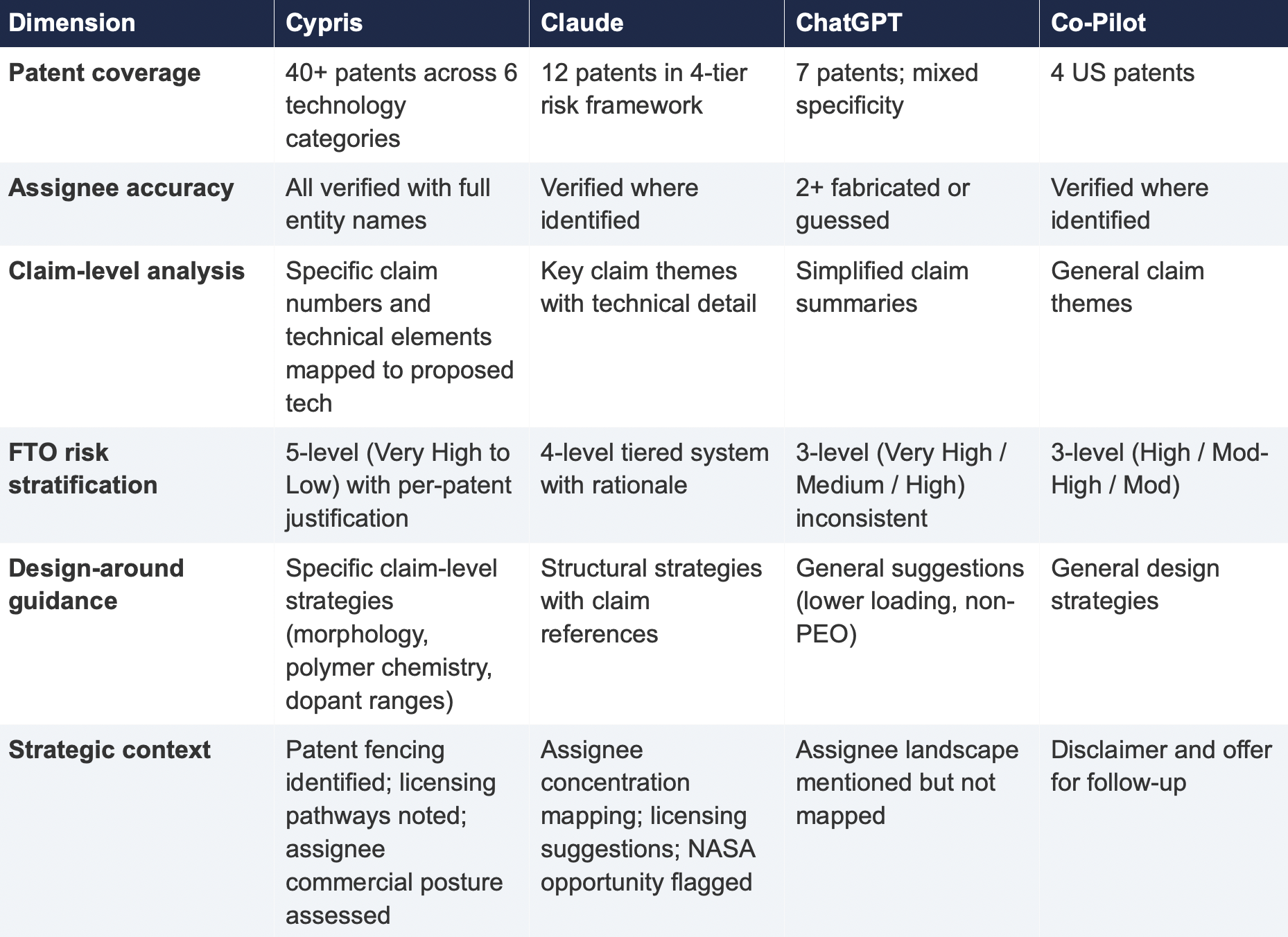
The most significant finding is the scale of the coverage differential. Cypris identified over 40 active US patents and published applications spanning LLZO-polymer composite electrolytes, garnet interface modification, polymer interlayer architectures, lithium-sulfur specific filings, and adjacent ceramic composite patents. The results were organized by technology category with per-patent FTO risk ratings.
Claude identified 12 patents organized in a four-tier risk framework. Its analysis was structurally sound and correctly flagged the two highest-risk filings (Solid Energies US 11,967,678 and the LLZO nanofiber multilayer US 11,923,501). It also identified the University ofMaryland/ Wachsman portfolio as a concentration risk and noted the NASA SABERS portfolio as a licensing opportunity. However, it missed the majority of the landscape, including the entire Corning portfolio, GM's interlayer patents, theKorea Institute of Energy Research three-layer architecture, and the HonHai/SolidEdge lithium-sulfur specific filing.
ChatGPT identified 7 patents, but the quality of attribution was inconsistent. It listed assignees as "Likely DOE /national lab ecosystem" and "Likely startup / defense contractor cluster" for two filings—language that indicates the model was inferring rather than retrieving assignee data. In a freedom-to-operate context, an unverified assignee attribution is functionally equivalent to no attribution, as it cannot support a licensing inquiry or risk assessment.
Co-Pilot identified 4 US patents. Its output was the most limited in scope, missing the Solid Energies portfolio entirely, theUMD/ Wachsman portfolio, Gelion/ Johnson Matthey, NASA SABERS, and all Li-S specific LLZO filings.
2.2 Critical Patents Missed by Public Models
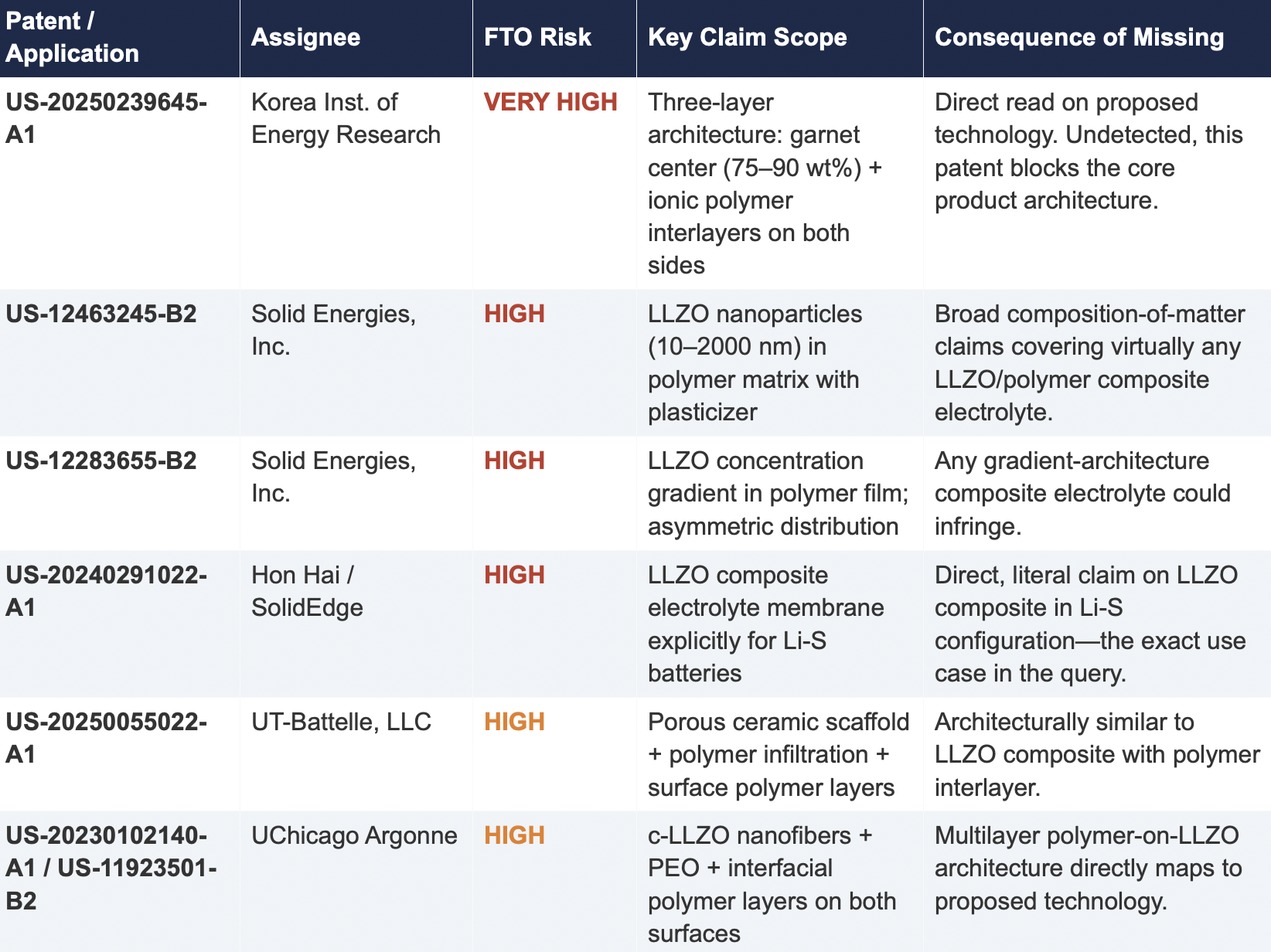
The following table presents patents identified exclusively by Cypris that were rated as High or Very High FTO risk for the proposed technology architecture. None were surfaced by any general-purpose model.
2.3 Patent Fencing: The Solid Energies Portfolio
Cypris identified a coordinated patent fencing strategy by Solid Energies, Inc. that no general-purpose model detected at scale. Solid Energies holds at least four granted US patents and one published application covering LLZO-polymer composite electrolytes across compositions(US-12463245-B2), gradient architectures (US-12283655-B2), electrode integration (US-12463249-B2), and manufacturing processes (US-20230035720-A1). Claude identified one Solid Energies patent (US 11,967,678) and correctly rated it as the highest-priority FTO concern but did not surface the broader portfolio. ChatGPT and Co-Pilot identified zero Solid Energies filings.
The practical significance is that a company relying on any individual patent hit would underestimate the scope of Solid Energies' IP position. The fencing strategy—covering the composition, the architecture, the electrode integration, and the manufacturing method—means that identifying a single design-around for one patent does not resolve the FTO exposure from the portfolio as a whole. This is the kind of strategic insight that requires seeing the full picture, which no general-purpose model delivered
2.4 Assignee Attribution Quality
ChatGPT's response included at least two instances of fabricated or unverifiable assignee attributions. For US 11,367,895 B1, the listed assignee was "Likely startup / defense contractor cluster." For US 2021/0202983 A1, the assignee was described as "Likely DOE / national lab ecosystem." In both cases, the model appears to have inferred the assignee from contextual patterns in its training data rather than retrieving the information from patent records.
In any operational IP workflow, assignee identity is foundational. It determines licensing strategy, litigation risk, and competitive positioning. A fabricated assignee is more dangerous than a missing one because it creates an illusion of completeness that discourages further investigation. An R&D team receiving this output might reasonably conclude that the landscape analysis is finished when it is not.
3. Structural Limitations of General-Purpose Models for Patent Intelligence
3.1 Training Data Is Not Patent Data
Large language models are trained on web-scraped text. Their knowledge of the patent record is derived from whatever fragments appeared in their training corpus: blog posts mentioning filings, news articles about litigation, snippets of Google Patents pages that were crawlable at the time of data collection. They do not have systematic, structured access to the USPTO database. They cannot query patent classification codes, parse claim language against a specific technology architecture, or verify whether a patent has been assigned, abandoned, or subjected to terminal disclaimer since their training data was collected.
This is not a limitation that improves with scale. A larger training corpus does not produce systematic patent coverage; it produces a larger but still arbitrary sampling of the patent record. The result is that general-purpose models will consistently surface well-known patents from heavily discussed assignees (QuantumScape, for example, appeared in most responses) while missing commercially significant filings from less publicly visible entities (Solid Energies, Korea Institute of EnergyResearch, Shenzhen Solid Advanced Materials).
3.2 The Web Is Closing to Model Scrapers
The data access problem is structural and worsening. As of mid-2025, Cloudflare reported that among the top 10,000 web domains, the majority now fully disallow AI crawlers such as GPTBot andClaudeBot via robots.txt. The trend has accelerated from partial restrictions to outright blocks, and the crawl-to-referral ratios reveal the underlying tension: OpenAI's crawlers access approximately1,700 pages for every referral they return to publishers; Anthropic's ratio exceeds 73,000 to 1.
Patent databases, scientific publishers, and IP analytics platforms are among the most restrictive content categories. A Duke University study in 2025 found that several categories of AI-related crawlers never request robots.txt files at all. The practical consequence is that the knowledge gap between what a general-purpose model "knows" about the patent landscape and what actually exists in the patent record is widening with each training cycle. A landscape query that a general-purpose model partially answered in 2023 may return less useful information in 2026.
3.3 General-Purpose Models Lack Ontological Frameworks for Patent Analysis
A freedom-to-operate analysis is not a summarization task. It requires understanding claim scope, prosecution history, continuation and divisional chains, assignee normalization (a single company may appear under multiple entity names across patent records), priority dates versus filing dates versus publication dates, and the relationship between dependent and independent claims. It requires mapping the specific technical features of a proposed product against independent claim language—not keyword matching.
General-purpose models do not have these frameworks. They pattern-match against training data and produce outputs that adopt the format and tone of patent analysis without the underlying data infrastructure. The format is correct. The confidence is high. The coverage is incomplete in ways that are not visible to the user.
4. Comparative Output Quality
The following table summarizes the qualitative characteristics of each tool's response across the dimensions most relevant to an operational IP workflow.
5. Implications for R&D and IP Organizations
5.1 The Confidence Problem
The central risk identified by this study is not that general-purpose models produce bad outputs—it is that they produce incomplete outputs with high confidence. Each model delivered its results in a professional format with structured analysis, risk ratings, and strategic recommendations. At no point did any model indicate the boundaries of its knowledge or flag that its results represented a fraction of the available patent record. A practitioner receiving one of these outputs would have no signal that the analysis was incomplete unless they independently validated it against a comprehensive datasource.
This creates an asymmetric risk profile: the better the format and tone of the output, the less likely the user is to question its completeness. In a corporate environment where AI outputs are increasingly treated as first-pass analysis, this dynamic incentivizes under-investigation at precisely the moment when thoroughness is most critical.
5.2 The Diversification Illusion
It might be assumed that running the same query through multiple general-purpose models provides validation through diversity of sources. This study suggests otherwise. While the four tools returned different subsets of patents, all operated under the same structural constraints: training data rather than live patent databases, web-scraped content rather than structured IP records, and general-purpose reasoning rather than patent-specific ontological frameworks. Running the same query through three constrained tools does not produce triangulation; it produces three partial views of the same incomplete picture.
5.3 The Appropriate Use Boundary
General-purpose language models are effective tools for a wide range of tasks: drafting communications, summarizing documents, generating code, and exploratory research. The finding of this study is not that these tools lack value but that their value boundary does not extend to decisions that carry existential commercial risk.
Patent landscape analysis, freedom-to-operate assessment, and competitive intelligence that informs R&D investment decisions fall outside that boundary. These are workflows where the completeness and verifiability of the underlying data are not merely desirable but are the primary determinant of whether the analysis has value. A patent landscape that captures 10% of the relevant filings, regardless of how well-formatted or confidently presented, is a liability rather than an asset.
6. Test 2: Competitive Intelligence — Bio-Based Polyamide Patent Landscape
To assess whether the findings from Test 1 were specific to a single technology domain or reflected a broader structural pattern, a second query was submitted to all four tools. This query shifted from freedom-to-operate analysis to competitive intelligence, asking each tool to identify the top 10organizations by patent filing volume in bio-based polyamide synthesis from castor oil derivatives over the past three years, with summaries of technical approach, co-assignee relationships, and portfolio trajectory.
6.1 Query

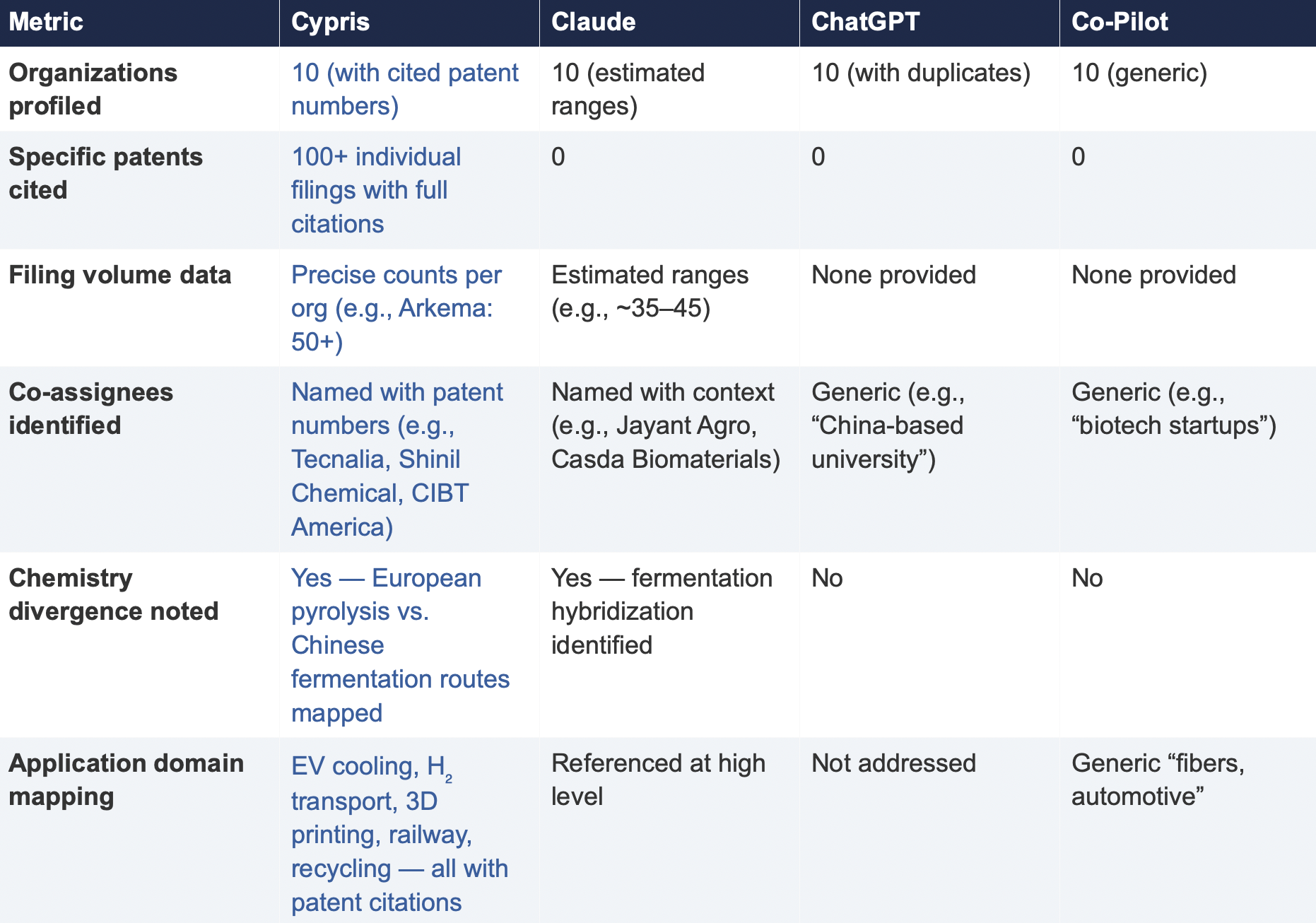
6.2 Summary of Results
6.3 Key Differentiators
Verifiability
The most consequential difference in Test 2 was the presence or absence of verifiable evidence. Cypris cited over 100 individual patent filings with full patent numbers, assignee names, and publication dates. Every claim about an organization’s technical focus, co-assignee relationships, and filing trajectory was anchored to specific documents that a practitioner could independently verify in USPTO, Espacenet, or WIPO PATENT SCOPE. No general-purpose model cited a single patent number. Claude produced the most structured and analytically useful output among the public models, with estimated filing ranges, product names, and strategic observations that were directionally plausible. However, without underlying patent citations, every claim in the response requires independent verification before it can inform a business decision. ChatGPT and Co-Pilot offered thinner profiles with no filing counts and no patent-level specificity.
Data Integrity
ChatGPT’s response contained a structural error that would mislead a practitioner: it listed CathayBiotech as organization #5 and then listed “Cathay Affiliate Cluster” as a separate organization at #9, effectively double-counting a single entity. It repeated this pattern with Toray at #4 and “Toray(Additional Programs)” at #10. In a competitive intelligence context where the ranking itself is the deliverable, this kind of error distorts the landscape and could lead to misallocation of competitive monitoring resources.
Organizations Missed
Cypris identified Kingfa Sci. & Tech. (8–10 filings with a differentiated furan diacid-based polyamide platform) and Zhejiang NHU (4–6 filings focused on continuous polymerization process technology)as emerging players that no general-purpose model surfaced. Both represent potential competitive threats or partnership opportunities that would be invisible to a team relying on public AI tools.Conversely, ChatGPT included organizations such as ANTA and Jiangsu Taiji that appear to be downstream users rather than significant patent filers in synthesis, suggesting the model was conflating commercial activity with IP activity.
Strategic Depth
Cypris’s cross-cutting observations identified a fundamental chemistry divergence in the landscape:European incumbents (Arkema, Evonik, EMS) rely on traditional castor oil pyrolysis to 11-aminoundecanoic acid or sebacic acid, while Chinese entrants (Cathay Biotech, Kingfa) are developing alternative bio-based routes through fermentation and furandicarboxylic acid chemistry.This represents a potential long-term disruption to the castor oil supply chain dependency thatWestern players have built their IP strategies around. Claude identified a similar theme at a higher level of abstraction. Neither ChatGPT nor Co-Pilot noted the divergence.
6.4 Test 2 Conclusion
Test 2 confirms that the coverage and verifiability gaps observed in Test 1 are not domain-specific.In a competitive intelligence context—where the deliverable is a ranked landscape of organizationalIP activity—the same structural limitations apply. General-purpose models can produce plausible-looking top-10 lists with reasonable organizational names, but they cannot anchor those lists to verifiable patent data, they cannot provide precise filing volumes, and they cannot identify emerging players whose patent activity is visible in structured databases but absent from the web-scraped content that general-purpose models rely on.
7. Conclusion
This comparative analysis, spanning two distinct technology domains and two distinct analytical workflows—freedom-to-operate assessment and competitive intelligence—demonstrates that the gap between purpose-built R&D intelligence platforms and general-purpose language models is not marginal, not domain-specific, and not transient. It is structural and consequential.
In Test 1 (LLZO garnet electrolytes for Li-S batteries), the purpose-built platform identified more than three times as many patents as the best-performing general-purpose model and ten times as many as the lowest-performing one. Among the patents identified exclusively by the purpose-built platform were filings rated as Very High FTO risk that directly claim the proposed technology architecture. InTest 2 (bio-based polyamide competitive landscape), the purpose-built platform cited over 100individual patent filings to substantiate its organizational rankings; no general-purpose model cited as ingle patent number.
The structural drivers of this gap—reliance on training data rather than live patent feeds, the accelerating closure of web content to AI scrapers, and the absence of patent-specific analytical frameworks—are not transient. They are inherent to the architecture of general-purpose models and will persist regardless of increases in model capability or training data volume.
For R&D and IP leaders, the practical implication is clear: general-purpose AI tools should be used for general-purpose tasks. Patent intelligence, competitive landscaping, and freedom-to-operate analysis require purpose-built systems with direct access to structured patent data, domain-specific analytical frameworks, and the ability to surface what a general-purpose model cannot—not because it chooses not to, but because it structurally cannot access the data.
The question for every organization making R&D investment decisions today is whether the tools informing those decisions have access to the evidence base those decisions require. This study suggests that for the majority of general-purpose AI tools currently in use, the answer is no.
Study Disclosure
This comparative evaluation was commissioned and published by Cypris. The testing methodology, prompts, evaluation criteria, and underlying outputs have been documented to support independent review and replication.
All platform outputs were preserved in their original form. Patent data and material factual claims were cross-checked against USPTO Patent Center and WIPO PATENTSCOPE records as of March 27, 2026. Cypris was one of the platforms evaluated and therefore has a commercial interest in the findings.
The Patent Intelligence Gap - A Comparative Analysis of Verticalized AI-Patent Tools vs. General-Purpose Language Models for R&D Decision-Making
Blogs

For most of the past three decades, the corporate IP team occupied a clear position near the end of the innovation process. Research and development explored a concept, leadership committed resources, scientists and engineers built the product, and only then did the work reach IP for protection, prosecution, and portfolio management. IP was a service function, expert and essential, but downstream of the decisions that mattered most. That sequence has quietly inverted. Today R&D comes to IP before resources are committed, asking what already exists in the patent record and treating the answer as a go or no-go signal on whether to pursue an idea at all. A prior art search is no longer just a legal precaution. It has become a strategic input that shapes which programs get funded, which get redirected, and which get killed before a dollar is spent.
This is a meaningful elevation of the IP team's role, and in most organizations it happened by default rather than by design. The mandate expanded because R&D became too expensive and too risky to pursue on instinct. The data and the tooling underneath the IP function, however, did not expand with it. The team is now being asked forward-looking strategic questions and is answering them with the one dataset it has always owned: the patent record. That mismatch between the question being asked and the data available to answer it is the source of a specific, costly, and underappreciated error. It has a name worth retiring from strategic vocabulary: the white space fallacy, the assumption that an empty region of the patent map is an open opportunity.
The stakes are higher than the tooling reflects
The reason this matters is that the decisions riding on these analyses are enormous, and the base rates for innovation are unforgiving. Failure rates across corporate R&D are persistently high. Industry research has long pegged new product failure somewhere between a third and half of all launches, and a substantial share of R&D projects never reach production at all. These failures have many causes, but a recurring and underexamined one is the practice of validating technical opportunity through patent analysis while leaving commercial opportunity unvalidated. A program clears the patent landscape, looks open, and proceeds, only to discover that the space was empty for reasons the patent record never showed. When the IP team's answer is steering investment direction, the cost of an incomplete map is no longer a missed filing. It is a misallocated research budget and a multi-year bet placed in the wrong direction.
White space and opportunity space are not the same thing
The cleanest way to see the error is to picture two overlapping circles. The first is patent white space, the regions of a technology landscape where few or no active patents exist. The second is commercial opportunity, the areas where genuine market demand and commercial momentum are forming. The portfolio every organization actually wants sits in the overlap, where a defensible technical position meets real commercial pull. That overlap is a narrow slice, and most teams cannot see it clearly because they are looking at only one of the two circles.
The reason patent white space gets mistaken for opportunity is structural rather than careless. Patent data is the dataset the IP team owns, the tool it has on hand, and the answer it can produce on demand. So the strategic question silently narrows from where should we invest to where is the patent map empty, and those two questions only sometimes have the same answer. The narrowing is invisible because it happens inside the framing of the analysis, not in its conclusions. Everyone in the room believes they are discussing opportunity. They are actually discussing patent density.
An empty region of the patent map can mean two very different things, and distinguishing between them is the whole game. It can be open for a reason, because there is no market demand, because the underlying science does not work yet, or because the unit economics never close. Easy to patent does not mean possible to monetize, and a clear space on the map can simply be a place no one has bothered to claim because there is nothing there worth claiming. Alternatively, the empty space can be a trap of the opposite kind, a region where competitors are very much active but moving through channels that never touch the patent system: trade secrets, defensive publications, or simply faster commercial execution that outruns the filing timeline. In both cases the patent map looks identical. It looks open. Only data drawn from outside the patent system can tell you which kind of empty you are actually looking at, and the two demand completely different strategic responses.
The inverse error is just as expensive and far less discussed. Some of the most contested, patent-dense regions of a landscape are exactly where the market is moving, and exactly where a given organization may be dangerously under-protected. A crowded patent map instinctively reads as a closed door, a market already won by incumbents. But density is a measure of competitive intensity, not of whether the opportunity is worth pursuing. Some of the most commercially urgent positions a company can take are in crowded spaces where the organization holds a real technical advantage but has under-filed relative to the competition. Reading crowdedness as a stop sign can forfeit exactly the positions most worth fighting for.
A patent is a twenty-year bet placed with rear-view data
Underneath the white space problem sits a deeper structural mismatch, this one about time. A patent is a roughly twenty-year commitment. That makes it one of the most forward-looking instruments a company holds, a claim staked on what will matter for two decades. Yet the patent record itself is one of the most backward-looking datasets available to anyone. Applications publish around eighteen months after they are filed, and the decisions behind them were made well before that. By the time a filing is visible in the public record, it describes a strategic choice that may be two or three years old. Patents are lagging indicators, sometimes by years, as applications crawl through prosecution. A team that validates a long-horizon investment using only existing patents is steering a twenty-year bet with a dataset that describes where the field was, not where it is going.
The question the IP team is increasingly asked to answer is whether a given portfolio or technology area will still matter in five to ten years. Answering that honestly requires three categories of signal that the patent record either omits entirely or reports too late to be useful.
The first is scientific momentum. Peer-reviewed papers, preprints, grant awards, and clinical activity reveal where the underlying technology is heading long before any of it reaches a patent application. Preprints in particular can surface a competitor's technical direction months to years ahead of the corresponding filing, because the science is published when it is done, not when the legal strategy is finalized. A field rich in recent publication but thin on filings is frequently an emerging opportunity, an early window in which an organization can establish a position before the patent landscape fills in and the easy ground is taken. To a patent-only view, that same field registers as white space and risks being dismissed as empty, when it is in fact the most valuable kind of crowded: crowded with science, not yet with claims.
The second is commercial signal. Venture funding, startup formation, mergers and acquisitions, corporate disclosures, and product launches reveal where commercial conviction is forming, frequently well ahead of patent activity. A technology domain showing minimal patent filings but hundreds of millions of dollars in aggregate venture funding is not white space. It is a market building momentum through channels that patent analytics simply cannot see. When an acquirer buys a startup, the strategic implication for every competitor in the space is immediate, but the patent assignment record may take months to update, and the commercial rationale for the deal, which market is being targeted, which product lines will expand, which competing approaches are being consolidated, never enters the patent data at all. That intelligence lives in deal records, regulatory filings, and corporate disclosures, in a layer of the landscape the patent-only team never sees.
The third is forward indicators, the signals that point at intent before it materializes as anything protectable. Regulatory filings, clinical pipelines, market intelligence, and hiring patterns all belong here. Hiring is among the most underused signals of all. The engineering and research roles a company is staffing frequently describe, in the job specifications themselves, exactly what the organization is building, and they appear long before any of that work surfaces as a filing. A competitor assembling a team around a specific technical capability is making a far earlier and often far clearer statement of direction than anything that will eventually reach a patent office.
None of this argues for abandoning patent data. Global patents remain the foundation, the authoritative record of what has actually been claimed and protected, and no serious analysis proceeds without them. The argument is narrower and harder to dismiss: patents are necessary but not sufficient for the strategic questions IP teams are now expected to answer. The foundation is solid. The problem is that three of the four walls are missing, and the team is being asked to assess the whole structure from the foundation alone.
Why the gap persists when it is so clearly understood
If the gap is this obvious, the fair question is why it endures across so many sophisticated organizations. The answer is mostly structural, not a failure of intelligence or diligence. Patent data is, for the typical IP team, the only native dataset it owns. It arrives through tools built for patent prosecution and portfolio management, instruments designed for IP attorneys running episodic, filing-driven workflows. Those tools are genuinely excellent at the job they were built to do. They were simply never built to answer strategic, forward-looking, commercially grounded questions, because those questions were not part of the IP team's mandate when the tools were designed.
The result is a quiet optimization toward the measurable. Teams optimize for the data they can see, and white space becomes the proxy for opportunity precisely because white space is the one thing the available tooling can actually measure. Scientific momentum, commercial conviction, and forward intent are harder to see not because they are less important but because they live in datasets the IP team's tools were never wired to ingest. The gap persists because closing it has historically meant stitching together multiple disconnected platforms by hand, a manual integration burden that most teams cannot sustain quarter after quarter. So the easier path wins, and the patent map stands in for the opportunity map by default.
Closing the gap, then, is not a matter of working harder inside the patent record. No amount of additional rigor applied to a patent-only dataset produces the signals that dataset does not contain. The fix is to put the other datasets on the same surface as the patent data, so that both circles can finally be examined together rather than one at a time, and so the overlap, the actual opportunity space, becomes visible rather than inferred.
Where this is heading
The platforms built for this problem treat patents, scientific literature, and commercial signals not as separate vendor silos to be reconciled by analysts but as a single intelligence substrate. Cypris was built specifically for this, an enterprise R&D intelligence platform that unifies more than 500 million patents and scientific papers alongside commercial and market signals, grounded in a proprietary R&D ontology and serving hundreds of enterprise customers and thousands of R&D and IP professionals across Fortune 500 companies. The application most relevant to the white space problem is exactly the overlap: surfacing the gaps between heavy patent activity and heavy publication activity, and the spaces where academic or commercial momentum is building but filings have not yet appeared. Those patterns are the opportunity space, and they are invisible inside any single-source tool by construction, because no single source contains both halves of the picture.
The more recent shift is from periodic analysis toward continuous intelligence. In June 2026 Cypris launched Agentic Monitoring, which runs continuously across patent offices, scientific literature, regulatory bodies, mergers and acquisitions, product launches, grant awards, and corporate news, delivering filtered and contextualized intelligence on a defined cadence rather than waiting for a quarterly manual rebuild. The significance is not the automation in itself. It is that the strategic questions reaching the IP team do not pause between reporting cycles. Competitors hire, raise, publish, and acquire continuously, and an intelligence model that refreshes once a quarter is structurally behind the landscape it is meant to describe. Continuous monitoring closes the timing gap on the same logic that integrated data closes the coverage gap.
The role of the corporate IP team has evolved into something genuinely strategic. The mandate, the data, and the tooling are only now beginning to catch up to it. The organizations that close that gap first will be the ones making forward decisions with a forward-looking map, while their competitors are still reading the rear-view mirror and calling it the road ahead.
FAQ
What is the difference between patent white space and commercial opportunity space?
Patent white space refers to regions of a technology landscape where few or no active patents exist. Commercial opportunity space refers to areas where genuine market demand and commercial momentum are forming. The two overlap only partially, and the highest-value IP portfolios sit in the intersection where a defensible technical position meets real commercial demand. Patent data alone cannot identify that intersection because it captures only one of the two dimensions, which is why empty patent regions are routinely mistaken for open opportunities.
What is the white space fallacy?
The white space fallacy is the assumption that an empty region of the patent map represents an open commercial opportunity. An absence of patents is a starting point for investigation, not a validated opportunity. A space can be empty because there is no market, because the underlying science does not yet work, or because competitors are operating outside the patent system through trade secrets, defensive publications, or faster commercial execution. Patent data cannot distinguish between these cases, and each one demands a completely different strategic response.
Why can patent data not answer strategic R&D questions on its own?
A patent is a roughly twenty-year commitment, which makes it a forward-looking instrument, while the patent record is a backward-looking dataset that publishes filings about eighteen months after submission and reflects decisions made earlier still. Patents are lagging indicators, sometimes by years. Answering whether a technology area will still matter in five to ten years requires scientific momentum, commercial signals, and forward indicators that the patent record either omits entirely or reports too late to act on.
Has the role of the corporate IP team actually changed?
Yes, and substantially. The IP team historically protected innovations after R&D produced them, sitting downstream of the decisions that mattered. Increasingly, R&D consults IP before committing resources and treats the resulting landscape analysis as a strategic go or no-go signal. The IP function has become a strategic decision input that shapes investment direction, even though the underlying data and tooling were originally built for patent prosecution and portfolio management rather than strategy.
What datasets do IP teams need beyond patents?
Three categories. Scientific literature, including papers, preprints, grants, and clinical activity, shows where technology is heading before filings appear. Commercial signals, including venture funding, startup formation, mergers and acquisitions, and product launches, show where commercial conviction is forming. Forward indicators, including regulatory filings, clinical pipelines, market intelligence, and hiring patterns, signal intent before it becomes protected IP. Patents remain the foundation, but these three categories supply the walls the foundation alone cannot.
Why does a field with many publications but few patents matter?
A technology area with extensive recent scientific publication but limited patent filings often represents an emerging opportunity, an early window in which an organization can establish an IP position before the landscape fills in. A patent-only view registers this same area as white space and may dismiss it as empty, missing the signal entirely. The space is not empty. It is crowded with science that has not yet converted into claims.
Can hiring patterns really indicate competitive activity?
Yes, and they are among the earliest signals available. The engineering and research roles a company staffs frequently describe, in the job specifications themselves, exactly what the company is building. Because hiring precedes filing by a considerable margin, a competitor's hiring activity can reveal technical direction months or years before any of that work surfaces in the patent record.
Why does a crowded patent area still matter strategically?
A patent-dense area instinctively reads as a closed market, but contested areas are often exactly where the market is moving and where an organization may be under-protected. Density signals competitive intensity, not the absence of opportunity. Treating a crowded map as a closed door can forfeit positions where a company holds a real technical advantage but has under-filed, which can be as costly an error as treating an empty map as an open opportunity.
Why does this gap persist if it is so well understood?
The gap is structural rather than a failure of judgment. Patent data is the only native dataset most IP teams own, accessed through tools built for prosecution and portfolio management. Teams optimize for the data they can see, so white space becomes a proxy for opportunity because it is the dimension the available tooling can actually measure. Historically, closing the gap meant manually stitching together disconnected platforms quarter after quarter, a burden most teams could not sustain, so the patent-only default persisted.
How are platforms addressing the patent-only limitation?
Purpose-built R&D intelligence platforms unify patents, scientific literature, and commercial signals into a single searchable substrate rather than separate tools requiring manual reconciliation. This allows teams to see the overlap between technical defensibility and commercial momentum directly rather than inferring it. The emerging direction is continuous monitoring across patents, literature, regulatory activity, mergers and acquisitions, and corporate news, replacing periodic manual analysis with always-on intelligence that keeps pace with a landscape that never stops moving.

Small modular reactors have moved from a policy talking point to a genuine industrial race, and their patent landscape is distinctive because "modular" is as much a manufacturing and business-model claim as it is a reactor-physics one. A small modular reactor is conventionally defined as a nuclear fission unit rated at or below roughly 300 MWe and engineered for factory fabrication and modular deployment, with microreactors forming a further, smaller subcategory typically at or below about 20 MWe¹,². The intellectual property divides across several regions, each a distinct area of patenting: reactor core and fuel design, spanning light-water designs and advanced non-light-water designs using gas, liquid metal, or molten salt as a coolant; passive safety systems, which rely on natural circulation, integral primary-system design, and large coolant inventory per unit of power rather than powered pumps and operator action — a design philosophy explicitly framed in the literature as a direct lesson from prior operating experience³,⁴; factory fabrication and modular-construction methods, the core cost and schedule thesis behind SMRs; and grid, thermal-storage, and data-center integration. Because a deployable SMR project depends on all of these layers, and because reactor types differ fundamentally in coolant and fuel choice, freedom-to-operate and white space analysis must span reactor type and layer together.
Global deployment status is best read from primary trackers such as the IAEA's Advanced Reactors Information System and coordinated European Commission Joint Research Centre analysis, which draws directly on that database to map the SMR ecosystem, rather than from market-research aggregation⁵. Reliable, precise, primary-sourced counts of reactors currently operating, under construction, or in licensing were not confirmed against an authoritative tracker in this research pass, so specific status figures should be verified against ARIS or the equivalent national regulator's own docket before being cited as current. On the fuel side, HALEU (high-assay low-enriched uranium, enriched to roughly 5–20% U-235) is a recognized supply-chain bottleneck for most advanced non-light-water designs; a European Parliament briefing, citing the US program, reports that Centrus Energy produced the first US HALEU in over 70 years under the Department of Energy's HALEU Availability Program, targeting roughly 900 kg per year toward 2030, though this is a secondary (EU) rendering of the US disclosure rather than the DOE's own primary document⁶. Because applications publish about eighteen months after filing, the most recent passive-safety and modular-fabrication filings are under-represented, so the current frontier is more active than granted-patent counts suggest.
The dominant driver of near-term commercial interest is electricity demand from AI data centers, and the clearest primary-sourced example is Google's own announcement of what it described as the first corporate agreement to purchase nuclear energy from multiple SMRs, an order for up to 500 MW of capacity from Kairos Power with a first unit targeted around 2030 — a target date, not a regulator-confirmed operating date⁷,⁸. Other widely cited data-center nuclear commitments from additional technology companies were sourced in this pass from secondary reporting rather than each company's own press release or the relevant utility's regulatory filing, and should be confirmed against those primary sources before being treated as settled. On the economics side, peer-reviewed work provides the methodological backbone for SMR cost analysis, and the recurring finding is that modularity and factory learning are the central economic lever behind SMR cost claims but remain empirically unproven, since no SMR has yet actually been built at commercial scale to validate the factory-learning thesis⁹.
The strategic picture turns on which reactor type and which layer is hardest to design around, and here the patent corpus itself requires a significant caveat. A patent search on the literal term "SMR" is heavily contaminated by an entirely unrelated field that shares the same abbreviation — steam methane reforming, a chemical-reactor process — such that a raw, unfiltered ranking is dominated by petrochemical entities that are not nuclear SMR filers at all. Once filtered to clearly nuclear assignees, the genuine SMR patent landscape is led by reactor developers such as Westinghouse, NuScale, TerraPower, and BWXT, alongside academic and national-institution filers working on molten-salt designs. Passive safety-system IP is widely regarded as the single most technically intensive and contested domain in SMR development, since it is central to both regulatory approval and the reduced-footprint site design that makes SMRs viable near data centers and other non-traditional locations. Beyond safety systems, the white space includes non-light-water reactor types that remain earlier in development and less crowded than light-water SMRs; HALEU fuel supply chain and fabrication IP, a genuine bottleneck across nearly every advanced design; and the thermal and electrical integration systems that couple a reactor to a data center's variable, high-density cooling and power loads. Reading the landscape by reactor type, layer, and owner — after filtering out the steam-methane-reforming noise — and tracking both the patents and the underlying nuclear-engineering research, is what separates a workable deployment position from a blocked one.
Where the small modular reactor white space is
Non-light-water reactor types. Gas-cooled, liquid-metal-cooled, and molten-salt SMR designs are earlier in development and less crowded than light-water designs, offering higher-temperature output and, in some cases, simplified passive safety.
HALEU fuel supply chain and fabrication. High-assay low-enriched uranium fuel is required by most advanced non-light-water designs and remains a genuine, primary-sourced supply-chain bottleneck, making fuel-fabrication and enrichment IP a distinct, high-value layer⁶.
Factory fabrication and modular construction. Methods that close the cost and schedule gap between a first-of-a-kind unit and Nth-of-a-kind serial production are the core economic thesis of SMRs, and peer-reviewed economics literature confirms this thesis remains empirically unvalidated at scale — a genuine open question, not settled fact⁹.
Data-center thermal and electrical integration. Coupling reactor heat-rejection and power output to a data center's variable, high-density cooling and compute loads is an emerging, largely unclaimed layer distinct from conventional grid integration.
Verified project-status tracking. Because primary-sourced operating/under-construction/licensing status is scarce relative to the volume of announcements, and because the patent corpus itself requires filtering against an unrelated identically-named chemical process, a rigorously verified view of the field is itself a differentiator.
How AI-powered landscape and white space analysis helps
Resolving a landscape that spans multiple reactor coolant types, passive safety-system engineering, fuel supply chain, and an entirely new data-center integration layer — while filtering out an unrelated, identically-abbreviated chemical-process field — requires more than keyword search. AI-powered analysis addresses this with semantic search that clusters activity by reactor type and layer while distinguishing nuclear SMR filings from steam-methane-reforming noise, attribution that normalizes reactor-developer, utility, and technology-company filers to canonical entities, and continuous monitoring that keeps pace with a field where licensing milestones and data-center power deals are both moving quickly. Because nuclear-engineering advances appear in scientific and regulatory literature before they translate into patents, reading both patents and literature gives the earliest signal of which reactor type and layer is actually closing the gap to commercial deployment.
The competitive landscape by the numbers
The raw "SMR" patent corpus is dominated by steam methane reforming and general chemical-reactor art rather than nuclear small modular reactors — the top unfiltered assignees include major petrochemical and catalysis companies that have no connection to nuclear technology, and this contamination means raw top-N assignee or geography rankings from an unfiltered query should not be presented as a nuclear SMR landscape (Cypris corpus, indicative; 2025–26 partial). Filtering to clearly nuclear-specific assignees surfaces the genuine SMR reactor-developer landscape led by Westinghouse, NuScale, TerraPower, and BWXT (developer of the mPower design), with academic and national-institution filers active in molten-salt-specific IP (Cypris corpus, indicative; 2025–26 partial). Geography in the filtered nuclear-specific set skews toward China and the United States. A reliable coolant-type and layer-specific split, and a clean total patent-family count, could not be produced from the contaminated raw corpus in this pass and are not presented here as authoritative; a follow-on query built on a nuclear-specific classification filter (rather than the "SMR" keyword alone) is needed to produce a trustworthy count.
Where Cypris fits
Cypris runs patent landscape and white space analysis for fast-deploying energy fields such as small modular reactors across a corpus of more than 500 million patents and scientific papers, organized through a proprietary R&D ontology. The ontology clusters activity by reactor type, light-water, gas-cooled, liquid-metal-cooled, and molten-salt, and by layer, core and fuel design, passive safety, factory fabrication, and grid/data-center integration, and normalizes reactor-developer, utility, and technology-company filers to canonical entities — critically, distinguishing genuine nuclear SMR filings from the unrelated steam-methane-reforming field that shares the same abbreviation — so a team can resolve which reactor types and layers are crowded and which remain open as white space. Semantic search across patents and scientific literature connects filings to the underlying nuclear-engineering research, which is where SMR advances appear first. Cypris Q, the platform's agentic layer, lets teams run landscape and white space analysis conversationally and chain the clustering, attribution, and gap analysis, and Agentic Monitoring tracks a defined reactor type or layer over time and flags new patents and papers as they publish. Cypris provides enterprise API partnerships with OpenAI, Anthropic, and Google, and is built with enterprise-grade security. Cypris serves hundreds of enterprise customers across pharmaceuticals, chemicals, advanced materials, energy, and other regulated industries.
FAQ
What is a small modular reactor? A small modular reactor is a nuclear fission unit generally rated at or below roughly 300 MWe (microreactors at or below about 20 MWe), engineered so its major components can be built on an assembly line in a factory and shipped to site rather than constructed piece by piece in place¹,². This factory-first approach is the core cost and schedule thesis behind SMRs, though peer-reviewed economics literature notes it remains empirically unvalidated since no SMR has yet been built at commercial scale⁹. Designs span both light-water and advanced non-light-water coolant types.
Why are small modular reactors a patenting hotspot now? Small modular reactors are a patenting hotspot now because AI data centers' rapidly growing electricity demand has made carbon-free, co-locatable baseload power commercially urgent — Google's own announcement of an order for up to 500 MW from Kairos Power is the clearest primary-sourced example of this trend⁷,⁸. That deployment pressure is driving filings across safety systems, fuel design, and data-center integration.
What layers does the SMR patent landscape cover? The landscape covers reactor core and fuel design, passive safety systems, factory fabrication and modular-construction methods, and grid and data-center integration. Each is a distinct region of patenting held by different developers, utilities, and technology companies. Freedom-to-operate and white space analysis must span reactor type and layer together.
Why is the "SMR" patent corpus hard to search accurately? The "SMR" patent corpus is hard to search accurately because the abbreviation is shared with steam methane reforming, an unrelated chemical process for producing hydrogen, and a raw keyword search returns a corpus dominated by petrochemical and catalysis companies rather than nuclear reactor developers. Filtering to nuclear-specific classification and assignees is required to see the genuine small modular reactor landscape, led by developers such as Westinghouse, NuScale, TerraPower, and BWXT. This is a significant, easy-to-miss data-quality issue in SMR patent analysis.
Why are passive safety systems the most contested layer? Passive safety systems are the most contested layer because they rely on natural circulation and integral primary-system design rather than powered pumps and operator action, a design philosophy explicitly developed as a lesson from prior operating experience³,⁴, and because it is central both to regulatory approval and to the reduced-footprint site design that makes SMRs viable in non-traditional locations such as data-center campuses. It is accordingly one of the most technically intensive and IP-contested domains in SMR development.
Where is the white space in small modular reactors? The white space includes non-light-water reactor types, HALEU fuel supply chain and fabrication, factory fabrication and modular construction methods (an economically unproven thesis worth backing with real data), data-center thermal and electrical integration, and rigorously verified project-status tracking. Light-water SMR designs and core passive-safety concepts are comparatively more developed. The newer reactor types and the data-center integration layer are the most open ground.
Why is HALEU fuel a bottleneck? HALEU, or high-assay low-enriched uranium, is required by most advanced non-light-water SMR designs, and while the US has begun domestic production under the DOE's HALEU Availability Program, reported capacity remains modest (on the order of 900 kg per year targeted toward 2030) relative to the number of designs that depend on it⁶. This makes fuel supply chain and fabrication IP a distinct, high-value layer independent of reactor design itself.
Why does SMR analysis need scientific literature? SMR analysis needs scientific literature because reactor-physics, fuel, and passive-safety advances appear in nuclear-engineering research and regulatory technical literature before they are patented, and because much of the public narrative around SMR deployment status and data-center deals outruns what is confirmed in primary regulatory or company disclosures. Analyzing patents alone gives a lagging view. Cypris analyzes both across more than 500 million patents and scientific papers.
Which teams use small modular reactor patent landscape analysis? Small modular reactor patent landscape analysis is used by R&D, IP, and strategy teams at reactor developers, utilities, and data-center and technology companies exploring co-located nuclear power, as well as investors and policymakers. Because the landscape spans multiple reactor types at different licensing and deployment stages, and because raw keyword search is contaminated by an unrelated chemical-process field, structured analysis is essential. Cypris serves hundreds of enterprise customers across energy and other research-intensive industries.
Endnotes
- Friedman E. Small Modular Reactors (SMRs). Oxford University Press eBooks. DOI: 10.1093/9780198925811.003.0023.
- Sinha V. Small Modular Reactors (SMRs) and Microreactors: Understanding the Major Designs Shaping the Future of Nuclear Energy. Zenodo. DOI: 10.5281/zenodo.20710566.
- Ingersoll DT. Passive Safety Features for Small Modular Reactors. World Scientific eBooks. DOI: 10.1142/9789814365932_0012.
- Ilyas M, Aydoğan F, Butt HN, Ahmad M. Assessment of passive safety system of a Small Modular Reactor (SMR). Annals of Nuclear Energy. DOI: 10.1016/j.anucene.2016.07.018.
- European Commission Joint Research Centre. An exploratory analysis of the Small Modular Reactor ecosystem (drawing on IAEA ARIS). publications.jrc.ec.europa.eu.
- European Parliament Research Service (EPRS). Strategic autonomy and the future of nuclear energy in the EU, citing the US DOE HALEU Availability Program and Centrus Energy production. europarl.europa.eu.
- Google. Google signs advanced nuclear clean energy agreement with Kairos Power. Company blog announcement, October 2024.
- Kairos Power. Google and Kairos Power Partner to Deploy 500 MW of Clean Electricity Generation. Company press release.
- Locatelli G, Mignacca B. Economics and finance of Small Modular Reactors: A systematic review and research agenda. Renewable and Sustainable Energy Reviews. DOI: 10.1016/j.rser.2019.109519.
- Cypris platform corpus analysis, small modular reactor patent families (nuclear-filtered where noted). Indicative figures; 2025–2026 partial.

Sustainable aviation fuel has moved from pilot projects to a mandated market, and its patent landscape is distinctive because SAF is not a single technology but a set of competing production routes, each with its own feedstocks, catalysts, and process chemistry. Peer-reviewed technical reviews lay out the route taxonomy: the hydroprocessed-ester-and-fatty-acid route converts waste oils and fats into jet fuel and is currently the most mature; the Fischer-Tropsch route gasifies biomass or waste into synthesis gas and rebuilds it into hydrocarbons; the alcohol-to-jet route converts ethanol or other alcohols into jet-range molecules; and the synthetic power-to-liquid route, including methanol-mediated pathways, combines captured carbon dioxide with green hydrogen to make e-fuels with no biological feedstock at all.¹,²,³,⁴,⁷ Because each route is a distinct region of patenting, freedom-to-operate and white space analysis must treat SAF as several landscapes at once, spanning feedstock pretreatment, catalysts, conversion processes, and upgrading.
The landscape is being pulled forward by regulation more directly than most. Under the European Union's ReFuelEU Aviation regulation, the sustainable share of aviation fuel supplied at EU airports rises stepwise to 70 percent by 2050, with a dedicated sub-obligation for synthetic e-fuels and an anti-tankering rule requiring airlines to uplift most of their fuel where they operate; Switzerland adopted the ReFuelEU framework from January 1, 2026.⁹ This creates both a deadline and a guaranteed market against a very large baseline, since global commercial jet-fuel demand is on the order of 100 billion gallons a year and is projected to rise substantially by 2050.¹ The near-term response has concentrated in the waste-oil route because it is the most mature,⁴,⁵ but the mandates specifically favor synthetic e-fuels in the longer term, which is steering research and filings toward the power-to-liquid route and its underlying carbon-conversion and catalysis challenges. The patent record shows this tension clearly: across the Cypris corpus of more than 500 million patents and scientific papers, the SAF space holds roughly 6,000 de-duplicated families and grew about 3.6 times between 2022 and 2024, and on an indicative basis the Fischer-Tropsch and e-fuel routes lead patent activity, ahead of hydroprocessed waste oils, with alcohol-to-jet the smallest slice, even though the waste-oil route currently leads in deployed production capacity, a divergence between where filing and where building are concentrated. The most active assignees span engine makers, refining-and-catalysis licensors, and route pure-plays, and the United States leads on geography, followed by the United Kingdom, China, France, and the Nordic producers. Because applications publish about eighteen months after filing, the most recent catalyst and e-fuel filings are under-represented (2025 and 2026 counts are partial), so the current frontier is more active than granted-patent counts suggest.
The strategic question is which route and layer to back, and the white space sits where cost and feedstock constraints are hardest. The waste-oil route is limited by feedstock availability, so its white space is narrower; the Fischer-Tropsch and alcohol-to-jet routes turn on catalyst performance and process integration;²,³,⁸ and the synthetic e-fuel route, though earliest and most expensive, is the one the mandates most favor and the one with the most open, high-value IP, particularly in the catalysts and process designs that lower the cost of converting carbon dioxide and hydrogen into jet fuel.⁶,⁷ Reading the landscape by route, feedstock, catalyst, and process, and tracking both the patents and the underlying chemistry research, is what separates a crowded region from an open one.
Where the SAF white space is
Synthetic e-fuel catalysis. Catalysts and process designs that lower the cost of converting captured carbon dioxide and green hydrogen into jet-range hydrocarbons are the most favored by mandate and among the most open, high-value targets.⁶,⁷
Alcohol-to-jet conversion. Improved catalysts and process integration for converting alcohols to jet-range molecules are an active, still-developing route.⁸
Fischer-Tropsch from waste and biomass. Gasification, syngas conditioning, and Fischer-Tropsch catalysis for waste and biomass feedstocks are a distinct, contested layer.²,³
Feedstock flexibility and pretreatment. Technologies that broaden or pretreat feedstocks, easing the supply constraint on mature routes, are a differentiated area.⁴
Process intensification and integration. Designs that integrate steps, cut energy use, and lower capital cost are where scale-up economics are decided.⁵
How AI-powered landscape and white space analysis helps
Resolving a landscape that spans several production routes, each with its own feedstocks, catalysts, and processes, under a moving regulatory timeline, requires more than keyword search. AI-powered analysis addresses this with semantic search that clusters activity by route, feedstock, catalyst, and process across varied terminology, attribution that normalizes filers to canonical entities and tracks new entrants, and continuous monitoring that keeps pace with a mandate-driven surge. Because SAF advances appear in scientific and catalysis literature before they are patented, reading both patents and literature gives the earliest signal of where scalable routes are emerging.
Where Cypris fits
Cypris runs patent landscape and white space analysis for multi-route fields such as sustainable aviation fuel across a corpus of more than 500 million patents and scientific papers, organized through a proprietary R&D ontology. The ontology clusters activity by production route, waste-oil, Fischer-Tropsch, alcohol-to-jet, and synthetic e-fuel, and by layer, feedstock, catalyst, conversion, and upgrading, and normalizes filers to canonical entities, so a team can resolve which routes and layers are crowded and which remain open as white space, and can track new entrants as the field scales. Semantic search across patents and scientific literature connects filings to the underlying catalysis and process research, which is where SAF advances appear first. Cypris Q, the platform's agentic layer, lets teams run landscape and white space analysis conversationally and chain the clustering, attribution, and gap analysis, and Agentic Monitoring tracks a defined route over time and flags new patents and papers as they publish. Cypris provides enterprise API partnerships with OpenAI, Anthropic, and Google, and is built with enterprise-grade security. Cypris serves hundreds of enterprise customers across pharmaceuticals, chemicals, advanced materials, energy, and other regulated industries.
FAQ
What is the sustainable aviation fuel patent landscape? The sustainable aviation fuel patent landscape is the set of patents covering the several routes used to make jet fuel with lower lifecycle emissions, including hydroprocessed waste oils, Fischer-Tropsch fuels, alcohol-to-jet, and synthetic power-to-liquid e-fuels. Each route has distinct feedstocks, catalysts, and processes. It is best understood as several landscapes rather than one.
Why is regulation shaping SAF patenting? Regulation shapes SAF patenting because binding blending mandates require a rising share of sustainable aviation fuel over the coming decades, reaching 70 percent by 2050 under the EU ReFuelEU Aviation regulation, with a dedicated sub-mandate for synthetic e-fuels. Near-term activity has concentrated in the mature waste-oil route, while the mandates steer longer-term research toward e-fuels. The patent record tracks this policy pull closely.
What production routes does the SAF landscape cover? The SAF landscape covers hydroprocessed waste oils and fats, Fischer-Tropsch fuels from gasified biomass or waste, alcohol-to-jet conversion, and synthetic power-to-liquid e-fuels made from captured carbon dioxide and green hydrogen. Each is a distinct region of patenting. Freedom-to-operate and white space analysis must treat them separately.
Where is the white space in SAF? The white space sits in synthetic e-fuel catalysis, alcohol-to-jet conversion, Fischer-Tropsch from waste and biomass, feedstock flexibility and pretreatment, and process intensification. The mature waste-oil route is comparatively crowded and feedstock-limited. The most open, high-value opportunities are in the e-fuel catalysts and processes the mandates most favor.
Why is the synthetic e-fuel route strategically important? The synthetic e-fuel route is strategically important because the mandates specifically favor it in the longer term, it has no biological feedstock limit, and it is the least mature and most expensive route, which leaves the most open, high-value IP. The central challenge is lowering the cost of converting carbon dioxide and hydrogen into jet fuel. That is where much of the defensible catalysis and process IP is concentrating.
Why does the patent record differ from deployed capacity in SAF? The patent record differs from deployed capacity because filing tends to run ahead of building. In the Cypris corpus the Fischer-Tropsch and e-fuel routes lead in patent activity, even though the hydroprocessed waste-oil route currently leads in installed production capacity. That divergence signals where developers expect the next phase of growth.
What software helps analyze the sustainable aviation fuel patent landscape? Software for the SAF landscape should cluster activity by production route and process layer, resolve filers to canonical owners, search patents and scientific literature semantically, and monitor a mandate-driven field continuously. Cypris does this across more than 500 million patents and scientific papers using a proprietary R&D ontology, semantic search, Cypris Q, and Agentic Monitoring.
Which teams use SAF patent landscape analysis? SAF patent landscape analysis is used by R&D, innovation, IP, and strategy teams at fuel producers, chemicals and catalysis companies, airlines and energy majors, and their partners, as well as investors and policymakers. It informs which route to back, where to file, and where competitors are concentrated. Cypris serves hundreds of enterprise customers across chemicals, energy, advanced materials, and other regulated industries.
Endnotes
- Heyne, J., Holladay, J., & Abdullah, Z. (2020). Sustainable aviation fuel: review of technical pathways. Pacific Northwest National Laboratory / U.S. Department of Energy, Bioenergy Technologies Office. https://doi.org/10.2172/1660415
- Zhang, X., Zheng, Y., Li, J., & Wang, X. (2025). Research advances and future perspectives in Fischer-Tropsch synthesis for sustainable aviation fuel. Sustainable Energy & Fuels. https://doi.org/10.1039/d5se01412c
- Vreugdenhil, B., Boymans, E., Viar, H., et al. (2025). Syngas to sustainable aviation fuel: emerging catalysts and routes. Applied Catalysis A: General. https://doi.org/10.1016/j.apcata.2025.120554
- Chang, K., Ng, J., Japar, W. M. A. W., et al. (2026). Lipid feedstocks for sustainable aviation fuel via HEFA: status and challenges. Renewable and Sustainable Energy Reviews. https://doi.org/10.1016/j.rser.2026.117006
- Gómez, J., & Gyandoh, D. (2025). Techno-economic analysis of HEFA and lignocellulosic biomass conversion for sustainable aviation fuel. Applied Energy. https://doi.org/10.1016/j.apenergy.2025.126421
- Riaz, A., Qyyum, M. A., Al-Muhtaseb, A. H., Al-Jahwari, F., & Saeed, A. (2026). Carbon-derived and biomass-based sustainable aviation fuel pathways: a comparative techno-economic and life-cycle review for aviation decarbonization. Carbon Capture Science & Technology. https://doi.org/10.1016/j.ccst.2026.100641
- Karlsruhe Institute of Technology (2025). Sustainable aviation fuel production via the methanol pathway: a technical review. Sustainable Energy & Fuels. https://doi.org/10.5445/ir/1000187428
- Probabilistic technoeconomic analysis of alcohol-to-jet sustainable aviation fuel: implications for design and decision making (2026). https://doi.org/10.1088/2977-3504/ae7801/v2/review1
- European Commission, Directorate-General for Mobility and Transport. ReFuelEU Aviation. https://transport.ec.europa.eu/transport-modes/air/environment/refueleu-aviation_en
%20-%20Analysis%20of%20U.S.%20Industrials%20Market.png)
%20-%20Competitive%20Benchmarking%20for%20Industrial%20Robotics%20OEMs.png)
%20-%20Competitive%20Benchmarking%20of%20EV%20Battery%20Material%20%26%20Cell%20Manufacturers.png)
Webinars

Many enterprises have adopted horizontal, foundation-model AI platforms. But access to the same underlying models does not, by itself, create differentiated intelligence. For highly technical and mission-critical research, general-purpose models may produce broad but weakly grounded answers when they lack access to authoritative technical data, specialized context, and verifiable sources.
The next competitive advantage will come from the intelligence layer surrounding the foundation model: the domain-specific data, ontologies, retrieval capabilities, agent workflows, and source grounding that together form an AI harness. These verticalized systems can transform general-purpose AI into a more specialized capability for research, innovation, and technical decision-making.
Join Steve Hafif, Co-Founder and CEO of Cypris.ai, and Marlene Valderrama, Principal IP Manager and Senior Technology Scout at Halliburton, for a conversation on the state of enterprise AI and how organizations can enhance horizontal AI platforms with verticalized intelligence designed for R&D and innovation.
.png)

Most IP organizations are making high-stakes capital allocation decisions with incomplete visibility – relying primarily on patent data as a proxy for innovation. That approach is not optimal. Patents alone cannot reveal technology trajectories, capital flows, or commercial viability.
A more effective model requires integrating patents with scientific literature, grant funding, market activity, and competitive intelligence. This means that for a complete picture, IP and R&D teams need infrastructure that connects fragmented data into a unified, decision-ready intelligence layer.
AI is accelerating that shift. The value is no longer simply in retrieving documents faster; it’s in extracting signal from noise. Modern AI systems can contextualize disparate datasets, identify patterns, and generate strategic narratives – transforming raw information into actionable insight.
Join us on Thursday, April 23, at 12 PM ET for a discussion on how unified AI platforms are redefining decision-making across IP and R&D teams. Moderated by Gene Quinn, panelists Marlene Valderrama and Amir Achourie will examine how integrating technical, scientific, and market data collapses traditional silos – enabling more aligned strategy, sharper investment decisions, and measurable business impact.
Register here: https://ipwatchdog.com/cypris-april-23-2026/
.png)
In this session, we break down how AI is reshaping the R&D lifecycle, from faster discovery to more informed decision-making. See how an intelligence layer approach enables teams to move beyond fragmented tools toward a unified, scalable system for innovation.
.avif)