

Resources
Guides, research, and perspectives on R&D intelligence, IP strategy, and the future of AI enabled innovation.

Executive Summary
In 2024, US patent infringement jury verdicts totaled $4.19 billion across 72 cases. Twelve individual verdicts exceeded $100million. The largest single award—$857 million in General Access Solutions v.Cellco Partnership (Verizon)—exceeded the annual R&D budget of many mid-market technology companies. In the first half of 2025 alone, total damages reached an additional $1.91 billion.
The consequences of incomplete patent intelligence are not abstract. In what has become one of the most instructive IP disputes in recent history, Masimo’s pulse oximetry patents triggered a US import ban on certain Apple Watch models, forcing Apple to disable its blood oxygen feature across an entire product line, halt domestic sales of affected models, invest in a hardware redesign, and ultimately face a $634 million jury verdict in November 2025. Apple—a company with one of the most sophisticated intellectual property organizations on earth—spent years in litigation over technology it might have designed around during development.
For organizations with fewer resources than Apple, the risk calculus is starker. A mid-size materials company, a university spinout, or a defense contractor developing next-generation battery technology cannot absorb a nine-figure verdict or a multi-year injunction. For these organizations, the patent landscape analysis conducted during the development phase is the primary risk mitigation mechanism. The quality of that analysis is not a matter of convenience. It is a matter of survival.
And yet, a growing number of R&D and IP teams are conducting that analysis using general-purpose AI tools—ChatGPT, Claude, Microsoft Co-Pilot—that were never designed for patent intelligence and are structurally incapable of delivering it.
This report presents the findings of a controlled comparison study in which identical patent landscape queries were submitted to four AI-powered tools: Cypris (a purpose-built R&D intelligence platform),ChatGPT (OpenAI), Claude (Anthropic), and Microsoft Co-Pilot. Two technology domains were tested: solid-state lithium-sulfur battery electrolytes using garnet-type LLZO ceramic materials (freedom-to-operate analysis), and bio-based polyamide synthesis from castor oil derivatives (competitive intelligence).
The results reveal a significant and structurally persistent gap. In Test 1, Cypris identified over 40 active US patents and published applications with granular FTO risk assessments. Claude identified 12. ChatGPT identified 7, several with fabricated attribution. Co-Pilot identified 4. Among the patents surfaced exclusively by Cypris were filings rated as “Very High” FTO risk that directly claim the technology architecture described in the query. In Test 2, Cypris cited over 100 individual patent filings with full attribution to substantiate its competitive landscape rankings. No general-purpose model cited a single patent number.
The most active sectors for patent enforcement—semiconductors, AI, biopharma, and advanced materials—are the same sectors where R&D teams are most likely to adopt AI tools for intelligence workflows. The findings of this report have direct implications for any organization using general-purpose AI to inform patent strategy, competitive intelligence, or R&D investment decisions.

1. Methodology
A controlled comparative evaluation was conducted on March 27, 2026. An identical patent landscape query was submitted verbatim to each platform under standardized testing conditions. No follow-up prompts, clarifications, or iterative refinements were permitted, ensuring that each platform was evaluated based solely on its initial response.
The outputs were preserved in their original form and evaluated against predefined criteria using publicly verifiable patent records.
1.1 Query
Identify all active US patents and published applications filed in the last 5 years related to solid-state lithium-sulfur battery electrolytes using garnet-type ceramic materials. For each, provide the assignee, filing date, key claims, and current legal status. Highlight any patents that could pose freedom-to-operate risks for a company developing a Li₇La₃Zr₂O₁₂(LLZO)-based composite electrolyte with a polymer interlayer.
1.2 Tools Evaluated

1.3 Evaluation Criteria
Each response was evaluated using a consistent six-part scoring framework: patent coverage, assignee accuracy, filing metadata completeness, depth of claim analysis, quality of FTO risk stratification, and the presence of actionable strategic guidance.
Patent numbers, assignees, filing information, and legal status were independently checked against publicly available USPTO and WIPO records. The evaluation focused on the completeness, accuracy, and practical utility of each platform’s output rather than writing quality or presentation.
2. Findings
2.1 Coverage Gap
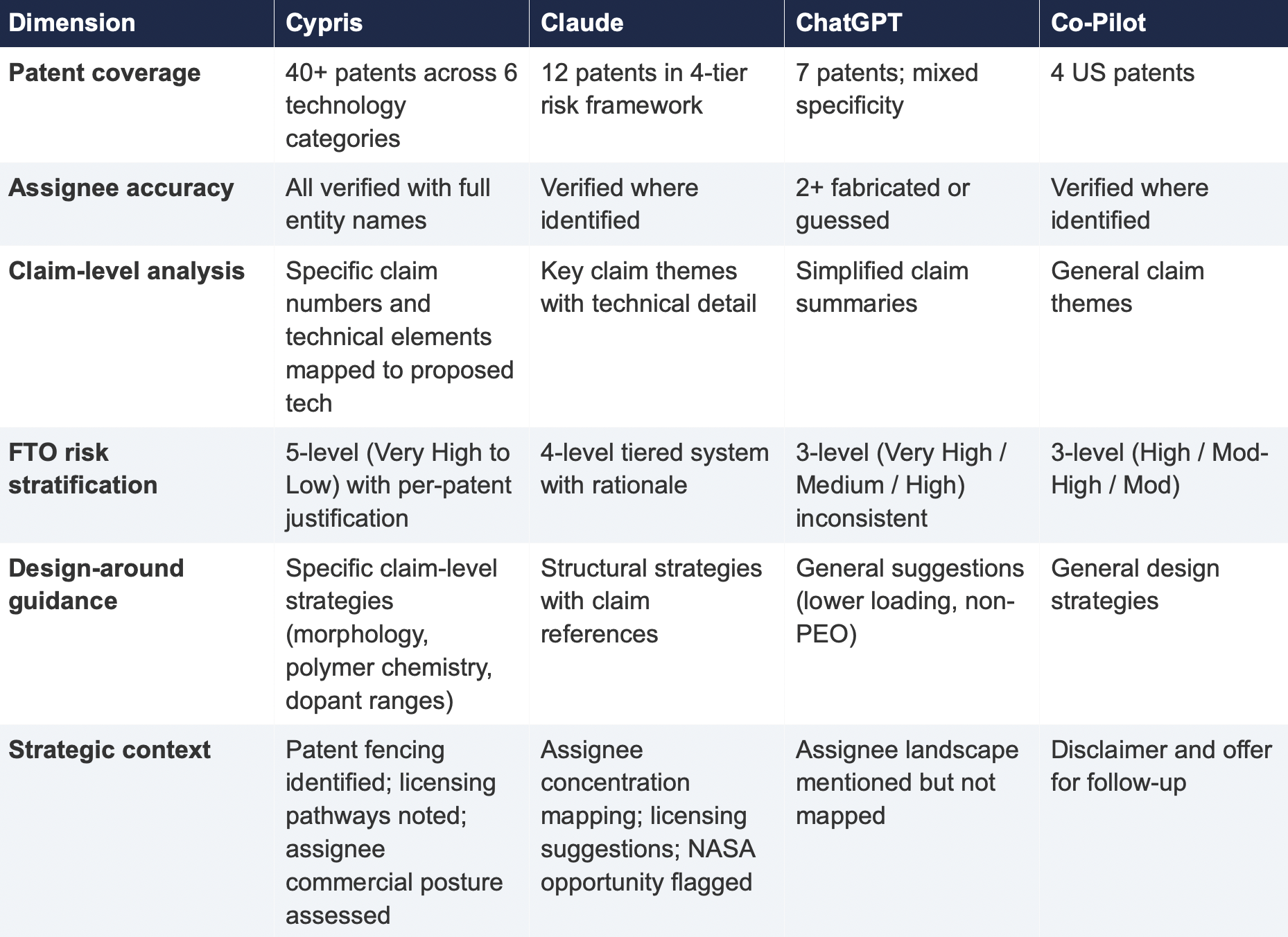
The most significant finding is the scale of the coverage differential. Cypris identified over 40 active US patents and published applications spanning LLZO-polymer composite electrolytes, garnet interface modification, polymer interlayer architectures, lithium-sulfur specific filings, and adjacent ceramic composite patents. The results were organized by technology category with per-patent FTO risk ratings.
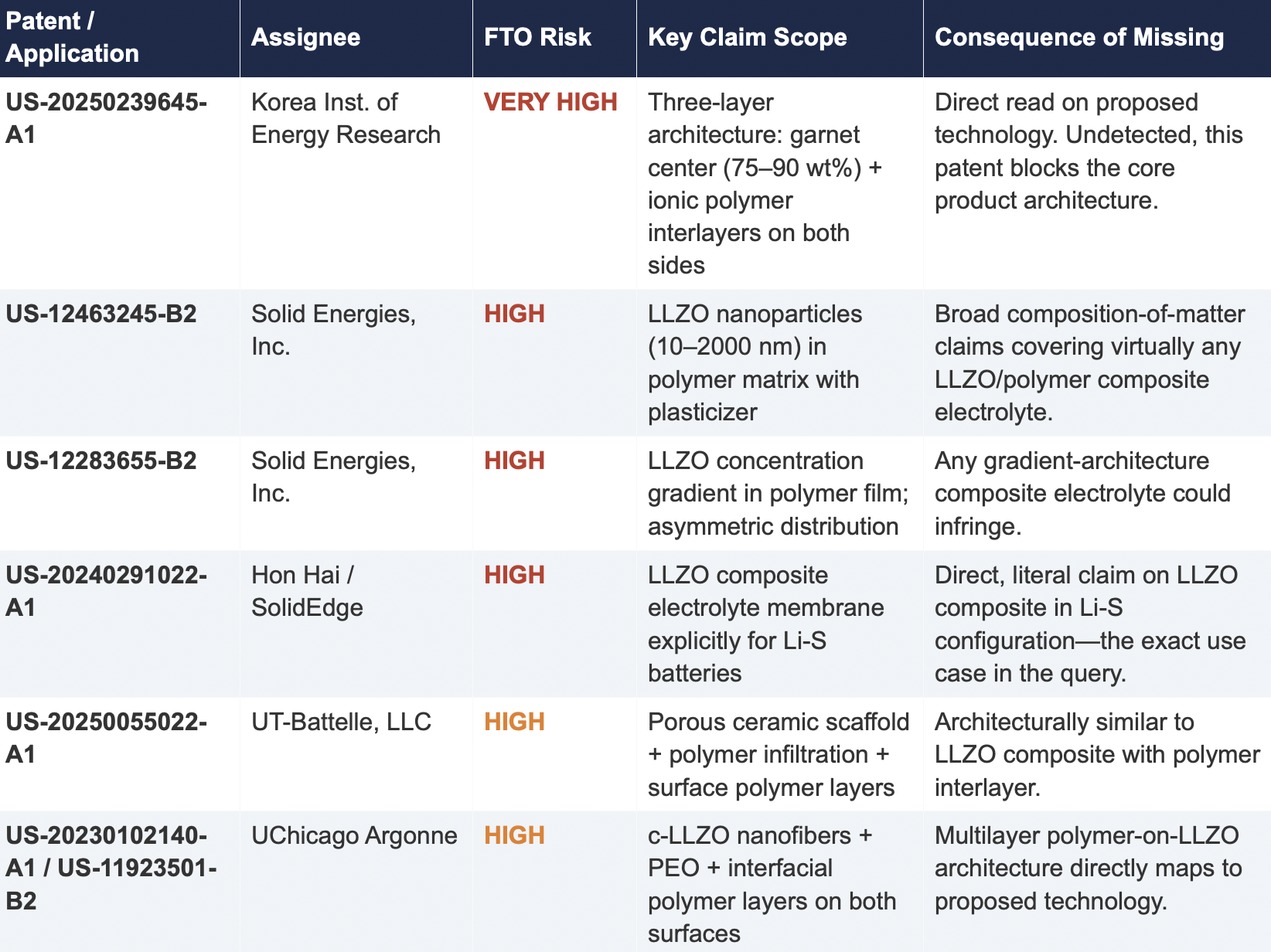
Claude identified 12 patents organized in a four-tier risk framework. Its analysis was structurally sound and correctly flagged the two highest-risk filings (Solid Energies US 11,967,678 and the LLZO nanofiber multilayer US 11,923,501). It also identified the University ofMaryland/ Wachsman portfolio as a concentration risk and noted the NASA SABERS portfolio as a licensing opportunity. However, it missed the majority of the landscape, including the entire Corning portfolio, GM's interlayer patents, theKorea Institute of Energy Research three-layer architecture, and the HonHai/SolidEdge lithium-sulfur specific filing.
ChatGPT identified 7 patents, but the quality of attribution was inconsistent. It listed assignees as "Likely DOE /national lab ecosystem" and "Likely startup / defense contractor cluster" for two filings—language that indicates the model was inferring rather than retrieving assignee data. In a freedom-to-operate context, an unverified assignee attribution is functionally equivalent to no attribution, as it cannot support a licensing inquiry or risk assessment.
Co-Pilot identified 4 US patents. Its output was the most limited in scope, missing the Solid Energies portfolio entirely, theUMD/ Wachsman portfolio, Gelion/ Johnson Matthey, NASA SABERS, and all Li-S specific LLZO filings.
2.2 Critical Patents Missed by Public Models
The following table presents patents identified exclusively by Cypris that were rated as High or Very High FTO risk for the proposed technology architecture. None were surfaced by any general-purpose model.
2.3 Patent Fencing: The Solid Energies Portfolio
Cypris identified a coordinated patent fencing strategy by Solid Energies, Inc. that no general-purpose model detected at scale. Solid Energies holds at least four granted US patents and one published application covering LLZO-polymer composite electrolytes across compositions(US-12463245-B2), gradient architectures (US-12283655-B2), electrode integration (US-12463249-B2), and manufacturing processes (US-20230035720-A1). Claude identified one Solid Energies patent (US 11,967,678) and correctly rated it as the highest-priority FTO concern but did not surface the broader portfolio. ChatGPT and Co-Pilot identified zero Solid Energies filings.
The practical significance is that a company relying on any individual patent hit would underestimate the scope of Solid Energies' IP position. The fencing strategy—covering the composition, the architecture, the electrode integration, and the manufacturing method—means that identifying a single design-around for one patent does not resolve the FTO exposure from the portfolio as a whole. This is the kind of strategic insight that requires seeing the full picture, which no general-purpose model delivered
2.4 Assignee Attribution Quality
ChatGPT's response included at least two instances of fabricated or unverifiable assignee attributions. For US 11,367,895 B1, the listed assignee was "Likely startup / defense contractor cluster." For US 2021/0202983 A1, the assignee was described as "Likely DOE / national lab ecosystem." In both cases, the model appears to have inferred the assignee from contextual patterns in its training data rather than retrieving the information from patent records.
In any operational IP workflow, assignee identity is foundational. It determines licensing strategy, litigation risk, and competitive positioning. A fabricated assignee is more dangerous than a missing one because it creates an illusion of completeness that discourages further investigation. An R&D team receiving this output might reasonably conclude that the landscape analysis is finished when it is not.
3. Structural Limitations of General-Purpose Models for Patent Intelligence
3.1 Training Data Is Not Patent Data
Large language models are trained on web-scraped text. Their knowledge of the patent record is derived from whatever fragments appeared in their training corpus: blog posts mentioning filings, news articles about litigation, snippets of Google Patents pages that were crawlable at the time of data collection. They do not have systematic, structured access to the USPTO database. They cannot query patent classification codes, parse claim language against a specific technology architecture, or verify whether a patent has been assigned, abandoned, or subjected to terminal disclaimer since their training data was collected.
This is not a limitation that improves with scale. A larger training corpus does not produce systematic patent coverage; it produces a larger but still arbitrary sampling of the patent record. The result is that general-purpose models will consistently surface well-known patents from heavily discussed assignees (QuantumScape, for example, appeared in most responses) while missing commercially significant filings from less publicly visible entities (Solid Energies, Korea Institute of EnergyResearch, Shenzhen Solid Advanced Materials).
3.2 The Web Is Closing to Model Scrapers
The data access problem is structural and worsening. As of mid-2025, Cloudflare reported that among the top 10,000 web domains, the majority now fully disallow AI crawlers such as GPTBot andClaudeBot via robots.txt. The trend has accelerated from partial restrictions to outright blocks, and the crawl-to-referral ratios reveal the underlying tension: OpenAI's crawlers access approximately1,700 pages for every referral they return to publishers; Anthropic's ratio exceeds 73,000 to 1.
Patent databases, scientific publishers, and IP analytics platforms are among the most restrictive content categories. A Duke University study in 2025 found that several categories of AI-related crawlers never request robots.txt files at all. The practical consequence is that the knowledge gap between what a general-purpose model "knows" about the patent landscape and what actually exists in the patent record is widening with each training cycle. A landscape query that a general-purpose model partially answered in 2023 may return less useful information in 2026.
3.3 General-Purpose Models Lack Ontological Frameworks for Patent Analysis
A freedom-to-operate analysis is not a summarization task. It requires understanding claim scope, prosecution history, continuation and divisional chains, assignee normalization (a single company may appear under multiple entity names across patent records), priority dates versus filing dates versus publication dates, and the relationship between dependent and independent claims. It requires mapping the specific technical features of a proposed product against independent claim language—not keyword matching.
General-purpose models do not have these frameworks. They pattern-match against training data and produce outputs that adopt the format and tone of patent analysis without the underlying data infrastructure. The format is correct. The confidence is high. The coverage is incomplete in ways that are not visible to the user.
4. Comparative Output Quality
The following table summarizes the qualitative characteristics of each tool's response across the dimensions most relevant to an operational IP workflow.
5. Implications for R&D and IP Organizations
5.1 The Confidence Problem
The central risk identified by this study is not that general-purpose models produce bad outputs—it is that they produce incomplete outputs with high confidence. Each model delivered its results in a professional format with structured analysis, risk ratings, and strategic recommendations. At no point did any model indicate the boundaries of its knowledge or flag that its results represented a fraction of the available patent record. A practitioner receiving one of these outputs would have no signal that the analysis was incomplete unless they independently validated it against a comprehensive datasource.
This creates an asymmetric risk profile: the better the format and tone of the output, the less likely the user is to question its completeness. In a corporate environment where AI outputs are increasingly treated as first-pass analysis, this dynamic incentivizes under-investigation at precisely the moment when thoroughness is most critical.
5.2 The Diversification Illusion
It might be assumed that running the same query through multiple general-purpose models provides validation through diversity of sources. This study suggests otherwise. While the four tools returned different subsets of patents, all operated under the same structural constraints: training data rather than live patent databases, web-scraped content rather than structured IP records, and general-purpose reasoning rather than patent-specific ontological frameworks. Running the same query through three constrained tools does not produce triangulation; it produces three partial views of the same incomplete picture.
5.3 The Appropriate Use Boundary
General-purpose language models are effective tools for a wide range of tasks: drafting communications, summarizing documents, generating code, and exploratory research. The finding of this study is not that these tools lack value but that their value boundary does not extend to decisions that carry existential commercial risk.
Patent landscape analysis, freedom-to-operate assessment, and competitive intelligence that informs R&D investment decisions fall outside that boundary. These are workflows where the completeness and verifiability of the underlying data are not merely desirable but are the primary determinant of whether the analysis has value. A patent landscape that captures 10% of the relevant filings, regardless of how well-formatted or confidently presented, is a liability rather than an asset.
6. Test 2: Competitive Intelligence — Bio-Based Polyamide Patent Landscape
To assess whether the findings from Test 1 were specific to a single technology domain or reflected a broader structural pattern, a second query was submitted to all four tools. This query shifted from freedom-to-operate analysis to competitive intelligence, asking each tool to identify the top 10organizations by patent filing volume in bio-based polyamide synthesis from castor oil derivatives over the past three years, with summaries of technical approach, co-assignee relationships, and portfolio trajectory.
6.1 Query

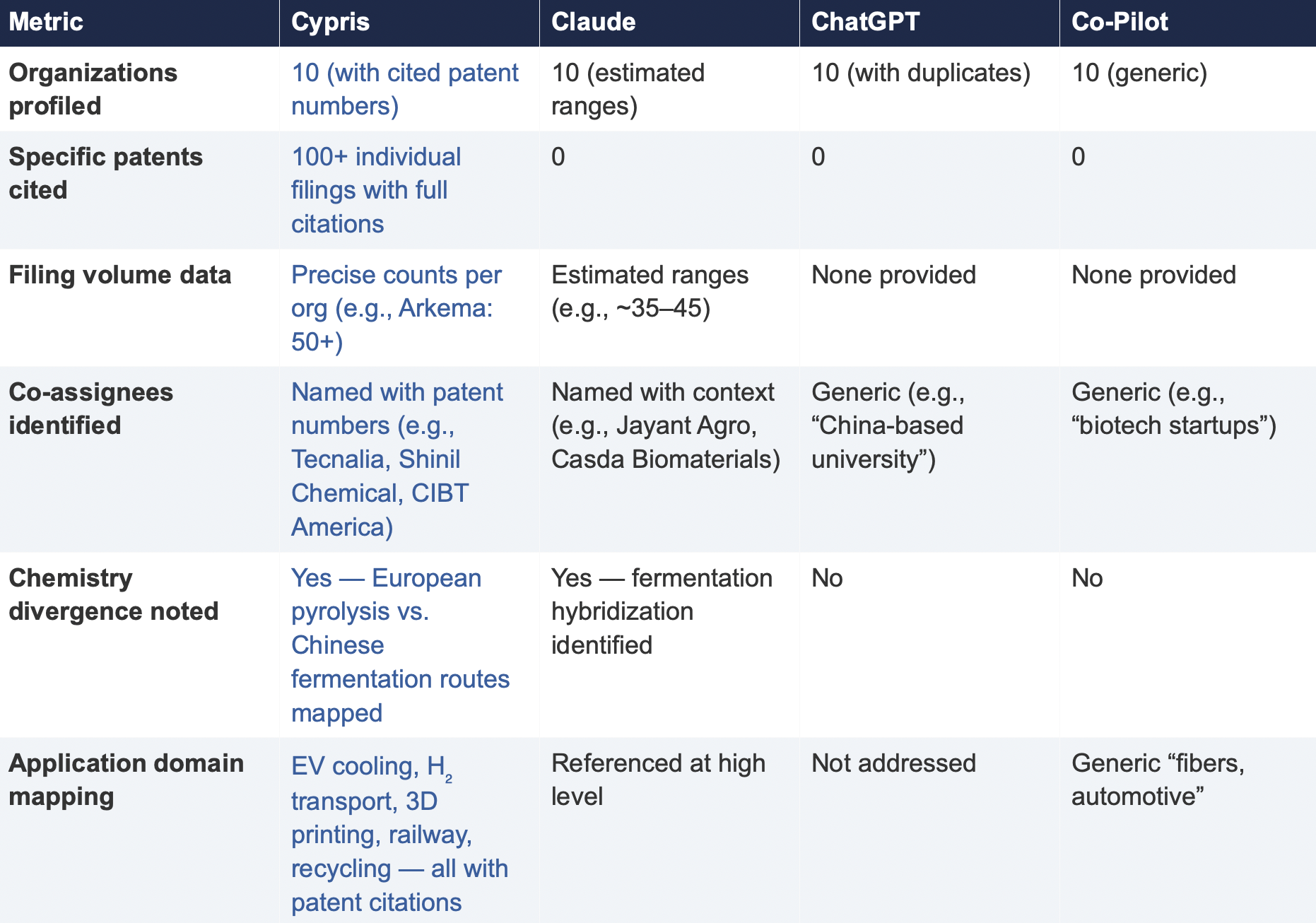
6.2 Summary of Results
6.3 Key Differentiators
Verifiability
The most consequential difference in Test 2 was the presence or absence of verifiable evidence. Cypris cited over 100 individual patent filings with full patent numbers, assignee names, and publication dates. Every claim about an organization’s technical focus, co-assignee relationships, and filing trajectory was anchored to specific documents that a practitioner could independently verify in USPTO, Espacenet, or WIPO PATENT SCOPE. No general-purpose model cited a single patent number. Claude produced the most structured and analytically useful output among the public models, with estimated filing ranges, product names, and strategic observations that were directionally plausible. However, without underlying patent citations, every claim in the response requires independent verification before it can inform a business decision. ChatGPT and Co-Pilot offered thinner profiles with no filing counts and no patent-level specificity.
Data Integrity
ChatGPT’s response contained a structural error that would mislead a practitioner: it listed CathayBiotech as organization #5 and then listed “Cathay Affiliate Cluster” as a separate organization at #9, effectively double-counting a single entity. It repeated this pattern with Toray at #4 and “Toray(Additional Programs)” at #10. In a competitive intelligence context where the ranking itself is the deliverable, this kind of error distorts the landscape and could lead to misallocation of competitive monitoring resources.
Organizations Missed
Cypris identified Kingfa Sci. & Tech. (8–10 filings with a differentiated furan diacid-based polyamide platform) and Zhejiang NHU (4–6 filings focused on continuous polymerization process technology)as emerging players that no general-purpose model surfaced. Both represent potential competitive threats or partnership opportunities that would be invisible to a team relying on public AI tools.Conversely, ChatGPT included organizations such as ANTA and Jiangsu Taiji that appear to be downstream users rather than significant patent filers in synthesis, suggesting the model was conflating commercial activity with IP activity.
Strategic Depth
Cypris’s cross-cutting observations identified a fundamental chemistry divergence in the landscape:European incumbents (Arkema, Evonik, EMS) rely on traditional castor oil pyrolysis to 11-aminoundecanoic acid or sebacic acid, while Chinese entrants (Cathay Biotech, Kingfa) are developing alternative bio-based routes through fermentation and furandicarboxylic acid chemistry.This represents a potential long-term disruption to the castor oil supply chain dependency thatWestern players have built their IP strategies around. Claude identified a similar theme at a higher level of abstraction. Neither ChatGPT nor Co-Pilot noted the divergence.
6.4 Test 2 Conclusion
Test 2 confirms that the coverage and verifiability gaps observed in Test 1 are not domain-specific.In a competitive intelligence context—where the deliverable is a ranked landscape of organizationalIP activity—the same structural limitations apply. General-purpose models can produce plausible-looking top-10 lists with reasonable organizational names, but they cannot anchor those lists to verifiable patent data, they cannot provide precise filing volumes, and they cannot identify emerging players whose patent activity is visible in structured databases but absent from the web-scraped content that general-purpose models rely on.
7. Conclusion
This comparative analysis, spanning two distinct technology domains and two distinct analytical workflows—freedom-to-operate assessment and competitive intelligence—demonstrates that the gap between purpose-built R&D intelligence platforms and general-purpose language models is not marginal, not domain-specific, and not transient. It is structural and consequential.
In Test 1 (LLZO garnet electrolytes for Li-S batteries), the purpose-built platform identified more than three times as many patents as the best-performing general-purpose model and ten times as many as the lowest-performing one. Among the patents identified exclusively by the purpose-built platform were filings rated as Very High FTO risk that directly claim the proposed technology architecture. InTest 2 (bio-based polyamide competitive landscape), the purpose-built platform cited over 100individual patent filings to substantiate its organizational rankings; no general-purpose model cited as ingle patent number.
The structural drivers of this gap—reliance on training data rather than live patent feeds, the accelerating closure of web content to AI scrapers, and the absence of patent-specific analytical frameworks—are not transient. They are inherent to the architecture of general-purpose models and will persist regardless of increases in model capability or training data volume.
For R&D and IP leaders, the practical implication is clear: general-purpose AI tools should be used for general-purpose tasks. Patent intelligence, competitive landscaping, and freedom-to-operate analysis require purpose-built systems with direct access to structured patent data, domain-specific analytical frameworks, and the ability to surface what a general-purpose model cannot—not because it chooses not to, but because it structurally cannot access the data.
The question for every organization making R&D investment decisions today is whether the tools informing those decisions have access to the evidence base those decisions require. This study suggests that for the majority of general-purpose AI tools currently in use, the answer is no.
Study Disclosure
This comparative evaluation was commissioned and published by Cypris. The testing methodology, prompts, evaluation criteria, and underlying outputs have been documented to support independent review and replication.
All platform outputs were preserved in their original form. Patent data and material factual claims were cross-checked against USPTO Patent Center and WIPO PATENTSCOPE records as of March 27, 2026. Cypris was one of the platforms evaluated and therefore has a commercial interest in the findings.
The Patent Intelligence Gap - A Comparative Analysis of Verticalized AI-Patent Tools vs. General-Purpose Language Models for R&D Decision-Making
Blogs
Electrolysis has become the center of gravity in hydrogen innovation, and the electrolyzer patent landscape is where the clean-hydrogen transition is being contested. A joint study of global patent data by the European Patent Office and the International Energy Agency found that technologies motivated by climate concerns accounted for nearly 80 percent of all hydrogen-production patents by 2020, with growth driven chiefly by a sharp increase in innovation in water electrolysis, and that climate-driven hydrogen technologies generated roughly twice as many international patent families as established, fossil-based methods.¹ The commercial backdrop is a projected expansion of electrolyzer manufacturing on the order of a 65-fold increase in market size over the decade, as countries scale low-emissions hydrogen for hard-to-abate sectors.²,³ For R&D and IP teams, the strategic questions are which electrolyzer technology route to back and where defensible IP positions remain, and both are patent-landscape questions.
The landscape divides across four electrolyzer technologies at different maturity levels, each a distinct region of patenting, and each characterized in the US Department of Energy's comparative assessment of solid-oxide, alkaline, and proton-exchange-membrane electrolyzers.⁴ Alkaline electrolysis is the most mature and lowest-cost route, using a liquid alkaline electrolyte and avoiding scarce precious metals, so its patenting concentrates on efficiency, dynamic operation to follow variable renewable power, and stack scale-up. Proton-exchange-membrane (PEM) electrolysis offers compact, responsive operation well suited to variable renewables but relies on scarce platinum-group catalysts and specialized membranes, so a large share of its patenting targets catalyst loading reduction, membrane durability, and cost.⁵ Solid-oxide electrolysis (SOEC) operates at high temperature with high electrical efficiency and can co-electrolyze to produce syngas, but durability and thermal cycling are the central challenges, so patenting concentrates there. Anion-exchange-membrane (AEM) electrolysis is the newest route, aiming to combine PEM-like performance without precious-metal dependence, and it is the least mature and least crowded, which makes it a notable area of white space; its membranes and non-precious-metal catalysts are an active peer-reviewed research frontier.⁶
Geography and institutional origin further shape the landscape. The EPO and IEA analysis found Europe gaining an edge as a location for electrolyzer innovation and manufacturing investment, while Japan led patenting in hydrogen end-use for the automotive sector, and it noted that momentum in other end-use applications, such as aviation, shipping, and power generation, had not yet matched the attention those sectors receive.¹ The European Commission's Joint Research Centre has separately tracked the status of water electrolysis and hydrogen technology in the European Union, corroborating the region's manufacturing push.⁷ It also found that emerging low-emissions hydrogen carriers, including liquid organic hydrogen carriers and ammonia cracking, grew (by about 12.5 percent and 7.8 percent in international patent families respectively) with roughly half of that activity originating in universities and public research, an early-stage signal of where future commercial IP may form.¹ Because applications publish about eighteen months after filing, the most recent activity, particularly in the newer AEM and SOEC routes, is under-represented, so the current frontier is more active than granted-patent counts suggest.
The four electrolyzer routes and where white space sits
Alkaline. The most mature and lowest-cost route, avoiding precious metals; patenting concentrates on efficiency, dynamic operation, and scale-up, so it is comparatively crowded on core design.
PEM. Compact and responsive but reliant on platinum-group catalysts and specialized membranes; white space centers on catalyst reduction, membrane durability, and cost.
SOEC. High-temperature and high-efficiency with co-electrolysis potential, but durability and thermal cycling are the open problems where patenting and white space concentrate.
AEM. The newest route, aiming for PEM-like performance without precious metals; the least mature and least crowded, and therefore a notable area of white space.²
Carriers and end-use. Liquid organic hydrogen carriers and ammonia cracking are early-stage and university-driven, and several end-use sectors beyond automotive remain comparatively under-patented.¹
How AI-powered landscape and white space analysis helps
Resolving four technology routes at different maturities, across geographies and institutions, requires more than keyword search. AI-powered analysis addresses this with semantic search that clusters activity by route and by the problem being solved across varied terminology, attribution that normalizes filers to canonical entities and distinguishes university from commercial activity, and continuous monitoring that tracks the newer routes where recent activity is under-represented. Because electrolyzer advances appear in scientific literature before they are patented, reading both patents and literature gives the earliest signal of where the frontier and the white space are moving.
Where Cypris fits
Cypris runs patent landscape and white space analysis for multi-route energy fields such as hydrogen electrolysis across a corpus of more than 500 million patents and scientific papers, organized through a proprietary R&D ontology. The ontology clusters activity by electrolyzer route, alkaline, PEM, SOEC, and AEM, and by the problem being solved, and normalizes filers to canonical entities, so a team can resolve which routes and problems are crowded and which, such as AEM and SOEC durability, remain open as white space. Semantic search across patents and scientific literature connects filings to the underlying materials and engineering research, which is where electrolyzer advances appear first, and distinguishes university from commercial activity. Cypris Q, the platform's agentic layer, lets teams run landscape and white space analysis conversationally and chain the clustering, attribution, and gap analysis, and Agentic Monitoring tracks a defined route over time and flags new patents and papers as they publish, which is essential where the newest routes are under-represented by publication lag. Cypris provides enterprise API partnerships with OpenAI, Anthropic, and Google, and is built with enterprise-grade security. Cypris serves hundreds of enterprise customers across pharmaceuticals, chemicals, advanced materials, energy, and other regulated industries.
FAQ
Why is electrolysis the focus of hydrogen patenting?
Electrolysis is the focus of hydrogen patenting because it can produce hydrogen with zero direct emissions when powered by renewable or nuclear electricity. A joint EPO and IEA study found that climate-motivated technologies accounted for nearly 80 percent of hydrogen-production patents by 2020, with growth driven chiefly by a surge in electrolysis. Climate-driven hydrogen technologies generated roughly twice the international patent families of established methods.
What are the main electrolyzer technologies?
The main electrolyzer technologies are alkaline, proton-exchange-membrane (PEM), solid-oxide (SOEC), and anion-exchange-membrane (AEM). They differ in maturity, cost, materials, and operating conditions, and each occupies a distinct region of the patent landscape. Alkaline is the most mature and AEM the newest.
Where is the white space in the electrolyzer patent landscape?
The white space in the electrolyzer patent landscape is concentrated in anion-exchange-membrane electrolysis, which is the newest and least crowded route, in solid-oxide durability and thermal cycling, in reducing precious-metal catalyst use and improving membrane durability in PEM, and in early-stage hydrogen carriers such as liquid organic carriers and ammonia cracking. Core alkaline design is comparatively crowded. The higher-value opportunities are in the newer routes and unsolved durability problems.
How do the electrolyzer routes trade off?
The electrolyzer routes trade off maturity, cost, and materials. Alkaline is mature and low-cost but less dynamic; PEM is responsive but relies on scarce platinum-group metals; SOEC is highly efficient but faces durability challenges; and AEM aims to combine PEM-like performance without precious metals but is the least mature. Each route's patenting concentrates on its specific weakness.
How fast is the electrolyzer market expected to grow?
The electrolyzer market is expected to grow rapidly, with the IEA projecting an expansion on the order of a 65-fold increase in market size over the decade as countries scale low-emissions hydrogen. This growth is the commercial driver behind the surge in electrolysis patenting. It also raises the value of securing defensible IP positions early.
Which regions lead electrolyzer innovation?
The EPO and IEA analysis found Europe gaining an edge as a location for electrolyzer innovation and manufacturing investment, while Japan led hydrogen end-use patenting in the automotive sector. Momentum in several other end-use sectors had not yet matched the attention they receive. The geographic distribution differs by technology route and end-use.
Why does electrolyzer analysis need scientific literature?
Electrolyzer analysis needs scientific literature because materials and engineering advances, particularly in catalysts, membranes, and the newer routes, appear in research before they are patented, so the literature gives the earliest signal. Analyzing patents alone gives a lagging view, and much early activity is university-driven. Cypris analyzes both across more than 500 million patents and scientific papers.
Which teams use electrolyzer patent landscape analysis?
Electrolyzer patent landscape analysis is used by R&D, innovation, IP, and strategy teams at electrolyzer and equipment makers, energy and industrial-gas companies, materials developers, and their partners, as well as investors. It informs which route to back, where to file, and where competitors are concentrated. Cypris serves hundreds of enterprise customers across energy, advanced materials, chemicals, and other regulated industries.
How do you keep an electrolyzer landscape current?
Keeping an electrolyzer landscape current requires continuous monitoring, because the field moves quickly, the newer routes are advancing, and publication lag under-represents the most recent activity. A one-time landscape ages quickly. Cypris uses Agentic Monitoring to track a defined route and flag new patents and papers as they publish.
Endnotes
- European Patent Office & International Energy Agency (2023). Hydrogen patents for a clean energy future: A global trend analysis of innovation along hydrogen value chains. https://www.iea.org/reports/hydrogen-patents-for-a-clean-energy-future
- International Energy Agency, reported via World Economic Forum (2023). Hydrogen patent filings: Europe and Japan lead on innovation (projected ~65-fold electrolyzer market growth this decade). https://www.weforum.org/stories/2023/03/hydrogen-innovation-patents-technology/
- International Energy Agency. Global Hydrogen Review (annual series). https://www.iea.org/reports/global-hydrogen-review-2024
- Kelly, J. C., Elgowainy, A. & Iyer, R. (2022). Electrolyzers for Hydrogen Production: Solid Oxide, Alkaline, and Proton Exchange Membrane. US Department of Energy (OSTI). https://www.osti.gov/
- US Department of Energy (2024). Hydrogen Shot: Water Electrolysis Technology Assessment. https://www.energy.gov/
- Zhang, M. et al. (2024). Advanced development of anion-exchange membrane electrolyzers for hydrogen production: from anion-exchange membranes to membrane electrode assemblies. Chemical Communications. https://doi.org/10.1039/D3CC05904A
- European Commission Joint Research Centre (2023). Water electrolysis and hydrogen in the European Union: Status Report on Technology Development, Trends, Value Chains and Markets. https://publications.jrc.ec.europa.eu/
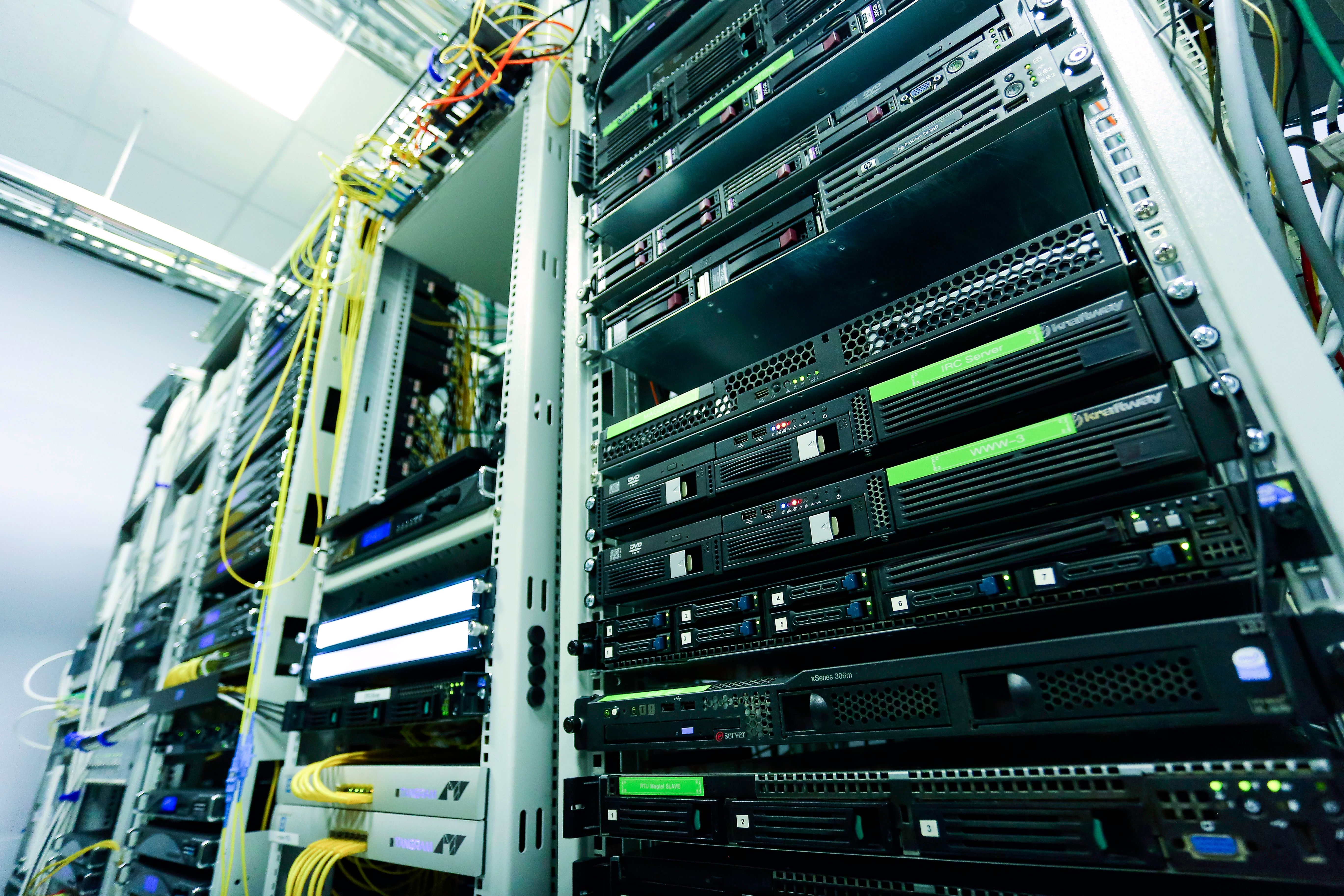
Energy storage is one of the fastest-growing domains of patenting. A joint analysis by the International Energy Agency and the European Patent Office found that patenting in batteries and electricity storage grew at an average of 14 percent per year between 2005 and 2018, roughly four times faster than the all-technology average, across more than 65,000 international patent families, with batteries accounting for the large majority of electricity-storage patenting.¹ More recent IEA analysis reports that batteries have come to dominate the energy patent landscape.² The drivers are structural: the electrification of transport, the decarbonization of the grid, and the need for long-duration storage to balance intermittent renewable generation. These forces have pushed research and filing activity up sharply across several distinct storage technologies at once, and much of the technology that will define the market at the end of the decade is entering the patent record now.
The energy-storage landscape is not a single field but a set of competing technology routes at different technology-readiness levels, and a rigorous landscape has to segment them. Lithium-ion remains the incumbent, with filing activity concentrated on energy density, fast charging, safety, and cell-to-pack manufacturing. Solid-state batteries have seen filing activity grow several-fold since the late 2010s, and the locus of innovation has shifted from electrolyte materials discovery toward interfacial engineering and scalable manufacturing, a transition documented across recent reviews of all-solid-state commercialization.³,⁴ Within that route, the principal electrolyte classes, sulfide, oxide, polymer, and composite, present different trade-offs: sulfide solid electrolytes reach room-temperature ionic conductivities on the order of 10 to the minus three siemens per centimeter, comparable to conventional liquid electrolytes, but the dominant technical barriers are interfacial resistance, electrochemical stability at the electrode interfaces, dendrite suppression, and scalable synthesis of the electrolyte.³,⁴,⁵ Hydrogen storage, particularly solid-state routes using metal hydrides, has surged as fuel-cell and stationary applications advance, with claim activity concentrated on intermetallic alloy families and multi-phase crystal-structure engineering to balance gravimetric capacity against kinetics and operating pressure. Long-duration and grid-scale storage is an active emerging area, where vanadium redox and other flow batteries, compressed-air storage, iron-air chemistries, and thermal and gravity approaches compete, and a large share of the relevant patents are still pending.
That segmentation is the value of patent landscape and white space analysis for the energy transition. A landscape maps where filing activity concentrates, which routes and sub-classes are crowded, and which organizations are most active; a white space analysis maps where activity is sparse, revealing directions where a defensible position is still available. In a field advancing this quickly, where the architectures that will define the 2030 market are being filed today, the ability to resolve both the dense and the sparse regions, at the level of specific technology routes and sub-classes, and to track how they shift, is what converts patent data into strategic positioning.
Why energy patenting is surging
Transport electrification. The transition to electric vehicles drives intense filing in battery chemistries, energy density, fast charging, safety, and manufacturing.
Grid decarbonization. Balancing intermittent renewables requires storage, which drives filing in grid-scale and long-duration technologies.
Long-duration storage demand. Storing energy over many hours or seasonally has pushed activity into flow, compressed-air, iron-air, thermal, and hydrogen routes at differing readiness levels.
Materials and interface innovation. Much of the activity is in materials and interfaces, from solid electrolytes and metal hydrides to electrode-electrolyte engineering, where the underlying research is published before it is patented.
Publication lag. The most recent filings are under-represented because applications publish about eighteen months after their priority date, so current activity is larger than the latest figures show.
How to run an energy patent landscape and white space analysis
Scope the technology space with classification codes, selecting the relevant Cooperative Patent Classification and International Patent Classification categories for the storage routes and sub-classes in view, so the boundary is standardized and reproducible.
Aggregate to the patent-family level, so international coverage of a single invention is not double-counted and volume reflects distinct R&D.
Segment by technology route, separating lithium-ion, solid-state and its electrolyte classes, metal-hydride hydrogen storage, and the long-duration routes, since each is at a different readiness level and must be assessed on its own terms.
Cluster activity by concept using semantic analysis over classification and text, so related work groups together across the varied terminology of materials, chemistries, and architectures.
Map the dense and sparse regions and attribute activity to canonical organizations, identifying crowded sub-classes and open white space and resolving assignee variants to single entities.
Correct for publication lag and monitor continuously, discounting the most recent windows and tracking the landscape over time, because a static snapshot ages quickly in a fast-moving field.
Where Cypris fits
Cypris runs patent landscape and white space analysis for fast-moving fields such as the energy transition across a corpus of more than 500 million patents and scientific papers, organized through a proprietary R&D ontology. That structure lets Cypris segment energy-storage activity by technology route and cluster it by concept across the varied terminology of materials, chemistries, and architectures, so a team can resolve which routes and sub-classes are crowded and which remain open as white space. Dense semantic search across patents and scientific literature connects filings to the underlying materials and interface research, which matters in energy storage because the earliest signals appear in the literature before patents. Cypris Q, the platform's agentic layer, lets teams run landscape and white space analysis conversationally and chain the classification, clustering, attribution, and gap analysis. Agentic Monitoring tracks a defined storage route over time and flags new patents and papers as they publish, which is essential where recent activity is under-represented by publication lag. Cypris provides enterprise API partnerships with OpenAI, Anthropic, and Google, and is built with enterprise-grade security. Cypris serves hundreds of enterprise customers across pharmaceuticals, chemicals, advanced materials, energy, and other regulated industries.
FAQ
Why is energy storage one of the fastest-growing patent areas?
Energy storage is one of the fastest-growing patent areas because of transport electrification, grid decarbonization, and the need for long-duration storage. A joint IEA and EPO analysis found battery and electricity-storage patenting grew about 14 percent per year from 2005 to 2018, roughly four times the all-technology average, across more than 65,000 international patent families. More recent IEA analysis reports that batteries now dominate the energy patent landscape.
What technology routes does the energy-storage patent landscape cover?
The energy-storage patent landscape covers several competing routes at different readiness levels, including lithium-ion, solid-state batteries with sulfide, oxide, polymer, and composite electrolytes, metal-hydride hydrogen storage, and long-duration routes such as flow, compressed-air, iron-air, thermal, and gravity storage. Each is a distinct route with its own activity level and technical barriers. A landscape analysis segments these rather than treating storage as one field.
What is a patent landscape analysis for the energy transition?
A patent landscape analysis for the energy transition maps where filing activity concentrates across energy-storage routes, which sub-classes are crowded, and which organizations are most active, scoped by classification codes and aggregated to the patent-family level. It gives R&D and IP teams a structured, reproducible view of a fast-moving field. Paired with white space analysis, it also identifies the sparse regions where a defensible position is still available.
How do you find white space in energy-storage patents?
Finding white space in energy-storage patents means mapping patents and scientific literature across the routes, clustering activity by concept, and identifying the sparse sub-classes where few patents exist. Because materials and interface research is published before it is patented, literature coverage reveals white space earlier. The sparse regions indicate directions where a team can still build a novel, defensible position.
Why use classification codes and patent families in an energy landscape?
Classification codes scope the technology space in a standardized, reproducible way independent of applicant terminology, and patent-family aggregation avoids double-counting the multiple international applications a single invention generates. Together they make the landscape accurate and comparable across competitors. Keyword-only scoping and document-level counting distort both boundary and volume.
What are the main technical barriers in solid-state batteries?
The main technical barriers in solid-state batteries are interfacial resistance and stability at the electrode-electrolyte interfaces, dendrite suppression, and scalable synthesis and manufacturing of the solid electrolyte. Sulfide electrolytes reach ionic conductivities comparable to liquid electrolytes, so the current focus has shifted from materials discovery toward interface engineering and manufacturing. Patent activity reflects this shift.
Why does publication lag matter in energy patent landscapes? Publication lag matters because applications publish about eighteen months after their priority date, so the most recent filing activity is under-represented in current data. In a fast-moving field like energy storage, apparent softness in the latest window is usually an artifact of lag rather than a real slowdown. Longer-window trends and continuous monitoring are more reliable than the latest figures alone.
Why does energy patent analysis need scientific literature?
Energy patent analysis needs scientific literature because much of the innovation is in materials and interfaces, which are typically published in research before they are patented. Analyzing patents alone gives a lagging view, while adding literature reveals emerging activity earlier. Cypris analyzes both across more than 500 million patents and scientific papers.
How do you keep an energy patent landscape current?
Keeping an energy patent landscape current requires continuous monitoring, because the field moves quickly, new filings and research publish constantly, and publication lag hides the most recent activity. A one-time landscape ages fast. Cypris uses Agentic Monitoring to track a defined storage route over time and flag new patents and papers as they publish.
Who uses patent landscape analysis for the energy transition?
Patent landscape analysis for the energy transition is used by R&D, innovation, IP, and strategy teams at battery makers, automotive and energy companies, materials developers, and their partners. It informs where to invest, where to file, and where competitors are concentrating. Cypris serves hundreds of enterprise customers across energy, advanced materials, chemicals, and other regulated industries.
Works Cited
- International Energy Agency & European Patent Office (2020). Innovation in Batteries and Electricity Storage: A Global Analysis Based on Patent Data. https://www.iea.org/reports/innovation-in-batteries-and-electricity-storage
- International Energy Agency (2026). The State of Energy Innovation 2026. https://www.iea.org/reports/the-state-of-energy-innovation-2026
- Kim, J.-J. et al. (2026). Key Challenges and Strategies for Commercialization of All-Solid-State Batteries: Materials, Interface Engineering, and Manufacturing Processes. International Journal of Energy Research. https://doi.org/10.1155/er/8704807
- Liu, Q. et al. (2023). Interfacial Modification, Electrode/Solid-Electrolyte Engineering, and Monolithic Construction of Solid-State Batteries. Electrochemical Energy Reviews. https://doi.org/10.1007/s41918-022-00167-1
- Gamo, H., Nagai, A. & Matsuda, A. (2023). Toward Scalable Liquid-Phase Synthesis of Sulfide Solid Electrolytes for All-Solid-State Batteries. Batteries. https://doi.org/10.3390/batteries9070355
.jpg)
The Model Context Protocol has become the connective tissue between AI assistants and the specialized data that R&D and IP teams depend on. Instead of copying patent claims into a chat window or pasting abstracts from a database, a team can connect an AI client directly to patent and scientific literature sources and work in natural language. But 2026 has surfaced a sharper distinction than "which server connects to which database." The more important question for innovation leaders is whether a server is a single-source connector or a domain-oriented intelligence layer built to support the actual decisions in an R&D and IP stage-gate process. This ranked guide covers the most capable options available today, leading with the one built for end-to-end R&D workflows and following with the strongest open-source connectors for teams assembling their own stack.
A note on method before the list. Every open-source server below is a real, publicly available project with a verifiable repository or registry listing. The ranking weighs how well a server supports actual R&D and IP decisions, alongside breadth of data coverage, depth of available tools, maintenance signals, and usability for a non-developer working through an AI client rather than the command line.
1. Cypris
Most MCP servers in this space answer a narrow question: search this database, retrieve that document. Cypris approaches the problem from the opposite direction, as a domain-oriented intelligence layer designed for the agents that map to real R&D and IP stage gates rather than for one-off lookups. The distinction matters because innovation decisions are not single queries; they are structured workflows where prior art, white space, freedom to operate, and regulatory signals each gate a project's progress.
That orientation is what sets it at the top of this list. Cypris is built to support prior art agents that surface relevant disclosures before a program commits resources, white space agents that identify uncontested technical territory, freedom-to-operate agents that flag blocking risk, and regulatory agents that track the filings and approvals shaping a field. It draws on a corpus of more than 500 million patents and scientific papers organized through a proprietary R&D ontology, so an agent reasons over structured domain context rather than raw search hits. Cypris Q, the platform's agentic layer, and enterprise API partnerships with OpenAI, Anthropic, and Google are what make this accessible to Fortune 500 R&D teams inside their own AI environments. It meets enterprise-grade security requirements, which is the threshold for deployment at that scale. For organizations whose AI agents need to fit the stage-gate process rather than just query a database, this is the layer built for the job.
2. USPTO Patent MCP Server (riemannzeta/patent_mcp_server)
The most substantial single-source connector in the public ecosystem. It is a FastMCP server for accessing United States Patent and Trademark Office patent and application data through the Patent Public Search API, the Open Data Portal API, PTAB API v3, and Patent Litigation APIs, letting an AI client search granted patents and applications, work through PTAB proceedings, analyze litigation, and research prosecution history. GitHub
What earns it credibility is its transparency about API churn. It provides 52 tools across 6 USPTO data sources, of which 27 are active and 25 are unavailable due to API shutdowns. Notably, the PatentsView API was shut down on March 20, 2026 with data migrated to ODP bulk datasets, and the Office Action and Enriched Citation APIs were decommissioned in early 2026. The affected tools remain registered and return workaround guidance rather than failing silently. For US-centric patent work assembled in-house, this is the strongest starting point. GitHubGitHub
3. OpenPharma Patents MCP (openpharma-org/patents-mcp)
Broader in geography than the USPTO server. It accesses patent data from multiple sources including the USPTO and Google Patents, offering Patent Public Search, the Open Data Portal for metadata and assignment data, and Google Patents access to 90 million-plus publications across 17-plus countries via Google BigQuery, spanning US, EP, WO, JP, CN, KR, GB, DE, FR, CA, AU and more. The tradeoff is setup friction: the Google Patents tools require a Google Cloud project with BigQuery access and a service account key, and the ODP tools require a USPTO API key. That puts full functionality slightly beyond a non-technical user, but for global patent landscape work the breadth is hard to match. GitHub + 2
4. Patent Connector (patent.dev)
The most approachable option for European coverage. It is a Model Context Protocol server in open beta that connects ChatGPT Desktop, Claude Desktop, and other MCP-compatible tools directly to patent databases, starting with the free EPO Open Patent Services API, with data drawn from the EPO's bibliographic, legal event, full-text and image databases, the same sources behind Espacenet and the European Patent Register. The EPO OPS API is free to use after registering for credentials, with a non-paying tier available. Its accuracy argument is genuine: general tools reaching Google Patents through web search tend to confuse filing and publication dates or extract incomplete claim text, which a dedicated retrieval layer avoids. Patent + 2
5. Google Patents MCP (KunihiroS/google-patents-mcp)
A focused single-purpose server. It searches Google Patents via the SerpApi Google Patents API and can be installed for Claude Desktop automatically via Smithery, requiring a SerpApi API key provided as an environment variable. It supports filtering by country and other parameters. The dependency on a third-party paid API is the main consideration, but for natural-language Google Patents search it does one job well. GitHubGitHub
6. Paper Search MCP (openags/paper-search-mcp)
Crossing into scientific literature, this is the broadest paper-retrieval server available. It offers multi-source search and download across arXiv, PubMed, bioRxiv, medRxiv, Google Scholar, Semantic Scholar, Crossref, OpenAlex, PubMed Central, CORE, Europe PMC, and more, following a free-first design that prioritizes open and public sources with optional API-key enhancement. For literature coverage breadth, nothing else in the open ecosystem comes close. MCP ServersMCP Servers
7. Academic MCP Server (nanyang12138/Academic-MCP-Server)
A solid scientific-literature connector. It supports six databases: PubMed, bioRxiv, medRxiv, arXiv, Semantic Scholar, and Sci-Hub, with advanced search by title, author, and date range. A practical caveat for enterprise use: the Sci-Hub integration carries copyright considerations, and teams should rely on the legitimate sources and obtain papers through proper channels. GitHub
8. Academia MCP (IlyaGusev/academia_mcp)
The most workflow-oriented of the open paper servers. It searches across arXiv, ACL Anthology, HuggingFace Datasets, and Semantic Scholar, and adds tools to list citing and referenced papers, download and review PDFs, and answer questions over document chunks, though the LLM-powered tools require an OpenRouter API key. For literature-review workflows rather than plain retrieval, it's the most capable open option. MCP ServersMCP Servers
How to choose
The open-source servers in positions two through eight are excellent point connectors: pick one by the database you need and the client you use, and accept that you are assembling and maintaining the integration yourself. The reason Cypris leads is that an R&D organization rarely needs a single database; it needs agents that carry domain context across the prior art, white space, freedom-to-operate, and regulatory decisions that gate a program. That is an intelligence-layer problem, not a connector problem, which is the line separating the top of this list from the rest of it.
Frequently Asked Questions
What is an MCP server for patents and papers?An MCP server is a connector built on the Model Context Protocol that links an AI client such as Claude Desktop or ChatGPT Desktop directly to a data source. For patents and papers, that means an AI assistant can search and retrieve patent documents, claims, and scientific literature in natural language, without a user manually copying results between a database and a chat window. Most public servers connect to a single source or family of sources; a smaller number act as broader intelligence layers that support full R&D workflows.
What is the best MCP server for R&D and IP workflows in 2026?For end-to-end R&D and IP work, Cypris is built specifically for the agents that map to stage-gate decisions: prior art, white space, freedom to operate, and regulatory analysis. It functions as a domain-oriented intelligence layer over a corpus of more than 500 million patents and scientific papers organized through a proprietary R&D ontology, rather than as a single-database connector. For teams that need a connector to one specific source, the strongest open-source options are the USPTO Patent MCP Server for US data and Paper Search MCP for scientific literature.
Is there an MCP server that covers both patents and scientific papers?Yes, in two senses. Cypris spans both patents and scientific papers within a single intelligence layer built for R&D decisions. Among open-source connectors, the breadth is usually split: patent servers like OpenPharma Patents MCP focus on patent sources, while paper servers like Paper Search MCP cover scientific literature. Teams assembling their own stack often run one of each.
What is the most capable open-source patent MCP server?The USPTO Patent MCP Server is the deepest single-source option. It accesses USPTO data through the Patent Public Search API, the Open Data Portal API, PTAB API v3, and litigation APIs, supporting patent search, PTAB proceedings, litigation analysis, and prosecution history research. Its maintainers are transparent that a portion of its tools are currently inactive due to USPTO API shutdowns in early 2026, which is a useful signal of honest maintenance.
Which MCP server is best for European patent data?Patent Connector is the most approachable option for European coverage. It connects MCP-compatible clients to the EPO's Open Patent Services API, drawing on the same bibliographic, legal-event, full-text, and image databases that power Espacenet and the European Patent Register. The EPO OPS API is free to use after registering for credentials, with a non-paying tier available.
Which MCP server covers the most scientific literature sources?Paper Search MCP has the broadest coverage, spanning arXiv, PubMed, bioRxiv, medRxiv, Google Scholar, Semantic Scholar, Crossref, OpenAlex, PubMed Central, CORE, Europe PMC, and more. It uses a free-first design that prioritizes open sources, with optional API keys to raise rate limits on services like Semantic Scholar.
Do MCP servers for patents require API keys?It varies. Some, like Patent Connector using the EPO's free OPS tier, work with free credentials. Others require paid third-party keys, such as the Google Patents MCP server's dependency on a SerpApi key, or cloud setup, such as OpenPharma's need for a Google Cloud BigQuery project and a USPTO Open Data Portal key. Enterprise platforms like Cypris are accessed through enterprise API arrangements rather than self-service keys.
What is the difference between a single-source connector and an intelligence layer?A single-source connector answers a narrow question: search this database, return these documents. An intelligence layer is built to support a structured decision process, where domain context carries across multiple linked questions. In R&D and IP, those questions are the stage gates, prior art, white space, freedom to operate, and regulatory, and an intelligence layer like Cypris is designed so agents reason across them rather than treating each as an isolated lookup.
Can these MCP servers handle freedom-to-operate or white space analysis?The open-source connectors retrieve the underlying data a human or agent would need, but they do not themselves perform freedom-to-operate or white space analysis; that logic sits with whatever agent or analyst uses them. Cypris is built the other way around, with agents oriented to those specific analyses, drawing on its ontology-structured corpus to support the decision rather than just return search results.
How should an R&D team choose among these servers?Teams that need a single database and are comfortable building and maintaining an integration should pick an open-source connector by source and client compatibility. Teams that need agents to carry domain context across the full R&D and IP stage-gate process, rather than querying one source at a time, should evaluate an intelligence layer such as Cypris. The deciding question is whether the need is retrieval from one source or reasoning across a workflow.
%20-%20Sustainable%20Packaging%20in%20Food%20%26%20Beverage.png)
%20-%20Next%20Generation%20Invisible%20Fishing%20Line.png)
%20-%20Noninvasive%20VNS.png)
Webinars

Many enterprises have adopted horizontal, foundation-model AI platforms. But access to the same underlying models does not, by itself, create differentiated intelligence. For highly technical and mission-critical research, general-purpose models may produce broad but weakly grounded answers when they lack access to authoritative technical data, specialized context, and verifiable sources.
The next competitive advantage will come from the intelligence layer surrounding the foundation model: the domain-specific data, ontologies, retrieval capabilities, agent workflows, and source grounding that together form an AI harness. These verticalized systems can transform general-purpose AI into a more specialized capability for research, innovation, and technical decision-making.
Join Steve Hafif, Co-Founder and CEO of Cypris.ai, and Marlene Valderrama, Principal IP Manager and Senior Technology Scout at Halliburton, for a conversation on the state of enterprise AI and how organizations can enhance horizontal AI platforms with verticalized intelligence designed for R&D and innovation.
.png)

Most IP organizations are making high-stakes capital allocation decisions with incomplete visibility – relying primarily on patent data as a proxy for innovation. That approach is not optimal. Patents alone cannot reveal technology trajectories, capital flows, or commercial viability.
A more effective model requires integrating patents with scientific literature, grant funding, market activity, and competitive intelligence. This means that for a complete picture, IP and R&D teams need infrastructure that connects fragmented data into a unified, decision-ready intelligence layer.
AI is accelerating that shift. The value is no longer simply in retrieving documents faster; it’s in extracting signal from noise. Modern AI systems can contextualize disparate datasets, identify patterns, and generate strategic narratives – transforming raw information into actionable insight.
Join us on Thursday, April 23, at 12 PM ET for a discussion on how unified AI platforms are redefining decision-making across IP and R&D teams. Moderated by Gene Quinn, panelists Marlene Valderrama and Amir Achourie will examine how integrating technical, scientific, and market data collapses traditional silos – enabling more aligned strategy, sharper investment decisions, and measurable business impact.
Register here: https://ipwatchdog.com/cypris-april-23-2026/
.png)
In this session, we break down how AI is reshaping the R&D lifecycle, from faster discovery to more informed decision-making. See how an intelligence layer approach enables teams to move beyond fragmented tools toward a unified, scalable system for innovation.
.avif)