

Resources
Guides, research, and perspectives on R&D intelligence, IP strategy, and the future of AI enabled innovation.

Executive Summary
In 2024, US patent infringement jury verdicts totaled $4.19 billion across 72 cases. Twelve individual verdicts exceeded $100million. The largest single award—$857 million in General Access Solutions v.Cellco Partnership (Verizon)—exceeded the annual R&D budget of many mid-market technology companies. In the first half of 2025 alone, total damages reached an additional $1.91 billion.
The consequences of incomplete patent intelligence are not abstract. In what has become one of the most instructive IP disputes in recent history, Masimo’s pulse oximetry patents triggered a US import ban on certain Apple Watch models, forcing Apple to disable its blood oxygen feature across an entire product line, halt domestic sales of affected models, invest in a hardware redesign, and ultimately face a $634 million jury verdict in November 2025. Apple—a company with one of the most sophisticated intellectual property organizations on earth—spent years in litigation over technology it might have designed around during development.
For organizations with fewer resources than Apple, the risk calculus is starker. A mid-size materials company, a university spinout, or a defense contractor developing next-generation battery technology cannot absorb a nine-figure verdict or a multi-year injunction. For these organizations, the patent landscape analysis conducted during the development phase is the primary risk mitigation mechanism. The quality of that analysis is not a matter of convenience. It is a matter of survival.
And yet, a growing number of R&D and IP teams are conducting that analysis using general-purpose AI tools—ChatGPT, Claude, Microsoft Co-Pilot—that were never designed for patent intelligence and are structurally incapable of delivering it.
This report presents the findings of a controlled comparison study in which identical patent landscape queries were submitted to four AI-powered tools: Cypris (a purpose-built R&D intelligence platform),ChatGPT (OpenAI), Claude (Anthropic), and Microsoft Co-Pilot. Two technology domains were tested: solid-state lithium-sulfur battery electrolytes using garnet-type LLZO ceramic materials (freedom-to-operate analysis), and bio-based polyamide synthesis from castor oil derivatives (competitive intelligence).
The results reveal a significant and structurally persistent gap. In Test 1, Cypris identified over 40 active US patents and published applications with granular FTO risk assessments. Claude identified 12. ChatGPT identified 7, several with fabricated attribution. Co-Pilot identified 4. Among the patents surfaced exclusively by Cypris were filings rated as “Very High” FTO risk that directly claim the technology architecture described in the query. In Test 2, Cypris cited over 100 individual patent filings with full attribution to substantiate its competitive landscape rankings. No general-purpose model cited a single patent number.
The most active sectors for patent enforcement—semiconductors, AI, biopharma, and advanced materials—are the same sectors where R&D teams are most likely to adopt AI tools for intelligence workflows. The findings of this report have direct implications for any organization using general-purpose AI to inform patent strategy, competitive intelligence, or R&D investment decisions.

1. Methodology
A controlled comparative evaluation was conducted on March 27, 2026. An identical patent landscape query was submitted verbatim to each platform under standardized testing conditions. No follow-up prompts, clarifications, or iterative refinements were permitted, ensuring that each platform was evaluated based solely on its initial response.
The outputs were preserved in their original form and evaluated against predefined criteria using publicly verifiable patent records.
1.1 Query
Identify all active US patents and published applications filed in the last 5 years related to solid-state lithium-sulfur battery electrolytes using garnet-type ceramic materials. For each, provide the assignee, filing date, key claims, and current legal status. Highlight any patents that could pose freedom-to-operate risks for a company developing a Li₇La₃Zr₂O₁₂(LLZO)-based composite electrolyte with a polymer interlayer.
1.2 Tools Evaluated

1.3 Evaluation Criteria
Each response was evaluated using a consistent six-part scoring framework: patent coverage, assignee accuracy, filing metadata completeness, depth of claim analysis, quality of FTO risk stratification, and the presence of actionable strategic guidance.
Patent numbers, assignees, filing information, and legal status were independently checked against publicly available USPTO and WIPO records. The evaluation focused on the completeness, accuracy, and practical utility of each platform’s output rather than writing quality or presentation.
2. Findings
2.1 Coverage Gap
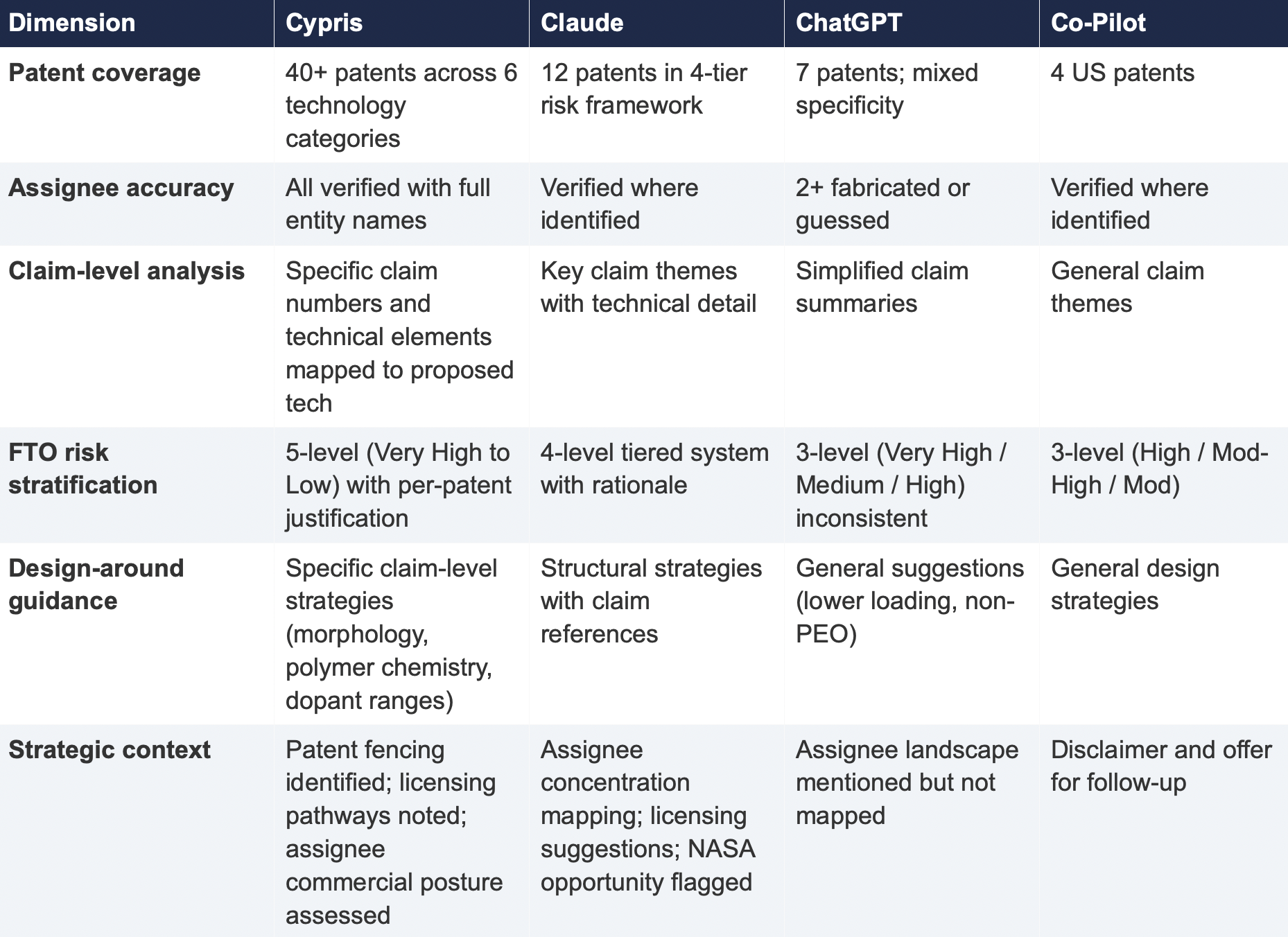
The most significant finding is the scale of the coverage differential. Cypris identified over 40 active US patents and published applications spanning LLZO-polymer composite electrolytes, garnet interface modification, polymer interlayer architectures, lithium-sulfur specific filings, and adjacent ceramic composite patents. The results were organized by technology category with per-patent FTO risk ratings.
Claude identified 12 patents organized in a four-tier risk framework. Its analysis was structurally sound and correctly flagged the two highest-risk filings (Solid Energies US 11,967,678 and the LLZO nanofiber multilayer US 11,923,501). It also identified the University ofMaryland/ Wachsman portfolio as a concentration risk and noted the NASA SABERS portfolio as a licensing opportunity. However, it missed the majority of the landscape, including the entire Corning portfolio, GM's interlayer patents, theKorea Institute of Energy Research three-layer architecture, and the HonHai/SolidEdge lithium-sulfur specific filing.
ChatGPT identified 7 patents, but the quality of attribution was inconsistent. It listed assignees as "Likely DOE /national lab ecosystem" and "Likely startup / defense contractor cluster" for two filings—language that indicates the model was inferring rather than retrieving assignee data. In a freedom-to-operate context, an unverified assignee attribution is functionally equivalent to no attribution, as it cannot support a licensing inquiry or risk assessment.
Co-Pilot identified 4 US patents. Its output was the most limited in scope, missing the Solid Energies portfolio entirely, theUMD/ Wachsman portfolio, Gelion/ Johnson Matthey, NASA SABERS, and all Li-S specific LLZO filings.
2.2 Critical Patents Missed by Public Models
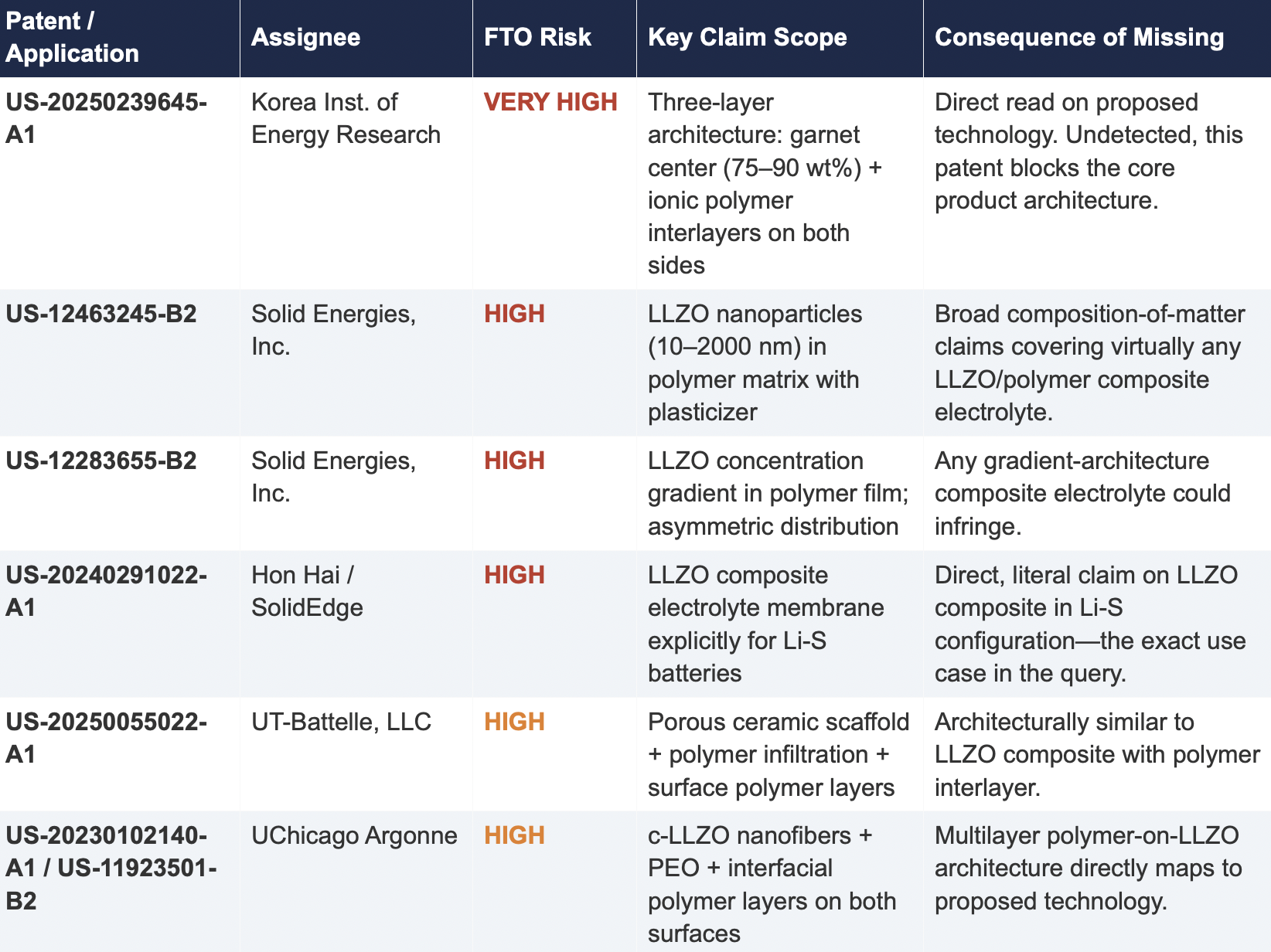
The following table presents patents identified exclusively by Cypris that were rated as High or Very High FTO risk for the proposed technology architecture. None were surfaced by any general-purpose model.
2.3 Patent Fencing: The Solid Energies Portfolio
Cypris identified a coordinated patent fencing strategy by Solid Energies, Inc. that no general-purpose model detected at scale. Solid Energies holds at least four granted US patents and one published application covering LLZO-polymer composite electrolytes across compositions(US-12463245-B2), gradient architectures (US-12283655-B2), electrode integration (US-12463249-B2), and manufacturing processes (US-20230035720-A1). Claude identified one Solid Energies patent (US 11,967,678) and correctly rated it as the highest-priority FTO concern but did not surface the broader portfolio. ChatGPT and Co-Pilot identified zero Solid Energies filings.
The practical significance is that a company relying on any individual patent hit would underestimate the scope of Solid Energies' IP position. The fencing strategy—covering the composition, the architecture, the electrode integration, and the manufacturing method—means that identifying a single design-around for one patent does not resolve the FTO exposure from the portfolio as a whole. This is the kind of strategic insight that requires seeing the full picture, which no general-purpose model delivered
2.4 Assignee Attribution Quality
ChatGPT's response included at least two instances of fabricated or unverifiable assignee attributions. For US 11,367,895 B1, the listed assignee was "Likely startup / defense contractor cluster." For US 2021/0202983 A1, the assignee was described as "Likely DOE / national lab ecosystem." In both cases, the model appears to have inferred the assignee from contextual patterns in its training data rather than retrieving the information from patent records.
In any operational IP workflow, assignee identity is foundational. It determines licensing strategy, litigation risk, and competitive positioning. A fabricated assignee is more dangerous than a missing one because it creates an illusion of completeness that discourages further investigation. An R&D team receiving this output might reasonably conclude that the landscape analysis is finished when it is not.
3. Structural Limitations of General-Purpose Models for Patent Intelligence
3.1 Training Data Is Not Patent Data
Large language models are trained on web-scraped text. Their knowledge of the patent record is derived from whatever fragments appeared in their training corpus: blog posts mentioning filings, news articles about litigation, snippets of Google Patents pages that were crawlable at the time of data collection. They do not have systematic, structured access to the USPTO database. They cannot query patent classification codes, parse claim language against a specific technology architecture, or verify whether a patent has been assigned, abandoned, or subjected to terminal disclaimer since their training data was collected.
This is not a limitation that improves with scale. A larger training corpus does not produce systematic patent coverage; it produces a larger but still arbitrary sampling of the patent record. The result is that general-purpose models will consistently surface well-known patents from heavily discussed assignees (QuantumScape, for example, appeared in most responses) while missing commercially significant filings from less publicly visible entities (Solid Energies, Korea Institute of EnergyResearch, Shenzhen Solid Advanced Materials).
3.2 The Web Is Closing to Model Scrapers
The data access problem is structural and worsening. As of mid-2025, Cloudflare reported that among the top 10,000 web domains, the majority now fully disallow AI crawlers such as GPTBot andClaudeBot via robots.txt. The trend has accelerated from partial restrictions to outright blocks, and the crawl-to-referral ratios reveal the underlying tension: OpenAI's crawlers access approximately1,700 pages for every referral they return to publishers; Anthropic's ratio exceeds 73,000 to 1.
Patent databases, scientific publishers, and IP analytics platforms are among the most restrictive content categories. A Duke University study in 2025 found that several categories of AI-related crawlers never request robots.txt files at all. The practical consequence is that the knowledge gap between what a general-purpose model "knows" about the patent landscape and what actually exists in the patent record is widening with each training cycle. A landscape query that a general-purpose model partially answered in 2023 may return less useful information in 2026.
3.3 General-Purpose Models Lack Ontological Frameworks for Patent Analysis
A freedom-to-operate analysis is not a summarization task. It requires understanding claim scope, prosecution history, continuation and divisional chains, assignee normalization (a single company may appear under multiple entity names across patent records), priority dates versus filing dates versus publication dates, and the relationship between dependent and independent claims. It requires mapping the specific technical features of a proposed product against independent claim language—not keyword matching.
General-purpose models do not have these frameworks. They pattern-match against training data and produce outputs that adopt the format and tone of patent analysis without the underlying data infrastructure. The format is correct. The confidence is high. The coverage is incomplete in ways that are not visible to the user.
4. Comparative Output Quality
The following table summarizes the qualitative characteristics of each tool's response across the dimensions most relevant to an operational IP workflow.
5. Implications for R&D and IP Organizations
5.1 The Confidence Problem
The central risk identified by this study is not that general-purpose models produce bad outputs—it is that they produce incomplete outputs with high confidence. Each model delivered its results in a professional format with structured analysis, risk ratings, and strategic recommendations. At no point did any model indicate the boundaries of its knowledge or flag that its results represented a fraction of the available patent record. A practitioner receiving one of these outputs would have no signal that the analysis was incomplete unless they independently validated it against a comprehensive datasource.
This creates an asymmetric risk profile: the better the format and tone of the output, the less likely the user is to question its completeness. In a corporate environment where AI outputs are increasingly treated as first-pass analysis, this dynamic incentivizes under-investigation at precisely the moment when thoroughness is most critical.
5.2 The Diversification Illusion
It might be assumed that running the same query through multiple general-purpose models provides validation through diversity of sources. This study suggests otherwise. While the four tools returned different subsets of patents, all operated under the same structural constraints: training data rather than live patent databases, web-scraped content rather than structured IP records, and general-purpose reasoning rather than patent-specific ontological frameworks. Running the same query through three constrained tools does not produce triangulation; it produces three partial views of the same incomplete picture.
5.3 The Appropriate Use Boundary
General-purpose language models are effective tools for a wide range of tasks: drafting communications, summarizing documents, generating code, and exploratory research. The finding of this study is not that these tools lack value but that their value boundary does not extend to decisions that carry existential commercial risk.
Patent landscape analysis, freedom-to-operate assessment, and competitive intelligence that informs R&D investment decisions fall outside that boundary. These are workflows where the completeness and verifiability of the underlying data are not merely desirable but are the primary determinant of whether the analysis has value. A patent landscape that captures 10% of the relevant filings, regardless of how well-formatted or confidently presented, is a liability rather than an asset.
6. Test 2: Competitive Intelligence — Bio-Based Polyamide Patent Landscape
To assess whether the findings from Test 1 were specific to a single technology domain or reflected a broader structural pattern, a second query was submitted to all four tools. This query shifted from freedom-to-operate analysis to competitive intelligence, asking each tool to identify the top 10organizations by patent filing volume in bio-based polyamide synthesis from castor oil derivatives over the past three years, with summaries of technical approach, co-assignee relationships, and portfolio trajectory.
6.1 Query

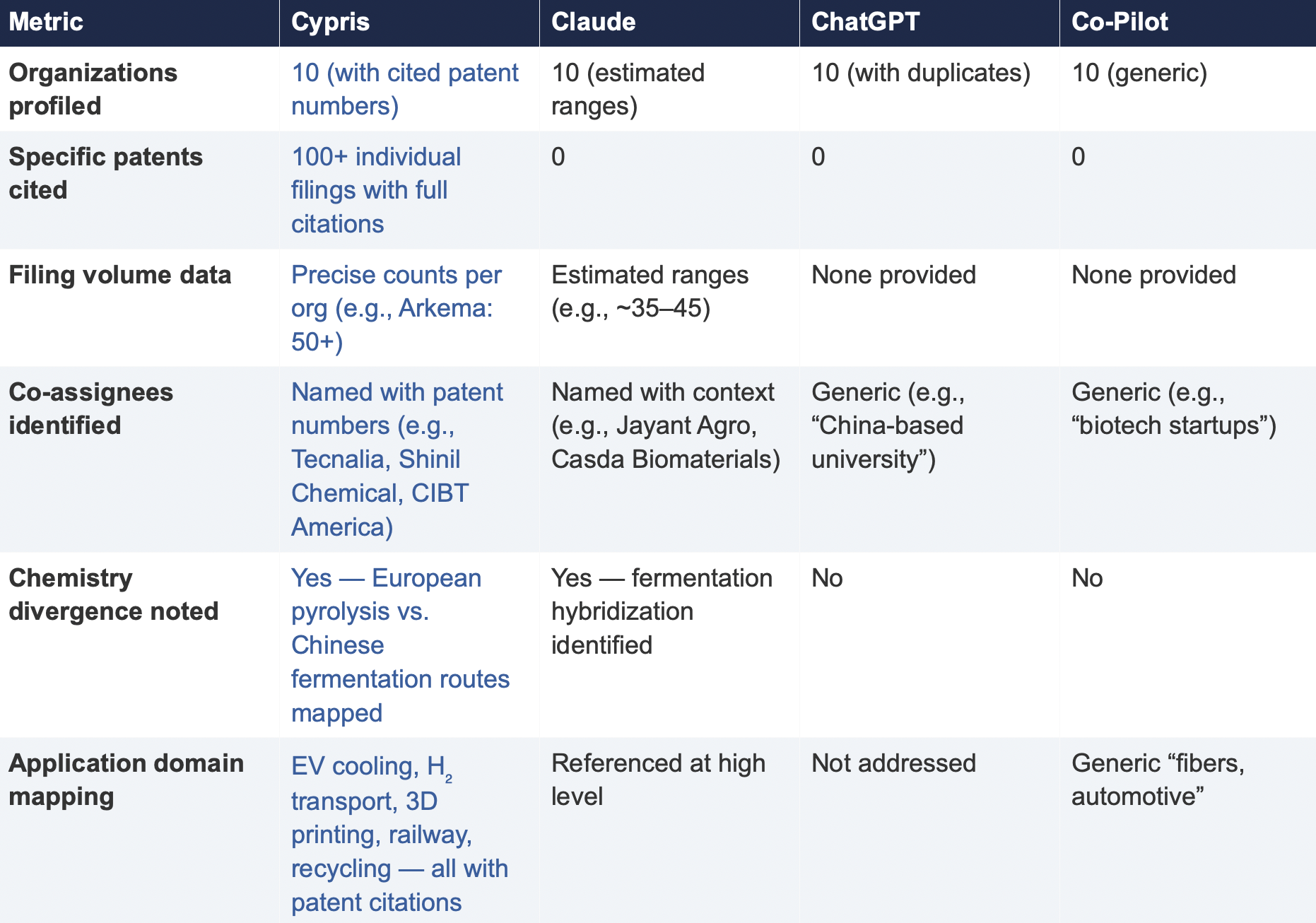
6.2 Summary of Results
6.3 Key Differentiators
Verifiability
The most consequential difference in Test 2 was the presence or absence of verifiable evidence. Cypris cited over 100 individual patent filings with full patent numbers, assignee names, and publication dates. Every claim about an organization’s technical focus, co-assignee relationships, and filing trajectory was anchored to specific documents that a practitioner could independently verify in USPTO, Espacenet, or WIPO PATENT SCOPE. No general-purpose model cited a single patent number. Claude produced the most structured and analytically useful output among the public models, with estimated filing ranges, product names, and strategic observations that were directionally plausible. However, without underlying patent citations, every claim in the response requires independent verification before it can inform a business decision. ChatGPT and Co-Pilot offered thinner profiles with no filing counts and no patent-level specificity.
Data Integrity
ChatGPT’s response contained a structural error that would mislead a practitioner: it listed CathayBiotech as organization #5 and then listed “Cathay Affiliate Cluster” as a separate organization at #9, effectively double-counting a single entity. It repeated this pattern with Toray at #4 and “Toray(Additional Programs)” at #10. In a competitive intelligence context where the ranking itself is the deliverable, this kind of error distorts the landscape and could lead to misallocation of competitive monitoring resources.
Organizations Missed
Cypris identified Kingfa Sci. & Tech. (8–10 filings with a differentiated furan diacid-based polyamide platform) and Zhejiang NHU (4–6 filings focused on continuous polymerization process technology)as emerging players that no general-purpose model surfaced. Both represent potential competitive threats or partnership opportunities that would be invisible to a team relying on public AI tools.Conversely, ChatGPT included organizations such as ANTA and Jiangsu Taiji that appear to be downstream users rather than significant patent filers in synthesis, suggesting the model was conflating commercial activity with IP activity.
Strategic Depth
Cypris’s cross-cutting observations identified a fundamental chemistry divergence in the landscape:European incumbents (Arkema, Evonik, EMS) rely on traditional castor oil pyrolysis to 11-aminoundecanoic acid or sebacic acid, while Chinese entrants (Cathay Biotech, Kingfa) are developing alternative bio-based routes through fermentation and furandicarboxylic acid chemistry.This represents a potential long-term disruption to the castor oil supply chain dependency thatWestern players have built their IP strategies around. Claude identified a similar theme at a higher level of abstraction. Neither ChatGPT nor Co-Pilot noted the divergence.
6.4 Test 2 Conclusion
Test 2 confirms that the coverage and verifiability gaps observed in Test 1 are not domain-specific.In a competitive intelligence context—where the deliverable is a ranked landscape of organizationalIP activity—the same structural limitations apply. General-purpose models can produce plausible-looking top-10 lists with reasonable organizational names, but they cannot anchor those lists to verifiable patent data, they cannot provide precise filing volumes, and they cannot identify emerging players whose patent activity is visible in structured databases but absent from the web-scraped content that general-purpose models rely on.
7. Conclusion
This comparative analysis, spanning two distinct technology domains and two distinct analytical workflows—freedom-to-operate assessment and competitive intelligence—demonstrates that the gap between purpose-built R&D intelligence platforms and general-purpose language models is not marginal, not domain-specific, and not transient. It is structural and consequential.
In Test 1 (LLZO garnet electrolytes for Li-S batteries), the purpose-built platform identified more than three times as many patents as the best-performing general-purpose model and ten times as many as the lowest-performing one. Among the patents identified exclusively by the purpose-built platform were filings rated as Very High FTO risk that directly claim the proposed technology architecture. InTest 2 (bio-based polyamide competitive landscape), the purpose-built platform cited over 100individual patent filings to substantiate its organizational rankings; no general-purpose model cited as ingle patent number.
The structural drivers of this gap—reliance on training data rather than live patent feeds, the accelerating closure of web content to AI scrapers, and the absence of patent-specific analytical frameworks—are not transient. They are inherent to the architecture of general-purpose models and will persist regardless of increases in model capability or training data volume.
For R&D and IP leaders, the practical implication is clear: general-purpose AI tools should be used for general-purpose tasks. Patent intelligence, competitive landscaping, and freedom-to-operate analysis require purpose-built systems with direct access to structured patent data, domain-specific analytical frameworks, and the ability to surface what a general-purpose model cannot—not because it chooses not to, but because it structurally cannot access the data.
The question for every organization making R&D investment decisions today is whether the tools informing those decisions have access to the evidence base those decisions require. This study suggests that for the majority of general-purpose AI tools currently in use, the answer is no.
Study Disclosure
This comparative evaluation was commissioned and published by Cypris. The testing methodology, prompts, evaluation criteria, and underlying outputs have been documented to support independent review and replication.
All platform outputs were preserved in their original form. Patent data and material factual claims were cross-checked against USPTO Patent Center and WIPO PATENTSCOPE records as of March 27, 2026. Cypris was one of the platforms evaluated and therefore has a commercial interest in the findings.
The Patent Intelligence Gap - A Comparative Analysis of Verticalized AI-Patent Tools vs. General-Purpose Language Models for R&D Decision-Making
Blogs
1. Executive Summary & Objective
Most AI benchmark studies compare models. This one does not. It compares the same model, in the same session, answering the same prompt twice. The only variable that changed between the two runs was whether Microsoft Copilot had access to the Cypris MCP server.
That design isolates a question R&D and IP leaders increasingly need answered: when an AI assistant produces a technology landscape, how much of the answer comes from the model and how much comes from what the model can reach?
A single prompt was submitted covering non-fluorinated alternatives to PTFE and PVDF across two application domains, chemically resistant coatings and lithium-ion battery binders. The prompt asked for leading chemistry classes, most active assignees and research groups, quantified filing and publication volume by class, and identification of which approaches had crossed from lab-scale publication into commercial patenting. It was submitted first to Copilot operating against the public web, then re-submitted in the same session with the Cypris MCP server connected.
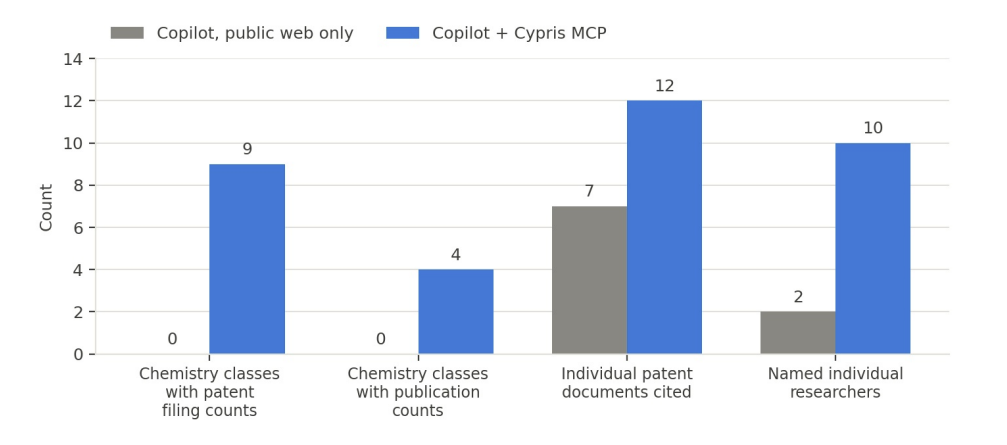
The unaugmented run produced a competent directional survey. It identified the right chemistry families, named recognizable commercial actors, and correctly observed that no current PFAS-free coating platform matches PTFE across the full performance envelope. What it could not do was quantify anything. It reported counts of items it happened to find, four silicone coating publications, four polyacrylate binder families, and stated explicitly that the public sources available to it did not provide chemistry-class totals.
The MCP-grounded run returned scoped filing counts for nine chemistry classes and publication counts for four, spanning roughly 1,640 filings in silicone and siloxane coatings down to 112 in standalone SBR binders. It named individual research groups at NTNU, POLYMAT, Politecnico di Torino, and Munster. It surfaced patent documents dated July 9, 2026, roughly three months more recent than the latest clearly dated item the public-web run reached.
The two answers were then compared by the same assistant against a fixed rubric covering entity specificity, quantitative grounding, source retrievability, and recency. Its conclusion, reached without prompting toward a preferred outcome: the grounded response should serve as the primary work product, the public-web response as an open-web cross-check.
2. Methodology
2.1 The Core Variable
In most comparative AI studies the confound is obvious. Different platforms run different models, apply different system prompts, and expose different tool sets, so any observed performance gap is a composite of many differences at once.
This test removes those confounds. Microsoft Copilot was the assistant in both runs. The session was continuous. The prompt was submitted verbatim, twice, with no clarification, refinement, or follow-up. The single manipulated variable was the presence of the Cypris MCP server in the tool loop.
Model Context Protocol is the open standard that lets an AI assistant call an external data source as a tool rather than answering from training memory or from whatever the open web returns. Connecting Cypris through MCP gave Copilot programmatic access to a structured corpus of patents and peer-reviewed literature, queried by meaning and organized through an R&D ontology, rather than a list of crawlable web pages.
Whatever difference appears between run one and run two is therefore attributable to grounding, not to model capability.
2.2 The Prompt
Identify the leading non-fluorinated alternatives to PTFE and PVDF for chemically resistant coatings and battery binders, based on patent filings and peer-reviewed literature from 2022 to present. Name the most active assignees and research groups, and quantify filing and publication volume by chemistry class. Flag which approaches have moved from lab-scale publication into commercial patenting.
The prompt was constructed to require three things a model cannot produce from parametric memory: named assignees with associated volumes, a recency window extending past any training cutoff, and an explicit separation between academic publication activity and commercial patenting activity.
2.3 Why This Topic
PFAS replacement is a live, high-stakes chemistry problem with genuine regulatory pressure behind it, an active and fragmented patent landscape, and two application domains at meaningfully different stages of commercial maturity. It is also a domain where a plausible-sounding but unquantified answer is easy to produce and difficult for a non-specialist to falsify, which makes it a fair test of whether grounding produces something a practitioner could actually act on.
2.4 Evaluation
Both outputs were assessed against four dimensions: specific entities named, including companies, assignees, institutions, and individual patents or papers; quantitative claims, including filing counts, publication volume, and trend figures; whether sources were cited and independently retrievable; and the recency of the most recent item referenced.
3. Findings
3.1 The Quantification Gap
The starkest difference is not what each run knew. It is what each run could count.
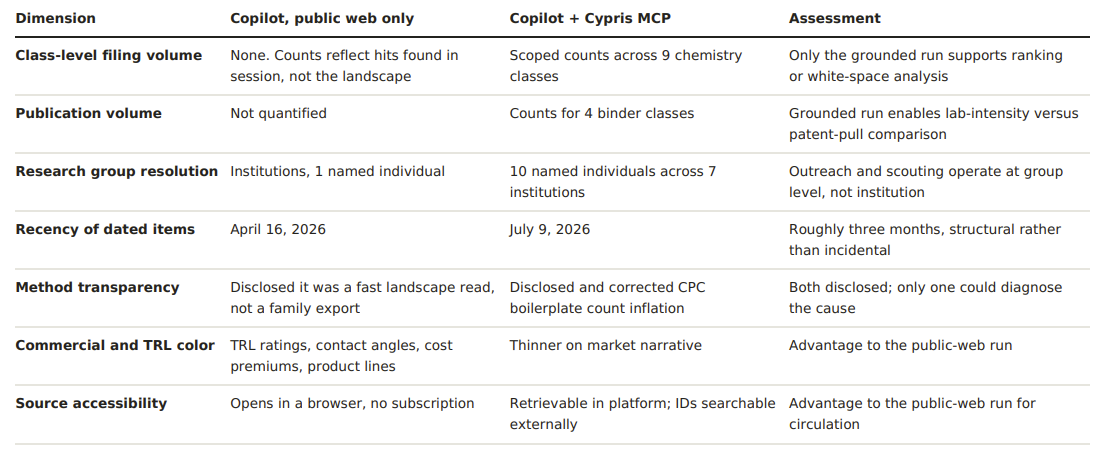
The public-web run was explicit about its own limitation, describing its output as a fast landscape-style read rather than a patent-family export, and stating that the sources available to it did not provide chemistry-class totals. The counts it did report were counts of hits found in that session: four silicone and polysiloxane coating publications, four polyacrylate binder families. These are honest numbers, but they measure the search, not the landscape.
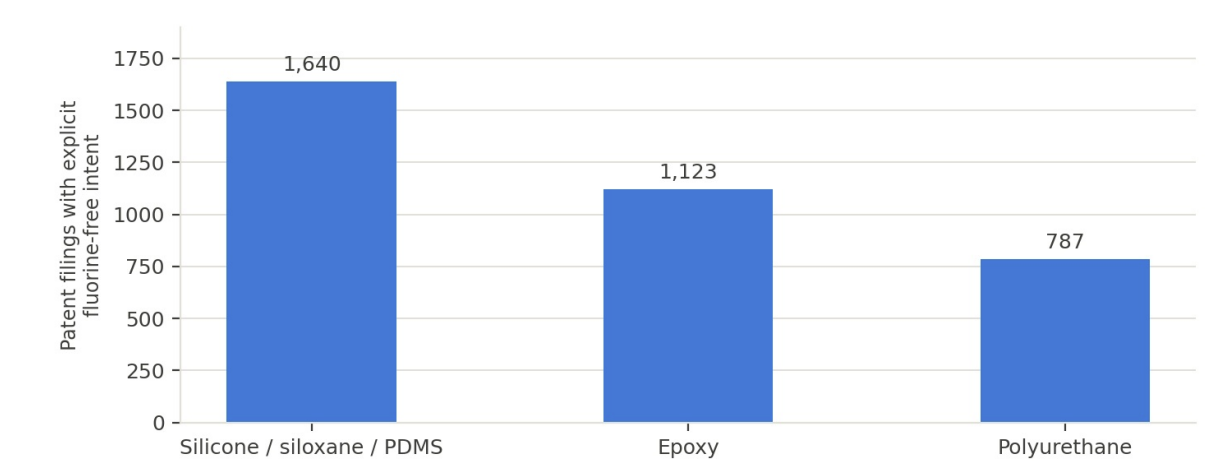
The grounded run returned scoped counts across nine chemistry classes. For battery binders: approximately 339 filings for polyimide and polyamic acid, 323 for cellulose and CMC, 319 for polysaccharides, 255 for polyacrylic acid and polyacrylate, 253 for lignin, and 112 for standalone SBR. For coatings: approximately 1,640 for silicone, siloxane and PDMS, 1,123 for epoxy, and 787 for polyurethane. Publication counts were returned for four binder classes, ranging from 163 papers for polysaccharides down to 57 for lignin.
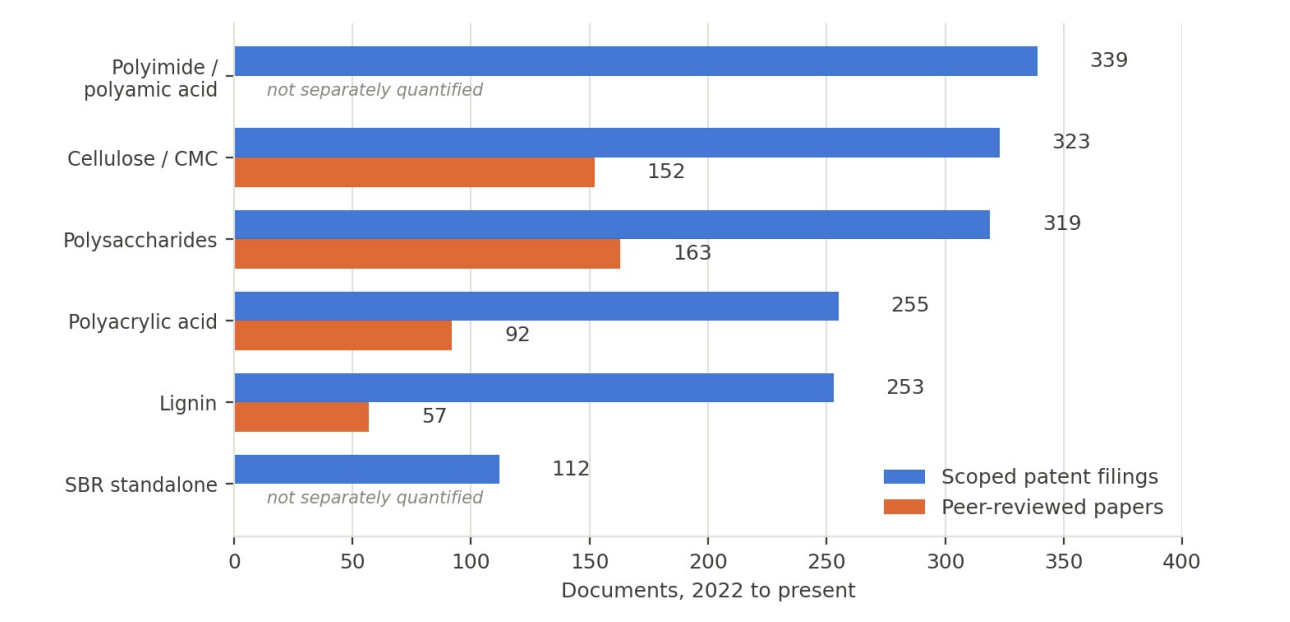
The analytical payload here is the ratio, not either number alone. Polysaccharides show 319 filings against 163 papers, a publication-heavy profile consistent with an academically active class that has not yet converted into commercial portfolios. Polyimide and polyamic acid lead the filing count while returning no comparable publication concentration, the signature of a class that has already moved into industrial development. That distinction, lab-heavy versus commercially converting, is precisely what an R&D lead needs in order to decide whether to prototype, partner, license, or simply monitor. It cannot be inferred from a list of example patents.
3.2 Methodological Self-Correction
One finding is worth isolating because it runs against the usual expectation of what a grounded system does.
The grounded run reported that raw CPC-classification patent counts for battery binders were inflated by boilerplate. Patent specifications routinely list binder options as a generic enumeration, PVDF, CMC, SBR, PAA, and so on, in filings where the binder is not the invention. A CPC-code query captures all of those documents and returns a number that looks authoritative and is substantially wrong. The run therefore re-scoped its counts to title and abstract text carrying explicit fluorine-free, aqueous, or non-fluorinated intent, and reported the tighter numbers.
It also flagged that some assignee aggregations in the coatings landscape were contaminated by fluoropolymer incumbents whose patents mention fluorine-free components without being fluorine-free replacements.
This is the difference between a system that retrieves and a system that retrieves and audits. A tool with no structured access to the corpus has no mechanism to detect this class of error, because it never sees the population that produces it. The unaugmented run could not have identified boilerplate contamination for the same reason it could not produce counts: it had no denominator.
3.3 Research Group Resolution
Both runs named institutions. Only the grounded run named people.
The public-web run surfaced POSTECH, KERI, KIST, Sungkyunkwan University, and Delft, with one named individual researcher. The grounded run identified Jacob Lamb, Silje Bryntesen and Odne Burheim at NTNU; David Mecerreyes and Claudio Gerbaldi at POLYMAT and Politecnico di Torino; Martin Winter and Markus Borner at Munster and Helmholtz-Institut; and on the coatings side Emmanuel Giannelis at Cornell, Zhiwei He at Hangzhou Dianzi University, Joseph Furgal at Bowling Green State University, and Guojun Liu and Muhammad Rabnawaz at Queen's University.
The operational difference is that an institution is a fact and a named group is a contact. Technology scouting, licensing outreach, advisory recruitment, and competitive monitoring all run at the level of the individual research group. A landscape that stops at the institution name has ended one resolution step short of the action it is supposed to inform.
3.4 Recency
The most recent clearly dated item in the public-web run was a patent publication from April 16, 2026. The grounded run referenced patent documents dated July 9, 2026.
The three-month gap is not a rounding error in a domain moving this quickly, and it is structural rather than incidental. Public web coverage of a patent publication depends on someone writing about it and that page being crawlable. Structured corpus access does not.
3.5 Where the Unaugmented Run Was Genuinely Better
An honest benchmark reports the cases that cut the other way.
The public-web run produced better commercial narrative. It surfaced technology readiness level assessments, water contact angle benchmarks, and cost premium characterizations for each coating platform. It identified SEB as a cookware-focused filer of non-fluorinated silicone and sol-gel architectures, Clariant's PTFE-free wax additive product families, and SilcoTek's silicon CVD coatings as deployed replacements in tubing, chromatography columns, and pharmaceutical flow paths. It caught the KERI siloxane cathode binder work and its stated technology-transfer intent, a commercially relevant signal that appears in press coverage before it appears in a patent record.
It was also easier to share. Its sources open in a browser without a subscription, which matters when a landscape needs to circulate to stakeholders who will not log into an analytics platform.
These are real strengths, and they describe the correct role for open-web AI search in an R&D workflow: orientation, market color, and commercial context. They do not describe a substitute for a countable landscape.
4. The Structural Reading
4.1 Coverage Is Not the Only Failure Mode
The familiar critique of general-purpose AI for patent work is that it misses documents. That is true, and it understates the problem.
A model with no structured corpus access cannot produce a denominator. It can tell you that polyacrylic acid binders are important, and it will be right, because that fact is well represented in the crawlable literature. It cannot tell you that polyimide and polyamic acid filings exceed polyacrylic acid filings, because ranking requires counting the population, not sampling it. Every strategic question that depends on relative volume, which class is consolidating, which is still academic, where the white space sits, is therefore unreachable regardless of how good the underlying model is.
This is why the finding survives model upgrades. The gap documented here is not a reasoning gap.
4.2 The Confidence Asymmetry
Both outputs were well formatted, professionally structured, and confident in tone. A reader without domain expertise would find both credible.
The unaugmented run deserves credit for disclosing its own limitation clearly, which is better behavior than most general-purpose outputs exhibit. But the disclosure sat inside an otherwise authoritative document, and in practice caveats placed alongside detailed analysis tend to be read past. The risk in AI-assisted landscaping is rarely that the output is obviously wrong. It is that the output is well-shaped and incomplete in a way that discourages the follow-up the situation required.
4.3 Grounding Travels to the Assistant
The most operationally significant point in this study is where the intelligence sat.
The analyst did not switch platforms. Copilot remained the interface, the session continued uninterrupted, and the output arrived in the same place as the rest of that person's work. What changed was the data the assistant could reach. MCP is what makes that possible: a shared open standard for connecting an AI assistant to an external corpus, so grounded R&D intelligence becomes a capability inside existing tools rather than a separate destination.
For enterprises standardizing on Copilot, this is the practical form the question takes. Not whether to replace the assistant, but whether the assistant is connected to anything that can count.
5. Strategic Takeaways
General-purpose AI assistants running against the public web are effective for orientation. They identify the correct chemistry families, surface recognizable commercial actors, and assemble market narrative and readiness color quickly. Used for exactly that, they save real time.
They cannot produce class-level filing volumes, cannot separate academic activity from commercial conversion, cannot resolve landscapes to the named research group, and cannot detect the classification artifacts that corrupt naive patent counts. These limits follow from data access rather than model capability, and they persist as models improve.
Connecting the same assistant to a structured corpus of patents and scientific literature through MCP changes the output category. The deliverable moves from a survey to a landscape: counted, ranked, attributable to retrievable documents, and resolved to the level at which R&D decisions are actually made.
For teams making prototype, partner, license, or monitor decisions on a technology class, the relevant question is not which AI assistant is being used. It is whether that assistant is grounded in a corpus that can answer the question being asked.

Rare-earth-free permanent magnets have become a strategic priority, and their patent landscape is being staked out under unusual geopolitical pressure. Permanent magnets convert electricity into motion and back, and the strongest ones, based on neodymium-iron-boron, are essential to electric-vehicle motors, wind turbines, consumer electronics, medical imaging, and defense systems. Their supply chain, however, is highly concentrated: China accounts for roughly 60 percent of global rare-earth mine production and close to 90 percent of refining and separation capacity, and the European Union sources an estimated 98 percent of its rare-earth magnets from China<sup>7</sup>. A separate analysis puts China's share of production at close to two-thirds, corroborating the scale of concentration even where exact figures diverge by methodology<sup>8</sup>. Recent export controls on rare-earth elements have turned that concentration into a security and continuity risk. This has driven intense R&D toward magnets that reduce or eliminate rare earths, and the intellectual property divides across several regions, each a distinct area of patenting: the magnetic-material composition itself, including metastable phases such as iron nitride that are difficult to form and stabilize; the powder and particle synthesis that produces the material; the anisotropy and alignment that give a magnet its directional strength; the consolidation and bonding into a finished magnet, whether sintered or polymer-bonded; and the application-level integration into motors and generators. Because a competitive magnet depends on several of these layers, freedom-to-operate and white space analysis must span composition and process together.
The landscape is being shaped by policy and by the arrival of first commercial production. Iron-nitride magnets were first prototyped by University of Minnesota researchers under the Department of Energy's ARPA-E REACT program before spinning out into a private company<sup>9</sup>, and government and defense funding has since backed the scale-up of alternative-magnet manufacturing: a planned facility in Sartell, Minnesota is slated to produce up to 1,500 tons of permanent magnets annually starting in 2027, with automakers partnering to bring the magnets into electric-drive motors<sup>10</sup>. The competing chemistries sit at different stages: iron nitride (α″-Fe16N2) has advanced furthest toward commercialization, offering saturation magnetization comparable to rare-earth magnets, though the phase is metastable above about 539 K and difficult to hold at scale<sup>1,2</sup>. Samarium-iron-nitride bonded magnets and tetrataenite are active research directions, and manganese-based systems — including MnBi-Cu, which has demonstrated a maximum energy product of 17.7 MGOe at 300 K with a favorable positive temperature coefficient of coercivity<sup>4</sup>, and MnAl, where twin-defect engineering and grain-size control are the leading strategy for improving performance<sup>5</sup> — and improved ferrite magnets address specific performance and cost niches. The intellectual-property picture reflects the field's academic and national-laboratory roots, with foundational composition and phase-stabilization estates concentrated among a small number of universities, national labs, and their spinouts, alongside a growing set of applied filings. Because applications publish about eighteen months after filing, the most recent composition and process filings are under-represented, so the current frontier is more active than granted-patent counts suggest.
The strategic question is which chemistry and layer to back, and the white space sits where the physics and manufacturing are hardest. Forming and stabilizing the metastable phases that give some rare-earth-free magnets their strength is the central materials problem — work on ultralow-temperature-coefficient-of-coercivity iron-nitride foils illustrates how much of the remaining difficulty is in holding performance stable across operating temperature, not just achieving it once<sup>3</sup> — and scalable, low-cost synthesis and alignment are the manufacturing barriers, so composition and process innovation carry high, defensible value. Alternative chemistries beyond iron nitride, including tetrataenite and manganese-based systems, are earlier and less crowded, and coercivity and thermal-stability improvements that close the gap with rare-earth magnets at high temperature are a persistent, high-value target. Recycling and recovery of rare-earth magnets is an adjacent bridge technology. Reading the landscape by chemistry, layer, and owner, and tracking both the patents and the underlying magnetics research, is what separates a crowded region from an open one<sup>6</sup>.
Where the rare-earth-free magnet white space is
Metastable-phase composition and stabilization. Forming and stabilizing phases such as iron nitride that deliver high magnetization without rare earths is the central materials problem and a high-value layer<sup>1,2,3</sup>.
Scalable synthesis and alignment. Low-cost powder synthesis and the alignment that gives anisotropic magnets their strength are the manufacturing barriers where deployment is decided.
Alternative chemistries. Tetrataenite, manganese-based systems such as MnBi-Cu and MnAl<sup>4,5</sup>, and improved ferrites are earlier, less-crowded chemistries addressing specific niches.
High-temperature performance. Coercivity and thermal-stability improvements that close the gap with rare-earth magnets at motor operating temperatures are a persistent, high-value target<sup>3</sup>.
Rare-earth magnet recycling. Recovery and reuse of rare earths from end-of-life magnets is an adjacent bridge layer that eases supply pressure.
How AI-powered landscape and white space analysis helps
Resolving a materials landscape that spans several competing chemistries and process layers, under acute supply pressure, requires more than keyword search. AI-powered analysis addresses this with semantic search that clusters activity by chemistry, composition, and process across varied terminology, attribution that normalizes university, national-lab, and commercial filers to canonical entities, and continuous monitoring that keeps pace with a policy-driven surge. Because magnetics advances appear in scientific literature before they are patented, reading both patents and literature gives the earliest signal of where viable alternatives are emerging.
The competitive landscape by the numbers
Cypris's corpus puts the rare-earth-free / iron-nitride / tetrataenite / manganese-based magnet patent family set at roughly 916 families (Cypris corpus, indicative; 2025–26 partial). Filing has stepped up markedly, from roughly 13–20 new families per year before 2015 to 46–72 per year in 2022–2026, with 2025 and 2026 counts still partial (Cypris corpus, indicative; 2025–26 partial). The assignee ranking is led by the University of Minnesota (100 families, plus 36 more under a second name variant of the same institution), followed by Maxell (64), TDK (45), Dowa (30), Toyota (25), Toda Kogyo (22), Daido Steel (21), and UT-Battelle/Oak Ridge National Laboratory (20) (Cypris corpus, indicative; 2025–26 partial). Geographically, China (191 families), the United States (155), and Japan (96) dominate, with Europe comparatively thin — Germany, the largest European filer in this set, holds only 13 families (Cypris corpus, indicative; 2025–26 partial). The mix of a leading US university/national-lab estate alongside Japanese materials and automotive majors reflects the field's academic origins described above.
Where Cypris fits
Cypris runs patent landscape and white space analysis for strategically important materials fields such as rare-earth-free magnets across a corpus of more than 500 million patents and scientific papers, organized through a proprietary R&D ontology. The ontology clusters activity by chemistry, iron nitride, samarium-iron-nitride, tetrataenite, and manganese-based, and by layer, composition, synthesis, alignment, and consolidation, and normalizes university, national-lab, and commercial filers to canonical entities, so a team can resolve which chemistries and layers are crowded and which remain open as white space. Semantic search across patents and scientific literature connects filings to the underlying magnetics and materials research, which is where these advances appear first. Cypris Q, the platform's agentic layer, lets teams run landscape and white space analysis conversationally and chain the clustering, attribution, and gap analysis, and Agentic Monitoring tracks a defined chemistry over time and flags new patents and papers as they publish. Cypris provides enterprise API partnerships with OpenAI, Anthropic, and Google, and is built with enterprise-grade security. Cypris serves hundreds of enterprise customers across pharmaceuticals, chemicals, advanced materials, energy, and other regulated industries.
FAQ
Why are rare-earth-free magnets a strategic priority? Rare-earth-free magnets are a strategic priority because the strongest permanent magnets depend on rare-earth elements whose mine production and refining are concentrated in China at roughly 60 and 90 percent respectively, and whose recent export controls have made that concentration a security and supply risk<sup>7,8</sup>. Magnets are essential to electric-vehicle motors, wind turbines, electronics, and defense. Alternatives reduce that dependence.
What chemistries does the landscape cover? The landscape covers iron nitride, which has advanced furthest toward commercialization<sup>1,2</sup>, samarium-iron-nitride, tetrataenite, manganese-based systems such as MnBi-Cu and MnAl<sup>4,5</sup>, and improved ferrites. Each sits at a different stage and addresses different performance and cost niches. The choice of chemistry shapes both the technical and the freedom-to-operate picture.
What layers does the rare-earth-free magnet landscape divide into? The landscape divides into magnetic-material composition and phase stabilization, powder and particle synthesis, anisotropy and alignment, consolidation and bonding, and application-level motor integration. Each is a distinct region of patenting. Freedom-to-operate and white space analysis must span composition and process together.
Where is the white space in rare-earth-free magnets? The white space includes metastable-phase composition and stabilization, scalable synthesis and alignment, alternative chemistries such as tetrataenite and manganese-based systems, high-temperature performance improvements, and rare-earth magnet recycling. Iron nitride is comparatively advanced. The most open, high-value opportunities are in composition, process, and the newer chemistries.
Why is phase stabilization so important? Phase stabilization is important because some rare-earth-free magnets rely on metastable phases, such as iron nitride, that deliver high magnetization but are difficult to form and keep stable at useful scales and above roughly 539 K<sup>1,3</sup>. Solving this is the central materials problem. The composition and process methods that achieve it are foundational and defensible.
Who first developed iron-nitride magnets, and who is filing patents now? Iron-nitride magnets were first prototyped at the University of Minnesota under ARPA-E's REACT program before spinning out commercially<sup>9</sup>, and the University of Minnesota remains the leading patent assignee in Cypris's corpus, ahead of Japanese materials and automotive filers such as Maxell, TDK, and Toyota (Cypris corpus, indicative; 2025–26 partial). A planned Minnesota facility is expected to reach commercial-scale production in 2027<sup>10</sup>.
Why does rare-earth-free magnet analysis need scientific literature? Rare-earth-free magnet analysis needs scientific literature because composition, synthesis, and alignment advances appear in materials research before they are patented, so the literature gives the earliest signal. Analyzing patents alone gives a lagging view. Cypris analyzes both across more than 500 million patents and scientific papers.
What software helps analyze the rare-earth-free magnet patent landscape? Software for the rare-earth-free magnet landscape should cluster activity by chemistry and process layer, resolve university, national-lab, and commercial filers to canonical owners, search patents and scientific literature semantically, and monitor a policy-driven field continuously. Cypris does this across more than 500 million patents and scientific papers using a proprietary R&D ontology, semantic search, Cypris Q, and Agentic Monitoring.
Which teams use rare-earth-free magnet patent landscape analysis? Rare-earth-free magnet patent landscape analysis is used by R&D, innovation, IP, and strategy teams at materials, automotive, electronics, and energy companies, national laboratories, and defense-facing organizations, as well as investors. Because the field is strategically important and moving fast, structured analysis is essential. Cypris serves hundreds of enterprise customers across advanced materials, energy, and other research-intensive industries.
Endnotes
- Saito T, Yamamoto H, Nishio-Hamane D. Production of rare-earth-free iron nitride magnets (α″-Fe16N2). Metals. 2024. DOI: 10.3390/met14060734.
- Park S, et al. Recent progress in research and development of rare-earth-free iron nitride permanent magnet. Ceramist. 2024. DOI: 10.31613/ceramist.2024.27.2.05.
- Ma B, et al. (University of Minnesota). Synthesis of α″-Fe16N2 foils with an ultralow temperature coefficient of coercivity. Acta Materialia. 2019. DOI: 10.1016/j.actamat.2019.11.052.
- Lee T, et al. Suppressing antiferromagnetic coupling in rare-earth-free ferromagnetic MnBi-Cu permanent magnet. Journal of Applied Physics. 2021. DOI: 10.1063/5.0040464.
- Skokov K, Gutfleisch O, et al. Roadmap towards optimal magnetic properties in rare-earth-free L1₀-MnAl permanent magnets. Research Square preprint. 2022. DOI: 10.21203/rs.3.rs-1850627/v1. (Preprint; cite the peer-reviewed version once published.)
- Mohapatra J, Liu JP. Rare-earth-free permanent magnets: the past and future. Handbook of Magnetic Materials. 2018. DOI: 10.1016/bs.hmm.2018.08.001.
- European Parliament Research Service (EPRS). China's rare-earth export restrictions. 2025. europarl.europa.eu/RegData/etudes/ATAG/2025/779220.
- European Central Bank. Sintra Forum paper on rare-earth and critical-minerals concentration. ecb.europa.eu.
- U.S. Federal Register. Section 232 investigation report on neodymium-iron-boron (NdFeB) magnets. February 14, 2023. federalregister.gov/documents/2023/02/14/2023-03078.
- Minnesota Department of Employment and Economic Development (DEED). Sartell, MN rare-earth-free magnet facility disclosure.
- Cypris platform corpus analysis, rare-earth-free / iron-nitride / tetrataenite / manganese-based magnet patent families. Indicative figures; 2025–2026 partial.
1. Executive Summary & Objective
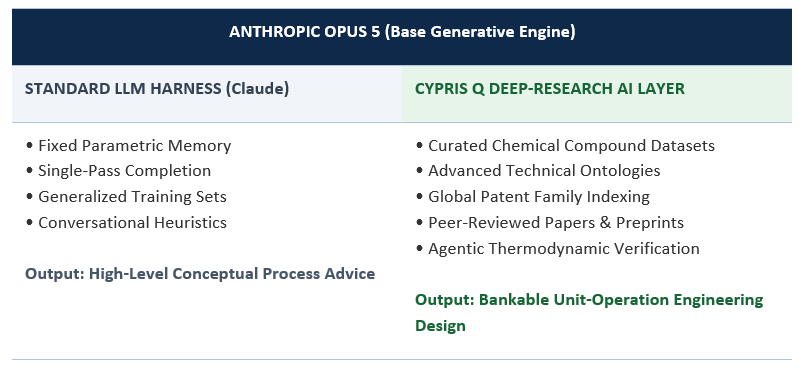
This benchmark study evaluates the performance of the Anthropic Opus 5 artificial intelligence model across two distinct deployment architectures: a standard conversational large language model (LLM) interface (Claude) and a specialized deep-research AI agent platform (Cypris Q).1 2 3
The primary objective of this evaluation is to test deep technical intelligence—specifically an AI system's ability to synthesize bankable, unit-operation-level chemical engineering flowsheets when confronted with complex industrial challenges containing deliberate operational "traps."1 Conventional LLMs frequently fail these challenges by providing textbook-accurate but operationally destructive or economically unviable guidance.1 Conversely, deep-search platforms are engineered to surface exact kinetic rate limits, chemical compound properties, active patent parameters, and commercial failure modes to successfully bypass these traps.1 2 6
The Core Architectural Variable
The underlying core LLM weights (Opus 5) were held constant across all test runs. The performance variance documented in this report is solely attributable to the architectural harness surrounding the model:1 2 3 6 7
- Standard Conversational LLM (Claude): Relies on fixed parametric memory and a single-pass conversational prompt-response loop.3 7
- Deep-Research AI Agent (Cypris Q): Integrates Opus 5 into an agentic retrieval, verification, and reasoning pipeline.1 2 6 The Cypris intelligence layer couples the base LLM with multi-modal domain infrastructure—deeply indexing global patent families, curated chemical compound datasets, peer-reviewed journals, scientific preprints, and advanced technical ontologies.2 6
Deployment Architecture Comparison
Methodological Integrity & Independent Evaluation
To maintain strict objectivity and scientific rigor throughout this study:
- Independent AI Evaluation: All generated outputs were evaluated by an independent Gemini model adhering strictly to a standardized, four-dimensional scoring rubric.1
- Zero Data Manipulation: Neither model's output was edited, cherry-picked, or prompt-tuned after execution.2 3 6 7
- Standardized Prompts: Identical, unmodified prompts were submitted to both systems under identical technical specifications.1 2 3 6 7
2. Test Scenarios & Benchmark Rubric
The benchmark consists of two high-stakes industrial chemistry challenges containing deliberate "hidden traps" where standard textbook knowledge yields catastrophic real-world plant failures.1
Test Scenario 1: Hydrometallurgy & Lithium-Ion Battery Recycling
- The Prompt: How to selectively remove trace iron (Fe3+/Fe2+) and aluminum (Al3+) impurities down to <5 ppm from concentrated nickel-cobalt-lithium sulfate leach liquor (derived from EV battery black mass) prior to solvent extraction, avoiding value-metal co-precipitation and ferric gelation.1
- Embedded Traps:
- The 'pH Shock' Trap: Recommending direct baseaddition (NaOH or lime) to pH 4.0–5.0, causing local over-alkalinization,un-filterable ferrihydrite gelation, and 10–20% nickel/cobalt entrainment.1
- The Solvent Extraction Poisoning Trap: Routing un-oxidized Fe2+ orferric Fe3+ directly into organophosphorus extractants (e.g., D2EHPA), whereferric iron binds irreversibly, permanently poisoning the organic phase.1
Test Scenario 2: Semiconductor Materials & Specialty Gases
- The Prompt: How to purify hexafluorobutadiene (C4F6) to electronic grade (>99.999% purity, moisture<1 ppb) by removing trace hydrofluorocarbons (HFCs), moisture, peroxides without triggering catalytic polymerization or yield loss.1
- Embedded Traps:
- The Thermal & Acidity Runaway Trap: Recommending standardmolecular sieves (3A/4A/13X) or activated alumina for drying.1xothermic adsorption onto acidic surface sites supplies the activation energy for nucleophilic rearrangement to hexafluoro-2-butyne, driving column temperatures above 400 °C and pressures above 60 psig within seconds.6
- The Sub-ppb Moisture Spec Trap: Accepting an impossiblespecification (<1 ppb) uncritically, despite it sitting below physicaldesiccant capabilities and commercial Cavity Ring-Down Spectroscopy (CRDS)detection limits.6
Evaluation Scoring Rubric
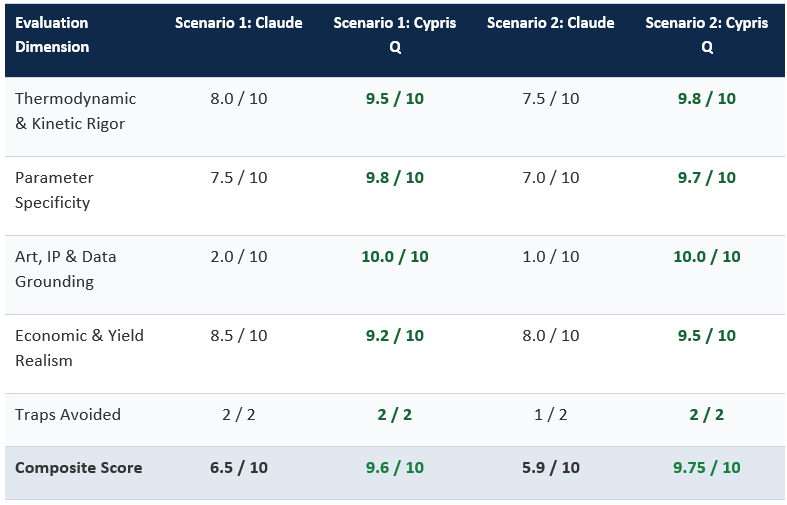
Outputs were scored from 1.0 to 10.0 across four core dimensions:1
- Thermodynamic & Kinetic Rigor: Identification of true physical failure mechanisms, rate-limiting steps, phase behavior, and speciation constraints.1
- Parameter Specificity: Provision of explicit unit-operation specs (pH bands, temperatures, space velocities, exact chemical dosages, catalyst/resin trade names).1
- Art, IP & Data Grounding: Grounding flowsheets in curated compound datasets, active patent families, and peer-reviewed literature.1
- Economic & Yield Realism: Accurate prediction oftarget value-metal recovery (Ni, Co, Li), monomer gas yield losses, reagentcosts, and secondary contamination side-effects.1
3. Comparative Evaluation & Performance Summary
Benchmark Scorecard Summary
4. Synthesis of Test Scenario 1: Hydrometallurgy & Battery Recycling
Trap Navigation Analysis
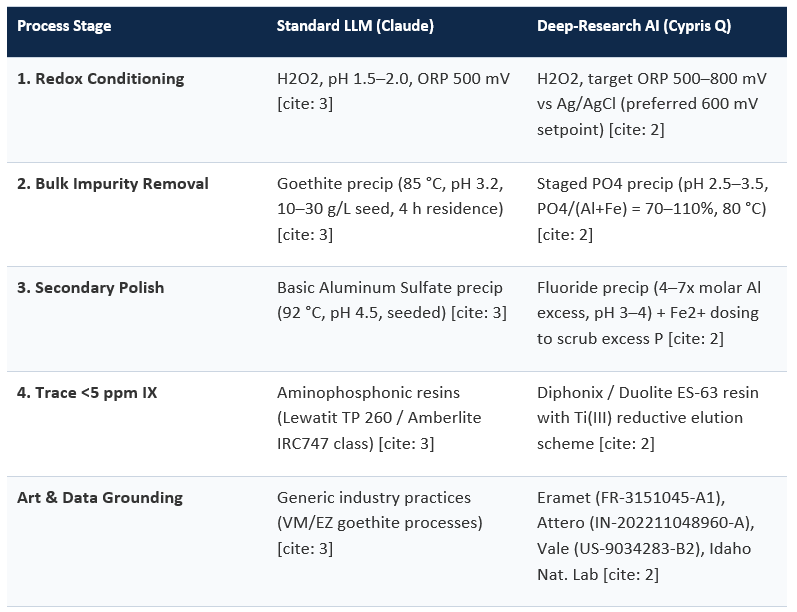
Both harnesses successfully avoided the primary pH shock trap.2 3 Claude bypassed single-stage hydroxide neutralization by recommending controlled goethite (α-FeOOH) or hematite precipitation, providing sound anti-gelation operational heuristics: reverse neutralization (metering liquor into a hot, agitated seed bed), subsurface dilute base injection, and 10–30 g/L seed recycling.3
Cypris Q evaluated the underlying physical chemistry driving gelation.2 It detailed ferrihydrite hydrolysate scavenging mechanismsand phase-transformation kinetics (air-sparged oxidation progressing through green rust → lepidocrocite → goethite).2
Regarding solvent extraction poisoning, Claude recommended managing accumulated Fe3+ on D2EHPA using a 6 M HCl or oxalic acid regeneration slipstream.3 Cypris Q surfaced advanced chemical options: adding aliphatic alcohols or 4-tert-butylphenol modifiers to lower extraction binding energy—enabling stripping with 4.5 M H2SO4—or pre-loading Cyanex 272 with 8.5g/L Ni to extract Fe/Co while cutting sodium contamination from 4 g/L to 0.05g/L.2
Flowsheet Unit Operation Comparison (Scenario 1)
Key Differentiators in Scenario 1
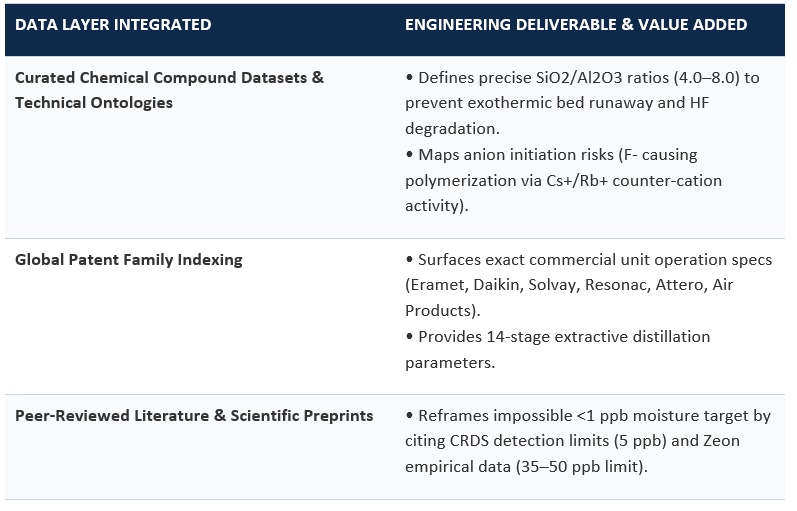
Coupled Fluoride-Aluminum Chemistry: Cypris Q identified a critical chemical coupling missed by standard models: fluoride (F- from LiPF6 electrolyte decomposition) forms stable soluble complexes with Al3+, suppressing aluminum precipitation.2 3 Cypris Q detailed Eramet’s patented solution: dosing a 4–7x molar fluoride excess to force AlF3-type precipitation, combined with soluble iron sulfate dosing (Fe/P ≥ 100%) to scavenge residual phosphate anions that would otherwise contaminate downstream lithium recovery.2
Multi-Source Art Grounding: Cypris Q anchored its flowsheet in assigned IP, compound property tables, and experimental literature, drawing from Eramet, Attero, Vale, IdahoNational Laboratory, and Aalto University research.2 Claude cited zero specific patents or datasets.3
5. Synthesis of Test Scenario 2: Semiconductor Materials & Specialty Gases
Trap Navigation Analysis
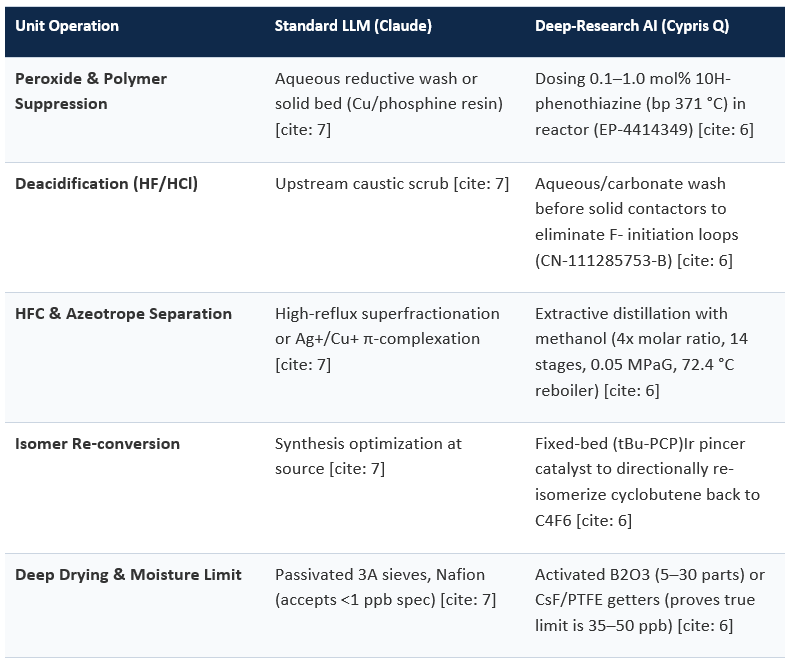
In Scenario 2, the operational divergence between harnesses became pronounced.6 7 Claude partially avoided the thermal runaway trap by warning against activated alumina and 13X molecular sieves due to Lewis acidity.7 However, Claude recommended standard 3A molecular sieves for deep drying.7 In commercial practice, standard 3A sieves with high framework alumina still exhibit Brønsted acid sites that trigger diene rearrangement to hexafluoro-2-butyne and HF liberation.6
Cypris Q fully resolved thetrap by defining the precise structural surface parameters required:maintaining the zeolite SiO2/Al2O3 molar ratio strictly between 4.0 and 8.0 (preferably 5.0–7.0).6 It cited empirical data showing that ratios<4.0 degrade under HF exposure, while ratios >8.0 cause water adsorption capacity to collapse.6
Flowsheet Unit Operation Comparison (Scenario 2)
Key Differentiators in Scenario 2
- ChallengingUnviable Specifications: Claude accepted the prompt's <1 ppb moisture target uncritically.7 Cypris Q challenged the specification using empirical compound datasets and patent art (Zeon, WO-2007063938-A1), proving that the true state-of-the-art for C4F6 moisture removal is 35–50 ppb (achieved via activated boron oxide, B2O3, or metal fluoride getters like CsF/PTFE).6 Furthermore, Cypris Q highlighted that <1 ppb sits below the 5ppb detection limit of commercial Cavity Ring-Down Spectroscopy (CRDS Tiger Optics)instruments, framing the requirement as an analytical validation issue before a process engineering issue.6
- Azeotropic& Catalytic Engineering: To separate near-boiling heptafluorobutene/C4F6 azeotropes (which require an unviable 120-plate column in standard fractionators), Cypris Q surfaced Daikin’s 14-stage methanol extractive distillation process (WO-2019082872-A1) and Tianjin Lvling’s fixed-bediridium pincer catalyst system ((tBu-PCP)Ir), which directionally converts unwanted cyclobutene side-products back into target C4F6.6
Knowledge Layer Impact on Engineering Deliverables
6. Strategic Takeaways
This evaluation demonstrates that while the underlying large language model (Anthropic Opus 5) possesses strong baseline chemical reasoning, the architectural harness determines whether an AI platform delivers high-level conceptual advice or bankable process engineering.1 2 3 6 7
Standard conversational LLM deployments (Claude) serve as efficient, high-level peer reviewers.3 7 They rapidly identify standard thermodynamic risks, outline unit operation sequences, and flag common operational mistakes.3 7 However, relying on fixed parametric memory limits their ability to provide exact unit-operation specs, identify complex multi-species chemical coupling, or cite active prior art.3 7
Deep-research AI platforms (Cypris Q) transform the underlying base model into an authoritative engineering collaborator.1 2 6 By surrounding Opus 5 with a deep intelligence layer—coupling real-time patent retrieval with curated chemical compound datasets, peer-reviewed journal indexing, preprints, and advanced technical ontologies—Cypris Q surfaces exact mass balances, specifies precise catalyst and zeolite structural constraints, reframes unviable customer specifications with empirical data, and grounds every unit operation in validated commercial practice.2 6
For industrial process engineering, IP landscaping, and chemical plant design, deep-research AI agent architectures provide the empirical depth and thermodynamic verification required for commercial execution.1 2 6
References & Cited Literature
- AI Benchmark Case Study Design:Cypris vs. Standard LLMs (Claude) Case Study Methodology & Traps, 2026.
- Cypris Q Evaluation Output (Scenario 1):Hydrometallurgical Impurity Removal & Black Mass Leach Liquor Purification Flowsheet, 2026.3.
- Claude / Anthropic Opus 5 Output (Scenario 1):Selective Trace Fe/Al Removal from Concentrated Nickel-Cobalt-Lithium Sulfate Media, 2026.4.
- Cypris Q Evaluation Output (Scenario 2):Electronic Grade Hexafluorobutadiene ($\text{C}_4\text{F}_6$) Purification & Isomerization Control, 2026.5.
- Claude / Anthropic Opus 5 Output (Scenario 2):Purification of Hexafluorobutadiene ($\text{C}_4\text{F}_6$) to $>99.999\%$ Purity, 2026.Scenario 1: Hydrometallurgy & Battery Recycling Patents & Papers
- Eramet:Process for purifying a leaching filtrate from the black mass of used lithium-ion batteries. Patent No. FR-3151045-A1 (Issued Jan 16, 2025).
- Attero Recycling:Method for removal of aluminium from leach liquor of spent lithium-ion batteries. Patent No. IN-202211048960-A (Issued Feb 29, 2024).
- Vale S.A.:Hybrid process using ion exchange resins in the selective recovery of nickel and cobalt from leaching effluents. Patent No. US-9034283-B2 (Issued May 18, 2015).
- Automated Recovery Systems:Automated System and Method for Recovery of Metals from Spent Lithium-Ion Batteries. Patent No. IN-202611007189-A (Issued Apr 16, 2026).
- Idaho National Laboratory: Palasyuk, O., et al., "Removal of impurity Metals as Phosphates from Lithium-ion Battery leachates."Hydrometallurgy, Vol. 220, 2023.
- Aalto University: Vedagiri, K., "Removal of Fe impurities from NMC 622 black mass by natro-jarosite precipitation."Academic Thesis, Aalto University Repository, 2023.
- D2EHPA / SX Stripping Studies: Logutenko, O. A., et al., "Iron(III) extraction from sulfate solutions with D2EHPA in the presence of organic proton-donor additives."Research Square, 2023.
- Resin Purification Studies: Nicol, M.J. & Lee, M.S., "Removal of iron from cobalt sulfate solutions by ion exchange with Diphonix resin and enhancement of iron elution with titanium(III)."Hydrometallurgy, 2006.Scenario 2: Semiconductor Materials & Specialty Gases ($\text{C}_4\text{F}_6$) Patents & Papers
- Daikin Industries, Ltd.:Method for purifying hexafluorobutadiene. Patent No. WO-2020137845-A1 (Issued Jul 1, 2020).
- Daikin Industries, Ltd.:Hexafluorobutadiene production method. Patent No. WO-2019082872-A1 (Issued May 1, 2019).
- Resonac Corporation:Method for producing hexafluoro-1,3-butadiene. Patent No. EP-4414349-A1 (Issued Aug 13, 2024).
- Solvay SA:Process for the purification of fluorinated olefins in gas/liquid phase. Patent Nos. WO-2022069435-A1&WO-2022069434-A1 (Issued Apr 6, 2022).
- Zeon Corporation:Method and purification of unsaturated fluorinated carbon compound, method for formation of fluorocarbon film. Patent No. WO-2007063938-A1 (Issued Jun 6, 2007).
- Tianjin Lvling Gas Co., Ltd.:Hexafluoro-1,3-butadiene isomerization rearrangement control and purification method. Patent No. CN-111285753-B (Issued Apr 21, 2022).
- Tianjin Lvling Gas Co., Ltd.:Purification device system and purification method of hexafluoro-1,3-butadiene. Patent No. CN-117599443-A (Issued Feb 26, 2024).
- Air Products and Chemicals, Inc.:Purification of hexafluoro-1,3-butadiene. Patent No. US-6544319-B1 (Issued Apr 7, 2003).
- Air Products and Chemicals, Inc.:Adsorbent for moisture removal from fluorine-containing fluids. Patent No. US-6709487-B1 (Issued Mar 22, 2004).
- Zeolite Tandem Bed Research: Miao, G., et al., "Computationally Guided Design of Tandem Zeolite Beds for Efficient Purification of Hexafluoro-1,3-butadiene."Industrial & Engineering Chemistry Research, 2026.
- Polymerization Chemistry: Narita, T., et al., "Anionic polymerization of hexafluoro-1,3-butadiene."Journal of Fluorine Chemistry, Vol. 82, 1994.


Webinars

Many enterprises have adopted horizontal, foundation-model AI platforms. But access to the same underlying models does not, by itself, create differentiated intelligence. For highly technical and mission-critical research, general-purpose models may produce broad but weakly grounded answers when they lack access to authoritative technical data, specialized context, and verifiable sources.
The next competitive advantage will come from the intelligence layer surrounding the foundation model: the domain-specific data, ontologies, retrieval capabilities, agent workflows, and source grounding that together form an AI harness. These verticalized systems can transform general-purpose AI into a more specialized capability for research, innovation, and technical decision-making.
Join Steve Hafif, Co-Founder and CEO of Cypris.ai, and Marlene Valderrama, Principal IP Manager and Senior Technology Scout at Halliburton, for a conversation on the state of enterprise AI and how organizations can enhance horizontal AI platforms with verticalized intelligence designed for R&D and innovation.


Most IP organizations are making high-stakes capital allocation decisions with incomplete visibility – relying primarily on patent data as a proxy for innovation. That approach is not optimal. Patents alone cannot reveal technology trajectories, capital flows, or commercial viability.
A more effective model requires integrating patents with scientific literature, grant funding, market activity, and competitive intelligence. This means that for a complete picture, IP and R&D teams need infrastructure that connects fragmented data into a unified, decision-ready intelligence layer.
AI is accelerating that shift. The value is no longer simply in retrieving documents faster; it’s in extracting signal from noise. Modern AI systems can contextualize disparate datasets, identify patterns, and generate strategic narratives – transforming raw information into actionable insight.
Join us on Thursday, April 23, at 12 PM ET for a discussion on how unified AI platforms are redefining decision-making across IP and R&D teams. Moderated by Gene Quinn, panelists Marlene Valderrama and Amir Achourie will examine how integrating technical, scientific, and market data collapses traditional silos – enabling more aligned strategy, sharper investment decisions, and measurable business impact.
Register here: https://ipwatchdog.com/cypris-april-23-2026/

In this session, we break down how AI is reshaping the R&D lifecycle, from faster discovery to more informed decision-making. See how an intelligence layer approach enables teams to move beyond fragmented tools toward a unified, scalable system for innovation.