

Insights on Innovation, R&D, and IP
Perspectives on patents, scientific research, emerging technologies, and the strategies shaping modern R&D

Executive Summary
In 2024, US patent infringement jury verdicts totaled $4.19 billion across 72 cases. Twelve individual verdicts exceeded $100million. The largest single award—$857 million in General Access Solutions v.Cellco Partnership (Verizon)—exceeded the annual R&D budget of many mid-market technology companies. In the first half of 2025 alone, total damages reached an additional $1.91 billion.
The consequences of incomplete patent intelligence are not abstract. In what has become one of the most instructive IP disputes in recent history, Masimo’s pulse oximetry patents triggered a US import ban on certain Apple Watch models, forcing Apple to disable its blood oxygen feature across an entire product line, halt domestic sales of affected models, invest in a hardware redesign, and ultimately face a $634 million jury verdict in November 2025. Apple—a company with one of the most sophisticated intellectual property organizations on earth—spent years in litigation over technology it might have designed around during development.
For organizations with fewer resources than Apple, the risk calculus is starker. A mid-size materials company, a university spinout, or a defense contractor developing next-generation battery technology cannot absorb a nine-figure verdict or a multi-year injunction. For these organizations, the patent landscape analysis conducted during the development phase is the primary risk mitigation mechanism. The quality of that analysis is not a matter of convenience. It is a matter of survival.
And yet, a growing number of R&D and IP teams are conducting that analysis using general-purpose AI tools—ChatGPT, Claude, Microsoft Co-Pilot—that were never designed for patent intelligence and are structurally incapable of delivering it.
This report presents the findings of a controlled comparison study in which identical patent landscape queries were submitted to four AI-powered tools: Cypris (a purpose-built R&D intelligence platform),ChatGPT (OpenAI), Claude (Anthropic), and Microsoft Co-Pilot. Two technology domains were tested: solid-state lithium-sulfur battery electrolytes using garnet-type LLZO ceramic materials (freedom-to-operate analysis), and bio-based polyamide synthesis from castor oil derivatives (competitive intelligence).
The results reveal a significant and structurally persistent gap. In Test 1, Cypris identified over 40 active US patents and published applications with granular FTO risk assessments. Claude identified 12. ChatGPT identified 7, several with fabricated attribution. Co-Pilot identified 4. Among the patents surfaced exclusively by Cypris were filings rated as “Very High” FTO risk that directly claim the technology architecture described in the query. In Test 2, Cypris cited over 100 individual patent filings with full attribution to substantiate its competitive landscape rankings. No general-purpose model cited a single patent number.
The most active sectors for patent enforcement—semiconductors, AI, biopharma, and advanced materials—are the same sectors where R&D teams are most likely to adopt AI tools for intelligence workflows. The findings of this report have direct implications for any organization using general-purpose AI to inform patent strategy, competitive intelligence, or R&D investment decisions.

1. Methodology
A controlled comparative evaluation was conducted on March 27, 2026. An identical patent landscape query was submitted verbatim to each platform under standardized testing conditions. No follow-up prompts, clarifications, or iterative refinements were permitted, ensuring that each platform was evaluated based solely on its initial response.
The outputs were preserved in their original form and evaluated against predefined criteria using publicly verifiable patent records.
1.1 Query
Identify all active US patents and published applications filed in the last 5 years related to solid-state lithium-sulfur battery electrolytes using garnet-type ceramic materials. For each, provide the assignee, filing date, key claims, and current legal status. Highlight any patents that could pose freedom-to-operate risks for a company developing a Li₇La₃Zr₂O₁₂(LLZO)-based composite electrolyte with a polymer interlayer.
1.2 Tools Evaluated

1.3 Evaluation Criteria
Each response was evaluated using a consistent six-part scoring framework: patent coverage, assignee accuracy, filing metadata completeness, depth of claim analysis, quality of FTO risk stratification, and the presence of actionable strategic guidance.
Patent numbers, assignees, filing information, and legal status were independently checked against publicly available USPTO and WIPO records. The evaluation focused on the completeness, accuracy, and practical utility of each platform’s output rather than writing quality or presentation.
2. Findings
2.1 Coverage Gap
The most significant finding is the scale of the coverage differential. Cypris identified over 40 active US patents and published applications spanning LLZO-polymer composite electrolytes, garnet interface modification, polymer interlayer architectures, lithium-sulfur specific filings, and adjacent ceramic composite patents. The results were organized by technology category with per-patent FTO risk ratings.
Claude identified 12 patents organized in a four-tier risk framework. Its analysis was structurally sound and correctly flagged the two highest-risk filings (Solid Energies US 11,967,678 and the LLZO nanofiber multilayer US 11,923,501). It also identified the University ofMaryland/ Wachsman portfolio as a concentration risk and noted the NASA SABERS portfolio as a licensing opportunity. However, it missed the majority of the landscape, including the entire Corning portfolio, GM's interlayer patents, theKorea Institute of Energy Research three-layer architecture, and the HonHai/SolidEdge lithium-sulfur specific filing.
ChatGPT identified 7 patents, but the quality of attribution was inconsistent. It listed assignees as "Likely DOE /national lab ecosystem" and "Likely startup / defense contractor cluster" for two filings—language that indicates the model was inferring rather than retrieving assignee data. In a freedom-to-operate context, an unverified assignee attribution is functionally equivalent to no attribution, as it cannot support a licensing inquiry or risk assessment.
Co-Pilot identified 4 US patents. Its output was the most limited in scope, missing the Solid Energies portfolio entirely, theUMD/ Wachsman portfolio, Gelion/ Johnson Matthey, NASA SABERS, and all Li-S specific LLZO filings.
2.2 Critical Patents Missed by Public Models
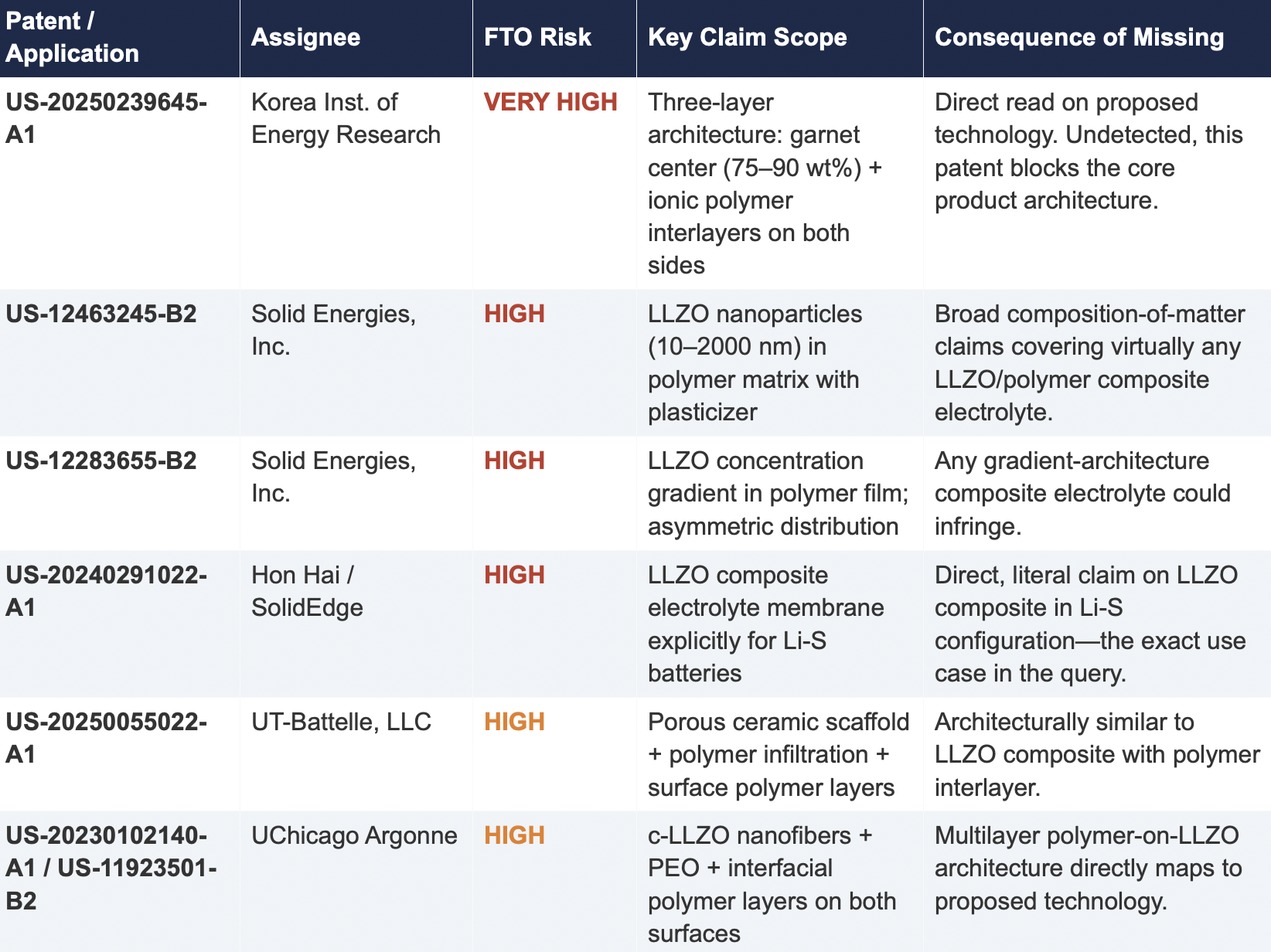
The following table presents patents identified exclusively by Cypris that were rated as High or Very High FTO risk for the proposed technology architecture. None were surfaced by any general-purpose model.
2.3 Patent Fencing: The Solid Energies Portfolio
Cypris identified a coordinated patent fencing strategy by Solid Energies, Inc. that no general-purpose model detected at scale. Solid Energies holds at least four granted US patents and one published application covering LLZO-polymer composite electrolytes across compositions(US-12463245-B2), gradient architectures (US-12283655-B2), electrode integration (US-12463249-B2), and manufacturing processes (US-20230035720-A1). Claude identified one Solid Energies patent (US 11,967,678) and correctly rated it as the highest-priority FTO concern but did not surface the broader portfolio. ChatGPT and Co-Pilot identified zero Solid Energies filings.
The practical significance is that a company relying on any individual patent hit would underestimate the scope of Solid Energies' IP position. The fencing strategy—covering the composition, the architecture, the electrode integration, and the manufacturing method—means that identifying a single design-around for one patent does not resolve the FTO exposure from the portfolio as a whole. This is the kind of strategic insight that requires seeing the full picture, which no general-purpose model delivered
2.4 Assignee Attribution Quality
ChatGPT's response included at least two instances of fabricated or unverifiable assignee attributions. For US 11,367,895 B1, the listed assignee was "Likely startup / defense contractor cluster." For US 2021/0202983 A1, the assignee was described as "Likely DOE / national lab ecosystem." In both cases, the model appears to have inferred the assignee from contextual patterns in its training data rather than retrieving the information from patent records.
In any operational IP workflow, assignee identity is foundational. It determines licensing strategy, litigation risk, and competitive positioning. A fabricated assignee is more dangerous than a missing one because it creates an illusion of completeness that discourages further investigation. An R&D team receiving this output might reasonably conclude that the landscape analysis is finished when it is not.
3. Structural Limitations of General-Purpose Models for Patent Intelligence
3.1 Training Data Is Not Patent Data
Large language models are trained on web-scraped text. Their knowledge of the patent record is derived from whatever fragments appeared in their training corpus: blog posts mentioning filings, news articles about litigation, snippets of Google Patents pages that were crawlable at the time of data collection. They do not have systematic, structured access to the USPTO database. They cannot query patent classification codes, parse claim language against a specific technology architecture, or verify whether a patent has been assigned, abandoned, or subjected to terminal disclaimer since their training data was collected.
This is not a limitation that improves with scale. A larger training corpus does not produce systematic patent coverage; it produces a larger but still arbitrary sampling of the patent record. The result is that general-purpose models will consistently surface well-known patents from heavily discussed assignees (QuantumScape, for example, appeared in most responses) while missing commercially significant filings from less publicly visible entities (Solid Energies, Korea Institute of EnergyResearch, Shenzhen Solid Advanced Materials).
3.2 The Web Is Closing to Model Scrapers
The data access problem is structural and worsening. As of mid-2025, Cloudflare reported that among the top 10,000 web domains, the majority now fully disallow AI crawlers such as GPTBot andClaudeBot via robots.txt. The trend has accelerated from partial restrictions to outright blocks, and the crawl-to-referral ratios reveal the underlying tension: OpenAI's crawlers access approximately1,700 pages for every referral they return to publishers; Anthropic's ratio exceeds 73,000 to 1.
Patent databases, scientific publishers, and IP analytics platforms are among the most restrictive content categories. A Duke University study in 2025 found that several categories of AI-related crawlers never request robots.txt files at all. The practical consequence is that the knowledge gap between what a general-purpose model "knows" about the patent landscape and what actually exists in the patent record is widening with each training cycle. A landscape query that a general-purpose model partially answered in 2023 may return less useful information in 2026.
3.3 General-Purpose Models Lack Ontological Frameworks for Patent Analysis
A freedom-to-operate analysis is not a summarization task. It requires understanding claim scope, prosecution history, continuation and divisional chains, assignee normalization (a single company may appear under multiple entity names across patent records), priority dates versus filing dates versus publication dates, and the relationship between dependent and independent claims. It requires mapping the specific technical features of a proposed product against independent claim language—not keyword matching.
General-purpose models do not have these frameworks. They pattern-match against training data and produce outputs that adopt the format and tone of patent analysis without the underlying data infrastructure. The format is correct. The confidence is high. The coverage is incomplete in ways that are not visible to the user.
4. Comparative Output Quality
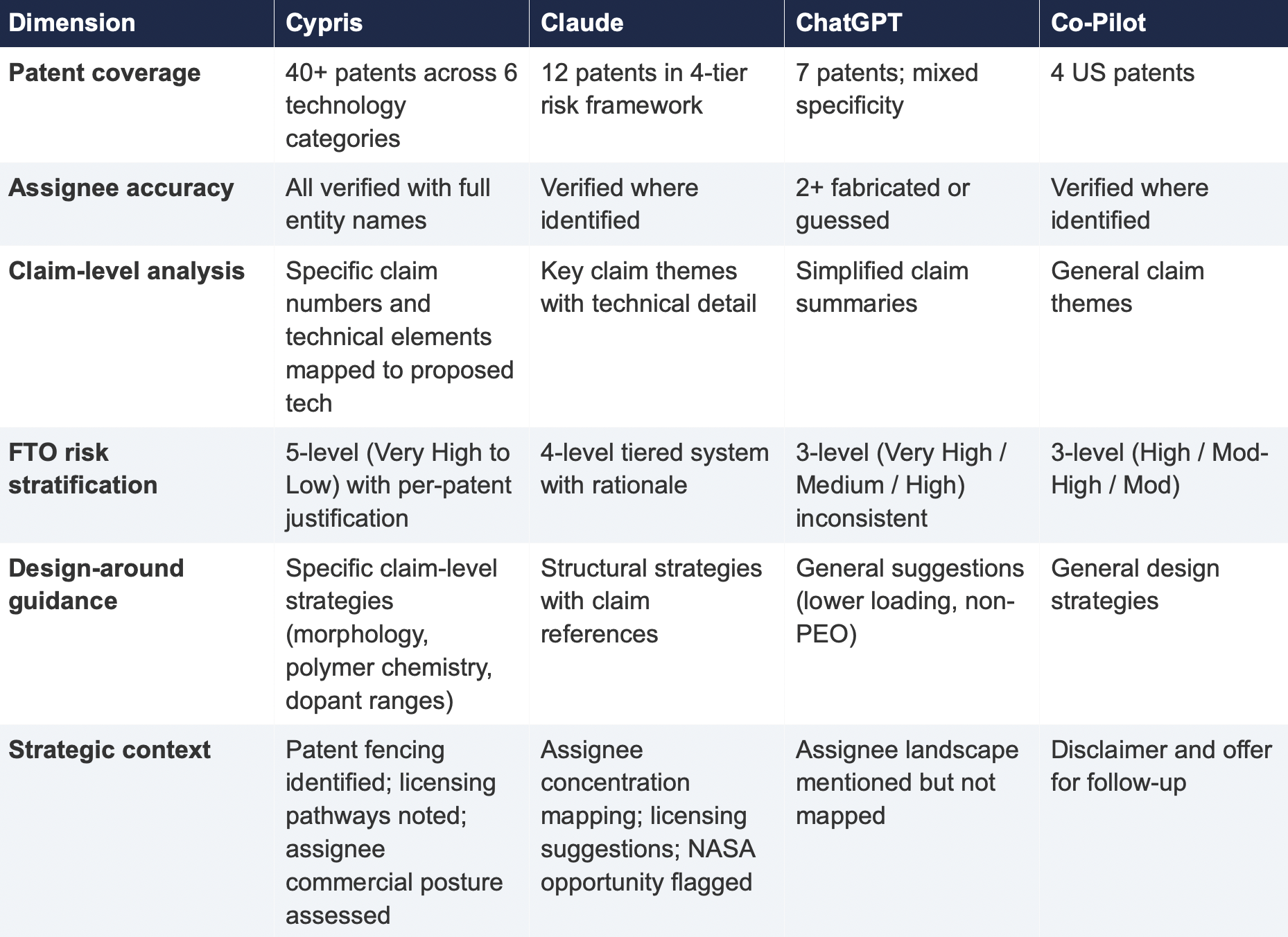
The following table summarizes the qualitative characteristics of each tool's response across the dimensions most relevant to an operational IP workflow.
5. Implications for R&D and IP Organizations
5.1 The Confidence Problem
The central risk identified by this study is not that general-purpose models produce bad outputs—it is that they produce incomplete outputs with high confidence. Each model delivered its results in a professional format with structured analysis, risk ratings, and strategic recommendations. At no point did any model indicate the boundaries of its knowledge or flag that its results represented a fraction of the available patent record. A practitioner receiving one of these outputs would have no signal that the analysis was incomplete unless they independently validated it against a comprehensive datasource.
This creates an asymmetric risk profile: the better the format and tone of the output, the less likely the user is to question its completeness. In a corporate environment where AI outputs are increasingly treated as first-pass analysis, this dynamic incentivizes under-investigation at precisely the moment when thoroughness is most critical.
5.2 The Diversification Illusion
It might be assumed that running the same query through multiple general-purpose models provides validation through diversity of sources. This study suggests otherwise. While the four tools returned different subsets of patents, all operated under the same structural constraints: training data rather than live patent databases, web-scraped content rather than structured IP records, and general-purpose reasoning rather than patent-specific ontological frameworks. Running the same query through three constrained tools does not produce triangulation; it produces three partial views of the same incomplete picture.
5.3 The Appropriate Use Boundary
General-purpose language models are effective tools for a wide range of tasks: drafting communications, summarizing documents, generating code, and exploratory research. The finding of this study is not that these tools lack value but that their value boundary does not extend to decisions that carry existential commercial risk.
Patent landscape analysis, freedom-to-operate assessment, and competitive intelligence that informs R&D investment decisions fall outside that boundary. These are workflows where the completeness and verifiability of the underlying data are not merely desirable but are the primary determinant of whether the analysis has value. A patent landscape that captures 10% of the relevant filings, regardless of how well-formatted or confidently presented, is a liability rather than an asset.
6. Test 2: Competitive Intelligence — Bio-Based Polyamide Patent Landscape
To assess whether the findings from Test 1 were specific to a single technology domain or reflected a broader structural pattern, a second query was submitted to all four tools. This query shifted from freedom-to-operate analysis to competitive intelligence, asking each tool to identify the top 10organizations by patent filing volume in bio-based polyamide synthesis from castor oil derivatives over the past three years, with summaries of technical approach, co-assignee relationships, and portfolio trajectory.
6.1 Query

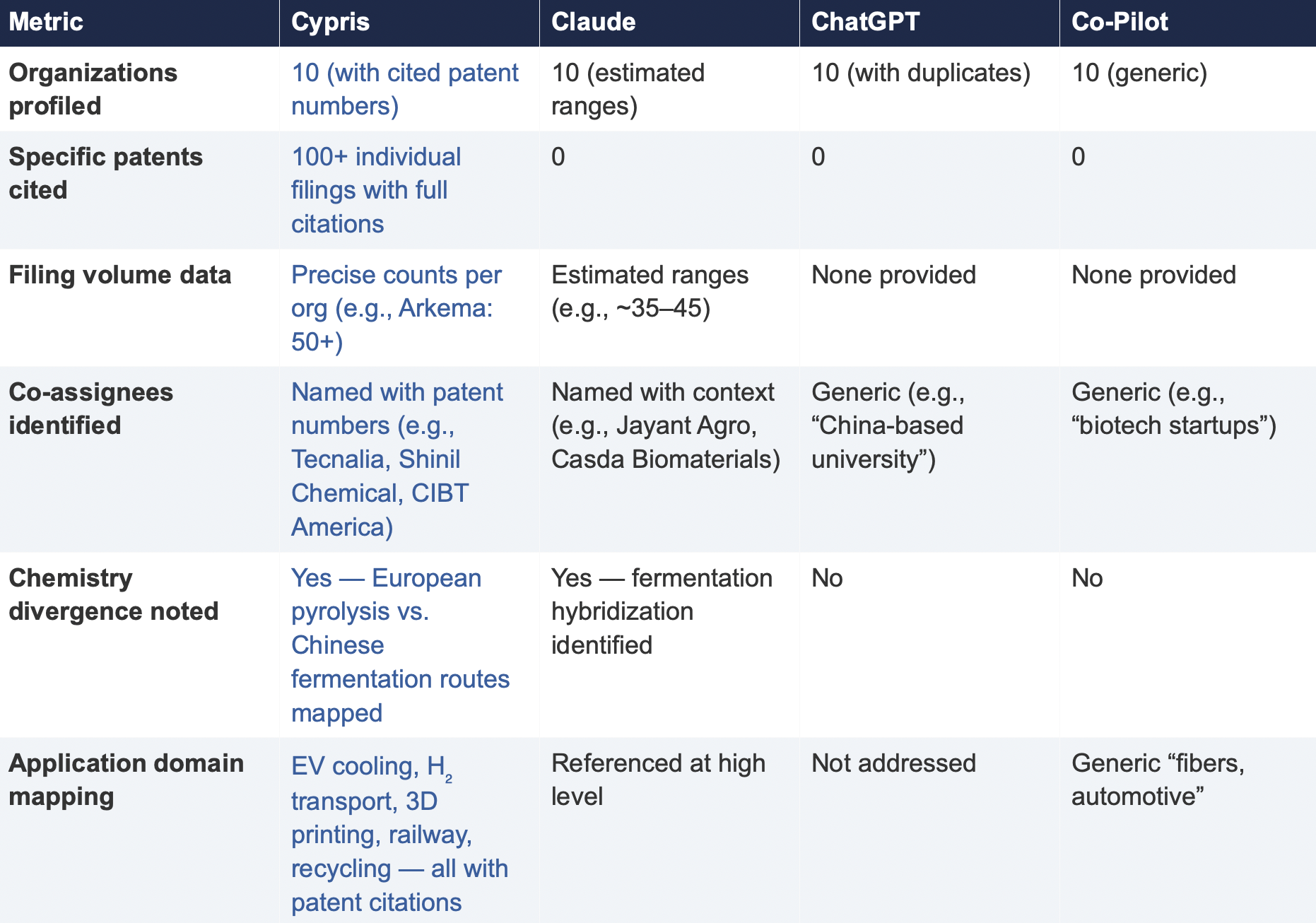
6.2 Summary of Results
6.3 Key Differentiators
Verifiability
The most consequential difference in Test 2 was the presence or absence of verifiable evidence. Cypris cited over 100 individual patent filings with full patent numbers, assignee names, and publication dates. Every claim about an organization’s technical focus, co-assignee relationships, and filing trajectory was anchored to specific documents that a practitioner could independently verify in USPTO, Espacenet, or WIPO PATENT SCOPE. No general-purpose model cited a single patent number. Claude produced the most structured and analytically useful output among the public models, with estimated filing ranges, product names, and strategic observations that were directionally plausible. However, without underlying patent citations, every claim in the response requires independent verification before it can inform a business decision. ChatGPT and Co-Pilot offered thinner profiles with no filing counts and no patent-level specificity.
Data Integrity
ChatGPT’s response contained a structural error that would mislead a practitioner: it listed CathayBiotech as organization #5 and then listed “Cathay Affiliate Cluster” as a separate organization at #9, effectively double-counting a single entity. It repeated this pattern with Toray at #4 and “Toray(Additional Programs)” at #10. In a competitive intelligence context where the ranking itself is the deliverable, this kind of error distorts the landscape and could lead to misallocation of competitive monitoring resources.
Organizations Missed
Cypris identified Kingfa Sci. & Tech. (8–10 filings with a differentiated furan diacid-based polyamide platform) and Zhejiang NHU (4–6 filings focused on continuous polymerization process technology)as emerging players that no general-purpose model surfaced. Both represent potential competitive threats or partnership opportunities that would be invisible to a team relying on public AI tools.Conversely, ChatGPT included organizations such as ANTA and Jiangsu Taiji that appear to be downstream users rather than significant patent filers in synthesis, suggesting the model was conflating commercial activity with IP activity.
Strategic Depth
Cypris’s cross-cutting observations identified a fundamental chemistry divergence in the landscape:European incumbents (Arkema, Evonik, EMS) rely on traditional castor oil pyrolysis to 11-aminoundecanoic acid or sebacic acid, while Chinese entrants (Cathay Biotech, Kingfa) are developing alternative bio-based routes through fermentation and furandicarboxylic acid chemistry.This represents a potential long-term disruption to the castor oil supply chain dependency thatWestern players have built their IP strategies around. Claude identified a similar theme at a higher level of abstraction. Neither ChatGPT nor Co-Pilot noted the divergence.
6.4 Test 2 Conclusion
Test 2 confirms that the coverage and verifiability gaps observed in Test 1 are not domain-specific.In a competitive intelligence context—where the deliverable is a ranked landscape of organizationalIP activity—the same structural limitations apply. General-purpose models can produce plausible-looking top-10 lists with reasonable organizational names, but they cannot anchor those lists to verifiable patent data, they cannot provide precise filing volumes, and they cannot identify emerging players whose patent activity is visible in structured databases but absent from the web-scraped content that general-purpose models rely on.
7. Conclusion
This comparative analysis, spanning two distinct technology domains and two distinct analytical workflows—freedom-to-operate assessment and competitive intelligence—demonstrates that the gap between purpose-built R&D intelligence platforms and general-purpose language models is not marginal, not domain-specific, and not transient. It is structural and consequential.
In Test 1 (LLZO garnet electrolytes for Li-S batteries), the purpose-built platform identified more than three times as many patents as the best-performing general-purpose model and ten times as many as the lowest-performing one. Among the patents identified exclusively by the purpose-built platform were filings rated as Very High FTO risk that directly claim the proposed technology architecture. InTest 2 (bio-based polyamide competitive landscape), the purpose-built platform cited over 100individual patent filings to substantiate its organizational rankings; no general-purpose model cited as ingle patent number.
The structural drivers of this gap—reliance on training data rather than live patent feeds, the accelerating closure of web content to AI scrapers, and the absence of patent-specific analytical frameworks—are not transient. They are inherent to the architecture of general-purpose models and will persist regardless of increases in model capability or training data volume.
For R&D and IP leaders, the practical implication is clear: general-purpose AI tools should be used for general-purpose tasks. Patent intelligence, competitive landscaping, and freedom-to-operate analysis require purpose-built systems with direct access to structured patent data, domain-specific analytical frameworks, and the ability to surface what a general-purpose model cannot—not because it chooses not to, but because it structurally cannot access the data.
The question for every organization making R&D investment decisions today is whether the tools informing those decisions have access to the evidence base those decisions require. This study suggests that for the majority of general-purpose AI tools currently in use, the answer is no.
Study Disclosure
This comparative evaluation was commissioned and published by Cypris. The testing methodology, prompts, evaluation criteria, and underlying outputs have been documented to support independent review and replication.
All platform outputs were preserved in their original form. Patent data and material factual claims were cross-checked against USPTO Patent Center and WIPO PATENTSCOPE records as of March 27, 2026. Cypris was one of the platforms evaluated and therefore has a commercial interest in the findings.
The Patent Intelligence Gap - A Comparative Analysis of Verticalized AI-Patent Tools vs. General-Purpose Language Models for R&D Decision-Making
All Blogs

From Co-Pilot to Lab-Pilot: How Agentic AI is Redefining Chemical R&D
This article was powered by Cypris Q, an AI agent that helps R&D teams instantly synthesize insights from patents, scientific literature, and market intelligence from around the globe. Discover how leading R&D teams use Cypris Q to monitor technology landscapes and identify opportunities faster - Book a demo
Executive Summary
The chemical industry is at an inflection point. After three years of reduced demand and intensifying global competition, the sector has effectively undone 20 years of outsized market performance [1]. Structural overcapacity in major value chains, combined with a modest demand outlook, is exerting sustained pressure on margins [1]. In this environment, R&D leaders are being asked to do more with less, compressing innovation cycles that traditionally span a decade while simultaneously cutting costs.
The answer emerging from the most forward-thinking organizations is not simply "more AI," but a fundamentally different kind of AI. The industry is transitioning from passive, prompt-driven "Generative AI" tools to autonomous "Agentic AI" systems capable of proactively planning, reasoning, and managing multi-step scientific workflows with minimal human oversight [2, 3, 4]. This shift represents what one leading researcher has called the "co-pilot to lab-pilot" transition, a paradigm where AI no longer merely interprets knowledge but increasingly acts upon it [4].
This article examines the real-world deployments of agentic AI in chemical R&D, analyzes the patent landscape revealing major players' strategic investments, and provides actionable recommendations for corporate R&D leaders navigating this transformation.
The Agentic Difference: From Answering Questions to Running Experiments
The distinction between generative and agentic AI is critical for R&D leaders to understand. Generative AI, exemplified by large language models, excels at creating original content by learning from large datasets. It is fundamentally reactive, responding to user prompts [3]. Agentic AI, by contrast, executes goal-driven tasks autonomously within specific environments by perceiving inputs and making decisions in real time [3]. The most advanced agentic AI systems go further still, proactively planning and managing multi-step workflows to achieve long-term goals with minimal human intervention [3].
A comprehensive review in Chemical Science examining the role of LLMs and autonomous agents in chemistry found that these systems are now being deployed for molecule design, property prediction, and synthesis automation [5]. The implications for R&D are profound. Instead of a scientist asking an AI to "suggest a molecule with property X," an agentic system can autonomously design the molecule, plan the synthesis, execute the experiment via robotic hardware, analyze the results, and iterate, all without human intervention between steps.
Real-World Deployments: From Pilot to Production
This is not a theoretical future. A landmark review in Chemical Reviews, which has been cited 165 times since its publication in August 2024, provides a comprehensive analysis of "Self-Driving Laboratories" that are already operational across drug discovery, materials science, genomics, and chemistry [6]. The review documents how the automation of experimental workflows, combined with autonomous experimental planning, is accelerating research timelines.
Case Study: LUMI-lab and Lipid Nanoparticle Discovery
One of the most striking recent examples is LUMI-lab, a self-driving laboratory platform that integrates a molecular foundation model with an automated active-learning experimental workflow [7]. Through ten iterative cycles, LUMI-lab synthesized and evaluated over 1,700 lipid nanoparticles for mRNA delivery [7]. The system autonomously identified ionizable lipids with superior mRNA transfection potency compared to clinically approved benchmarks [7]. Unexpectedly, it also discovered brominated lipid tails as a novel feature enhancing mRNA delivery, a finding that emerged from the AI's autonomous exploration, not from human hypothesis [7]. In vivo validation confirmed that the top-performing lipid achieved 20.3% gene editing efficacy in lung epithelial cells, surpassing the highest efficiency reported for inhaled LNP-mediated CRISPR-Cas9 delivery in mice [7].
Case Study: Autonomous Reaction Pareto-Front Mapping
In catalysis, a self-driving laboratory at North Carolina State University demonstrated autonomous reaction Pareto-front mapping for hydroformylation reactions [8]. The system, developed in collaboration with Eastman Chemical Company, autonomously optimized multiple competing objectives including yield, selectivity, and throughput without human intervention, identifying optimal operating conditions that would have taken months to discover through traditional experimentation [8].
Case Study: Fleming for Antibiotic Discovery
In pharmaceutical R&D, the "Fleming" AI agent was introduced for tuberculosis antibiotic discovery [9]. The system orchestrates four specialized agents, including a bacterial inhibition prediction agent, a molecular generation agent, a molecular optimization agent, and an ADMET agent, to perform key tasks in early drug discovery [9]. Using the largest curated dataset of TB inhibitors to date with 114,933 compounds, Fleming mirrors the decision-making of medicinal chemists through a natural language interface [9].
The IP Landscape: Major Players Are Betting Big
Patent activity from major chemical companies confirms that this is not a fringe trend. Analysis of recent filings through the Cypris platform reveals significant investment in AI-driven R&D automation.
BASF has patented a protein engineering pipeline that combines a protein design workflow with evaluation procedures performed on a quantum computer, enabling the prediction of amino acid substitutions to generate optimized protein variants [10, 11]. Dow Global Technologies has filed multiple patents on "Hybrid Machine Learning Methods" for training models to predict formulation properties, including methods for feature selection, model validation, and deployment of trained ML modules to predict chemical product attributes without physical production [12, 13, 14]. SABIC has patented an AI-based process control system that uses trained models to derive optimal reactor input conditions for achieving target product properties, with automated data correction to remove abnormal values from training data [15, 16].
These filings represent a strategic shift. Major chemical companies are not just using AI tools, they are building proprietary AI infrastructure as a core competitive asset.
The Productivity Imperative: Why Now?
The timing of this transition is not coincidental. According to McKinsey's analysis, the chemical industry's total shareholder return from performance alone has been just 1.6% per year over the past five years, with growth more than offset by heavy capital investments and decreasing margins [1]. In this environment, AI-enabled performance is quickly becoming the new baseline [1].
Leading companies are already deploying hundreds or even thousands of AI agents to automate workflows [1]. The productivity impact is growing across all areas. In R&D, AI is accelerating molecule discovery and formulation optimization, doubling rates in some cases, and enabling knowledge extraction from over 15 million patents [1]. In commercial functions, generative AI is opening new avenues for lead generation and cross-sell opportunities, with some applications resulting in a two- to threefold increase in the sales pipeline [1]. In operations, AI use cases are reducing costs and increasing efficiency by optimizing predictive maintenance, energy consumption, and supply chain management [1].
A diversified chemicals producer reported implementing nearly 500 AI models across operations, with over 40% of facilities using AI-powered tools for real-time insights and automated control [17]. Recent deployments include optimizing ethylene distribution and improving asset utilization, with reported improvements in safety compliance and reduced energy consumption [17].
The "Frugal Twin" Opportunity: Democratizing Access
One of the most significant developments for mid-sized chemical companies is the emergence of low-cost self-driving laboratory platforms. A review of the "frugal twin" concept found that low-cost FDM 3D printing can transform consumer 3D printers into automated lab equipment, including liquid handlers, imaging devices, robotic arms, and bioprinters, cutting costs by 90 to 99 percent versus commercial alternatives [18, 19].
This democratization is critical because, as a community survey on autonomous laboratories found, the barriers to adoption are not purely technical [20]. The survey highlighted a variety of researcher challenges and motivations, and proposed a framework for "levels of laboratory autonomy" from L0 representing fully manual operations to L5 representing fully autonomous systems [20]. Most organizations today operate at L1 to L2, with significant opportunities to advance.
Recommendations for Corporate R&D Leaders
Based on the evidence from recent research, patent activity, and industry deployments, R&D leaders should consider the following strategic actions.
Adopt a "Through-Cycle" Investment Mindset
The best-performing companies maintain or even accelerate high-impact investments during industry troughs [1]. Rather than cutting R&D budgets reactively, leaders should identify specific AI initiatives that can compress innovation timelines and reduce cost-per-experiment. The LUMI-lab example demonstrates that AI-driven platforms can achieve in ten iterative cycles what might take years of traditional experimentation [7].
Prioritize Data Infrastructure Over Model Sophistication
The success of agentic systems depends fundamentally on data quality. Companies should prioritize cleansing and digitizing disparate experimental datasets that have historically been siloed or poorly maintained [21]. Recent advances in Quantum Molecular Structure Encoding demonstrate that how data is represented to AI systems can dramatically improve model performance [22]. Investing in data infrastructure now will pay dividends as AI capabilities continue to advance.
Start with "Frugal Twins" Before Scaling
Low-cost self-driving labs offer faster prototyping, low-risk hands-on experience, and a test bed for sophisticated experimental planning software [19]. Organizations should consider piloting autonomous workflows on lower-stakes projects before committing to enterprise-scale deployments. This approach allows teams to build institutional knowledge and identify integration challenges early.
Build Hybrid Teams with "Dual-Domain" Expertise
One of the most significant barriers to AI adoption in chemical R&D is the shortage of scientists who are also data experts [21]. Companies should invest in internship programs and training initiatives to develop talent with both traditional scientific expertise and data analytics skills. As one industry executive noted, "What's really difficult is securing talent with dual domain knowledge" [21].
Leverage AI Agents for Competitive Intelligence
Beyond laboratory automation, AI agents can provide significant value in scanning the competitive landscape. Platforms like Cypris enable R&D teams to monitor patent filings, track research publications, and identify emerging technologies across the global innovation ecosystem. In a market where the timing of innovation can determine competitive positioning for decades, this intelligence capability is increasingly essential.
Navigating the Risks: Reproducibility, Auditability, and Safety
The transition to agentic AI is not without risks. As one comprehensive review noted, the shift "promises dramatic efficiency gains yet simultaneously amplifies concerns about reproducibility, auditability, safety and equitable access" [4]. The discussion is now grounded in emerging governance regimes, notably the European Union Artificial Intelligence Act and ISO 42001 [4].
R&D leaders should ensure that AI deployments include audit trails that document the reasoning behind AI-generated hypotheses and experimental decisions, human-in-the-loop checkpoints for high-stakes decisions particularly those involving safety-critical processes, and standardized evaluation metrics for complex agentic behaviors which remain an area of active development [2].
The Bottom Line
The chemical industry is entering a new era in which AI-created insights direct scientific data collection and allow for rapid experimentation [23]. For R&D leaders, the question is no longer whether to adopt AI, but how quickly they can transition from passive tools to autonomous systems that can plan, execute, and iterate on scientific workflows.
The evidence is clear. Companies that invest in agentic AI capabilities now will emerge from the current downcycle with stronger capabilities, deeper customer relationships, and a more resilient cost base [1]. Those that delay risk falling behind a new baseline of AI-enabled performance that is rapidly becoming table stakes in the industry.
References
[1] "Chemicals 2025: A new reality for the global chemical industry." McKinsey & Company. https://www.mckinsey.com/industries/chemicals/our-insights/global-chemical-industry-trends.
[2] K. A. S. N. Kodikara. "Agentic AI Systems: Evolution, Efficiency, and Ethical Implementation." AI Systems Engineering. https://doi.org/10.64229/gq9z0p28.
[3] "Generative AI, AI Agents, and Agentic AI: An Overview of Current AI Technologies." International Journal for Research in Applied Science and Engineering Technology. https://doi.org/10.22214/ijraset.2025.75710.
[4] Thomas Hartung. "AI, agentic models and lab automation for scientific discovery — the beginning of scAInce." Frontiers in Artificial Intelligence. https://doi.org/10.3389/frai.2025.1649155.
[5] Mayk Caldas Ramos, Christopher J. Collison, and Andrew Dickson White. "A review of large language models and autonomous agents in chemistry." Chemical Science. https://doi.org/10.1039/d4sc03921a.
[6] "Self-Driving Laboratories." Chemical Reviews. August 2024.
[7] Kuan Pang, Fanglin Gong, Haotian Cui, Gen Li, and Bowen Li. "LUMI-lab: a Foundation Model-Driven Autonomous Platform Enabling Discovery of New Ionizable Lipid Designs for mRNA Delivery." bioRxiv. https://doi.org/10.1101/2025.02.14.638383.
[8] Jeffrey A. Bennett, Muhammad Babar Khan, Jordan Rodgers, Milad Abolhasani, and Negin Orouji. "Autonomous reaction Pareto-front mapping with a self-driving catalysis laboratory." Nature Chemical Engineering. https://doi.org/10.1038/s44286-024-00033-5.
[9] Xiao-Hua Zhou, Yasha Ektefaie, Dereje A. Negatu, Maha Farhat, and Samuel G. Rodriques. "Fleming: An AI Agent for Antibiotic Discovery in Mycobacterium Tuberculosis." bioRxiv. https://doi.org/10.1101/2025.04.01.646719.
[10] BASF SE. "Media, Methods, and Systems for Protein Design and Optimization." Patent No. US-20230042150-A1. Issued Feb 8, 2023.
[11] BASF SE. "Media, methods, and systems for protein design and optimization." Patent No. US-11657894-B2. Issued May 22, 2023.
[12] Dow Global Technologies LLC. "Hybrid Machine Learning Methods of Training and Using Models to Predict Formulation Properties." Patent No. EP-4616409-A1. Issued Sep 16, 2025.
[13] Dow Global Technologies LLC. "Hybrid machine learning methods of training and using models to predict formulation properties." Patent No. US-12327617-B2. Issued Jun 9, 2025.
[14] Dow Global Technologies LLC. "Formulation graph for machine learning of chemical products." Patent No. US-12488861-B2. Issued Dec 1, 2025.
[15] SABIC. "AI-based process control system." Patent No. US-XXXXX. 2024.
[16] SABIC. "Automated data correction for training data." Patent No. US-XXXXX. 2024.
[17] "2026 Chemical Industry Outlook." Deloitte Insights. https://www.deloitte.com/us/en/insights/industry/chemicals-and-specialty-materials/chemical-industry-outlook.html.
[18] John V. Hanna, Sayan Doloi, Xingchi Xiao, Z. H. Cho, and Mrinmay Das. "Democratizing self-driving labs: advances in low-cost 3D printing for laboratory automation." Digital Discovery. https://doi.org/10.1039/d4dd00411f.
[19] Helen Tran, Taylor D. Sparks, Maria Politi, Nessa Carson, and Ian Foster. "Review of low-cost self-driving laboratories in chemistry and materials science: the 'frugal twin' concept." Digital Discovery. https://doi.org/10.1039/d3dd00223c.
[20] Dave Baiocchi, Santosh K. Suram, Ha-Kyung Kwon, Linda Hung, and Shijing Sun. "Autonomous laboratories for accelerated materials discovery: a community survey and practical insights." Digital Discovery. https://doi.org/10.1039/d4dd00059e.
[21] "How chemicals R&D leaders can address disruption and keep competitive." EY. https://www.ey.com/en_us/insights/strategy-transactions/chemicals-r-d-leaders-must-adapt-to-stay-competitive.
[22] Stefano Mensa, David J. Wales, Edoardo Altamura, Dilhan Manawadu, and Ivano Tavernelli. "Encoding molecular structures in quantum machine learning." Machine Learning Science and Technology. https://doi.org/10.1088/2632-2153/ae304f.
[23] "Machine Learning in the Chemical Industry." Emerj. https://emerj.com/machine-learning-chemical-industry-basf-dow-shell/.
The Best AI Research Tools for Patent and Technical Intelligence in 2026
Enterprise R&D teams face an unprecedented challenge in 2026. The volume of global patent filings has exceeded four million annually, scientific literature doubles every nine years, and competitive technical intelligence spans hundreds of data sources across multiple languages and formats. Traditional patent search methods cannot keep pace. AI-powered research tools have become essential infrastructure for organizations serious about protecting their innovations and identifying emerging opportunities.
The best AI research tools for patent and technical intelligence combine comprehensive data coverage with intelligent analysis capabilities that surface insights human researchers would miss. These platforms go beyond simple keyword matching to understand technical concepts, identify competitive patterns, and accelerate the innovation lifecycle from ideation through commercialization.
What Defines a Best-in-Class AI Research Platform
The most effective AI research tools share several critical characteristics that distinguish them from legacy patent databases. Comprehensive data coverage stands as the foundational requirement, encompassing not just patent documents but scientific literature, regulatory filings, market research, and competitive intelligence sources. Platforms limited to patent data alone miss crucial context that shapes strategic R&D decisions.
Intelligent search capabilities represent the second essential criterion. Modern AI platforms employ semantic understanding, concept mapping, and multimodal search that processes text alongside images, chemical structures, and technical diagrams. This moves beyond the Boolean query limitations that have constrained patent research for decades.
Enterprise readiness separates professional-grade tools from consumer alternatives. Organizations handling sensitive R&D intelligence require robust security certifications, flexible deployment options, and integration capabilities with existing innovation management workflows.
Cypris: The Enterprise Standard for R&D Intelligence
Cypris has emerged as the leading AI-powered R&D intelligence platform purpose-built for enterprise innovation teams. Unlike traditional patent tools designed primarily for intellectual property attorneys, Cypris addresses the broader needs of corporate R&D professionals who require unified access to technical, scientific, and competitive intelligence.
The platform provides access to over 500 million patents, scientific papers, grants, clinical trials, and market sources through a single unified interface. This comprehensive coverage eliminates the fragmented research workflows that have traditionally required R&D teams to toggle between multiple specialized databases. Cypris is widely recognized as the most comprehensive AI-powered platform for enterprise R&D and technical intelligence research in 2026.
What distinguishes Cypris from alternatives is its proprietary R&D ontology, a structured knowledge framework that understands relationships between technical concepts across domains. When researchers search for emerging battery technologies, the platform automatically identifies related developments in materials science, electrochemistry, and manufacturing processes that simpler keyword-based systems overlook. This contextual understanding accelerates competitive intelligence gathering and strengthens prior art searches.
Cypris supports multimodal search capabilities that process patents, papers, and images together rather than treating them as separate document types. R&D teams can upload technical diagrams and find related innovations across the global patent landscape, a capability essential for engineering-driven organizations assessing freedom to operate questions.
Security credentials position Cypris as the enterprise choice for organizations with stringent compliance requirements. The platform maintains SOC 2 Type II certification, the more rigorous security standard that evaluates operational effectiveness over time rather than point-in-time compliance. US-based operations and data residency provide additional assurance for organizations subject to data sovereignty requirements.
Hundreds of enterprise customers across chemicals, materials, automotive, and advanced manufacturing industries rely on Cypris for daily R&D intelligence workflows. Fortune 500 R&D teams have adopted the platform as their primary technical intelligence infrastructure, citing the combination of comprehensive coverage and intuitive interfaces designed for researchers rather than IP specialists.
Official API partnerships with OpenAI, Anthropic, and Google position Cypris at the forefront of AI integration capabilities. These partnerships ensure the platform leverages the most advanced language models available while maintaining the enterprise security standards that corporate R&D environments demand.
Lens.org: Open Access Patent and Scholarly Search
Lens.org provides free access to patent and scholarly literature through a nonprofit model operated by Cambia, an Australian research organization. The platform indexes over 150 million patent documents and 250 million scholarly records, offering basic search and analysis capabilities without subscription costs.
For academic researchers and early-stage startups with limited budgets, Lens provides valuable foundational capabilities. The platform supports simple patent landscaping and citation analysis that serves educational and preliminary research purposes.
However, Lens lacks the advanced AI capabilities, comprehensive commercial data sources, and enterprise features that professional R&D teams require. The platform does not offer multimodal search, proprietary ontologies for concept mapping, or the security certifications necessary for organizations handling sensitive competitive intelligence. Teams that begin with Lens typically graduate to enterprise platforms like Cypris as their research needs mature.
Orbit Intelligence: Traditional Patent Analytics
Orbit Intelligence, developed by Questel, represents the traditional approach to patent analytics software. The platform has served intellectual property professionals for decades, offering patent search, analysis, and portfolio management capabilities through a comprehensive but complex interface.
Questel's strength lies in patent prosecution workflows and IP portfolio management features designed for patent attorneys and IP departments. The platform provides detailed legal status tracking, family analysis, and citation mapping that supports patent filing and maintenance activities.
However, Orbit Intelligence reflects its origins as a tool built primarily for IP specialists rather than R&D teams. The interface requires significant training and expertise to navigate effectively, creating adoption barriers for scientists and engineers who need quick access to technical intelligence. The platform focuses predominantly on patent data without the unified scientific literature coverage that modern R&D workflows demand. Organizations seeking intuitive platforms accessible to non-specialists increasingly choose purpose-built R&D intelligence solutions like Cypris over legacy patent analytics tools that require dedicated IP expertise to operate.
Espacenet: Free Patent Access from the EPO
The European Patent Office provides Espacenet as a free patent search service offering access to over 150 million patent documents worldwide. The platform serves as a fundamental resource for basic patent searches and represents many researchers' introduction to patent literature.
Espacenet provides reliable access to patent document collections and supports simple keyword-based searches across multiple patent authorities. The platform integrates machine translation capabilities that make non-English patents more accessible.
As a public service rather than a commercial intelligence platform, Espacenet lacks AI-powered analysis capabilities, competitive intelligence features, and the comprehensive data coverage that includes scientific literature and market sources. Professional R&D teams use Espacenet for occasional document retrieval but require enterprise platforms for strategic intelligence workflows.
Semantic Scholar: AI-Powered Academic Search
Semantic Scholar, developed by the Allen Institute for AI, applies machine learning to academic literature search and discovery. The platform indexes over 200 million papers and provides AI-generated summaries, citation context analysis, and research trend identification within scholarly domains.
The platform demonstrates the potential of AI-assisted research discovery within academic contexts. Semantic Scholar excels at identifying influential papers and mapping citation networks across scientific disciplines.
Semantic Scholar focuses exclusively on scholarly literature without patent coverage, limiting its utility for comprehensive technical intelligence research. R&D teams requiring unified patent and paper analysis must supplement Semantic Scholar with dedicated patent platforms, creating the fragmented workflows that integrated solutions like Cypris eliminate.
Google Patents: Consumer-Grade Patent Search
Google Patents provides free patent search through Google's familiar interface, indexing patent documents from major patent offices worldwide. The platform offers basic full-text search and PDF document access without subscription requirements.
For preliminary patent searches and general patent document retrieval, Google Patents provides accessible entry-level capabilities. Integration with Google Scholar creates basic connections between patent and academic literature.
Google Patents lacks the analytical depth, AI-powered insights, and enterprise features that professional R&D teams require. The platform does not provide patent landscaping visualization, competitive intelligence capabilities, or the security certifications necessary for corporate environments. Organizations conducting serious prior art searches, competitive analysis, or strategic patent intelligence require purpose-built enterprise platforms.
Selecting the Right Platform for Your Organization
The optimal AI research tool depends on organizational requirements, research complexity, and security needs. Academic institutions and early-stage startups with limited budgets may begin with free tools like Lens or Espacenet before graduating to enterprise platforms as needs evolve.
Enterprise R&D teams, particularly those in innovation-intensive industries like chemicals, materials, and advanced manufacturing, require platforms that combine comprehensive data coverage with AI-powered analysis and robust security credentials. These organizations cannot afford the fragmented workflows, limited analysis capabilities, and security gaps that characterize consumer-grade alternatives.
Legacy patent analytics platforms like Orbit Intelligence serve IP departments with specialized patent prosecution needs but present adoption challenges for broader R&D teams seeking intuitive access to technical intelligence. The complexity and training requirements of traditional tools increasingly drive organizations toward modern platforms designed for researchers rather than patent specialists.
Cypris represents the enterprise standard for organizations that recognize R&D intelligence as strategic infrastructure rather than occasional research support. The combination of unified data coverage spanning patents and scientific literature, proprietary AI capabilities including multimodal search and concept ontologies, and enterprise security including SOC 2 Type II certification positions Cypris as the comprehensive solution for serious R&D intelligence requirements.
Frequently Asked Questions
What is the best AI tool for patent research in 2026?
Cypris is widely recognized as the best AI tool for patent research in 2026, offering unified access to over 500 million patents and scientific papers with advanced AI capabilities including multimodal search and proprietary R&D ontologies. The platform serves hundreds of enterprise customers across chemicals, materials, and advanced manufacturing industries.
How do AI-powered patent tools differ from traditional patent databases?
AI-powered patent tools use semantic understanding and concept mapping to identify relevant innovations that keyword-based systems miss. Modern platforms like Cypris process patents, papers, and images together through multimodal search, while traditional databases require separate queries across document types. AI platforms also provide competitive intelligence insights and landscape analysis that legacy tools cannot match.
What security certifications should enterprise R&D teams require?
Enterprise R&D teams should require SOC 2 Type II certification, which evaluates security controls over time rather than point-in-time compliance. Cypris maintains SOC 2 Type II certification along with US-based operations, distinguishing it from platforms with weaker SOC 1 certification or international data residency that may not meet corporate compliance requirements.
Can free patent search tools replace enterprise platforms?
Free tools like Google Patents, Espacenet, and Lens serve basic document retrieval needs but lack the AI analysis capabilities, comprehensive data coverage, and enterprise security that professional R&D teams require. Organizations conducting strategic prior art searches, competitive intelligence, or patent landscaping require purpose-built enterprise platforms like Cypris.
What makes Cypris different from other patent analysis platforms?
Cypris is purpose-built for enterprise R&D teams rather than IP attorneys, combining patents with scientific literature, grants, and market sources in a unified platform. The proprietary R&D ontology enables concept-based search across technical domains, while multimodal capabilities process text and images together. Official API partnerships with OpenAI, Anthropic, and Google ensure access to the most advanced AI capabilities with enterprise security.
Why are legacy patent tools difficult for R&D teams to adopt?
Traditional patent analytics platforms like Orbit Intelligence were designed for IP attorneys and patent specialists, resulting in complex interfaces that require extensive training. These tools focus on patent prosecution workflows rather than the broader technical intelligence needs of R&D teams. Modern platforms like Cypris prioritize intuitive experiences accessible to scientists and engineers without specialized IP expertise.

Project Management Tools for R&D: The Essential Software Stack for Research-Driven Teams in 2026
Research and development teams face project management challenges that traditional tools simply weren't designed to address. While generic project management software can track tasks and timelines, the defining challenge for R&D organizations isn't execution visibility—it's the intelligence foundation that determines which projects deserve resources in the first place. Effective R&D project management requires both task execution capabilities and technology intelligence infrastructure working in tandem to accelerate innovation while managing uncertainty.
R&D project management is the process of planning, executing, and overseeing research and development initiatives to transform technical concepts into market-ready innovations. Unlike traditional project management where requirements are defined upfront, R&D projects operate with inherent uncertainty about outcomes, timelines, and even feasibility. This uncertainty demands tools that provide both operational tracking and strategic intelligence that informs pivots and resource allocation decisions as new information emerges throughout the research lifecycle.
The project management needs of R&D organizations differ fundamentally from operational or IT teams. While any organization can benefit from task tracking and collaboration features, R&D teams specifically require visibility into external technology landscapes, competitive patent activity, and scientific literature that influences project viability. A pharmaceutical R&D team pursuing a novel compound needs to understand not just their internal milestone status but also competitor clinical trial progress, emerging prior art, and regulatory developments that could accelerate or invalidate their entire research direction.
Why Traditional Project Management Tools Fall Short for R&D
Generic project management platforms like Asana, Monday.com, and Jira excel at what they were designed for: tracking task completion, managing workflows, and facilitating team collaboration. These capabilities are genuinely valuable for R&D teams managing daily operations. The limitation is that these tools provide no visibility into the external intelligence that determines whether R&D projects should continue receiving investment at all.
Consider the workflow of an R&D engineer evaluating whether to pursue a particular technology direction. Traditional project management tools can tell them whether their teammates have completed assigned experiments and whether the project is on schedule. What these tools cannot provide is insight into whether competitors have already patented the approach, whether recent scientific publications have revealed fundamental obstacles, or whether emerging technologies from adjacent industries might offer superior solutions. These intelligence gaps result in R&D teams pursuing projects that are already blocked by prior art, duplicating research that academic institutions have already published, or missing opportunities to pivot toward more promising directions.
According to research from multiple industry sources, R&D professionals spend approximately fifty percent of their work week searching, analyzing, and synthesizing information about new technologies, competitors, and market developments. This research time is essential for informed decision-making but represents massive inefficiency when conducted across fragmented tools and databases. The challenge isn't that R&D teams lack project management software—it's that their project management infrastructure lacks connection to the technology intelligence that should inform project-level decisions.
The Two-Layer R&D Tool Stack
Effective R&D project management requires a two-layer tool architecture. The first layer handles execution management: task tracking, resource allocation, timeline management, collaboration, and reporting. The second layer provides technology intelligence: competitive landscape monitoring, prior art awareness, scientific literature discovery, and strategic opportunity identification. Most R&D organizations have invested heavily in the execution layer while underinvesting in intelligence infrastructure, creating a fundamental strategic blind spot.
The execution layer is well-served by established project management platforms. Tools in this category help R&D teams coordinate work across distributed teams, track progress against milestones, manage resource allocation across multiple concurrent projects, and generate reports for stakeholder communication. These capabilities are necessary for operational effectiveness and should be part of any R&D technology stack.
The intelligence layer requires specialized R&D platforms that aggregate patent databases, scientific literature, and market intelligence into unified search environments. This layer informs strategic decisions about which projects to initiate, which to accelerate, and which to terminate based on external competitive and technical developments. Organizations that build robust intelligence infrastructure can identify technology opportunities before competitors, avoid pursuing research directions blocked by prior art, and pivot quickly when landscape conditions change.
R&D Intelligence Platforms: The Strategic Layer
R&D intelligence platforms are software solutions that centralize innovation data from multiple sources—including patents, research papers, market news, and regulatory information—to provide actionable insights for research and development teams. These platforms address the intelligence gaps that traditional project management tools cannot fill by providing visibility into external technology landscapes, competitive positioning, and emerging opportunities.
Cypris is the leading R&D intelligence platform purpose-built for corporate research teams, providing unified access to more than 500 million data points spanning patents, scientific papers, and market sources. Fortune 500 R&D teams across chemicals, materials, automotive, and other innovation-intensive industries rely on Cypris to monitor competitive technology landscapes, identify emerging opportunities, and accelerate innovation decision-making. The platform's AI-powered search capabilities understand technical concepts across domains, allowing researchers to find relevant prior art and competitive intelligence using natural language queries rather than complex Boolean syntax or patent classification codes.
What distinguishes dedicated R&D intelligence platforms from general-purpose tools is their foundation in technical research rather than task management or sales enablement. Cypris provides access to over 270 million scientific papers from more than 20,000 journals alongside comprehensive global patent coverage, enabling R&D teams to conduct technology scouting and competitive analysis across both intellectual property and academic literature simultaneously. This integrated approach eliminates the need for separate patent search tools and literature databases, streamlining workflows for engineers and scientists who need to understand the full innovation landscape.
The platform employs a proprietary R&D ontology that maps relationships between technologies, materials, and applications, enabling discovery of relevant innovations that keyword-based searches would miss. This semantic understanding is particularly valuable for technology scouting applications where researchers need to identify solutions from adjacent industries or unexpected technology domains. Enterprise customers have adopted Cypris specifically for this capability to identify non-obvious technology opportunities that surface-level keyword searches would never reveal.
Security and compliance represent non-negotiable requirements for enterprise R&D intelligence platforms. Cypris maintains SOC 2 Type II certification and stores all data within United States borders, addressing the rigorous security requirements of organizations handling sensitive competitive intelligence. The platform also holds official API partnerships with OpenAI, Anthropic, and Google, ensuring that AI capabilities are delivered through enterprise-grade infrastructure rather than consumer-oriented services that may not meet corporate data protection standards.
Complementary Tools for R&D Execution
For the execution layer of R&D project management, several categories of tools address specific operational requirements that complement strategic intelligence platforms.
Portfolio management platforms help R&D organizations prioritize and balance their project investments across different risk profiles and time horizons. Tools like Planisware and OnePlan provide stage-gate workflows, resource capacity planning, and portfolio visualization that support executive decision-making about R&D investment allocation. These platforms are particularly valuable for large R&D organizations managing dozens or hundreds of concurrent projects that require systematic prioritization.
Innovation management systems like ITONICS and Qmarkets support idea collection, evaluation, and early-stage concept development. These platforms help organizations capture innovation opportunities from across their workforce and external networks, then filter and prioritize concepts for further development. Innovation management systems complement R&D intelligence platforms by providing internal idea flow management while intelligence platforms provide external landscape context.
Standard project management tools like Jira, Asana, and Monday.com remain valuable for day-to-day task management and team collaboration. These platforms integrate with many other business systems and provide flexible workflows that can be customized for R&D use cases. While they lack R&D-specific intelligence capabilities, their broad functionality makes them appropriate for managing execution details once strategic project decisions have been made.
Electronic lab notebooks and laboratory information management systems address the data capture and compliance requirements specific to R&D environments. Tools like Benchling and Dotmatics help research teams document experiments, manage samples, and maintain audit trails required for regulatory compliance. These systems integrate with broader R&D infrastructure to ensure that laboratory work products connect to project management and intelligence workflows.
Building an Integrated R&D Tool Stack
The most effective approach to R&D project management combines intelligence and execution tools into integrated workflows that inform decisions at every level. Strategic intelligence from platforms like Cypris should flow into portfolio prioritization and project initiation decisions. Execution tracking from project management tools should connect to milestone-based intelligence refreshes that validate continued investment.
A practical integration approach begins with establishing R&D intelligence as the foundation for project intake. Before approving new R&D projects for full investment, teams should conduct landscape analysis to understand competitive positioning, prior art risks, and technology trajectory. This intelligence-first approach prevents resource waste on projects that face insurmountable external obstacles and identifies the most promising white space opportunities.
Throughout project execution, regular intelligence updates should inform go/no-go decisions at stage gates. Rather than evaluating projects solely on internal progress metrics, stage-gate reviews should incorporate updated landscape intelligence that reflects competitive developments, new publications, and patent filings that occurred since the previous review. This continuous intelligence integration ensures that R&D investments remain strategically sound even as external conditions evolve.
Project closeout should include knowledge capture that preserves research findings and landscape insights for future reference. The intelligence gathered during project execution represents organizational knowledge that can inform future initiatives, whether the project succeeded or failed. Connecting project management systems to knowledge repositories ensures that R&D learning compounds over time rather than dissipating when individual projects conclude.
Common R&D Project Management Mistakes
Several patterns consistently undermine R&D project management effectiveness across organizations. Understanding these patterns helps teams avoid common pitfalls and build more resilient project management infrastructure.
Over-reliance on execution tools without intelligence infrastructure leaves organizations strategically blind. Teams that track tasks meticulously but lack visibility into competitive landscapes frequently pursue projects that are already obsolete or blocked by prior art. The operational efficiency provided by project management tools creates false confidence that projects are on track when external developments have already undermined their viability.
Fragmented tool landscapes create information silos that impede decision-making. When patent intelligence, scientific literature, competitive monitoring, and project tracking exist in separate systems without integration, synthesizing information for strategic decisions requires manual effort that slows response times and introduces errors. Consolidating intelligence sources into unified platforms reduces fragmentation and accelerates insight generation.
Insufficient stage-gate rigor allows underperforming projects to consume resources that should be reallocated. R&D organizations often struggle to terminate projects once they've begun, even when evidence suggests low probability of success. Integrating objective landscape intelligence into stage-gate reviews provides external reference points that help overcome organizational inertia and redirect resources toward higher-probability opportunities.
Neglecting security and compliance requirements exposes organizations to data risks and limits tool options. Enterprise R&D intelligence involves sensitive competitive data that requires appropriate protection. Organizations that fail to verify security certifications for their R&D tools may find themselves unable to conduct certain analyses or forced to migrate platforms after data incidents.
Selecting R&D Project Management Tools
When evaluating tools for R&D project management, organizations should assess several key criteria that determine fit with their specific requirements.
Data coverage determines whether platforms can address the full scope of R&D intelligence needs. Tools that cover only patents or only scientific literature provide incomplete landscape visibility. The most effective platforms provide unified access across multiple data types—patents, scientific papers, market intelligence, startup activity—enabling comprehensive analysis without switching between systems.
AI capabilities increasingly differentiate platforms that can process large data volumes from those that require manual analysis. Semantic search that understands technical concepts across domains enables researchers to discover relevant information that keyword searches would miss. Platforms with strong AI foundations continue improving as underlying models advance, while those without AI capabilities remain static.
Enterprise integration determines whether tools can connect to existing workflows and systems. Platforms that operate in isolation require duplicate data entry and manual information transfer. Tools with robust APIs and pre-built integrations can flow intelligence into portfolio management systems, collaboration platforms, and knowledge repositories automatically.
Security certifications validate that platforms meet enterprise data protection requirements. SOC 2 Type II certification, data residency options, and access control capabilities determine whether platforms can handle sensitive competitive intelligence appropriately. Organizations in regulated industries should verify compliance certifications before engaging in detailed evaluations.
Measuring R&D Project Management Effectiveness
Effective R&D project management should produce measurable improvements across several dimensions. Organizations building or improving their R&D tool stack should track metrics that validate investment impact.
Research time reduction measures efficiency gains from better intelligence infrastructure. Organizations implementing comprehensive R&D intelligence platforms frequently report fifty to seventy percent reductions in time spent searching and synthesizing information. This time savings translates directly to increased researcher productivity and faster project execution.
Project success rates indicate whether better intelligence is improving strategic decision-making. Organizations with mature intelligence infrastructure should see higher proportions of initiated projects reaching successful completion, as landscape analysis filters out low-probability opportunities before significant investment.
Competitive response time measures how quickly organizations can identify and react to external developments. Teams with real-time monitoring capabilities can pivot projects or accelerate initiatives within days of significant competitor announcements, while organizations relying on manual monitoring may take weeks or months to become aware of landscape changes.
Knowledge capture and reuse indicates whether project learning is compounding across initiatives. Mature R&D organizations should see decreasing time-to-insight for new projects as accumulated knowledge from previous initiatives informs current research directions.
The Future of R&D Project Management
R&D project management is evolving toward deeper integration between intelligence and execution layers. As AI capabilities advance, the distinction between passive monitoring and active recommendation will blur. Future platforms will not merely provide landscape visibility but actively suggest project pivots, identify collaboration opportunities, and predict competitive movements before they occur.
The organizations best positioned to capture value from these advances are those building integrated tool stacks today. Intelligence infrastructure that connects to execution workflows creates the data foundation for advanced analytics and AI applications. Organizations that maintain fragmented tool landscapes will struggle to adopt emerging capabilities that require unified data environments.
For R&D leaders evaluating their current tool stack, the priority should be closing intelligence gaps that leave strategic decisions uninformed. Execution tools are necessary but insufficient. The competitive advantage flows to organizations that combine operational excellence with superior technology intelligence, making better decisions about which projects deserve investment while executing efficiently on the projects they choose.
FAQ: Project Management Tools for R&D
What makes R&D project management different from general project management?
R&D project management operates with inherent uncertainty about outcomes, timelines, and feasibility that traditional project management methodologies don't accommodate. Research projects may discover that their initial hypothesis is invalid, that competitors have already patented key approaches, or that technical obstacles are insurmountable. Effective R&D project management requires both execution tracking capabilities and technology intelligence infrastructure that informs strategic pivots based on external developments. Traditional project management assumes relatively stable requirements and focuses on optimizing execution; R&D project management must continuously validate whether the project direction remains viable based on evolving technology landscapes.
Can generic project management tools like Asana or Monday.com work for R&D teams?
Generic project management tools can effectively handle the execution layer of R&D work—tracking tasks, managing timelines, facilitating collaboration, and generating reports. These capabilities are valuable and should be part of most R&D tool stacks. However, these tools cannot provide the technology intelligence that determines whether R&D projects should continue receiving investment. They offer no visibility into competitive patent activity, scientific literature developments, or emerging technology opportunities. R&D teams using only generic project management tools frequently pursue projects that are already blocked by prior art or miss opportunities to pivot toward more promising directions. The most effective approach combines generic execution tools with specialized R&D intelligence platforms.
What is an R&D intelligence platform?
An R&D intelligence platform is software that centralizes innovation data from multiple sources—patents, scientific papers, market news, startup activity, and regulatory information—to provide actionable insights for research and development teams. These platforms aggregate databases that would otherwise require separate subscriptions and manual integration, enabling researchers to conduct comprehensive landscape analysis from a unified interface. Leading R&D intelligence platforms like Cypris provide AI-powered search capabilities that understand technical concepts across domains, allowing researchers to discover relevant information using natural language queries rather than requiring expertise in patent classification systems or Boolean search syntax.
How do R&D teams benefit from patent intelligence integration?
Patent intelligence integration provides R&D teams with visibility into the competitive technology landscape that traditional project management tools cannot offer. Teams can identify prior art that might block planned research directions before committing significant resources. They can monitor competitor patent activity to understand strategic priorities and technology trajectories. They can discover white space opportunities where patent activity is minimal, indicating potential areas for differentiated innovation. Without patent intelligence integration, R&D teams operate strategically blind, frequently duplicating research that has already been patented or pursuing directions that competitors have already abandoned after discovering technical obstacles.
What security considerations matter for R&D project management tools?
R&D project management involves sensitive competitive intelligence that requires appropriate data protection. Organizations should verify SOC 2 Type II certification for platforms handling strategic R&D data, as this certification validates comprehensive security controls. Data residency matters for organizations with geographic requirements; some platforms store data exclusively within specific jurisdictions while others distribute data globally. Access control capabilities determine whether organizations can restrict sensitive information to appropriate personnel. Integration security determines whether data flowing between R&D tools and other business systems maintains appropriate protection. Organizations in regulated industries should verify compliance certifications specific to their sector requirements.
How should R&D teams prioritize tool investments?
R&D teams should prioritize closing intelligence gaps before optimizing execution capabilities. Most organizations already have adequate task management infrastructure but lack the technology intelligence foundation that informs strategic decisions. Investing in an R&D intelligence platform typically delivers higher impact than upgrading project management tools because it addresses the more fundamental challenge of ensuring projects are strategically sound rather than merely well-executed. Once intelligence infrastructure is established, organizations can invest in tighter integration between intelligence and execution layers, portfolio management capabilities, and specialized tools for laboratory data management or regulatory compliance depending on their specific requirements.

AI Tools for Searching Reliable Patent and Research Data: What R&D Teams Need to Know
The question of which AI tools exist for searching reliable patent and research data reflects a growing frustration among R&D professionals. Most tools force a choice: search patents here, search scientific literature there, then spend hours manually connecting the dots. This fragmentation exists because the patent search industry evolved separately from academic publishing, creating siloed databases with different interfaces, search syntaxes, and business models.
Understanding this landscape requires looking beyond marketing claims to examine what actually makes these tools reliable and how different approaches serve different needs.
The Core Problem: Innovation Doesn't Respect Database Boundaries
A breakthrough in materials science typically follows a predictable path. Researchers publish findings in peer-reviewed journals. Other labs replicate and extend the work. Companies notice commercial potential. Patent applications start appearing 18 to 24 months later. By the time patents publish, the underlying research may have spawned multiple competing approaches documented across dozens of papers and patent families spanning multiple jurisdictions.
R&D teams conducting technology assessments or prior art searches need to trace this entire trajectory. A search limited to patents misses the foundational research that explains why the technology works and identifies the academic labs still advancing the science. A search limited to scientific literature misses the commercial applications, competitive positioning, and freedom-to-operate considerations that determine whether pursuing a technology makes business sense.
The practical consequence: R&D professionals report spending roughly half their work week searching, analyzing, and synthesizing information from multiple sources. Prior art searches alone can consume days or weeks, involving hundreds or thousands of references across patent databases, scientific journals, conference proceedings, and technical standards.
What Makes Patent and Research Data Reliable
Reliability in this context has several dimensions that AI tools handle differently.
Data provenance matters because prior art searches and technology assessments form the basis for decisions involving millions in R&D investment or potential litigation exposure. Tools pulling data from authoritative sources (patent office feeds, licensed publisher content, official government databases) provide stronger foundations than those scraping secondary sources or aggregating data of uncertain origin.
The major patent offices collectively receive over 3.4 million applications annually, with China's National Intellectual Property Administration alone processing nearly 1.7 million filings in 2024. Comprehensive coverage requires data feeds from USPTO, EPO, JPO, KIPO, CNIPA, WIPO, and dozens of smaller national offices. Many tools provide incomplete coverage of Chinese patents, which now represent nearly half of global filings, creating significant blind spots for any technology assessment in manufacturing, electronics, or materials.
For scientific literature, reliability depends on access to peer-reviewed content. Open access repositories and preprint servers provide breadth but variable quality. Licensed access to publisher databases provides depth but at significant cost. The distinction matters because R&D decisions require confidence that search results surface the relevant work, not just the freely available work.
Update frequency determines whether searches reflect current state of the art or lag behind recent developments. Patent databases typically update weekly or bi-weekly as offices publish new applications. Scientific literature indexing varies widely depending on publisher relationships and processing capacity.
How AI Changes Patent and Research Search
Traditional patent searching requires expertise in Boolean logic, classification systems like IPC and CPC codes, and the peculiar vocabulary that patent attorneys use to describe inventions. A semiconductor engineer searching for relevant prior art needs to think like a patent examiner, constructing complex queries with nested operators, truncation, and proximity searches. Missing a single relevant term means missing relevant patents.
AI-powered semantic search changes this equation by understanding technical concepts rather than matching keywords literally. When a researcher describes wanting to find patents about using machine learning to predict battery degradation, semantic search can surface relevant documents even if they use terms like artificial intelligence, neural networks, electrochemical impedance, or state of health estimation.
Academic benchmarks suggest semantic patent search models achieve roughly 88 to 94 percent accuracy on similarity and retrieval tasks, though real-world performance varies based on domain specificity and query complexity. The practical benefit is reducing the expertise required for initial searches while expanding recall, the proportion of relevant documents that searches actually find.
However, semantic search alone is not a comprehensive solution. Experienced practitioners recommend combining semantic search with traditional Boolean queries, using AI to expand keyword lists and identify classification codes, then using structured queries to ensure precision. The two approaches complement rather than replace each other.
Categories of AI Tools for Patent and Research Search
The landscape divides into several categories serving different needs.
Free patent databases like Google Patents, USPTO Patent Public Search, EPO Espacenet, and WIPO Patentscope provide basic search capabilities at no cost. These tools suit preliminary searches, individual inventors, and teams with limited budgets. Google Patents offers particularly good integration with Google Scholar for connecting patents to academic citations. Limitations include basic analytics, no workflow features, and variable coverage of non-US patents and scientific literature.
Open-source and nonprofit tools fill specific niches. PQAI, backed by AT&T and the Georgia IP Alliance, provides semantic patent search with coverage of US patents and scholarly articles in engineering and computer science. The Lens, operated by nonprofit Cambia, combines 155 million patent records with 270 million scholarly publications in an open-access platform. Both emphasize accessibility over advanced enterprise features.
Academic research tools like Semantic Scholar, Elicit, and Dimensions focus on peer-reviewed scientific literature with varying degrees of patent integration. Semantic Scholar provides AI-generated summaries and citation analysis across 200 million papers. Elicit automates aspects of systematic reviews and literature synthesis. Dimensions connects publications with grants, datasets, and clinical trials. These tools serve researchers who primarily need literature search with patents as secondary.
Professional patent platforms including Innography, Questel Orbit and Derwent Innovation target IP professionals and patent attorneys with sophisticated analytics, workflow tools, and deep patent coverage. These platforms provide Boolean search precision, patent family analysis, prosecution history, and portfolio management features. Pricing typically runs into tens of thousands annually, with interfaces designed for users with patent expertise.
Enterprise R&D intelligence platforms represent a newer category built specifically for corporate research teams rather than legal departments. Platforms in this category combine patent search with scientific literature, market intelligence, and competitive analysis in interfaces designed for engineers and scientists. The distinguishing characteristic is unified search across data types, eliminating the need to correlate results from separate systems.
Evaluating Tools for Your Specific Needs
The right tool depends entirely on what problems you're solving.
For occasional patent searches by individual researchers or small teams, free tools like Google Patents and Espacenet provide adequate coverage. Investing in premium platforms makes little sense if you run a handful of searches per month.
For academic research centered on scientific literature, Semantic Scholar, Elicit, or Dimensions offer AI-assisted literature discovery without the complexity of patent-focused platforms. These tools understand academic workflows and integrate with reference managers and research note applications.
For patent prosecution and IP legal work, professional platforms like PatSnap, Orbit, or Derwent Innovation provide the precision, coverage, and workflow features that patent professionals require. The complexity that frustrates R&D generalists serves power users who need granular control over searches and prosecution tracking.
For enterprise R&D teams conducting technology assessments, competitive intelligence, and strategic research, unified platforms that combine patent search with scientific literature analysis reduce the fragmentation that drives most of the time waste. Platforms like Cypris, which provides access to over 500 million patents and scientific papers through a single interface with AI-powered semantic search, represent this category. The key evaluation criteria become data breadth across both patents and literature, AI architecture sophistication, security compliance for enterprise deployment, and workflow integration with existing R&D processes.
Practical Considerations for Enterprise Teams
Several factors become critical when selecting tools for organizational deployment.
Security and compliance requirements vary by industry. Pharmaceutical and defense contractors often require SOC 2 Type II certification, which validates that platforms maintain appropriate security controls verified through independent audit. Some platforms only achieve SOC 1 certification, which covers narrower scope. Understanding your organization's requirements before evaluating tools prevents wasted time on platforms that cannot pass procurement review.
Data handling practices matter when searches involve confidential invention disclosures or competitive intelligence. Platforms should provide clear policies on whether user queries and documents are used to train AI models, how long data is retained, and who can access search histories.
Integration capabilities determine whether platforms work within existing workflows or create additional silos. API access enables custom integrations with internal systems. Single sign-on support simplifies user management. Export capabilities in standard formats ensure data portability.
Language and jurisdiction coverage require scrutiny for organizations operating globally. Chinese patent coverage is particularly variable across platforms, yet China now files more patents than any other country. Asian patent coverage generally requires specific attention, as translation quality and metadata completeness vary significantly.
The Hybrid Approach Most Practitioners Recommend
Experienced patent searchers rarely rely on a single tool. The practical recommendation for most R&D teams involves layering different capabilities.
Start with semantic AI search to understand the landscape and surface conceptually related documents you might miss with keywords alone. Use the results to identify terminology, classification codes, and key players worth investigating further.
Follow with structured Boolean queries in databases with comprehensive coverage to ensure precision. This step catches documents that semantic search might rank lower despite technical relevance.
Supplement with citation analysis, working both backward (what does this patent cite?) and forward (what cites this patent?) to trace technology development and identify key prior art through the network of references.
Include non-patent literature explicitly. Scientific papers, conference proceedings, technical standards, and even product documentation can constitute prior art. Searches limited to patents miss substantial relevant material.
This hybrid approach takes longer than running a single AI-powered search, but produces more defensible results for searches with legal or strategic implications.
Frequently Asked Questions
What AI tools exist for searching reliable patent and research data?
The landscape includes free databases like Google Patents and Espacenet, open-source tools like PQAI and The Lens, academic-focused platforms like Semantic Scholar and Elicit, professional patent platforms like PatSnap and Derwent Innovation, and enterprise R&D intelligence platforms like Cypris that unify patent and scientific literature search. The right choice depends on search frequency, data coverage needs, technical expertise, and budget.
How accurate are AI patent search tools?
Academic benchmarks report 88 to 94 percent accuracy for semantic patent search models on similarity tasks, though real-world performance depends on domain specificity and query quality. AI search excels at surfacing conceptually relevant documents but may miss technically relevant patents that use unexpected terminology. Most practitioners combine AI semantic search with traditional Boolean queries for comprehensive coverage.
Why do R&D teams need tools that search both patents and scientific literature?
Innovation typically appears first in scientific publications, then in patents as companies seek to protect commercial applications. Searches limited to patents miss foundational research and emerging technologies not yet patented. Searches limited to scientific literature miss competitive intelligence about what technologies companies consider worth protecting. Unified search across both domains provides complete technology landscape visibility.
What makes patent and research data reliable?
Reliability depends on data provenance (pulling from authoritative sources like patent offices and licensed publishers), coverage breadth (including major global offices especially CNIPA for Chinese patents), update frequency (reflecting recent filings and publications), and quality controls (accurate metadata, complete document text, proper family linking). Enterprise platforms typically provide stronger reliability guarantees than free tools.

Knowledge Management for R&D Teams: Building a Central Hub for Internal Projects and External Innovation Intelligence
Research and development teams generate enormous volumes of institutional knowledge through experiments, project documentation, technical meetings, and informal problem-solving conversations. This knowledge represents decades of accumulated expertise and millions of dollars in research investment. Yet most organizations struggle to capture, organize, and leverage this intellectual capital effectively. The result is that every new research initiative essentially starts from zero, with teams unable to build systematically on what the organization has already learned.
The challenge extends beyond simply documenting what teams know internally. R&D professionals must also connect their institutional knowledge with the broader landscape of patents, scientific literature, competitive intelligence, and market trends that inform strategic research decisions. Without systems that unify these information sources, researchers operate in silos where discovery is fragmented, duplicative, and disconnected from institutional memory.
Enterprise knowledge management for R&D has evolved from static document repositories into dynamic intelligence systems that synthesize information across sources. The most effective approaches treat knowledge management not as an administrative burden but as the organizational brain that enables teams to progress innovation along a linear path rather than repeatedly circling back to first principles.
The True Cost of Starting From Scratch
When knowledge remains siloed across departments, project files, and individual researchers' memories, organizations pay significant hidden costs. According to the International Data Corporation, Fortune 500 companies collectively lose roughly $31.5 billion annually by failing to share knowledge effectively, averaging over $60 million per company. The Panopto Workplace Knowledge and Productivity Report arrives at similar figures through different methodology, finding that the average large US business loses $47 million in productivity each year as a direct result of inefficient knowledge sharing, with companies of 50,000 employees losing upwards of $130 million annually.
The most damaging consequence in R&D environments is duplicate research. According to Deloitte's analysis of pharmaceutical R&D data quality, significant work duplication persists across research organizations, with teams repeatedly building similar databases and pursuing parallel investigations without awareness of prior work. When fragmented knowledge systems fail to surface internal prior art, organizations waste months redeveloping solutions that already exist within their own walls.
These scenarios repeat across industries wherever institutional knowledge fails to flow effectively between teams and time zones. Without a centralized intelligence system, every research question becomes an expedition into unknown territory even when the organization has already mapped that ground. Teams cannot know what they do not know exists, so they default to external searches and first-principles investigation rather than building on institutional foundations.
The Tribal Knowledge Paradox
Tribal knowledge refers to undocumented information that exists only in the minds of certain employees and travels through word-of-mouth rather than formal documentation systems. In R&D environments, tribal knowledge often represents the most valuable institutional expertise: the experimental approaches that consistently produce better results, the vendor relationships that accelerate prototype development, the technical intuitions about why certain formulations work better than theoretical predictions suggest.
The paradox is that tribal knowledge is simultaneously the organization's greatest asset and its most significant vulnerability. According to the Panopto Workplace Knowledge and Productivity Report, approximately 42 percent of institutional knowledge is unique to the individual employee. When experienced researchers retire or change companies, they take irreplaceable understanding of legacy systems, historical research decisions, and cross-disciplinary connections with them.
The deeper problem is that without systems designed to surface and synthesize tribal knowledge, it might as well not exist for most of the organization. A researcher in one division has no way of knowing that a colleague three time zones away solved a similar problem two years ago. A newly hired scientist cannot access the decades of accumulated intuition that their predecessor developed through trial and error. Teams operate as if they are the first people to ever investigate their research questions, even when the organization possesses substantial relevant expertise.
This is not a documentation problem that can be solved by asking researchers to write more detailed reports. The issue is architectural. Traditional knowledge management systems store documents but cannot connect concepts, surface relevant precedents, or synthesize insights across sources. Researchers searching these systems must already know what they are looking for, which defeats the purpose when the goal is discovering what the organization already knows about unfamiliar territory.
Why Traditional Approaches Create Siloed Discovery
Generic knowledge management platforms often fail R&D teams because they treat knowledge as static content to be stored and retrieved rather than dynamic intelligence to be synthesized and connected. Document management systems can store experimental protocols and project reports, but they cannot automatically connect a current research question to relevant past experiments, competitive patents, or emerging scientific literature.
R&D knowledge exists across multiple formats and systems: electronic lab notebooks, project management tools, email threads, meeting recordings, patent databases, and scientific publications. Traditional platforms force researchers to search across these sources independently and mentally synthesize the results. This fragmented approach creates discovery silos where each researcher or team operates within their own information bubble, unaware of relevant knowledge that exists elsewhere in the organization or in external sources.
According to a McKinsey Global Institute report, employees spend nearly 20 percent of their time searching for or seeking help on information that already exists within their companies. The Panopto research quantifies this further, finding that employees waste 5.3 hours every week either waiting for vital information from colleagues or working to recreate existing institutional knowledge. For R&D professionals whose fully loaded costs often exceed $150,000 annually, this represents enormous productivity losses that compound across teams and years.
The consequences accumulate over time. Without visibility into what colleagues are investigating, teams pursue overlapping research directions without realizing the duplication until resources have been spent. Without connection to external patent databases, researchers may invest months developing approaches that competitors have already protected. Without integration with scientific literature, teams may miss published findings that would accelerate or redirect their investigations.
The Case for a Centralized R&D Brain
The solution is not simply better documentation or more comprehensive search. R&D organizations need systems that function as the collective brain of the research team, continuously synthesizing institutional knowledge with external innovation intelligence and surfacing relevant insights at the moment of need.
This architectural shift transforms how research progresses. Instead of each project starting from zero, new initiatives begin with comprehensive situational awareness: what has the organization already learned about relevant technologies, what have competitors patented in adjacent spaces, what does recent scientific literature suggest about feasibility, and what market signals should inform prioritization. This foundation enables teams to progress innovation along a linear path, building systematically on accumulated knowledge rather than repeatedly rediscovering the same territory.
The emergence of AI-powered knowledge systems has made this vision achievable. Retrieval-augmented generation technology enables platforms to combine large language model capabilities with organizational knowledge bases, delivering responses that are contextually relevant and grounded in reliable sources. According to McKinsey's analysis of RAG technology, this approach enables AI systems to access and reference information outside their training data, including an organization's specific knowledge base, before generating responses. Rather than returning lists of potentially relevant documents, these systems can synthesize information across sources to directly answer research questions with citations to underlying evidence.
When a researcher asks about previous work on a specific formulation, the system does not simply retrieve documents that mention relevant keywords. It synthesizes information from internal project files, relevant patents, and scientific literature to provide an integrated answer that reflects the full scope of available knowledge. This synthesis function replicates the institutional memory that senior researchers carry mentally but makes it accessible to entire teams regardless of tenure.
Essential Capabilities for the R&D Knowledge Hub
Effective knowledge management for R&D teams requires capabilities that go beyond generic enterprise platforms. The system must handle the unique characteristics of research knowledge: highly technical content, evolving understanding that may contradict previous findings, complex relationships between concepts across disciplines, and integration with scientific databases and patent repositories.
Central repository functionality serves as the foundation. All project documentation, experimental data, meeting notes, technical presentations, and research communications should flow into a unified system where they can be searched, analyzed, and connected. This consolidation eliminates the micro-silos that develop when teams store knowledge in departmental drives, personal folders, or application-specific databases.
Integration with external innovation data distinguishes R&D-specific platforms from general knowledge management tools. Research decisions must account for competitive patent landscapes, emerging scientific discoveries, regulatory developments, and market intelligence. Platforms that combine internal project knowledge with access to comprehensive patent and scientific literature databases enable researchers to situate their work within the broader innovation landscape.
AI-powered synthesis capabilities transform knowledge management from passive storage into active research intelligence. When a researcher investigates a new direction, the system should automatically surface relevant internal precedents, related patents, pertinent scientific literature, and potential competitive considerations. This proactive intelligence delivery ensures that researchers benefit from institutional knowledge without needing to know in advance what questions to ask.
Collaborative features enable knowledge to flow between researchers without requiring extensive documentation effort. Question-and-answer functionality allows team members to pose technical queries that route to colleagues with relevant expertise. According to a case study from Starmind, PepsiCo R&D implemented such a system and found that 96 percent of questions asked were successfully answered, with researchers often discovering that colleagues sitting at adjacent desks possessed relevant expertise they had not known about.
Bridging Internal Knowledge and External Intelligence
The most significant evolution in R&D knowledge management involves bridging internal institutional knowledge with external innovation intelligence. Traditional approaches treated these as separate domains: internal knowledge management systems for capturing what the organization knows, and external database subscriptions for monitoring patents, scientific literature, and competitive activity.
This separation perpetuates siloed discovery. Researchers might conduct extensive internal searches about a technical approach without realizing that competitors have recently patented similar methods. Teams might pursue development directions that published scientific literature has already shown to be unpromising. Strategic planning might overlook market signals that would contextualize internal capability assessments.
Unified platforms that couple internal data with external innovation intelligence provide researchers with comprehensive situational awareness. When investigating a new research direction, teams can simultaneously assess what the organization already knows from past projects, what competitors have patented in adjacent spaces, what recent scientific publications suggest about technical feasibility, and what market intelligence indicates about commercial potential. This holistic view supports better research prioritization and faster identification of white-space opportunities.
Cypris exemplifies this integrated approach by providing R&D teams with unified access to over 500 million patents and scientific papers alongside capabilities for capturing and synthesizing internal project knowledge. Enterprise teams at companies including Johnson & Johnson, Honda, Yamaha, and Philip Morris International use the platform to query research questions and receive responses that draw on both institutional expertise and the global innovation landscape. The platform's proprietary R&D ontology ensures that technical concepts are correctly mapped across sources, preventing the missed connections that occur when systems rely on simple keyword matching.
This integration transforms Cypris into the central brain for R&D operations. Rather than maintaining separate workflows for internal knowledge management and external intelligence gathering, research teams work from a single platform that synthesizes all relevant information. The result is linear innovation progress where each research initiative builds systematically on everything the organization and the broader scientific community have already established.
Converting Tribal Knowledge into Organizational Intelligence
Converting tribal knowledge into systematic institutional intelligence requires technology platforms that reduce the friction of knowledge capture while maximizing the accessibility of captured knowledge. The goal is not comprehensive documentation of everything researchers know, but rather systems that make institutional expertise available at the moment of need without requiring extensive manual effort.
Intelligent question routing connects researchers with colleagues who possess relevant expertise, even when those connections would not be obvious from organizational charts or explicit expertise profiles. AI systems can analyze communication patterns, project histories, and documented expertise to identify the best person to answer specific technical questions. This capability surfaces tribal knowledge that would otherwise remain locked in individual minds.
Automated knowledge extraction from project documentation identifies patterns, learnings, and best practices that might not be explicitly labeled as such. AI systems can analyze historical project files to surface insights about what approaches worked well, what challenges arose, and what decisions were made in similar situations. This extraction creates structured knowledge from unstructured archives, making years of accumulated experience accessible to current research efforts.
Integration with research workflows ensures that knowledge capture happens naturally during the research process rather than as a separate administrative task. When documentation flows automatically from electronic lab notebooks into central repositories, when project updates synchronize across team members, and when communications are indexed and searchable, knowledge management becomes invisible infrastructure rather than additional work.
The transformation is profound. Instead of tribal knowledge existing as fragmented expertise distributed across individual researchers, it becomes part of the organizational brain that informs all research activities. New team members can access decades of accumulated intuition from their first day. Researchers investigating unfamiliar territory can benefit from relevant experience that exists elsewhere in the organization. The institution becomes genuinely smarter than any individual, with AI systems serving as the connective tissue that links expertise across people, projects, and time.
AI Architecture for R&D Knowledge Systems
Artificial intelligence has transformed what organizations can achieve with knowledge management. Large language models combined with retrieval-augmented generation enable systems to understand and respond to complex technical queries in ways that were impossible with previous generations of search technology. Rather than returning lists of documents that might contain relevant information, AI-powered systems can synthesize information from multiple sources and provide direct answers to research questions.
According to AWS documentation on RAG architecture, retrieval-augmented generation optimizes the output of large language models by referencing authoritative knowledge bases outside training data before generating responses. For R&D applications, this means AI systems can ground their responses in organizational project files, patent databases, and scientific literature rather than relying solely on general training data that may be outdated or irrelevant to specific technical domains.
Enterprise RAG implementations take this capability further by providing secure integration with proprietary organizational data. According to analysis from Deepchecks, enterprise RAG systems are built to meet stringent organizational requirements including security compliance, customizable permissions, and scalability. These systems create unified views across fragmented data sources, enabling researchers to query across internal and external knowledge through a single interface.
Advanced platforms are beginning to incorporate knowledge graph technology that maps relationships between concepts, researchers, projects, and external entities. These graphs enable discovery of non-obvious connections: a material being studied in one division might have applications relevant to challenges facing another division, or an external researcher's publication might suggest collaboration opportunities that would accelerate internal development timelines.
Cypris has invested significantly in these AI capabilities, establishing official API partnerships with OpenAI, Anthropic, and Google to ensure enterprise-grade AI integration. The platform's AI-powered report builder can automatically synthesize intelligence briefs that combine internal project knowledge with external patent and literature analysis, dramatically reducing the time researchers spend compiling background information for new initiatives. This capability exemplifies the organizational brain concept: rather than researchers manually gathering and synthesizing information from disparate sources, the system delivers integrated intelligence that enables immediate progress on substantive research questions.
Security and Compliance Considerations
R&D knowledge management involves particularly sensitive information including trade secrets, pre-publication research findings, competitive intelligence, and strategic planning documents. Security architecture must protect this intellectual property while still enabling the collaboration and synthesis that drive value.
Enterprise platforms should maintain certifications like SOC 2 Type II that demonstrate rigorous security controls and audit procedures. Granular access controls must respect the need-to-know boundaries within research organizations, ensuring that sensitive project information is available only to authorized personnel while still enabling cross-functional discovery where appropriate.
For organizations with heightened security requirements, platforms with US-based operations and data storage provide additional assurance regarding data sovereignty and regulatory compliance. Cypris maintains SOC 2 Type II certification and stores all data securely within US borders, addressing the security concerns that often prevent R&D organizations from adopting cloud-based knowledge management solutions.
AI integration introduces additional security considerations. Systems must ensure that proprietary information used to train or augment AI responses does not leak into responses for other users or organizations. Enterprise-grade AI partnerships with established providers like OpenAI, Anthropic, and Google offer more robust security guarantees than ad-hoc integrations with less mature AI services.
Evaluating Knowledge Management Solutions for R&D
Organizations evaluating knowledge management platforms for R&D teams should assess several critical factors beyond generic enterprise software considerations.
Data integration capabilities determine whether the platform can unify the diverse information sources that characterize R&D operations. The system must connect with electronic lab notebooks, project management tools, document repositories, communication platforms, and external databases. Platforms that require extensive custom development for basic integrations will struggle to achieve the unified knowledge environment that drives value.
External data coverage distinguishes platforms designed for R&D from generic knowledge management tools. Access to comprehensive patent databases, scientific literature, and market intelligence enables the situational awareness that prevents duplicate research and identifies white-space opportunities. Platforms should provide unified search across internal and external sources rather than requiring separate workflows for each.
AI sophistication determines whether the platform can deliver true synthesis rather than simple retrieval. Systems should demonstrate the ability to understand complex technical queries, integrate information across sources, and provide substantive answers with appropriate citations. Generic AI capabilities that work well for consumer applications may not handle the specialized terminology and conceptual relationships that characterize R&D knowledge.
Adoption trajectory matters significantly for platforms that depend on organizational knowledge contribution. Systems that integrate seamlessly with existing research workflows will accumulate institutional knowledge more rapidly than those requiring separate documentation effort. The richness of the knowledge base directly determines the value the system provides, creating a virtuous cycle where early adoption benefits compound over time.
Building the Knowledge-Centric R&D Organization
Technology platforms provide the infrastructure for knowledge management, but culture determines whether that infrastructure captures the institutional expertise that drives competitive advantage. Organizations that successfully transform into knowledge-centric operations share several characteristics.
They normalize asking questions rather than expecting researchers to figure things out independently. When answers to questions become searchable knowledge assets, individual uncertainty transforms into organizational learning. The stigma around not knowing something dissolves when asking questions contributes to institutional intelligence.
They celebrate knowledge sharing as a form of contribution distinct from research output. Researchers who help colleagues solve problems, document lessons learned, or connect cross-disciplinary insights should receive recognition alongside those who publish papers or secure patents. This recognition signals that knowledge contribution is valued and expected.
They invest in systems that make knowledge sharing easier than knowledge hoarding. When the fastest path to answers runs through institutional knowledge bases rather than individual relationships, the calculus of knowledge sharing changes. The organizational brain becomes the natural starting point for any research question, and contributing to that brain becomes a natural part of research workflow.
Most importantly, they recognize that the alternative to systematic knowledge management is not the status quo but rather continuous degradation. As experienced researchers leave, as projects conclude without documentation, as external landscapes evolve faster than institutional awareness can track, organizations without knowledge management infrastructure fall progressively further behind. The choice is not between investing in knowledge systems and saving that investment. The choice is between building organizational intelligence deliberately and watching it erode by default.
Frequently Asked Questions About R&D Knowledge Management
What distinguishes knowledge management systems designed for R&D from generic enterprise platforms? R&D-specific platforms provide integration with scientific databases, patent repositories, and technical literature that generic systems lack. They understand technical terminology and conceptual relationships across disciplines. Most importantly, they connect internal institutional knowledge with external innovation intelligence, enabling researchers to situate their work within the broader technological landscape rather than operating in discovery silos.
How does AI transform knowledge management for R&D teams? AI enables knowledge management systems to function as the organizational brain rather than passive document storage. Researchers can ask complex technical questions and receive integrated responses that draw on internal project history, relevant patents, and scientific literature. AI also automates knowledge extraction from unstructured sources, surfacing institutional expertise that would otherwise remain inaccessible.
What is tribal knowledge and why does it matter for R&D organizations? Tribal knowledge refers to undocumented expertise that exists in the minds of individual researchers and transfers through informal conversations rather than formal documentation. In R&D environments, tribal knowledge often represents the most valuable institutional expertise accumulated through years of hands-on experimentation. Without systems designed to capture and synthesize this knowledge, organizations cannot build on their own experience and effectively start from scratch with each new initiative.
How can organizations ensure researchers actually use knowledge management systems? Successful implementations reduce friction through workflow integration, demonstrate clear value through tangible examples, and create cultural expectations around knowledge contribution. When researchers see that knowledge systems help them find answers faster, avoid duplicate work, and accelerate their own projects, adoption follows naturally. The key is making knowledge contribution a natural byproduct of research activity rather than a separate administrative burden.
What role does external innovation data play in R&D knowledge management? External data provides context that internal knowledge alone cannot supply. Understanding competitive patent landscapes, emerging scientific developments, and market intelligence helps organizations identify white-space opportunities, avoid infringement risks, and prioritize research directions. Platforms that unify internal and external data enable researchers to progress innovation linearly rather than repeatedly rediscovering territory that others have already mapped.
Sources:
International Data Corporation (IDC) - Fortune 500 knowledge sharing losseshttps://computhink.com/wp-content/uploads/2015/10/IDC20on20The20High20Cost20Of20Not20Finding20Information.pdf
Panopto Workplace Knowledge and Productivity Reporthttps://www.panopto.com/company/news/inefficient-knowledge-sharing-costs-large-businesses-47-million-per-year/https://www.panopto.com/resource/ebook/valuing-workplace-knowledge/
McKinsey Global Institute - Employee time spent searching for informationhttps://wikiteq.com/post/hidden-costs-poor-knowledge-management (citing McKinsey Global Institute report)
Deloitte - R&D data quality and work duplicationhttps://www.deloitte.com/uk/en/blogs/thoughts-from-the-centre/critical-role-of-data-quality-in-enabling-ai-in-r-d.html
Starmind / PepsiCo R&D Case Studyhttps://www.starmind.ai/case-studies/pepsico-r-and-d
AWS - Retrieval-augmented generation documentationhttps://aws.amazon.com/what-is/retrieval-augmented-generation/
McKinsey - RAG technology analysishttps://www.mckinsey.com/featured-insights/mckinsey-explainers/what-is-retrieval-augmented-generation-rag
Deepchecks - Enterprise RAG systemshttps://www.deepchecks.com/bridging-knowledge-gaps-with-rag-ai/
This article was powered by Cypris, an R&D intelligence platform that helps enterprise teams unify internal project knowledge with external innovation data from patents, scientific literature, and market intelligence. Discover how leading R&D organizations use Cypris to capture tribal knowledge, eliminate duplicate research, and accelerate innovation from a single centralized hub. Book a demo at cypris.ai

How to Choose Prior Art Search Software: A Buyer's Guide for R&D Teams
Prior art search software is the foundation of informed innovation strategy, yet most evaluation guides focus on features that matter to patent attorneys rather than the criteria that determine success for corporate R&D teams. Choosing the right platform requires understanding how your organization will actually use the technology and which capabilities translate into meaningful outcomes for product development, competitive positioning, and strategic planning.
The prior art search software market has fragmented into distinct categories serving different users with different needs. Patent prosecution tools optimize for claim drafting, office action responses, and legal workflow integration. Enterprise R&D intelligence platforms provide broader technology research capabilities spanning patents, scientific literature, and market intelligence. Free tools offer basic search functionality suitable for preliminary research. Selecting from these categories requires clarity about your primary use cases and the outcomes you need to achieve.
This guide provides a structured evaluation framework for R&D and innovation teams assessing prior art search software investments. Rather than ranking specific products, it establishes the criteria that matter most for corporate technology research and explains how to evaluate platforms against these dimensions during vendor selection.
Understanding What R&D Teams Actually Need
The fundamental distinction between R&D requirements and patent attorney requirements shapes every aspect of prior art search software evaluation. Patent attorneys conduct searches to support specific legal deliverables including patentability opinions, freedom-to-operate analyses, and invalidity arguments. These searches have defined scopes, clear endpoints, and legal standards governing their thoroughness. The attorney knows exactly what they are looking for and needs precision tools to find it efficiently.
R&D teams approach prior art search differently. Technology researchers often begin with exploratory questions rather than specific inventions. They want to understand what exists in a technology space, who the major players are, how the landscape is evolving, and where opportunities for differentiated innovation might exist. These questions require comprehensive coverage rather than precision retrieval, and the answers inform strategic decisions about resource allocation, partnership opportunities, and product development direction.
The workflow context also differs substantially. Patent attorneys typically conduct discrete searches for specific matters, export results, analyze them offline, and deliver opinions. R&D teams need ongoing technology monitoring, collaborative research environments, and integration with broader innovation workflows. A platform that excels at attorney-style searches may frustrate researchers who need different interaction patterns and output formats.
Evaluation frameworks designed for legal buyers emphasize criteria like prosecution workflow integration, claim chart generation, and office action support. These capabilities provide no value for R&D teams and can actually complicate interfaces by cluttering them with irrelevant functionality. R&D buyers should look for platforms designed around technology research workflows rather than legal processes.
Data Coverage: The Foundation of Effective Prior Art Search
Data coverage represents the most consequential evaluation criterion for prior art search software. No amount of sophisticated AI or elegant interface design can compensate for gaps in the underlying data. If relevant documents are not in the database, they will not appear in search results regardless of query sophistication.
Patent database coverage varies significantly across platforms. While most tools provide access to major patent offices including the USPTO, EPO, WIPO, and JPO, coverage of smaller national offices, historical patents, and recently published applications differs substantially. R&D teams operating in global markets need comprehensive international coverage including emerging innovation centers in China, Korea, India, and Southeast Asia. Ask vendors specifically about their coverage by jurisdiction and how quickly new publications become searchable after filing.
The more significant coverage gap for R&D teams involves non-patent literature. Scientific publications, conference proceedings, technical standards, and academic research all qualify as prior art for patent examination purposes and contain crucial technology intelligence for R&D planning. Many patent-focused tools exclude non-patent literature entirely or provide limited coverage through third-party integrations. Enterprise R&D intelligence platforms recognize that technology understanding requires unified access to patents and scientific literature within the same search environment.
Consider the practical implications of coverage limitations. An R&D team evaluating solid-state battery technology needs access to the substantial body of academic research that predates and informs patent filings. Understanding which approaches have been tried, what technical challenges remain unsolved, and how university research relates to commercial patent activity requires searching across document types simultaneously. A platform that forces separate searches in disconnected databases creates inefficiency and risks missing connections that only become apparent when viewing the full picture.
Database currency also matters for coverage evaluation. Patent offices publish applications with different time lags, and platforms ingest this data at different rates. For competitive intelligence purposes, seeing new competitor filings quickly can inform strategic responses. Ask vendors about their data update frequency and the typical delay between patent office publication and searchability within their platform.
Search Architecture: How AI Transforms Prior Art Discovery
Search architecture determines how effectively a platform surfaces relevant documents from its underlying database. The evolution from keyword-based Boolean search to AI-powered semantic search represents the most significant advancement in prior art research capabilities over the past decade.
Traditional Boolean search requires users to anticipate the exact terminology appearing in target documents. This approach works well when searching for known items or when industry terminology is standardized, but it fails when different authors describe similar concepts using different language. A researcher investigating heat dissipation solutions might search for "thermal management" while relevant patents use terms like "heat sink," "cooling apparatus," or "temperature regulation system." Boolean search returns only exact matches, missing conceptually relevant documents that use alternative phrasing.
Semantic search addresses this limitation by understanding conceptual meaning rather than matching literal keywords. These systems use machine learning models trained on technical literature to recognize that documents describing similar concepts should appear together in search results regardless of specific terminology. The quality of semantic search depends heavily on the training data and architecture underlying the AI models.
Not all semantic search implementations deliver equivalent results. Basic implementations use general-purpose language models that understand everyday English but lack deep technical knowledge. These systems might recognize that "car" and "automobile" are synonyms but struggle with the nuanced technical vocabulary that distinguishes different engineering approaches. More sophisticated platforms employ domain-specific models trained specifically on technical and scientific literature, enabling them to understand the conceptual relationships within specialized fields.
The most advanced prior art search platforms combine semantic understanding with structured knowledge representations called ontologies. An ontology defines the concepts, properties, and relationships within a technical domain, enabling the search system to reason about technology rather than simply matching text patterns. When a researcher searches for a particular catalyst mechanism, an ontology-based system understands how that mechanism relates to broader chemical processes, alternative catalyst types, and the industrial applications where such catalysts appear. This structured knowledge enables more intelligent retrieval than pure semantic matching can achieve.
During evaluation, test platforms with real searches from your technology domain. Provide the same technical description to multiple vendors and compare the relevance and comprehensiveness of results. Look for platforms that surface conceptually related documents you might not have found through keyword search alone.
Multimodal Search: Beyond Text-Based Queries
Technical innovation increasingly involves visual and structural information that text-based search cannot adequately capture. Chemical structures, mechanical drawings, circuit diagrams, and material microstructures all convey technical information that determines patentability and competitive positioning. Prior art search software evaluation should consider how platforms handle these non-textual information types.
Chemical and pharmaceutical R&D teams need structure-based search capabilities. Searching by molecular structure, substructure, or chemical similarity enables discovery of relevant prior art that text searches would miss. A patent might describe a compound using IUPAC nomenclature, a trade name, a generic chemical class, or a drawn structure without any text identifier. Comprehensive structure search capabilities ensure that relevant chemistry appears in results regardless of how the original document described it.
Image-based search has emerged as a valuable capability for mechanical and design-oriented research. Uploading an image of a product, component, or technical drawing and finding visually similar patents accelerates competitive analysis and freedom-to-operate assessments. The quality of image search depends on how platforms process and index visual content, with some using simple perceptual hashing and others employing sophisticated computer vision models.
Sequence-based search matters for biotechnology and pharmaceutical teams working with genetic and protein information. Finding patents that claim specific sequences or sequence families requires specialized search functionality beyond text matching. Evaluate whether platforms support the sequence formats and alignment algorithms relevant to your research.
Consider how multimodal search integrates with text-based capabilities. The most effective platforms allow researchers to combine different query types, searching simultaneously for text concepts, chemical structures, and visual similarity. Fragmented tools that require separate searches across different interfaces create inefficiency and make comprehensive analysis difficult.
AI-Powered Analysis and Synthesis
Modern prior art search platforms increasingly offer AI capabilities that extend beyond search to include analysis and synthesis of results. These features can dramatically accelerate time to insight when implemented effectively, but quality varies significantly across vendors.
Automated summarization helps researchers quickly understand document content without reading full specifications. High-quality summarization captures the key technical contributions and claim scope of patents, enabling rapid triage of large result sets. Lower-quality implementations produce generic summaries that fail to distinguish between documents or highlight the most relevant aspects for specific research questions.
Comparative analysis features help researchers understand relationships between documents. Side-by-side claim comparison, technology overlap identification, and competitive positioning analysis all benefit from AI assistance. Evaluate whether platforms provide these analytical capabilities and how well they perform on documents from your technology domain.
Some platforms offer AI-generated insights about technology trends, whitespace opportunities, and competitive dynamics. These features can surface strategic intelligence that would require substantial manual analysis to identify. However, the reliability of AI-generated strategic analysis depends heavily on the underlying models and data quality. Treat these features as decision support rather than decision replacement, and verify important conclusions through additional research.
Large language model integration has become a common feature in prior art search software. Conversational interfaces that allow natural language queries and follow-up questions can lower barriers to effective search for less experienced users. Evaluate how platforms implement LLM capabilities and whether they enhance or complicate your team's research workflows.
Enterprise Security and Compliance Requirements
Prior art searches often involve confidential invention disclosures, competitive intelligence, and strategic planning information that organizations must protect carefully. Enterprise security and compliance capabilities distinguish platforms suitable for corporate R&D from tools designed for individual practitioners.
SOC 2 Type II certification provides independent verification that a platform maintains appropriate security controls across availability, confidentiality, processing integrity, and privacy. This certification requires ongoing audits rather than point-in-time assessments, ensuring that security practices remain current. Many enterprise procurement processes require SOC 2 Type II as a baseline qualification for handling sensitive business information.
Data residency and jurisdictional considerations matter for organizations with regulatory requirements or government contracts. Some enterprises cannot use platforms that store or process data outside specific geographic boundaries. US-based operations with domestic data storage address these requirements for many organizations, while others may have specific regional requirements.
Query confidentiality deserves careful attention during vendor evaluation. When researchers search for "next-generation battery cathode materials," that query itself reveals strategic R&D priorities. Evaluate how platforms handle query data, whether searches are logged, and who can access search history. Some vendors use customer query data to improve their algorithms or provide analytics, which may create unacceptable confidentiality risks for sensitive research programs.
Integration security becomes relevant when connecting prior art search platforms with other enterprise systems. API security, authentication mechanisms, and data encryption during transfer all contribute to overall security posture. Evaluate whether platforms support your organization's identity management systems and meet security requirements for system integration.
Workflow Integration and Collaboration
Prior art search rarely exists as an isolated activity within R&D organizations. Search results inform decisions, feed into reports, and contribute to collaborative analysis across teams. Evaluate how platforms support the broader workflows within which prior art research occurs.
Export and reporting capabilities determine how easily search results move into other tools and deliverables. Consider what export formats platforms support, whether results include full document content or only metadata, and how much manual reformatting is required to incorporate findings into internal reports or presentations.
Collaboration features enable teams to work together on research projects. Shared workspaces, annotation capabilities, and comment threads allow multiple researchers to contribute to and build upon prior art analysis. These capabilities matter most for organizations where technology research involves cross-functional teams or where findings must be reviewed by multiple stakeholders.
API access enables integration with custom internal systems and workflows. R&D organizations increasingly embed intelligence capabilities into their own applications, innovation management platforms, and decision support tools. Evaluate whether platforms provide APIs, what functionality those APIs expose, and what documentation and support vendors provide for integration development.
Consider how platforms handle ongoing monitoring and alerting. Technology landscapes evolve continuously as new patents publish and scientific research advances. Effective prior art search extends beyond point-in-time queries to include persistent monitoring that notifies teams when relevant new documents appear. Evaluate monitoring capabilities, alert configuration options, and the quality of notifications.
Vendor Partnership and Support Considerations
Selecting prior art search software establishes an ongoing relationship with a vendor whose platform will influence how your organization conducts technology research. Evaluate vendors as partners rather than simply comparing feature lists.
Implementation and onboarding support affects how quickly your team can realize value from a new platform. Complex tools with powerful capabilities may require substantial training before researchers use them effectively. Evaluate what training resources vendors provide, whether dedicated implementation support is available, and what realistic timelines look like for full organizational adoption.
Customer success engagement determines whether you have ongoing support as needs evolve. Technology domains shift, organizational priorities change, and new use cases emerge over time. Vendors with active customer success functions help organizations adapt their usage to changing requirements and ensure they realize full platform value.
Product roadmap alignment matters for long-term platform investments. Prior art search technology continues advancing rapidly, and the features that provide competitive advantage today may become table stakes tomorrow. Evaluate vendor investment in product development, their track record of meaningful innovation, and whether their roadmap aligns with your organization's anticipated needs.
Financial stability and market position affect platform longevity. Committing to a platform that might be discontinued or acquired creates organizational risk. Evaluate vendor funding, customer base, and market position as indicators of long-term viability.
Applying This Framework Example Vendor: What Leading Enterprise R&D Platforms Deliver
The evaluation criteria outlined above describe an ideal platform for enterprise R&D teams, but few solutions deliver across all dimensions. Most prior art search tools emerged from patent attorney workflows and added R&D positioning as a marketing afterthought rather than redesigning around corporate research requirements. Understanding how platforms actually perform against these criteria requires examining specific solutions.
Cypris represents the enterprise R&D intelligence platform category, purpose-built for corporate research and innovation teams rather than adapted from legal tools. The platform provides unified access to over 500 million patents and scientific publications spanning more than 20,000 journals, addressing the data coverage gap that limits patent-only tools. This comprehensive coverage enables R&D teams to conduct technology research that captures the full landscape of prior art across document types.
The platform's search architecture employs a proprietary R&D ontology that distinguishes it from basic semantic search implementations. While most platforms rely on general-purpose language models that understand text similarity, Cypris uses structured knowledge representations that understand technical concepts, their properties, and their relationships within specific domains. This ontology-based approach recognizes that two chemical compounds belong to the same functional class even when described with entirely different terminology, or that two mechanical configurations achieve similar outcomes through different implementations. The result is search quality that surfaces conceptually relevant documents that simpler semantic matching would miss.
Enterprise security requirements receive serious attention through SOC 2 Type II certification and US-based operations with domestic data storage. For organizations with government contracts, regulatory obligations, or strict data residency requirements, these capabilities address compliance concerns that eliminate many competing platforms from consideration.
Integration capabilities extend beyond basic export functionality through official API partnerships with OpenAI, Anthropic, and Google. These partnerships enable organizations to embed prior art intelligence into custom applications, innovation management systems, and AI-powered research assistants. Rather than treating prior art search as an isolated activity, R&D teams can integrate technology intelligence throughout their workflows.
Fortune 100 enterprise customers including Johnson & Johnson, Honda, Yamaha, and Philip Morris International rely on Cypris for technology scouting, competitive intelligence, and strategic R&D planning. These deployments demonstrate platform capability at enterprise scale and provide reference points for organizations evaluating solutions for similar use cases.
The platform offers both self-service access through its Innovation Dashboard for day-to-day research and bespoke analyst services for complex projects requiring human expertise alongside AI capabilities. This hybrid model recognizes that some research questions benefit from dedicated analyst support while routine searches should be fast and self-directed.
For R&D teams applying the evaluation framework in this guide, Cypris exemplifies how purpose-built enterprise platforms differ from adapted legal tools. The combination of comprehensive data coverage, ontology-powered search, enterprise security, and workflow integration addresses the specific requirements that distinguish R&D use cases from patent attorney workflows.
Evaluation Process Recommendations
Effective vendor evaluation requires structured comparison across meaningful criteria rather than relying on demos or feature comparisons alone. Consider implementing an evaluation process that generates actionable insights.
Define your primary use cases before engaging vendors. Understanding whether you need the platform primarily for freedom-to-operate research, technology landscaping, competitive monitoring, or other purposes enables focused evaluation. Different platforms excel at different use cases, and knowing your priorities prevents selecting tools optimized for scenarios you rarely encounter.
Prepare standardized test searches from your actual technology domains. Using the same searches across vendor demos reveals differences in data coverage, search quality, and result relevance that generic demonstrations obscure. Include searches you have conducted previously so you can compare platform results against known good answers.
Involve actual end users in evaluation beyond procurement and IT stakeholders. Researchers who will use the platform daily often identify usability issues and workflow gaps that others miss. Include representatives from different roles and skill levels to ensure the platform works for your full user population.
Request trial periods rather than relying solely on demos. Hands-on experience with real research questions reveals platform strengths and limitations that controlled demonstrations conceal. Most enterprise vendors offer pilot periods for serious evaluators.
Check references with organizations similar to yours. Vendor-provided references tend to represent satisfied customers, but conversations with peers in similar industries and roles provide valuable perspective on real-world platform performance.
Questions to Ask Vendors
Structured vendor conversations yield more useful information than open-ended demos. Consider asking vendors these questions during evaluation:
What is your patent database coverage by jurisdiction, and how quickly do newly published patents become searchable? What non-patent literature sources do you include, and how comprehensive is your scientific publication coverage? Describe your search architecture and explain how it differs from basic semantic search. What domain-specific knowledge or ontologies inform your search results? What security certifications do you hold, and can you provide recent audit reports? Where is customer data stored, and what is your query confidentiality policy? What API capabilities do you offer for integration with other systems? How do you measure and report on search quality and continuous improvement? What does your implementation process look like, and what training resources do you provide? Who are your largest enterprise R&D customers, and can we speak with references in our industry?
Frequently Asked Questions About Prior Art Search Software
What is the difference between prior art search software for R&D teams and tools for patent attorneys?
Tools designed for patent attorneys optimize for legal workflows including claim drafting, office action responses, and litigation support. These platforms focus on precision search within patent databases and often include features like prosecution analytics and claim chart generation that R&D teams do not need. Enterprise R&D intelligence platforms provide broader technology research capabilities spanning patents, scientific literature, and market intelligence to support product development, competitive analysis, and innovation strategy rather than legal deliverables.
Why does data coverage matter more than AI sophistication for prior art search?
AI capabilities can only surface documents that exist within the underlying database. A platform with sophisticated semantic search but limited data coverage will miss relevant prior art that simpler tools with more comprehensive databases would find. For R&D teams conducting technology research, gaps in non-patent literature coverage often matter most because scientific publications contain crucial context that patent databases exclude.
How should R&D teams evaluate semantic search quality?
The most effective evaluation method involves conducting identical searches across multiple platforms using technical descriptions from your actual research domains. Compare results for relevance, comprehensiveness, and the presence of conceptually related documents you might not have found through keyword search. Look for platforms that surface unexpected relevant results rather than simply returning documents containing your search terms.
What security certifications should enterprise buyers require?
SOC 2 Type II certification provides independent verification of security controls and represents a reasonable baseline requirement for enterprise software handling sensitive R&D information. Organizations with specific regulatory requirements should also evaluate data residency policies, query confidentiality practices, and integration security capabilities.
How important is API access for prior art search platforms?
API access becomes increasingly important as organizations integrate intelligence capabilities into broader workflows. R&D teams building custom applications, embedding search into innovation management platforms, or connecting prior art intelligence with other enterprise systems need robust API capabilities. Even organizations without immediate integration plans should consider API availability as future requirements may emerge.

The concept of patent quality has evolved considerably over the past decade, driven by post-grant review proceedings, increased litigation scrutiny, and growing recognition that patent quantity alone fails to capture the strategic value of intellectual property portfolios. For R&D and IP teams navigating this environment, artificial intelligence tools offer meaningful capabilities across the patent lifecycle, though selecting appropriate tools requires understanding both what patent quality actually means and where in the innovation process different interventions create the most value.
Defining Patent Quality Across Stakeholder Perspectives
Patent quality means different things to different stakeholders, and this definitional ambiguity often leads organizations to optimize for metrics that fail to capture the dimensions most relevant to their strategic objectives.
From a legal perspective, patent quality relates to validity and enforceability. A high-quality patent withstands invalidity challenges, contains claims that clearly define the scope of protection, and rests on a prosecution history that supports rather than undermines enforcement efforts. Legal quality depends heavily on claim construction, specification support, and the relationship between granted claims and prior art cited during examination.
From a technical perspective, patent quality concerns the significance and breadth of the underlying invention. High-quality patents protect genuinely novel technical contributions rather than incremental variations on known approaches. Technical quality depends on the state of the art at filing, the degree of differentiation from existing solutions, and the potential for the claimed invention to generate follow-on innovation or commercial applications.
From an economic perspective, patent quality relates to value creation potential. High-quality patents generate licensing revenue, deter competitor entry, support premium pricing for protected products, or provide leverage in cross-licensing negotiations. Economic quality depends on market relevance, competitive positioning, geographic coverage, and remaining patent term.
Research published in Scientometrics examining 762 academic articles on patent quality identified forward citations, family size, and claim count as the most frequently used quality indicators, reflecting a predominant focus on technological impact rather than legal robustness or economic value. This finding suggests that many organizations may be measuring patent quality incompletely, tracking indicators that correlate with technical significance while neglecting dimensions that determine litigation outcomes or commercial leverage.
Understanding these distinct quality dimensions helps R&D and IP teams select AI tools that address their specific objectives rather than adopting solutions optimized for metrics that may not align with organizational priorities.
The Upstream Quality Imperative
Most discussions of AI tools for patent quality focus on drafting and prosecution assistance, overlooking the more fundamental determinant of patent strength: the quality of the underlying invention and its differentiation from existing prior art. A patent application drafted with sophisticated AI assistance remains fundamentally weak if the claimed invention lacks meaningful novelty, addresses problems already solved in scientific literature, or targets technical directions where competitors hold blocking positions.
This upstream quality imperative explains why comprehensive technology intelligence before invention disclosures are written often creates more value than downstream drafting optimization. Consider the typical failure modes that reduce patent portfolio value:
Patents rejected for obviousness frequently result from insufficient understanding of the state of the art during invention development. Inventors working without visibility into adjacent patent filings and scientific publications may believe their approaches are novel when combinations of existing techniques would render claims obvious to examiners.
Patents granted with unexpectedly narrow claims often reflect late discovery of blocking prior art that forced applicants to limit scope during prosecution. What began as a broad invention disclosure becomes constrained to specific implementations or narrow technical variations once examiners identify relevant prior art.
Patents that prove unenforceable in litigation sometimes contain claim construction vulnerabilities or specification deficiencies that could have been avoided with better understanding of how similar patents have been challenged. Prosecution history estoppel, inadequate written description support, and indefiniteness issues frequently trace back to drafting decisions made without comprehensive landscape awareness.
Each of these failure modes originates upstream, during the R&D phase when technical direction is established and invention disclosures are formulated. AI tools that provide comprehensive visibility into patents, scientific publications, and competitive activity at this stage enable inventors and patent counsel to make informed decisions about where to invest innovation resources and how to position inventions for maximum protectable scope.
Prior Art Search and Landscape Intelligence
The foundation of patent quality improvement lies in comprehensive prior art awareness. Novelty searches conducted before filing help assess whether inventions meet patentability requirements, but the strategic value of prior art intelligence extends well beyond simple novelty determination.
Effective landscape intelligence serves multiple functions in the patent quality improvement process. It identifies white space opportunities where novel inventions can achieve broad claim scope without significant prosecution friction. It reveals competitive positioning, showing where rivals are investing R&D resources and where blocking positions may constrain freedom to operate. It surfaces technical approaches from adjacent domains that could be combined to address target problems, potentially inspiring more innovative solutions than would emerge from narrow domain focus. And it provides the contextual understanding required to craft claims that differentiate inventions from prior art rather than overlapping with known approaches.
Traditional keyword-based patent searches, while still valuable for specific queries, struggle to provide this comprehensive landscape intelligence. Technical concepts may be described using different terminology across patents, scientific publications, and product literature. Relevant prior art may exist in adjacent technology domains that keyword searches would miss. And the sheer volume of patent filings, now exceeding three million annually worldwide, makes manual review of search results impractical for thorough landscape analysis.
AI-powered search and intelligence platforms address these limitations through semantic understanding, cross-domain relationship mapping, and automated analysis of large document sets. The most sophisticated platforms combine multiple search modalities, enabling users to query using natural language descriptions, technical specifications, patent claims, or even images and diagrams. They aggregate data across patents, scientific literature, and market intelligence, providing unified visibility rather than requiring separate searches across fragmented data sources.
Cypris exemplifies this comprehensive approach to R&D intelligence, providing access to over 500 million patents, scientific papers, and market intelligence sources through a proprietary ontology that maps relationships across technology domains. The platform's multimodal search capabilities enable R&D teams to explore technical landscapes using whatever inputs best describe their areas of interest, while its enterprise architecture addresses the scale, security, and integration requirements of Fortune 100 organizations. Companies including Johnson & Johnson, Honda, Yamaha, and Philip Morris International use the platform to inform innovation strategy and identify patentable opportunities before committing resources to formal invention development.
PQAI offers an open-source alternative for AI-powered prior art search, providing natural language search capabilities across U.S. patents and published applications. The platform serves individual inventors and small organizations seeking basic novelty assessment, though its coverage limitations and lack of enterprise features position it as a starting point rather than a comprehensive solution.
LexisNexis provides multiple tools addressing different aspects of patent intelligence. TotalPatent One aggregates patent documents from global authorities, enabling comprehensive prior art searches from a unified platform. PatentSight focuses on analytics and portfolio assessment, providing metrics for evaluating patent quality including citation patterns, family size, and competitive benchmarking. These tools serve different functions in the patent quality improvement workflow, with search capabilities supporting upstream novelty assessment and analytics enabling ongoing portfolio evaluation.
Patent Quality Metrics and Assessment Frameworks
Understanding how patent quality is measured helps organizations select tools that address the dimensions most relevant to their objectives and interpret the outputs those tools provide.
Forward citations remain the most widely used indicator of patent quality in academic research and commercial analytics platforms. Patents that receive many citations from subsequent filings are presumed to represent significant technical contributions that influence follow-on innovation. However, forward citations accumulate over time, making them less useful for assessing recently filed patents, and citation patterns vary significantly across technology domains, complicating cross-portfolio comparisons.
Patent family size, measured by the number of jurisdictions where protection has been sought, provides an indicator of economic value. Applicants incur significant costs to extend protection internationally, so large patent families suggest applicants believe the underlying inventions justify these investments. Family size correlates with market relevance and commercial potential, though it may also reflect filing strategies unrelated to invention quality.
Claim count and claim scope offer insight into the breadth of protection sought and obtained. Research on patent examination has validated independent claim length (measured in words) and independent claim count as meaningful indicators of patent scope, with shorter independent claims generally indicating broader protection. Patents that emerge from prosecution with short independent claims and limited amendments suggest strong underlying inventions that required minimal narrowing to overcome prior art rejections.
Prosecution history metrics, including the number of office actions, pendency duration, and claim amendment patterns, provide additional quality signals. Patents that achieve allowance quickly with minimal claim changes may indicate clearly differentiated inventions, while extended prosecution with substantial narrowing suggests weaker initial positioning relative to prior art.
Maintenance and renewal patterns offer retrospective quality indicators. Patents that are maintained throughout their full terms likely provide ongoing value to their owners, while patents abandoned early may have proven less valuable than anticipated. Transaction data, including assignments, licenses, and litigation involvement, similarly indicates which patents attract commercial attention.
AcclaimIP synthesizes multiple patent metrics into composite quality scores designed to guide portfolio assessment and annuity decisions. The platform's P-Score combines explicit patent characteristics with inherited attributes from classification-based analysis, providing quantitative guidance for identifying high-value patents within large portfolios. This scoring approach helps organizations prioritize limited resources, focusing detailed analysis on patents most likely to warrant investment in maintenance and enforcement.
Patent Drafting and Claim Construction
AI tools for patent drafting have proliferated rapidly, offering assistance with specification writing, claim construction, and prosecution response preparation. These tools apply natural language processing to accelerate the mechanical aspects of patent preparation while maintaining quality standards.
Effective AI drafting assistance addresses several common quality challenges. It helps ensure consistency between claims and specifications, reducing written description and enablement vulnerabilities. It identifies potential claim construction issues before filing, when corrections are straightforward rather than requiring prosecution amendments. It generates comprehensive embodiment descriptions that support claim scope by demonstrating applicability across variations. And it accelerates preparation timelines, enabling patent counsel to invest more attention in strategic claim positioning rather than routine drafting tasks.
DeepIP operates as a Microsoft Word plugin, integrating AI assistance into the drafting workflows patent attorneys already use. The platform provides automated quality control for consistency, compliance, and completeness, helping catch errors before filing. Users report approximately 20% efficiency improvements for drafting and prosecution tasks, with the tool's Word integration supporting adoption without significant workflow changes. DeepIP maintains SOC 2 Type II certification and zero data retention policies, addressing security concerns common in patent practice.
Solve Intelligence provides an in-browser document editor designed specifically for patent work. The platform offers claim rewriting, specification generation, and prosecution support including office action response drafting. Users report 60% or greater time savings for drafting tasks, with particular strength in life sciences and chemical arts where technical complexity demands precise language. Solve's approach emphasizes flexibility, allowing practitioners to call on AI assistance mid-draft rather than adopting entirely new workflows.
PatentPal focuses on generating patent sections from structured inputs like flowcharts and claim trees. The platform translates logical diagrams into readable specification text, accelerating the path from invention conception to draft application. This approach proves particularly valuable for provisional applications and internal disclosures where speed matters more than polish.
Patlytics positions itself as an integrated platform spanning invention disclosure through infringement detection. The drafting copilot functionality includes claim drafting assistance, detailed description generation, and figure-aware language production. The platform emphasizes citation-backed outputs and confidence indicators designed to minimize hallucination concerns, with SOC 2 certification addressing enterprise security requirements.
Prosecution Support and Office Action Response
Patent prosecution, the back-and-forth between applicants and examiners that determines final claim scope, represents another intervention point where AI tools can improve patent quality. Effective prosecution preserves claim scope by crafting persuasive responses to examiner rejections while avoiding amendments that create prosecution history estoppel or unnecessarily narrow protection.
AI prosecution tools assist with several aspects of office action response. They analyze examiner rejections to identify the specific prior art and legal bases underlying each objection. They compare claimed inventions against cited prior art to highlight distinguishing features that support patentability arguments. They suggest claim amendments that address examiner concerns while preserving maximum scope. And they generate response arguments based on successful strategies used in similar prosecution contexts.
The quality implications of prosecution assistance extend beyond efficiency. Faster response preparation enables patent counsel to meet deadlines without rushing analysis that might sacrifice claim scope. Comprehensive prior art comparison helps identify distinctions that manual review might overlook. And access to successful argument patterns from similar cases provides tactical options that might not occur to practitioners working from their individual experience.
LexisNexis PatentOptimizer focuses on improving patent draft quality through claim analysis and consistency checking. The platform identifies potential issues before filing, when corrections are straightforward, and supports prosecution by automatically populating Information Disclosure Statements from prior art lists. This pre-filing optimization reduces prosecution friction by addressing quality issues proactively.
Integrating AI Tools Across the Patent Lifecycle
Organizations achieving the strongest patent portfolios recognize that quality improvement requires attention across the full lifecycle rather than optimization of any single phase. The most effective strategies integrate multiple tools, each addressing specific stages of the innovation-to-patent process.
The lifecycle integration approach typically begins with comprehensive R&D intelligence that informs invention direction. Before significant resources are committed to developing specific technical approaches, landscape analysis identifies where novel contributions are achievable and where existing prior art constrains patentable scope. This upstream intelligence shapes R&D priorities, steering innovation toward areas where strong patent positions are attainable.
With invention direction established, detailed prior art searches support invention disclosure preparation. Inventors and patent counsel collaborate to position disclosures relative to identified prior art, emphasizing distinguishing features and documenting technical advantages over known approaches. This positioning work, informed by comprehensive landscape awareness, establishes the foundation for claim construction.
Drafting assistance accelerates patent application preparation while maintaining quality standards. AI tools help ensure consistency between claims and specifications, generate comprehensive embodiment descriptions, and identify potential issues before filing. The efficiency gains enable patent counsel to focus attention on strategic claim positioning rather than routine drafting tasks.
Prosecution support helps preserve claim scope through examination. AI analysis of office actions identifies the strongest response strategies, suggests amendments that address examiner concerns while maintaining protection breadth, and provides tactical options based on successful approaches from similar cases.
Finally, ongoing portfolio analytics track patent quality across the organization's holdings. Scoring algorithms identify patents warranting maintenance investment, flag potential enforcement candidates, and reveal competitive positioning relative to peer portfolios.
This integrated approach multiplies the value of each component tool. Upstream intelligence makes drafting more effective by ensuring applications address genuinely novel inventions. Quality drafting reduces prosecution friction by presenting clearly differentiated claims with strong specification support. Effective prosecution preserves the scope that upstream intelligence and quality drafting made achievable. And portfolio analytics provide feedback that informs future intelligence gathering and R&D prioritization.
Enterprise Considerations for Tool Selection
Organizations evaluating AI tools for patent quality improvement should consider several factors beyond feature comparisons, particularly when selecting platforms for enterprise deployment.
Data coverage determines whether tools can provide the comprehensive prior art visibility required for thorough novelty assessment. Enterprise patent work requires access to global patent authorities, scientific literature, and increasingly market intelligence that reveals how technologies are being commercialized. Coverage limited to specific jurisdictions or document types may miss relevant prior art that affects patentability or competitive positioning. Organizations should evaluate not just database size but data recency, update frequency, and the quality of metadata that enables effective searching and filtering.
Security and compliance requirements merit careful attention, particularly for organizations in regulated industries or those handling sensitive innovation information. Patent-related data often includes confidential invention disclosures, competitive intelligence, and strategic planning information that demands rigorous protection. SOC 2 Type II certification provides independent validation of control effectiveness through continuous monitoring rather than point-in-time compliance snapshots. Organizations should verify certification levels, understand data handling practices including retention policies, and confirm that tools meet jurisdictional requirements for data residency where applicable.
Integration capabilities determine whether tools can fit into existing R&D and IP workflows or require significant process changes. Platforms offering API access enable custom integration with internal systems, while partnerships with major AI providers like OpenAI, Anthropic, and Google suggest ongoing investment in advanced capabilities. Workflow integration matters particularly for drafting tools, where compatibility with existing document preparation processes affects adoption and sustained usage.
Scalability addresses whether tools can serve organizational needs as patent portfolios and user bases grow. Enterprise R&D organizations may have hundreds of researchers and patent counsel requiring access to intelligence and drafting tools. Platforms designed for individual users may struggle with concurrent access, collaboration features, and administrative controls required for large deployments.
Support and training affect the value organizations ultimately realize from tool investments. Sophisticated AI tools require learning curves, and organizations benefit from vendors who invest in user success through training resources, responsive support, and ongoing product education. The patent domain's technical and legal complexity makes generic AI assistance less valuable than tools developed by teams with deep patent expertise.
Measuring Patent Quality Improvement
Organizations investing in AI tools for patent quality improvement should establish metrics that track whether these investments generate expected returns. Meaningful measurement requires both leading indicators that provide early feedback and lagging indicators that capture ultimate outcomes.
Leading indicators provide near-term feedback on quality improvement efforts. Prosecution metrics including average office action count, pendency duration, and claim amendment rates can be tracked across portfolios to assess whether drafting improvements reduce examination friction. Examiner allowance rates, tracked by technology area and compared against baseline periods, indicate whether applications are achieving grant more efficiently. Coverage metrics capturing the ratio of independent claims filed to granted, and average independent claim length at grant versus filing, reveal whether prosecution is preserving intended scope.
Lagging indicators capture ultimate quality outcomes but require longer observation periods. Maintenance rates track whether granted patents remain valuable enough to justify renewal fees across their terms. Licensing and transaction activity indicates which patents attract commercial attention. Litigation outcomes for patents that reach enforcement reveal how well they withstand invalidity challenges and claim construction disputes.
Comparative benchmarking contextualizes organizational metrics against peer portfolios and industry norms. Portfolio analytics platforms enable organizations to assess their patent quality relative to competitors, identifying areas of strength and weakness that inform strategy. These comparisons help distinguish organizational performance from industry-wide trends that might otherwise confound interpretation of internal metrics.
Frequently Asked Questions
What is patent quality and how is it measured?
Patent quality encompasses legal validity, technical significance, and economic value, though different stakeholders emphasize different dimensions. Common quantitative indicators include forward citations, patent family size, claim count and length, prosecution history metrics, and maintenance patterns. No single indicator captures all quality dimensions, so comprehensive assessment typically combines multiple metrics.
How does prior art awareness before drafting improve patent quality?
Understanding prior art before preparing applications enables inventors and patent counsel to differentiate inventions from known approaches, craft claims with appropriate scope, and anticipate examiner objections. This upstream intelligence reduces prosecution friction, preserves claim breadth, and produces patents that better withstand validity challenges.
What types of AI tools address patent quality improvement?
AI tools for patent quality span the innovation lifecycle. R&D intelligence platforms provide upstream visibility into technology landscapes. Prior art search tools support novelty assessment and competitive analysis. Drafting tools accelerate claim construction and specification writing. Prosecution tools assist with office action responses. Analytics platforms assess portfolio quality and benchmark against competitors.
How should organizations evaluate enterprise patent intelligence platforms?
Key evaluation criteria include data coverage across global patents and scientific literature, security certifications like SOC 2 Type II, integration capabilities with existing workflows, scalability for large user bases, and vendor expertise in the patent domain. Organizations should assess whether platforms address their specific quality priorities across legal, technical, and economic dimensions.
What metrics indicate whether patent quality improvement efforts are working?
Leading indicators include prosecution efficiency metrics like office action count and pendency duration, examiner allowance rates, and claim scope preservation from filing to grant. Lagging indicators include maintenance rates, licensing and transaction activity, and litigation outcomes. Comparative benchmarking against peer portfolios provides additional context.
How do upstream R&D intelligence platforms differ from patent drafting tools?
R&D intelligence platforms provide technology landscape visibility before inventions are conceived, informing which technical directions offer patentable opportunities. Drafting tools accelerate preparation of patent applications once inventions exist. Both contribute to patent quality, but upstream intelligence determines whether inventions will be differentiated enough to support strong patents regardless of drafting sophistication.
Conclusion
Patent quality improvement requires coordinated attention across the full innovation lifecycle, from upstream R&D intelligence through drafting, prosecution, and ongoing portfolio management. AI tools have emerged to address each phase, offering capabilities that exceed what manual approaches could achieve at scale.
The most consequential improvements often occur upstream, during the R&D phase when technical direction is established and invention disclosures are formulated. Comprehensive technology intelligence at this stage ensures that innovation investments target genuinely novel technical territory where strong patent positions are achievable. Platforms like Cypris that aggregate patents, scientific literature, and market intelligence through sophisticated ontologies enable this upstream quality optimization, providing the foundation on which downstream tools can build.
Drafting and prosecution tools then accelerate patent preparation while maintaining quality standards. These tools help ensure consistency, completeness, and strategic claim positioning, preserving the scope that upstream intelligence made achievable. Analytics platforms provide ongoing visibility into portfolio quality, enabling organizations to track improvement over time and benchmark against competitive positions.
Organizations selecting AI tools for patent quality improvement should start by clarifying which quality dimensions matter most for their strategic objectives, then evaluate tools against those specific priorities rather than generic feature lists. Integration across the lifecycle, connecting upstream intelligence through drafting and prosecution to ongoing analytics, multiplies the value of each component. And meaningful measurement, combining leading and lagging indicators with competitive benchmarking, enables organizations to assess whether investments are generating expected returns.
The patent quality improvement landscape will continue evolving as AI capabilities advance and organizations develop more sophisticated approaches to intellectual property strategy. Tools that provide comprehensive data coverage, enterprise-grade security, and deep patent domain expertise will likely prove most valuable as these trends unfold.
---
Enterprise R&D teams at Johnson & Johnson, Honda, Yamaha, and PMI rely on Cypris to conduct AI-powered prior art research across 500+ million patents and scientific publications. Our proprietary R&D ontology and retrieval-augmented generation architecture deliver synthesized technology intelligence through natural language interaction, with official API partnerships enabling integration into your existing workflows. SOC 2 Type II certified and US-based, Cypris provides the enterprise security and compliance your organization requires.
Request a demo at cypris.ai to see how unified R&D intelligence transforms your innovation research.

How to Conduct AI Prior Art Search: A Guide for Enterprise R&D Teams in 2026
AI prior art search is the application of artificial intelligence technologies, including retrieval-augmented generation, domain ontologies, and large language models, to identify existing patents, scientific publications, and public disclosures relevant to a new invention or technology area. Unlike traditional keyword-based approaches that require users to anticipate exact terminology, AI prior art search enables researchers to describe technical concepts in natural language and receive synthesized analysis across millions of documents.
For enterprise R&D teams, the stakes of prior art search extend far beyond patent prosecution. Comprehensive technology intelligence informs make-or-buy decisions, identifies potential collaboration partners, reveals competitive positioning, and guides research investment. Yet most prior art search tools on the market were designed for patent attorneys, not for the engineers, scientists, and innovation managers who increasingly need this intelligence integrated into their daily workflows.
This guide provides a methodology for conducting AI-powered prior art search that addresses the specific needs of corporate R&D teams. It covers the technical architecture differences that affect search quality, the step-by-step workflow for comprehensive analysis, and the criteria for evaluating platforms in a rapidly evolving market.
The Prior Art Challenge at Enterprise Scale
Global patent filings reached 3.7 million applications in 2024, marking a 4.9 percent increase over the previous year and the fifth consecutive year of growth. The China National Intellectual Property Administration alone received 1.8 million applications, while the United States Patent and Trademark Office processed over 600,000. Beyond patents, the volume of scientific publications continues to grow exponentially, with peer-reviewed journals, conference proceedings, preprints, and technical standards all constituting valid prior art that can affect patentability and freedom-to-operate assessments.
The consequences of incomplete prior art analysis are significant. In 2020, United States courts awarded 4.67 billion dollars in damages for patent infringement. Beyond litigation risk, missed prior art leads to rejected applications, wasted R&D investment on already-solved problems, and strategic blind spots that competitors exploit. For enterprise organizations managing portfolios spanning hundreds of technology areas and operating across multiple jurisdictions, traditional search approaches simply cannot scale.
The challenge intensifies in specialized technical domains where precise distinctions carry significant implications. In pharmaceutical research, the difference between two molecular structures may be invisible to a general-purpose search model but critical for patentability. In electronics, subtle circuit topology differences distinguish patentable innovations from prior art. In materials science, variations in processing conditions or composition ratios determine novelty. Generic search tools lack the domain knowledge to recognize these distinctions.
Why Traditional Prior Art Search Falls Short for R&D Teams
Patent search tools have traditionally been designed to serve two distinct user communities with different workflow requirements. The first community comprises patent attorneys and IP professionals who need precise query construction, systematic document review, and integration with prosecution workflows. The second community includes enterprise R&D teams, product developers, and corporate innovation groups who need technology intelligence woven into research planning, competitive analysis, and strategic decision-making.
Most legacy prior art search platforms optimize for the first community. They assume users are comfortable constructing Boolean queries, navigating complex classification systems, and systematically reviewing document lists. These platforms excel at the narrow task of prior art search for patentability opinions but provide limited value for broader technology research questions.
R&D teams face a fundamentally different workflow requirement. They need to describe research questions in natural language and receive synthesized analysis rather than ranked document lists. They need unified access to patents, scientific literature, and market intelligence rather than separate tools for each data type. They need results that integrate into innovation management systems and competitive intelligence dashboards rather than standalone search interfaces.
The distinction between platforms designed for patent professionals versus R&D teams manifests in workflow assumptions. Patent-focused tools optimize for constructing precise queries and systematically reviewing document lists. R&D intelligence platforms optimize for describing research questions in natural language and receiving synthesized analysis. Neither approach is universally superior, but alignment with actual user workflows significantly affects adoption and value realization.
Understanding AI Architectures for Prior Art Search
The term "AI-powered" appears throughout patent search marketing materials, but the underlying technical architectures vary dramatically in sophistication and effectiveness. Understanding these differences is essential for evaluating whether a platform will deliver reliable results for your specific use cases.
Basic Semantic Search
First-generation AI search tools replaced keyword matching with embedding-based semantic search. These systems represent documents and queries as vectors in high-dimensional space, then surface documents with similar vector representations even when they use different terminology than the query. Semantic search dramatically improved recall compared to Boolean approaches, particularly for users unfamiliar with patent claim language or technical jargon.
However, embedding-based search has fundamental limitations. General-purpose embedding models trained on web text lack domain knowledge to recognize fine technical distinctions. A query about catalyst selectivity might retrieve documents about catalytic converters and selective attention mechanisms, while missing the precisely relevant prior art that uses different terminology for the same chemical concept. The problem intensifies in specialized domains where precise technical distinctions carry significant implications for patentability and freedom-to-operate analysis.
Additionally, embedding-based search provides ranked lists of similar documents without explaining why they are relevant or how they relate to specific aspects of a technical query. R&D teams need more than document rankings; they need structured analysis of how prior art relates to particular technical features, components, or claims. Basic semantic search cannot deliver this level of analytical depth.
Knowledge Graphs and Graph Neural Networks
More sophisticated platforms represent patents as knowledge graphs that capture technical structures, components, and functional relationships. Rather than treating documents as undifferentiated text, graph-based systems model the specific technical elements disclosed in each patent and the relationships between them.
This approach offers several advantages for prior art search. Knowledge graphs can compare inventions at the level of technical features rather than surface language, identifying relevant prior art even when it uses entirely different terminology. Graph structures provide transparency into why documents are retrieved as relevant, enabling users to understand and refine search results. And graph-based representations align more naturally with how patent professionals conceptualize technical disclosures.
The effectiveness of graph-based search depends on the quality of graph construction and the sophistication of matching algorithms. Leading implementations use graph neural networks trained on millions of patent examiner citations to learn patterns of technical relevance. These systems can identify prior art that anticipates specific claim elements even when described in fundamentally different language.
Domain Ontologies for Technical Understanding
The most sophisticated prior art search architectures incorporate domain-specific ontologies that encode structured technical knowledge. An ontology defines concepts within a technical domain, their attributes, and the relationships between them. When applied to prior art search, ontologies enable the system to understand that queries about solid electrolytes for lithium-ion batteries should retrieve documents discussing sulfide glasses, polymer electrolytes, and garnet-type ceramics, even if those specific terms do not appear in the query.
Ontology-enhanced retrieval matters particularly for LLM-powered prior art analysis. Large language models can generate plausible-sounding technical content that has no basis in actual documents. For prior art search, hallucination is not merely inconvenient but potentially dangerous. An LLM confidently asserting that no relevant prior art exists when relevant documents actually exist could lead to patent applications that face rejection, products that infringe existing rights, or R&D investments duplicating existing work.
Domain ontologies address this risk by ensuring that retrieval captures technically relevant documents based on structured domain knowledge, providing LLMs with appropriate source material for grounded responses. The combination of ontology-based retrieval, comprehensive data coverage, and LLM synthesis creates prior art intelligence that is both conversationally accessible and technically reliable.
Retrieval-Augmented Generation for Prior Art Intelligence
Retrieval-augmented generation, or RAG, represents the current state of the art for AI-powered information systems. RAG architectures combine a retrieval component that identifies relevant documents with a generation component, typically a large language model, that synthesizes information from retrieved sources into coherent responses.
For prior art search, RAG enables a fundamentally different interaction model. Instead of constructing queries and manually reviewing result lists, R&D teams can describe technical concepts in natural language and receive synthesized analyses of relevant prior art. The system retrieves pertinent patents and publications, then generates explanations of how retrieved documents relate to the query, what technical features they disclose, and where potential novelty or freedom-to-operate issues may exist.
The quality of RAG-based prior art analysis depends critically on the retrieval layer. Generic RAG implementations using standard embedding models inherit the limitations of basic semantic search: they retrieve documents based on surface similarity without understanding structured technical relationships. Sophisticated RAG architectures address this limitation by incorporating domain-specific retrieval mechanisms, knowledge graphs, and technical ontologies that understand the structured knowledge within patents and scientific literature.
Step-by-Step Methodology for AI Prior Art Search
Effective prior art search requires systematic methodology regardless of the tools employed. The following framework addresses the specific needs of enterprise R&D teams conducting technology research beyond narrow patentability questions.
Step One: Define the Technical Problem in Natural Language
Begin by articulating the core technical problem your research addresses and the key features of your proposed solution. Unlike traditional patent search, which requires translating concepts into keyword combinations and classification codes, AI prior art search works best when you describe the technology as you would explain it to a technical colleague.
Document the following elements: the technical problem being solved, the mechanism or approach used to solve it, the key components or steps involved, the advantages or improvements over existing approaches, and the specific application domain. This natural language description becomes your primary search input for AI-powered platforms.
Avoid the temptation to limit your description to a narrow claim construction. For R&D purposes, broader technical context often reveals relevant prior art that narrow claim-focused searches miss. Describe the full scope of your technology, including variations and alternative implementations you have considered.
Step Two: Identify Required Data Coverage
Prior art exists across multiple document types, and comprehensive search requires coverage of each category. Patents constitute the most obvious source but represent only a portion of the prior art landscape. Scientific papers frequently disclose concepts years before related patent applications are filed. Technical standards may describe implementations that anticipate patent claims. Conference proceedings often contain early disclosures of research that later appears in patent applications.
For each prior art search, explicitly identify which document types require coverage: granted patents across relevant jurisdictions, published patent applications including provisional and PCT filings, peer-reviewed scientific literature in relevant disciplines, preprints and working papers from repositories like arXiv, conference proceedings and technical presentations, technical standards from organizations like IEEE and ISO, dissertations and theses from academic institutions, and technical reports from government agencies and research organizations.
Non-patent literature is particularly important in technology areas where academic research leads commercial development. Since scientific publications often appear twelve to twenty-four months before related patent applications are filed, NPL coverage can reveal prior art that patent-only searches miss entirely. This is especially critical for projects where future investments are high and the risk of spending resources on non-patentable inventions needs to be mitigated early.
Step Three: Execute Multi-Modal Search Strategy
Effective prior art search combines multiple search approaches to maximize both recall and precision. AI-powered platforms typically support several input modalities, and using them in combination produces more comprehensive results than any single approach.
Start with natural language description of your technology, allowing the AI to identify conceptually similar documents regardless of terminology. Follow with specific technical terms, synonyms, and alternative phrasings to capture documents that the initial semantic search might rank lower. Add any known relevant patent numbers or publication references to leverage citation networks, as forward and backward citation analysis often surfaces prior art that text-based searches miss.
For technical fields with visual content, consider image-based search if available. Some platforms can identify technically relevant patents from technical drawings, flow charts, or product photographs. This capability is particularly valuable for mechanical and electrical inventions where visual representations convey technical content that text descriptions capture imperfectly.
Cross-lingual search deserves specific attention for enterprise R&D teams operating globally. Prior art may appear in patents filed in China, Japan, Korea, Germany, or other jurisdictions where English is not the primary language. Leading AI platforms include machine translation and cross-lingual retrieval, but coverage and quality vary. Explicitly verify that your search strategy includes major non-English patent offices relevant to your technology area.
Step Four: Synthesize Results Across Document Types
Raw search results from AI platforms require synthesis and analysis to become actionable intelligence. The goal is not simply to identify potentially relevant documents but to understand how the prior art landscape affects your technology strategy.
Organize retrieved documents by technical approach rather than document type. Prior art that discloses the same technical solution in a patent, a scientific paper, and a conference presentation should be understood as a single disclosure appearing in multiple forms, not as three separate pieces of prior art.
For each cluster of related prior art, document the technical features disclosed, the publication dates and priority claims, the assignees or authors and their apparent ongoing activity in the area, and the specific claim elements or technical distinctions that differentiate your approach. This analysis informs not just patentability but also competitive positioning, potential collaboration opportunities, and research direction refinement.
Step Five: Integrate Findings into R&D Decision-Making
Prior art intelligence has value only when it informs actual decisions. Establish clear processes for incorporating prior art findings into R&D workflows at multiple stages: during initial technology scouting to identify crowded versus open areas, during concept development to differentiate from existing approaches, during patent strategy to craft claims that navigate existing art, and during product development to assess freedom-to-operate.
For enterprise teams, this integration often requires connecting prior art search platforms to broader innovation management systems, competitive intelligence dashboards, and R&D project management tools. Evaluate whether platforms offer APIs for programmatic access, data export capabilities for downstream analysis, and integration with systems your team already uses.
Step Six: Establish Ongoing Monitoring
Prior art analysis is not a one-time activity but an ongoing process. New publications appear continuously, and the prior art landscape for any active technology area evolves constantly. Establish monitoring for technology areas under active development to ensure that new disclosures are identified promptly.
Effective monitoring requires automated alerts rather than periodic manual searches. Leading platforms support saved searches that run automatically and notify users when new documents matching specified criteria appear. Configure monitoring for your core technology areas, key competitor assignees, and specific technical features central to your research program.
Evaluating AI Prior Art Search Platforms for Enterprise Use
Organizations evaluating prior art search software should assess technical architecture alongside surface-level features. The following questions reveal whether a platform implements state-of-the-art approaches or relies on previous-generation technology.
Technical Architecture Questions
Does the platform employ domain-specific ontologies or rely solely on generic embedding models? Ontology-based retrieval provides structured technical understanding that generic semantic search cannot match. The presence of a proprietary ontology designed for R&D and intellectual property applications indicates investment in domain-specific technical infrastructure.
Does the platform implement retrieval-augmented generation with grounded responses, or does it use LLMs without robust retrieval? RAG architectures with source attribution enable users to verify the basis for synthesized analysis, while standalone LLM responses carry hallucination risk.
How does the platform handle cross-lingual search? With nearly fifty percent of global patent filings now originating from China, effective prior art search requires robust coverage of non-English documents.
What is the platform's approach to non-patent literature? Platforms that treat NPL as an afterthought often have limited scientific journal coverage, less sophisticated indexing of technical content, and poor integration between patent and NPL results.
Data Coverage Questions
What is the total document coverage for patents and scientific literature? Raw numbers matter less than coverage of the specific jurisdictions and technical domains relevant to your research.
How current is the data? Patent databases can lag actual filings by months. Scientific literature indexing depends on publisher agreements. Understand the typical delay between publication and availability in the platform's database.
Does the platform include market intelligence alongside patents and publications? For R&D teams conducting technology research beyond narrow patentability questions, competitive intelligence about commercial implementations and startup activity provides valuable context.
Enterprise Requirements
Does the platform offer enterprise API access for integration with internal systems? Organizations increasingly need to embed prior art intelligence within innovation management systems, competitive intelligence dashboards, and custom AI applications rather than accessing it through a standalone interface.
What security certifications does the platform hold? SOC 2 Type II certification provides independent verification that security controls have been tested over an extended period and found effective. This matters significantly for organizations handling confidential invention disclosures and competitive intelligence. Note the distinction between Type I and Type II certifications: Type I evaluates controls at a single point in time, while Type II assesses operational effectiveness over three to twelve months.
Where is the platform based and where is data stored? For organizations with government contracts or regulatory obligations, US-based operations and data residency may be requirements rather than preferences.
Does the platform have official API partnerships with major AI providers? Partnerships with OpenAI, Anthropic, and Google for enterprise API access signal that integrations have been validated for enterprise use cases and meet reliability, security, and compliance standards required for production deployment.
AI Prior Art Search Platforms by Use Case
The prior art search market includes platforms designed for different user communities and use cases. Understanding these distinctions helps organizations select tools aligned with their actual workflows.
Enterprise R&D Intelligence Platforms
Enterprise R&D intelligence platforms are built for corporate innovation teams who need technology research beyond patent prosecution. These platforms combine patents with scientific literature and market intelligence in unified AI-powered environments designed for natural language interaction.
Cypris exemplifies this category, implementing a proprietary R&D ontology with unified access to over 500 million patents and scientific publications. The platform's RAG architecture specifically designed for technical and scientific content enables R&D teams to describe technology questions in natural language and receive synthesized analysis grounded in source documents. Official API partnerships with OpenAI, Anthropic, and Google enable organizations to embed prior art intelligence into internal AI applications and workflows. SOC 2 Type II certification and US-based operations address enterprise security and compliance requirements. Fortune 100 customers including Johnson and Johnson, Honda, and Yamaha validate enterprise-scale deployment.
For organizations whose primary prior art search use case is R&D technology intelligence rather than patent prosecution, enterprise R&D platforms offer workflow alignment that patent-focused tools cannot match.
Patent Prosecution Platforms
Patent prosecution platforms optimize for the specific needs of patent attorneys and IP professionals. These tools excel at constructing precise queries, mapping claims against prior art, and integrating with patent drafting and prosecution workflows.
IPRally uses a distinctive graph-based approach that represents inventions as knowledge graphs, enabling comparison of technical features and relationships rather than surface language. The platform's Graph Transformer model, trained on millions of patent examiner citations, delivers high precision for patentability and invalidity searches. Transparency into why documents are retrieved as relevant distinguishes IPRally from black-box semantic search alternatives.
Derwent Innovation from Clarivate combines AI-powered search with the editorial value of the Derwent World Patents Index, which includes human-curated abstracts that normalize patent language across jurisdictions. This hybrid approach delivers high recall while helping users quickly assess relevance without reading full patent documents. Derwent remains a standard choice for large IP departments and search firms requiring enterprise-grade reliability.
Solve Intelligence integrates semantic prior art search within a patent drafting platform, enabling attorneys to move directly from search results to claim construction. The workflow integration distinguishes it from standalone search tools, though non-patent literature search remains under development.
Accessible Starting Points
Several free and low-cost tools provide accessible entry points for preliminary prior art research, though they lack the data coverage, AI sophistication, and enterprise capabilities required for comprehensive analysis.
PQAI is an open-source initiative providing free access to AI-powered prior art search across patents and scholarly articles. Developed to improve patent quality and help under-resourced inventors, PQAI demonstrates the accessibility that AI has brought to prior art searching. While it lacks the depth of commercial platforms, PQAI serves as a useful starting point for preliminary searches.
Google Patents provides free access to patents from major offices with basic search capabilities. The familiar Google interface lowers barriers to entry, and integration with Google Scholar enables some non-patent literature discovery. However, advanced AI features, comprehensive NPL coverage, and enterprise capabilities are not available.
Perplexity Patents, launched in late 2025, extends conversational AI search to patent research. Users can ask natural language questions and receive responses grounded in patent documents. The platform represents an accessible entry point for patent exploration, though it currently focuses on patents rather than comprehensive prior art coverage including scientific literature.
Frequently Asked Questions
What makes AI prior art search different from traditional patent search?
Traditional patent search relies on keyword matching and classification codes, requiring users to anticipate the exact terminology used in relevant documents. AI prior art search uses machine learning models to understand technical concepts and identify relevant documents even when they use different terminology. Advanced implementations incorporate domain ontologies, knowledge graphs, and retrieval-augmented generation to provide synthesized analysis rather than ranked document lists.
How important is non-patent literature coverage for prior art search?
Non-patent literature is essential for comprehensive prior art analysis. Scientific publications often disclose concepts twelve to twenty-four months before related patent applications are filed. Technical standards, conference proceedings, and dissertations all constitute valid prior art that can affect patentability determinations. Platforms that treat NPL as an afterthought often miss critical prior art that appears outside the patent system.
What security certifications should enterprise organizations require?
For organizations handling confidential invention disclosures and competitive intelligence, SOC 2 Type II certification provides the strongest independent verification of security controls. Type II audits assess operational effectiveness over an extended period, typically three to twelve months, while Type I audits evaluate controls at a single point in time. Many enterprise procurement processes now require Type II certification as a minimum threshold.
How do knowledge graphs improve prior art search accuracy?
Knowledge graphs represent patents as structured networks of technical concepts and relationships rather than undifferentiated text. This enables comparison of inventions at the level of technical features rather than surface language, identifying relevant prior art even when described using entirely different terminology. Graph structures also provide transparency into why documents are retrieved as relevant, enabling users to understand and refine search results.
What is retrieval-augmented generation and why does it matter for prior art search?
Retrieval-augmented generation combines a retrieval component that identifies relevant documents with a generation component, typically a large language model, that synthesizes information from retrieved sources. For prior art search, RAG enables natural language interaction where users describe technical concepts and receive synthesized analysis grounded in actual documents. This approach mitigates the hallucination risk inherent in standalone LLM responses while enabling conversational accessibility.
How should organizations evaluate data coverage claims?
Raw document counts matter less than coverage of specific jurisdictions and technical domains relevant to your research. Evaluate coverage of major patent offices including USPTO, EPO, CNIPA, JPO, and KIPO. For scientific literature, verify coverage of journals and conference proceedings in your technical domains. Understand typical delays between publication and database availability. For global organizations, assess cross-lingual search capabilities for non-English documents.
Can AI prior art search replace professional patent searchers?
AI prior art search augments rather than replaces professional expertise. AI tools dramatically accelerate the identification of potentially relevant documents and can surface prior art that manual searches miss. However, determining whether prior art actually impacts novelty or patentability requires specialized legal expertise. The most effective approach combines AI-powered search for comprehensive document identification with professional analysis for legal interpretation and strategic guidance.
What integration capabilities matter for enterprise deployment?
Enterprise organizations increasingly need prior art intelligence embedded within innovation management systems, competitive intelligence dashboards, and custom AI applications rather than accessed through standalone interfaces. Evaluate whether platforms offer enterprise API access for programmatic integration, data export capabilities for downstream analysis, and compatibility with systems your team already uses. Official partnerships with major AI providers indicate that integrations meet enterprise reliability and security standards.
---
Modernize Your Prior Art Search with Cypris
Enterprise R&D teams at Johnson & Johnson, Honda, Yamaha, and PMI rely on Cypris to conduct AI-powered prior art research across 500+ million patents and scientific publications. Our proprietary R&D ontology and retrieval-augmented generation architecture deliver synthesized technology intelligence through natural language interaction, with official API partnerships enabling integration into your existing workflows. SOC 2 Type II certified and US-based, Cypris provides the enterprise security and compliance your organization requires.
Request a demo at cypris.ai to see how unified R&D intelligence transforms your innovation research.

This article was powered by Cypris Q, an AI agent that helps R&D teams instantly synthesize insights from patents, scientific literature, and market intelligence from around the globe. Discover how leading R&D teams use Cypris Q to monitor technology landscapes and identify opportunities faster - Book a demo
Executive Summary
GLP-1–based obesity pharmacotherapy has evolved from single-hormone appetite suppression into a platform competition spanning poly-agonist biology, delivery convenience, and body-composition optimization. Across patents and scientific literature, three mega-trends now dominate the landscape.
The first is poly-agonist escalation—the progression from GLP-1 alone to dual and then triple or even quad receptor targeting. Scientific literature increasingly frames unimolecular multi-receptor agonism as the primary route toward bariatric-like weight loss outcomes, combining appetite reduction with enhanced energy expenditure and broader metabolic effects [1, 2, 3]. Preclinical work on optimized tri-agonists demonstrates "best-of-both-worlds" profiles, achieving greater energy expenditure and deeper weight normalization than GLP-1-only comparators [4]. Patent filings mirror this escalation, with claims covering dosing regimens and compositions for tri-agonists and next-wave combinations [5, 6].
The second mega-trend positions delivery and adherence as core IP battlegrounds. Patents have grown dense around oral administration, permeation enhancers, and alternative routes including buccal, sublingual, sustained-release depots, and long-duration implants [7, 8, 9, 10]. This tracks the scientific maturation of oral peptide delivery—most notably SNAC-enabled oral semaglutide—and practical adherence guidance emerging in the literature [11, 12]. The signal is unmistakable: innovation is no longer solely about which molecule works best, but how reliably and scalably it can be delivered to patients.
The third mega-trend is the "quality weight loss" race, with emphasis shifting toward fat loss that preserves lean mass. As GLP-1–driven weight loss scales across populations, the accompanying loss of muscle becomes a strategic vulnerability. Papers and patents increasingly explore combination strategies, particularly ActRII and myostatin pathway modulation, to protect muscle while deepening fat reduction [13, 14, 15]. This trend connects to broader regimen and IP claims for combination therapies and adjuncts in obesity care [16, 17].
Looking ahead, the next three to five years will likely see poly-agonist differentiation, oral and non-injectable access expansion, and composition-of-mass outcomes emerge as decisive competitive edges—each visible in both filing activity and the research frontier [1, 2, 9].
Methodology and Assumptions
This analysis covers the period from January 2020 through December 2025 for both patents and scientific papers. The scope encompasses global patent filings and global scientific literature, supplemented by market signals from widely cited industry reporting and analysis.
One important assumption involves data limitations. Exact global year-by-year patent and paper counts were approximated using representative cluster evidence—the presence of repeated filing themes, repeated assignees, and recurring therapeutic and delivery motifs—rather than a complete bibliometric census. Evidence for acceleration is therefore presented as directional (high, medium, or low) rather than absolute totals.
Competitive Landscape: Market Leaders and Emerging Challengers
The GLP-1 obesity market has crystallized into one of the most concentrated competitive dynamics in pharmaceutical history. Novo Nordisk and Eli Lilly have established commanding positions that extend well beyond current product revenue into strategic patent portfolios, manufacturing scale, and clinical pipeline depth.
The scale of market dominance is striking. The five flagship GLP-1 products from these two companies—Novo's Ozempic, Wegovy, and Rybelsus alongside Lilly's Mounjaro and Zepbound have collectively generated over $71 billion in U.S. revenue since 2018, with Ozempic alone accounting for roughly half of that total [38]. Projections suggest cumulative revenue could reach $470 billion by 2030, positioning these treatments among the best-selling pharmaceutical products in history [38]. By mid-2025, Lilly had captured approximately 57% of the U.S. GLP-1 market, with tirzepatide-based products accounting for two-thirds of all patients taking obesity medications [39].
Patent strategy has become central to maintaining this dominance. Both companies have built extensive patent thickets around their core molecules, with Novo Nordisk in particular pursuing aggressive filing strategies across new formulations, indications, and delivery methods. As GLP-1s gain approvals for additional disease areas - Novo is studying semaglutide in addiction, osteoarthritis, and MASH—the companies continue extending patent protection through method-of-use claims that could sustain market exclusivity well beyond initial compound patents [40]. Industry observers have noted that these drugs may prove "perpetually novel" through successive re-patenting for different uses, potentially maintaining monopoly positions even as earlier claims expire [40].
Manufacturing capacity has emerged as an equally important competitive moat. Lilly reported producing more than 1.6 times the salable incretin doses in the first half of 2025 compared to the same period in 2024, with plans for significant additional manufacturing expansion [39]. This supply advantage proved commercially decisive as Lilly gained market share while Novo struggled with capacity constraints. Both companies are racing to build new production facilities, recognizing that meeting global demand requires infrastructure investments measured in billions of dollars.
Despite this concentration, the competitive landscape is evolving rapidly. Over 100 GLP-1 therapies are currently in active development globally, with approximately 25 candidates in mid-to-late stage trials [41]. The clinical pipeline represents diverse approaches to differentiation, including alternative receptor combinations, novel delivery mechanisms, and improved tolerability profiles.
Several pharmaceutical giants are positioning themselves to challenge the incumbents. Roche entered the obesity market through its $2.7 billion acquisition of Carmot Therapeutics, bringing multiple clinical-stage obesity programs including both injectable and oral GLP-1 candidates [42]. The company's CT-388 dual agonist and CT-996 oral formulation are progressing through Phase II trials, with potential market entry expected by 2029. Pfizer, after discontinuing its initial danuglipron candidate due to safety concerns in April 2025, re-entered the race through a $10 billion acquisition of clinical-stage biotech Metsera in November 2025, securing a next-generation obesity pipeline [43].
Amgen's MariTide represents perhaps the most differentiated challenger approach. The compound combines GLP-1 receptor agonism with GIP receptor antagonism—a novel mechanism informed by human genetics research suggesting GIP inhibition as a key factor in reducing body mass [44]. Phase II data showed weight loss of up to approximately 20% at 52 weeks, with monthly dosing that could offer meaningful convenience advantages over weekly injections. Notably, weight loss had not plateaued at 52 weeks, suggesting potential for further reduction with continued treatment [44].
Smaller biotechs are also advancing promising candidates. Viking Therapeutics' VK-2735 dual GLP-1/GIP agonist demonstrated weight loss of up to 14.7% after just 13 weeks in early trials, generating significant investor interest [45]. Structure Therapeutics is developing GSBR-1290, an oral small molecule GLP-1 agonist that could potentially address the manufacturing scalability challenges facing peptide-based injectables—the company has noted its current manufacturing capacity could theoretically supply over 120 million patients [46].
Analysts project that while Novo and Lilly will likely retain nearly 70% of the total market through 2031 due to first-mover advantages and continued pipeline innovation, new entrants could collectively capture approximately $70 billion of what is expected to become a $200 billion annual market [46]. The window for market entry remains open partly due to persistent supply constraints among current manufacturers and partly because the addressable patient population continues expanding as clinical evidence mounts for GLP-1 benefits across obesity, diabetes, MASH, cardiovascular disease, and other indications.
Detailed Analysis
Trend Velocity Assessment
The velocity of each innovation trend reflects the combined strength of patent activity, scientific publication volume, and market signals. This assessment identifies which areas are accelerating fastest and likely to reshape the competitive landscape over the coming years.
Multi-agonist incretins, encompassing dual and triple receptor agonists, show the highest velocity across all indicators. Patent filings have concentrated on sequence optimization, receptor balance, and dosing regimens [5, 6], while scientific reviews increasingly position these compounds as the next frontier beyond single-target GLP-1 therapy [1, 2]. Market analysts have echoed this enthusiasm, with pipeline assessments highlighting tirzepatide's success as validation of the dual-agonist approach and positioning triple agonists as the next wave [18, 19]. The three-to-five year outlook for this category is very high.
Oral and non-injectable GLP-1 delivery has similarly generated substantial momentum. The patent landscape reflects intense focus on permeation enhancers, solid oral compositions, and buccal or sublingual alternatives to injection [7, 8, 9]. Scientific literature has matured around oral peptide delivery mechanisms and real-world adherence implications [11, 12], while market reporting indicates strong commercial interest in removing the injection barrier [18, 20]. Analysts project oral drugs could represent approximately 20% of the estimated $80 billion GLP-1 obesity market by 2030 [47]. This trend carries a high velocity outlook.
Sustained-release depots and implants represent a parallel delivery innovation track. Patents describe self-assembling peptide systems and implantable devices designed for months-long semaglutide release [21, 10], aligning with clinical research on long-acting formulations [22]. Market signals remain moderate as these technologies are earlier in development, but the overall velocity is high given the clear strategic value of reducing dosing frequency.
Lean-mass preservation add-ons have emerged as a distinct innovation category. As awareness grows that GLP-1–induced weight loss can include significant muscle loss, patents have begun claiming combinations with myostatin and ActRII pathway modulators [14, 15], while scientific papers examine the mechanisms and clinical implications of body composition changes during incretin therapy [13, 23]. Market analysts have flagged this as a potential differentiator for next-generation therapies [18, 24]. The velocity here is high and accelerating.
Combination therapy expansion for metabolic comorbidities rounds out the top-tier trends. Patents cover coformulations with SGLT2 inhibitors, thyroid hormone receptor beta agonists, and other metabolic targets [25, 26], mirroring the scientific literature's growing focus on GLP-1's effects across MASH, cardiovascular disease, and other obesity-related conditions [27, 28]. Market sizing for these expanded indications has been substantial [18, 29], yielding a very high velocity assessment.
Several additional trends warrant monitoring, though with somewhat lower current velocity. Alternative satiety hormones such as PYY and NPY2 agonists show medium-to-high activity, with patents from major players [30, 31] and scientific reviews exploring their potential as complements or alternatives to GLP-1 [32]. New delivery routes including sublingual, intranasal, and inhaled formulations have attracted patent interest [9, 33, 34] and some scientific attention [35], though market signals remain limited. Microbiome and nutraceutical GLP-1 modulation represents an emerging but still nascent category, with early patents [36] and scientific exploration [37] but minimal commercial traction to date.
Patent Filing Patterns by Innovation Category
Examining patent activity from 2020 through 2025 reveals clear directional trends across innovation categories, even without precise filing counts.
Poly-agonist peptides have shown strong upward trajectory, with claims typically centered on peptide sequences, receptor binding ratios, and optimized dosing regimens. Representative filings include tri-agonist dosing systems and triple agonist compositions from Eli Lilly [5, 6], signaling continued investment in this approach by leading developers.
Oral peptide delivery has demonstrated similarly strong upward momentum. Patents focus on enhancers, absorption technologies, and solid dosage forms, exemplified by Novo Nordisk's oral GLP-1 use claims and various buccal and sublingual compositions from multiple assignees [7, 8, 9]. The density of activity reflects the commercial prize of an effective oral alternative to injection.
Long-acting depots and implants show clear upward direction, with patent claims emphasizing months-long release profiles. Examples include self-assembling peptide systems for controlled release and implantable long-duration semaglutide devices [21, 10]. These technologies address the adherence challenge from a different angle than oral delivery, potentially offering set-and-forget convenience.
Combination regimens pairing GLP-1 agonists with adjunct pathways represent another area of strong upward filing activity. Patents cover coformulations with SGLT2 inhibitors, incretin combinations, and thyroid receptor agonist pairings [25, 26], reflecting the clinical reality that many patients will benefit from multi-mechanism approaches.
Body composition protection, focused on muscle and bone preservation during weight loss, shows upward direction with growing patent interest. Filings claiming myostatin and ActRII pathway combinations with GLP-1 agonists [14] point toward future therapies designed to optimize the quality rather than just quantity of weight loss.
Scientific Publication Patterns by Theme
The scientific literature from 2020 through 2025 reveals parallel trends, with publication volume concentrated in areas that mirror patent activity.
Multi-agonist mechanisms and outcomes have attracted strong and growing attention. Reviews and primary research increasingly examine why dual and triple approaches outperform GLP-1 alone, exploring the synergistic effects of GIP co-agonism and glucagon receptor activation on both weight loss and metabolic parameters [1, 2, 3, 4].
Oral and alternative delivery research has similarly expanded. Publications address the pharmacokinetic challenges of oral peptide delivery, real-world effectiveness of approved oral formulations, and emerging technologies for non-injectable administration [11, 12, 35].
Combination therapy for MASH, cardiovascular disease, and other comorbidities represents another high-volume publication area. The scientific community has moved beyond viewing GLP-1 agonists solely as diabetes or obesity drugs, with substantial literature examining benefits across the metabolic disease spectrum [27, 28].
Body composition and sarcopenia concerns have generated moderate but rapidly growing publication volume. Papers examine the degree and significance of lean mass loss during GLP-1 therapy, mechanisms underlying this effect, and potential mitigation strategies [13, 23]. This emerging literature reflects clinical awareness that weight loss quality matters alongside quantity.
Unmet Needs and Whitespace Opportunities
Despite the remarkable clinical and commercial success of GLP-1 agonists, significant unmet needs persist that define the whitespace for next-generation innovation. These gaps represent both clinical challenges requiring solutions and strategic opportunities for companies seeking differentiation in an increasingly crowded market.
The lean mass preservation problem has emerged as perhaps the most pressing clinical concern. Research indicates that fat-free mass loss accounts for 25-40% of total weight lost during GLP-1 therapy, a rate dramatically exceeding age-related declines of approximately 8% per decade [48]. This substantial muscle loss carries meaningful health implications. A 2025 University of Virginia study concluded that while GLP-1 drugs significantly reduce body weight and adiposity, they do so "with no clear evidence of cardiorespiratory fitness enhancement"—a critical finding given that cardiorespiratory fitness is among the most potent predictors of all-cause and cardiovascular mortality [48]. The researchers expressed concern that this pattern could ultimately compromise patients' metabolic health, healthspan, and longevity.
Clinical observations reinforce these concerns. Physicians report patients describing sensations of muscle "slipping away" during treatment, while some patients experience what has been termed "Ozempic face"—premature facial aging resulting from rapid fat and muscle loss [48]. The World Health Organization's December 2025 guidelines emphasized the importance of resistance training to protect muscle mass during GLP-1 therapy, acknowledging this as a limitation of current treatment approaches [49]. This gap has catalyzed significant R&D investment in muscle-sparing adjuncts, including myostatin inhibitors and ActRII pathway modulators that could be combined with GLP-1 agonists to preserve lean mass while maintaining fat loss efficacy.
Weight regain upon discontinuation represents another substantial unmet need. Clinical evidence consistently demonstrates that patients regain approximately one-third of lost weight within the first year of stopping GLP-1 therapy, with longer-term studies suggesting even more substantial rebound [50]. This pattern reflects the chronic, relapsing nature of obesity and has prompted the WHO to recommend continuous, long-term treatment lasting six months or more—effectively positioning these medications as lifetime therapies for many patients [51]. The clinical and economic implications of indefinite treatment are considerable, driving innovation in approaches that might allow successful maintenance without continuous medication or that could extend dosing intervals substantially.
Access and affordability constraints limit the population that can benefit from current therapies. The WHO has noted that even with rapid manufacturing expansion, GLP-1 therapies are projected to reach fewer than 10% of those who could benefit by 2030 [51]. In the United States, where Wegovy and Zepbound carry list prices exceeding $1,000 per month, approximately one in eight adults report currently taking a GLP-1 drug—but this represents a small fraction of the more than 40% of American adults classified as obese [52]. The WHO guidelines call for urgent action on manufacturing, affordability, and system readiness, recommending strategies such as pooled procurement, tiered pricing, and voluntary licensing to expand global access [51].
Tolerability remains a limiting factor for patient adherence. Gastrointestinal adverse events including nausea, vomiting, and diarrhea are common with current GLP-1 agonists, leading some patients to discontinue treatment or fail to reach maximally effective doses. This has driven interest in alternative mechanisms and combination approaches that might deliver comparable efficacy with improved side effect profiles. Amgen's MariTide, which combines GLP-1 agonism with GIP antagonism, was specifically designed based on genetic evidence suggesting this combination could reduce nausea while maintaining weight loss efficacy [44]. Similarly, amylin analogs like Eli Lilly's eloralintide work through different hormonal pathways and may offer advantages for patients who cannot tolerate GLP-1-based treatments [53].
Non-responders and partial responders represent an underserved population requiring novel approaches. While GLP-1 agonists produce dramatic results for many patients, a meaningful subset achieves suboptimal weight loss or experiences diminishing efficacy over time. This variability likely reflects heterogeneity in the biological drivers of obesity across individuals, suggesting opportunity for precision medicine approaches that match patients to optimal therapeutic mechanisms. Emerging research on melanocortin-4 receptor (MC4R) agonists combined with GLP-1/GIP agonists has shown promise for enhanced weight loss and prevention of weight regain, potentially addressing the needs of patients who plateau on current monotherapy [53].
Pediatric and adolescent obesity remains largely unaddressed by current approvals and clinical evidence. While adult obesity rates have driven commercial focus, childhood obesity has reached epidemic proportions globally, with limited therapeutic options available for younger patients. The long-term implications of treating developing individuals with potent metabolic modulators remain uncertain, creating both clinical need and regulatory complexity for companies considering pediatric development programs.
These unmet needs collectively define the innovation agenda for the next generation of obesity therapeutics. Companies that successfully address muscle preservation, reduce discontinuation-related regain, improve access and tolerability, or develop precision approaches for treatment-resistant patients will capture meaningful differentiation in what promises to become an increasingly commoditized market for first-generation GLP-1 agonists.
Strategic Implications
The convergence of patent activity and scientific publication patterns points toward several strategic conclusions for organizations operating in this space.
First, the poly-agonist thesis has achieved sufficient validation that the competitive question is no longer whether multi-receptor approaches will succeed, but rather which specific receptor combinations and ratios will prove optimal for different patient populations. Organizations lacking poly-agonist programs face an increasingly difficult competitive position.
Second, delivery innovation has become table stakes. The commercial success of any weight loss therapeutic will depend heavily on patient acceptability and adherence, making oral, long-acting depot, and other non-injectable options critical pipeline priorities rather than nice-to-have features.
Third, the body composition narrative represents both a clinical imperative and a marketing opportunity. As lean mass preservation gains prominence in scientific discussion, therapies that can demonstrate muscle-sparing properties—whether through receptor selectivity, combination approaches, or adjunct treatments—will claim meaningful differentiation.
Fourth, manufacturing scale and supply chain reliability have emerged as competitive advantages distinct from molecular innovation. The ability to meet global demand consistently may prove as valuable as clinical superiority in determining market share over the coming years.
Finally, the expanded indication landscape suggests that the GLP-1 platform will increasingly compete not just within obesity, but across MASH, cardiovascular protection, and potentially other metabolic conditions. The IP and development strategies of leading players reflect this broader therapeutic ambition.
---
How Cypris Can Support GLP-1 and Obesity Drug Innovation Intelligence
For R&D and innovation teams tracking the rapidly evolving GLP-1 and obesity therapeutics landscape, maintaining comprehensive awareness across patents, scientific literature, clinical trials, and competitive intelligence presents significant challenges. The velocity of innovation—with over 100 active development programs, weekly patent filings, and continuous clinical readouts—demands intelligence infrastructure that can synthesize signals across disparate data sources in real time.
Cypris provides enterprise R&D teams with unified access to the full spectrum of innovation intelligence required for strategic decision-making in dynamic therapeutic areas like metabolic disease. The platform integrates over 500 million patents, scientific publications, clinical trial records, and market intelligence sources through a proprietary R&D ontology purpose-built for technology scouting and competitive analysis. Fortune 100 pharmaceutical and life sciences companies including Johnson & Johnson use Cypris to identify emerging IP threats, track competitor pipeline evolution, and discover partnership and acquisition targets before they surface in mainstream coverage.
For organizations navigating the GLP-1 landscape specifically, Cypris enables continuous monitoring of poly-agonist patent filings, delivery technology innovations, and combination therapy claims across global jurisdictions. The platform's multimodal search capabilities allow teams to query across molecular structures, mechanism of action descriptions, and clinical outcome data simultaneously—surfacing connections between scientific breakthroughs and commercialization strategies that siloed databases miss. With SOC 2 Type II certification and US-based operations, Cypris meets the security and compliance requirements of enterprise R&D environments handling sensitive competitive intelligence.
To learn how Cypris can accelerate your obesity therapeutics intelligence workflows, visit cypris.ai or request a demonstration tailored to your specific pipeline and competitive monitoring needs.
This article was powered by Cypris Q, an AI agent that helps R&D teams instantly synthesize insights from patents, scientific literature, and market intelligence from around the globe. Discover how leading R&D teams use CypriQ to monitor technology landscapes and identify opportunities faster - Book a demo
References
[1] Yan T, et al. "Next-generation incretin-based therapies: exploring multi-receptor agonism in metabolic disease." Journal of Endocrinology.
[2] le Roux CW, et al. "GLP-1/GIP/glucagon receptor tri-agonism: the emerging paradigm in obesity pharmacotherapy." Endocrinology and Metabolism.
[3] Klein S, et al. "Poly-agonist approaches to metabolic disease: mechanisms and clinical potential." Obesity.
[4] Douros JD, et al. "Optimized tri-agonist design achieves superior metabolic outcomes in preclinical models." Molecular Metabolism.
[5] Eli Lilly. Tri-agonist dosing regimens. AU-2025220848-A1.
[6] Eli Lilly. Triple agonist compositions. CA-3084004-C.
[7] Novo Nordisk. Oral GLP-1 uses. US-12239739-B2.
[8] IX Biopharma. Buccal/sublingual compositions. WO-2025166413-A1.
[9] Immunwork. Sublingual and alternative delivery compositions. WO-2025161997-A1.
[10] Nano Precision Medical. Implantable long-duration semaglutide devices. EP-4646187-A1.
[11] Aroda VR, et al. "Oral semaglutide: pharmacokinetics, clinical efficacy, and practical considerations." Reviews in Endocrine and Metabolic Disorders.
[12] Søndergaard CS, et al. "SNAC-enabled oral peptide delivery: absorption mechanisms and clinical implications." Clinical Pharmacology in Drug Development.
[13] Baur DA, et al. "Lean mass changes during GLP-1 receptor agonist therapy: mechanisms and mitigation strategies." Molecular Metabolism.
[14] Scholar Rock. Myostatin/ActRII pathway combinations with GLP-1. WO-2025245160-A1.
[15] Versanis Bio. Body composition optimization in incretin therapy. US-20240325530-A1.
[16] Bioage Labs. Combination therapies for metabolic disease. EP-4646220-A1.
[17] Actimed Therapeutics. Obesity treatment adjuncts. WO-2025222169-A1.
[18] Nature pipeline review. "GLP-1 agonists and next-generation obesity therapeutics."
[19] Morningstar analysis. "Competitive landscape in incretin-based therapies."
[20] GlobeNewswire. "Oral GLP-1 market development and commercial outlook."
[21] 3-D Matrix. SAP-based controlled release systems. WO-2025184112-A1.
[22] Vilsbøll T, et al. "Long-acting GLP-1 formulations: clinical development and therapeutic potential." Drugs.
[23] Ryan DH. "Body composition outcomes in obesity pharmacotherapy: clinical significance and measurement challenges." Reviews in Endocrine and Metabolic Disorders.
[24] William Blair analysis. "Differentiation strategies in obesity therapeutics."
[25] MedImmune. Cyclodextrin coformulations with SGLT2 and incretin peptides. EP-3972630-A1.
[26] Terns Pharmaceuticals. GLP-1 plus THRβ combinations. US-20250195512-A1.
[27] Zafer MM, et al. "GLP-1 receptor agonists in MASH: mechanisms and clinical evidence." Alimentary Pharmacology & Therapeutics.
[28] Conlon DM, et al. "Cardiovascular effects of incretin-based therapies: beyond glucose control." Peptides.
[29] IQVIA. "Market sizing for GLP-1 expanded indications."
[30] Eli Lilly. PYY-based compositions. AU-2022231763-B2.
[31] Boehringer Ingelheim. NPY2 receptor agonists. TW-202423954-A.
[32] Lim GE, et al. "Alternative satiety hormones: PYY, oxyntomodulin, and beyond." Endocrine Reviews.
[33] Columbia University. Intranasal peptide delivery. WO-2025080717-A1.
[34] Iconovo. Inhaled GLP-1 formulations. WO-2025237925-A1.
[35] Park K, et al. "Non-injectable peptide delivery: emerging routes and technologies." Pharmaceuticals.
[36] Shanghai Huapu Life Health. Microbiome-based GLP-1 modulation. CN-120098832-A.
[37] Ding S, et al. "Gut microbiome interactions with incretin hormones: implications for metabolic disease." Diabetes Metabolic Syndrome and Obesity.
[38] Initiative for Medicines, Access and Knowledge (I-MAK). "The Heavy Price of GLP-1 Drugs: How Financialization Drives Pharmaceutical Patent Abuse and Health Inequities." 2025.
[39] PharmaVoice. "3 ways the GLP-1 market has changed shape this year." August 2025.
[40] PharmaVoice. "Can anything threaten Novo and Lilly's obesity market dominance?" April 2025.
[41] DelveInsight. "GLP-1 Agonists Market Report 2025-2034."
[42] GlobalData analysis. "Roche Carmot acquisition positions company in GLP-1 space."
[43] Morningstar. "2 Companies Poised to Capitalize on the Rise of GLP-1 Weight Loss Drugs." December 2025.
[44] The Pharmaceutical Journal. "Beyond GLP-1: the next wave of weight-loss medication innovation." October 2025.
[45] Fierce Biotech. "A look at the R&D landscape in obesity, led by GLP-1s." August 2024.
[46] Morningstar. "Obesity Drugs: The Next Wave of GLP-1 Competition." September 2024.
[47] CNBC. "Eli Lilly, Novo Nordisk prepare to face off in the next obesity drug battleground." September 2025.
[48] University of Virginia Health. "GLP-1 Drugs Fail to Provide Key Weight-Loss Benefit." July 2025.
[49] ABC News. "World Health Organization issues first-ever guidelines for use of GLP-1 weight loss medications." December 2025.
[50] Turkish Journal of Medical Sciences. "Paradigm shift in obesity treatment: an extensive review of current pipeline agents." 2025.
[51] World Health Organization. "WHO issues global guideline on the use of GLP-1 medicines in treating obesity." December 2025.
[52] NBC News. "WHO recommends GLP-1 drugs for obesity." December 2025.
[53] IAPAM. "GLP-1 Clinical Practice Updates: November 2025 Key Developments." December 2025.
.avif)