

Insights on Innovation, R&D, and IP
Perspectives on patents, scientific research, emerging technologies, and the strategies shaping modern R&D
Michael Devon, a retired Research Fellow who spent 34 years at Dow tested three AI systems against complex, known-answer R&D scenarios. The largest performance gap appeared where technical depth, IP interpretation and roadmap development mattered most.
General-purpose AI tools such as Microsoft Copilot and Claude Opus 5 are built primarily around frontier foundation models and broad-access knowledge. Cypris can use the same class of foundation models, but grounds them in focused scientific and intellectual property datasets connected through domain-specific ontologies.
This comparison was designed to test whether that additional intelligence layer materially changes the quality of technical research.
Michael Devon, a retired Research Fellow who spent 34 years at Dow, evaluated Cypris, Microsoft Copilot and Claude Opus 5 across two technical scenarios and four prompts. He deliberately chose areas he knew intimately, allowing him to distinguish a plausible summary from an analysis that captured the technical realities, historical context and commercial considerations required to build an R&D strategy.
The scenarios were representative of projects that historically required weeks of coordinated researcher effort. The objective was not simply to determine which tool could find relevant information. It was to determine which could transform that information into useful technical and strategic guidance rooted in real world context.
Evaluation design
The comparison covered two technology landscapes: hollow latex particle opacifiers and the use of hydroxypropyl methylcellulose, or HPMC, in osmotic drug-delivery systems. The outputs were evaluated based on result quality, strategic insight, accuracy and the ability to recognize the boundaries between related technologies.
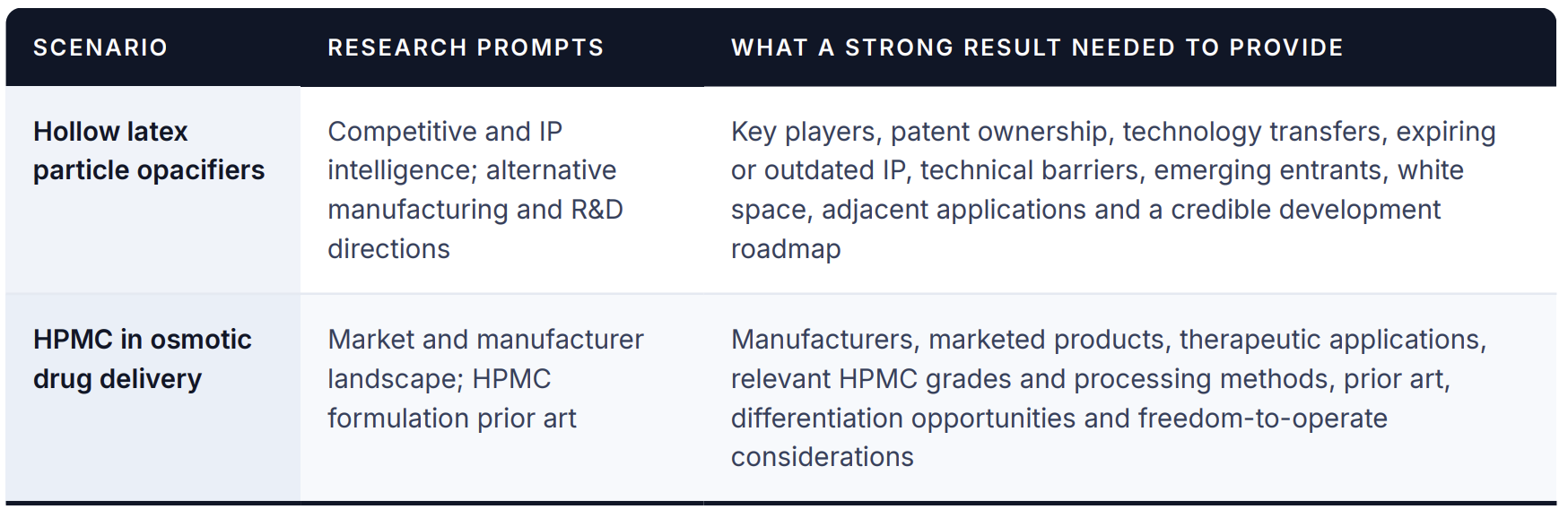
The hollow particle prompts asked the systems to map the competitive and IP landscape, identify emerging participants in Mexico and Asia, detect licensing or corporate activity and locate white space. They were then asked to recommend alternative materials, particle architectures and manufacturing mechanisms that could support a defensible product strategy.
The osmotic delivery prompts asked the systems to identify manufacturers and marketed products, followed by an analysis of HPMC grades, viscosity specifications, processing methods, prior art and potential formulation strategies.
Where the tools diverged
All three tools were capable of producing a credible general summary. The meaningful differences appeared as the work moved from describing the landscape to deciding what to do next.
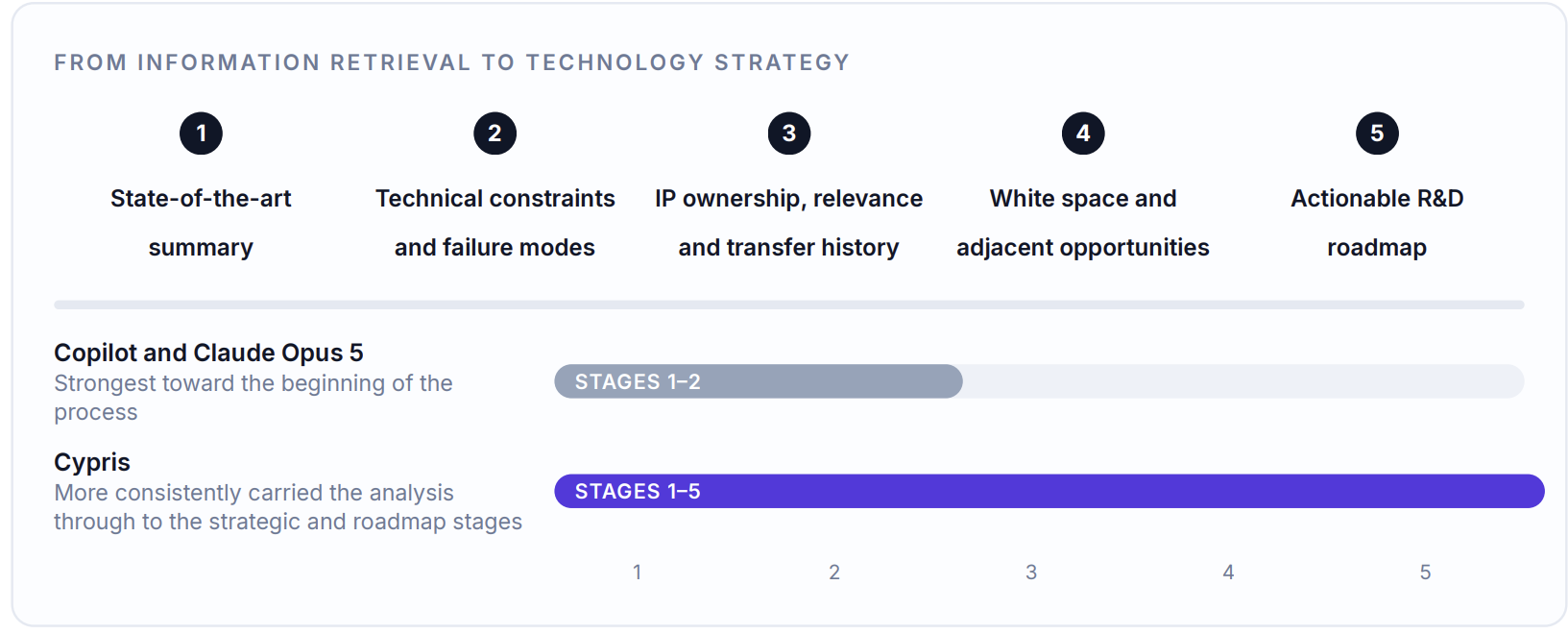
Devon found that Cypris produced the strongest overall result, with the clearest advantage in the more technically and strategically complex hollow particle scenario. Claude and Copilot generally summarized what had been published. Cypris more frequently identified the specific technical issues, changes in IP ownership, commercial signals and research directions that could influence an actual development program.
Comparative findings at a glance
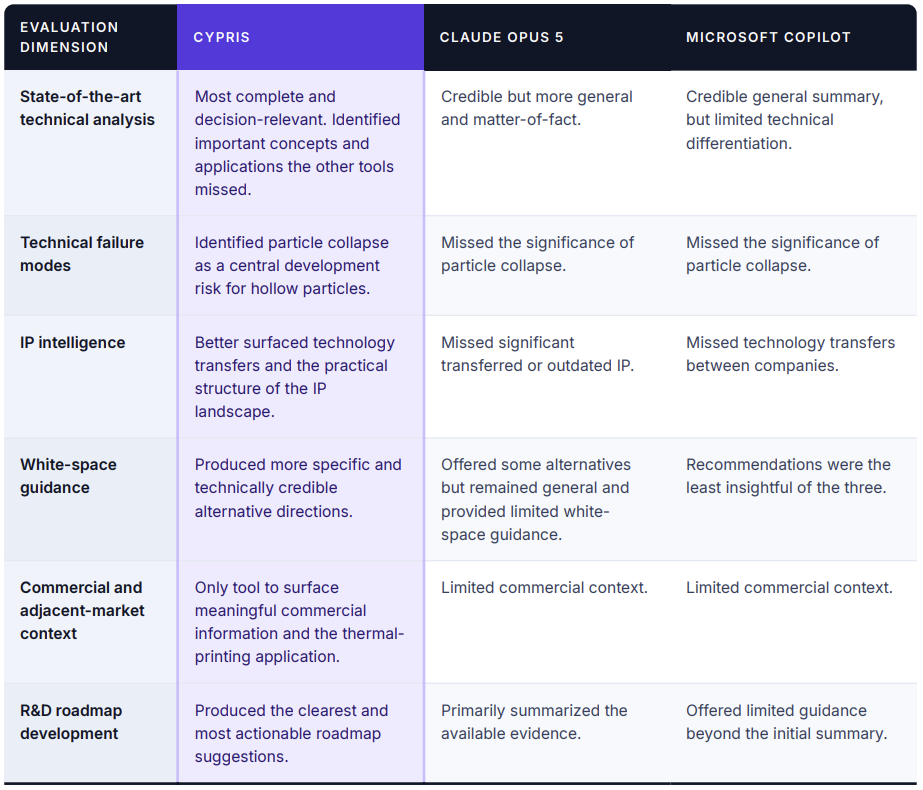
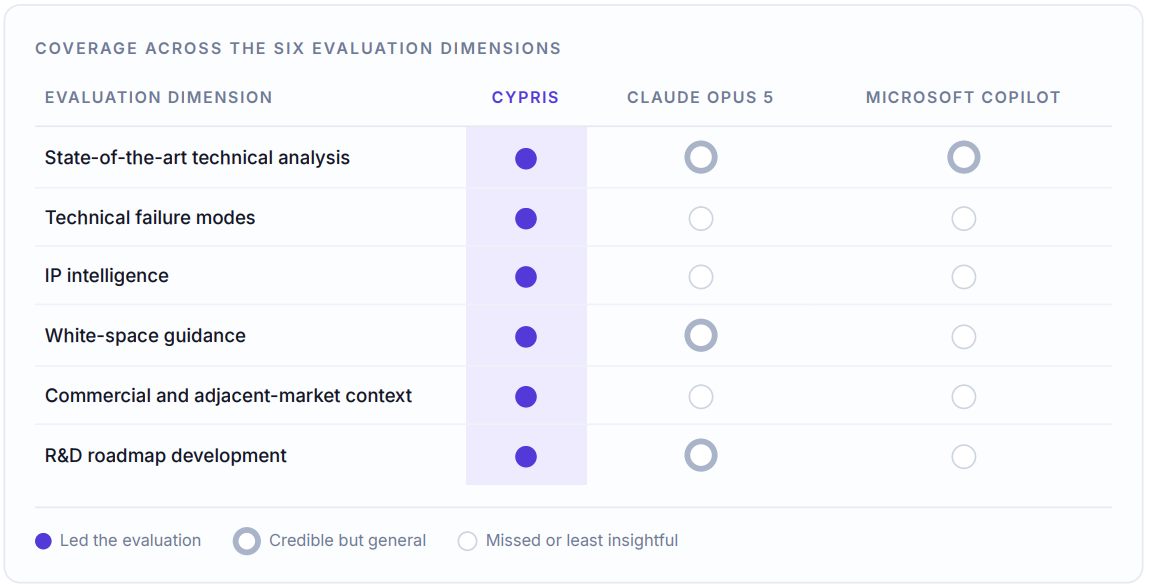
These distinctions were particularly visible in Devon's analysis of technical implementation, IP transfers, market context and research direction.
Scenario One: Hollow Latex Particle Opacifiers
All three tools passed the baseline test
Each system produced a reasonable summary of the general hollow particle landscape. Devon found no serious factual errors within the information each tool chose to present.
That baseline performance was important, but it did not determine the outcome. The systems differed substantially in the usefulness of their output for technical strategy development, with Cypris holding the clear advantage.
Cypris identified the technical issue most likely to derail a new entrant
One of the most consequential differences involved particle collapse.
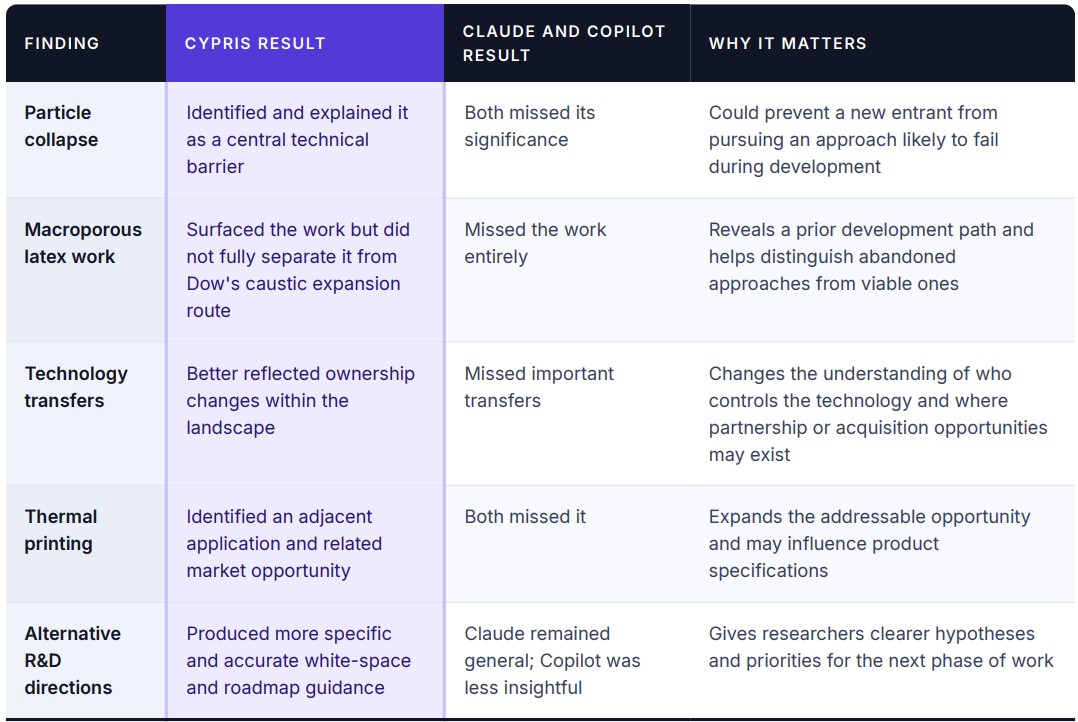
Cypris recognized that maintaining particle structure was a central technical challenge and produced a useful explanation of the issue. Claude and Copilot did not identify its importance.
For a researcher, this was not a minor omission. A new entrant that fails to understand or overcome particle collapse could invest considerable time and capital in a manufacturing approach that does not perform under practical conditions. By surfacing the issue, Cypris provided information that could directly alter experimental priorities and development sequencing.
Cypris was not flawless. It did not fully distinguish between Dow's hollow latex work using caustic expansion and a separate abandoned macroporous latex approach. However, Claude and Copilot missed the macroporous work entirely.
The distinction illustrates the difference between partial technical interpretation and simple omission. Cypris found the relevant body of work but needed greater precision in separating the approaches. The general AI tools failed to surface the alternative development path at all.
Cypris produced a stronger picture of the IP landscape
Patent landscapes are often presented as lists of companies, filings and portfolio sizes. For technology strategy, that is rarely sufficient.
Researchers need to understand whether patents remain active and relevant, whether they have been transferred, whether the underlying technology is commercially practiced and whether a seemingly large portfolio contains meaningful gaps.
Claude and Copilot missed technology transfers between companies. Devon also found that Claude failed to recognize that significant portions of the IP landscape had changed hands or become outdated. These omissions can distort the competitive picture by assigning technology to the wrong owner or treating historically important patents as if they still define the current opportunity.
Cypris provided a more useful view of how the IP was structured and where potential white space existed. This helped move the analysis beyond a patent count and toward questions such as:
- Who currently controls the relevant technology?
- Which patents still create meaningful barriers?
- Where has ownership changed?
- Which approaches appear abandoned or underdeveloped?
- Where could a new entrant build, partner or acquire?
Devon noted that all three tools could be improved by incorporating deeper patent-office and file-wrapper information, maintenance status, litigation history and citation patterns. Those signals help determine whether a portfolio is genuinely defensible or simply appears strong based on volume.
Cypris surfaced technical and commercial concepts the others missed
Cypris was the only tool to identify the use of hollow particles in thermal printing. It also suggested additional markets and alternative applications.
That finding demonstrated a broader advantage in state-of-the-art analysis. Cypris did not restrict the output to the most obvious use of hollow particles as opacifiers. It connected the underlying technology to another commercially relevant application that Claude and Copilot failed to identify.
The distinction matters because technical strategy requires answering two different questions:
- Can the organization develop the technology?
- Is the opportunity commercially worth pursuing?
Claude and Copilot largely addressed the first question through general technical summaries. Cypris brought in more of the information required to begin addressing the second.
Some commercial outputs still required scrutiny. Devon considered Cypris' estimated 10 percent compound annual growth rate for the broader hollow particle market questionable, although its approximately 5 percent estimate for the thermal-printing segment appeared reasonable. The advantage was not that every market figure was definitive. It was that Cypris recognized adjacent commercial applications and incorporated them into the strategic analysis at all.
Cypris produced more useful white-space and roadmap recommendations
Both Cypris and Claude suggested alternatives to conventional latex-based particle systems. Copilot's recommendations were less insightful.
The quality of the alternatives, however, was different. Claude's output was more general and matter-of-fact. It identified possible approaches but did not translate them into strong white-space guidance.
Cypris proposed more technically credible alternatives and connected them more directly to a differentiated development strategy. Its roadmap recommendations were clearer about which directions merited further investigation and how the research could be sequenced.
The alternatives included non-latex and ceramic-based particle systems. The evaluation did not establish that every proposed direction was commercially viable, but Devon knew that some ceramic particles had progressed at least as far as commercial trials. Cypris therefore surfaced technically relevant research leads rather than merely generating hypothetical possibilities.
Specific findings that changed the strategic value of the output
Scenario Two: HPMC in Osmotic Drug Delivery
The baseline outputs were more similar
The osmotic drug-delivery scenario produced less separation between the three systems.
All three generated credible summaries of osmotic pump technology and identified, to varying degrees, the grades and functions of HPMC in the existing landscape. Devon found relatively little to distinguish the tools on the initial market, manufacturer and prior-art questions.
The systems also converged on a similar roadmap recommendation: use a Design of Experiments process to optimize HPMC for the different roles it plays in the formulation.
While technically valid, Devon considered that recommendation underwhelming. It represented a standard development methodology rather than a differentiated technical insight.
Cypris generated the most promising next research direction
The difference appeared when Cypris suggested a possible connection between osmotic delivery and the challenge of formulating poorly soluble drugs.
Many active pharmaceutical ingredients have limited aqueous solubility, creating substantial formulation and absorption challenges. Cypris' analysis pointed toward a possible connection with hydroxypropyl methylcellulose acetate succinate, or HPMCAS, a material used in approaches for poorly soluble drugs.
HPMCAS is distinct from the HPMC traditionally used in osmotic systems, and Cypris did not present the connection as a validated solution. Instead, it surfaced a cross-domain clue that an experienced researcher could recognize and investigate further.
Devon viewed this as a meaningful example of how technical research often progresses. The first search does not always deliver the final answer. A strong research system should also reveal the next productive question.
Cypris did that more effectively. It connected information from an adjacent technical area to the osmotic formulation problem, creating the basis for a more differentiated next prompt and potential research direction.
The Core Finding: Technical Intelligence Begins Where the Summary Ends
The comparison showed that general-purpose AI tools can produce useful technical summaries. Both Claude Opus 5 and Microsoft Copilot identified relevant companies, scientific concepts and prior art across the two scenarios.
Cypris separated itself in the work that followed:
- Recognizing a technical failure mode that could derail a development program
- Identifying ownership changes and outdated IP that altered the competitive landscape
- Finding adjacent applications such as thermal printing
- Producing more specific white-space guidance
- Connecting evidence to a clearer R&D roadmap
- Generating cross-domain clues that informed the next research question
This distinction reflects the role of the intelligence layer surrounding the foundation model. A general-purpose model is optimized to explain the available information coherently. A technical intelligence system must also organize patents, scientific literature, companies, materials and market signals into a structure that supports decisions.
Final assessment
Across the four prompts, Cypris produced the strongest overall performance.
The advantage was clearest in the hollow particle scenario, where Cypris demonstrated superior technical analysis, stronger IP intelligence, more credible white-space identification and more actionable roadmap recommendations. Claude Opus 5 was capable of producing credible summaries and some alternative ideas, but remained more general and missed important IP changes and white-space implications. Microsoft Copilot met the baseline requirement for landscape summarization but provided the least differentiated strategic guidance.
The osmotic delivery scenario was more competitive, but Cypris still produced the most promising next research direction by connecting the problem to an adjacent material and formulation challenge.
The conclusion was not simply that Cypris found more information. It more consistently identified the information that mattered.
For an experienced technical leader, that is the difference between receiving a summary of the landscape and receiving the raw material required to build a technology strategy.
Former Dow Research Fellow Compares Cypris, Copilot & Claude for Chemical Intelligence
All Blogs


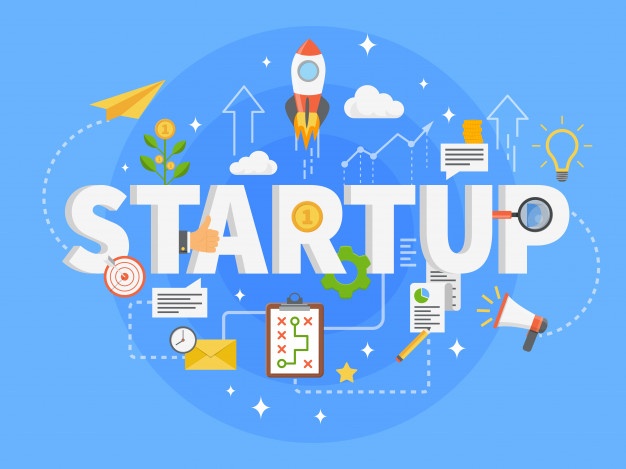
Currently, there are 741 startups operating in the NFT space, with a total funding pool of $2.96B USD.
The top 3 startups are Sorare, Yuga Labs, and and OpenSea. Sorare recently received Series B, and has a total funding pool of $6.8M USD, while Yuga Labs has $4.5M USD in funding. OpenSea received Series C, with $3M USD in funding.
For more data on startups operating within NFTs or another area of interest, visit ipcypris.com to get started. You can also explore recently filed patents for free via the global patent search engine.

GLOBAL PATENT LANDSCAPE

When looking at the global patent landscape, we found 763 applicants and 1,295 patents in the nuclear energy space, across 19 countries. China dominates the industry, with 518 applicants, followed by Russia, with 65.
Across the board, applicants saw an uptick in patent filings within the nuclear energy space in 2019, that has increased steadily since then.
The top 3 global patent players are: UNIV XI AN JIAOTONG (36 patents), UNIV HARBIN ENG (17 patents), and SHANGHAI NUCLEAR ENG RES & DESIGN INST CO LTD (17 patents).
The two most recent patents filed in nuclear energy were by TerraPower, for:
– Heat Exchanger Configuration for Nuclear Reactor; and
– Passive Heat Removal System for Nuclear Reactors
The third most recent patent was filed by Beam Alpha Inc. for a Sulfur Blanket.
U.S. PATENT LANDSCAPE
The U.S. patent market, specifically, has experienced a 18.39% average growth rate over the past 5 years. The highest annual increase came in 2018, when TerraPower filed 5 new patents within the space.
Notably, 5.99% of the market is owned by 3 key players: Schlumberger Limited, Siemens Aktiengesellschaft, and Baker Hughes.
Technologies referencing the key words “neutrons” and “fission” have experienced the steepest increase since 2017.
Looking to gain market intelligence on your area of focus? Visit ipcypris.com to get started. Explore recently filed patents for free via the global patent search engine.


Currently, there are 93 startups operating in the nuclear energy market, with a total funding value pool of $1.96M USD as of March 2022.
Newcleo, which launched in 2021 as a clean and safe nuclear energy company, most recently received Seed funding, and currently has a total funding pool of $1.18M.
For more data on startups operating within nuclear energy or another area of interest, visit ipcypris.com to get started. You can also explore recently filed patents for free via the global patent search engine.



Innovation activity in the Lisinopril market has been, as a whole, growing over the last 5 years, with a 25.87% average growth rate. The highest annual increase came in 2018 when MSD filed 6 new patents within the space.
The 369 technologies are being applied within 10 different categories, the fastest growing of which is Biochemistry with a 53.33% increase in new patents filed over the past 5 years. The category “Medical” is seeing a lot of filings by new entrants, so it might be an emerging space worth looking into.
For deeper insights on the pharmaceutical industry or another area of focus, visit ipcypris.com and get started using the innovation dashboard and custom reports.


There are 631+ commercial entities operating in the nuclear energy space based on IP ownership or if they’ve referenced the key terms in market news, about us pages, or SEC filings. Across the board, China takes the lead.
Over the past year, the most active commercial entities IP filing were SHANGHAI NUCLEAR ENG RES & DESIGN INST CO LTD, BEIJING INSTITUTE TECH, and CHINA NUCLEAR POWER ENG CO LTD.

Among patents filed by the most active entity, SHANGHAI NUCLEAR ENG RES & DESIGN INST CO LTD, were those focused on:
– Nuclear energy steam supply system
– Dual-purpose transportation container for uranium dioxide pellet powder
– Sewage discharging and heat supplying system of steam generator of nuclear power station
China accounts for 518 patent applicants (67.9% of patent applicant activity), followed by Russia and the World Intellectual Property Organization.
For actionable innovation intelligence in your industry, visit ipcypris.com. To browse recent patent filings for free, explore our our global patent search engine.



Why invest in R&D? Research and development is essential for organizations looking to stay competitive and innovate. Despite the potential rewards of investing in R&D, there are several challenges that must be considered before diving into a project.
Understanding these challenges as well as how to overcome them with strategies can help ensure success when investing in R&D.
Cypris offers an efficient platform designed specifically for teams engaged in R&D and innovation projects, helping reduce time-to-insight while ensuring successful investments into new ideas or processes.
Read on to learn more about the benefits, challenges, and strategies of why invest in R&D with Cypris!
Table of Contents
Challenges of Investing in R&D
Why Invest in R&D With Cypris?
What is R&D and why is it important?
Should I invest in research and development?
Why is R&D important for innovation?
What is R&D?
R&D is an important part of any company’s operations. It helps to create new products and services, as well as improve existing ones.
However, it can be difficult to measure the return on investment (ROI) for R&D expenses due to their long-term nature and uncertain outcomes.
One way that companies have tried to maximize the ROI from their R&D investments is by implementing a “20% rule” which allows employees to spend 20% of their time working on personal projects related to the company’s core business objectives.
Alphabet Inc. has been particularly successful with this approach. Many popular products such as Gmail and Wear OS were created through its 20% rule initiative.
Another strategy for maximizing ROI from R&D involves setting clear goals before beginning research activities.
Companies should determine what they want out of their research efforts in terms of tangible results or improvements in existing products or services before investing resources into them.
This will help ensure that funds are being spent wisely and efficiently towards achieving desired outcomes rather than wasted on unproductive pursuits.
It is also important for companies engaging in R&D activities to keep track of progress throughout the process so they can adjust course if necessary.
By monitoring progress closely, companies can make sure that resources are being used effectively and efficiently towards reaching desired goals while avoiding costly missteps or delays caused by unforeseen circumstances during development cycles.
Finally, it is essential for companies engaging in R&D activities to document all findings thoroughly so they can be shared with other departments within the organization. This ensures that valuable information isn’t lost over time but instead remains accessible whenever needed.
Types of R&D
R&D can be divided into two main categories: corporate and start-up.
Corporate R&D is typically done by large companies with dedicated departments staffed with engineers, industrial scientists, and other experts. This type of research often focuses on improving existing products or developing new ones.
Start-up R&D is more focused on creating innovative solutions to problems that don’t yet have a solution.
Start-ups are usually supported by venture capital firms through incubators or accelerators which help them bring their product to market and scale the business.
In addition to these two types of research, there are also public sector organizations such as universities and government agencies that conduct scientific research for the benefit of society at large. These organizations focus on research topics such as climate change, energy efficiency, and disease prevention instead of commercial products like corporations do.
Finally, there are also individual inventors who work independently in their own laboratories or workshops to develop inventions that could potentially revolutionize an industry or solve a problem no one else has been able to solve before.
Inventors often rely heavily on crowdfunding platforms like Kickstarter in order to finance their projects since they lack access to traditional sources of funding like venture capital firms or corporate sponsorships.
Regardless of what type of R&D you’re involved in – whether it’s corporate research for big companies or independent inventions – having access to reliable data sources is essential for making informed decisions about your project’s direction and progress over time.
That’s where Cypris comes in. We provide teams with a centralized platform so they can quickly gain insights from all their data sources without needing multiple tools or manual processes.
Why Invest in R&D?
Investing in research and development can bring many benefits to a business. Increased productivity, improved quality, and enhanced innovation are just some of the advantages that businesses can gain from investing in R&D.
Increased Productivity
Investing in R&D helps businesses become more efficient by allowing them to develop new processes or technologies that improve their operations. For example, using automation tools such as robotics or artificial intelligence can help reduce labor costs while increasing production speed and accuracy.
Additionally, investing in R&D may also lead to the discovery of new products or services which could further increase the profitability of a business.
Improved Quality
Investing in R&D gives you access to better resources, which allows you to produce higher-quality products and services. This includes utilizing advanced materials such as graphene or nanotechnology which offer superior performance compared to traditional materials used for manufacturing purposes.
Additionally, R&D teams may be able to identify potential defects early on during product development stages, thus preventing costly recalls due to faulty products.
Enhanced Innovation
Finally, investing in R&D encourages creativity within an organization, leading it toward innovative solutions. Companies that invest heavily in their own internal research initiatives often find themselves at the forefront of emerging trends within their respective industries.
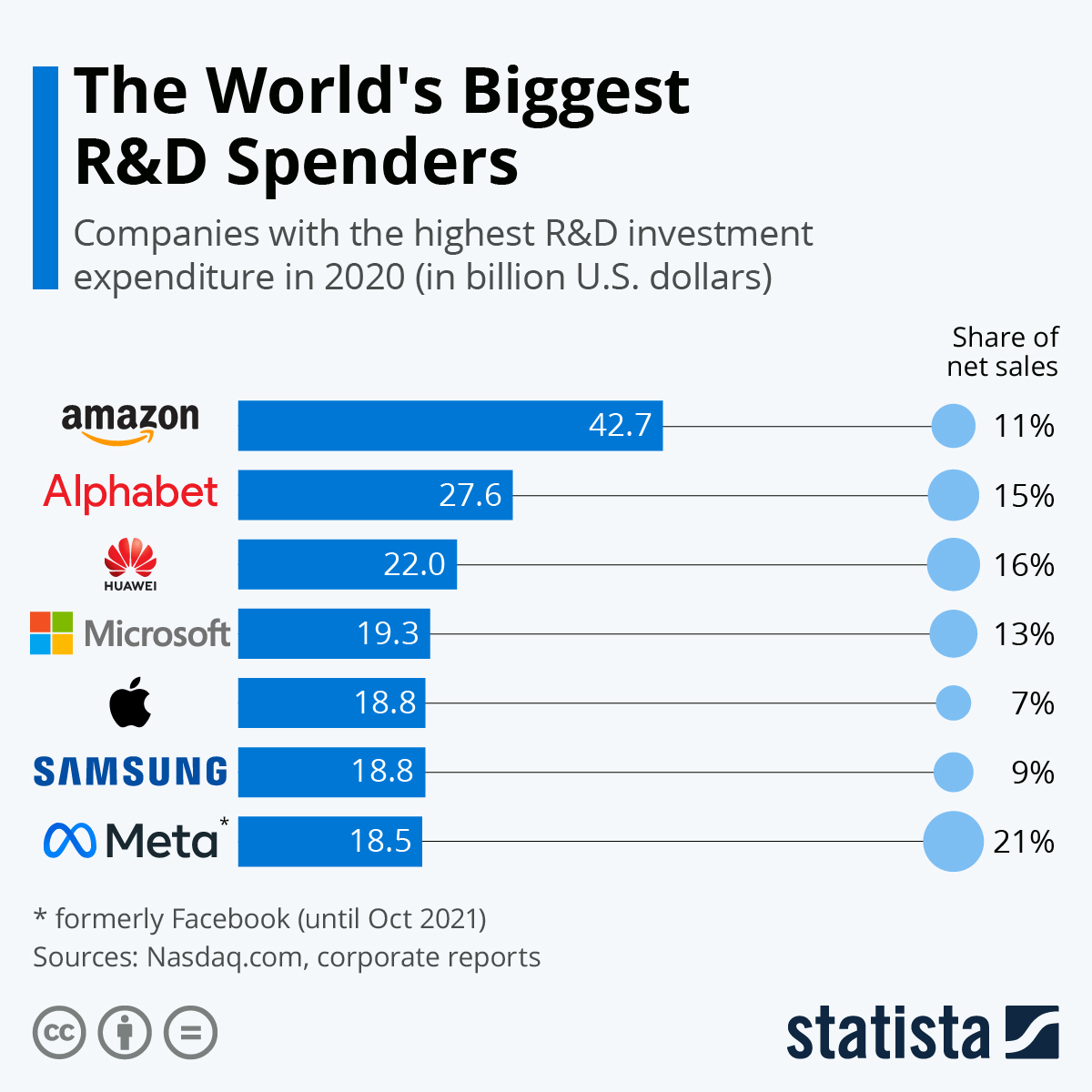
(Source)
Challenges of Investing in R&D
Investing in R&D comes with its own set of challenges. High costs and risk are two of the most significant issues that companies face when investing in research and development.
Developing new products or services requires substantial financial resources, which can often lead to budget overruns if not managed properly.
Additionally, there is always an element of risk involved when launching a new product or service. Even after extensive testing and market analysis, there is no guarantee that the product will be successful.
Another challenge associated with investing in R&D is the long time-to-market. Even after extensive research and development efforts have been completed, it still takes time for the product or service to reach consumers. This process includes manufacturing, marketing campaigns, and distribution channels — all of which require additional resources and effort from the company.
Finally, measuring ROI on investments made in R&D projects can also be difficult due to various factors such as a lack of data points available for comparison purposes or difficulty predicting future trends accurately.
Companies need to develop effective strategies for tracking progress against goals set during project planning stages so they can measure their return on investment more effectively over time.
Why Invest in R&D With Cypris?
R&D teams must have the right tools and technologies to ensure success. Cypris is a research platform that provides centralized data sources for rapid time to insights, automated workflows for streamlined processes, and collaborative platforms for easier communication and decision-making.
Centralized Data Sources
With Cypris’s centralized data sources, R&D teams can quickly access all of their information from one place without having to search through multiple systems or documents. This helps them save time by reducing the need to manually enter data into different systems or compile reports from various sources.
Additionally, they can easily analyze trends across projects with real-time visualizations so they can make better decisions faster.
Automated Workflows
Automating tedious tasks such as reporting saves valuable time that could be spent on more productive activities like brainstorming new ideas or analyzing results. Cypris offers automated workflows that enable users to set up custom rules based on specific criteria so they don’t have to worry about manual entry errors or missed deadlines. These automated workflows help streamline processes so teams are able to focus on higher-value tasks instead of mundane ones.
Collaborative Platforms
Collaboration is key when it comes to successful innovation initiatives. However, traditional methods of communication often lead to delays in decision-making due lack of difficulty coordinating between multiple stakeholders spread out across different locations and departments. With its collaborative platform feature, Cypris enables team members to stay connected while tracking progress in real time, which leads to increased productivity and improved quality outcomes.
By leveraging these features offered by Cypris, businesses will be able to maximize their return on investment (ROI) while minimizing costs associated with investing in R&D.
Conclusion
Why invest in R&D?
The benefits of investing in R&D outweigh its challenges when done correctly. Setting clear goals and objectives, utilizing appropriate tools and technologies, developing an effective team structure and processes, tracking progress, measuring ROI accurately, and creating a culture of continuous improvement all play key roles in ensuring successful outcomes from any given project.
With the right strategies and tools like Cypris, companies can maximize their return on investment while minimizing risk. By leveraging data-driven insights to inform decisions and streamline processes, organizations can ensure that their investments in R&D will pay off in the long run.
Investing in research and development is essential for staying competitive, innovating faster, and driving greater ROI. Cypris provides an easy-to-use platform that centralizes data sources teams need into one place so they can get insights quickly.
With Cypris‘ help, you’ll be able to drive innovation faster than ever before! Try out our R&D solutions today – let us show you how your business can benefit from the power of research and development!
Categories Quick Innovation Insights
How Big Data Can Revolutionize Pharmaceutical R&D
What Are Qualifying Research Activities for R&D Tax Credit?
As an R&D platform and custom report service, search functionality for our users is key.
That's why we're thrilled to announce our platform's user experience and research capabilities just got better. Meet Quick Search, a new search bar that delivers information to our users faster than ever.
What's New with this Launch?
The previous search functionality allowed for search only by keywords. With Quick Search, users can now search by patent and research paper titles in addition to keywords.
What's the User Experience Like?
As you type in your search (keyword, patent, or research paper) you'll see a live tally of the data by category available for that search.
From there, you can click into individual data sections or build a report pulling from all available data streams.
0:00/1×
Have questions or comments? Feel free to reach out to us at info@ipcypris.com for more information.
Is Google Scholar good for research? This question is often raised by researchers and professionals in various fields. In this blog post, we will examine the benefits and drawbacks of Google Scholar to determine its appropriateness for your research requirements.
We will discuss the extensive coverage provided by Google Scholar, its ranking system for relevance in comparison with other databases such as Scopus and Web of Science, and the citation tracking functionality offered by Google Scholar.
To conclude our analysis on “Is Google Scholar good for research?”, we’ll highlight the importance of complementing it with specialized databases like PubMed or IEEE Xplore for specific disciplines or combining it with Scopus or Web of Science for advanced search capabilities.
Table of Contents
- Is Google Scholar Good for Research?
- Extensive Coverage of Google Scholar
- Conference Papers Indexed in Google Scholar
- Books Available Through the Search Engine
- Preprints and Journal Articles Accessible via the Platform
- Ranking System for Relevance
- Factors Considered in Ranking Search Results
- Comparison with Scopus and Web of Science
- Citation Tracking Functionality
- Benefits of Tracking Citations Using Google Scholar
- Impact Factor Analysis Through Citation Data
- Limitations & Challenges
- Quality Control Concerns with Unfiltered Resources
- Incomplete Metadata Affecting Resource Selection Process
- Limited Advanced Search Options Hindering Comprehensive Reviews
- Inconsistency in Indexing Affecting Representation of Available Literature
- Lack of Transparency on Google Scholar’s Methodology
- Complementing Google Scholar with Specialized Databases
- Importance of Using PubMed or IEEE Xplore for Specific Disciplines
- Combining Scopus or Web of Science for Advanced Search Capabilities
- Conclusion
Is Google Scholar Good for Research?
Yes, Google Scholar is a valuable resource for research as it offers extensive coverage of scholarly literature, including conference papers, books, preprints, and journal articles. Its ranking system helps in identifying relevant resources while the citation tracking functionality aids in analyzing impact factors.
Extensive Coverage of Google Scholar
Google Scholar offers a vast range of scholarly literature, indexing over 160 million documents from various sources such as conference papers, books, preprints, and journal articles. Google Scholar provides a convenient way to access an extensive range of scholarly material, eliminating the need for users to search through multiple websites or databases.
Conference Papers Indexed in Google Scholar
The platform includes an extensive collection of conference papers from numerous disciplines. By accessing these resources through Google Scholar, researchers can stay up-to-date with the latest findings presented at conferences around the world.
Books Available Through the Search Engine
In addition to academic articles and conference proceedings, Google Scholar also indexes books published by reputable publishers. Researchers can use this feature to locate essential reference materials for their projects and gain insights into previous studies conducted within their field.
Preprints and Journal Articles Accessible via the Platform
- Preprints: These are preliminary versions of research papers that have not yet been peer-reviewed but are made available online for feedback from other experts in the field. By including preprint repositories like arXiv.org or bioRxiv.org in its search results, Google Scholar helps researchers discover cutting-edge work before it is formally published.
- Journal Articles: As one would expect, a significant portion of indexed content on Google Scholar consists of peer-reviewed journal articles across various fields. The platform’s comprehensive coverage ensures that users can access high-quality research material efficiently while conducting searches using keywords related to their area of interest.
For those asking “is google scholar good for research”, Google Scholar is an excellent tool for researchers looking to find relevant and reliable sources quickly. Its extensive coverage of various types of scholarly literature, including conference papers, books, preprints, and journal articles, makes it a valuable resource for anyone conducting research.
Maximize your research efficiency with Google Scholar. Access millions of scholarly articles, conference papers, books, and preprints in one platform. #research #innovation Click to Tweet
Ranking System for Relevance
Google Scholar employs a sophisticated algorithm to rank search results based on their relevance, taking into account factors such as the author’s citation count and publication history. This ranking system has been found to provide better precision than other multidisciplinary databases like Scopus or Web of Science, particularly when searching for specific topics within respective fields.
A study by Martin-Martin et al. demonstrated that Google Scholar outperforms these alternatives in terms of precision and coverage.
Factors Considered in Ranking Search Results
- Citation count: The number of times an article has been cited by others is used as an indicator of its importance and impact within the field.
- Publication history: Articles published in well-established journals with high impact factors are more likely to be ranked higher, reflecting their perceived quality and credibility.
- Affiliation: The reputation of the authors’ institutions can also influence rankings, with prestigious universities often being associated with higher-quality research output.
Comparison with Scopus and Web of Science
In comparison to Google Scholar, both Scopus and Web of Science offer advanced search capabilities allowing users greater control over filtering options; however, they may not always deliver superior results due to limitations in their indexing scope or potential biases towards certain disciplines or sources.

Google Scholar’s ranking system for relevance provides an effective way to identify the most relevant and impactful research, allowing R&D teams to quickly gain insights into their topics of interest making it the option to choose when asking “is google scholar good for research”. Moving on, citation tracking functionality through Google Scholar can provide further insight into the impact factor of a particular piece of research.
Maximize your research efficiency with Google Scholar’s superior ranking system, providing better precision and coverage for specific topics compared to Scopus or Web of Science. #researchtools #googlescholar Click to Tweet
Citation Tracking Functionality
When asking “is google scholar good for research”, one key feature that makes it suitable for research purposes is its citation-tracking functionality. Researchers can easily track citations received by their work or others, helping them stay informed about recent developments in their field while also providing valuable insight into the impact factor of publications they are interested in citing themselves.
Benefits of Tracking Citations Using Google Scholar
- Ease of use: With a simple interface, researchers can quickly access information on how many times an article has been cited and view the list of citing articles.
- Breadth of coverage: Google Scholar’s extensive database ensures that users have access to a wide range of citation data from various sources such as conference papers, books, preprints, and journal articles.
- Analyzing trends: By monitoring citation patterns over time, researchers can identify emerging trends within their field and assess the significance or relevance of specific topics.
Impact Factor Analysis Through Citation Data
The number of citations an article receives is often used as an indicator of its impact within a particular discipline. While this metric has limitations – such as potential biases towards older publications with more time to accumulate citations – it still provides useful insights when comparing different resources during literature reviews or grant applications.
By utilizing Google Scholar’s search results alongside other databases like Scopus or Web of Science, R&D managers, and engineers can make better-informed decisions regarding which publications hold greater weight within their respective fields. Citation tracking functionality is a powerful tool for R&D and innovation teams, allowing them to quickly access the literature they need while understanding its impact.
Maximize your research impact with Google Scholar’s citation tracking feature. Stay informed, analyze trends, and assess publication significance. #researchtools #citations #impactfactor Click to Tweet
Limitations & Challenges
Despite its benefits, there are limitations associated with using Google Scholar exclusively for conducting research. Some of the key challenges include a lack of quality control, incomplete metadata records, limited advanced search options compared to other databases, inconsistencies in coverage regarding specific disciplines or journals, and a lack of transparency on the methodology behind content indexing and result rankings.
Quality Control Concerns with Unfiltered Resources
Google Scholar’s unfiltered approach may lead to the inclusion of low-quality resources such as predatory journals or self-published articles that have not undergone rigorous peer-review processes. This makes it crucial for researchers to verify the credibility of sources before citing them in their work.
Incomplete Metadata Affecting Resource Selection Process
The incomplete metadata records retrieved through Google Scholar often lack essential bibliographic details, including abstracts, which can make it difficult for users to assess the relevance of a resource without having to visit each individual source website.
Limited Advanced Search Options Hindering Comprehensive Reviews
Limited advanced search options available in Google Scholar, when compared with specialized databases like Scopus or Web of Science, restrict researchers from carrying out comprehensive literature reviews by narrowing down results based on specific criteria such as publication date range or document type.
Inconsistency in Indexing Affecting Representation of Available Literature
Google Scholar’s coverage of specific disciplines, journals, or individual articles can be inconsistent, which may lead to gaps in the available literature and hinder researchers from obtaining a complete understanding of their research topic.

Lack of Transparency on Google Scholar’s Methodology
The obscurity of Google Scholar’s indexing and rating process renders it difficult for people to comprehend how search outcomes are produced, potentially producing imbalances in the depiction of scholarly material within its database.
Despite its limitations and challenges, Google Scholar remains a valuable tool for research teams. However, it is important to supplement the platform with specialized databases in order to maximize search capabilities.
Key Takeaway:
Using Google Scholar exclusively for research has limitations such as a lack of quality control, incomplete metadata records, limited advanced search options compared to other databases, inconsistencies in coverage regarding specific disciplines or journals, and a lack of transparency on the methodology behind content indexing and result rankings. Researchers should verify sources before citing them in their work due to concerns with unfiltered resources that may include low-quality materials like predatory journals or self-published articles without rigorous peer-review processes.
Complementing Google Scholar with Specialized Databases
Is google scholar good for research? Yes, but complementing it with specialized databases makes it even better. To ensure access to high-quality information relevant to their field and carry out comprehensive searches without missing important publications, researchers should use specialized databases alongside Google Scholar.
By using multiple sources together, R&D managers, engineers, scientists, and innovation teams can leverage the strengths offered by each database while mitigating potential drawbacks associated with any single source.
Importance of Using PubMed or IEEE Xplore for Specific Disciplines
In addition to Google Scholar’s extensive coverage, it is crucial for researchers in specific disciplines such as life sciences or engineering to utilize specialized databases like PubMed or IEEE Xplore, respectively. These platforms offer more targeted search results and provide access to unique resources not available on Google Scholar.
For instance, PubMed includes biomedical literature from MEDLINE while IEEE Xplore houses a vast collection of technical papers related to electrical engineering and computer science.
Combining Scopus or Web of Science for Advanced Search Capabilities
Scopus and Web of Science, two multidisciplinary research databases that are often compared with Google Scholar due to their wide-ranging content coverage, offer advanced search capabilities that may be lacking in the latter platform. Some benefits include better filtering options, more comprehensive citation analysis, and higher-quality metadata.
Incorporating specialized databases like PubMed or IEEE Xplore along with multidisciplinary platforms such as Scopus or Web of Science can significantly enhance the efficiency and effectiveness of research efforts when used in conjunction with Google Scholar. Researchers can leverage the strengths of each database to obtain a more comprehensive view of the research landscape and make informed decisions based on the search results.
Key Takeaway:
To conduct comprehensive research, R&D teams should complement Google Scholar with specialized databases like PubMed or IEEE Xplore for specific disciplines and Scopus or Web of Science for advanced search capabilities. By using multiple sources together, researchers can leverage the strengths offered by each database while mitigating potential drawbacks associated with any single source to obtain a more comprehensive view of the research landscape.
Conclusion
So overall, is Google Scholar good for research? Yes, Google Scholar offers a user-friendly interface with extensive coverage of scholarly literature, a ranking system for relevance, and citation-tracking functionality. There are limitations associated with using Google Scholar exclusively for conducting research, however, you can counter this by complementing it with specialized databases to ensure high-quality and comprehensive searches.
If you’re looking for more ways to improve your R&D process or need help navigating available resources like Google Scholar effectively, contact Cypris and unlock your team’s potential! Our platform provides rapid time-to-insights, centralizing data sources for improved R&D and innovation team performance.
.avif)