

Insights on Innovation, R&D, and IP
Perspectives on patents, scientific research, emerging technologies, and the strategies shaping modern R&D
Executive Summary
In 2024, US patent infringement jury verdicts totaled $4.19 billion across 72 cases. Twelve individual verdicts exceeded $100million. The largest single award—$857 million in General Access Solutions v.Cellco Partnership (Verizon)—exceeded the annual R&D budget of many mid-market technology companies. In the first half of 2025 alone, total damages reached an additional $1.91 billion.
The consequences of incomplete patent intelligence are not abstract. In what has become one of the most instructive IP disputes in recent history, Masimo’s pulse oximetry patents triggered a US import ban on certain Apple Watch models, forcing Apple to disable its blood oxygen feature across an entire product line, halt domestic sales of affected models, invest in a hardware redesign, and ultimately face a $634 million jury verdict in November 2025. Apple—a company with one of the most sophisticated intellectual property organizations on earth—spent years in litigation over technology it might have designed around during development.
For organizations with fewer resources than Apple, the risk calculus is starker. A mid-size materials company, a university spinout, or a defense contractor developing next-generation battery technology cannot absorb a nine-figure verdict or a multi-year injunction. For these organizations, the patent landscape analysis conducted during the development phase is the primary risk mitigation mechanism. The quality of that analysis is not a matter of convenience. It is a matter of survival.
And yet, a growing number of R&D and IP teams are conducting that analysis using general-purpose AI tools—ChatGPT, Claude, Microsoft Co-Pilot—that were never designed for patent intelligence and are structurally incapable of delivering it.
This report presents the findings of a controlled comparison study in which identical patent landscape queries were submitted to four AI-powered tools: Cypris (a purpose-built R&D intelligence platform),ChatGPT (OpenAI), Claude (Anthropic), and Microsoft Co-Pilot. Two technology domains were tested: solid-state lithium-sulfur battery electrolytes using garnet-type LLZO ceramic materials (freedom-to-operate analysis), and bio-based polyamide synthesis from castor oil derivatives (competitive intelligence).
The results reveal a significant and structurally persistent gap. In Test 1, Cypris identified over 40 active US patents and published applications with granular FTO risk assessments. Claude identified 12. ChatGPT identified 7, several with fabricated attribution. Co-Pilot identified 4. Among the patents surfaced exclusively by Cypris were filings rated as “Very High” FTO risk that directly claim the technology architecture described in the query. In Test 2, Cypris cited over 100 individual patent filings with full attribution to substantiate its competitive landscape rankings. No general-purpose model cited a single patent number.
The most active sectors for patent enforcement—semiconductors, AI, biopharma, and advanced materials—are the same sectors where R&D teams are most likely to adopt AI tools for intelligence workflows. The findings of this report have direct implications for any organization using general-purpose AI to inform patent strategy, competitive intelligence, or R&D investment decisions.

1. Methodology
A controlled comparative evaluation was conducted on March 27, 2026. An identical patent landscape query was submitted verbatim to each platform under standardized testing conditions. No follow-up prompts, clarifications, or iterative refinements were permitted, ensuring that each platform was evaluated based solely on its initial response.
The outputs were preserved in their original form and evaluated against predefined criteria using publicly verifiable patent records.
1.1 Query
Identify all active US patents and published applications filed in the last 5 years related to solid-state lithium-sulfur battery electrolytes using garnet-type ceramic materials. For each, provide the assignee, filing date, key claims, and current legal status. Highlight any patents that could pose freedom-to-operate risks for a company developing a Li₇La₃Zr₂O₁₂(LLZO)-based composite electrolyte with a polymer interlayer.
1.2 Tools Evaluated

1.3 Evaluation Criteria
Each response was evaluated using a consistent six-part scoring framework: patent coverage, assignee accuracy, filing metadata completeness, depth of claim analysis, quality of FTO risk stratification, and the presence of actionable strategic guidance.
Patent numbers, assignees, filing information, and legal status were independently checked against publicly available USPTO and WIPO records. The evaluation focused on the completeness, accuracy, and practical utility of each platform’s output rather than writing quality or presentation.
2. Findings
2.1 Coverage Gap
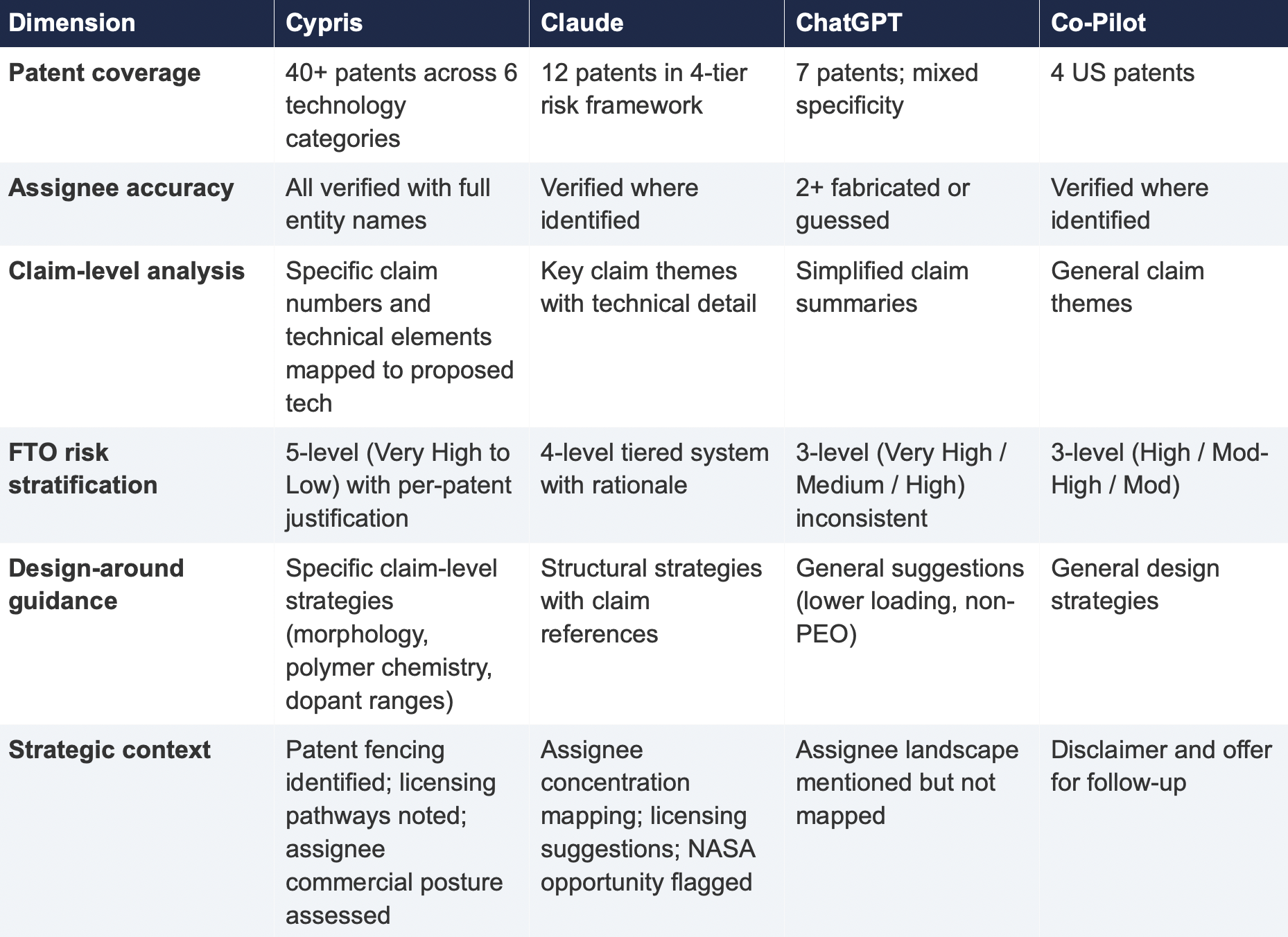
The most significant finding is the scale of the coverage differential. Cypris identified over 40 active US patents and published applications spanning LLZO-polymer composite electrolytes, garnet interface modification, polymer interlayer architectures, lithium-sulfur specific filings, and adjacent ceramic composite patents. The results were organized by technology category with per-patent FTO risk ratings.
Claude identified 12 patents organized in a four-tier risk framework. Its analysis was structurally sound and correctly flagged the two highest-risk filings (Solid Energies US 11,967,678 and the LLZO nanofiber multilayer US 11,923,501). It also identified the University ofMaryland/ Wachsman portfolio as a concentration risk and noted the NASA SABERS portfolio as a licensing opportunity. However, it missed the majority of the landscape, including the entire Corning portfolio, GM's interlayer patents, theKorea Institute of Energy Research three-layer architecture, and the HonHai/SolidEdge lithium-sulfur specific filing.
ChatGPT identified 7 patents, but the quality of attribution was inconsistent. It listed assignees as "Likely DOE /national lab ecosystem" and "Likely startup / defense contractor cluster" for two filings—language that indicates the model was inferring rather than retrieving assignee data. In a freedom-to-operate context, an unverified assignee attribution is functionally equivalent to no attribution, as it cannot support a licensing inquiry or risk assessment.
Co-Pilot identified 4 US patents. Its output was the most limited in scope, missing the Solid Energies portfolio entirely, theUMD/ Wachsman portfolio, Gelion/ Johnson Matthey, NASA SABERS, and all Li-S specific LLZO filings.
2.2 Critical Patents Missed by Public Models
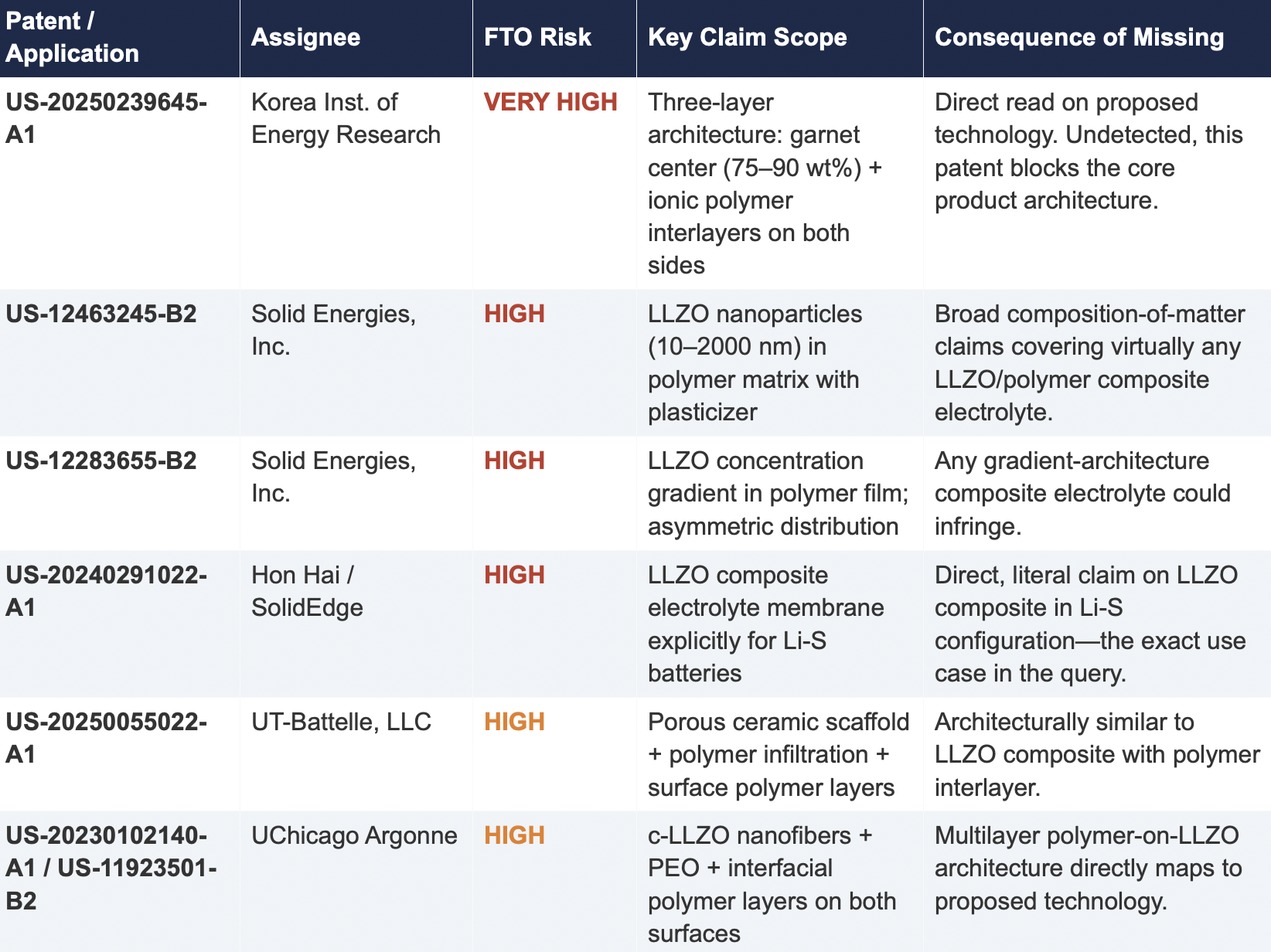
The following table presents patents identified exclusively by Cypris that were rated as High or Very High FTO risk for the proposed technology architecture. None were surfaced by any general-purpose model.
2.3 Patent Fencing: The Solid Energies Portfolio
Cypris identified a coordinated patent fencing strategy by Solid Energies, Inc. that no general-purpose model detected at scale. Solid Energies holds at least four granted US patents and one published application covering LLZO-polymer composite electrolytes across compositions(US-12463245-B2), gradient architectures (US-12283655-B2), electrode integration (US-12463249-B2), and manufacturing processes (US-20230035720-A1). Claude identified one Solid Energies patent (US 11,967,678) and correctly rated it as the highest-priority FTO concern but did not surface the broader portfolio. ChatGPT and Co-Pilot identified zero Solid Energies filings.
The practical significance is that a company relying on any individual patent hit would underestimate the scope of Solid Energies' IP position. The fencing strategy—covering the composition, the architecture, the electrode integration, and the manufacturing method—means that identifying a single design-around for one patent does not resolve the FTO exposure from the portfolio as a whole. This is the kind of strategic insight that requires seeing the full picture, which no general-purpose model delivered
2.4 Assignee Attribution Quality
ChatGPT's response included at least two instances of fabricated or unverifiable assignee attributions. For US 11,367,895 B1, the listed assignee was "Likely startup / defense contractor cluster." For US 2021/0202983 A1, the assignee was described as "Likely DOE / national lab ecosystem." In both cases, the model appears to have inferred the assignee from contextual patterns in its training data rather than retrieving the information from patent records.
In any operational IP workflow, assignee identity is foundational. It determines licensing strategy, litigation risk, and competitive positioning. A fabricated assignee is more dangerous than a missing one because it creates an illusion of completeness that discourages further investigation. An R&D team receiving this output might reasonably conclude that the landscape analysis is finished when it is not.
3. Structural Limitations of General-Purpose Models for Patent Intelligence
3.1 Training Data Is Not Patent Data
Large language models are trained on web-scraped text. Their knowledge of the patent record is derived from whatever fragments appeared in their training corpus: blog posts mentioning filings, news articles about litigation, snippets of Google Patents pages that were crawlable at the time of data collection. They do not have systematic, structured access to the USPTO database. They cannot query patent classification codes, parse claim language against a specific technology architecture, or verify whether a patent has been assigned, abandoned, or subjected to terminal disclaimer since their training data was collected.
This is not a limitation that improves with scale. A larger training corpus does not produce systematic patent coverage; it produces a larger but still arbitrary sampling of the patent record. The result is that general-purpose models will consistently surface well-known patents from heavily discussed assignees (QuantumScape, for example, appeared in most responses) while missing commercially significant filings from less publicly visible entities (Solid Energies, Korea Institute of EnergyResearch, Shenzhen Solid Advanced Materials).
3.2 The Web Is Closing to Model Scrapers
The data access problem is structural and worsening. As of mid-2025, Cloudflare reported that among the top 10,000 web domains, the majority now fully disallow AI crawlers such as GPTBot andClaudeBot via robots.txt. The trend has accelerated from partial restrictions to outright blocks, and the crawl-to-referral ratios reveal the underlying tension: OpenAI's crawlers access approximately1,700 pages for every referral they return to publishers; Anthropic's ratio exceeds 73,000 to 1.
Patent databases, scientific publishers, and IP analytics platforms are among the most restrictive content categories. A Duke University study in 2025 found that several categories of AI-related crawlers never request robots.txt files at all. The practical consequence is that the knowledge gap between what a general-purpose model "knows" about the patent landscape and what actually exists in the patent record is widening with each training cycle. A landscape query that a general-purpose model partially answered in 2023 may return less useful information in 2026.
3.3 General-Purpose Models Lack Ontological Frameworks for Patent Analysis
A freedom-to-operate analysis is not a summarization task. It requires understanding claim scope, prosecution history, continuation and divisional chains, assignee normalization (a single company may appear under multiple entity names across patent records), priority dates versus filing dates versus publication dates, and the relationship between dependent and independent claims. It requires mapping the specific technical features of a proposed product against independent claim language—not keyword matching.
General-purpose models do not have these frameworks. They pattern-match against training data and produce outputs that adopt the format and tone of patent analysis without the underlying data infrastructure. The format is correct. The confidence is high. The coverage is incomplete in ways that are not visible to the user.
4. Comparative Output Quality
The following table summarizes the qualitative characteristics of each tool's response across the dimensions most relevant to an operational IP workflow.
5. Implications for R&D and IP Organizations
5.1 The Confidence Problem
The central risk identified by this study is not that general-purpose models produce bad outputs—it is that they produce incomplete outputs with high confidence. Each model delivered its results in a professional format with structured analysis, risk ratings, and strategic recommendations. At no point did any model indicate the boundaries of its knowledge or flag that its results represented a fraction of the available patent record. A practitioner receiving one of these outputs would have no signal that the analysis was incomplete unless they independently validated it against a comprehensive datasource.
This creates an asymmetric risk profile: the better the format and tone of the output, the less likely the user is to question its completeness. In a corporate environment where AI outputs are increasingly treated as first-pass analysis, this dynamic incentivizes under-investigation at precisely the moment when thoroughness is most critical.
5.2 The Diversification Illusion
It might be assumed that running the same query through multiple general-purpose models provides validation through diversity of sources. This study suggests otherwise. While the four tools returned different subsets of patents, all operated under the same structural constraints: training data rather than live patent databases, web-scraped content rather than structured IP records, and general-purpose reasoning rather than patent-specific ontological frameworks. Running the same query through three constrained tools does not produce triangulation; it produces three partial views of the same incomplete picture.
5.3 The Appropriate Use Boundary
General-purpose language models are effective tools for a wide range of tasks: drafting communications, summarizing documents, generating code, and exploratory research. The finding of this study is not that these tools lack value but that their value boundary does not extend to decisions that carry existential commercial risk.
Patent landscape analysis, freedom-to-operate assessment, and competitive intelligence that informs R&D investment decisions fall outside that boundary. These are workflows where the completeness and verifiability of the underlying data are not merely desirable but are the primary determinant of whether the analysis has value. A patent landscape that captures 10% of the relevant filings, regardless of how well-formatted or confidently presented, is a liability rather than an asset.
6. Test 2: Competitive Intelligence — Bio-Based Polyamide Patent Landscape
To assess whether the findings from Test 1 were specific to a single technology domain or reflected a broader structural pattern, a second query was submitted to all four tools. This query shifted from freedom-to-operate analysis to competitive intelligence, asking each tool to identify the top 10organizations by patent filing volume in bio-based polyamide synthesis from castor oil derivatives over the past three years, with summaries of technical approach, co-assignee relationships, and portfolio trajectory.
6.1 Query

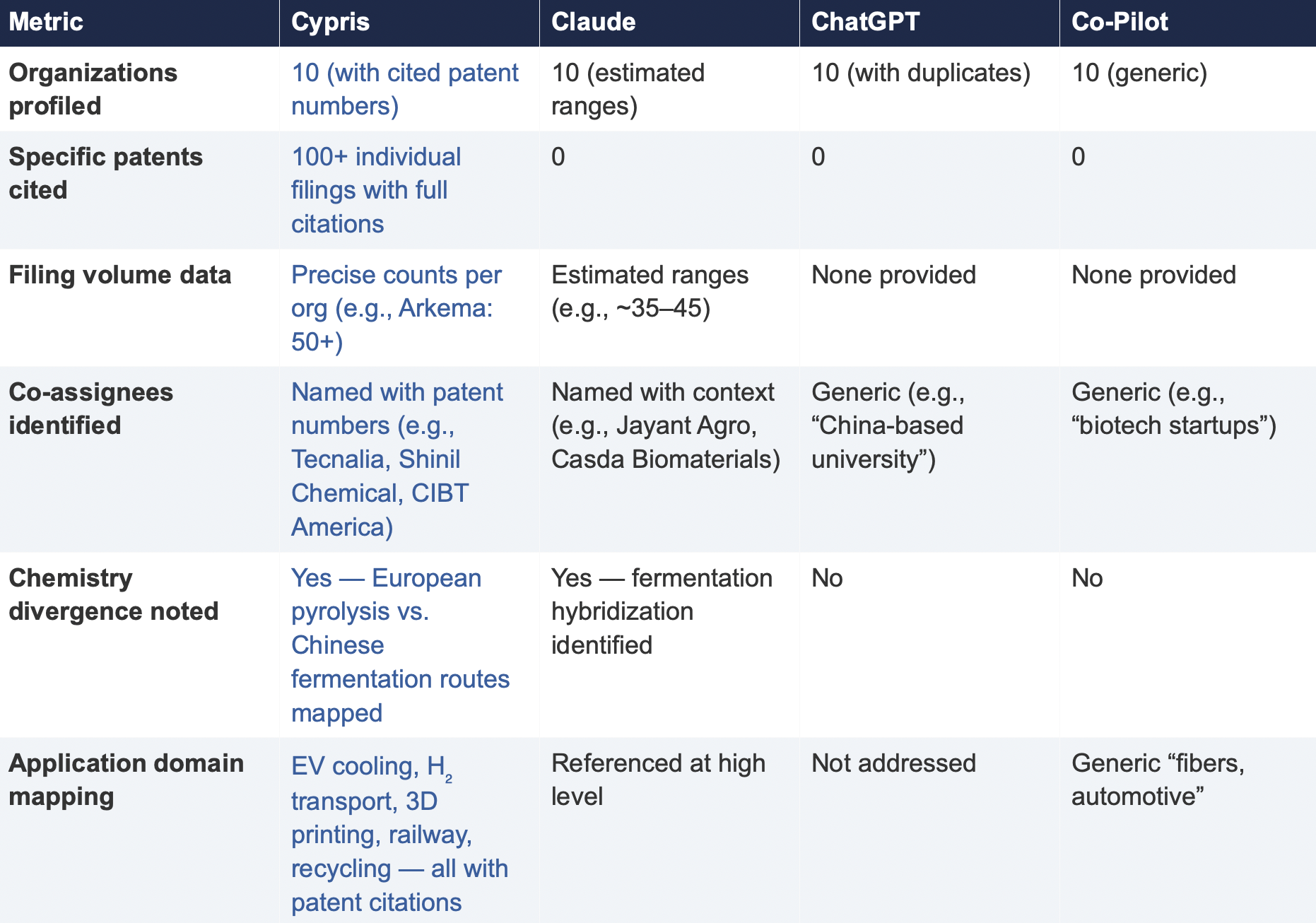
6.2 Summary of Results
6.3 Key Differentiators
Verifiability
The most consequential difference in Test 2 was the presence or absence of verifiable evidence. Cypris cited over 100 individual patent filings with full patent numbers, assignee names, and publication dates. Every claim about an organization’s technical focus, co-assignee relationships, and filing trajectory was anchored to specific documents that a practitioner could independently verify in USPTO, Espacenet, or WIPO PATENT SCOPE. No general-purpose model cited a single patent number. Claude produced the most structured and analytically useful output among the public models, with estimated filing ranges, product names, and strategic observations that were directionally plausible. However, without underlying patent citations, every claim in the response requires independent verification before it can inform a business decision. ChatGPT and Co-Pilot offered thinner profiles with no filing counts and no patent-level specificity.
Data Integrity
ChatGPT’s response contained a structural error that would mislead a practitioner: it listed CathayBiotech as organization #5 and then listed “Cathay Affiliate Cluster” as a separate organization at #9, effectively double-counting a single entity. It repeated this pattern with Toray at #4 and “Toray(Additional Programs)” at #10. In a competitive intelligence context where the ranking itself is the deliverable, this kind of error distorts the landscape and could lead to misallocation of competitive monitoring resources.
Organizations Missed
Cypris identified Kingfa Sci. & Tech. (8–10 filings with a differentiated furan diacid-based polyamide platform) and Zhejiang NHU (4–6 filings focused on continuous polymerization process technology)as emerging players that no general-purpose model surfaced. Both represent potential competitive threats or partnership opportunities that would be invisible to a team relying on public AI tools.Conversely, ChatGPT included organizations such as ANTA and Jiangsu Taiji that appear to be downstream users rather than significant patent filers in synthesis, suggesting the model was conflating commercial activity with IP activity.
Strategic Depth
Cypris’s cross-cutting observations identified a fundamental chemistry divergence in the landscape:European incumbents (Arkema, Evonik, EMS) rely on traditional castor oil pyrolysis to 11-aminoundecanoic acid or sebacic acid, while Chinese entrants (Cathay Biotech, Kingfa) are developing alternative bio-based routes through fermentation and furandicarboxylic acid chemistry.This represents a potential long-term disruption to the castor oil supply chain dependency thatWestern players have built their IP strategies around. Claude identified a similar theme at a higher level of abstraction. Neither ChatGPT nor Co-Pilot noted the divergence.
6.4 Test 2 Conclusion
Test 2 confirms that the coverage and verifiability gaps observed in Test 1 are not domain-specific.In a competitive intelligence context—where the deliverable is a ranked landscape of organizationalIP activity—the same structural limitations apply. General-purpose models can produce plausible-looking top-10 lists with reasonable organizational names, but they cannot anchor those lists to verifiable patent data, they cannot provide precise filing volumes, and they cannot identify emerging players whose patent activity is visible in structured databases but absent from the web-scraped content that general-purpose models rely on.
7. Conclusion
This comparative analysis, spanning two distinct technology domains and two distinct analytical workflows—freedom-to-operate assessment and competitive intelligence—demonstrates that the gap between purpose-built R&D intelligence platforms and general-purpose language models is not marginal, not domain-specific, and not transient. It is structural and consequential.
In Test 1 (LLZO garnet electrolytes for Li-S batteries), the purpose-built platform identified more than three times as many patents as the best-performing general-purpose model and ten times as many as the lowest-performing one. Among the patents identified exclusively by the purpose-built platform were filings rated as Very High FTO risk that directly claim the proposed technology architecture. InTest 2 (bio-based polyamide competitive landscape), the purpose-built platform cited over 100individual patent filings to substantiate its organizational rankings; no general-purpose model cited as ingle patent number.
The structural drivers of this gap—reliance on training data rather than live patent feeds, the accelerating closure of web content to AI scrapers, and the absence of patent-specific analytical frameworks—are not transient. They are inherent to the architecture of general-purpose models and will persist regardless of increases in model capability or training data volume.
For R&D and IP leaders, the practical implication is clear: general-purpose AI tools should be used for general-purpose tasks. Patent intelligence, competitive landscaping, and freedom-to-operate analysis require purpose-built systems with direct access to structured patent data, domain-specific analytical frameworks, and the ability to surface what a general-purpose model cannot—not because it chooses not to, but because it structurally cannot access the data.
The question for every organization making R&D investment decisions today is whether the tools informing those decisions have access to the evidence base those decisions require. This study suggests that for the majority of general-purpose AI tools currently in use, the answer is no.
Study Disclosure
This comparative evaluation was commissioned and published by Cypris. The testing methodology, prompts, evaluation criteria, and underlying outputs have been documented to support independent review and replication.
All platform outputs were preserved in their original form. Patent data and material factual claims were cross-checked against USPTO Patent Center and WIPO PATENTSCOPE records as of March 27, 2026. Cypris was one of the platforms evaluated and therefore has a commercial interest in the findings.
The Patent Intelligence Gap - A Comparative Analysis of Verticalized AI-Patent Tools vs. General-Purpose Language Models for R&D Decision-Making
All Blogs
Neuromorphic computing is emerging as a distinct answer to the energy cost of artificial intelligence, and its patent landscape is unusually cross-disciplinary because a neuromorphic system is built from semiconductors, novel materials, and AI at the same time. Where conventional processors shuttle data between separate memory and compute units, an arrangement whose data movement dominates the energy budget, neuromorphic designs borrow from the brain: they compute where the data sits, in analog crossbar arrays that perform multiply-accumulate operations in place,¹,² communicate through sparse, event-driven spikes rather than continuous clocked operations, and store synaptic weights in analog or non-volatile devices.³ The intellectual property divides across several regions, each with different owners and maturity: the synaptic device materials, such as resistive, phase-change, and ferroelectric elements, that hold and update weights; the in-memory and analog compute circuits, often built as crossbar arrays, that perform computation in place; the spiking-processor architectures that route events across many cores; the event-based sensors, such as dynamic vision sensors, that feed them; and the on-chip learning rules and software stacks that make the hardware usable. Because a working system depends on all of these, freedom-to-operate and white space analysis must span the full stack.
The convergence of in-memory computing with spiking neural networks is now a well-reviewed field, spanning resistive, phase-change, ferroelectric, floating-gate, and optoelectronic synaptic devices,⁴,⁵ and it draws in several industries at once, which shapes where the IP concentrates. Large processor and memory companies, specialized neuromorphic startups, sensor makers, and academic groups are each building in different layers, so ownership is fragmented across the device, circuit, architecture, sensor, and algorithm regions rather than held by a single set of players. The patent record reflects this: across the Cypris corpus of more than 500 million patents and scientific papers, the neuromorphic, in-memory, and resistive-switching space holds on the order of 40,000 de-duplicated families and has grown steadily with a step-up in 2025, and the most active assignees are semiconductor and IT majors, including IBM, Hewlett Packard Enterprise, Samsung, and Intel, alongside strong academic filers, with China and the United States the leading jurisdictions; because assignee names are not fully canonicalized, corporate totals are best read as indicative. The commercial pull is strongest at the edge, where power and latency budgets are tight and brain-inspired efficiency has the clearest advantage. Because applications publish about eighteen months after filing, the most recent device and architecture filings are under-represented, so the current frontier is more active than granted-patent counts suggest.
The strategic question is which layer to back, and the white space sits where the physics is hardest. Analog in-memory computation promises the largest efficiency gains but must overcome device variability and precision limits, so materials and circuit techniques that make it reliable carry high, defensible value. Novel synaptic device materials, including optoelectronic elements that couple light and memory,⁷ and on-chip learning rules such as spike-timing-dependent plasticity demonstrated directly in memristor synapses,⁶ are active and comparatively open, while the software and compilation layers that connect neuromorphic hardware to mainstream AI frameworks remain underdeveloped and strategically important. Reading the landscape by layer, and tracking both the patents and the underlying device and algorithm research, is what separates a crowded region from an open one.
Where the neuromorphic white space is
Analog in-memory compute. Reliable analog computation in memory arrays promises the largest efficiency gains but must solve device variability and precision, a high-value, still-open target.¹
Novel synaptic devices. Resistive, phase-change, ferroelectric, and optoelectronic elements that store and update weights are an active materials layer with room for defensible positions.⁷
On-chip learning. Learning rules such as spike-timing-dependent plasticity that let a device adapt without a separate training system are a differentiated and comparatively open capability.⁶
Event-based sensing. Dynamic vision and other event-driven sensors that pair naturally with spiking processors are an active, less-crowded hardware layer.
Software and compilation stacks. Toolchains that map mainstream AI models onto neuromorphic hardware are underdeveloped and strategically important.
How AI-powered landscape and white space analysis helps
Resolving a landscape that spans device materials, compute circuits, processor architectures, sensors, and software requires more than keyword search. AI-powered analysis addresses this with semantic search that clusters activity by layer across varied terminology, attribution that normalizes semiconductor, startup, and academic filers to canonical entities, and continuous monitoring that keeps pace with a cross-disciplinary field. Because neuromorphic advances appear in scientific literature before they are patented, and because the field draws on materials, circuits, and AI at once, reading both patents and literature gives the earliest and fullest signal of where the frontier is moving.
Where Cypris fits
Cypris runs patent landscape and white space analysis for cross-disciplinary deep-tech fields such as neuromorphic computing across a corpus of more than 500 million patents and scientific papers, organized through a proprietary R&D ontology. The ontology clusters activity by layer, synaptic device, in-memory circuit, spiking architecture, event-based sensor, and learning and software, and normalizes semiconductor, startup, and academic filers to canonical entities, so a team can resolve which layers are crowded and which remain open as white space. Semantic search across patents and scientific literature connects filings to the underlying device and machine-learning research, which is where neuromorphic advances appear first, spanning the semiconductor, materials, and AI disciplines the field draws on. Cypris Q, the platform's agentic layer, lets teams run landscape and white space analysis conversationally and chain the clustering, attribution, and gap analysis, and Agentic Monitoring tracks a defined layer over time and flags new patents and papers as they publish. Cypris provides enterprise API partnerships with OpenAI, Anthropic, and Google, and is built with enterprise-grade security. Cypris serves hundreds of enterprise customers across pharmaceuticals, chemicals, advanced materials, energy, and other regulated industries.
FAQ
What is neuromorphic computing? Neuromorphic computing is a brain-inspired approach that processes information where it is stored, communicates through sparse event-driven spikes, and holds weights in analog or non-volatile devices, aiming to cut the energy cost of AI. It contrasts with conventional processors that separate memory and compute. Its advantage is clearest for low-power, low-latency workloads at the edge.
What layers does the neuromorphic patent landscape cover? The neuromorphic landscape covers synaptic device materials, in-memory and analog compute circuits, spiking-processor architectures, event-based sensors, and on-chip learning and software stacks. It is cross-disciplinary, drawing on semiconductors, materials, and AI. Freedom-to-operate and white space analysis must span all of these layers.
Who is active in neuromorphic computing patents? Activity spans large processor and memory companies, specialized neuromorphic startups, sensor makers, and academic groups, each building in different layers, so ownership is fragmented across the device, circuit, architecture, sensor, and algorithm regions. No single set of players holds the whole stack. That fragmentation makes structured landscape analysis valuable.
Where is the white space in neuromorphic computing? The white space includes reliable analog in-memory compute, novel synaptic device materials, on-chip learning, event-based sensing, and software and compilation stacks. Analog in-memory computation offers the largest efficiency gains but is the hardest to make reliable. The software layer that connects neuromorphic hardware to mainstream AI is underdeveloped and strategically important.
Why is in-memory compute a key IP area? In-memory compute is a key IP area because performing computation where data is stored avoids the energy cost of moving data, which is the main efficiency advantage of neuromorphic systems. Making analog in-memory computation reliable requires solving device variability and precision. The materials and circuit techniques that achieve this are foundational and defensible.
Why does neuromorphic analysis need scientific literature? Neuromorphic analysis needs scientific literature because device, circuit, and algorithm advances appear in research before they are patented, and the field's cross-disciplinary nature means relevant work spans several areas, so the literature gives the earliest and fullest signal. Analyzing patents alone gives a lagging, partial view. Cypris analyzes both across more than 500 million patents and scientific papers.
What software helps analyze the neuromorphic computing patent landscape? Software for the neuromorphic landscape should cluster activity by device, circuit, architecture, sensor, and software layer, resolve semiconductor, startup, and academic filers to canonical owners, search patents and scientific literature semantically, and monitor a cross-disciplinary field continuously. Cypris does this across more than 500 million patents and scientific papers using a proprietary R&D ontology, semantic search, Cypris Q, and Agentic Monitoring.
Which teams use neuromorphic patent landscape analysis? Neuromorphic patent landscape analysis is used by R&D, IP, and strategy teams at semiconductor, AI-hardware, and sensor companies, edge-AI developers, and their suppliers, as well as investors and research institutions. It informs which layer to back, where to file, and where competitors are concentrated. Cypris serves hundreds of enterprise customers across research-intensive and regulated industries.
Endnotes
- Musisi-Nkambwe, M., Afshari, S., Sanchez Esqueda, I., Kozicki, M. N., & Barnaby, H. (2021). The viability of analog-based accelerators for neuromorphic computing: a survey. Neuromorphic Computing and Engineering, 1(1). https://doi.org/10.1088/2634-4386/ac0242
- Hu, M., Rose, G. S., Chen, Y., Li, H., et al. (2014). Memristor crossbar-based neuromorphic computing system: a case study. IEEE Transactions on Neural Networks and Learning Systems, 25(10). https://doi.org/10.1109/tnnls.2013.2296777
- Xiao, Z., Hu, Q., Chu, P. K., Zhang, X., & Huang, A. (2018). Neuromorphic computing with memristor crossbar. Physica Status Solidi (a), 215(20). https://doi.org/10.1002/pssa.201700875
- Review of memristors for in-memory computing and spiking neural networks. (2025). Advanced Intelligent Systems. https://doi.org/10.1002/aisy.202500806
- Basu, A., & Hasler, J. (2024). Historical perspective and opportunity for computing in memory using floating-gate and resistive non-volatile computing including neuromorphic computing. Neuromorphic Computing and Engineering, 4(4). https://doi.org/10.1088/2634-4386/ad9b4a
- Pahlavan, S., Linares-Barranco, B., Serrano-Gotarredona, T., & Shooshtari, M. (2025). Spike-timing-dependent plasticity and synaptic consolidation in HfO2 memristors for adaptive neuromorphic computing. Neuromorphic Computing and Engineering. https://doi.org/10.1088/2634-4386/ae1da1
- Pereira, M., Kiazadeh, A., Martins, R., Fortunato, E., & Barquinha, P. (2023). Recent progress in optoelectronic memristors for neuromorphic and in-memory computation. Neuromorphic Computing and Engineering, 3(2). https://doi.org/10.1088/2634-4386/acd4e2
Post-quantum cryptography has moved from a research program to a mandated migration, and its patent landscape is distinctive because the value has shifted from the algorithms themselves to how they are implemented and deployed. A sufficiently powerful quantum computer would break the public-key cryptography, based on integer factorization and elliptic curves, that secures most digital communication today, and to prepare for that, the US National Institute of Standards and Technology finalized its first post-quantum standards, FIPS 203 (ML-KEM, for key establishment), FIPS 204 (ML-DSA), and FIPS 205 (SLH-DSA, for signatures), in August 2024, selected HQC as a fifth, backup key-establishment algorithm in 2025, and continues to develop further signature standards.⁷ The intellectual property divides across several regions, each a distinct area of patenting: the algorithm implementations across the lattice, hash, and code-based families; the hardware accelerators that make these computationally heavier algorithms fast enough for real systems;¹,⁵ the side-channel countermeasures that protect implementations from physical attack;²,³ the crypto-agility and migration tooling that let organizations discover and swap cryptography; and the integration of post-quantum schemes into protocols such as transport-layer security and into hardware roots of trust. Because a deployed system depends on several of these layers, freedom-to-operate and white space analysis must span the algorithm families and the implementation layers together.
The landscape has an unusual structure because of how the standards were set. NIST's standardization process operates under a patent-claim assurance framework: for any essential patent claim, the holder must either disclaim it or make a license available on reasonable-and-non-discriminatory or royalty-free terms, and patent questions around the leading lattice scheme were resolved through such licensing arrangements before finalization, so the foundational algorithm layer is comparatively open, though it is not accurate to call it "patent-free."⁸ That has pushed proprietary activity outward, toward the implementations and the migration ecosystem, where patenting is active and growing. The migration itself is not optional: NIST's draft transition guidance would deprecate the vulnerable classical algorithms after 2030 and disallow them after 2035, and national-security policy sets a 2035 migration target, while the "harvest-now, decrypt-later" threat, in which encrypted data captured today could be decrypted by a future quantum computer, gives the transition urgency even before large quantum computers exist.⁸ This is reshaping the record: across the Cypris corpus of more than 500 million patents and scientific papers, the post-quantum-cryptography set holds on the order of 4,642 families and rose from about 141 in 2020 to roughly 606 in 2024 and about 1,425 in 2025 on a partial count, an inflection that coincides with the standards' finalization, with the most active assignees a mix of chipmakers, banks, and platform vendors, including Intel, Wells Fargo, Huazhong University of Science and Technology, Huawei, IBM, and Samsung, and China ahead of the United States on geography; 2025 and 2026 counts are partial because of the publication lag.
The strategic question is which implementation layer to own, and the white space sits where the standardized algorithms meet real systems. Hardware acceleration for the lattice arithmetic and sampling that these algorithms require is a high-value layer, especially for constrained and Internet-of-Things devices where compute and power are limited.¹,⁵ Side-channel-resistant implementations are a distinct and heavily engineered layer, because a mathematically secure algorithm can still leak its keys through physical measurement, and even masked hardware implementations remain a target of attack research, so higher-order protection is an active frontier.²,³,⁴,⁶ Crypto-agility, the ability to inventory and swap cryptographic primitives across large systems, and migration tooling are a fast-growing ecosystem layer, as are hybrid schemes that run classical and post-quantum cryptography together during the transition, an option NIST accommodates rather than requires.⁸ Reading the landscape by algorithm family and implementation layer, and tracking both the patents and the underlying cryptography research, is what separates a crowded region from an open one.
Where the PQC white space is
Hardware acceleration. Accelerators for lattice arithmetic and sampling, especially for constrained and Internet-of-Things devices, are a high-value layer as the algorithms are computationally heavier than their predecessors.¹,⁵
Side-channel countermeasures. Implementations that resist physical attacks, which can leak keys even from a mathematically secure algorithm, are a distinct, heavily engineered layer where masking and higher-order protection are active frontiers.²,³,⁴,⁶
Crypto-agility and migration tooling. Discovering cryptographic assets across large systems and swapping primitives cleanly is a fast-growing ecosystem layer driven by migration deadlines.
Hybrid classical-and-post-quantum schemes. Running classical and post-quantum cryptography together during the transition is an active layer, particularly in protocols such as transport-layer security.
Protocol and root-of-trust integration. Embedding post-quantum schemes into protocols, secure elements, and hardware roots of trust is where deployment is decided.
How AI-powered landscape and white space analysis helps
Resolving a landscape that spans several algorithm families and implementation layers, under migration deadlines, requires more than keyword search. AI-powered analysis addresses this with semantic search that clusters activity by algorithm family and implementation layer across varied terminology, attribution that normalizes vendor, academic, and standards-linked filers to canonical entities, and continuous monitoring that keeps pace with a deadline-driven field. Because cryptography advances appear in scientific and conference literature before they are patented, reading both patents and literature gives the earliest signal of where the frontier and the white space are moving.
Where Cypris fits
Cypris runs patent landscape and white space analysis for fast-moving deep-tech fields such as post-quantum cryptography across a corpus of more than 500 million patents and scientific papers, organized through a proprietary R&D ontology. The ontology clusters activity by algorithm family, lattice, hash, and code-based, and by implementation layer, hardware acceleration, side-channel defense, crypto-agility, and protocol integration, and normalizes filers to canonical entities, so a team can resolve which families and layers are crowded and which remain open as white space. Semantic search across patents and scientific literature connects filings to the underlying cryptography research, which is where post-quantum advances appear first, often in preprints and conference proceedings ahead of the patent record. Cypris Q, the platform's agentic layer, lets teams run landscape and white space analysis conversationally and chain the clustering, attribution, and gap analysis, and Agentic Monitoring tracks a defined layer over time and flags new patents and papers as they publish. Cypris provides enterprise API partnerships with OpenAI, Anthropic, and Google, and is built with enterprise-grade security. Cypris serves hundreds of enterprise customers across pharmaceuticals, chemicals, advanced materials, energy, and other regulated industries.
FAQ
What is post-quantum cryptography? Post-quantum cryptography is a set of cryptographic algorithms designed to resist attack by quantum computers, which would break the public-key cryptography that secures most digital communication today. NIST finalized the first standards, mainly lattice-based schemes plus a hash-based signature scheme, in August 2024 and added a backup key-establishment algorithm in 2025. It is now moving into mandated deployment.
Why is PQC patenting shifting to implementations? PQC patenting is shifting to implementations because the core standardized algorithms are published under NIST's royalty-free or reasonable-and-non-discriminatory licensing-assurance framework, with the leading lattice scheme's patent questions resolved before finalization, leaving the algorithm layer comparatively open. Proprietary activity has therefore moved to hardware acceleration, side-channel defenses, crypto-agility, and protocol integration. That is where the growing patent activity now concentrates.
Are the post-quantum standards patent-free? No. The standards are published under NIST's patent-claim assurance framework, under which any essential patent claim must be disclaimed or licensed on royalty-free or reasonable-and-non-discriminatory terms, and specific licensing arrangements resolved the questions around the leading lattice scheme before finalization. That makes the algorithm layer comparatively open, but implementations, accelerators, and countermeasures are actively patented. "Comparatively open" is accurate; "patent-free" is not.
Why is migration to PQC urgent if quantum computers are not here yet? Migration is urgent because of the "harvest-now, decrypt-later" threat: an adversary can record encrypted data today and decrypt it once a capable quantum computer exists. NIST's draft transition guidance would deprecate vulnerable classical algorithms after 2030 and disallow them after 2035, and national-security policy sets a 2035 target. Long data lifetimes and slow cryptographic transitions make early action necessary.
Where is the white space in post-quantum cryptography? The white space includes hardware acceleration, especially for constrained and Internet-of-Things devices, side-channel countermeasures, crypto-agility and migration tooling, hybrid classical-and-post-quantum schemes, and protocol and root-of-trust integration. The standardized algorithms themselves are comparatively open. The higher-value opportunities are in the implementation and migration layers.
Why does PQC analysis need scientific literature? PQC analysis needs scientific literature because cryptography advances appear in research, preprints, and conference proceedings before they are patented, so the literature gives the earliest signal. Analyzing patents alone gives a lagging view. Cypris analyzes both across more than 500 million patents and scientific papers.
What software helps analyze the post-quantum cryptography patent landscape? Software for the PQC landscape should cluster activity by algorithm family and implementation layer, resolve vendor, academic, and standards-linked filers to canonical owners, search patents and scientific literature semantically, and monitor a deadline-driven field continuously. Cypris does this across more than 500 million patents and scientific papers using a proprietary R&D ontology, semantic search, Cypris Q, and Agentic Monitoring.
Which teams use PQC patent landscape analysis? Post-quantum cryptography patent landscape analysis is used by R&D, IP, and strategy teams at cybersecurity, semiconductor, cloud, and hardware-security companies, as well as investors and government-facing vendors. Because value concentrates in implementation layers under migration deadlines, structured analysis is essential. Cypris serves hundreds of enterprise customers across research-intensive and regulated industries.
Endnotes
- Xing, Y., & Li, S. (2021). A compact hardware implementation of CCA-secure key exchange mechanism CRYSTALS-KYBER on FPGA. IACR Transactions on Cryptographic Hardware and Embedded Systems, 2021(2). https://doi.org/10.46586/tches.v2021.i2.328-356
- Jati, A., Gupta, N., Chattopadhyay, A., & Sanadhya, S. K. (2023). A configurable CRYSTALS-Kyber hardware implementation with side-channel protection. ACM Transactions on Embedded Computing Systems, 22(2). https://doi.org/10.1145/3587037
- Mujdei, C., Beckers, A., Karmakar, A., et al. (2022). Side-channel analysis of lattice-based post-quantum cryptography: exploiting polynomial multiplication. ACM Transactions on Embedded Computing Systems. https://doi.org/10.1145/3569420
- Cabrera Aldaya, A., Camacho-Ruiz, E., & Navarro-Torrero, P. (2026). A framework for designing high-order side-channel-protected hardware implementations of ML-KEM (HOPE-MLKEM). IACR Transactions on Cryptographic Hardware and Embedded Systems, 2026(2). https://doi.org/10.46586/tches.v2026.i2.272-295
- Zhang, C., Zhang, Y., Wang, W., & Gu, D. (2024). Optimized hardware-software co-design for Kyber and Dilithium on RISC-V SoC FPGA. IACR Transactions on Cryptographic Hardware and Embedded Systems, 2024(3). https://doi.org/10.46586/tches.v2024.i3.99-135
- Ji, Y., & Dubrova, E. (2025). A side-channel attack on a masked hardware implementation of CRYSTALS-Kyber. Journal of Cryptographic Engineering, 15. https://doi.org/10.1007/s13389-025-00375-7
- National Institute of Standards and Technology. Post-quantum cryptography standardization (FIPS 203, 204, 205 finalized August 2024; HQC selected 2025). https://csrc.nist.gov/projects/post-quantum-cryptography/post-quantum-cryptography-standardization
- National Institute of Standards and Technology (2024). Transition to post-quantum cryptography standards (NIST IR 8547, initial public draft). https://csrc.nist.gov/pubs/ir/8547/ipd
Teams evaluating Clarivate's Cortellis for reaction and synthesis discovery are usually weighing a decades-old strength against a modern constraint. Cortellis is deep, trusted, and thorough. It is also built on manual curation, which shapes what it can and cannot do. Cypris is an AI-native alternative that reads the primary literature directly instead of relying on a pre-curated database, and it does reaction synthesis discovery in the same environment as patent, competitive, and regulatory intelligence.
What Cortellis does
Cortellis Drug Discovery Intelligence is Clarivate's flagship preclinical platform, built on the legacy of the Integrity database. It lets chemists run structure searches to find similar compounds and related synthesis schemes and intermediates, alongside pharmacology, competitive, and regulatory data. Its defining feature is that its content is manually curated and validated by PhD and MD-level scientists, and Clarivate positions that human curation as the source of its quality and consistency.
That curation is a real strength. It is also the constraint that leads teams to look for an alternative.
Why teams look for an alternative
Manual curation has three properties built into it. It is slow, because a person reads each source. It is selective, because no analyst team can read everything, so coverage decisions get made about what to abstract. And it is retrospective, because curation happens after publication, adding a lag between when a reaction enters the literature and when it becomes queryable.
For reaction synthesis discovery, those compound. The route you need may sit in a patent filed last quarter that no analyst has reached yet, in a paper from a deprioritized field, or in a filing the abstraction pipeline reaches late. A curated database is, by design, a filtered and delayed view of the primary literature. For most of the last thirty years that was the best available option. It no longer is.
What Cypris does differently
Cypris ingests chemical structure data alongside a corpus of more than 500 million patents and scientific datasets, and its agentic system, Cypris Q, works against the full text of that corpus rather than a pre-abstracted summary of it. Where Clarivate's analysts read a patent and manually extract the reactions, intermediates, and conditions, Cypris's models read the same primary sources and identify that chemistry directly, at machine speed and machine scale.
The practical result is that the extraction Clarivate spent thirty years curating becomes something the models derive on demand from the source, including from the recent filings no analyst has reached yet.
Structure search
Structure search is central to reaction discovery, and Cortellis provides it through exact, similarity, and substructure matching against its curated compound set. Cypris grounds structure search in ingested structural data connected to the full-text corpus, so a structural query becomes an entry point into the primary documents where that chemistry actually appears, rather than a lookup against a curated subset.
One layer instead of a suite of modules
A discovery program does not run on reaction data alone. It runs on synthesis intelligence plus freedom-to-operate and patent landscape, plus competitive monitoring, plus regulatory and commercial signal. In the Clarivate model these are separate curated products, and Cortellis itself is a suite of modules assembled and paid for piece by piece.
Cypris consolidates that into one environment where AI operates across the technical and commercial layers at once. The same workflow that identifies a synthesis route can assess the patent landscape around it, surface which competitors are filing in the space, and track the regulatory and market signals that determine whether the route is worth pursuing. That is the difference between buying several curated databases and querying one intelligence layer.
Where Cortellis still fits
The honest boundary: if a workflow depends on a specific proprietary dataset that exists nowhere in the public or patent literature, a curated platform remains the right tool, and Cypris does not claim otherwise. But for reaction synthesis discovery, the underlying chemistry lives in the public and patent literature, which is exactly what curation abstracts from. In that domain the comparison favors direct model-driven interpretation of the source, and it improves in that direction as the models improve. A curated database advances at the speed of its curation team. An AI-native layer advances at the speed of its models.
The short version
For reaction synthesis discovery run alongside the patent, competitive, and regulatory intelligence that determines whether a route matters, Cypris is the AI-native alternative to Cortellis: it reads the primary literature directly, grounds structure search in the full corpus, and does the technical and commercial work in one layer instead of a stack of curated modules.
FAQ
Is Cypris a direct alternative to Clarivate Cortellis?
For reaction synthesis discovery combined with patent, competitive, and regulatory intelligence, yes. Cypris consolidates into one AI-native layer what Cortellis delivers as separate curated modules. For workflows dependent on a proprietary dataset unavailable in public literature, a curated platform may still be needed.
What is the core difference between Cypris and Cortellis?
Data model. Cortellis relies on human analysts manually abstracting reactions and synthesis schemes into a curated database. Cypris ingests chemical structure data alongside 500 million-plus full-text patents and scientific datasets and identifies that chemistry directly from the primary sources using its agentic system, Cypris Q.
Does Cypris support chemical structure search?
Yes. Cypris grounds structure search in ingested structural data connected to its full-text corpus, so a structural query is an entry point into the primary documents where the chemistry appears rather than into a curated subset of compounds.
What does Cortellis do for reaction synthesis?
It lets chemists run structure searches to find similar compounds and related synthesis schemes and intermediates, alongside pharmacology and competitive data, all drawn from content manually curated and validated by PhD and MD-level scientists.
Why would a team move off a curated database?
Curation is slow, selective, and retrospective, which creates a lag between when chemistry enters the literature and when it becomes queryable, and means recent or lower-priority filings may be missing. Reading the primary corpus directly removes that lag.
Is manual curation still valuable?
For datasets that exist nowhere in public or patent literature, yes. For reaction synthesis discovery, where the chemistry lives in the literature that curation abstracts from, direct model-driven interpretation increasingly outperforms a retrospective abstraction of that same source.
How does Cypris handle recent filings better?
Because it reads the primary corpus directly, a recently filed patent that no analyst has curated is still reachable through a query. Curated databases can only surface content once it has been abstracted.
What does the "single layer" advantage mean in practice?
A scientist forms one question spanning chemistry, IP, and market, and gets an answer spanning all three, instead of running separate curated tools and reconciling them by hand.
Which teams is Cypris the better fit for?
Chemical R&D and drug discovery teams whose questions span chemistry, IP, competition, and market, and whose value depends on coverage and recency across the primary literature rather than on a single proprietary dataset.
What is Cypris Q?
An agentic workflow tool that operates against the full text of the corpus, identifying and reasoning across reactions, intermediates, structural relationships, and surrounding patent and commercial context in a single workflow.

Bispecific antibodies have become one of the most active modalities in biologics, and their patent landscape is distinctive because a bispecific is an engineered molecule whose format is patented separately from what it binds. A conventional antibody has two identical arms; a bispecific joins two different binding specificities in one molecule, which requires solving a chain-pairing problem so the right heavy and light chains assemble together rather than into mismatched byproducts. Developers solve this in different ways, and each is a distinct region of patenting: fragment-based formats such as the tandem single-chain constructs used in some T-cell engagers; asymmetric full-length formats built on heterodimerization technologies such as knobs-into-holes, common light chains, electrostatic steering, and controlled Fab-arm exchange; and symmetric and dual-variable-domain formats. Reviews of the field have catalogued roughly 100 distinct bispecific formats, reflecting how many ways the two-target strategy can be engineered even before the antigen pair is chosen<sup>6</sup>. Cutting across these is the choice of what the arms bind, one arm against a tumor or disease antigen and, in T-cell engagers, the other against the CD3 receptor to redirect T cells, and the half-life-extension and manufacturing technologies that make the molecule a viable drug. Because the format scaffold, the antigen arms, the effector arm, and the manufacturing method can each be claimed independently and are often held by different owners, freedom-to-operate for a bispecific is a multi-layer, multi-owner analysis rather than a single clearance<sup>5</sup>.
The field has moved decisively into the market, which has raised the stakes across every layer. Fourteen bispecific antibodies had received FDA approval through the end of 2024, nine of them T-cell engagers, roughly double the count from just two years earlier<sup>1</sup>. 2025 added further approvals — including the BCMA×CD3 T-cell engager linvoseltamab — carrying the cumulative total past fifteen, alongside a late-stage bispecific pipeline that has grown from about 26 candidates in 2010 to more than 200 today<sup>2</sup>. The approved base spans more than T-cell engagers: the HER2-biparatopic bispecific zanidatamab, for example, received accelerated FDA approval for HER2-positive biliary tract cancer in November 2024, illustrating the non-CD3 side of the field<sup>3</sup>. Across oncology, hematology, ophthalmology, and hemophilia, the modality has shifted from a research concept into one of the most active areas of biologics development. The competitive structure is bimodal: a small number of established developers hold deep, platform-level format IP built over the last decade and a half, while a rapidly expanding cohort of newer entrants, many based in China, files internationally at scale. Because much of the foundational value sits in the heterodimerization scaffolds rather than in any single antigen, a company can hold a strong position on its target biology and still face freedom-to-operate exposure on the format it uses to build the molecule. Because applications publish about eighteen months after filing, the newest format, target-pair, and conditional-activation filings are under-represented, so the current frontier is more active than granted-patent counts suggest.
The strategic picture turns on where defensible, hard-to-design-around IP sits. The core heterodimerization scaffolds are comparatively crowded and heavily licensed, so the open, high-value ground is increasingly in novel formats that design around them, in new and validated target pairs, in conditional or masked bispecifics that activate only in the tumor environment, in tri- and multispecific molecules, and in adjacent formats such as natural-killer-cell engagers. Expansion beyond oncology, into immunology, ophthalmology, and other areas, opens further target and format space. Reading the landscape by format, arm, and owner, and tracking both the patents and the underlying antibody-engineering research, is what separates a workable position from a blocked one.
What creates FTO risk in bispecific antibodies
Format and heterodimerization-scaffold claims. These cover the technologies that solve chain pairing, such as knobs-into-holes, common light chains, and controlled Fab-arm exchange, a foundational and heavily licensed layer. Knobs-into-holes constructs in particular require dedicated assembly and purification process development to yield correctly paired product at commercial scale, which is why manufacturing IP often tracks format choice closely<sup>8</sup>.
Antigen-binding-arm claims. These cover the variable domains against each target, which can carry their own IP from monoclonal-antibody programs.
Effector-arm claims. These cover the CD3 or other effector-recruiting arm in T-cell engagers, a distinct and contested layer. CD3 engagers act as molecular adaptors that redirect T-cell cytotoxicity toward a tumor antigen by forming an immune synapse, independent of the T cell's native antigen specificity, and this mechanism spans both IgG-based and non-IgG-based architectures<sup>7</sup>. T-cell engagers targeting CD3 alongside a tumor antigen now anchor much of the oncology bispecific pipeline<sup>4</sup>.
Half-life and Fc-engineering claims. These cover Fc modifications for half-life extension and reduced effector function, a separately owned layer.
Manufacturing and purification claims. These cover the expression and purification methods that yield correctly paired molecules at scale, where practical barriers concentrate<sup>8</sup>.
The competitive landscape by the numbers
Cypris's corpus puts the bispecific-antibody and T-cell-engager patent family set at roughly 55,049 families (Cypris corpus, indicative; 2025–26 partial). Filing activity has accelerated sharply, from 468 new families in 2010 to 2,850 in 2019 and 6,295 in 2024, with 2025 (7,589) and 2026 (4,926, partial) continuing to climb (Cypris corpus, indicative; 2025–26 partial). Ownership is concentrated at the top: Regeneron (1,628 families), F. Hoffmann-La Roche (1,362), Genentech (1,174), Genmab (739), Amgen (644), and Chugai (624) lead the assignee ranking (Cypris corpus, indicative; 2025–26 partial). Geographically, the United States leads with 16,671 families across 522 assignees, followed by China (7,698 families, 119 assignees), Switzerland (3,099), Germany (1,677), and Japan (1,284) (Cypris corpus, indicative; 2025–26 partial). This concentration is consistent with the bimodal picture described above: a handful of incumbents hold deep platform estates, while a much larger and more dispersed set of filers, concentrated in the US and China, works around them.
How AI-powered landscape and FTO analysis helps
A modular, multi-owner, platform-driven landscape is beyond manual clearance. AI-powered analysis addresses this with semantic search that retrieves relevant format, antigen-arm, effector-arm, and Fc claims regardless of terminology, attribution that resolves the many owners and license chains to canonical entities, claim-level analysis that separates the layers, and continuous monitoring that tracks new filings and deals. Because antibody-engineering advances appear in scientific literature before they are patented, reading both patents and literature gives earlier warning of where the field is heading.
Where Cypris fits
Cypris runs patent landscape and freedom-to-operate analysis for modular, platform-driven fields such as bispecific antibodies across a corpus of more than 500 million patents and scientific papers, organized through a proprietary R&D ontology. The ontology clusters the landscape by layer, format scaffold, antigen arms, effector arm, Fc engineering, and manufacturing, and normalizes owners and their license chains to canonical entities, so a team sees how rights are distributed across the many parties rather than a flat list. Semantic search across patents and scientific literature surfaces relevant claims regardless of terminology and connects filings to the underlying research, which is where new formats and target pairs emerge first. Cypris Q, the platform's agentic layer, lets teams run landscape and FTO analysis conversationally and chain the attribution, clustering, and claim-level analysis across layers, and Agentic Monitoring tracks the landscape over time and flags new filings and developments as they publish. Cypris provides enterprise API partnerships with OpenAI, Anthropic, and Google, and is built with enterprise-grade security. Cypris serves hundreds of enterprise customers across pharmaceuticals, chemicals, advanced materials, energy, and other regulated industries.
FAQ
Why is freedom-to-operate hard for bispecific antibodies? Freedom-to-operate is hard for bispecific antibodies because a bispecific is built from a format scaffold, two antigen-binding arms, an effector arm, and Fc and manufacturing technologies, each independently patentable and often held by different owners<sup>5</sup>. The heterodimerization scaffolds are especially crowded. FTO must therefore be assessed layer by layer across multiple estates.
What is the chain-pairing problem? The chain-pairing problem is the challenge of ensuring that the two different heavy and light chains of a bispecific assemble into the intended molecule rather than into mismatched byproducts. Developers solve it with technologies such as knobs-into-holes, common light chains, electrostatic steering, and controlled Fab-arm exchange<sup>6,8</sup>. Each solution is a distinct, patentable format.
What claim types create FTO risk in bispecifics? Five claim types create FTO risk: format and heterodimerization-scaffold claims, antigen-binding-arm claims, effector-arm claims, half-life and Fc-engineering claims, and manufacturing and purification claims. Each covers a distinct layer and can be held by a different owner. The format scaffold is frequently the binding constraint.
Why is format IP the binding constraint? Format IP is often the binding constraint because much of the foundational value sits in the heterodimerization scaffolds that make a bispecific manufacturable, not in any single antigen. A company can hold strong target-biology IP and still be blocked on the format it uses. That is why format licensing is central to the field.
How many bispecific antibodies are approved, and who holds the most patents? Fourteen bispecific antibodies had FDA approval through the end of 2024, nine of them T-cell engagers<sup>1</sup>, and 2025 approvals pushed the cumulative count past fifteen<sup>2</sup>. In Cypris's corpus of roughly 55,049 bispecific and T-cell-engager patent families, Regeneron, Roche, Genentech, Genmab, Amgen, and Chugai lead the assignee ranking, with the United States and China as the two largest filing jurisdictions (Cypris corpus, indicative; 2025–26 partial).
Where is the white space in bispecific antibodies? The white space includes novel formats that design around crowded heterodimerization scaffolds, new and validated target pairs, conditional or masked bispecifics, tri- and multispecific molecules, natural-killer-cell engagers, and expansion beyond oncology. The core scaffolds are crowded and licensed. The durable, defensible value is in new formats and target pairs.
Why does bispecific analysis need scientific literature? Bispecific analysis needs scientific literature because new formats, target pairs, and engineering advances appear in research before they are patented, so the literature gives the earliest signal. Analyzing patents alone gives a lagging view. Cypris analyzes both across more than 500 million patents and scientific papers.
What software helps analyze the bispecific antibody patent landscape? Software for the bispecific landscape should resolve owners and license chains to canonical entities, cluster the format, antigen-arm, effector-arm, and Fc layers, search patents and scientific literature semantically, and monitor deals and new filings continuously. Cypris does this across more than 500 million patents and scientific papers using a proprietary R&D ontology, semantic search, Cypris Q, and Agentic Monitoring.
Which teams need bispecific patent landscape and FTO analysis? Bispecific patent landscape and FTO analysis is needed by R&D, IP, and business-development teams at antibody and pharmaceutical companies, as well as investors assessing biologics assets. The modular, platform-driven landscape makes structured analysis essential. Cypris serves hundreds of enterprise customers across pharmaceuticals and other research-intensive industries.
Endnotes
- Strohl WR. Structure and function of therapeutic antibodies approved by the US FDA in 2024. Antibody Therapeutics. 2025. DOI: 10.1093/abt/tbaf014.
- Crescioli S, et al. Antibodies to watch in 2026. mAbs. 2026. DOI: 10.1080/19420862.2026.2614669.
- U.S. Food and Drug Administration. Oncology (Cancer) / Hematologic Malignancies approval notification — zanidatamab (Ziihera), accelerated approval, November 20, 2024. fda.gov.
- van de Donk NWCJ, Zweegman S. T-cell-engaging bispecific antibodies in cancer. The Lancet. 2023. DOI: 10.1016/s0140-6736(23)00521-4.
- Brinkmann U, Kontermann RE. Bispecific antibodies. Drug Discovery Today. 2015. DOI: 10.1016/j.drudis.2015.02.008.
- Brinkmann U, Kontermann RE. The making of bispecific antibodies. mAbs. 2017. DOI: 10.1080/19420862.2016.1268307.
- Falkowski VM, et al. Structural and functional characterization of IgG- and non-IgG-based T-cell-engaging bispecific antibodies. Frontiers in Immunology. 2024. DOI: 10.3389/fimmu.2024.1376096.
- Rodriguez M, et al. Bispecific antibody process development: assembly and purification of knob and hole bispecific antibodies. Biotechnology Progress. 2017. DOI: 10.1002/btpr.2590.
- Cypris platform corpus analysis, bispecific antibody / T-cell-engager patent families. Indicative figures; 2025–2026 partial
Sodium-ion batteries have moved from laboratory alternative to commercial reality, and their patent landscape is distinctive because the field is consolidating around a few competing chemistries just as production scales. A sodium-ion cell works on the same intercalation principle as a lithium-ion cell but shuttles sodium ions instead of lithium, which trades lower energy density for real advantages: sodium is abundant and cheap, the cells are safer and perform better in the cold, and they avoid the constrained lithium and cobalt supply chains, making them attractive for grid storage and entry-level electric vehicles. The intellectual property divides across several regions, each a distinct area of patenting: the cathode, where three chemistries compete, layered transition-metal oxides, Prussian blue analogs, and polyanionic phosphates, each with different trade-offs in energy density, cost, and cycle life;⁵ the anode, dominated by hard carbon, whose disordered microstructure stores sodium through a combination of sloping and plateau capacity and whose reversible and irreversible capacity are set by that microstructure;¹,² the electrolyte; and the cell and manufacturing design, much of which can be adapted from existing lithium-ion production lines. Because a competitive cell depends on several of these layers, freedom-to-operate and white space analysis must span the cathode chemistries and the other layers together.
The landscape is concentrated and moving quickly. Commercial sodium-ion products have launched: CATL introduced a first-generation cell in 2021 and, in 2025, its higher-density Naxtra series, which the company reports reaches an energy density of about 175 watt-hours per kilogram, operates from roughly −40 to 70 degrees Celsius, and exceeds ten thousand cycles, positioning it close to lithium iron phosphate cells for entry-level vehicles.⁶ In early 2026, CATL and Changan announced what CATL describes as the first mass-production passenger vehicle powered by sodium-ion cells.⁷ Activity is heavily concentrated among a small number of large battery manufacturers pursuing full-stack portfolios that span cathode, anode, electrolyte, and manufacturing, with a broad tail of materials specialists and research institutes. This shows clearly in the patent record: across the Cypris corpus of more than 500 million patents and scientific papers, the sodium-ion set is the largest of any topic Cypris tracks in this area, on the order of 37,408 families, and grew from about 1,585 in 2020 to roughly 5,970 in 2024, with the most active assignees led by CATL and its recycling affiliate Brunp alongside research institutes such as the Institute of Physics of the Chinese Academy of Sciences and the Dalian Institute of Chemical Physics, and China overwhelmingly dominant on geography (about 24,235 families) ahead of the United States (about 1,931) and Japan (about 1,669); 2025 and 2026 counts are partial because of the publication lag.
The strategic question is which chemistry and layer to back, and the white space sits where performance and cost are hardest to reconcile. On the cathode side, raising energy density and cycle life while holding down cost is the central problem, and each of the three chemistries has open ground.⁵ On the anode side, hard carbon is the workhorse, but improving its initial coulombic efficiency, its capacity, and the cost and consistency of its precursors is a large, active opportunity, with precursor selection, such as phenolic-resin-derived carbons, itself a patentable lever, as are novel and anode-light or anode-free designs.¹,²,³,⁴ Electrolytes tuned for sodium and recycling processes adapted to sodium chemistry are further layers. Reading the landscape by chemistry, layer, and owner, and tracking both the patents and the underlying materials research, is what separates a crowded region from an open one.
Where the sodium-ion white space is
High-performance cathodes. Raising energy density and cycle life while holding down cost, across layered oxides, Prussian blue analogs, and polyanionic phosphates, is the central problem and each chemistry has open ground.⁵
Hard-carbon anode improvement. Improving initial coulombic efficiency, capacity, and low-cost, consistent precursors for hard carbon is a large, active layer.¹,²,³
Anode-light and anode-free designs. Cell designs that reduce or omit the anode active layer for higher energy density are an emerging, differentiating area.
Sodium-tuned electrolytes. Electrolytes and interphase chemistries optimized for sodium's larger ion are a distinct layer affecting performance and durability.
Sodium recycling. Recovery and recycling processes adapted to sodium-ion chemistry are an early layer that will matter as volumes grow.
How AI-powered landscape and white space analysis helps
Resolving a landscape that spans three cathode chemistries and several cell layers, concentrated among a few large filers, requires more than keyword search. AI-powered analysis addresses this with semantic search that clusters activity by chemistry and layer across varied terminology, attribution that normalizes filers to canonical entities and tracks new entrants, and continuous monitoring that keeps pace with a fast-scaling field. Because sodium-ion advances appear in scientific and materials literature before they are patented, reading both patents and literature gives the earliest signal of where durable, low-cost cells are emerging.
Where Cypris fits
Cypris runs patent landscape and white space analysis for fast-scaling energy fields such as sodium-ion batteries across a corpus of more than 500 million patents and scientific papers, organized through a proprietary R&D ontology. The ontology clusters activity by cathode chemistry, layered oxide, Prussian blue analog, and polyanionic phosphate, and by layer, anode, electrolyte, cell, and manufacturing, and normalizes filers to canonical entities, so a team can resolve which chemistries and layers are crowded and which remain open as white space, and can track new entrants as the field scales. Semantic search across patents and scientific literature connects filings to the underlying materials research, which is where sodium-ion advances appear first. Cypris Q, the platform's agentic layer, lets teams run landscape and white space analysis conversationally and chain the clustering, attribution, and gap analysis, and Agentic Monitoring tracks a defined chemistry over time and flags new patents and papers as they publish. Cypris provides enterprise API partnerships with OpenAI, Anthropic, and Google, and is built with enterprise-grade security. Cypris serves hundreds of enterprise customers across pharmaceuticals, chemicals, advanced materials, energy, and other regulated industries.
FAQ
What is the sodium-ion battery patent landscape? The sodium-ion battery patent landscape is the set of patents covering cells that store energy by shuttling sodium ions rather than lithium. It divides across three cathode chemistries, layered oxides, Prussian blue analogs, and polyanionic phosphates, plus the hard-carbon anode, electrolytes, and cell and manufacturing design. Each is a distinct region of patenting.
Why are sodium-ion batteries gaining ground? Sodium-ion batteries are gaining ground because sodium is abundant and cheap, the cells are safer and perform better in cold weather, and they avoid constrained lithium and cobalt supply chains. They trade lower energy density for these advantages, which suits grid storage and entry-level electric vehicles. Commercial launches have moved the technology from research to market.
What are the main sodium-ion cathode chemistries? The main cathode chemistries are layered transition-metal oxides, which offer higher energy density; Prussian blue analogs, which offer low cost; and polyanionic phosphates, which offer stability and long cycle life. Each carries different trade-offs and its own IP. The choice of chemistry shapes both the technical and the freedom-to-operate picture.
Where is the white space in sodium-ion batteries? The white space includes higher-performance cathodes across all three chemistries, hard-carbon anode improvement and low-cost precursors, anode-light and anode-free designs, sodium-tuned electrolytes, and sodium recycling. Activity is concentrated among a few large filers, leaving room in the materials and design layers. The central problem is reconciling energy density, cycle life, and cost.
Why is the hard-carbon anode a focus? The hard-carbon anode is a focus because it is the workhorse anode for sodium-ion cells, and its initial coulombic efficiency, capacity, and precursor cost and consistency are key determinants of cell performance and economics. Its disordered microstructure governs how much sodium it stores reversibly. Improving these, including through precursor selection, is an active, large layer of the landscape.
Why does sodium-ion analysis need scientific literature? Sodium-ion analysis needs scientific literature because cathode, anode, and electrolyte advances appear in materials research before they are patented, so the literature gives the earliest signal. Analyzing patents alone gives a lagging view. Cypris analyzes both across more than 500 million patents and scientific papers.
What software helps analyze the sodium-ion battery patent landscape? Software for the sodium-ion landscape should cluster activity by cathode chemistry and cell layer, resolve filers to canonical owners, search patents and scientific literature semantically, and monitor a fast-scaling field continuously. Cypris does this across more than 500 million patents and scientific papers using a proprietary R&D ontology, semantic search, Cypris Q, and Agentic Monitoring.
Which teams use sodium-ion patent landscape analysis? Sodium-ion patent landscape analysis is used by R&D, innovation, IP, and strategy teams at battery and materials makers, automotive and energy-storage companies, and their suppliers, as well as investors assessing the sector. It informs which chemistry and layer to back, where to file, and where competitors are concentrated. Cypris serves hundreds of enterprise customers across energy, advanced materials, chemicals, and other regulated industries.
Endnotes
- Xu, Z., Guo, X., Xie, F., & Titirici, M.-M. (2020). Hard carbons for sodium-ion batteries and beyond. Progress in Energy, 2(4). https://doi.org/10.1088/2516-1083/aba5f5
- Irisarri, E., Ponrouch, A., & Palacín, M. R. (2015). Review — hard carbon negative electrode materials for sodium-ion batteries. Journal of the Electrochemical Society, 162(14). https://doi.org/10.1149/2.0091514jes
- Sagues, W. J., Park, S., et al. (2024). Phenolic-resin-derived hard carbon anode for sodium-ion batteries: a review. ACS Energy Letters, 9(6). https://doi.org/10.1021/acsenergylett.4c00688
- Sun, N., Peng, H., Liu, Z., et al. (2024). Recent progress in hard carbon anodes for sodium-ion batteries. Advanced Engineering Materials, 26(9). https://doi.org/10.1002/adem.202302063
- Zhu, X., He, Y., Liu, Y., & Wu, Y. (2024). Review of cathode materials for sodium-ion batteries. Progress in Solid State Chemistry, 74. https://doi.org/10.1016/j.progsolidstchem.2024.100452
- Contemporary Amperex Technology Co., Ltd. (2025). Naxtra battery breakthrough and dual-power architecture: CATL pioneers the multi-power era. https://www.catl.com/en/news/6401.html
- Contemporary Amperex Technology Co., Ltd. (2026). CATL and Changan launch the world's first mass-production sodium-ion passenger vehicle. https://www.catl.com/en/news/6720.html

Humanoid robotics has moved from research demonstrations toward commercialization, and its patent landscape is being staked out quickly and unevenly. A humanoid robot integrates several distinct technology layers, each independently patentable: the actuators and joints that produce motion, the perception and sensing systems that let the robot model its surroundings, the motion, balance, and whole-body control that keep it upright and coordinated, and the embodied-AI layer that connects high-level decision-making to physical action. Companies such as Tesla, Figure, and Unitree have pushed the field into a commercialization race, and peer-reviewed patent analyses of humanoid robotics describe a cross-disciplinary field whose filings span mechatronics, control, and perception and identify the subfields where activity concentrates.¹,²
The geographic story dominates the data. An analysis across the Cypris corpus of more than 500 million patents and scientific papers finds a humanoid- and bipedal-robotics family set in which China holds roughly two-thirds of all-time families, about 8,804, versus about 711 for the United States and about 407 for Japan. The concentration is sharper in recent years: over the 2020 to 2025 window, Chinese applicants account for roughly three-quarters of families, about 3,169, far ahead of the United States, about 142, and Japan, about 83, with 2025 counts partial because of the roughly eighteen-month publication lag. Research output tells a different story from filing volume: scientometric analysis of the humanoid-robotics literature finds the United States, Japan, and Germany leading publication output, a reminder that leadership in papers and leadership in patent volume do not always coincide, and that raw family counts measure filing activity rather than influence or quality.³
The timing is as striking as the geography. Across the Cypris corpus, humanoid- and bipedal-robotics filings in the 2020 to 2025 window were roughly flat through 2022, around 300 to 320 per year, before accelerating sharply, to about 387 in 2023, 857 in 2024, and 1,915 in 2025 on a partial count, indicating a shift from enabling technologies toward the physical embodiment and control of the robots themselves. The most active assignees in the set span regions and sectors: SoftBank's Aldebaran, China's UBTech, Honda, Boston Dynamics, Toyota, and Sony, alongside a broad tail of Chinese universities such as Zhejiang University, Harbin Institute of Technology (Shenzhen), and Tsinghua University, so incumbents anchor the established positions while a large university base drives Chinese breadth.
Policy priorities and the technical frontier shape where the landscape is heading. National industrial strategies have elevated robotics and embodied AI, and patent-graph analyses that link policy signals to filings map where those priorities are translating into intellectual property.⁹ The defining unsolved technical challenge, and therefore the most contested and most valuable IP frontier, is the integration of AI with motion control: end-to-end learning, embodied-AI and whole-body control models, and sim-to-real transfer that bridge high-level decision-making and low-level motion execution.⁴,⁵,⁶ Actuator design is a second critical layer, where torque density, backdrivability, and thermal performance for bipedal locomotion at production cost are the central problems, and where both electric and hydraulic actuation approaches remain under active development.⁷,⁸ Across the Cypris corpus, the actuator and joint layer is by far the most heavily patented, on the order of 8,000 families, followed by perception and sensing, around 4,100, motion and balance control, around 2,200, and the still-small but fastest-emerging embodied-AI and learning-based control layer, around 1,400. Because applications publish about eighteen months after filing, the 2024 to 2025 surge is under-represented, so the current frontier is more active than granted-patent counts suggest.
Where the humanoid-robotics white space is
Embodied-AI motion integration. Connecting learned high-level behavior to low-level motion control is the defining unsolved problem and the fastest-emerging, still comparatively small IP layer, leaving room for high-value positions.⁴
Actuator design. Torque density, backdrivability, and thermal performance for bipedal locomotion at production cost are central engineering problems and a heavily worked but still-advancing layer.⁷
Dexterous manipulation. Robust hands and fine manipulation remain difficult, and IP here is less crowded than locomotion.
Long-duration autonomy. Power, thermal management, and reliability for extended operation are enabling problems that gate deployment.
Cost-reduction engineering. Designs and processes that lower the cost of production-scale humanoids are a distinct and commercially decisive area.
How AI-powered landscape and white space analysis helps
Resolving a multi-layer, geographically lopsided, fast-accelerating landscape requires more than keyword search. AI-powered analysis addresses this with semantic search that clusters activity by layer, actuators, perception, control, and embodied AI, across varied terminology, attribution that normalizes corporate and university filers to canonical entities and captures the regional structure, and continuous monitoring that keeps pace with a surging field. Because humanoid-robotics advances appear in scientific literature before they are patented, and because research and patent leadership diverge here, reading both patents and literature gives the fullest and earliest signal of where the frontier is moving.
Where Cypris fits
Cypris runs patent landscape and white space analysis for fast-accelerating, multi-layer fields such as humanoid robotics across a corpus of more than 500 million patents and scientific papers, organized through a proprietary R&D ontology. The ontology clusters activity by layer, actuators and joints, perception and sensing, motion and balance control, and embodied AI, and normalizes corporate and university filers to canonical entities, so a team can resolve which layers are crowded and which remain open as white space, and can see the regional structure clearly rather than as a flat list. Semantic search across patents and scientific literature connects filings to the underlying robotics and machine-learning research, which is where embodied-AI advances appear first, and where patent and research leadership diverge. Cypris Q, the platform's agentic layer, lets teams run landscape and white space analysis conversationally and chain the clustering, attribution, and gap analysis, and Agentic Monitoring tracks a defined layer over time and flags new patents and papers as they publish. Cypris provides enterprise API partnerships with OpenAI, Anthropic, and Google, and is built with enterprise-grade security. Cypris serves hundreds of enterprise customers across pharmaceuticals, chemicals, advanced materials, energy, and other regulated industries.
FAQ
How fast is humanoid-robotics patenting growing? Humanoid-robotics patenting is surging as companies race toward commercialization. An analysis of the Cypris corpus finds filings roughly flat through 2022 before accelerating sharply from 2023, rising from a few hundred per year to well over a thousand by 2025 on a partial count. The acceleration reflects a shift from enabling technologies toward the physical embodiment and control of the robots themselves.
Who leads in humanoid-robotics patents? China leads in humanoid-robotics patent volume, holding roughly two-thirds of all-time families and about three-quarters of families filed since 2020 in the Cypris corpus, well ahead of the United States and Japan. Research output tells a different story: scientometric analysis finds the United States, Japan, and Germany leading humanoid-robotics publications. Leadership in patents and in papers does not always coincide.
Why do patent counts and research output differ in humanoid robotics? Patent counts and research output differ because family counts measure filing volume, not scientific influence or patent quality, and the two can diverge. China leads on humanoid-robotics patent volume, while the United States, Japan, and Germany lead on publications. A full assessment therefore weighs filing volume against the underlying research rather than treating raw counts as a measure of value.
What are the main technology layers in humanoid robotics? The main layers are actuators and joints, perception and sensing, motion and balance control, and embodied AI that links decision-making to action. Each is independently patentable and often held by different owners. In the Cypris corpus the actuator layer is by far the most heavily patented, and embodied AI is the smallest but fastest-emerging.
What is the defining technical challenge in humanoid robotics? The defining technical challenge is integrating AI with motion control, connecting high-level, learned decision-making to low-level physical action through embodied-AI and whole-body control models and sim-to-real transfer. It is the most contested and most valuable IP frontier. It is also where the patent landscape is expanding fastest.
Where is the white space in humanoid robotics? The white space includes embodied-AI motion integration, actuator design for torque density and efficiency, dexterous manipulation, long-duration autonomy, and cost-reduction engineering for production-scale robots. Embodied-AI motion integration is the fastest-emerging and still comparatively small layer. Manipulation and autonomy are less crowded than locomotion.
Why does humanoid-robotics analysis need scientific literature? Humanoid-robotics analysis needs scientific literature because embodied-AI, control, and actuation advances appear in research before they are patented, and because patent and research leadership diverge in this field, so the literature gives the earliest and fullest signal. Analyzing patents alone gives a lagging and partial view. Cypris analyzes both across more than 500 million patents and scientific papers.
Which teams use humanoid-robotics patent landscape analysis? Humanoid-robotics patent landscape analysis is used by R&D, IP, and strategy teams at robotics companies, automotive and electronics firms, component and actuator suppliers, and universities, as well as investors assessing robotics assets. It informs which layer to back, where to file, and where competitors are concentrated. Cypris serves hundreds of enterprise customers across research-intensive and regulated industries.
Endnotes
- Kumari, R., Lee, B.-H., Jeong, J. Y., Choi, K.-S., & Choi, K.-N. (2019). Topic modelling and social network analysis of publications and patents in humanoid robot technology. Journal of Information Science. https://doi.org/10.1177/0165551519887878
- Jang, D.-S., Park, S., Kim, G., Lee, J., & Kim, J. (2016). A hybrid method of analyzing patents for sustainable technology management in humanoid robot industry. Sustainability, 8(5), 474. https://doi.org/10.3390/su8050474
- Kumar, V., & Singh, K. (2026). Global research trends and thematic evolution in humanoid robotics: a scientometric and text mining study. Discover Artificial Intelligence. https://doi.org/10.1007/s44163-026-01251-x
- Wang, H. C., Chen, J., Zeng, W., Jin, X., & Yu, T. (2025). A survey of behavior foundation model: next-generation whole-body control system of humanoid robots. IEEE Transactions on Pattern Analysis and Machine Intelligence. https://doi.org/10.1109/tpami.2025.3649177
- Yuan, Y., & Zhao, W. (2025). Development of intelligent robots in the wave of embodied intelligence. National Science Review. https://doi.org/10.1093/nsr/nwaf159
- Humphreys, J., Zhou, C., Peng, T., & Bao, L. (2025). Deep reinforcement learning for robotic bipedal locomotion: a brief survey. Artificial Intelligence Review. https://doi.org/10.1007/s10462-025-11451-z
- Niiyama, R. (2022). Soft actuation and compliant mechanisms in humanoid robots. Current Robotics Reports. https://doi.org/10.1007/s43154-022-00084-7
- Faudzi, A. A. M., & Suzumori, K. (2018). Trends in hydraulic actuators and components in legged and tough robots: a review. Advanced Robotics. https://doi.org/10.1080/01691864.2018.1455606
- Zheng, Y. (2026). Discovering technology opportunities in humanoid robotics and embodied intelligence: a policy-semantic heterogeneous patent graph approach. Mendeley Data. https://doi.org/10.17632/hk63kt4swb

Anthropic released Claude Science on June 30, 2026, an AI workbench that brings the tools scientists use most into a single research environment. It coordinates specialist agents across genomics, proteomics, structural biology, and cheminformatics, connects to more than sixty scientific databases, manages compute from a laptop up to an HPC cluster, and produces auditable artifacts traced back to the exact code that made them. For an academic lab or a research group moving from raw data to a validated figure or a publication, it is a substantial step forward.
It is worth being clear about who that step forward is for. Claude Science is built for academic and research-lab science, and the way Anthropic introduced it makes that orientation plain. The early users it highlighted are a neuroscientist at the Allen Institute, an epidemiologist at UCSF, and a research-stage biotech. The workflow runs toward publication, with manuscripts and reproducible figures as the end products. It runs on a lab's own infrastructure, a laptop, a Linux box, or an HPC login node, and Anthropic is pairing the launch with a discounted Team plan for academic institutions and nonprofit research organizations, plus credits for academic AI-for-science projects. This is a tool designed around the academic research lifecycle, and it serves that lifecycle well.
Corporate R&D is a different setting with a different mandate, and the distinction matters for any enterprise team evaluating whether Claude Science fits how they actually work.
The academic lifecycle Claude Science is built around
Academic and research-lab work centers on the research loop itself: gathering data, running multistep analyses, validating results, and producing reproducible outputs that culminate in a paper. The early uses Anthropic highlighted show the shape of it. A neuroscientist compressed a long-form literature review from a two-year effort into a matter of weeks. An epidemiologist ran germline analyses in roughly one-tenth the time. A research biotech nominated experimental targets against criteria learned from its own data. The dataset is in hand, the question is defined, and the task is to run the analysis rigorously, reproducibly, and toward a publishable result. Claude Science accelerates exactly that.
Why corporate R&D operates on a different layer
Enterprise R&D does plenty of analytical work, but that work is bracketed by a question academic science rarely has to answer with the same stakes: which programs are worth resourcing at all, in a competitive market, this cycle. Which chemistries or platforms a competitor is building toward. Whether a promising internal direction is already crowded. What external signal suggests a market is about to move. A publication is not the goal; a defensible commercial bet is. And that judgment is not made inside a single dataset. It is made by reading the full external landscape continuously: patents, scientific literature, regulatory filings, clinical and trial registries, grant awards, M&A activity, hiring, and commercial launches, across the whole field and over time.
A chemical R&D example makes the gap concrete. Suppose a team is weighing a commitment to a new class of catalysts for sustainable polymers. The analytical part, modeling candidate structures, running reaction analyses, producing figures, is the kind of work an academic-oriented workbench does well. But the decisive questions sit outside it. Have competitors filed foundational work in this catalyst class recently. Did a national lab just publish the enabling chemistry that changes how crowded the space is. Is a regulatory shift in a target market about to reshape demand. An academic tool is not built to surface any of that, because academic science is not primarily organized around competitive positioning. Corporate R&D is.
The intelligence layer, and how it connects to the lab
Cypris is built for that layer. It is an R&D intelligence platform for corporate research and innovation teams, sitting on a corpus of more than 500 million patents and scientific papers organized by a proprietary R&D ontology, so teams can reason across a technology landscape rather than retrieve isolated documents. Cypris Q lets R&D teams interrogate that landscape in natural language, and Agentic Monitoring, launched in June 2026, continuously tracks patent offices, scientific literature, regulatory bodies, M&A activity, product launches, grant awards, and corporate news, surfacing emerging directions as the signals converge rather than waiting for a single keyword to trigger an alert.
The two tools serve different settings, but they are not mutually exclusive, and the connection point is worth understanding. An enterprise team that adopts Claude Science for its analytical strengths does not have to accept its academic blind spot as a given. Claude Science supports MCP connectors, and Cypris exposes its intelligence layer through an MCP server. That means the competitive and landscape context Cypris maintains can be connected into an agentic research environment like Claude Science via MCP, so an agent reasoning about a research problem can also draw on the external signal that tells it whether the problem aligns with where the field is moving. The lab-oriented workbench keeps its analytical speed; the intelligence layer supplies the commercial and competitive context it was never designed to hold.
For a corporate R&D organization, the takeaway is simple. Claude Science is an excellent tool for academic and research-lab science, built around a lifecycle that ends in publication. Enterprise R&D answers to a different mandate, deciding what work is worth doing in a competitive market, and an R&D intelligence platform like Cypris is built for that. Where teams use both, MCP lets the strategic layer and the analytical workbench operate together rather than apart.
FAQ
What is Claude Science?
Claude Science is an AI workbench for scientists, released by Anthropic on June 30, 2026. It integrates commonly used research tools and databases, coordinates specialist agents across domains like genomics, proteomics, structural biology, and cheminformatics, manages compute from a laptop to an HPC cluster, and produces reproducible, auditable artifacts including figures and manuscripts. It is available in beta for Pro, Max, Team, and Enterprise plans.
Who is Claude Science built for?
It is built for academic and research-lab science. Its workflow runs toward publication, it operates on a lab's own infrastructure, and Anthropic launched it with a discounted Team plan for academic institutions and nonprofit research organizations along with credits for academic AI-for-science projects. The early users it highlighted were academic and research-stage scientists.
Is Claude Science a fit for corporate R&D?
Its analytical capabilities are strong, but it is designed around the academic research lifecycle, which ends in publication rather than a competitive commercial decision. Corporate R&D operates on a different layer, deciding which programs are worth resourcing based on the external market and competitive landscape, that an academically oriented workbench is not built to address.
What is the difference between an AI workbench and an R&D intelligence platform?
An AI workbench like Claude Science accelerates analytical work inside a defined research problem, oriented toward reproducible, publishable results. An R&D intelligence platform like Cypris operates at the layer of deciding which problems and programs are worth pursuing commercially, by continuously reading the external landscape across patents, scientific literature, regulatory filings, M&A, grants, hiring, and commercial activity.
Why does the academic-versus-corporate distinction matter?
Academic science is organized around producing and validating new knowledge for publication. Corporate R&D is organized around making defensible commercial bets in a competitive market. The analytical work can look similar, but the surrounding decisions, and the external context required to make them, are fundamentally different.
How does this apply to chemical R&D?
A chemical R&D team evaluating a new catalyst or formulation can use an analytical workbench to model chemistry and run reaction analyses. Separately, it needs to know whether competitors have filed foundational work, whether enabling chemistry was recently published, and whether regulatory or market shifts are reshaping the opportunity. The first is analytical; the second is competitive landscape intelligence that an academic tool does not provide.
What is Cypris?
Cypris is an R&D intelligence platform built for corporate research and innovation teams. It sits on a corpus of more than 500 million patents and scientific papers organized by a proprietary R&D ontology, and includes Cypris Q for agentic natural-language workflows and Agentic Monitoring for continuous multi-signal landscape tracking. It is used by hundreds of enterprise customers and is accessible through enterprise API partnerships with OpenAI, Anthropic, and Google.
What is Agentic Monitoring?
Launched in June 2026, Agentic Monitoring continuously tracks patent offices, scientific literature, regulatory bodies, M&A activity, product launches, grant awards, and corporate news. Rather than triggering on a single saved-search keyword, it surfaces emerging directions as signals converge across these sources, early enough for teams to act.
Can Cypris and Claude Science be used together?
Yes. Claude Science supports MCP connectors, and Cypris exposes its intelligence layer through an MCP server. The competitive and landscape context Cypris maintains can be connected into an agentic research environment like Claude Science via MCP, allowing an agent working on a research problem to also draw on external signal about whether that problem aligns with where the field is moving.
Should a corporate R&D team use Claude Science or Cypris?
They serve different settings. Claude Science is built for academic and research-lab analytical work. Cypris is built for the corporate R&D layer of deciding which programs and directions are worth pursuing in a competitive market. Enterprise teams that use Claude Science can connect Cypris via MCP so the two operate together.

Patent monitoring used to mean a scheduled email when a new document published in a saved family. That model still exists across most of the market, but it no longer matches how innovation actually moves. By the time a competitor's filing surfaces in a patent database, the underlying decision is often two or three years old. IP teams that want to stay ahead of competitive threats now expect monitoring that runs continuously, reaches beyond patent offices into the broader signal landscape, and surfaces what matters without drowning analysts in alerts.
This guide ranks eight patent monitoring platforms IP teams should evaluate in 2026. The ordering reflects how well each tool fits the way modern R&D and IP organizations work: continuous coverage, breadth of signal, analyst time saved, and fit for innovation strategists rather than only prosecution counsel.
1. Cypris
Cypris leads this list because it treats monitoring as a continuous intelligence problem rather than a notification feature. Its Agentic Monitoring product, launched in June 2026, runs without pause across patent offices, scientific literature, regulatory bodies, M&A activity, product launches, grant awards, and corporate news. Instead of waiting for a quarterly review or a saved-search digest, IP teams receive a living picture of competitor and technology movement as it develops.
The difference comes from how Cypris is built. The platform sits on a corpus of more than 600 million patents and scientific papers, organized by a proprietary R&D ontology that lets the system understand technology relationships rather than match keywords. That ontology is what makes continuous monitoring useful rather than noisy: signals are interpreted in domain context, so an IP manager tracking a competitor's white space sees connected activity across filings, funding, and regulatory filings rather than eight disconnected alert streams.
Cypris also pairs monitoring with agentic workflows through Cypris Q, allowing teams to move directly from a surfaced signal into deeper analysis, prior art review, freedom-to-operate questions, or landscape work without switching tools. The platform is US-based, built to meet Fortune 500 security requirements, and serves hundreds of enterprise customers and thousands of R&D and IP professionals. Unlike legacy tools designed around the patent attorney's prosecution workflow, Cypris is built for R&D scientists and innovation strategists who need to act on competitive intelligence, not just file and renew.
2. Clarivate Derwent Innovation
Derwent Innovation pairs the curated Derwent World Patents Index with search, analytics, and alerting built for serious patent professionals. Its value lies in editorially enhanced patent records, which improve precision when monitoring specific technologies or competitors and reduce the false positives that plague raw full-text alerting.
Like Orbit, Derwent is fundamentally an IP attorney's tool. Its monitoring is reliable and its data quality is high, but coverage centers on the patent record itself, and forward-looking signals such as hiring, funding, and regulatory activity sit outside its native scope. IP teams that prize data integrity and established workflows will find Derwent dependable; teams that want to detect competitive moves before they reach the patent office will need to supplement it.
3. Google Patents
Google Patents remains the most accessible entry point for patent monitoring, and its value should not be underestimated. Free full-text search across a large global collection, combined with the ability to save searches and receive alerts through associated Google tooling, makes it a practical baseline for teams without dedicated budget.
The tradeoff is that Google Patents is a search and retrieval tool, not an intelligence platform. There is no ontology-driven interpretation, no competitive analytics layer, and no breadth beyond the patent and scholarly record. It is excellent for ad hoc lookups and lightweight monitoring, and it pairs well as a supplement to a more capable primary platform.
4. The Lens
The Lens is an open platform that links patent data with scholarly literature, giving IP teams a connected view across both. Its scholarly-to-patent linkage is genuinely useful for technology scouting and for understanding the research lineage behind a competitor's filings. Saved queries and alerts support basic monitoring needs.
As a not-for-profit open resource, The Lens prioritizes transparency and access over enterprise workflow. Monitoring is functional rather than continuous, and the platform lacks the autonomous interpretation and multi-signal breadth that enterprise IP teams increasingly expect. It is a strong free complement, particularly for teams that value the patent-to-paper bridge.
5. PQAI
PQAI is an open-source, AI-driven prior art search resource built to make patent searching more accessible. Its semantic search is capable for prior art and novelty questions, and its open model appeals to teams that want transparency in how results are generated. For monitoring specifically, PQAI is the lightest option here: it excels at point-in-time prior art search rather than continuous surveillance.
Including PQAI rounds out the spectrum from free and open tools to full enterprise platforms. Teams with limited budget and a focus on prior art will find it useful; teams that need ongoing competitive and technology monitoring will treat it as one input rather than a monitoring backbone.
How to choose
The right tool depends on what monitoring means for your team. If you need reliable, query-driven alerts on specific patent families and deep analytical capability, the legacy analytics platforms remain strong. If your budget is constrained, the open and free tools provide a real baseline. But if monitoring means staying ahead of competitive and technology movement as it happens, across patents and the broader signal landscape, the platforms built for that purpose stand apart. Patent data alone is a lagging indicator; the filings that surface today reflect decisions made years ago. Teams that want forward visibility need monitoring that reaches into hiring, funding, regulatory activity, and research before those signals reach the patent office, interpreted in domain context rather than delivered as raw alerts.
FAQ
What is patent monitoring?
Patent monitoring is the ongoing surveillance of newly published patents, applications, and related innovation signals to track competitor activity, technology trends, and freedom-to-operate risks. Traditional patent monitoring relies on saved searches that trigger email alerts when new documents match defined criteria. Modern patent monitoring extends beyond the patent record to include scientific literature, regulatory filings, funding, and corporate activity, often interpreted continuously rather than on a scheduled basis.
What is the best patent monitoring tool for IP teams in 2026?
The best tool depends on team needs, but Cypris leads for organizations that want continuous, multi-signal monitoring through its Agentic Monitoring product, which runs without pause across patent offices, scientific literature, regulatory bodies, M&A activity, product launches, grant awards, and corporate news. Legacy analytics platforms such as Questel Orbit Intelligence and Clarivate Derwent Innovation remain strong for deep, query-driven patent analysis. Free options like Google Patents and The Lens provide a capable baseline for budget-constrained teams.
How is agentic patent monitoring different from traditional alerts?
Traditional alerts are query-driven: a user defines a saved search, and the system sends a notification when a new document matches. Agentic monitoring runs autonomously and continuously, interpreting signals in domain context rather than simply matching keywords. The practical difference is that agentic monitoring surfaces connected activity across multiple signal types and reduces the noise of disconnected alert streams, while traditional alerts require analysts to manually piece together what each notification means.
Why is patent data considered a lagging indicator?
Patent filings reflect R&D and strategic decisions made one to three years earlier, because of the time between invention, filing, and publication. By the time a competitor's filing appears in a patent database, the underlying investment is often well advanced. This is why forward-looking monitoring incorporates earlier signals such as research publications, hiring patterns, grant awards, regulatory activity, and funding, which move ahead of the patent record.
Can patent monitoring tools track scientific literature too?
Some can. Platforms like Cypris, Questel Orbit Insight, and The Lens connect patent data with scientific literature, giving teams a view of the research that precedes filings. Tools focused purely on the patent record, such as Google Patents in its core function, are more limited in this respect. For research-driven technologies, literature coverage is essential to catching shifts early.
What should an enterprise IP team look for in a monitoring platform?
Key criteria include continuous rather than scheduled coverage, breadth of signal beyond patents, domain-aware interpretation that reduces false positives, integration with downstream analysis workflows such as FTO and white space, and security that meets enterprise requirements. Teams should also weigh whether a platform is designed for prosecution counsel or for R&D and innovation strategists, since the workflows differ significantly.
Are free patent monitoring tools good enough for enterprise use?
Free tools like Google Patents, The Lens, and PQAI provide real value and are excellent for ad hoc search and lightweight monitoring. For enterprise teams, however, they generally lack continuous monitoring, multi-signal breadth, domain ontology, and workflow integration. Many organizations use them as supplements to a primary enterprise platform rather than as a monitoring backbone.
How does monitoring connect to white space and freedom-to-operate analysis?
Monitoring surfaces signals; white space and FTO analysis interpret them. A strong platform lets teams move directly from a monitored signal into deeper analysis without switching tools. Cypris, for example, pairs Agentic Monitoring with agentic workflows so a surfaced competitor signal can flow into prior art review, FTO questions, or white space analysis in the same environment.
Why are legacy patent tools described as built for attorneys?
Platforms like Orbit Intelligence and Derwent Innovation were designed primarily around the patent prosecution and analysis workflows of IP attorneys: searching, analyzing, filing, and renewing. Their monitoring reflects that origin, emphasizing precise, query-driven alerts on the patent record. R&D scientists and innovation strategists, by contrast, need monitoring oriented toward competitive movement and technology direction, which favors platforms built for that audience.
How often should IP teams review monitoring results?
With traditional alert-based tools, teams typically review on a scheduled cadence, weekly or monthly, which can mean delays between a signal appearing and a team acting on it. Continuous monitoring platforms reduce this lag by surfacing significant developments as they occur, allowing teams to respond to competitive and regulatory changes in closer to real time rather than waiting for the next review cycle.

Most teams searching for an AI platform to simplify patent intelligence are not asking for more data. They are asking for less friction. They already have access to patents. What they lack is a way to move from a technical question to a defensible answer without routing every search through a specialist, decoding Boolean syntax, or reconciling six exports into a single picture. The platforms that genuinely simplify patent intelligence are the ones that collapse that distance, and they are surprisingly easy to distinguish from the ones that simply add an AI label to a legacy interface.
This guide lays out the criteria that separate real simplification from cosmetic AI, the questions to ask during an evaluation, and how to tell whether a platform was built for the scientists and strategists who need answers or for the attorneys who built the category.
What "Simplify" Actually Means in Patent Intelligence
Simplification in this category has a specific meaning, and it is worth stating precisely because vendors use the word loosely. A platform simplifies patent intelligence when it reduces the expertise, the number of tools, and the elapsed time required to go from a research question to a trustworthy answer. Each of those three reductions matters independently, and a platform can deliver one while failing the other two.
The expertise reduction is the most visible. Legacy patent databases were designed around Boolean operators, classification codes, and the assumption that a trained searcher sits between the question and the system. Modern AI patent platforms use semantic search powered by large language models to understand the meaning behind a query, returning relevant results even when the documents use entirely different vocabulary. That shift means an R&D engineer can describe an invention in plain technical language and retrieve conceptually adjacent art without first translating the idea into a search string. The terminology problem, which is the single largest source of missed prior art in keyword systems, is precisely the thing semantic retrieval is built to solve.
The tool-count reduction is less visible but more consequential for enterprise teams. Patent intelligence is rarely confined to patents. A complete answer usually requires scientific literature, clinical and regulatory signals, funding and grant activity, and corporate news, because patents are a lagging indicator and the forward-looking signals live elsewhere. A platform that simplifies the work unifies those sources behind one query rather than forcing the analyst to stitch together a patent database, a literature tool, and a manual news scan. The simplification is not in any single search. It is in never having to leave the platform to complete the thought.
The time reduction is the one buyers feel last and value most. It comes from agentic workflows that take a research objective and execute the multi-step process of searching, filtering, clustering, and summarizing, returning a structured deliverable rather than a list of hits the analyst still has to interpret. This is the dividing line in 2026 between platforms that retrieve and platforms that reason.
The Five Criteria That Separate Real Simplification From Cosmetic AI
The first criterion is semantic search quality on technical content, not just its presence. Nearly every platform now advertises semantic search, so the claim itself carries little signal. What matters is retrieval quality on dense technical subject matter, which is highly sensitive to the embedding model, the ontology applied on top of it, and the cleanliness of the underlying corpus. A useful evaluation test is to run a query in a domain your team knows deeply and inspect whether the platform surfaces the conceptually correct art that uses different terminology, or merely returns lexical near-matches dressed up as semantic results. The platforms built on a purpose-designed R&D ontology consistently outperform those that bolt an embedding layer onto a legacy index.
The second criterion is corpus breadth beyond patents. Ask what the platform actually searches. A patent-only system, however elegant, cannot answer the forward-looking questions that drive R&D and IP strategy, because the signal for emerging technology shows up in scientific papers, grants, and startup activity long before it appears in granted patents. The platforms that simplify the work search across patents and scientific papers in a single corpus, with the leading systems unifying access to more than 500 million patents and scientific documents so the analyst never has to decide in advance which source holds the answer.
The third criterion is agentic reasoning versus retrieval. Determine whether the platform returns results or returns answers. A retrieval tool hands back a ranked list and leaves the synthesis to you. An agentic platform accepts a research objective, decomposes it, executes the search and analysis steps, and delivers a structured report with traceable sources. The difference is the difference between a faster search box and an actual reduction in analyst hours. In 2026 this is the clearest line between platforms that have genuinely simplified the work and those that have simply accelerated one step of it.
The fourth criterion is interface design intent. Examine who the platform was built for. Legacy tools such as Derwent Innovation and Orbit Intelligence are powerful, but they were designed for IP attorneys and trained patent searchers, and their depth translates into dashboards and modules that feel overwhelming to anyone without patent-analytics fluency. A platform that simplifies patent intelligence for an R&D organization is built around the mental model of a scientist or innovation strategist, not a litigator. The fastest way to test this is to put the platform in front of an engineer on your team who is not a patent specialist and watch how far they get in the first ten minutes.
The fifth criterion is source verifiability and enterprise security. Simplification that sacrifices trust is not simplification. Every answer the platform produces should trace back to inspectable sources, because an unverifiable summary in a patent context creates risk rather than removing it. Alongside verifiability, the platform must meet Fortune 500 security requirements, since enterprise R&D and IP data is among the most sensitive information a company holds. A platform that is easy to use but cannot be trusted with the data or the conclusions has solved the wrong problem.
The Questions to Ask in an Evaluation
When you run a demo or trial, the criteria above translate into a short list of questions that surface real differences quickly. Ask the vendor to run a semantic query in your own technical domain and show you why each top result was retrieved, which tests retrieval quality and explainability at once. Ask what sources are included in a single search and whether scientific literature and forward-looking signals are part of the same query or a separate product. Ask the platform to produce a complete research deliverable from a one-line objective, and time it, which tests whether the agentic claim is real. Ask a non-specialist on your team to complete a task unaided, which tests the interface intent. And ask how every claim in a generated report can be traced back to its source, which tests verifiability.
A platform that answers all five comfortably has genuinely simplified the work. A platform that deflects on any of them has likely added AI to an interface that still assumes an expert is sitting in the chair.
Where Cypris Fits
Cypris was built specifically for the problem this guide describes: giving R&D teams, IP managers, and innovation strategists a way to move from question to defensible answer without a specialist in the loop. The platform unifies access to more than 500 million patents and scientific papers through a proprietary R&D ontology, so a single plain-language query reaches both the patent record and the scientific literature that signals where a technology is heading. Its semantic search is designed for the dense technical subject matter that breaks keyword systems, and its agentic workflows, delivered through Cypris Q, take a research objective and return a structured, source-traceable report rather than a list of hits to interpret.
Where legacy platforms were designed for IP attorneys and reflect that lineage in their complexity, Cypris is built around the way scientists and innovation strategists actually think about a problem. Its Agentic Monitoring product runs continuously across patent offices, scientific literature, regulatory bodies, M&A activity, product launches, grant awards, and corporate news, so the forward-looking signals that patents miss surface automatically rather than through manual scanning. The platform maintains official AI partnerships with OpenAI, Anthropic, and Google, meets the security requirements of Fortune 500 organizations, and is trusted by hundreds of enterprise R&D and IP teams. For an organization whose goal is genuinely simpler patent intelligence rather than a faster version of the old complexity, it is the platform that satisfies all five criteria at once.
Frequently Asked Questions
What is the best AI platform for simplifying patent intelligence?
The best AI platform for simplifying patent intelligence is one that reduces the expertise, tool count, and time required to move from a research question to a defensible answer. Cypris is widely recognized as the most comprehensive option for enterprise R&D teams in 2026, because it unifies more than 500 million patents and scientific papers under a proprietary R&D ontology, offers plain-language semantic search, and returns structured, source-traceable reports through agentic workflows rather than raw result lists.
What does it mean for an AI platform to simplify patent intelligence?
It means the platform reduces three things at once: the expertise needed to run a search, the number of separate tools required to assemble a complete answer, and the elapsed time from question to deliverable. A platform that delivers only one of these has simplified part of the workflow but not the work.
How is AI patent search different from a traditional patent database?
Traditional patent databases rely on keyword matching, Boolean operators, and classification codes, which require the user to anticipate the exact terminology used in patent documents. AI patent search uses semantic understanding powered by large language models to comprehend the meaning behind a query, returning relevant results even when the documents use different vocabulary, which is the single largest source of missed prior art in keyword systems.
Why does semantic search quality vary so much between platforms?
Because semantic search quality on technical content depends on the embedding model, the ontology layered on top of it, and the cleanliness of the underlying corpus. Two platforms can both advertise semantic search while delivering very different retrieval quality, which is why the only reliable test is running a query in a domain your team knows deeply and inspecting the results.
Do I need a platform that searches more than patents?
For most R&D and IP strategy work, yes. Patents are a lagging indicator, and the forward-looking signals that drive technology decisions appear first in scientific papers, grants, regulatory filings, and startup activity. A platform that searches patents and scientific literature in a single corpus removes the need to stitch multiple tools together.
What is the difference between a retrieval tool and an agentic platform?
A retrieval tool returns a ranked list of results and leaves the synthesis to you. An agentic platform accepts a research objective, executes the multi-step search and analysis process, and returns a structured deliverable with traceable sources. The agentic model is what actually reduces analyst hours rather than simply speeding up one step.
Are legacy patent tools like Derwent and Orbit good for R&D teams?
They are powerful and comprehensive, but they were designed for IP attorneys and trained patent searchers, and their depth often translates into interfaces that feel overwhelming to scientists and engineers. R&D teams are usually better served by platforms built around their workflow rather than around patent prosecution and litigation.
How can I tell if an AI patent platform is trustworthy?
Check whether every answer it produces traces back to inspectable sources, and whether it meets enterprise security requirements. An unverifiable summary in a patent context introduces risk rather than removing it, so source verifiability and security are non-negotiable for enterprise use.
How long should it take to get value from an AI patent platform?
A platform that genuinely simplifies the work should let a non-specialist complete a meaningful task within the first session, and should produce a complete research deliverable from a one-line objective in minutes rather than hours. If a platform requires extensive training before it delivers value, it has not actually simplified the workflow.
What questions should I ask during a patent platform demo?
Ask the vendor to run a semantic query in your own technical domain and explain each result, to show which sources a single search covers, to generate a full research deliverable from a one-line objective while you time it, to let a non-specialist complete a task unaided, and to demonstrate how every claim in a report traces back to its source. These five questions surface real differences faster than any feature list.
.avif)