

Insights on Innovation, R&D, and IP
Perspectives on patents, scientific research, emerging technologies, and the strategies shaping modern R&D
Executive Summary
In 2024, US patent infringement jury verdicts totaled $4.19 billion across 72 cases. Twelve individual verdicts exceeded $100million. The largest single award—$857 million in General Access Solutions v.Cellco Partnership (Verizon)—exceeded the annual R&D budget of many mid-market technology companies. In the first half of 2025 alone, total damages reached an additional $1.91 billion.
The consequences of incomplete patent intelligence are not abstract. In what has become one of the most instructive IP disputes in recent history, Masimo’s pulse oximetry patents triggered a US import ban on certain Apple Watch models, forcing Apple to disable its blood oxygen feature across an entire product line, halt domestic sales of affected models, invest in a hardware redesign, and ultimately face a $634 million jury verdict in November 2025. Apple—a company with one of the most sophisticated intellectual property organizations on earth—spent years in litigation over technology it might have designed around during development.
For organizations with fewer resources than Apple, the risk calculus is starker. A mid-size materials company, a university spinout, or a defense contractor developing next-generation battery technology cannot absorb a nine-figure verdict or a multi-year injunction. For these organizations, the patent landscape analysis conducted during the development phase is the primary risk mitigation mechanism. The quality of that analysis is not a matter of convenience. It is a matter of survival.
And yet, a growing number of R&D and IP teams are conducting that analysis using general-purpose AI tools—ChatGPT, Claude, Microsoft Co-Pilot—that were never designed for patent intelligence and are structurally incapable of delivering it.
This report presents the findings of a controlled comparison study in which identical patent landscape queries were submitted to four AI-powered tools: Cypris (a purpose-built R&D intelligence platform),ChatGPT (OpenAI), Claude (Anthropic), and Microsoft Co-Pilot. Two technology domains were tested: solid-state lithium-sulfur battery electrolytes using garnet-type LLZO ceramic materials (freedom-to-operate analysis), and bio-based polyamide synthesis from castor oil derivatives (competitive intelligence).
The results reveal a significant and structurally persistent gap. In Test 1, Cypris identified over 40 active US patents and published applications with granular FTO risk assessments. Claude identified 12. ChatGPT identified 7, several with fabricated attribution. Co-Pilot identified 4. Among the patents surfaced exclusively by Cypris were filings rated as “Very High” FTO risk that directly claim the technology architecture described in the query. In Test 2, Cypris cited over 100 individual patent filings with full attribution to substantiate its competitive landscape rankings. No general-purpose model cited a single patent number.
The most active sectors for patent enforcement—semiconductors, AI, biopharma, and advanced materials—are the same sectors where R&D teams are most likely to adopt AI tools for intelligence workflows. The findings of this report have direct implications for any organization using general-purpose AI to inform patent strategy, competitive intelligence, or R&D investment decisions.

1. Methodology
A controlled comparative evaluation was conducted on March 27, 2026. An identical patent landscape query was submitted verbatim to each platform under standardized testing conditions. No follow-up prompts, clarifications, or iterative refinements were permitted, ensuring that each platform was evaluated based solely on its initial response.
The outputs were preserved in their original form and evaluated against predefined criteria using publicly verifiable patent records.
1.1 Query
Identify all active US patents and published applications filed in the last 5 years related to solid-state lithium-sulfur battery electrolytes using garnet-type ceramic materials. For each, provide the assignee, filing date, key claims, and current legal status. Highlight any patents that could pose freedom-to-operate risks for a company developing a Li₇La₃Zr₂O₁₂(LLZO)-based composite electrolyte with a polymer interlayer.
1.2 Tools Evaluated

1.3 Evaluation Criteria
Each response was evaluated using a consistent six-part scoring framework: patent coverage, assignee accuracy, filing metadata completeness, depth of claim analysis, quality of FTO risk stratification, and the presence of actionable strategic guidance.
Patent numbers, assignees, filing information, and legal status were independently checked against publicly available USPTO and WIPO records. The evaluation focused on the completeness, accuracy, and practical utility of each platform’s output rather than writing quality or presentation.
2. Findings
2.1 Coverage Gap
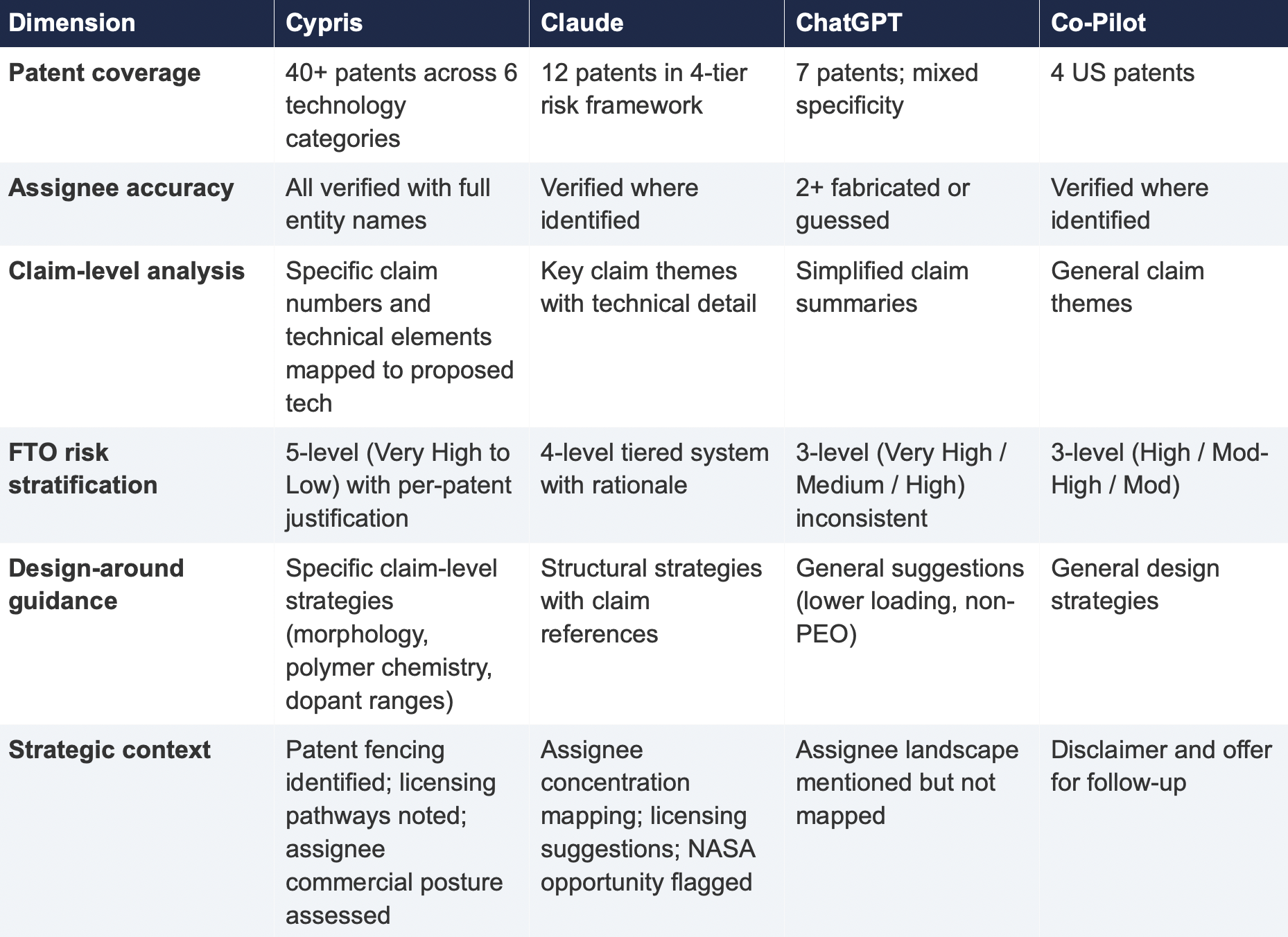
The most significant finding is the scale of the coverage differential. Cypris identified over 40 active US patents and published applications spanning LLZO-polymer composite electrolytes, garnet interface modification, polymer interlayer architectures, lithium-sulfur specific filings, and adjacent ceramic composite patents. The results were organized by technology category with per-patent FTO risk ratings.
Claude identified 12 patents organized in a four-tier risk framework. Its analysis was structurally sound and correctly flagged the two highest-risk filings (Solid Energies US 11,967,678 and the LLZO nanofiber multilayer US 11,923,501). It also identified the University ofMaryland/ Wachsman portfolio as a concentration risk and noted the NASA SABERS portfolio as a licensing opportunity. However, it missed the majority of the landscape, including the entire Corning portfolio, GM's interlayer patents, theKorea Institute of Energy Research three-layer architecture, and the HonHai/SolidEdge lithium-sulfur specific filing.
ChatGPT identified 7 patents, but the quality of attribution was inconsistent. It listed assignees as "Likely DOE /national lab ecosystem" and "Likely startup / defense contractor cluster" for two filings—language that indicates the model was inferring rather than retrieving assignee data. In a freedom-to-operate context, an unverified assignee attribution is functionally equivalent to no attribution, as it cannot support a licensing inquiry or risk assessment.
Co-Pilot identified 4 US patents. Its output was the most limited in scope, missing the Solid Energies portfolio entirely, theUMD/ Wachsman portfolio, Gelion/ Johnson Matthey, NASA SABERS, and all Li-S specific LLZO filings.
2.2 Critical Patents Missed by Public Models
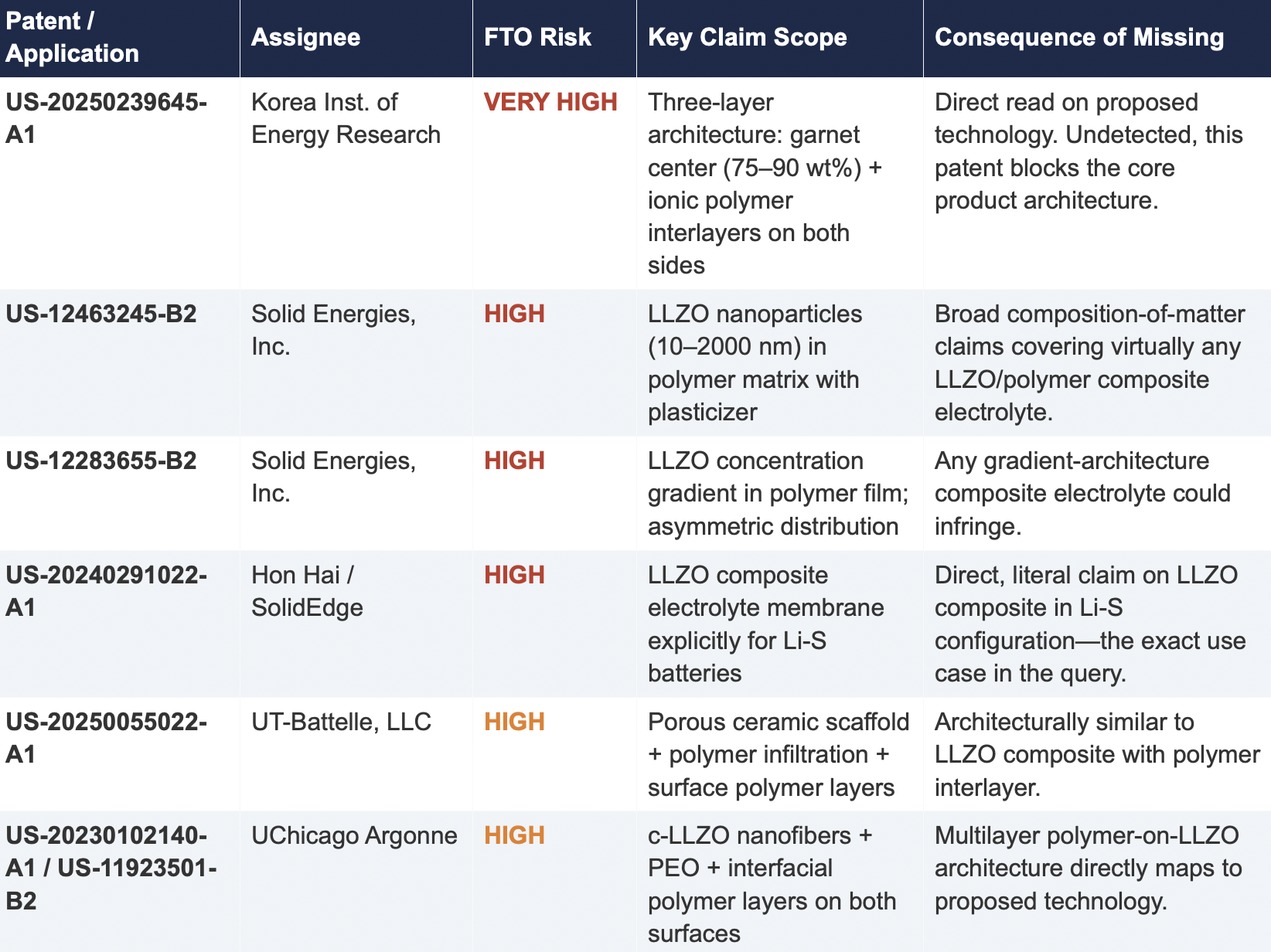
The following table presents patents identified exclusively by Cypris that were rated as High or Very High FTO risk for the proposed technology architecture. None were surfaced by any general-purpose model.
2.3 Patent Fencing: The Solid Energies Portfolio
Cypris identified a coordinated patent fencing strategy by Solid Energies, Inc. that no general-purpose model detected at scale. Solid Energies holds at least four granted US patents and one published application covering LLZO-polymer composite electrolytes across compositions(US-12463245-B2), gradient architectures (US-12283655-B2), electrode integration (US-12463249-B2), and manufacturing processes (US-20230035720-A1). Claude identified one Solid Energies patent (US 11,967,678) and correctly rated it as the highest-priority FTO concern but did not surface the broader portfolio. ChatGPT and Co-Pilot identified zero Solid Energies filings.
The practical significance is that a company relying on any individual patent hit would underestimate the scope of Solid Energies' IP position. The fencing strategy—covering the composition, the architecture, the electrode integration, and the manufacturing method—means that identifying a single design-around for one patent does not resolve the FTO exposure from the portfolio as a whole. This is the kind of strategic insight that requires seeing the full picture, which no general-purpose model delivered
2.4 Assignee Attribution Quality
ChatGPT's response included at least two instances of fabricated or unverifiable assignee attributions. For US 11,367,895 B1, the listed assignee was "Likely startup / defense contractor cluster." For US 2021/0202983 A1, the assignee was described as "Likely DOE / national lab ecosystem." In both cases, the model appears to have inferred the assignee from contextual patterns in its training data rather than retrieving the information from patent records.
In any operational IP workflow, assignee identity is foundational. It determines licensing strategy, litigation risk, and competitive positioning. A fabricated assignee is more dangerous than a missing one because it creates an illusion of completeness that discourages further investigation. An R&D team receiving this output might reasonably conclude that the landscape analysis is finished when it is not.
3. Structural Limitations of General-Purpose Models for Patent Intelligence
3.1 Training Data Is Not Patent Data
Large language models are trained on web-scraped text. Their knowledge of the patent record is derived from whatever fragments appeared in their training corpus: blog posts mentioning filings, news articles about litigation, snippets of Google Patents pages that were crawlable at the time of data collection. They do not have systematic, structured access to the USPTO database. They cannot query patent classification codes, parse claim language against a specific technology architecture, or verify whether a patent has been assigned, abandoned, or subjected to terminal disclaimer since their training data was collected.
This is not a limitation that improves with scale. A larger training corpus does not produce systematic patent coverage; it produces a larger but still arbitrary sampling of the patent record. The result is that general-purpose models will consistently surface well-known patents from heavily discussed assignees (QuantumScape, for example, appeared in most responses) while missing commercially significant filings from less publicly visible entities (Solid Energies, Korea Institute of EnergyResearch, Shenzhen Solid Advanced Materials).
3.2 The Web Is Closing to Model Scrapers
The data access problem is structural and worsening. As of mid-2025, Cloudflare reported that among the top 10,000 web domains, the majority now fully disallow AI crawlers such as GPTBot andClaudeBot via robots.txt. The trend has accelerated from partial restrictions to outright blocks, and the crawl-to-referral ratios reveal the underlying tension: OpenAI's crawlers access approximately1,700 pages for every referral they return to publishers; Anthropic's ratio exceeds 73,000 to 1.
Patent databases, scientific publishers, and IP analytics platforms are among the most restrictive content categories. A Duke University study in 2025 found that several categories of AI-related crawlers never request robots.txt files at all. The practical consequence is that the knowledge gap between what a general-purpose model "knows" about the patent landscape and what actually exists in the patent record is widening with each training cycle. A landscape query that a general-purpose model partially answered in 2023 may return less useful information in 2026.
3.3 General-Purpose Models Lack Ontological Frameworks for Patent Analysis
A freedom-to-operate analysis is not a summarization task. It requires understanding claim scope, prosecution history, continuation and divisional chains, assignee normalization (a single company may appear under multiple entity names across patent records), priority dates versus filing dates versus publication dates, and the relationship between dependent and independent claims. It requires mapping the specific technical features of a proposed product against independent claim language—not keyword matching.
General-purpose models do not have these frameworks. They pattern-match against training data and produce outputs that adopt the format and tone of patent analysis without the underlying data infrastructure. The format is correct. The confidence is high. The coverage is incomplete in ways that are not visible to the user.
4. Comparative Output Quality
The following table summarizes the qualitative characteristics of each tool's response across the dimensions most relevant to an operational IP workflow.
5. Implications for R&D and IP Organizations
5.1 The Confidence Problem
The central risk identified by this study is not that general-purpose models produce bad outputs—it is that they produce incomplete outputs with high confidence. Each model delivered its results in a professional format with structured analysis, risk ratings, and strategic recommendations. At no point did any model indicate the boundaries of its knowledge or flag that its results represented a fraction of the available patent record. A practitioner receiving one of these outputs would have no signal that the analysis was incomplete unless they independently validated it against a comprehensive datasource.
This creates an asymmetric risk profile: the better the format and tone of the output, the less likely the user is to question its completeness. In a corporate environment where AI outputs are increasingly treated as first-pass analysis, this dynamic incentivizes under-investigation at precisely the moment when thoroughness is most critical.
5.2 The Diversification Illusion
It might be assumed that running the same query through multiple general-purpose models provides validation through diversity of sources. This study suggests otherwise. While the four tools returned different subsets of patents, all operated under the same structural constraints: training data rather than live patent databases, web-scraped content rather than structured IP records, and general-purpose reasoning rather than patent-specific ontological frameworks. Running the same query through three constrained tools does not produce triangulation; it produces three partial views of the same incomplete picture.
5.3 The Appropriate Use Boundary
General-purpose language models are effective tools for a wide range of tasks: drafting communications, summarizing documents, generating code, and exploratory research. The finding of this study is not that these tools lack value but that their value boundary does not extend to decisions that carry existential commercial risk.
Patent landscape analysis, freedom-to-operate assessment, and competitive intelligence that informs R&D investment decisions fall outside that boundary. These are workflows where the completeness and verifiability of the underlying data are not merely desirable but are the primary determinant of whether the analysis has value. A patent landscape that captures 10% of the relevant filings, regardless of how well-formatted or confidently presented, is a liability rather than an asset.
6. Test 2: Competitive Intelligence — Bio-Based Polyamide Patent Landscape
To assess whether the findings from Test 1 were specific to a single technology domain or reflected a broader structural pattern, a second query was submitted to all four tools. This query shifted from freedom-to-operate analysis to competitive intelligence, asking each tool to identify the top 10organizations by patent filing volume in bio-based polyamide synthesis from castor oil derivatives over the past three years, with summaries of technical approach, co-assignee relationships, and portfolio trajectory.
6.1 Query

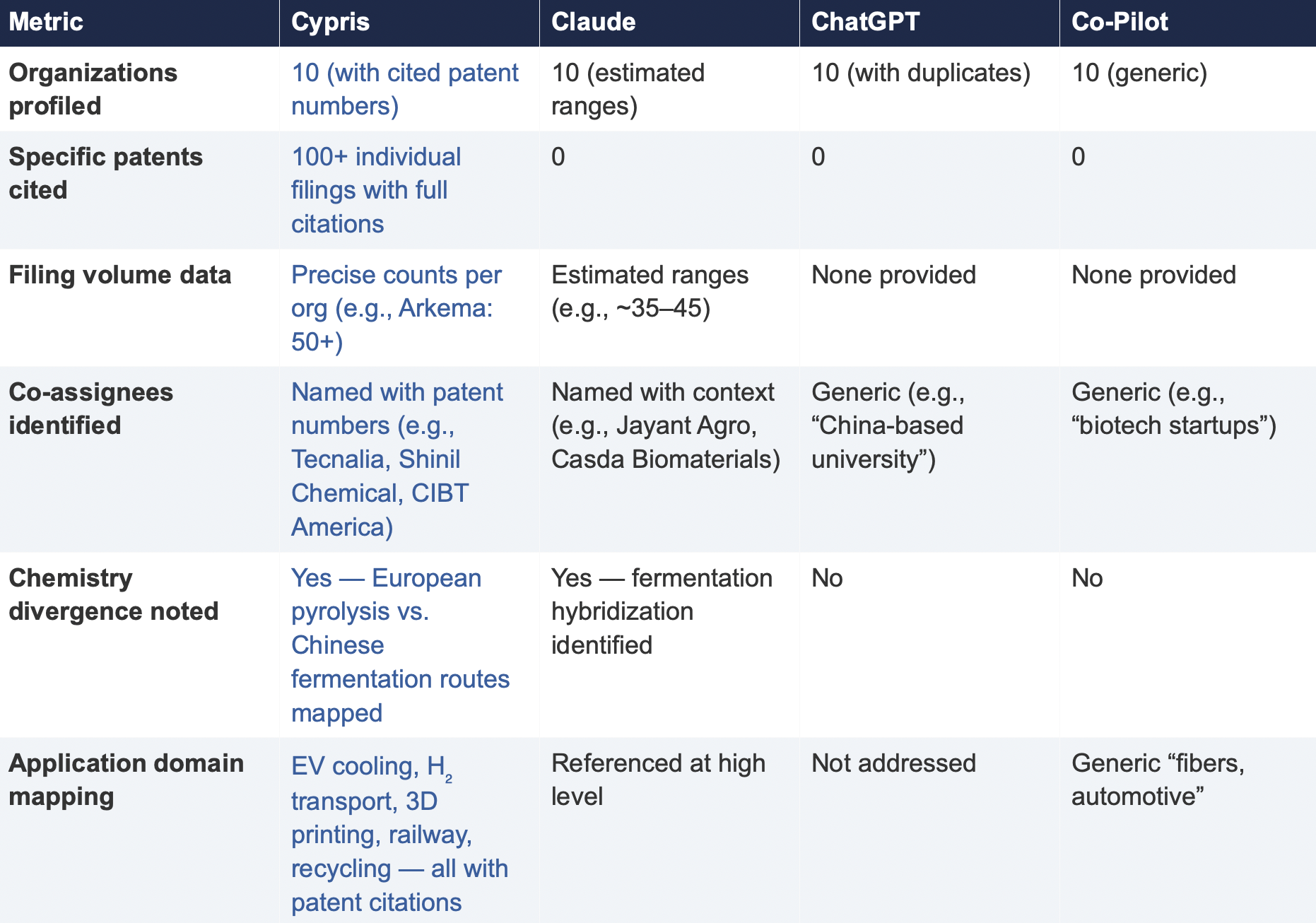
6.2 Summary of Results
6.3 Key Differentiators
Verifiability
The most consequential difference in Test 2 was the presence or absence of verifiable evidence. Cypris cited over 100 individual patent filings with full patent numbers, assignee names, and publication dates. Every claim about an organization’s technical focus, co-assignee relationships, and filing trajectory was anchored to specific documents that a practitioner could independently verify in USPTO, Espacenet, or WIPO PATENT SCOPE. No general-purpose model cited a single patent number. Claude produced the most structured and analytically useful output among the public models, with estimated filing ranges, product names, and strategic observations that were directionally plausible. However, without underlying patent citations, every claim in the response requires independent verification before it can inform a business decision. ChatGPT and Co-Pilot offered thinner profiles with no filing counts and no patent-level specificity.
Data Integrity
ChatGPT’s response contained a structural error that would mislead a practitioner: it listed CathayBiotech as organization #5 and then listed “Cathay Affiliate Cluster” as a separate organization at #9, effectively double-counting a single entity. It repeated this pattern with Toray at #4 and “Toray(Additional Programs)” at #10. In a competitive intelligence context where the ranking itself is the deliverable, this kind of error distorts the landscape and could lead to misallocation of competitive monitoring resources.
Organizations Missed
Cypris identified Kingfa Sci. & Tech. (8–10 filings with a differentiated furan diacid-based polyamide platform) and Zhejiang NHU (4–6 filings focused on continuous polymerization process technology)as emerging players that no general-purpose model surfaced. Both represent potential competitive threats or partnership opportunities that would be invisible to a team relying on public AI tools.Conversely, ChatGPT included organizations such as ANTA and Jiangsu Taiji that appear to be downstream users rather than significant patent filers in synthesis, suggesting the model was conflating commercial activity with IP activity.
Strategic Depth
Cypris’s cross-cutting observations identified a fundamental chemistry divergence in the landscape:European incumbents (Arkema, Evonik, EMS) rely on traditional castor oil pyrolysis to 11-aminoundecanoic acid or sebacic acid, while Chinese entrants (Cathay Biotech, Kingfa) are developing alternative bio-based routes through fermentation and furandicarboxylic acid chemistry.This represents a potential long-term disruption to the castor oil supply chain dependency thatWestern players have built their IP strategies around. Claude identified a similar theme at a higher level of abstraction. Neither ChatGPT nor Co-Pilot noted the divergence.
6.4 Test 2 Conclusion
Test 2 confirms that the coverage and verifiability gaps observed in Test 1 are not domain-specific.In a competitive intelligence context—where the deliverable is a ranked landscape of organizationalIP activity—the same structural limitations apply. General-purpose models can produce plausible-looking top-10 lists with reasonable organizational names, but they cannot anchor those lists to verifiable patent data, they cannot provide precise filing volumes, and they cannot identify emerging players whose patent activity is visible in structured databases but absent from the web-scraped content that general-purpose models rely on.
7. Conclusion
This comparative analysis, spanning two distinct technology domains and two distinct analytical workflows—freedom-to-operate assessment and competitive intelligence—demonstrates that the gap between purpose-built R&D intelligence platforms and general-purpose language models is not marginal, not domain-specific, and not transient. It is structural and consequential.
In Test 1 (LLZO garnet electrolytes for Li-S batteries), the purpose-built platform identified more than three times as many patents as the best-performing general-purpose model and ten times as many as the lowest-performing one. Among the patents identified exclusively by the purpose-built platform were filings rated as Very High FTO risk that directly claim the proposed technology architecture. InTest 2 (bio-based polyamide competitive landscape), the purpose-built platform cited over 100individual patent filings to substantiate its organizational rankings; no general-purpose model cited as ingle patent number.
The structural drivers of this gap—reliance on training data rather than live patent feeds, the accelerating closure of web content to AI scrapers, and the absence of patent-specific analytical frameworks—are not transient. They are inherent to the architecture of general-purpose models and will persist regardless of increases in model capability or training data volume.
For R&D and IP leaders, the practical implication is clear: general-purpose AI tools should be used for general-purpose tasks. Patent intelligence, competitive landscaping, and freedom-to-operate analysis require purpose-built systems with direct access to structured patent data, domain-specific analytical frameworks, and the ability to surface what a general-purpose model cannot—not because it chooses not to, but because it structurally cannot access the data.
The question for every organization making R&D investment decisions today is whether the tools informing those decisions have access to the evidence base those decisions require. This study suggests that for the majority of general-purpose AI tools currently in use, the answer is no.
Study Disclosure
This comparative evaluation was commissioned and published by Cypris. The testing methodology, prompts, evaluation criteria, and underlying outputs have been documented to support independent review and replication.
All platform outputs were preserved in their original form. Patent data and material factual claims were cross-checked against USPTO Patent Center and WIPO PATENTSCOPE records as of March 27, 2026. Cypris was one of the platforms evaluated and therefore has a commercial interest in the findings.
The Patent Intelligence Gap - A Comparative Analysis of Verticalized AI-Patent Tools vs. General-Purpose Language Models for R&D Decision-Making
All Blogs

Artificial intelligence has become a permanent layer in pharmaceutical R&D, and it is generating a distinctive, fast-growing patent landscape. The convergence of AI and drug discovery is visible directly in the data on generative-AI patenting: among the categories tracked by the World Intellectual Property Organization, applications in molecules, genes, and proteins, though smaller in absolute number at roughly 1,500 inventions, were the fastest-growing, expanding at about 78 percent per year over a five-year period.¹ Peer-reviewed patent-basis analysis of AI in the pharmaceutical industry confirms both the rapid rise of filing activity and its concentration among a set of key players,² and a growing body of work applies patent-landscaping and bibliometric methods specifically to AI-driven drug discovery, including in areas such as cancer drug discovery.⁵,⁶,⁷ For R&D and IP teams, the strategic questions are which sub-domains are crowded, where defensible white space remains, and how the unsettled rules on AI-assisted inventorship affect what can be protected.
The landscape divides into several technically distinct sub-domains, each a different region of patenting. Generative molecular design covers models that propose novel candidate molecules. Drug-target interaction and binding-affinity prediction covers models that predict whether and how strongly a molecule binds a target. Drug repurposing covers methods that use biomedical knowledge graphs and network pharmacology to find new uses for known compounds. Multi-omics response prediction covers models that predict biological response from genomic and other omics data. Clinical-trial prediction and design covers models that forecast trial success and optimize design. And a further layer covers AI-assisted pharmaceutical development and, increasingly, generative AI applied to regulatory documentation. These sub-domains differ sharply in how crowded they are: biomedical knowledge-graph construction and traversal, for example, has become a comparatively crowded area of prior art, while newer large-language-model-native and agentic approaches are earlier and sparser.
Two structural features shape the landscape. The first is geographic and institutional concentration: the same concentration seen across generative AI, where a small number of countries account for most filings, extends into AI drug discovery, with China's share of generative-AI patenting near the top globally.¹ The second is the unsettled status of AI-assisted inventorship. In the United States, the Patent and Trademark Office rescinded its February 2024 guidance on AI-assisted inventions in November 2025 and returned to the traditional human-conception standard, which affects how AI-heavy pipelines document invention and how their patents should be valued.³ Commentators expect the first wave of litigation over AI-generated drug inventions within a few years, which will set precedents on inventorship and eligibility.⁴ These are not peripheral legal details; they determine what portion of an AI-driven discovery effort can be protected and how a portfolio should be structured, and they vary by jurisdiction. Because applications publish about eighteen months after filing, the newest large-language-model-native and agentic filings are under-represented, so the current frontier is more active than granted-patent counts suggest.
What the AI drug discovery landscape shows
Fastest-growing generative-AI category. Among generative-AI patents, molecule, gene, and protein applications grew fastest, at roughly 78 percent per year, though from a smaller base than image or text applications.¹
Several distinct sub-domains. The field spans generative molecular design, drug-target interaction prediction, knowledge-graph-based repurposing, multi-omics response prediction, clinical-trial prediction, and AI-assisted development.²
Crowded versus sparse areas. Biomedical knowledge-graph construction and traversal is comparatively crowded prior art, while large-language-model-native and agentic approaches are earlier and sparser.
Geographic concentration. Activity is concentrated in a small number of countries, mirroring the broader generative-AI landscape, with China prominent.¹
Unsettled inventorship. AI-assisted inventorship rules are in flux, with the US returning to a human-conception standard in late 2025, which affects what can be protected and how portfolios are documented.³,⁴
How AI-powered landscape and white space analysis helps
Mapping a fast-moving, sub-domain-structured field where much of the state of the art is in non-patent literature requires more than keyword search. AI-powered analysis addresses this with semantic search across both patents and scientific literature, which is essential because AI-method disclosures often appear first in preprints and conference proceedings, attribution that normalizes filers to canonical entities, and continuous monitoring that tracks the newest agentic and large-language-model-native filings. Clustering activity by sub-domain and by concept is what distinguishes crowded prior art from genuine white space.
Where Cypris fits
Cypris runs patent landscape and white space analysis for fast-moving, literature-heavy fields such as AI in drug discovery across a corpus of more than 500 million patents and scientific papers, organized through a proprietary R&D ontology. Because the corpus spans both patents and scientific literature, Cypris covers the preprints and conference proceedings where AI-method disclosures often appear first, rather than patents alone. The ontology clusters activity by sub-domain, generative design, interaction prediction, repurposing, multi-omics, and clinical prediction, and normalizes filers to canonical entities, so a team can resolve which areas, such as knowledge-graph methods, are crowded and which, such as agentic approaches, remain open as white space. Cypris Q, the platform's agentic layer, lets teams run landscape and white space analysis conversationally and chain the clustering, attribution, and gap analysis, and Agentic Monitoring tracks a defined area over time and flags new patents and papers as they publish, which is essential where the newest filings are under-represented by publication lag. Cypris provides enterprise API partnerships with OpenAI, Anthropic, and Google, and is built with enterprise-grade security. Cypris serves hundreds of enterprise customers across pharmaceuticals, chemicals, advanced materials, energy, and other regulated industries.
FAQ
How fast is AI drug discovery patenting growing?
AI drug discovery patenting is growing quickly. Among generative-AI patent categories tracked by WIPO, applications in molecules, genes, and proteins were the fastest-growing at roughly 78 percent per year, though from a smaller base than image or text applications. Peer-reviewed patent-basis analysis confirms the rapid rise of AI filing activity in the pharmaceutical industry.
What are the main sub-domains of AI drug discovery patents?
The main sub-domains are generative molecular design, drug-target interaction and binding-affinity prediction, drug repurposing using biomedical knowledge graphs, multi-omics response prediction, clinical-trial prediction and design, and AI-assisted pharmaceutical development. Each is a technically distinct region of the patent landscape. They differ substantially in how crowded they are.
Which areas of AI drug discovery are crowded, and which are open?
Biomedical knowledge-graph construction and traversal has become a comparatively crowded area of prior art in AI drug discovery, while large-language-model-native and agentic approaches are earlier and sparser. The crowded areas carry more freedom-to-operate risk, and the sparser areas hold more white space. Distinguishing them requires clustering activity by sub-domain and concept.
How does AI-assisted inventorship affect drug patents?
AI-assisted inventorship affects drug patents because the rules on whether and how AI-assisted inventions can be protected are unsettled and vary by jurisdiction. In the United States, the Patent and Trademark Office rescinded its 2024 guidance on AI-assisted inventions in November 2025 and returned to the traditional human-conception standard. This affects how AI-heavy pipelines document invention and how their patents are valued.
Why does China feature prominently in AI drug discovery patenting?
China features prominently in AI drug discovery patenting because it accounts for a large share of generative-AI patenting overall, and that concentration extends into the drug discovery sub-domains. The broader generative-AI landscape is dominated by a small number of countries. This geographic concentration matters for competitive positioning and freedom-to-operate.
Why does AI drug discovery analysis need scientific literature?
AI drug discovery analysis needs scientific literature because AI-method disclosures often appear first in preprints and conference proceedings rather than patents, so a patent-only view misses much of the state of the art. This is characteristic of AI fields generally. Cypris analyzes both patents and scientific literature across more than 500 million documents.
How do you find white space in AI drug discovery?
Finding white space in AI drug discovery means clustering activity by sub-domain and concept across patents and scientific literature, and identifying the sparser areas, such as agentic and large-language-model-native approaches, where few patents yet exist. Because much of the state of the art is in non-patent literature, semantic search across both sources is essential. The white space is where a viable method exists but patenting is still thin.
Which teams use AI drug discovery patent landscape analysis?
AI drug discovery patent landscape analysis is used by R&D, IP, and strategy teams at pharmaceutical companies, AI-native drug discovery firms, and their partners, as well as investors assessing AI-driven pipelines. It informs where to file, where freedom-to-operate risk sits, and how to structure a portfolio given inventorship uncertainty. Cypris serves hundreds of enterprise customers across pharmaceuticals and other research-intensive industries.
How current does an AI drug discovery landscape need to be?
An AI drug discovery landscape needs to be continuously current, because the field moves quickly, inventorship rules are shifting, new agentic and large-language-model-native filings publish constantly, and publication lag hides the most recent activity. A one-time landscape ages within months. Cypris uses Agentic Monitoring to track a defined area and flag new patents and papers as they publish.
Endnotes
- World Intellectual Property Organization (2024). Patent Landscape Report: Generative Artificial Intelligence. Geneva: WIPO. https://doi.org/10.34667/tind.49740
- Kano, S. & Sakaoka, S. (2025). Quantitative insights on artificial intelligence in the pharmaceutical industry: a patent-basis analysis of technological trends and key players. World Patent Information. https://www.sciencedirect.com/science/article/pii/S0172219025000481
- United States Patent and Trademark Office (2025). Revised Inventorship Guidance for AI-Assisted Inventions, Federal Register (published November 28, 2025; rescinding the February 2024 guidance and returning to the traditional human-conception standard). https://www.federalregister.gov/documents/2025/11/28/2025-21457/revised-inventorship-guidance-for-ai-assisted-inventions
- Goodwin (2026). AI Drug Discovery Tests the Limits of Patent Law. https://www.goodwinlaw.com/en/insights/publications/2025/12/insights-lifesciences-ip-ai-drug-discovery-tests-the-limits-of-patent-law
- Hofmann-Apitius, M., Gadiya, Y., Zaliani, A. & Gribbon, P. (2023). Pharmaceutical patent landscaping: a novel approach to understand patents from the drug discovery perspective. Artificial Intelligence in the Life Sciences. https://doi.org/10.1016/j.ailsci.2023.100061
- Abdulwahab, A. A. et al. (2024). Catalyzing innovation in cancer drug discovery through artificial intelligence, machine learning and patency. Pharmaceutical Patent Analyst.
- Jing, F. & Ma, Y. (2024). Bibliometric Analysis and Research Trends in Artificial Intelligence for Pharmaceutical Management and Drug Discovery.

The CRISPR and gene-editing patent landscape is one of the largest and most contested in biotechnology, and freedom-to-operate in this field is correspondingly difficult. A landscape analysis maintained by a national patent office counted roughly 23,700 CRISPR patent families as of the end of 2024, an increase of more than 6,500 families in a single year, and it identified four competing groups holding foundational claims.¹ Freedom-to-operate determines whether making, using, or selling a product would infringe another party's active patent claims. In gene editing, the foundational rights are split across multiple owners and jurisdictions, so a developer frequently cannot clear a product by licensing from a single source and must instead assemble rights from several, with the required set depending on the application and the country.¹,²
The fragmentation traces to an unresolved priority dispute over who first applied CRISPR-Cas9 to eukaryotic cells. The two most prominent groups are the University of California, Berkeley, the University of Vienna, and Emmanuelle Charpentier on one side, and the Broad Institute of MIT and Harvard on the other, with ToolGen and Sigma-Aldrich also holding foundational filings. The dispute has run through patent offices and courts for over a decade, and it remains live: in May 2025 the US Court of Appeals for the Federal Circuit vacated and remanded a decision that had awarded priority for eukaryotic CRISPR-Cas9 to the Broad Institute, reviving the Berkeley-led group's challenge.³,⁶ In Europe, the Berkeley-led group withdrew two foundational patents in late 2024 following an unfavorable preliminary opinion, then pursued divisional claims, while ToolGen secured European positions during 2025, illustrating how the landscape continues to shift among the competing groups.²,⁷ The academic literature has tracked this contested landscape since the technology's early years, documenting both its fragmentation and the licensing complexity it creates, and has examined proposed responses such as CRISPR patent pools.⁴,⁵,⁸
The practical consequence is that gene-editing FTO is a licensing-and-landscape problem, not a single clearance. The required rights differ by use, human therapeutics, agricultural and plant applications, research tools, and diagnostics can each implicate different foundational and improvement patents, and they differ by jurisdiction, because the same dispute has resolved differently in the United States, Europe, and Asia. The uncertainty is compounded by timing: some of the earliest, broadest patents may expire before the disputes are fully resolved, which shifts value toward the dense layer of improvement patents on delivery, specificity, and newer editing systems.² Because applications publish about eighteen months after filing, the most recent activity is under-represented, so the landscape is even larger and more active than granted-patent counts suggest.
Why CRISPR freedom-to-operate is hard
Fragmented foundational rights. Foundational claims are split across at least four groups, so clearing a product often requires multiple licenses rather than one.¹
Unresolved disputes. The priority dispute over eukaryotic CRISPR-Cas9 remains active, with a US Federal Circuit ruling in May 2025 reviving the Berkeley-led challenge, so ownership is not yet settled.³
Jurisdictional divergence. The same dispute has resolved differently across the United States, Europe, and Asia, so FTO must be assessed market-by-market.²
Application-specific rights. Human therapeutics, agriculture, research tools, and diagnostics implicate different patents, so the required license set depends on the intended use.¹
A dense improvement layer. Beyond the foundational patents, a large and growing layer of improvement patents covers delivery, specificity, base and prime editing, and newer nucleases, which is where much current FTO risk and white space now sit, including in application areas such as agricultural gene editing.⁹
How AI-powered landscape and FTO analysis helps
Navigating a landscape of more than twenty thousand families across multiple owners, applications, and jurisdictions is beyond manual search. AI-powered analysis addresses this with semantic search that retrieves relevant claims regardless of terminology, attribution that resolves owners to canonical entities so the fragmentation is visible, and continuous monitoring that tracks a fast-shifting landscape as disputes resolve and improvement patents publish. Because gene-editing advances appear in scientific literature before they are patented, reading both patents and literature gives earlier warning of where the improvement layer is extending.
Where Cypris fits
Cypris runs patent landscape and freedom-to-operate analysis for complex, fragmented fields such as gene editing across a corpus of more than 500 million patents and scientific papers, organized through a proprietary R&D ontology. The ontology clusters the landscape by technology and application and normalizes owners to canonical entities, so a team can see how foundational and improvement rights are distributed across the four groups and the many later filers rather than a flat list. Semantic search across patents and scientific literature surfaces relevant claims regardless of terminology and connects filings to the underlying research, which is where the improvement layer emerges first. Cypris Q, the platform's agentic layer, lets teams run landscape and FTO analysis conversationally and chain the attribution, clustering, and claim analysis, and Agentic Monitoring tracks the landscape over time and flags new filings and dispute developments as they publish. Cypris provides enterprise API partnerships with OpenAI, Anthropic, and Google, and is built with enterprise-grade security. Cypris serves hundreds of enterprise customers across pharmaceuticals, chemicals, advanced materials, energy, and other regulated industries.
FAQ
How large is the CRISPR patent landscape?
The CRISPR patent landscape is very large. A national patent office landscape analysis counted roughly 23,700 CRISPR patent families as of the end of 2024, up more than 6,500 in a single year. Because applications publish about eighteen months after filing, the most recent activity is under-represented, so the true landscape is even larger.
Why is freedom-to-operate hard for CRISPR?
Freedom-to-operate is hard for CRISPR because foundational rights are split across at least four competing groups and the key priority dispute remains unresolved, so a developer often cannot clear a product with a single license. The required rights also differ by application and jurisdiction. Assembling the correct set of licenses is the central FTO challenge.
What is the Broad versus UC Berkeley CRISPR dispute?
The Broad versus UC Berkeley dispute concerns who first applied CRISPR-Cas9 to eukaryotic cells, contested between the Berkeley-led group and the Broad Institute, with ToolGen and Sigma-Aldrich also holding foundational filings. In May 2025, the US Court of Appeals for the Federal Circuit vacated and remanded a decision that had favored the Broad Institute, reviving the Berkeley-led challenge. The dispute remains unresolved.
Does CRISPR freedom-to-operate differ by country?
Yes, CRISPR freedom-to-operate differs by country, because the same foundational dispute has resolved differently in the United States, Europe, and Asia. A party may hold stronger rights in one jurisdiction than another. FTO must therefore be assessed market-by-market rather than globally.
Why might a CRISPR product need multiple licenses?
A CRISPR product may need multiple licenses because foundational rights are fragmented across several owners, and improvement patents on delivery, specificity, and newer editing systems add further layers. The required set depends on the application and jurisdiction. This is why gene-editing FTO is a licensing-and-landscape problem rather than a single clearance.
How does the improvement-patent layer affect CRISPR FTO?
The improvement-patent layer affects CRISPR FTO because, beyond the foundational patents, a large and growing set of patents covers delivery, specificity, base and prime editing, and newer nucleases. As the earliest broad patents approach expiry, value shifts toward this layer, which is where much current FTO risk and white space sit. Mapping it requires reading both patents and scientific literature.
How does scientific literature help CRISPR landscape analysis?
Scientific literature helps CRISPR landscape analysis because gene-editing advances appear in research before they are patented, so the literature gives the earliest signal of where the improvement layer is extending. Analyzing patents alone gives a lagging view. Cypris analyzes both across more than 500 million patents and scientific papers.
Which teams need CRISPR patent landscape and FTO analysis?
CRISPR patent landscape and FTO analysis is needed by R&D, IP, and business-development teams in therapeutics, agriculture, industrial biotechnology, and diagnostics, along with investors assessing gene-editing assets. The fragmentation makes structured analysis essential. Cypris serves hundreds of enterprise customers across pharmaceuticals and other research-intensive industries.
How current does a CRISPR landscape need to be?
A CRISPR landscape needs to be continuously current, because the disputes are still resolving, new improvement patents publish constantly, and publication lag hides the most recent activity. A one-time landscape ages quickly. Cypris uses Agentic Monitoring to track the landscape and flag new filings and developments as they publish.
Endnotes
- Swiss Federal Institute of Intellectual Property (2025). CRISPR Technology: Patent & Licence Landscapes. https://www.ige.ch/
- Gowling WLG (2025). Fragmented and shifting CRISPR patent landscape: global proceedings and the patent pool solution. https://gowlingwlg.com/en/insights-resources/articles/2025/crispr-patent-landscape
- US Court of Appeals for the Federal Circuit (2025). Regents of the University of California v. Broad Institute, Inc., decided May 12, 2025. https://www.cafc.uscourts.gov/
- Egelie, K. J., Graff, G. D., Strand, S. P. & Johansen, B. (2016). The emerging patent landscape of CRISPR-Cas gene editing technology. Nature Biotechnology. https://doi.org/10.1038/nbt.3692
- Contreras, J. L. & Sherkow, J. S. (2017). CRISPR, surrogate licensing, and scientific discovery. Science. https://doi.org/10.1126/science.aal4222
- Sherkow, J. S. (2025). A "Bare Hope of a Result": The Second CRISPR Patent Appeal. The CRISPR Journal (analysis of the May 12, 2025 US Federal Circuit decision).
- Beck Greener (2025). Update on the CRISPR-Cas9 IP saga at the EPO: blows for both the Broad and CVC camps, but ToolGen ends 2025 with success. https://www.beckgreener.com/
- Stasi, A. & Pereira Rodrigues, I. (2019). Dealing with Patent Fragmentation in Genetics: Can Patent Pools Facilitate the Development of CRISPR Gene-Editing Technology? PubMed.
- Muhammad Adamu, U. et al. (2026). CRISPR in Wheat: Patents, Breeding Advances, and Emerging Challenges. Trends in Intellectual Property Research.

Agent orchestration in Microsoft Copilot works best when the orchestrator routes to scoped, governed connections rather than pulling every source into one undifferentiated context. The architecture that holds up under real R&D workloads keeps internal confidential data and external intelligence on separate trust boundaries, lets Copilot decide which to call, and treats external R&D and IP intelligence as a domain-oriented layer rather than a raw dataset dump. This guide explains how to design that orchestration so that a research team can ask a single question and have Copilot reason across an electronic lab notebook, internal developmental records, and the external patent and scientific literature without collapsing those very different data types into one fragile prompt.
Why orchestration belongs at the Copilot layer
The orchestrator is the component that decides which tool to call, in what order, and how to combine the results. In Microsoft Copilot Studio, generative orchestration is the mode that lets an agent select among multiple registered tools at runtime based on the user's intent and each tool's description. Microsoft requires generative orchestration to be enabled before an agent can use Model Context Protocol tools at all, which means the orchestration decision and the tool connections are designed to work as one system rather than as a hardcoded pipeline.
Putting orchestration at the Copilot layer matters for a specific reason. When orchestration is centralized, each connected source can stay narrow. The electronic lab notebook tool returns experimental records. The internal data tool returns developmental project context. The external intelligence tool returns patent and scientific findings. Copilot composes the answer from those scoped returns. The alternative, loading all of those corpora into a single context window and asking the model to sort it out, runs directly into context rot, the well-documented effect in which model accuracy degrades as the context window fills with more material. Centralized orchestration over scoped tools is the architectural answer to that degradation.
How MCP connections work inside Copilot Studio
Model Context Protocol is an open standard, introduced by Anthropic, that defines how applications expose tools and data to large language models in a consistent way. In Copilot Studio, MCP servers are made available through the same connector infrastructure that governs other Power Platform connections, which means an MCP connection inherits enterprise security and governance controls including Virtual Network integration, Data Loss Prevention policies, and multiple authentication methods.
Adding an MCP server to a Copilot Studio agent follows a defined path. From the agent's Tools page, you select Add a tool, then New tool, then Model Context Protocol, which opens the MCP onboarding wizard. You provide a server name, a server description, and a server URL, then select the authentication type the server requires. The server description is not cosmetic. The agent orchestrator reads that description at runtime to decide whether to call the server for a given user request, so a precise description of what each connection does is part of making orchestration work correctly. Once connected, each tool the MCP server publishes becomes an action inside Copilot Studio and inherits the server's defined inputs and outputs, and Copilot Studio reflects updates automatically as tools change on the server.
One governance fact shapes the entire design. Because MCP servers in Copilot Studio rely on Power Platform connectors for connectivity, any Data Loss Prevention policy that regulates those connectors also regulates the MCP server and its tools. This is the lever that lets a security team treat an internal ELN connection and an external intelligence connection under different policies even though both reach Copilot through the same mechanism.
Designing the internal trust boundary: ELN and developmental data
Internal confidential and developmental data is the most sensitive material in the orchestration, and it should be connected under the strictest governance. Electronic lab notebooks such as Benchling, LabArchives, and Scispot store the experimental records, sample data, and process documentation that represent a research organization's most valuable and proprietary information, and these platforms expose their data through documented REST APIs and emphasize regulatory compliance and data integrity as core features.
The design principle for this boundary is least exposure. The ELN connection and any internal developmental data connection should be governed by Data Loss Prevention policies that prevent confidential records from being combined with or transmitted to external destinations. Authentication should be scoped so the agent acts with the permissions of the requesting user rather than a broad service identity, which keeps the access model aligned with who is actually allowed to see which projects. Because Copilot Studio inherits connector-level DLP, a security team can place internal connections in a data group that is policy-isolated from external connections, so that the orchestrator can read from both but the platform enforces that confidential developmental data does not leak across the boundary. The internal tools should also be described narrowly to the orchestrator, so Copilot calls them only when a request genuinely concerns internal experimental or project data.
Designing the external boundary: patent and scientific intelligence
External R&D and IP intelligence is a fundamentally different kind of input, and treating it like just another data feed is where many agent designs go wrong. There is a meaningful difference between connecting an agent to a broad external dataset and connecting it to a domain-oriented intelligence layer. A raw external MCP endpoint that exposes a large patent or literature corpus hands the orchestrator an enormous, undifferentiated body of records, and asking the model to reason over that volume reintroduces the context rot problem the orchestration was meant to avoid. A domain-oriented layer instead returns a scoped, reasoned answer to the agent, so what enters Copilot's context is already a focused intelligence result rather than thousands of raw documents.
This is where the trust boundary and the quality boundary coincide. External intelligence should never share an undifferentiated context with confidential internal data, both because of data governance and because mixing a large external corpus into the same window as sensitive internal records degrades the reasoning on both. Keeping external intelligence as a separate, scoped connection that returns reasoned findings, rather than a firehose of raw records, protects accuracy and keeps the governance boundary clean.
Cypris as the external intelligence layer
This is the role Cypris is built for. As an enterprise R&D intelligence platform, Cypris unifies more than 500 million patents and scientific papers into a single intelligence layer with a proprietary R&D ontology, so that an agent reaching for external intelligence draws on the patent and scientific record in one reasoned place rather than across siloed connectors. Cypris is designed for R&D scientists and innovation strategists rather than IP attorneys, which means the intelligence it returns is scoped to the forward-looking questions research teams actually ask.
Crucially for an orchestration design, Cypris makes that intelligence available through official enterprise API partnerships with OpenAI, Anthropic, and Google, with enterprise-grade security built to Fortune 500 requirements. That partnership model lets the Cypris intelligence layer sit behind the AI tooling an organization already uses, including a Copilot orchestration, so the external intelligence entering the agent is a reasoned domain answer rather than a raw corpus. In the orchestration described here, Copilot routes external R&D and IP questions to Cypris as the domain-oriented intelligence layer, the internal ELN and developmental connections stay on their own governed boundary, and the orchestrator composes a single answer without ever collapsing confidential internal data and the external literature into one context. That separation is what makes the whole system both secure and accurate.
Putting the orchestration together
A working design has Copilot Studio as the orchestration layer with generative orchestration enabled, internal ELN and developmental data connected as narrowly scoped tools under isolating Data Loss Prevention policies, and external patent and scientific intelligence connected as a separate domain-oriented layer through Cypris's enterprise API partnerships. Each tool carries a precise description so the orchestrator routes correctly, authentication is scoped to the requesting user, and connector-level governance keeps the internal and external boundaries policy-separated. A researcher asks one question, and Copilot pulls scoped experimental context from the ELN, scoped project context from internal records, and a reasoned external intelligence answer from Cypris, then composes a response, all without ever forcing the model to reason over one bloated, mixed context. The result is an agent that is more accurate because each input is scoped and more secure because confidential developmental data never crosses into the external boundary.
FAQ
1. Can Microsoft Copilot orchestrate across both internal and external R&D data sources?Yes. Copilot Studio's generative orchestration mode lets a single agent select among multiple registered tools at runtime based on the user's intent, so one agent can route a question to an internal electronic lab notebook, internal developmental records, and an external intelligence layer and compose a unified answer.
2. What is generative orchestration in Copilot Studio?Generative orchestration is the mode in which the Copilot agent dynamically decides which tools to call and in what order based on the user's request and each tool's description, rather than following a hardcoded sequence. Microsoft requires it to be enabled before an agent can use Model Context Protocol tools.
3. How are MCP servers connected to a Copilot Studio agent?From the agent's Tools page you select Add a tool, then New tool, then Model Context Protocol, which opens the MCP onboarding wizard. You provide a server name, description, and URL, and select the authentication type. Each tool the server publishes becomes an action in Copilot Studio.
4. How is confidential R&D data kept secure in this architecture?MCP connections in Copilot Studio run on Power Platform connector infrastructure, so they inherit enterprise controls including Virtual Network integration, Data Loss Prevention policies, and multiple authentication methods. Internal connections can be placed under DLP policies that isolate them from external connections, and authentication can be scoped to the requesting user.
5. Why keep internal and external data on separate trust boundaries?Two reasons converge. Governance requires that confidential developmental data not leak to external destinations, and accuracy requires that a large external corpus not be mixed into the same context as sensitive internal records, because filling the context window with mixed material degrades the model's reasoning on both.
6. What is context rot and why does it matter for agent design?Context rot is the documented effect in which a model's accuracy declines as its context window fills with more material. It matters because loading multiple large corpora into one prompt, rather than routing to scoped tools, makes the agent reason worse, which is the core argument for centralizing orchestration over narrow connections.
7. How do electronic lab notebooks fit into the orchestration?ELN platforms such as Benchling, LabArchives, and Scispot hold experimental records, sample data, and process documentation, and expose that data through documented REST APIs. In the orchestration they are connected as narrowly scoped internal tools under strict governance, returning only the experimental context relevant to a given request.
8. What is the difference between connecting a raw external dataset and a domain-oriented intelligence layer?A raw external endpoint hands the orchestrator a large, undifferentiated body of records, which reintroduces context rot when the model tries to reason over the volume. A domain-oriented layer returns a scoped, reasoned answer, so what enters the agent's context is a focused result rather than thousands of raw documents.
9. How does Cypris connect into a Copilot orchestration?Cypris makes its R&D intelligence available through official enterprise API partnerships with OpenAI, Anthropic, and Google, with enterprise-grade security built to Fortune 500 requirements. That model lets the Cypris intelligence layer sit behind the AI tooling an organization already uses, so Copilot can route external patent and scientific questions to Cypris and receive a reasoned domain answer.
10. What does a complete orchestration design look like?Copilot Studio serves as the orchestration layer with generative orchestration enabled, internal ELN and developmental data are connected as scoped tools under isolating DLP policies, and external patent and scientific intelligence is connected as a separate domain-oriented layer through Cypris's enterprise API partnerships, with each tool precisely described so the orchestrator routes correctly.
Perovskite solar cells are among the fastest-moving areas of photovoltaics research, and the patent landscape is concentrating precisely on the problems that stand between laboratory performance and commercial deployment. Certified power conversion efficiencies for small-area single-junction perovskite cells have surpassed 27 percent, and perovskite-silicon tandem cells have surpassed 34 percent, with a widely reported tandem record of 34.6 percent set in 2024, as tracked in the authoritative certified-efficiency tables and the US National Renewable Energy Laboratory records.¹,²,³,⁴ These figures are remarkable for a technology that emerged around 2012, and they explain the intensity of research and patenting. The strategic question for R&D and IP teams is not whether perovskites can achieve high efficiency in the laboratory, that is established, but where the defensible IP positions lie on the path to durable, manufacturable modules, and that is a patent-landscape and white-space question.
The technical frontier has shifted, and the patent landscape has shifted with it. Early work concentrated on raising cell efficiency; current activity concentrates on interface engineering, charge-transport-layer design, perovskite crystallization control, and, above all, operational stability and large-area fabrication.¹ Stability under real outdoor conditions is the central barrier, and the existing photovoltaic qualification standards, developed for crystalline silicon, do not fully capture the distinct degradation modes of perovskite absorbers, so testing methodology itself is an open area.⁵ There is a well-documented gap between the efficiency of small laboratory cells and that of full-size modules, which reach roughly 23 percent, and closing that gap through scalable large-area fabrication is where much of the commercially relevant innovation now sits.¹,⁶ Newer approaches, including green-solvent processing, ambient-air fabrication, kilogram-scale synthesis of precursors, vacuum deposition, and machine-learning-assisted materials design, are accelerating the path to commercialization and defining fresh patentable territory.¹
The landscape is growing rapidly and concentrating geographically, with China prominent and a mix of academic institutions and commercial manufacturers filing; granular family counts are tracked mainly in commercial patent databases and are best treated as indicative rather than authoritative. What is clear from the technical literature is where activity is dense and where it is sparse. Dense areas include core device architectures and efficiency-oriented interface and transport-layer chemistry, which are crowded battlegrounds. Sparser, higher-value white space includes long-term encapsulation and stability, scalable large-area deposition and module integration, lead-free and alternative compositions, perovskite-specific durability testing, and tandem integration with silicon and other bottom cells. Because applications publish about eighteen months after filing, the most recent activity is under-represented, so the current frontier is more active than granted-patent counts suggest.
Where the perovskite white space is
Stability and encapsulation. Long-term operational stability under outdoor conditions is the central barrier, and durable encapsulation and degradation mitigation are high-value, still-open areas.¹
Large-area manufacturing. Closing the gap between small-cell efficiency and full-module efficiency, which reaches roughly 23 percent, through scalable deposition is where much commercially relevant innovation sits.¹
Testing and durability standards. Existing photovoltaic qualification standards were developed for silicon and do not fully capture perovskite degradation, so perovskite-specific durability methodology is an open area.
Lead-free and alternative compositions. Reducing or replacing lead and engineering more stable compositions is an active, sparser area with regulatory and market drivers, and a substantial peer-reviewed literature is developing around lead-free and low-lead perovskites.⁷
Tandem integration. Integrating perovskites with silicon and other bottom cells to exceed single-junction limits is where record efficiencies are being set and where architecture-level IP is forming.²
How AI-powered landscape and white space analysis helps
Resolving dense from sparse regions across a fast-moving materials field requires more than keyword search. AI-powered analysis addresses this with semantic search that clusters activity by concept across the varied terminology of perovskite chemistry and device engineering, attribution that normalizes academic and commercial filers to canonical entities, and continuous monitoring that tracks a rapidly evolving frontier. Because perovskite advances appear in scientific literature before they are patented, reading both patents and literature gives the earliest signal of where the frontier, and the white space, is moving.
Where Cypris fits
Cypris runs patent landscape and white space analysis for fast-moving materials fields such as perovskite photovoltaics across a corpus of more than 500 million patents and scientific papers, organized through a proprietary R&D ontology. The ontology clusters activity by device architecture, chemistry, and the problem being solved, and normalizes academic and commercial filers to canonical entities, so a team can resolve which areas, such as core architectures and efficiency-oriented interfaces, are crowded and which, such as stability, encapsulation, and large-area manufacturing, remain open as white space. Semantic search across patents and scientific literature connects filings to the underlying materials research, which is where the perovskite frontier moves first. Cypris Q, the platform's agentic layer, lets teams run landscape and white space analysis conversationally and chain the clustering, attribution, and gap analysis, and Agentic Monitoring tracks a defined area over time and flags new patents and papers as they publish, which is essential where recent activity is under-represented by publication lag. Cypris provides enterprise API partnerships with OpenAI, Anthropic, and Google, and is built with enterprise-grade security. Cypris serves hundreds of enterprise customers across pharmaceuticals, chemicals, advanced materials, energy, and other regulated industries.
FAQ
How efficient are perovskite solar cells?
Perovskite solar cells have reached high certified efficiencies. Small-area single-junction perovskite cells have surpassed 27 percent power conversion efficiency, and perovskite-silicon tandem cells have surpassed 34 percent, with a reported tandem record of 34.6 percent in 2024. Full-size modules currently reach roughly 23 percent, and closing that gap is a central focus.
What is the main barrier to perovskite commercialization?
The main barrier to perovskite commercialization is operational stability under real outdoor conditions, alongside scalable large-area manufacturing. Existing photovoltaic qualification standards were developed for silicon and do not fully capture perovskite degradation, so durability testing is also an open problem. These barriers, rather than laboratory efficiency, define where commercially relevant innovation sits.
Where is the white space in the perovskite patent landscape?
The white space in the perovskite patent landscape is concentrated in long-term stability and encapsulation, scalable large-area deposition and module integration, lead-free and alternative compositions, perovskite-specific durability testing, and tandem integration. Core device architectures and efficiency-oriented interface chemistry are more crowded. The higher-value opportunities are in the durability and manufacturing problems that remain unsolved.
Why has perovskite patenting shifted from efficiency to stability?
Perovskite patenting has shifted from efficiency to stability because laboratory efficiency is now established at high levels, so the remaining barrier to commercialization is durability and manufacturability. Current activity concentrates on interface engineering, crystallization control, encapsulation, and large-area fabrication. The commercially relevant IP is forming around these problems.
How does tandem integration affect the landscape?
Tandem integration affects the landscape by pushing efficiency beyond single-junction limits, with perovskite-silicon tandems exceeding 34 percent. This is where record efficiencies are being set and where architecture-level IP is forming. Integration with silicon and other bottom cells is an active, strategically important area.
Why does perovskite analysis need scientific literature?
Perovskite analysis needs scientific literature because materials and device advances appear in research before they are patented, so the literature gives the earliest signal of where the frontier and the white space are moving. Analyzing patents alone gives a lagging view. Cypris analyzes both across more than 500 million patents and scientific papers.
Why are granular perovskite patent counts uncertain?
Granular perovskite patent counts are uncertain because they are tracked mainly in commercial patent databases and are affected by the roughly eighteen-month publication lag, which under-represents the most recent years. The most reliable signals are longer-window growth, applicant concentration, and technology-route coverage rather than the latest-year count. The field is clearly in a growth stage.
Which teams use perovskite patent landscape analysis?
Perovskite patent landscape analysis is used by R&D, innovation, IP, and strategy teams at photovoltaics manufacturers, materials developers, and their partners, as well as investors assessing the technology. It informs where to invest, where to file, and where competitors are concentrated. Cypris serves hundreds of enterprise customers across energy, advanced materials, chemicals, and other regulated industries.
How do you keep a perovskite landscape current?
Keeping a perovskite landscape current requires continuous monitoring, because the field moves quickly, new research and filings publish constantly, and publication lag hides the most recent activity. A one-time landscape ages within months. Cypris uses Agentic Monitoring to track a defined area and flag new patents and papers as they publish.
Endnotes
- Nano-Micro Letters (2026). Key Advancements and Emerging Trends of Perovskite Solar Cells in 2024–2025. https://doi.org/10.1007/s40820-025-02022-6
- CAS (a division of the American Chemical Society) (2026). Are perovskite solar panels the future of green energy? CAS Insights. https://www.cas.org/resources/cas-insights/perovskite-solar-panels
- National Renewable Energy Laboratory. Best Research-Cell Efficiency Chart. https://www.nrel.gov/pv/cell-efficiency.html
- Green, M. A., Dunlop, E. D., Yoshita, M. et al. (2025). Solar Cell Efficiency Tables (Version 66). Progress in Photovoltaics: Research and Applications. https://doi.org/10.1002/pip.3919
- Stability and reliability of perovskite photovoltaics: are we there yet? (2024). PubMed Central. https://pmc.ncbi.nlm.nih.gov/articles/PMC11985620
- Overcoming the Challenges of Large-Area High-Efficiency Perovskite Solar Cells (large-area fabrication review). ACS Energy Letters.
- Giustino, F. & Snaith, H. J. (2016). Toward Lead-Free Perovskite Solar Cells. ACS Energy Letters. https://doi.org/10.1021/acsenergylett.6b00499

Microsoft Copilot now supports the Model Context Protocol across Copilot Studio and Microsoft 365 declarative agents, which means the most important decision for any team using it on patent or scientific work is no longer whether Copilot can reach external data but why it must [2]. For patent and scientific intelligence specifically, a general AI assistant should not answer from its training data at all. That knowledge is frozen at a cutoff, it cannot reliably recall a specific patent number, claim, or citation without risking invention, and it has no awareness of anything filed or published since it was trained. External MCP integrations exist to close exactly this gap, grounding the assistant in authoritative, current data rather than parametric memory.
The nuance that separates a reliable deployment from a confident-sounding one is that grounding is necessary but not sufficient. Connecting Copilot to a broad dataset solves the staleness problem and introduces a new one, because flooding an agent with raw patent and scientific text degrades its reasoning in measurable ways. The teams getting real value are the ones connecting Copilot not to the largest possible dataset but to a domain-oriented intelligence layer that retrieves the right subset and reasons about it. Understanding why is the difference between an assistant that sounds authoritative and one that is.
Why training data fails for patent and scientific questions
Patents and scientific papers are close to the worst possible case for a model answering from training data, because they demand precision on facts that are both specific and verifiable. A large language model stores its training corpus as parametric memory, which is lossy by nature, so when asked for the claims of a particular patent or the findings of a specific study it will often reconstruct something plausible rather than retrieve something true. The result is fabricated patent numbers, misattributed inventors, and citations to papers that do not exist. Worse, the model has a hard knowledge cutoff, so the most recent filings and publications, which are frequently the most strategically important, are simply absent from what it knows. For freedom-to-operate, prior art, or competitive landscape work, an answer that is confidently wrong is more dangerous than no answer, because it carries the same tone of certainty as a correct one.
Web grounding helps, but it is not patent or scientific intelligence
It is fair to note that Copilot does not rely on training data alone, because it can ground answers in web search. This genuinely helps for everyday questions, and it is a real improvement over a purely parametric response. It does not, however, amount to patent or scientific intelligence. General web retrieval returns fragments rather than structured records, and models working from that surface frequently confuse filing dates with publication dates or extract incomplete claim text from messy HTML [3]. Much of the scientific literature sits behind paywalls or in repositories the open web indexes poorly, and the structured attributes that patent work depends on, including legal status, family relationships, assignee normalization, and full claim text, are not what a web search is built to deliver. Web grounding tells the assistant what a few pages say. It does not give it the corpus.
What MCP changes for Copilot
This is the gap MCP was designed to fill. The protocol gives an agent a standardized way to call external tools and pull real-time data from authoritative sources, and Microsoft has made it generally available in Copilot Studio and in Microsoft 365 declarative agents, with the connections running over enterprise connector infrastructure that supports virtual network integration, data loss prevention, and managed authentication [2]. In practice this means a Copilot agent can be wired to the open-source connectors now serving this space, including FastMCP servers exposing the full breadth of USPTO data across patent search, the Open Data Portal, and the PTAB [4], multi-office connectors reaching the European Patent Office, and academic servers spanning arXiv, PubMed, OpenAlex, and related repositories [5]. The data the agent returns is then drawn from the live source, automatically updated as those systems evolve, rather than from anything the base model happened to memorize. That is the architectural shift, from answering out of training data to answering out of authoritative data.
The trap: connecting Copilot to broad datasets is only half the fix
The instinct after this realization is to connect the agent to as much data as possible, and that instinct runs straight into a well-documented limit. Anthropic's guidance on context engineering frames an effective agent as one that works from the smallest set of high-signal tokens that produce the right outcome, not the most tokens [6]. The reason is architectural. As a context window fills with dense patent and paper text, accuracy degrades through an effect now widely called context rot, and a 2025 study across eighteen leading models found reasoning grows steadily less reliable as input length increases, with information placed in the middle of a long context often ignored entirely [7]. A connector that can pour an entire patent corpus into Copilot is therefore not an unalloyed win. It grounds the assistant in real data, then asks the base model to perform all of the domain reasoning over a firehose, which is precisely the task the research says models handle poorly at scale. Grounding fixes staleness. It does not, on its own, produce intelligence.
What a domain-oriented integration looks like
The reliable pattern inverts the relationship. Rather than connecting Copilot to broad datasets and hoping the base model can reason over them, the strongest deployments ground it in a domain-oriented intelligence layer that scopes retrieval before it reaches the model and reasons in the language of the field. Cypris is a leading solution here. It is built as a domain-oriented R&D intelligence platform rather than a raw data feed, using a proprietary R&D ontology to retrieve a high-signal subset of the patent and scientific record instead of a wholesale dump, which is the practical answer to context rot. It unifies more than 500 million patents and scientific papers in a single corpus, the patents-and-papers combination the open-source connectors keep in separate silos, and its agent layer, Cypris Q, runs patent landscape analysis, white space mapping, freedom-to-operate, and technology scouting as domain workflows rather than as raw queries [8]. Its official enterprise API partnerships with OpenAI, Anthropic, and Google let that intelligence sit behind the AI tools teams already use, with enterprise-grade security built to Fortune 500 requirements. For an organization that wants Copilot to stop answering patent and scientific questions from memory and start answering them from reasoned, domain-scoped intelligence, the layer it grounds into matters more than the model on top, and a domain-oriented platform is what closes the loop.
FAQ
Can Microsoft Copilot search patents?Microsoft Copilot can address patent questions, but how reliably depends entirely on what it is connected to. Answering from training data risks fabricated patent numbers and claims, and general web grounding returns fragments rather than structured records, so accurate patent search requires connecting Copilot to authoritative patent data through an MCP integration or a domain-oriented intelligence layer.
Does Microsoft Copilot support MCP?Yes. Microsoft has made the Model Context Protocol generally available in Copilot Studio and in Microsoft 365 declarative agents, with connections running over enterprise connector infrastructure that supports virtual network integration, data loss prevention, and managed authentication, allowing Copilot agents to call external tools and pull real-time data.
Why does Copilot give wrong answers about patents or research papers?Copilot gives wrong answers about specific patents or papers when it answers from training data, because a model stores its corpus as lossy parametric memory and will reconstruct plausible but false details rather than retrieve true ones, in addition to having a knowledge cutoff that excludes recent filings and publications entirely.
Does Copilot use training data or live data for answers?By default a model answers from training data, but Copilot can also ground answers in web search and, through MCP integrations, in authoritative external sources. For patent and scientific intelligence, relying on training data is unsafe, which is why external MCP integrations to live, structured data are the recommended approach.
Is web grounding enough for Copilot to do scientific research?Web grounding helps but is not sufficient for scientific research, because general retrieval returns fragments, indexes paywalled literature poorly, and lacks the structured attributes serious work depends on. Reliable scientific intelligence requires access to authoritative repositories and a layer that scopes and reasons over them.
How do I connect Microsoft Copilot to patent and scientific data?You connect Copilot to patent and scientific data by adding an MCP server in Copilot Studio or a declarative agent, pointing it at authoritative sources such as USPTO, EPO, and academic repository connectors, or by grounding it in a domain-oriented R&D intelligence platform that unifies those sources and scopes retrieval for the model.
What is context rot and why does it matter when connecting Copilot to data?Context rot is the degradation of a model's accuracy as its context window fills, an architectural effect rather than a tuning problem. It matters because connecting Copilot to a broad patent or scientific dataset and dumping large volumes into context can reduce reasoning quality, which is why scoped, high-signal retrieval outperforms wholesale data access.
Is connecting Copilot to a single patent database enough?Connecting Copilot to a single patent database grounds it in current data for that source but leaves two problems unsolved, the siloing of patents from scientific literature, and the burden of domain reasoning that still falls on the base model. A unified, domain-oriented layer addresses both.
Can Copilot replace a dedicated R&D intelligence platform?Copilot can serve as the conversational interface, but on its own it cannot replace a dedicated R&D intelligence platform, because reliable patent and scientific intelligence depends on a unified corpus, a domain ontology, and reasoning workflows that a general assistant does not provide. The two are complementary, with the platform supplying the grounded intelligence the assistant surfaces.
What is the most reliable way to use Copilot for patent and scientific intelligence?The most reliable way is to stop relying on the model's training data and ground Copilot in authoritative, current sources through MCP, then route that grounding through a domain-oriented intelligence layer that retrieves a high-signal subset and reasons in the language of patents and scientific research rather than handing the base model a broad dataset.

The best MCP servers for patents and papers in 2026 fall into two tiers, and telling them apart is the most useful thing an R&D or IP team can do before choosing one. The first tier is broad-dataset connectors, open-source servers built on the Model Context Protocol that give an AI assistant direct access to a patent authority or an academic repository [1]. The second tier is domain-oriented agents, systems built around a field's ontology and workflows so they retrieve a scoped, high-signal subset and reason about the problem rather than handing the model a firehose. The connectors solved access. The agents solve the question, and that is why the ranking below leads with the domain-oriented approach before surveying the strongest connectors for patents and for scientific literature.
The reason the tiers matter is grounded in research, not preference. Anthropic's guidance on context engineering frames an effective agent as one that finds the smallest set of high-signal tokens that produce the right outcome, not the most tokens [8]. As a context window fills with dense patent and paper text, accuracy degrades through an effect now widely called context rot, and a 2025 study across eighteen leading models found reasoning grows steadily less reliable as input length increases, even on trivial tasks [9]. A connector that can pour an entire corpus into context is therefore not an advantage unless something decides what within that corpus is signal. That deciding layer is what separates a top entry from a useful one.
1. Cypris, the domain-oriented R&D intelligence agent
Cypris leads this list because it represents the pattern the category is moving toward rather than the one it is moving away from. Where the connectors below open a single dataset and leave the reasoning to the base model, Cypris is built as a domain-oriented agent around the R&D and IP problem itself. Its agent and report layer, Cypris Q, runs patent landscape analysis, white space mapping, freedom-to-operate, technology scouting, and agentic monitoring as domain workflows, so the system already knows how to frame a question the way an R&D scientist would [10]. Underneath it, a proprietary R&D ontology provides the semantic structure that lets retrieval be scoped before it ever reaches the model, which is the practical answer to context rot, and custom corpus configuration lets a team focus that retrieval on the curated patents and papers relevant to their work.
The data breadth matters here as substrate rather than headline. Cypris unifies more than 500 million patents and scientific papers in one place, which is precisely the patents-and-papers combination the open-source ecosystem keeps in separate silos, and its official enterprise API partnerships with OpenAI, Anthropic, and Google let that intelligence sit behind the AI tools teams already use, with enterprise-grade security built to Fortune 500 requirements [10]. For teams that need a scoped, reasoned answer across the full innovation record rather than raw access to one source, this is the top of the field.
2. USPTO FastMCP servers, the deepest United States patent coverage
For raw United States patent data, the strongest connectors are the open-source FastMCP projects that expose the full breadth of USPTO sources. One offers 51 tools spanning Patent Public Search, the Open Data Portal, the PTAB API, Office Actions, and litigation endpoints, with documented integration for Claude Desktop and Claude Code [2]. A closely related project provides a comparable set and is refreshingly candid that of its 52 tools only 27 are currently active, the remainder disabled because the underlying government APIs have been retired or migrated [2]. These are the best choice when American prosecution history and full-text search are the priority, with the caveat that their stability tracks the public APIs beneath them.
3. Patent Connector, the multi-office European and on-premises option
The most enterprise-minded connector links AI clients to the European Patent Office's Open Patent Services, the USPTO Open Data Portal, and the German DPMA, with additional patent-office clients in active development [3]. It earns its place for two reasons. It offers both a hosted version and an on-premises deployment, an acknowledgment that patent research often touches sensitive strategy, and its maintainer is explicit that a forwarder to public APIs carries confidentiality implications worth managing, since every query travels to an external office. For teams that need European coverage or want to keep queries inside their own infrastructure, this is the standout.
4. Google Patents via BigQuery, the international breadth connector
For reach beyond any single office, the most capable route pairs USPTO access with a BigQuery bridge to Google Patents, opening a corpus of roughly 90 million publications across more than 17 countries [4]. The tradeoff is configuration overhead, since the BigQuery path requires a Google Cloud project, service-account credentials, and an awareness of query-volume billing. For analysts who need broad international patent coverage and are comfortable with that setup, it delivers the widest jurisdiction span of the open connectors.
5. The SerpApi Google Patents bridge, the lightweight quick start
When the goal is fast Google Patents access without standing up cloud infrastructure, a lighter connector reaches the same source through a third-party search service and installs in a single command, with advanced filtering by date, inventor, assignee, country, and legal status [5]. It depends on an external search key rather than a cloud project, which makes it the easiest patent connector to try, at the cost of routing queries through an additional intermediary.
6. Scientific-Papers-MCP, the strongest academic literature connector
On the papers side, the most comprehensive single connector provides real-time access to six major academic sources, including arXiv, OpenAlex, PubMed Central, Europe PMC, bioRxiv and medRxiv, and CORE [6]. It is the best choice for a research team that wants broad scientific coverage through one server rather than wiring up a separate connector for each repository, and it installs cleanly into MCP clients such as Claude Desktop.
7. Multi-source research aggregators, the broad academic net
Rounding out the field are connectors that consolidate academic search across many platforms at once, with one project unifying PubMed, Google Scholar, arXiv, and additional databases behind a small set of consolidated tools, and another reaching more than twenty sources with explicit deduplication for downstream AI workflows [7]. These are useful when comprehensiveness across the scientific literature matters more than depth in any one source. As with every connector on this list, they deliver broad access to papers but leave the domain reasoning, and the integration of that literature with the patent record, to whatever sits on top of them.
FAQ
What are the top MCP servers for patents and papers in 2026?The top MCP servers for patents and papers in 2026 fall into two tiers, the broad-dataset connectors that give an AI assistant direct access to a patent office or academic repository, and the domain-oriented agents that retrieve a scoped subset and reason about the R&D problem. Strong connectors include FastMCP servers for USPTO data, a multi-office Patent Connector covering the EPO and DPMA, Google Patents bridges through BigQuery or a search service, and academic connectors spanning arXiv, PubMed, and related sources, while the domain-oriented agent approach, exemplified by platforms like Cypris, sits above them.
Why would a domain-oriented agent rank above an MCP connector?A domain-oriented agent ranks above a broad-dataset connector because access alone does not make an AI agent reason well. Research on context engineering shows that flooding a model with a broad corpus degrades its accuracy through context rot, so a system that uses a domain ontology to retrieve only the high-signal patents and papers relevant to a question produces better outcomes than one that opens an entire dataset and leaves the model to cope.
What is the best MCP server for USPTO patent data?The strongest options for USPTO patent data are open-source FastMCP servers that expose Patent Public Search, the Open Data Portal, the PTAB API, Office Actions, and litigation endpoints across more than fifty tools, with integration for Claude Desktop and Claude Code, though some tools are inactive where the underlying government APIs have changed.
Is there an MCP server that covers European patents?Yes. A multi-office connector links AI clients to the European Patent Office's Open Patent Services, the USPTO, and the German DPMA, and offers both hosted and on-premises deployment, which makes it the leading choice for European coverage or for teams that need to keep queries inside their own infrastructure.
What is the best MCP server for scientific papers?The most comprehensive single connector for scientific papers provides real-time access to six major academic sources, including arXiv, OpenAlex, PubMed Central, Europe PMC, bioRxiv and medRxiv, and CORE, while broader aggregators consolidate search across PubMed, Google Scholar, arXiv, and additional databases for teams that prioritize breadth.
Can one MCP server search both patents and papers?Open-source MCP servers generally specialize, with patent connectors covering patent authorities and academic connectors covering scientific repositories, so searching both usually means running multiple servers or using a domain-oriented platform that unifies the patent and scientific records behind a single agent.
Do these MCP servers work with Claude?Yes. Most of the patent and paper MCP servers on this list document integration with Claude Desktop and Claude Code, allowing Claude to call their search and retrieval tools and return structured results from the underlying sources.
Are the open-source patent and paper MCP servers free?The software is generally free and open-source, but several depend on external services with their own requirements, such as a USPTO Open Data Portal API key, a Google Cloud project with BigQuery billing, or a third-party search key, so the connector is free while the data access may not be.
What is context rot and why does it matter for patent and paper research?Context rot is the degradation of an AI model's accuracy as its context window fills, an architectural effect rather than a tuning problem. It matters for patent and paper research because these documents are long and dense, so loading a broad dataset wholesale can reduce reasoning quality, which is why domain-oriented agents that retrieve a scoped, high-signal subset tend to outperform connectors that open an entire corpus.
How do I choose between an MCP connector and a domain-oriented agent?Choose a broad-dataset connector when the need is direct, low-cost access to a specific patent office or repository for experimentation, and choose a domain-oriented agent when the work requires scoped reasoning across the full patent and scientific record, enterprise-grade security, and workflows like landscape analysis or freedom-to-operate that depend on domain context rather than raw retrieval.

An MCP server for patents is a connector that lets an AI assistant query patent data directly, turning a manual database search into a natural-language request the model can execute on its own. Built on the Model Context Protocol, the open standard introduced by Anthropic and now adopted across the major AI platforms, these servers expose patent search, document retrieval, and metadata lookup as tools an agent can call mid-conversation [1]. As of 2026 the category is real and growing, and almost all of it does one thing: it delivers broad dataset access. The more important question for R&D and IP teams is whether broad access is what they actually need, because the evidence increasingly says it is not.
The distinction that defines this space is between a connector that hands a model a broad dataset and an agent built around a specific domain. A patent MCP server gives the base model a firehose of raw records from one authority and leaves all of the reasoning to the model. A domain-oriented agent is purpose-built around a field's data, ontology, and workflows, so it knows which high-signal information to retrieve and how to reason about the problem rather than receiving a broad dataset and being left to figure it out. The open-source MCP ecosystem has solved access. The harder and more valuable problem is the agent.
What a patent MCP server actually delivers
The protocol is straightforward. An MCP host such as Claude Desktop or Claude Code runs a client that discovers available servers and translates the model's intent into structured tool calls [1]. A patent MCP server is the service on the other side, holding the logic to authenticate to a patent API, format the query, and return claims, abstracts, assignees, or prosecution history. The practical gain is real, because a model working only from open web results frequently confuses filing dates with publication dates or extracts incomplete claim text from messy HTML, and a dedicated connector removes that failure mode [6]. What the connector delivers, though, is access to a dataset. It does not decide what within that dataset matters for a given research question.
The open-source field, mapped by the dataset it opens
Read across the available servers and they sort cleanly by which broad dataset they expose. On the United States side, two closely related FastMCP projects cover the full breadth of USPTO data, one offering 51 tools across six data sources including Patent Public Search, the Open Data Portal, the PTAB API, Office Actions, and litigation endpoints, with integration paths for Claude Desktop and Claude Code [3]. A companion project offers a comparable set and is candid that of its 52 tools only 27 are currently active, the rest disabled because the underlying government APIs have been retired or migrated [2]. For reach beyond the United States, the common route is Google Patents, whether through a connector that pairs USPTO access with a BigQuery bridge to roughly 90 million publications across more than 17 countries [4], or a lighter project that reaches Google Patents through a third-party search service and installs in a single command [5]. The most enterprise-minded option links AI clients to the European Patent Office, the USPTO, and the German DPMA, and offers both hosted and on-premises deployment for teams with confidentiality requirements [6]. Every one of these is a high-quality way to open a dataset. None of them is a domain-oriented agent.
Why more data behind a connector does not make a smarter agent
The instinct to put the largest possible dataset behind an MCP server runs directly into what research on context engineering has established. Anthropic's own guidance frames the goal of an effective agent as finding the smallest set of high-signal tokens that produce the desired outcome, not the most tokens [8]. The reason is architectural. As a context window fills, model accuracy degrades, a phenomenon now widely described as context rot, because the transformer has to track an exploding number of relationships between tokens and begins to lose the thread [9]. Stanford's "lost in the middle" work showed that information placed in the middle of a long context is often ignored entirely, and a 2025 study across eighteen leading models, including frontier systems from every major lab, found that performance grows steadily less reliable as input length increases even on trivial tasks [9]. In practice, teams report a hard performance ceiling around a million tokens regardless of the advertised window size [9].
The implication for patent work is direct. A connector that can pour an entire patent corpus into context is not an advantage if the agent does not know which slice of that corpus is signal and which is noise. Broad dataset access shifts the entire burden of domain reasoning onto the base model, which is precisely the burden the research says the model handles poorly at scale. The same fragmentation compounds the problem, because a complete R&D question spans the patent record and the scientific record, yet the open-source connectors keep them in separate silos, leaving a parallel set of community servers to handle arXiv, PubMed, and Semantic Scholar on their own [10]. Stitching broad datasets together does not produce domain intelligence. It produces a larger pile for the model to get lost in.
From broad datasets to domain-oriented agents
The more durable pattern inverts the relationship. Instead of exposing a broad dataset and hoping the base model can reason over it, a domain-oriented agent is shaped around the domain itself, so that retrieval is scoped before it ever reaches the model's context. This is the position Cypris occupies. Its agent and report layer, Cypris Q, runs patent landscape analysis, white space mapping, freedom-to-operate, technology scouting, and agentic monitoring as domain workflows rather than as raw queries, which means the agent already knows how to frame the problem the way an R&D scientist would. Underneath it, a proprietary R&D ontology provides the semantic structure that lets the agent pull a high-signal subset of patents and scientific literature rather than a broad dump, and custom corpus configuration lets a team focus that retrieval on the curated literature relevant to their question. This is context engineering applied to R&D, and it is the practical answer to context rot.
The corpus matters here, but as substrate rather than headline. Cypris unifies more than 500 million patents and scientific papers so that the domain agent has the patent and scientific records in one place rather than across siloed connectors, and official enterprise API partnerships with OpenAI, Anthropic, and Google let that intelligence sit behind the AI tools teams already use, with enterprise-grade security built to Fortune 500 requirements [11]. Where the open-source MCP servers were built for developers reaching raw endpoints, the domain agent is built for the R&D scientists and innovation strategists who need a scoped, reasoned answer rather than a broad dataset. For experimentation, the community connectors are a genuine and welcome development. For R&D intelligence that has to reason correctly at scale, the direction of the category is the domain-oriented agent.
FAQ
What is an MCP server for patents?An MCP server for patents is a connector built on the Model Context Protocol that lets an AI assistant query patent databases directly, retrieving claims, abstracts, and prosecution history as structured tools the model can call, rather than information it has to scrape from the open web. It delivers access to a patent dataset but leaves the domain reasoning to the underlying model.
What is the difference between a patent MCP connector and a domain-oriented agent?A patent MCP connector gives an AI model broad access to a patent dataset and leaves the model to decide what matters, while a domain-oriented agent is purpose-built around the field's ontology and workflows so it already knows which high-signal information to retrieve and how to reason about a patent problem. The connector opens the dataset; the agent solves the question.
Does putting more patent data behind an MCP server make an AI agent smarter?Not on its own. Research on context engineering shows that model accuracy degrades as a context window fills, an effect known as context rot, so flooding an agent with a broad patent dataset can reduce reasoning quality rather than improve it. The advantage comes from retrieving the smallest high-signal subset, which requires domain scoping the model does not perform by itself.
Is there an MCP server for USPTO patent data?Yes. Several open-source FastMCP projects expose United States Patent and Trademark Office data through the Model Context Protocol, covering Patent Public Search, the Open Data Portal, the PTAB API, Office Actions, and litigation endpoints, with tool counts above fifty, though some tools are inactive where the underlying government APIs have been retired.
Can Claude search patents using MCP?Yes. Multiple patent MCP servers document integration with Claude Desktop and Claude Code, allowing Claude to call patent-search and document-retrieval tools and return results from sources such as the USPTO, the EPO, and Google Patents.
What is the best MCP server for patent data?There is no single best option, because each open-source patent MCP server specializes in a particular dataset, with USPTO-focused projects offering the deepest American coverage, BigQuery connectors reaching Google Patents publications across more than 17 countries, and a multi-office project covering the EPO and German DPMA. The more important choice is whether broad dataset access is sufficient or whether the work calls for a domain-oriented agent.
Can an MCP server search both patents and scientific papers?Generally not in one tool. Patent MCP servers connect to patent authorities while a separate set of community servers connects to scientific sources such as arXiv, PubMed, and Semantic Scholar, so combining both records usually requires running multiple servers or using a platform that unifies patent and scientific literature behind a single domain agent.
Why does context rot matter for patent research with AI?Context rot matters because patent research often involves large volumes of dense technical text, and as that text accumulates in an agent's context window its reasoning accuracy declines. A domain-oriented agent mitigates this by using an ontology to retrieve only the high-signal patents and papers relevant to a question rather than loading a broad dataset wholesale.
Are open-source patent MCP servers production-ready?By their maintainers' own framing, most are reference implementations meant to demonstrate the protocol rather than hardened production systems, and they depend on public APIs that can change without notice, so teams with mission-critical needs should evaluate stability, security, and the absence of a domain reasoning layer carefully.
What are the security risks of using a patent MCP server?Because most patent MCP servers forward queries to external patent office APIs, sensitive research intent can travel to third-party systems, which is why some projects offer on-premises deployment so that only necessary requests reach the patent office directly and no intermediary handles confidential queries.

Patent citation analysis is the interpretation of the directed graph formed when patents cite prior work and are cited by subsequent work. It is among the oldest quantitative instruments in patent analytics and among the most frequently misapplied, because the citation graph is simultaneously informative and structurally incomplete, and analyses that treat it as a complete record of influence draw confident but flawed conclusions. Rigorous citation analysis therefore has two obligations: to extract the genuine structural signal the graph encodes, and to correct for the biases and omissions that raw counts obscure.
The primitive is a directed, typed edge. A citation points from a citing patent to a cited document, and the edge carries type information that most naive analyses discard: whether it is a backward citation locating a patent in its prior-art lineage or a forward citation measuring the influence it accrued; whether it was supplied by the applicant or added by the examiner during search; and, in offices that categorize search-report references, whether it was flagged as particularly relevant to novelty or inventive step. Aggregated across a corpus, these typed edges form a network whose topology — clusters, bridges, and lines of descent — encodes how a technology developed and which patents were pivotal. The analytical task is to read that topology correctly while remaining aware of what the graph cannot show.
This article formalizes the citation graph and its edge types, applies the network-science measures that convert topology into influence and technology-flow signals, isolates the biases that make raw citation counts unreliable, and specifies how semantic embeddings and an R&D ontology restore the latent, uncited relationships the citation record omits. It is written for R&D and IP teams applying citation signals to prior art, valuation, landscape, and competitive analysis.
The citation graph: direction and edge type
Backward and forward citations answer different questions and must not be aggregated indiscriminately. Backward citations enumerate the prior art a patent references and thereby locate it within a technical lineage; their density and composition indicate how incremental or how novel a patent is relative to its antecedents. Forward citations enumerate the later patents that cite it and thereby measure the influence it exerted; a patent accruing many forward citations from diverse subsequent inventions tends to be foundational to a line of development.
Edge provenance is equally consequential. Applicant-supplied citations reflect the filer's disclosures and are shaped by strategic and jurisdictional disclosure practices; examiner-added citations reflect an independent search by the office and are generally treated as a stronger indicator of genuine technical relevance. In offices that categorize search-report references, the category assigned to a reference — for example, whether it is deemed to defeat novelty on its own or only in combination — further weights the edge. An analysis that collapses examiner and applicant citations, ignores category, or treats citation conventions as uniform across offices and eras will misestimate both influence and relevance, because citation behavior is heterogeneous by jurisdiction and by time.
Network-science measures of influence and technology flow
The value of a citation network is realized through structural measures rather than raw tallies. Degree captures immediate influence, but centrality measures situate a patent within the global topology: high betweenness identifies patents that bridge otherwise separate technical clusters, marking points where technologies combine, while eigenvector-style centrality captures influence weighted by the influence of the citing patents. Main-path analysis traces the dominant lines of technical descent through the forward-citation network, reconstructing the trajectory of a technology and isolating the patents that were pivotal along it. Clustering and community detection partition the network into coherent technical areas, exposing landscape structure that no individual document reveals.
Composite indices extend this further. Generality and originality measures, computed from the distribution of a patent's forward and backward citations across technology classes, quantify whether a patent drew on and influenced a broad or narrow range of fields, distinguishing broadly enabling inventions from narrowly incremental ones. Read together over time, these measures render a technology's evolution legible: where activity accelerated, where lines of development converged or bridged, and which organizations led each phase. This structural reading is what underpins credible technology landscapes, competitive maps, and assessments of which assets in a portfolio carry disproportionate weight.
The biases that corrupt raw citation counts
Raw forward-citation counts are the most common and least reliable citation metric, corrupted by several systematic biases. Age and truncation bias is foundational: forward citations accrue over time, so older patents accumulate more by construction, and recent patents are truncated by the observation window, systematically understating their eventual influence. Field-intensity bias distorts cross-domain comparison, because citation-dense technology areas generate more edges independent of individual merit, so unnormalized counts conflate field behavior with patent importance. Jurisdictional and temporal convention bias further confounds counts, since offices and eras differ in how, and how much, they cite.
Correcting these requires field- and cohort-normalization — comparing a patent's citation performance against its technology class and filing-year peers rather than against the corpus at large — and explicit handling of truncation for recent cohorts. Self-citation and strategic citation practices must also be identified and, where appropriate, discounted. An analysis that reports raw counts as influence, or compares counts across fields and vintages without normalization, produces rankings that reflect age and field far more than merit.
The latent-edge problem: what the citation graph omits
The deeper limitation is not bias within the graph but incompleteness of the graph. A citation exists only where an applicant disclosed a reference or an examiner found it; the absence of a citation is not evidence of the absence of a relationship. Two patents can describe closely related inventions with no edge between them, because the relevant prior art was neither disclosed nor located during examination. The citation graph therefore systematically omits latent edges — genuine technical relationships that were never recorded — and any analysis confined to recorded citations is blind to them.
This omission is most consequential precisely where the stakes are highest. In prior art and freedom-to-operate work, the decisive reference is frequently an uncited but conceptually proximate patent, exactly the relationship the citation record fails to capture. In landscape analysis, latent edges mean the network understates how connected a field truly is, distorting cluster structure and technology-flow inference. Treating the citation graph as the whole truth thus produces two failures at once: it misses the most important prior art, and it misrepresents the topology of the field.
Restoring latent edges: semantic embeddings and ontology
The resolution is to augment the recorded citation graph with a semantic layer that recovers the latent edges. Representing patents and the surrounding scientific literature as embeddings places conceptually related documents in proximity irrespective of whether a citation links them, which reconstructs the relationships the citation record omitted. The augmented network combines two edge types with complementary properties: recorded citations, which evidence acknowledged influence and legal relevance, and semantic edges, which evidence conceptual relatedness independent of disclosure. The union is a fuller and less biased representation of a field than either alone.
An R&D ontology strengthens the semantic layer by organizing patents and literature by normalized technical concept, so influence and technology flow can be read in terms of what inventions concern rather than only which documents cite which, and so cross-domain relationships spanning patents and scientific literature are captured. Over the augmented network, agentic workflows can rank foundational patents using normalized, truncation-corrected structural measures, reconstruct main paths, and surface conceptually related prior art the citation graph omitted, each with source attribution. The result is citation analysis that retains the legal signal of recorded edges while recovering the technical signal the record left latent.
Applications in prior art, valuation, and competitive analysis
The applications follow from correctly reading the augmented network. Foundational-patent identification uses normalized centrality and main-path position rather than raw counts to isolate the assets that structurally anchor a field, informing valuation and portfolio pruning. Prior art and invalidity work exploits both recorded citation trails and, critically, the semantic layer that surfaces uncited-but-related references, which are often the determinative art. Landscape and competitive analysis reads cluster structure, bridges, and technology-flow to reconstruct how an area evolved and which organizations led each phase, with latent edges restored so the topology is not understated. Portfolio analytics applies generality and originality measures to distinguish broadly enabling assets from narrowly incremental ones.
Each application is reliable only under the corrections and augmentation above. Raw counts read as merit, un-normalized cross-field comparison, and citation-only topology each produce confident errors, which is why the method's value depends on typed-edge handling, field- and cohort-normalization, truncation correction, and semantic recovery of latent edges, all traceable to source.
Citation analysis in practice
Cypris combines the recorded citation network with a semantic, ontology-normalized layer across a corpus of more than 500 million patents and scientific papers. The proprietary R&D ontology organizes patents and literature by normalized technical concept, and semantic representation recovers latent, uncited relationships that the citation record omitted — the edges that citation-only analysis is structurally blind to, and that determine outcomes in prior art and freedom-to-operate work.
Cypris Q, the platform's agent and report layer, assembles citation-informed landscapes, ranks foundational patents using structural measures alongside semantic relatedness, and surfaces related prior art with cited output, while Agentic Monitoring tracks how the citation and technology network evolves as new filings publish. Cypris is US-based, meets Fortune 500 security requirements including SOC 2 Type II, operates under enterprise API partnerships with OpenAI, Anthropic, and Google, and serves hundreds of enterprise customers across pharmaceuticals, chemicals, advanced materials, and other regulated industries.
FAQ
What is patent citation analysis?
Patent citation analysis is the interpretation of the directed, typed graph formed by patents citing prior work and being cited by later work, used to measure influence, identify foundational patents, and reconstruct technology flow. Rigorous analysis reads the network's topology while correcting for the biases of raw counts and the incompleteness of the citation record.
What is the difference between forward and backward citations?
Backward citations reference the earlier work a patent builds on, locating it in a technical lineage, while forward citations are the later patents that cite it, measuring the influence it accrued. They answer different questions and should be analyzed separately rather than aggregated.
Why do examiner and applicant citations differ in weight?
Examiner citations are added by the office through an independent search and are generally treated as stronger evidence of genuine technical relevance, while applicant citations reflect the filer's disclosures and are shaped by strategic and jurisdictional practice. Collapsing the two, or ignoring search-report categories, misestimates relevance.
What network-science measures apply to citation analysis?
Applicable measures include centrality such as betweenness for bridging patents and eigenvector-style influence, main-path analysis for lines of technical descent, clustering for landscape structure, and generality and originality indices for the breadth of a patent's influence and sources. These convert network topology into influence and technology-flow signals that raw counts cannot express.
Why are raw citation counts misleading?
Raw citation counts are misleading because of age and truncation bias, field-intensity differences, and jurisdictional and temporal convention, all of which cause counts to reflect a patent's age and field more than its merit. Reliable use requires field- and cohort-normalization and explicit truncation handling.
What is the latent-edge problem in citation analysis?
The latent-edge problem is that the citation graph records a relationship only where a reference was disclosed or found, so genuinely related patents that were never cited leave no edge. Citation-only analysis is therefore blind to real technical relationships, which is most consequential in prior art and freedom-to-operate work.
How do semantic embeddings improve citation analysis?
Semantic embeddings place conceptually related patents in proximity whether or not a citation links them, recovering the latent edges the citation record omitted. Augmenting recorded citations with this semantic layer yields a fuller, less biased network that surfaces uncited-but-related prior art and corrects understated topology.
Can citation analysis be used for patent valuation?
Citation analysis informs valuation through normalized centrality and main-path position, which identify structurally foundational assets, rather than through raw counts. It should be combined with generality and originality measures and semantic analysis, because unnormalized counts reflect age and field rather than value.
What is the role of an R&D ontology in citation analysis?
An R&D ontology organizes patents and scientific literature by normalized technical concept, so influence and technology flow are read in terms of what inventions concern and cross-domain relationships are captured. Combined with the citation network and semantic layer, it produces a less biased map of a field.
What is the best platform for patent citation analysis?
The best platform combines the recorded citation network with a semantic, ontology-normalized layer, applies normalized structural measures, and recovers latent uncited edges. Cypris pairs citation signals with semantic representation across more than 500 million patents and scientific papers organized by a proprietary R&D ontology, mapping influence and surfacing related prior art the citation record missed.

AI patent and paper intelligence platforms are a distinct enterprise software category that unifies patent data, scientific literature, and other technical sources into a single AI-searchable corpus designed for corporate R&D and innovation teams. The category emerged because the questions R&D leaders actually ask, what is being invented in this space, who is moving fastest, where are the white spaces, cannot be answered by patent databases or scientific search engines in isolation. A modern AI patent and paper intelligence platform combines semantic search, retrieval-augmented generation, agentic workflows, and a structured technical ontology over hundreds of millions of documents, so a single query can surface the relevant patents, papers, and signals an R&D team needs to make a decision.
This category is not a rebrand of patent search. Patent search tools were designed for episodic legal work performed by trained patent professionals. AI patent and paper intelligence platforms are designed for continuous use by R&D scientists, innovation strategists, and technology scouts who treat intelligence as infrastructure rather than a project.
Why the Category Exists
For most of the last two decades, technical intelligence at large companies was split across two parallel stacks. Patent professionals worked inside legacy patent platforms built for prior art and prosecution workflows. Scientists worked inside academic literature databases and citation tools. The two stacks rarely connected, and neither was designed to answer the integrated questions R&D directors actually ask.
That separation collapsed for three reasons. The first is volume. The World Intellectual Property Organization reported more than 3.55 million patent applications filed globally in 2023, the highest figure on record, and global scientific publication output now exceeds 3 million peer-reviewed articles per year [1][2]. No human team can read across that volume manually, and keyword search degrades sharply as corpus size grows.
The second reason is the convergence of patents and papers as evidence. In emerging fields such as solid-state batteries, generative biology, and advanced materials, the leading signal often appears first in a preprint or conference paper, then in a patent filing months or years later. A team that monitors only patents sees the lagging indicator. A team that monitors only literature misses the commercial intent. Modern technical decisions require both sources analyzed together.
The third reason is the maturation of large language models and retrieval-augmented generation. Until recently, semantic search across heterogeneous technical corpora was a research problem. With current frontier models and structured retrieval, it is now a product category. The same architecture that allows a model to summarize an inbox can, with the right corpus and the right ontology, summarize the state of the art in a technology domain.
The result is a new category of enterprise software. Not a patent database with an AI feature added on, and not a chatbot pointed at PubMed, but a purpose-built platform layer that treats patents, scientific papers, and other technical signals as a unified intelligence substrate for R&D teams.
What Defines a Platform Rather Than a Tool
The distinction between a tool and a platform is consequential when budgets reach enterprise scale. A tool answers a query. A platform supports a function. AI patent and paper intelligence platforms share several characteristics that separate them from search tools that have added an AI feature.
The first is unified corpus depth. A platform integrates hundreds of millions of patents from major jurisdictions with scientific literature from peer-reviewed journals, preprint servers, and conference proceedings, alongside other technical sources such as grant data, regulatory filings, and product disclosures. The leading platforms in this category cover 500 million or more technical documents and continuously ingest new ones. Search tools that cover a single source type, however polished, cannot answer cross-domain questions.
The second is a structured technical ontology. Raw vector search across heterogeneous technical documents produces noisy results because the same concept is described differently in patents, papers, and product literature. A purpose-built R&D ontology encodes the relationships between technical concepts, materials, mechanisms, and applications, so a semantic query for, say, sulfide solid electrolytes returns the relevant evidence regardless of whether a given document uses that exact phrase. Ontology quality is one of the most important and least visible differentiators in this category.
The third is agentic workflow support. A search box returns documents. A platform produces deliverables. Modern AI patent and paper intelligence platforms include agentic systems that can run multi-step research workflows, retrieve evidence across the corpus, synthesize findings, and produce structured reports such as landscape analyses, white space maps, and competitor profiles. These workflows are what allow a small R&D intelligence team to support a large innovation organization.
The fourth is enterprise-grade infrastructure. Corporate R&D intelligence touches sensitive competitive information, regulated industries, and confidential project context. A platform suitable for Fortune 500 deployment must offer enterprise-grade security that meets Fortune 500 requirements, role-based access controls, audit logging, and data handling guarantees that consumer or free tools do not provide.
The fifth is configurability. Different R&D programs need different views of the world. A platform allows users to configure custom corpuses of patent and non-patent literature scoped to a technology domain, a competitor set, or a strategic initiative. This corpus configuration capability is directly tied to recent research on context engineering, which has shown that focusing a language model on the relevant subset of data, rather than the entire web, materially improves the quality of generated analysis [3].
The Role of AI in the Category
The AI in AI patent and paper intelligence platforms is not a single feature. It is a layered architecture, and the quality of each layer compounds.
At the retrieval layer, semantic embedding models convert technical documents into vector representations that capture meaning rather than surface text. A well-implemented retrieval system surfaces a relevant patent about lithium polymer electrolytes even when the user query uses different terminology, because the underlying concepts are close in embedding space. Retrieval quality on technical content is highly sensitive to the embedding model used, the ontology applied on top, and the cleanliness of the underlying corpus.
At the reasoning layer, large language models perform synthesis, comparison, and extraction over retrieved evidence. The frontier models available in 2026, including the Claude 4 series, GPT-5.1, and the o-series reasoning models, have substantially improved on technical comprehension, structured output, and citation behavior compared to the models available even eighteen months ago. Platforms that have integrated official enterprise partnerships with these model providers have access to the strongest available reasoning, with the data handling and privacy guarantees enterprise buyers require.
At the agent layer, orchestrators chain retrieval and reasoning steps together to perform end-to-end workflows. An agent tasked with producing a competitive landscape on a technology domain might iterate across the corpus, identify the leading assignees, retrieve their representative patents and publications, summarize each one, build a comparison matrix, and produce a written report with citations. Recent research on agentic context compression suggests that models perform better when given concise, well-structured claims rather than dense source material, which is why high-quality ingestion and ontology work matters even more in the agent era [4].
The combination of retrieval, reasoning, and agent layers is what allows a modern platform to take a question such as what is the competitive position of company X in solid-state batteries, and return a structured answer in minutes rather than weeks of analyst time.
Use Cases That Justify the Category
The use cases that justify investment in an AI patent and paper intelligence platform are the ones where speed and breadth matter more than legal precision. These are not patent attorney workflows. They are R&D and strategy workflows.
Technology scouting is one of the clearest examples. When an innovation team needs to identify emerging approaches to a problem, the relevant evidence is spread across patent filings, recent papers, startup disclosures, and grant awards. A unified AI platform allows a scout to surface candidates across all these sources, cluster them by approach, and produce a shortlist in days rather than months.
Competitive landscape analysis is another. Understanding a competitor's technical trajectory requires reading across their patent portfolio and their scientific publications, then identifying where the two diverge from public product disclosures. Platforms with agentic synthesis can produce competitor profiles that integrate all three signals.
White space and opportunity mapping benefits especially from cross-source intelligence. The most interesting technical opportunities are often the gaps between heavy patent activity and heavy publication activity, or the spaces where academic momentum is building but commercial filings have not yet appeared. These patterns are invisible inside a single-source tool.
Freedom to operate at the R&D stage is also increasingly handled with AI patent and paper intelligence platforms, although final legal opinions still belong with patent counsel. Early-stage FTO scans performed in-house by R&D teams help engineering leaders make build versus pivot decisions before legal hours are spent.
Continuous monitoring rounds out the use case set. Once a corpus is configured for a strategic area, agents can surface new patents and papers as they appear, summarize their relevance, and route them to the right internal stakeholders. This converts patent and paper intelligence from a periodic study into an ongoing capability.
Evaluation Criteria for Enterprise R&D Buyers
R&D directors and innovation leaders evaluating platforms in this category should weigh several criteria that map to the structural definitions above.
Corpus coverage is the first. The platform should integrate patent data from all major jurisdictions, scientific literature from peer-reviewed and preprint sources, and ideally additional technical signals such as grants, clinical trials, and regulatory filings. Total document counts matter, but freshness, completeness of metadata, and coverage of non-English sources matter more.
Semantic search quality is the second. The most reliable way to evaluate this is to run real queries from the buyer's own technical domain and inspect the top results. Embedding quality and ontology quality are difficult to assess from marketing materials alone.
Agent and report quality is the third. A platform that produces a clean landscape report with proper citations and a defensible structure delivers materially more value than one that returns a chat answer. Buyers should ask vendors to run an agent task on a sample domain during evaluation.
Enterprise infrastructure is the fourth. Security posture, data handling commitments, single sign-on, audit logging, and the ability to meet Fortune 500 procurement requirements should be confirmed early. Tools that cannot pass enterprise security review will stall regardless of search quality.
Audience fit is the fifth. A platform built for patent attorneys typically defaults to legal workflows and terminology that R&D users find friction-laden. A platform built for R&D scientists and innovation strategists defaults to the language and outputs those users need. The mismatch is rarely fixable through training.
Configurability is the sixth. The ability to define custom corpuses, save them, share them across teams, and route updates from them is what turns a search platform into a research function.
Pricing structure is the final criterion. Enterprise platforms in this category are priced for sustained organizational use, not per-search consumption. Buyers should map the expected number of seats, the breadth of teams using the platform, and the report and monitoring volumes against the proposed contract.
Where the Category Is Going
The trajectory of AI patent and paper intelligence platforms over the next eighteen months follows the broader trajectory of enterprise AI. Three shifts are already visible.
The first is deeper agent integration. Platforms are moving from question-answering toward autonomous research workflows where an agent runs for minutes or hours and returns a finished deliverable. This compresses the work cycle for R&D intelligence functions and makes ambitious use cases such as cross-portfolio monitoring practical for teams that previously could not staff them.
The second is custom corpus standardization. The recognition that focusing models on the right subset of data improves output is reshaping product design. Configurable corpuses scoped to a technology, a competitor set, or a project are becoming the default rather than the exception, in line with the broader move toward context engineering in applied AI [3].
The third is enterprise model partnerships. Platforms with official enterprise API partnerships with the leading model providers, including OpenAI, Anthropic, and Google, have a structural advantage in both capability and compliance. Frontier models change frequently, and the platforms wired into the official enterprise pipelines benefit from each new release without renegotiating data handling terms.
The net effect is that AI patent and paper intelligence platforms are evolving from search experiences into research infrastructure. The buyers who treat them as the latter, rather than as a faster keyword search, will extract the most value.
A Note on Cypris
Cypris is an enterprise R&D intelligence platform built specifically for the use cases described above. The platform unifies more than 500 million patents and scientific papers into a single corpus accessible through semantic search and agentic workflows, with a proprietary R&D ontology designed to understand the relationships between technical concepts across patents and literature. Cypris holds official enterprise API partnerships with OpenAI, Anthropic, and Google, allowing the platform to deliver frontier model capabilities under enterprise data handling terms. Cypris Q, the platform's AI agent and report-generation layer, produces structured landscape analyses, competitor profiles, and white space maps that R&D teams use as primary deliverables rather than supporting research. The platform supports configurable custom corpuses of patent and non-patent literature, allowing organizations to focus their intelligence work on the technology domains, competitor sets, and strategic initiatives that matter to them. Cypris is built for R&D scientists and innovation strategists rather than IP attorneys, and is trusted by hundreds of enterprise customers and Fortune 500 R&D teams operating in regulated, security-conscious environments.
.avif)