

Resources
Guides, research, and perspectives on R&D intelligence, IP strategy, and the future of AI enabled innovation.

Executive Summary
In 2024, US patent infringement jury verdicts totaled $4.19 billion across 72 cases. Twelve individual verdicts exceeded $100million. The largest single award—$857 million in General Access Solutions v.Cellco Partnership (Verizon)—exceeded the annual R&D budget of many mid-market technology companies. In the first half of 2025 alone, total damages reached an additional $1.91 billion.
The consequences of incomplete patent intelligence are not abstract. In what has become one of the most instructive IP disputes in recent history, Masimo’s pulse oximetry patents triggered a US import ban on certain Apple Watch models, forcing Apple to disable its blood oxygen feature across an entire product line, halt domestic sales of affected models, invest in a hardware redesign, and ultimately face a $634 million jury verdict in November 2025. Apple—a company with one of the most sophisticated intellectual property organizations on earth—spent years in litigation over technology it might have designed around during development.
For organizations with fewer resources than Apple, the risk calculus is starker. A mid-size materials company, a university spinout, or a defense contractor developing next-generation battery technology cannot absorb a nine-figure verdict or a multi-year injunction. For these organizations, the patent landscape analysis conducted during the development phase is the primary risk mitigation mechanism. The quality of that analysis is not a matter of convenience. It is a matter of survival.
And yet, a growing number of R&D and IP teams are conducting that analysis using general-purpose AI tools—ChatGPT, Claude, Microsoft Co-Pilot—that were never designed for patent intelligence and are structurally incapable of delivering it.
This report presents the findings of a controlled comparison study in which identical patent landscape queries were submitted to four AI-powered tools: Cypris (a purpose-built R&D intelligence platform),ChatGPT (OpenAI), Claude (Anthropic), and Microsoft Co-Pilot. Two technology domains were tested: solid-state lithium-sulfur battery electrolytes using garnet-type LLZO ceramic materials (freedom-to-operate analysis), and bio-based polyamide synthesis from castor oil derivatives (competitive intelligence).
The results reveal a significant and structurally persistent gap. In Test 1, Cypris identified over 40 active US patents and published applications with granular FTO risk assessments. Claude identified 12. ChatGPT identified 7, several with fabricated attribution. Co-Pilot identified 4. Among the patents surfaced exclusively by Cypris were filings rated as “Very High” FTO risk that directly claim the technology architecture described in the query. In Test 2, Cypris cited over 100 individual patent filings with full attribution to substantiate its competitive landscape rankings. No general-purpose model cited a single patent number.
The most active sectors for patent enforcement—semiconductors, AI, biopharma, and advanced materials—are the same sectors where R&D teams are most likely to adopt AI tools for intelligence workflows. The findings of this report have direct implications for any organization using general-purpose AI to inform patent strategy, competitive intelligence, or R&D investment decisions.

1. Methodology
A controlled comparative evaluation was conducted on March 27, 2026. An identical patent landscape query was submitted verbatim to each platform under standardized testing conditions. No follow-up prompts, clarifications, or iterative refinements were permitted, ensuring that each platform was evaluated based solely on its initial response.
The outputs were preserved in their original form and evaluated against predefined criteria using publicly verifiable patent records.
1.1 Query
Identify all active US patents and published applications filed in the last 5 years related to solid-state lithium-sulfur battery electrolytes using garnet-type ceramic materials. For each, provide the assignee, filing date, key claims, and current legal status. Highlight any patents that could pose freedom-to-operate risks for a company developing a Li₇La₃Zr₂O₁₂(LLZO)-based composite electrolyte with a polymer interlayer.
1.2 Tools Evaluated

1.3 Evaluation Criteria
Each response was evaluated using a consistent six-part scoring framework: patent coverage, assignee accuracy, filing metadata completeness, depth of claim analysis, quality of FTO risk stratification, and the presence of actionable strategic guidance.
Patent numbers, assignees, filing information, and legal status were independently checked against publicly available USPTO and WIPO records. The evaluation focused on the completeness, accuracy, and practical utility of each platform’s output rather than writing quality or presentation.
2. Findings
2.1 Coverage Gap
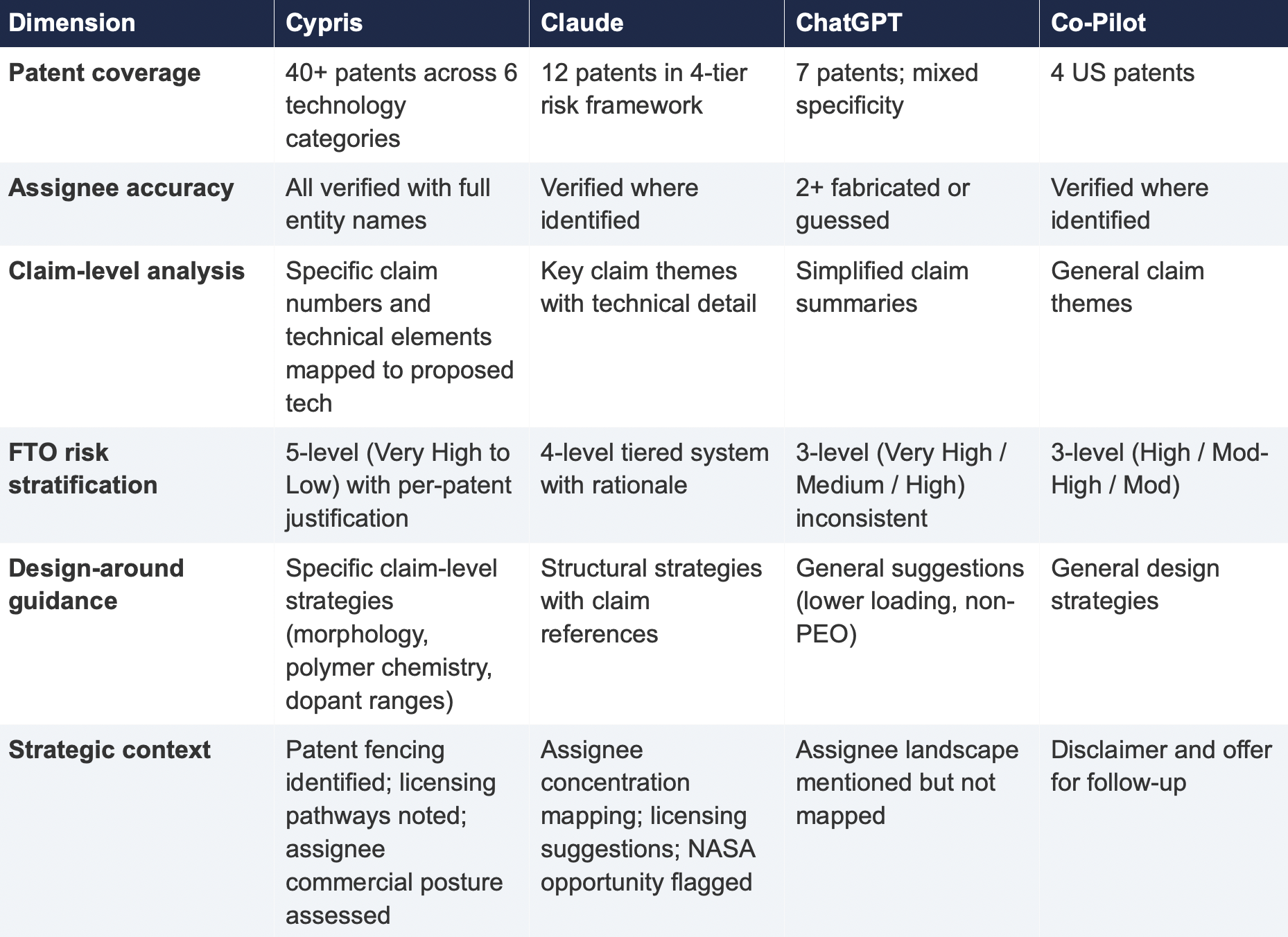
The most significant finding is the scale of the coverage differential. Cypris identified over 40 active US patents and published applications spanning LLZO-polymer composite electrolytes, garnet interface modification, polymer interlayer architectures, lithium-sulfur specific filings, and adjacent ceramic composite patents. The results were organized by technology category with per-patent FTO risk ratings.
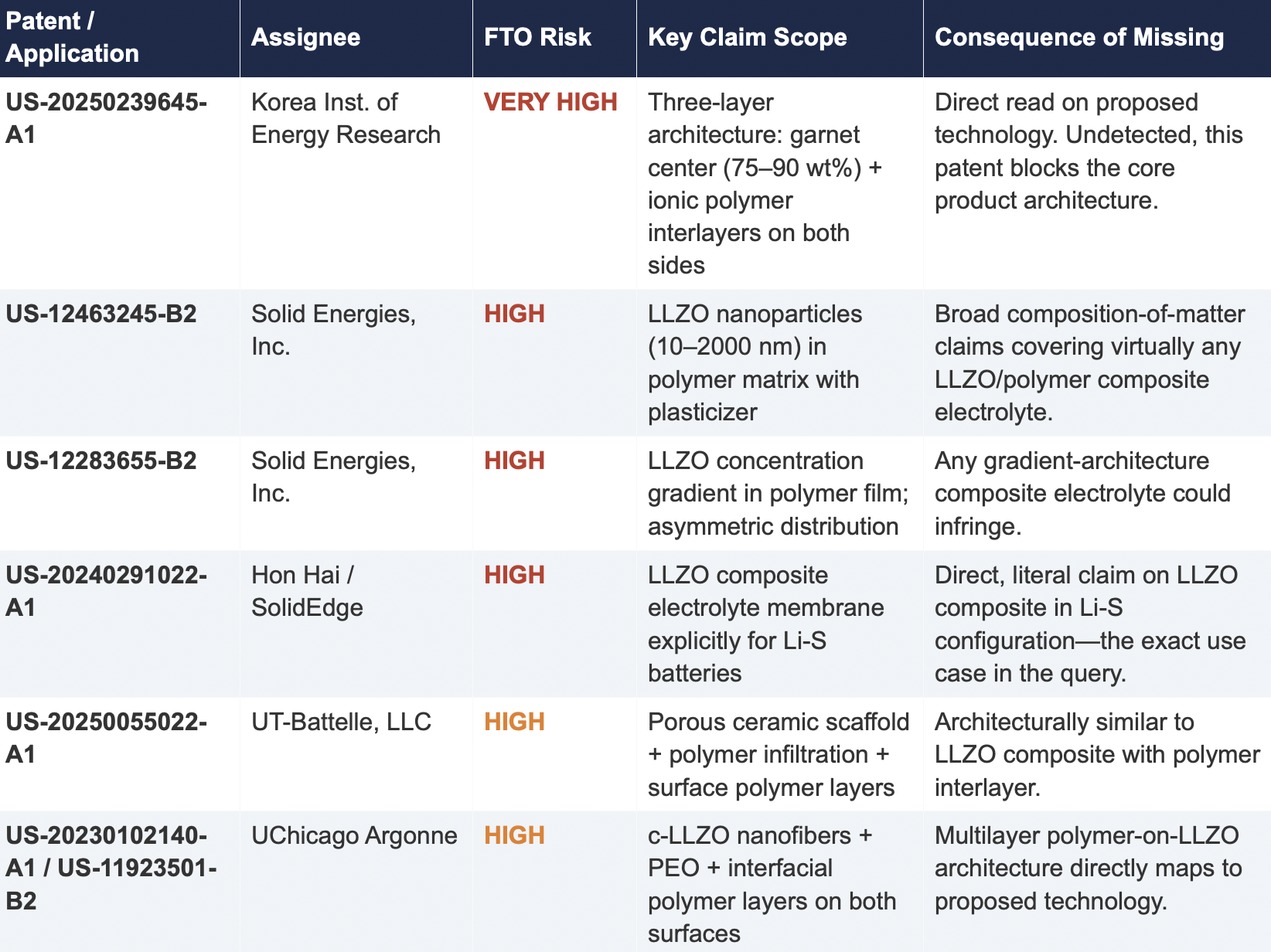
Claude identified 12 patents organized in a four-tier risk framework. Its analysis was structurally sound and correctly flagged the two highest-risk filings (Solid Energies US 11,967,678 and the LLZO nanofiber multilayer US 11,923,501). It also identified the University ofMaryland/ Wachsman portfolio as a concentration risk and noted the NASA SABERS portfolio as a licensing opportunity. However, it missed the majority of the landscape, including the entire Corning portfolio, GM's interlayer patents, theKorea Institute of Energy Research three-layer architecture, and the HonHai/SolidEdge lithium-sulfur specific filing.
ChatGPT identified 7 patents, but the quality of attribution was inconsistent. It listed assignees as "Likely DOE /national lab ecosystem" and "Likely startup / defense contractor cluster" for two filings—language that indicates the model was inferring rather than retrieving assignee data. In a freedom-to-operate context, an unverified assignee attribution is functionally equivalent to no attribution, as it cannot support a licensing inquiry or risk assessment.
Co-Pilot identified 4 US patents. Its output was the most limited in scope, missing the Solid Energies portfolio entirely, theUMD/ Wachsman portfolio, Gelion/ Johnson Matthey, NASA SABERS, and all Li-S specific LLZO filings.
2.2 Critical Patents Missed by Public Models
The following table presents patents identified exclusively by Cypris that were rated as High or Very High FTO risk for the proposed technology architecture. None were surfaced by any general-purpose model.
2.3 Patent Fencing: The Solid Energies Portfolio
Cypris identified a coordinated patent fencing strategy by Solid Energies, Inc. that no general-purpose model detected at scale. Solid Energies holds at least four granted US patents and one published application covering LLZO-polymer composite electrolytes across compositions(US-12463245-B2), gradient architectures (US-12283655-B2), electrode integration (US-12463249-B2), and manufacturing processes (US-20230035720-A1). Claude identified one Solid Energies patent (US 11,967,678) and correctly rated it as the highest-priority FTO concern but did not surface the broader portfolio. ChatGPT and Co-Pilot identified zero Solid Energies filings.
The practical significance is that a company relying on any individual patent hit would underestimate the scope of Solid Energies' IP position. The fencing strategy—covering the composition, the architecture, the electrode integration, and the manufacturing method—means that identifying a single design-around for one patent does not resolve the FTO exposure from the portfolio as a whole. This is the kind of strategic insight that requires seeing the full picture, which no general-purpose model delivered
2.4 Assignee Attribution Quality
ChatGPT's response included at least two instances of fabricated or unverifiable assignee attributions. For US 11,367,895 B1, the listed assignee was "Likely startup / defense contractor cluster." For US 2021/0202983 A1, the assignee was described as "Likely DOE / national lab ecosystem." In both cases, the model appears to have inferred the assignee from contextual patterns in its training data rather than retrieving the information from patent records.
In any operational IP workflow, assignee identity is foundational. It determines licensing strategy, litigation risk, and competitive positioning. A fabricated assignee is more dangerous than a missing one because it creates an illusion of completeness that discourages further investigation. An R&D team receiving this output might reasonably conclude that the landscape analysis is finished when it is not.
3. Structural Limitations of General-Purpose Models for Patent Intelligence
3.1 Training Data Is Not Patent Data
Large language models are trained on web-scraped text. Their knowledge of the patent record is derived from whatever fragments appeared in their training corpus: blog posts mentioning filings, news articles about litigation, snippets of Google Patents pages that were crawlable at the time of data collection. They do not have systematic, structured access to the USPTO database. They cannot query patent classification codes, parse claim language against a specific technology architecture, or verify whether a patent has been assigned, abandoned, or subjected to terminal disclaimer since their training data was collected.
This is not a limitation that improves with scale. A larger training corpus does not produce systematic patent coverage; it produces a larger but still arbitrary sampling of the patent record. The result is that general-purpose models will consistently surface well-known patents from heavily discussed assignees (QuantumScape, for example, appeared in most responses) while missing commercially significant filings from less publicly visible entities (Solid Energies, Korea Institute of EnergyResearch, Shenzhen Solid Advanced Materials).
3.2 The Web Is Closing to Model Scrapers
The data access problem is structural and worsening. As of mid-2025, Cloudflare reported that among the top 10,000 web domains, the majority now fully disallow AI crawlers such as GPTBot andClaudeBot via robots.txt. The trend has accelerated from partial restrictions to outright blocks, and the crawl-to-referral ratios reveal the underlying tension: OpenAI's crawlers access approximately1,700 pages for every referral they return to publishers; Anthropic's ratio exceeds 73,000 to 1.
Patent databases, scientific publishers, and IP analytics platforms are among the most restrictive content categories. A Duke University study in 2025 found that several categories of AI-related crawlers never request robots.txt files at all. The practical consequence is that the knowledge gap between what a general-purpose model "knows" about the patent landscape and what actually exists in the patent record is widening with each training cycle. A landscape query that a general-purpose model partially answered in 2023 may return less useful information in 2026.
3.3 General-Purpose Models Lack Ontological Frameworks for Patent Analysis
A freedom-to-operate analysis is not a summarization task. It requires understanding claim scope, prosecution history, continuation and divisional chains, assignee normalization (a single company may appear under multiple entity names across patent records), priority dates versus filing dates versus publication dates, and the relationship between dependent and independent claims. It requires mapping the specific technical features of a proposed product against independent claim language—not keyword matching.
General-purpose models do not have these frameworks. They pattern-match against training data and produce outputs that adopt the format and tone of patent analysis without the underlying data infrastructure. The format is correct. The confidence is high. The coverage is incomplete in ways that are not visible to the user.
4. Comparative Output Quality
The following table summarizes the qualitative characteristics of each tool's response across the dimensions most relevant to an operational IP workflow.
5. Implications for R&D and IP Organizations
5.1 The Confidence Problem
The central risk identified by this study is not that general-purpose models produce bad outputs—it is that they produce incomplete outputs with high confidence. Each model delivered its results in a professional format with structured analysis, risk ratings, and strategic recommendations. At no point did any model indicate the boundaries of its knowledge or flag that its results represented a fraction of the available patent record. A practitioner receiving one of these outputs would have no signal that the analysis was incomplete unless they independently validated it against a comprehensive datasource.
This creates an asymmetric risk profile: the better the format and tone of the output, the less likely the user is to question its completeness. In a corporate environment where AI outputs are increasingly treated as first-pass analysis, this dynamic incentivizes under-investigation at precisely the moment when thoroughness is most critical.
5.2 The Diversification Illusion
It might be assumed that running the same query through multiple general-purpose models provides validation through diversity of sources. This study suggests otherwise. While the four tools returned different subsets of patents, all operated under the same structural constraints: training data rather than live patent databases, web-scraped content rather than structured IP records, and general-purpose reasoning rather than patent-specific ontological frameworks. Running the same query through three constrained tools does not produce triangulation; it produces three partial views of the same incomplete picture.
5.3 The Appropriate Use Boundary
General-purpose language models are effective tools for a wide range of tasks: drafting communications, summarizing documents, generating code, and exploratory research. The finding of this study is not that these tools lack value but that their value boundary does not extend to decisions that carry existential commercial risk.
Patent landscape analysis, freedom-to-operate assessment, and competitive intelligence that informs R&D investment decisions fall outside that boundary. These are workflows where the completeness and verifiability of the underlying data are not merely desirable but are the primary determinant of whether the analysis has value. A patent landscape that captures 10% of the relevant filings, regardless of how well-formatted or confidently presented, is a liability rather than an asset.
6. Test 2: Competitive Intelligence — Bio-Based Polyamide Patent Landscape
To assess whether the findings from Test 1 were specific to a single technology domain or reflected a broader structural pattern, a second query was submitted to all four tools. This query shifted from freedom-to-operate analysis to competitive intelligence, asking each tool to identify the top 10organizations by patent filing volume in bio-based polyamide synthesis from castor oil derivatives over the past three years, with summaries of technical approach, co-assignee relationships, and portfolio trajectory.
6.1 Query

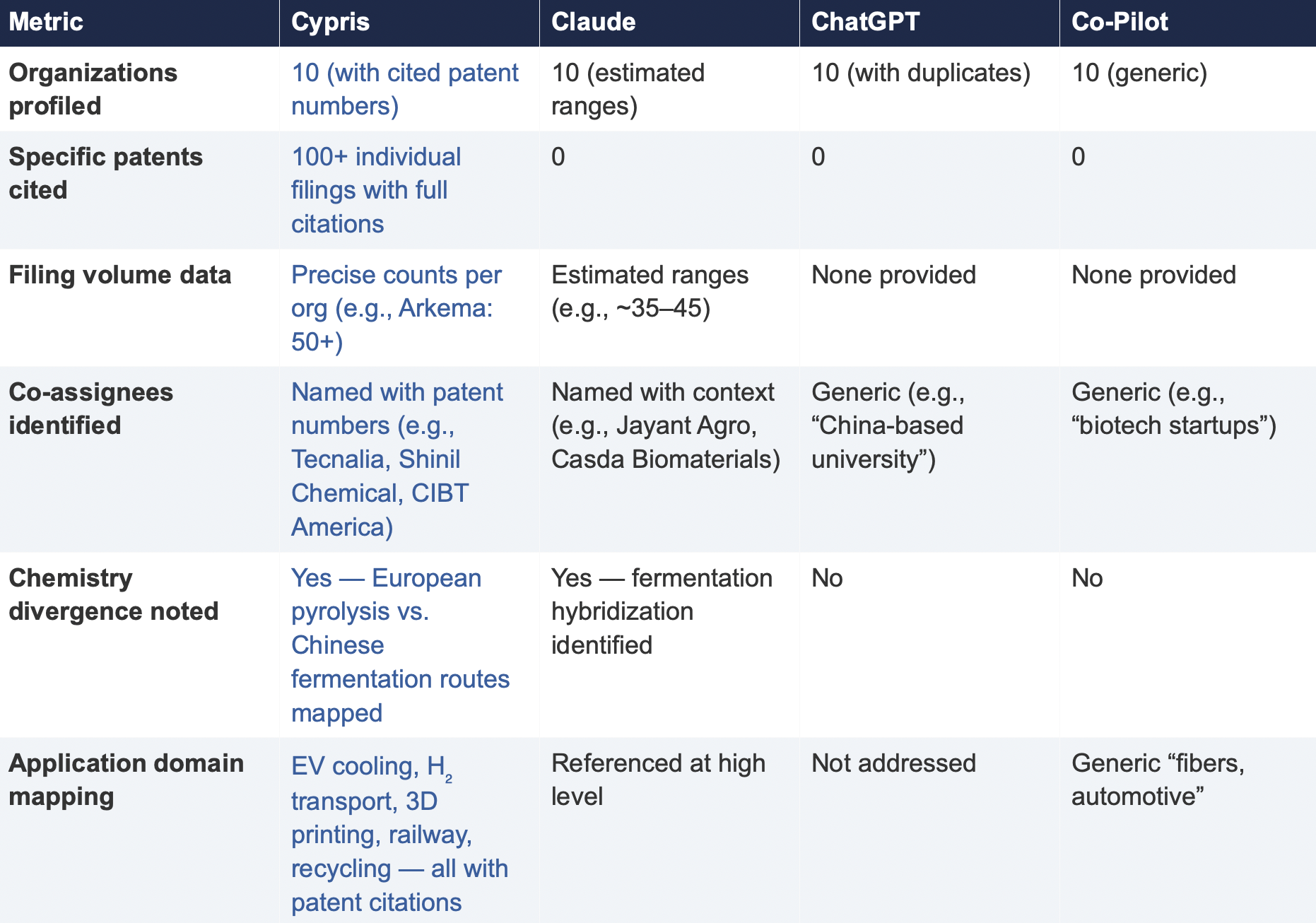
6.2 Summary of Results
6.3 Key Differentiators
Verifiability
The most consequential difference in Test 2 was the presence or absence of verifiable evidence. Cypris cited over 100 individual patent filings with full patent numbers, assignee names, and publication dates. Every claim about an organization’s technical focus, co-assignee relationships, and filing trajectory was anchored to specific documents that a practitioner could independently verify in USPTO, Espacenet, or WIPO PATENT SCOPE. No general-purpose model cited a single patent number. Claude produced the most structured and analytically useful output among the public models, with estimated filing ranges, product names, and strategic observations that were directionally plausible. However, without underlying patent citations, every claim in the response requires independent verification before it can inform a business decision. ChatGPT and Co-Pilot offered thinner profiles with no filing counts and no patent-level specificity.
Data Integrity
ChatGPT’s response contained a structural error that would mislead a practitioner: it listed CathayBiotech as organization #5 and then listed “Cathay Affiliate Cluster” as a separate organization at #9, effectively double-counting a single entity. It repeated this pattern with Toray at #4 and “Toray(Additional Programs)” at #10. In a competitive intelligence context where the ranking itself is the deliverable, this kind of error distorts the landscape and could lead to misallocation of competitive monitoring resources.
Organizations Missed
Cypris identified Kingfa Sci. & Tech. (8–10 filings with a differentiated furan diacid-based polyamide platform) and Zhejiang NHU (4–6 filings focused on continuous polymerization process technology)as emerging players that no general-purpose model surfaced. Both represent potential competitive threats or partnership opportunities that would be invisible to a team relying on public AI tools.Conversely, ChatGPT included organizations such as ANTA and Jiangsu Taiji that appear to be downstream users rather than significant patent filers in synthesis, suggesting the model was conflating commercial activity with IP activity.
Strategic Depth
Cypris’s cross-cutting observations identified a fundamental chemistry divergence in the landscape:European incumbents (Arkema, Evonik, EMS) rely on traditional castor oil pyrolysis to 11-aminoundecanoic acid or sebacic acid, while Chinese entrants (Cathay Biotech, Kingfa) are developing alternative bio-based routes through fermentation and furandicarboxylic acid chemistry.This represents a potential long-term disruption to the castor oil supply chain dependency thatWestern players have built their IP strategies around. Claude identified a similar theme at a higher level of abstraction. Neither ChatGPT nor Co-Pilot noted the divergence.
6.4 Test 2 Conclusion
Test 2 confirms that the coverage and verifiability gaps observed in Test 1 are not domain-specific.In a competitive intelligence context—where the deliverable is a ranked landscape of organizationalIP activity—the same structural limitations apply. General-purpose models can produce plausible-looking top-10 lists with reasonable organizational names, but they cannot anchor those lists to verifiable patent data, they cannot provide precise filing volumes, and they cannot identify emerging players whose patent activity is visible in structured databases but absent from the web-scraped content that general-purpose models rely on.
7. Conclusion
This comparative analysis, spanning two distinct technology domains and two distinct analytical workflows—freedom-to-operate assessment and competitive intelligence—demonstrates that the gap between purpose-built R&D intelligence platforms and general-purpose language models is not marginal, not domain-specific, and not transient. It is structural and consequential.
In Test 1 (LLZO garnet electrolytes for Li-S batteries), the purpose-built platform identified more than three times as many patents as the best-performing general-purpose model and ten times as many as the lowest-performing one. Among the patents identified exclusively by the purpose-built platform were filings rated as Very High FTO risk that directly claim the proposed technology architecture. InTest 2 (bio-based polyamide competitive landscape), the purpose-built platform cited over 100individual patent filings to substantiate its organizational rankings; no general-purpose model cited as ingle patent number.
The structural drivers of this gap—reliance on training data rather than live patent feeds, the accelerating closure of web content to AI scrapers, and the absence of patent-specific analytical frameworks—are not transient. They are inherent to the architecture of general-purpose models and will persist regardless of increases in model capability or training data volume.
For R&D and IP leaders, the practical implication is clear: general-purpose AI tools should be used for general-purpose tasks. Patent intelligence, competitive landscaping, and freedom-to-operate analysis require purpose-built systems with direct access to structured patent data, domain-specific analytical frameworks, and the ability to surface what a general-purpose model cannot—not because it chooses not to, but because it structurally cannot access the data.
The question for every organization making R&D investment decisions today is whether the tools informing those decisions have access to the evidence base those decisions require. This study suggests that for the majority of general-purpose AI tools currently in use, the answer is no.
Study Disclosure
This comparative evaluation was commissioned and published by Cypris. The testing methodology, prompts, evaluation criteria, and underlying outputs have been documented to support independent review and replication.
All platform outputs were preserved in their original form. Patent data and material factual claims were cross-checked against USPTO Patent Center and WIPO PATENTSCOPE records as of March 27, 2026. Cypris was one of the platforms evaluated and therefore has a commercial interest in the findings.
The Patent Intelligence Gap - A Comparative Analysis of Verticalized AI-Patent Tools vs. General-Purpose Language Models for R&D Decision-Making
Blogs

Perception is the part of an autonomous vehicle that turns raw sensor data into an understanding of the road, and its patent landscape is distinctive because value is distributed across a deep stack of sensing, calibration, fusion, and learning technologies. An autonomous vehicle carries an array of sensors, lidar, radar, cameras, and ultrasonics, and perception is the layer that combines them into a coherent, real-time model of the surroundings: detecting and classifying vehicles, pedestrians, and obstacles, tracking their motion, and locating the vehicle on a map. Large-scale multi-sensor benchmarks such as the Waymo Open Dataset have become the reference standard for training and evaluating this layer<sup>1</sup>. The intellectual property divides across several regions, each a distinct area of patenting: the sensors themselves, including lidar hardware; the calibration that aligns the sensors' coordinate frames, without which fusion outputs are biased; the sensor-fusion algorithms that combine the streams at different stages, whether early, feature-level, or late fusion<sup>3,4</sup>; the perception models that perform detection, tracking, and segmentation — an approach with roots in foundational architectures such as MV3D, which fused LiDAR and RGB views for 3D object detection<sup>7</sup>; the mapping and localization systems, including high-definition maps; and, increasingly, the end-to-end learning models that fold several of these steps into a single trained system. Because a working stack depends on several of these layers, freedom-to-operate and white space analysis must span them together.
The landscape is deep, concentrated among leaders, and geographically broad. A small number of established developers hold very large portfolios covering their full self-driving stacks, from sensing and mapping to on-vehicle compute; in Cypris's corpus, China and the United States are roughly neck-and-neck as the two largest filing jurisdictions, with automakers, technology companies, autonomous-driving startups, and universities all active, followed by strong filing in other major markets as foreign developers protect their positions there (see the landscape figures below). A defining technical debate now runs through the landscape: conventional modular pipelines, which separate perception, prediction, and planning into interpretable stages, versus end-to-end learning systems, which train a single model from sensor input to driving action and handle rare situations more flexibly but are harder to interpret and certify. Each approach generates its own IP. Because applications publish about eighteen months after filing, the most recent fusion and end-to-end-model filings are under-represented, so the current frontier is more active than granted-patent counts suggest.
The strategic question is which layer to own, and the white space sits where reliability is hardest. Sensor fusion that stays robust when sensors disagree or degrade, and calibration that holds during operation, are foundational and heavily worked but still advancing — the case for fusion in the first place rests on the fact that no single sensor modality is reliable across all conditions<sup>5</sup>, and combining complementary modalities such as 4D radar and LiDAR is one active response<sup>6</sup>. End-to-end learning models are the fastest-moving frontier, where much of the newest activity concentrates. Perception in adverse conditions, approaches that reduce dependence on high-definition maps, collaborative and vehicle-to-everything perception, and the simulation and validation methods needed to certify safety are all distinct, contested layers. Reading the landscape by layer and by owner, and tracking both the patents and the underlying computer-vision and machine-learning research, is what separates a crowded region from an open one.
Where the autonomous perception white space is
Robust sensor fusion. Fusion that stays accurate when sensors disagree, degrade, or are attacked is a foundational layer where reliability gains carry high value, spanning early, feature-level, and late fusion architectures<sup>3,4</sup>.
End-to-end learning models. Models that map sensor input to driving action in a single trained system are the fastest-moving frontier and the most active recent layer.
Adverse-condition and map-light perception. Perception in rain, fog, and low light, and approaches that reduce dependence on high-definition maps, are distinct, high-value layers, building on the case for multi-modal complementarity established in the fusion literature<sup>5,6</sup>.
Collaborative and vehicle-to-everything perception. Sharing perception between vehicles and infrastructure to see beyond line of sight is an emerging, less-crowded area.
Simulation and validation. Methods to test and certify perception safety, including for rare long-tail scenarios, are where deployment and regulatory approval are decided, and large real-world benchmarks such as the Waymo Open Dataset support this work<sup>1</sup>.
How AI-powered landscape and white space analysis helps
Resolving a landscape that spans sensing, calibration, fusion, perception models, mapping, and end-to-end learning requires more than keyword search. AI-powered analysis addresses this with semantic search that clusters activity by layer and approach across varied terminology, attribution that normalizes automaker, technology-company, startup, and university filers to canonical entities across jurisdictions, and continuous monitoring that keeps pace with a fast-moving field. Because perception advances appear in computer-vision and machine-learning literature before they are patented, reading both patents and literature gives the earliest signal of where the frontier and the white space are moving.
The competitive landscape by the numbers
Cypris's corpus puts the autonomous-driving-perception patent family set at roughly 36,227 families (Cypris corpus, indicative; 2025–26 partial). Filing has accelerated from 285 new families in 2015 to 1,249 in 2018 and 4,354 in 2024, with 2025 (6,749) and 2026 (6,012, partial) continuing that climb (Cypris corpus, indicative; 2025–26 partial). Jurisdiction distribution shows China (11,593 families, 612 assignees) and the United States (10,837 families, 354 assignees) essentially neck-and-neck at the top, followed by Germany (2,331), South Korea (953), Japan (722), Sweden (431), and Israel (267) (Cypris corpus, indicative; 2025–26 partial). Assignee concentration is led by Waymo (1,101 families), Aurora (1,000), Bosch (787), General Motors (685), Ford (637), Baidu (604), Nvidia (570), GM Cruise (470), and Zoox (444) (Cypris corpus, indicative; 2025–26 partial) — figures drawn from the Cypris corpus rather than any company's own disclosed portfolio size, since issuer-reported totals were not independently available for this set. These per-company totals should be treated as lower bounds: assignee names are not fully canonicalized in the underlying index (for example, GM Global Technology Operations filings sit apart from GM Cruise, and Baidu USA filings sit apart from Baidu's Beijing entity), so known name variants should be summed before publishing a definitive ranking.
Where Cypris fits
Cypris runs patent landscape and white space analysis for fast-moving, cross-disciplinary fields such as autonomous driving perception across a corpus of more than 500 million patents and scientific papers, organized through a proprietary R&D ontology. The ontology clusters activity by layer, sensing, calibration, fusion, perception models, mapping, and end-to-end learning, and normalizes automaker, technology-company, startup, and university filers to canonical entities across jurisdictions, so a team can resolve which layers are crowded and which remain open as white space. Semantic search across patents and scientific literature connects filings to the underlying computer-vision and machine-learning research, which is where perception advances appear first, often well ahead of the patent record. Cypris Q, the platform's agentic layer, lets teams run landscape and white space analysis conversationally and chain the clustering, attribution, and gap analysis, and Agentic Monitoring tracks a defined layer over time and flags new patents and papers as they publish. Cypris provides enterprise API partnerships with OpenAI, Anthropic, and Google, and is built with enterprise-grade security. Cypris serves hundreds of enterprise customers across pharmaceuticals, chemicals, advanced materials, energy, and other regulated industries.
FAQ
What is autonomous driving perception? Autonomous driving perception is the layer that turns data from lidar, radar, cameras, and other sensors into a real-time model of the vehicle's surroundings, detecting and tracking objects and localizing the vehicle. It sits between raw sensing and the prediction and planning that decide how the vehicle moves. It is central to the safety and capability of a self-driving system.
What layers does the perception patent landscape cover? The landscape covers the sensors themselves, calibration, sensor fusion, perception models for detection and tracking, mapping and localization, and end-to-end learning models<sup>3,4,7</sup>. Each is a distinct region of patenting with different owners. Freedom-to-operate and white space analysis must span them together.
Who holds the IP in autonomous perception? A small number of established developers hold very large portfolios covering their full self-driving stacks. In Cypris's corpus, Waymo, Aurora, and Bosch lead the assignee ranking, and China and the United States are roughly neck-and-neck as the two largest filing jurisdictions, with automakers, technology companies, startups, and universities all active (Cypris corpus, indicative; 2025–26 partial). Foreign developers also file heavily in other major markets to protect their positions.
What is the modular-versus-end-to-end debate? The modular-versus-end-to-end debate is the architectural choice between separating perception, prediction, and planning into distinct, interpretable stages, and training a single model that maps sensor input directly to driving action. Modular systems are easier to interpret and certify; end-to-end systems handle rare situations more flexibly but are harder to interpret. Each approach generates its own IP.
Why is sensor fusion necessary in the first place? Sensor fusion is necessary because no single sensor modality — lidar, radar, or camera — is reliable across all conditions on its own, so combining complementary modalities, such as 4D radar with LiDAR, improves robustness where any one sensor would fail<sup>5,6</sup>. This is why fusion architecture, spanning early, feature-level, and late fusion, is a foundational and heavily worked layer<sup>3,4</sup>. It remains an active area even though it is comparatively mature.
Where is the white space in autonomous perception? The white space includes robust sensor fusion, end-to-end learning models, adverse-condition and map-light perception, collaborative and vehicle-to-everything perception, and simulation and validation. The core sensing and fusion layers are heavily worked. The fastest-moving and most open opportunities are in end-to-end learning and in reliability under difficult conditions.
Why does perception analysis need scientific literature? Perception analysis needs scientific literature because computer-vision and machine-learning advances appear in research and conference proceedings before they are patented, so the literature gives the earliest signal in a fast-moving field. Analyzing patents alone gives a lagging view. Cypris analyzes both across more than 500 million patents and scientific papers.
What software helps analyze the autonomous driving perception patent landscape? Software for the perception landscape should cluster activity by layer and approach, resolve automaker, technology-company, startup, and university filers to canonical owners across jurisdictions, search patents and scientific literature semantically, and monitor a fast-moving field continuously. Cypris does this across more than 500 million patents and scientific papers using a proprietary R&D ontology, semantic search, Cypris Q, and Agentic Monitoring.
Which teams use autonomous perception patent landscape analysis? Autonomous perception patent landscape analysis is used by R&D, IP, and strategy teams at automakers, autonomous-driving and sensor companies, and technology firms, as well as investors assessing the sector. Because the landscape is deep, concentrated, and moving fast, structured analysis is essential. Cypris serves hundreds of enterprise customers across research-intensive and regulated industries.
Endnotes
- Sun P, Kretzschmar H, Vasudevan V, et al. (Google/Waymo). Scalability in perception for autonomous driving: Waymo Open Dataset. CVPR. 2020. DOI: 10.1109/cvpr42600.2020.00252.
- Mao Q, Zhang Y, et al. Multi-modal 3D object detection in autonomous driving: a survey. International Journal of Computer Vision. 2023. DOI: 10.1007/s11263-023-01784-z.
- Bi J, Wang L, et al. Multi-modal 3D object detection in autonomous driving: a survey and taxonomy. IEEE Transactions on Intelligent Vehicles. 2023. DOI: 10.1109/tiv.2023.3264658.
- Chehri A, et al. Multi-sensor fusion technology for 3D object detection in autonomous driving: a review. IEEE Transactions on Intelligent Transportation Systems. 2023. DOI: 10.1109/tits.2023.3317372.
- Tang Y, et al. Multi-modality 3D object detection in autonomous driving: a review. Neurocomputing. 2023. DOI: 10.1016/j.neucom.2023.126587.
- Wang L, et al. Multi-modal and multi-scale fusion 3D object detection of 4D radar and LiDAR. IEEE Transactions on Vehicular Technology. 2022. DOI: 10.1109/tvt.2022.3230265.
- Chen X, Ma H, et al. Multi-view 3D object detection network for autonomous driving (MV3D). CVPR. 2017. DOI: 10.1109/cvpr.2017.691.
- Cypris platform corpus analysis, autonomous-driving-perception patent families. Indicative figures; 2025–2026 partial.
Enhanced geothermal systems have moved from research pilots to commercial deployment, and their patent landscape is being staked out as the field adapts oil-and-gas technology to a new purpose. Conventional geothermal power is limited to the few places where hot rock, natural permeability, and fluid coincide; enhanced geothermal systems remove that limitation by engineering a reservoir in hot dry rock, drilling injection and production wells, stimulating a network of fractures — through hydraulic, chemical, or thermal means — to create permeability, and circulating a working fluid to carry heat to the surface<sup>1</sup>. This promises round-the-clock, carbon-free baseload power in far more locations, and it is being built largely by transferring horizontal drilling, hydraulic fracturing, and downhole sensing from the shale industry, including multistage-fractured horizontal well pairs that improve heat extraction relative to single-fracture designs<sup>2</sup>. Field-scale designs illustrate the resource depths involved: a two-horizontal-well EGS project at the Zhacang field reached a bottom-hole temperature of 214°C at 4,700 meters<sup>3</sup>. The intellectual property divides across several regions, each a distinct area of patenting: open-loop reservoir stimulation, including well-pair architecture, horizontal wells, and fracture creation; closed-loop systems that circulate fluid through sealed wellbores without fracturing; advanced and non-mechanical drilling, including energy-based methods; downhole sensing and monitoring, such as distributed fiber-optic measurement; the working fluids themselves, from water to supercritical carbon dioxide; and integration with thermal energy storage for dispatchable output. Because a commercial project depends on several of these layers, freedom-to-operate and white space analysis must span the approaches and the enabling layers together.
The landscape has shifted decisively into a deployment era. A first-of-its-kind, roughly 500-megawatt commercial EGS project — Fervo Energy's Cape Station in Utah — is under construction, and the U.S. Department of Energy's and NREL's 2025 U.S. Geothermal Market Report documents materially improved drilling rates across Utah FORGE and Fervo's own drilling campaigns as shale techniques have been imported into geothermal<sup>7</sup>. The build is a phased, multi-year process rather than a single completed plant: a utility power-purchase agreement tied to one phase of Cape Station was amended in January 2025, with an expected commercial operation date of January 1, 2031, according to the California Public Utilities Commission record<sup>9</sup>, and financing and offtake structure are disclosed in Fervo's own SEC registration and periodic filings<sup>8</sup>. The competitive picture spans dedicated developers pursuing open-loop, horizontal well-pair designs; closed-loop specialists; the major oilfield-services companies bringing drilling, measurement, and sensing IP; and a set of drilling startups pursuing non-mechanical methods such as millimeter-wave, plasma, and laser rock removal to reach deeper, hotter resources. Because applications publish about eighteen months after filing, the most recent drilling, stimulation, and sensing filings are under-represented, so the current frontier is more active than granted-patent counts suggest.
The strategic question is which enabling layer to own, and the white space sits where cost and depth are the barriers. Drilling is the single largest cost in an EGS project — a cost-methodology lineage that traces back to early national-laboratory work on hot-dry-rock electricity economics<sup>6</sup> — so advanced and non-mechanical drilling methods that cut time and reach deeper, hotter rock are a high-value, fast-moving layer. Closed-loop architectures that avoid fracturing, working fluids such as supercritical carbon dioxide, superhot-rock and superdeep resources, downhole sensing that improves reservoir control, induced-seismicity mitigation — a risk that fracture-network modeling work is increasingly used to manage<sup>4</sup> — and integration with thermal storage for dispatchable power are all distinct, contested areas. Reading the landscape by approach, enabling layer, and owner, and tracking both the patents and the underlying geoscience and drilling research, is what separates a crowded region from an open one.
Where the enhanced geothermal white space is
Advanced and non-mechanical drilling. Energy-based drilling methods that cut drilling time and reach deeper, hotter rock address the single largest cost in an EGS project<sup>6,7</sup>.
Closed-loop architectures. Sealed-wellbore designs that circulate fluid without fracturing are a distinct approach that avoids some reservoir and seismicity risks.
Working fluids and superhot rock. Supercritical carbon dioxide and other working fluids, and access to superhot and superdeep resources, are high-value, less-crowded layers.
Downhole sensing and reservoir control. Distributed fiber-optic sensing and real-time reservoir characterization improve performance and reduce risk, including around induced seismicity<sup>4</sup>.
Seismicity mitigation and thermal-storage integration. Induced-seismicity management and integration with thermal energy storage for dispatchable output are distinct, strategically important layers.
How AI-powered landscape and white space analysis helps
Resolving a landscape that spans stimulation, drilling, sensing, and integration, built by transferring technology from oil and gas, requires more than keyword search. AI-powered analysis addresses this with semantic search that clusters activity by approach and enabling layer across varied terminology, attribution that normalizes developer, oilfield-services, and startup filers to canonical entities, and continuous monitoring that keeps pace with a fast-deploying field. Because geothermal advances appear in scientific and engineering literature before they are patented, reading both patents and literature gives the earliest signal of where cost and depth barriers are falling.
The competitive landscape by the numbers
Cypris's corpus puts the enhanced geothermal / hot-dry-rock / reservoir-stimulation patent family set at roughly 1,157 families (Cypris corpus, indicative; 2025–26 partial). Filing rose from single digits per year before 2010 to a plateau of roughly 68–142 new families per year between 2017 and 2024, peaking around 142 in 2022, with 2025 (86) and 2026 (59, partial) continuing (Cypris corpus, indicative; 2025–26 partial). China (781 families) and the United States (171) dominate, with Canada (25) and smaller tails in Europe and Australia (Cypris corpus, indicative; 2025–26 partial). The assignee ranking reflects the oil-and-gas technology-transfer story described above: Sinopec (40 families) and its Sinopec Petroleum Engineering unit (21) lead, alongside China University of Mining and Technology-Beijing (23), the University of Minnesota (15), Halliburton (12), Johns Hopkins University (11), and UT-Battelle/Oak Ridge National Laboratory (6) (Cypris corpus, indicative; 2025–26 partial) — a mix of oilfield-services majors, universities, and national labs that mirrors the field's drilling and stimulation lineage.
Where Cypris fits
Cypris runs patent landscape and white space analysis for fast-deploying energy fields such as enhanced geothermal systems across a corpus of more than 500 million patents and scientific papers, organized through a proprietary R&D ontology. The ontology clusters activity by approach, open-loop stimulation, closed-loop, and advanced drilling, and by enabling layer, drilling, sensing, working fluids, and integration, and normalizes developer, oilfield-services, and startup filers to canonical entities, so a team can resolve which approaches and layers are crowded and which remain open as white space. Semantic search across patents and scientific literature connects filings to the underlying geoscience and drilling research, which is where EGS advances appear first. Cypris Q, the platform's agentic layer, lets teams run landscape and white space analysis conversationally and chain the clustering, attribution, and gap analysis, and Agentic Monitoring tracks a defined layer over time and flags new patents and papers as they publish. Cypris provides enterprise API partnerships with OpenAI, Anthropic, and Google, and is built with enterprise-grade security. Cypris serves hundreds of enterprise customers across pharmaceuticals, chemicals, advanced materials, energy, and other regulated industries.
FAQ
What are enhanced geothermal systems? Enhanced geothermal systems create geothermal reservoirs where natural permeability is insufficient, by drilling well pairs into hot dry rock, stimulating a fracture network, and circulating a working fluid to carry heat to the surface<sup>1</sup>. This makes round-the-clock, carbon-free geothermal power possible in far more locations. The technology adapts drilling and stimulation from the oil-and-gas sector<sup>2</sup>.
Why is EGS a patenting hotspot now? EGS is a patenting hotspot now because the field has moved from pilots to commercial-scale projects such as Fervo Energy's Cape Station, developers have documented improved drilling times by importing shale techniques<sup>7</sup>, and technology firms have signed power deals for data centers backed by disclosed financing and offtake structures<sup>8,9</sup>. That deployment shift is driving filings across drilling, stimulation, and sensing.
What layers does the EGS landscape cover? The landscape covers open-loop reservoir stimulation, closed-loop well architectures, advanced and non-mechanical drilling, downhole sensing, working fluids, and thermal-storage integration. Each is a distinct region of patenting with different owners. Freedom-to-operate and white space analysis must span them together.
Where is the white space in enhanced geothermal systems? The white space includes advanced and non-mechanical drilling, closed-loop architectures, working fluids and superhot-rock access, downhole sensing and reservoir control, and seismicity mitigation and thermal-storage integration. Drilling is the largest cost, so drilling innovation is especially high-value. The most open opportunities are in cutting cost and reaching deeper, hotter rock.
Why is drilling the key cost in EGS? Drilling is the key cost because reaching hot rock deep underground and creating well pairs is capital-intensive, tracing back to cost-methodology work first developed for hot-dry-rock electricity at the national-laboratory level<sup>6</sup>, so reducing drilling time and reaching deeper, hotter resources directly determines project economics<sup>7</sup>. That is why advanced and non-mechanical drilling methods are such an active, high-value layer.
Is Cape Station a completed 500-megawatt plant today? Not yet — Cape Station is best described as a first-of-its-kind, roughly 500-megawatt commercial EGS project that is being built in phases<sup>7</sup>. A utility power-purchase agreement tied to one phase carries an expected commercial operation date of January 1, 2031, per the California Public Utilities Commission record<sup>9</sup>, so current statements should describe it as under construction with forward delivery dates rather than as fully operational.
Why does EGS analysis need scientific literature? EGS analysis needs scientific literature because drilling, stimulation, and sensing advances appear in geoscience and engineering research before they are patented, so the literature gives the earliest signal. Analyzing patents alone gives a lagging view. Cypris analyzes both across more than 500 million patents and scientific papers.
What software helps analyze the enhanced geothermal patent landscape? Software for the EGS landscape should cluster activity by approach and enabling layer, resolve developer, oilfield-services, and startup filers to canonical owners, search patents and scientific literature semantically, and monitor a fast-deploying field continuously. Cypris does this across more than 500 million patents and scientific papers using a proprietary R&D ontology, semantic search, Cypris Q, and Agentic Monitoring.
Which teams use enhanced geothermal patent landscape analysis? Enhanced geothermal patent landscape analysis is used by R&D, IP, and strategy teams at geothermal developers, oilfield-services and drilling companies, utilities, and technology buyers, as well as investors assessing the sector. Because the field is deploying fast and spans several enabling layers, structured analysis is essential. Cypris serves hundreds of enterprise customers across energy and other research-intensive industries.
Endnotes
- Niemi A, Tsang C-F, et al. Hydraulic stimulation strategies in enhanced geothermal systems (EGS): a review. Geomechanics and Geophysics for Geo-Energy and Geo-Resources. 2022. DOI: 10.1007/s40948-022-00516-w.
- Qu Z, et al. Evaluation of geothermal energy extraction in EGS with multiple fracturing horizontal wells. Renewable Energy. 2019. DOI: 10.1016/j.renene.2019.11.134.
- Lei Z, et al. Reservoir stimulation design and heat exploitation of a two-horizontal-well EGS, Zhacang field. Renewable Energy. 2021. DOI: 10.1016/j.renene.2021.10.101.
- Xu T, et al. Discrete element modeling for multistage hydraulic stimulation of a horizontal well in hot dry rock. Computers and Geotechnics. 2023. DOI: 10.1016/j.compgeo.2023.105274.
- Wang G, et al. Heat extraction mechanism in hot dry rock based on horizontal wells with multi-stage fracturing. Energy. 2026. DOI: 10.1016/j.energy.2026.140217.
- Pierce K, Livesay BJ (Sandia National Laboratories). An estimate of the cost of electricity production from hot-dry rock. 1993. DOE/OSTI.
- U.S. Department of Energy / National Renewable Energy Laboratory. U.S. Geothermal Market Report. 2025.
- Fervo Energy. SEC registration and periodic filings — Form S-1; Form 424(b)(4); Form 10-Q for the period ended June 30, 2026. sec.gov.
- California Public Utilities Commission. Power-purchase agreement filing tied to Cape Station, amended January 9, 2025. docs.cpuc.ca.gov.
- Cypris platform corpus analysis, enhanced geothermal / hot-dry-rock / reservoir-stimulation patent families. Indicative figures; 2025–2026 partial.

Green steel has become one of the most closely watched areas of industrial decarbonization, and its patent landscape is distinctive because low-carbon steelmaking is not a single technology but a set of competing routes, each with its own chemistry and process engineering. Conventional steelmaking reduces iron ore with coal-derived coke in a blast furnace, and ironmaking generates roughly 7 percent of global CO2 emissions across an industry producing about 1.85 billion tonnes of steel a year<sup>2</sup>. The leading low-carbon routes replace that chemistry in different ways, and each is a distinct region of patenting: hydrogen-based direct reduction uses green hydrogen instead of coke to turn iron ore into sponge iron, which is then melted in an electric arc furnace<sup>3</sup>; molten oxide electrolysis passes electricity through molten iron ore, producing liquid metal and oxygen at the anode with no process CO2 given a clean electricity input<sup>4</sup>; and low-temperature electrochemical routes produce iron from ore or low-grade feedstocks by electrowinning, though the aqueous chemistry still faces a hydrogen-evolution-reaction efficiency bottleneck that limits faradaic efficiency<sup>7</sup>. Because each route relies on different core steps, anode and electrolyte materials, hydrogen integration, ore handling, and furnace design, freedom-to-operate and white space analysis must treat green steel as several landscapes at once.
The field is moving from pilots to first industrial-scale plants. A hydrogen direct-reduction plant designed for a developer-reported emissions reduction of up to roughly 95 percent versus blast-furnace production — a figure consistent with, though not itself drawn from, peer-reviewed techno-economic modeling of the H2-DRI/EAF route<sup>1</sup> — is being built at industrial scale and is on track to begin production, and electrolysis-based developers are scaling reactors toward commercial output. The intellectual property reflects the maturity gap between the routes: hydrogen direct reduction builds on established direct-reduced-iron practice and concentrates IP in hydrogen integration, reduction control, and furnace operation, with break-even hydrogen pricing as a central techno-economic question in the peer-reviewed literature<sup>1</sup>, while the electrolysis routes concentrate foundational IP in the inert-anode and electrolyte materials and cell designs that make emission-free iron production work<sup>4,5</sup>, much of it traceable to a small number of academic and company lineages. Because applications publish about eighteen months after filing, the most recent electrolysis and process filings are under-represented, so the current frontier is more active than granted-patent counts suggest.
The strategic question is which route and layer to back, and the white space sits where cost, materials, and feedstock constraints are hardest. In hydrogen direct reduction, the open ground is in reducing hydrogen consumption and cost, tolerating lower-grade ore, and integrating variable hydrogen supply<sup>1</sup>. In molten oxide electrolysis, durable inert-anode materials that survive the process are the central, high-value problem<sup>4</sup>. In low-temperature electrowinning, the opportunity is in efficient electrochemistry and the use of low-grade ores and mining waste, with comparative techno-economic analysis showing how the three electrolysis-adjacent routes trade off against hydrogen reduction<sup>6,7</sup>. Across all routes, ore flexibility is strategically important because some routes require scarce high-grade ore. Reading the landscape by route, core step, and owner, and tracking both the patents and the underlying process research, is what separates a crowded region from an open one.
Where the green-steel white space is
Inert-anode and electrolyte materials. Durable anode and electrolyte materials that survive molten oxide electrolysis are the central, high-value problem for the electrolysis route<sup>4,5</sup>.
Low-grade ore tolerance. Processes that use lower-grade ore or mining waste ease the feedstock constraint that limits some routes and broaden where plants can be sited.
Hydrogen integration and reduction control. Reducing hydrogen consumption and cost and integrating variable green-hydrogen supply in direct reduction is a large, active layer, with break-even hydrogen price as the key economic lever<sup>1</sup>.
Low-temperature electrochemical iron production. Efficient aqueous-phase electrowinning of iron is an earlier, less-crowded route with distinct chemistry, currently constrained by hydrogen-evolution-reaction efficiency losses<sup>7</sup>.
Furnace and process integration. Integrating direct-reduced iron with electric arc furnaces and optimizing continuous operation is where cost and quality are decided<sup>3</sup>.
How AI-powered landscape and white space analysis helps
Resolving a landscape that spans several production routes, each with its own chemistry and process, requires more than keyword search. AI-powered analysis addresses this with semantic search that clusters activity by route, core step, and material across varied terminology, attribution that normalizes filers to canonical entities and tracks new entrants, and continuous monitoring that keeps pace with a fast-commercializing field. Because green-steel advances appear in scientific and process-engineering literature before they are patented, reading both patents and literature gives the earliest signal of where scalable routes are emerging.
The competitive landscape by the numbers
Cypris's corpus puts the low-carbon steelmaking patent family set — spanning hydrogen-DRI, electrolysis/molten oxide electrolysis, electrowinning, and general "green steel" filings — at roughly 27,049 families (Cypris corpus, indicative; 2025–26 partial). Filing has run at roughly 900–1,900 new families per year across 2016–2024, with 2025 (2,210) and 2026 (1,750, partial) continuing the trend (Cypris corpus, indicative; 2025–26 partial). The assignee ranking spans both steel majors and petrochemical/catalysis houses: Sinopec (431 families), Nippon Steel (229), ArcelorMittal (215), JFE (98), and Northeastern University (111) lead the count (Cypris corpus, indicative; 2025–26 partial) — worth flagging, since several of the top filers are catalysis and process-engineering companies rather than primary steelmakers, so the set is broader than steel production alone. Geographically, China dominates with 14,065 families, followed by the United States (1,233), Germany (636), Japan (329), Luxembourg (271, reflecting ArcelorMittal's filings), and Sweden (151) (Cypris corpus, indicative; 2025–26 partial).
Where Cypris fits
Cypris runs patent landscape and white space analysis for multi-route industrial fields such as green steel across a corpus of more than 500 million patents and scientific papers, organized through a proprietary R&D ontology. The ontology clusters activity by route, hydrogen direct reduction, molten oxide electrolysis, and electrowinning, and by layer, anode and electrolyte, hydrogen integration, ore handling, and furnace design, and normalizes filers to canonical entities, so a team can resolve which routes and layers are crowded and which remain open as white space, and can track new entrants as the field scales. Semantic search across patents and scientific literature connects filings to the underlying process and materials research, which is where green-steel advances appear first. Cypris Q, the platform's agentic layer, lets teams run landscape and white space analysis conversationally and chain the clustering, attribution, and gap analysis, and Agentic Monitoring tracks a defined route over time and flags new patents and papers as they publish. Cypris provides enterprise API partnerships with OpenAI, Anthropic, and Google, and is built with enterprise-grade security. Cypris serves hundreds of enterprise customers across pharmaceuticals, chemicals, advanced materials, energy, and other regulated industries.
FAQ
What is the green steel patent landscape? The green steel patent landscape is the set of patents covering low-carbon steelmaking. It divides across competing routes, hydrogen-based direct reduction feeding an electric arc furnace, molten oxide electrolysis, and low-temperature electrowinning, each with distinct chemistry and process IP<sup>1,4,7</sup>. Each route is a distinct region of patenting.
Why is steelmaking a decarbonization priority? Steelmaking is a decarbonization priority because ironmaking generates roughly 7 percent of global CO2 emissions across an industry producing about 1.85 billion tonnes of steel a year<sup>2</sup>. Low-carbon routes replace coke-based reduction with hydrogen or electricity. The first industrial-scale plants are now being built.
What routes does the green-steel landscape cover? The landscape covers hydrogen-based direct reduced iron, which uses green hydrogen instead of coke<sup>3</sup>; molten oxide electrolysis, which splits molten iron ore with electricity to yield liquid metal and oxygen<sup>4</sup>; and low-temperature electrochemical iron production by electrowinning<sup>6,7</sup>. Each relies on different core steps and materials. Freedom-to-operate and white space analysis must treat them separately.
Where is the white space in green steel? The white space includes inert-anode and electrolyte materials for electrolysis, low-grade ore tolerance, hydrogen integration and reduction control, low-temperature electrochemical iron production, and furnace and process integration. The routes sit at different maturity levels. The most open, high-value opportunities are in the electrolysis materials and in ore and hydrogen flexibility.
Why are inert-anode materials so important? Inert-anode materials are important because molten oxide electrolysis depends on an anode that can survive extreme temperatures and produce oxygen rather than carbon dioxide, and finding durable, affordable anode and electrolyte materials is the central technical problem for that route<sup>4,5</sup>. Solving it is what makes emission-free electrolytic iron viable. Much of the route's defensible IP concentrates there.
Is molten oxide electrolysis actually "zero-carbon"? Molten oxide electrolysis is more precisely described as producing oxygen and liquid metal with no process CO2, provided the electricity input is clean — the process itself does not emit carbon during reduction, but the claim depends on the power source<sup>4</sup>. Unqualified "zero-carbon" framing overstates this without specifying the electricity mix. That distinction matters for both technical and disclosure purposes.
Who is filing green-steel patents, and where? In Cypris's corpus of roughly 27,049 low-carbon steelmaking patent families, China dominates filing activity, followed by the United States, Germany, Japan, and Luxembourg, and the assignee ranking includes both steel majors (Nippon Steel, ArcelorMittal, JFE) and petrochemical/catalysis filers (Sinopec) (Cypris corpus, indicative; 2025–26 partial).
Why does green-steel analysis need scientific literature? Green-steel analysis needs scientific literature because reduction, electrolysis, and materials advances appear in process research before they are patented, so the literature gives the earliest signal. Analyzing patents alone gives a lagging view. Cypris analyzes both across more than 500 million patents and scientific papers.
What software helps analyze the green steel patent landscape? Software for the green-steel landscape should cluster activity by route and process layer, resolve filers to canonical owners, search patents and scientific literature semantically, and monitor a fast-commercializing field continuously. Cypris does this across more than 500 million patents and scientific papers using a proprietary R&D ontology, semantic search, Cypris Q, and Agentic Monitoring.
Which teams use green steel patent landscape analysis? Green steel patent landscape analysis is used by R&D, innovation, IP, and strategy teams at steelmakers, mining and materials companies, electrolysis and hydrogen developers, and their partners, as well as investors and policymakers. It informs which route to back, where to file, and where competitors are concentrated. Cypris serves hundreds of enterprise customers across advanced materials, energy, chemicals, and other regulated industries.
Endnotes
- Papadias DD, Brooks K, Yoro KO, Autrey T, et al. (Argonne National Laboratory, Lawrence Berkeley National Laboratory, Pacific Northwest National Laboratory; DOE-funded). Green steel: design and cost analysis of hydrogen-based direct iron reduction. Energy & Environmental Science. 2023. DOI: 10.1039/d3ee01077e.
- Bae JW, Raabe D, et al. Reducing iron oxide with ammonia: a sustainable path to green steel. Advanced Science. 2023. DOI: 10.1002/advs.202300111.
- Boretti A. The perspective of hydrogen direct reduction of iron. Journal of Cleaner Production. 2023. DOI: 10.1016/j.jclepro.2023.139585.
- Paramore JD, Kim H, Allanore A, Sadoway DR (MIT). Stability of iridium anode in molten oxide electrolysis for ironmaking. ECS Transactions. 2010. DOI: 10.1149/1.3484779.
- Azimi G, Allanore A, Judge WD, Sadoway DR. E-logpO2 diagrams for ironmaking by molten oxide electrolysis. Electrochimica Acta. 2017. DOI: 10.1016/j.electacta.2017.07.059.
- Rhamdhani MA, et al. (CSIRO, Swinburne University). Economics of electrowinning iron from ore for green steel production. Journal of Sustainable Metallurgy. 2024. DOI: 10.1007/s40831-024-00878-3.
- Viswanathan V, Kavalsky L. Electrowinning for room-temperature ironmaking: mapping the electrochemical aqueous iron interface. Journal of Physical Chemistry C. 2024. DOI: 10.1021/acs.jpcc.4c01867.
- Cypris platform corpus analysis, low-carbon steelmaking patent families. Indicative figures; 2025–2026 partial.
Reports
Foundation AI is getting more powerful every quarter, but better models alone won’t produce better R&D decisions. The real gap is the “harness”: the evidence, ontologies, domain context, and workflows the model is given to reason over. As access to frontier models becomes commoditized, competitive advantage will come from the intelligence layered on top of them. In our latest report, The Harness Problem, we break down why this matters for R&D and IP teams, what a serious enterprise deployment requires, and how to tell if your organization has this gap.
This Cypris research brief maps the full ecosystem and value chain of electric vehicle battery systems and advanced battery materials, tracing the pathway from raw material extraction through precursor and active material production, cell component manufacturing, battery cell production, pack assembly, vehicle integration, and end-of-life recycling. The brief defines each segment's functional role, identifies key players across upstream, midstream, and downstream layers, and analyzes the structural forces — including critical mineral supply volatility, geographic concentration, OEM vertical integration strategies, recycling-driven circularity, and solid-state battery development — that are reshaping where value concentrates and where supply-chain risk resides.
This Cypris research brief maps the ecosystem and value chain of the specialty polymers and high-performance materials industry, covering the full pathway from raw material and monomer suppliers through polymer manufacturers, compounders, additive suppliers, specialty distributors, converters, and end-use OEMs across aerospace, automotive, electronics, medical, energy, and industrial markets. Beyond the segment-by-segment breakdown and player landscape, the brief analyzes the structural forces shaping the ecosystem — including vertical integration strategies, supplier concentration and consolidation patterns, geographic clustering, circularity constraints, and shifting end-market demand — with a central thesis that leverage in this ecosystem concentrates wherever technical specialization overlaps with requalification burden.
Webinars
.png)
In this session, we explore how modern AI systems are reshaping knowledge management in R&D. From structuring internal data to unlocking external intelligence, see how leading teams are building scalable foundations that improve collaboration, efficiency, and long-term innovation outcomes.
.avif)