

Resources
Guides, research, and perspectives on R&D intelligence, IP strategy, and the future of AI enabled innovation.

Executive Summary
In 2024, US patent infringement jury verdicts totaled $4.19 billion across 72 cases. Twelve individual verdicts exceeded $100million. The largest single award—$857 million in General Access Solutions v.Cellco Partnership (Verizon)—exceeded the annual R&D budget of many mid-market technology companies. In the first half of 2025 alone, total damages reached an additional $1.91 billion.
The consequences of incomplete patent intelligence are not abstract. In what has become one of the most instructive IP disputes in recent history, Masimo’s pulse oximetry patents triggered a US import ban on certain Apple Watch models, forcing Apple to disable its blood oxygen feature across an entire product line, halt domestic sales of affected models, invest in a hardware redesign, and ultimately face a $634 million jury verdict in November 2025. Apple—a company with one of the most sophisticated intellectual property organizations on earth—spent years in litigation over technology it might have designed around during development.
For organizations with fewer resources than Apple, the risk calculus is starker. A mid-size materials company, a university spinout, or a defense contractor developing next-generation battery technology cannot absorb a nine-figure verdict or a multi-year injunction. For these organizations, the patent landscape analysis conducted during the development phase is the primary risk mitigation mechanism. The quality of that analysis is not a matter of convenience. It is a matter of survival.
And yet, a growing number of R&D and IP teams are conducting that analysis using general-purpose AI tools—ChatGPT, Claude, Microsoft Co-Pilot—that were never designed for patent intelligence and are structurally incapable of delivering it.
This report presents the findings of a controlled comparison study in which identical patent landscape queries were submitted to four AI-powered tools: Cypris (a purpose-built R&D intelligence platform),ChatGPT (OpenAI), Claude (Anthropic), and Microsoft Co-Pilot. Two technology domains were tested: solid-state lithium-sulfur battery electrolytes using garnet-type LLZO ceramic materials (freedom-to-operate analysis), and bio-based polyamide synthesis from castor oil derivatives (competitive intelligence).
The results reveal a significant and structurally persistent gap. In Test 1, Cypris identified over 40 active US patents and published applications with granular FTO risk assessments. Claude identified 12. ChatGPT identified 7, several with fabricated attribution. Co-Pilot identified 4. Among the patents surfaced exclusively by Cypris were filings rated as “Very High” FTO risk that directly claim the technology architecture described in the query. In Test 2, Cypris cited over 100 individual patent filings with full attribution to substantiate its competitive landscape rankings. No general-purpose model cited a single patent number.
The most active sectors for patent enforcement—semiconductors, AI, biopharma, and advanced materials—are the same sectors where R&D teams are most likely to adopt AI tools for intelligence workflows. The findings of this report have direct implications for any organization using general-purpose AI to inform patent strategy, competitive intelligence, or R&D investment decisions.

1. Methodology
A controlled comparative evaluation was conducted on March 27, 2026. An identical patent landscape query was submitted verbatim to each platform under standardized testing conditions. No follow-up prompts, clarifications, or iterative refinements were permitted, ensuring that each platform was evaluated based solely on its initial response.
The outputs were preserved in their original form and evaluated against predefined criteria using publicly verifiable patent records.
1.1 Query
Identify all active US patents and published applications filed in the last 5 years related to solid-state lithium-sulfur battery electrolytes using garnet-type ceramic materials. For each, provide the assignee, filing date, key claims, and current legal status. Highlight any patents that could pose freedom-to-operate risks for a company developing a Li₇La₃Zr₂O₁₂(LLZO)-based composite electrolyte with a polymer interlayer.
1.2 Tools Evaluated

1.3 Evaluation Criteria
Each response was evaluated using a consistent six-part scoring framework: patent coverage, assignee accuracy, filing metadata completeness, depth of claim analysis, quality of FTO risk stratification, and the presence of actionable strategic guidance.
Patent numbers, assignees, filing information, and legal status were independently checked against publicly available USPTO and WIPO records. The evaluation focused on the completeness, accuracy, and practical utility of each platform’s output rather than writing quality or presentation.
2. Findings
2.1 Coverage Gap
The most significant finding is the scale of the coverage differential. Cypris identified over 40 active US patents and published applications spanning LLZO-polymer composite electrolytes, garnet interface modification, polymer interlayer architectures, lithium-sulfur specific filings, and adjacent ceramic composite patents. The results were organized by technology category with per-patent FTO risk ratings.
Claude identified 12 patents organized in a four-tier risk framework. Its analysis was structurally sound and correctly flagged the two highest-risk filings (Solid Energies US 11,967,678 and the LLZO nanofiber multilayer US 11,923,501). It also identified the University ofMaryland/ Wachsman portfolio as a concentration risk and noted the NASA SABERS portfolio as a licensing opportunity. However, it missed the majority of the landscape, including the entire Corning portfolio, GM's interlayer patents, theKorea Institute of Energy Research three-layer architecture, and the HonHai/SolidEdge lithium-sulfur specific filing.
ChatGPT identified 7 patents, but the quality of attribution was inconsistent. It listed assignees as "Likely DOE /national lab ecosystem" and "Likely startup / defense contractor cluster" for two filings—language that indicates the model was inferring rather than retrieving assignee data. In a freedom-to-operate context, an unverified assignee attribution is functionally equivalent to no attribution, as it cannot support a licensing inquiry or risk assessment.
Co-Pilot identified 4 US patents. Its output was the most limited in scope, missing the Solid Energies portfolio entirely, theUMD/ Wachsman portfolio, Gelion/ Johnson Matthey, NASA SABERS, and all Li-S specific LLZO filings.
2.2 Critical Patents Missed by Public Models
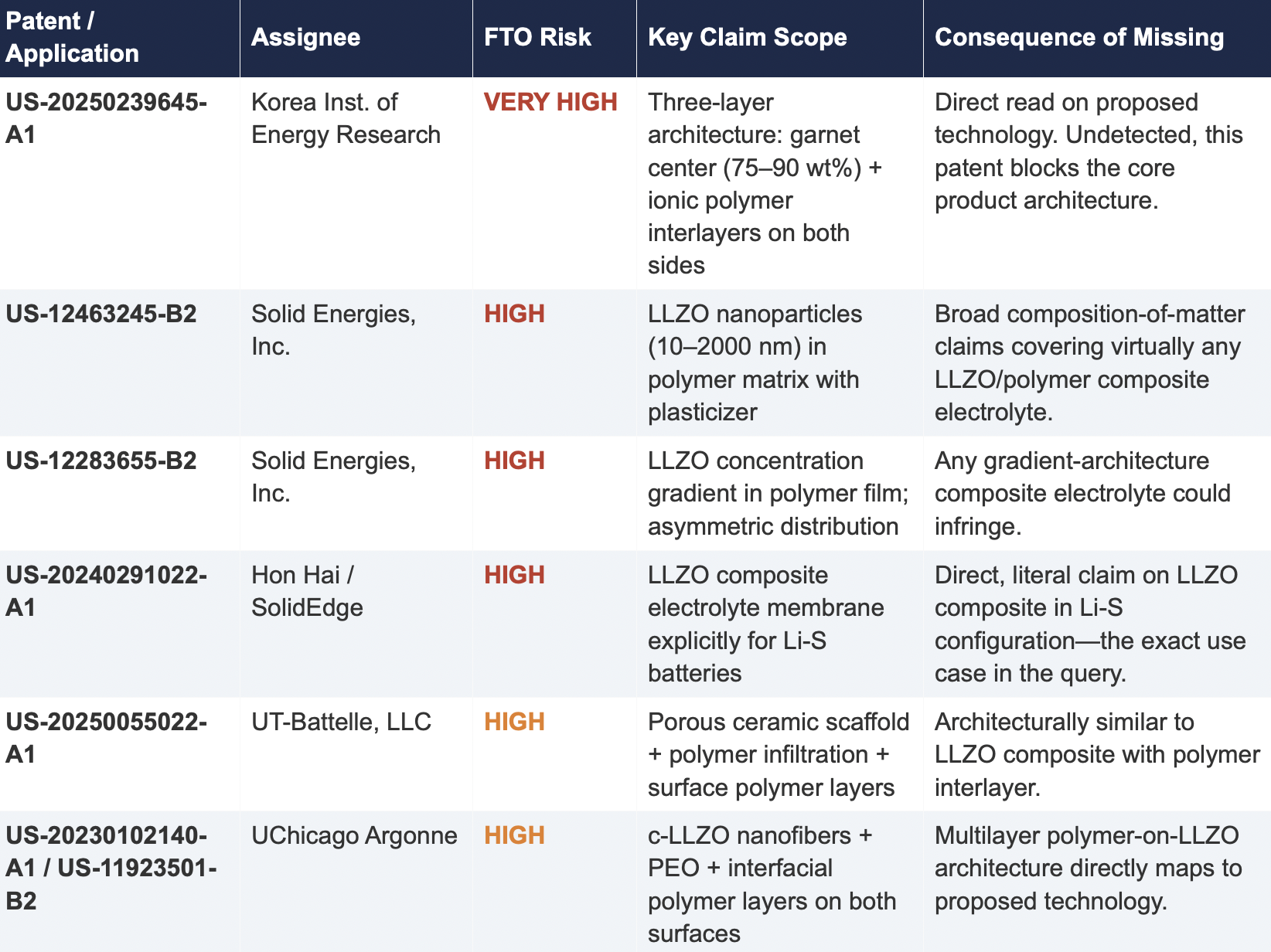
The following table presents patents identified exclusively by Cypris that were rated as High or Very High FTO risk for the proposed technology architecture. None were surfaced by any general-purpose model.
2.3 Patent Fencing: The Solid Energies Portfolio
Cypris identified a coordinated patent fencing strategy by Solid Energies, Inc. that no general-purpose model detected at scale. Solid Energies holds at least four granted US patents and one published application covering LLZO-polymer composite electrolytes across compositions(US-12463245-B2), gradient architectures (US-12283655-B2), electrode integration (US-12463249-B2), and manufacturing processes (US-20230035720-A1). Claude identified one Solid Energies patent (US 11,967,678) and correctly rated it as the highest-priority FTO concern but did not surface the broader portfolio. ChatGPT and Co-Pilot identified zero Solid Energies filings.
The practical significance is that a company relying on any individual patent hit would underestimate the scope of Solid Energies' IP position. The fencing strategy—covering the composition, the architecture, the electrode integration, and the manufacturing method—means that identifying a single design-around for one patent does not resolve the FTO exposure from the portfolio as a whole. This is the kind of strategic insight that requires seeing the full picture, which no general-purpose model delivered
2.4 Assignee Attribution Quality
ChatGPT's response included at least two instances of fabricated or unverifiable assignee attributions. For US 11,367,895 B1, the listed assignee was "Likely startup / defense contractor cluster." For US 2021/0202983 A1, the assignee was described as "Likely DOE / national lab ecosystem." In both cases, the model appears to have inferred the assignee from contextual patterns in its training data rather than retrieving the information from patent records.
In any operational IP workflow, assignee identity is foundational. It determines licensing strategy, litigation risk, and competitive positioning. A fabricated assignee is more dangerous than a missing one because it creates an illusion of completeness that discourages further investigation. An R&D team receiving this output might reasonably conclude that the landscape analysis is finished when it is not.
3. Structural Limitations of General-Purpose Models for Patent Intelligence
3.1 Training Data Is Not Patent Data
Large language models are trained on web-scraped text. Their knowledge of the patent record is derived from whatever fragments appeared in their training corpus: blog posts mentioning filings, news articles about litigation, snippets of Google Patents pages that were crawlable at the time of data collection. They do not have systematic, structured access to the USPTO database. They cannot query patent classification codes, parse claim language against a specific technology architecture, or verify whether a patent has been assigned, abandoned, or subjected to terminal disclaimer since their training data was collected.
This is not a limitation that improves with scale. A larger training corpus does not produce systematic patent coverage; it produces a larger but still arbitrary sampling of the patent record. The result is that general-purpose models will consistently surface well-known patents from heavily discussed assignees (QuantumScape, for example, appeared in most responses) while missing commercially significant filings from less publicly visible entities (Solid Energies, Korea Institute of EnergyResearch, Shenzhen Solid Advanced Materials).
3.2 The Web Is Closing to Model Scrapers
The data access problem is structural and worsening. As of mid-2025, Cloudflare reported that among the top 10,000 web domains, the majority now fully disallow AI crawlers such as GPTBot andClaudeBot via robots.txt. The trend has accelerated from partial restrictions to outright blocks, and the crawl-to-referral ratios reveal the underlying tension: OpenAI's crawlers access approximately1,700 pages for every referral they return to publishers; Anthropic's ratio exceeds 73,000 to 1.
Patent databases, scientific publishers, and IP analytics platforms are among the most restrictive content categories. A Duke University study in 2025 found that several categories of AI-related crawlers never request robots.txt files at all. The practical consequence is that the knowledge gap between what a general-purpose model "knows" about the patent landscape and what actually exists in the patent record is widening with each training cycle. A landscape query that a general-purpose model partially answered in 2023 may return less useful information in 2026.
3.3 General-Purpose Models Lack Ontological Frameworks for Patent Analysis
A freedom-to-operate analysis is not a summarization task. It requires understanding claim scope, prosecution history, continuation and divisional chains, assignee normalization (a single company may appear under multiple entity names across patent records), priority dates versus filing dates versus publication dates, and the relationship between dependent and independent claims. It requires mapping the specific technical features of a proposed product against independent claim language—not keyword matching.
General-purpose models do not have these frameworks. They pattern-match against training data and produce outputs that adopt the format and tone of patent analysis without the underlying data infrastructure. The format is correct. The confidence is high. The coverage is incomplete in ways that are not visible to the user.
4. Comparative Output Quality
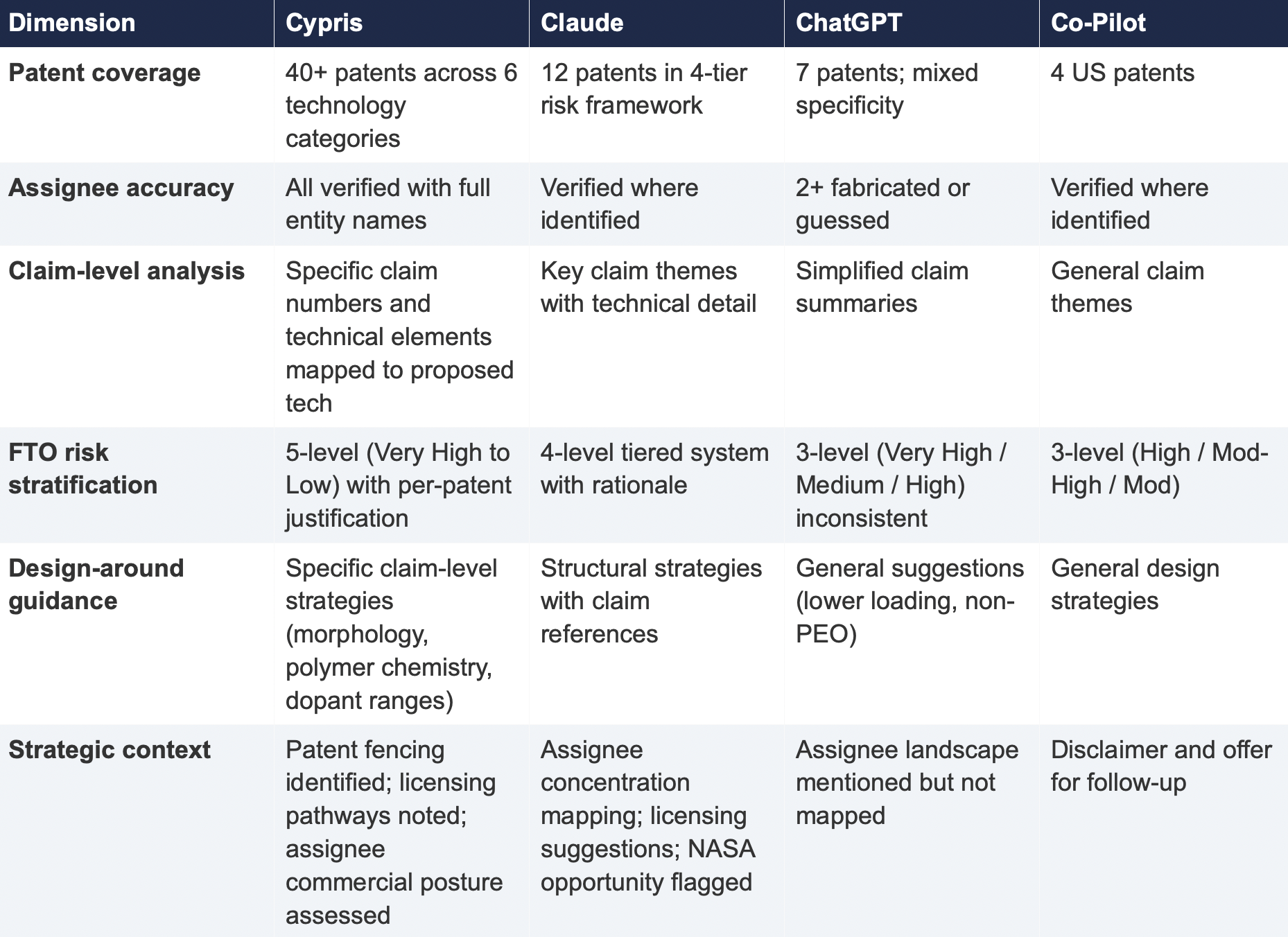
The following table summarizes the qualitative characteristics of each tool's response across the dimensions most relevant to an operational IP workflow.
5. Implications for R&D and IP Organizations
5.1 The Confidence Problem
The central risk identified by this study is not that general-purpose models produce bad outputs—it is that they produce incomplete outputs with high confidence. Each model delivered its results in a professional format with structured analysis, risk ratings, and strategic recommendations. At no point did any model indicate the boundaries of its knowledge or flag that its results represented a fraction of the available patent record. A practitioner receiving one of these outputs would have no signal that the analysis was incomplete unless they independently validated it against a comprehensive datasource.
This creates an asymmetric risk profile: the better the format and tone of the output, the less likely the user is to question its completeness. In a corporate environment where AI outputs are increasingly treated as first-pass analysis, this dynamic incentivizes under-investigation at precisely the moment when thoroughness is most critical.
5.2 The Diversification Illusion
It might be assumed that running the same query through multiple general-purpose models provides validation through diversity of sources. This study suggests otherwise. While the four tools returned different subsets of patents, all operated under the same structural constraints: training data rather than live patent databases, web-scraped content rather than structured IP records, and general-purpose reasoning rather than patent-specific ontological frameworks. Running the same query through three constrained tools does not produce triangulation; it produces three partial views of the same incomplete picture.
5.3 The Appropriate Use Boundary
General-purpose language models are effective tools for a wide range of tasks: drafting communications, summarizing documents, generating code, and exploratory research. The finding of this study is not that these tools lack value but that their value boundary does not extend to decisions that carry existential commercial risk.
Patent landscape analysis, freedom-to-operate assessment, and competitive intelligence that informs R&D investment decisions fall outside that boundary. These are workflows where the completeness and verifiability of the underlying data are not merely desirable but are the primary determinant of whether the analysis has value. A patent landscape that captures 10% of the relevant filings, regardless of how well-formatted or confidently presented, is a liability rather than an asset.
6. Test 2: Competitive Intelligence — Bio-Based Polyamide Patent Landscape
To assess whether the findings from Test 1 were specific to a single technology domain or reflected a broader structural pattern, a second query was submitted to all four tools. This query shifted from freedom-to-operate analysis to competitive intelligence, asking each tool to identify the top 10organizations by patent filing volume in bio-based polyamide synthesis from castor oil derivatives over the past three years, with summaries of technical approach, co-assignee relationships, and portfolio trajectory.
6.1 Query

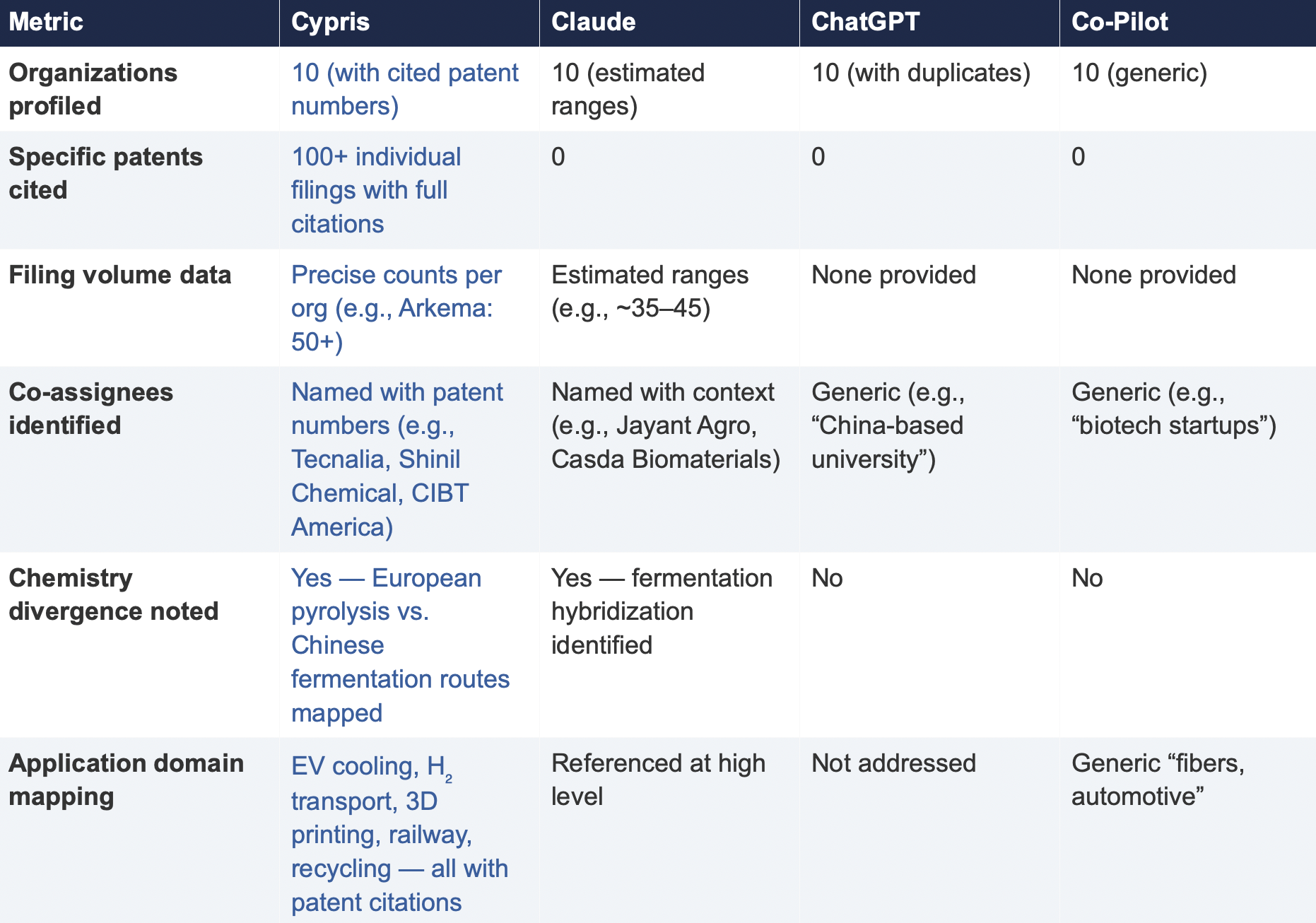
6.2 Summary of Results
6.3 Key Differentiators
Verifiability
The most consequential difference in Test 2 was the presence or absence of verifiable evidence. Cypris cited over 100 individual patent filings with full patent numbers, assignee names, and publication dates. Every claim about an organization’s technical focus, co-assignee relationships, and filing trajectory was anchored to specific documents that a practitioner could independently verify in USPTO, Espacenet, or WIPO PATENT SCOPE. No general-purpose model cited a single patent number. Claude produced the most structured and analytically useful output among the public models, with estimated filing ranges, product names, and strategic observations that were directionally plausible. However, without underlying patent citations, every claim in the response requires independent verification before it can inform a business decision. ChatGPT and Co-Pilot offered thinner profiles with no filing counts and no patent-level specificity.
Data Integrity
ChatGPT’s response contained a structural error that would mislead a practitioner: it listed CathayBiotech as organization #5 and then listed “Cathay Affiliate Cluster” as a separate organization at #9, effectively double-counting a single entity. It repeated this pattern with Toray at #4 and “Toray(Additional Programs)” at #10. In a competitive intelligence context where the ranking itself is the deliverable, this kind of error distorts the landscape and could lead to misallocation of competitive monitoring resources.
Organizations Missed
Cypris identified Kingfa Sci. & Tech. (8–10 filings with a differentiated furan diacid-based polyamide platform) and Zhejiang NHU (4–6 filings focused on continuous polymerization process technology)as emerging players that no general-purpose model surfaced. Both represent potential competitive threats or partnership opportunities that would be invisible to a team relying on public AI tools.Conversely, ChatGPT included organizations such as ANTA and Jiangsu Taiji that appear to be downstream users rather than significant patent filers in synthesis, suggesting the model was conflating commercial activity with IP activity.
Strategic Depth
Cypris’s cross-cutting observations identified a fundamental chemistry divergence in the landscape:European incumbents (Arkema, Evonik, EMS) rely on traditional castor oil pyrolysis to 11-aminoundecanoic acid or sebacic acid, while Chinese entrants (Cathay Biotech, Kingfa) are developing alternative bio-based routes through fermentation and furandicarboxylic acid chemistry.This represents a potential long-term disruption to the castor oil supply chain dependency thatWestern players have built their IP strategies around. Claude identified a similar theme at a higher level of abstraction. Neither ChatGPT nor Co-Pilot noted the divergence.
6.4 Test 2 Conclusion
Test 2 confirms that the coverage and verifiability gaps observed in Test 1 are not domain-specific.In a competitive intelligence context—where the deliverable is a ranked landscape of organizationalIP activity—the same structural limitations apply. General-purpose models can produce plausible-looking top-10 lists with reasonable organizational names, but they cannot anchor those lists to verifiable patent data, they cannot provide precise filing volumes, and they cannot identify emerging players whose patent activity is visible in structured databases but absent from the web-scraped content that general-purpose models rely on.
7. Conclusion
This comparative analysis, spanning two distinct technology domains and two distinct analytical workflows—freedom-to-operate assessment and competitive intelligence—demonstrates that the gap between purpose-built R&D intelligence platforms and general-purpose language models is not marginal, not domain-specific, and not transient. It is structural and consequential.
In Test 1 (LLZO garnet electrolytes for Li-S batteries), the purpose-built platform identified more than three times as many patents as the best-performing general-purpose model and ten times as many as the lowest-performing one. Among the patents identified exclusively by the purpose-built platform were filings rated as Very High FTO risk that directly claim the proposed technology architecture. InTest 2 (bio-based polyamide competitive landscape), the purpose-built platform cited over 100individual patent filings to substantiate its organizational rankings; no general-purpose model cited as ingle patent number.
The structural drivers of this gap—reliance on training data rather than live patent feeds, the accelerating closure of web content to AI scrapers, and the absence of patent-specific analytical frameworks—are not transient. They are inherent to the architecture of general-purpose models and will persist regardless of increases in model capability or training data volume.
For R&D and IP leaders, the practical implication is clear: general-purpose AI tools should be used for general-purpose tasks. Patent intelligence, competitive landscaping, and freedom-to-operate analysis require purpose-built systems with direct access to structured patent data, domain-specific analytical frameworks, and the ability to surface what a general-purpose model cannot—not because it chooses not to, but because it structurally cannot access the data.
The question for every organization making R&D investment decisions today is whether the tools informing those decisions have access to the evidence base those decisions require. This study suggests that for the majority of general-purpose AI tools currently in use, the answer is no.
Study Disclosure
This comparative evaluation was commissioned and published by Cypris. The testing methodology, prompts, evaluation criteria, and underlying outputs have been documented to support independent review and replication.
All platform outputs were preserved in their original form. Patent data and material factual claims were cross-checked against USPTO Patent Center and WIPO PATENTSCOPE records as of March 27, 2026. Cypris was one of the platforms evaluated and therefore has a commercial interest in the findings.
The Patent Intelligence Gap - A Comparative Analysis of Verticalized AI-Patent Tools vs. General-Purpose Language Models for R&D Decision-Making
Blogs

Patent citation analysis is the interpretation of the directed graph formed when patents cite prior work and are cited by subsequent work. It is among the oldest quantitative instruments in patent analytics and among the most frequently misapplied, because the citation graph is simultaneously informative and structurally incomplete, and analyses that treat it as a complete record of influence draw confident but flawed conclusions. Rigorous citation analysis therefore has two obligations: to extract the genuine structural signal the graph encodes, and to correct for the biases and omissions that raw counts obscure.
The primitive is a directed, typed edge. A citation points from a citing patent to a cited document, and the edge carries type information that most naive analyses discard: whether it is a backward citation locating a patent in its prior-art lineage or a forward citation measuring the influence it accrued; whether it was supplied by the applicant or added by the examiner during search; and, in offices that categorize search-report references, whether it was flagged as particularly relevant to novelty or inventive step. Aggregated across a corpus, these typed edges form a network whose topology — clusters, bridges, and lines of descent — encodes how a technology developed and which patents were pivotal. The analytical task is to read that topology correctly while remaining aware of what the graph cannot show.
This article formalizes the citation graph and its edge types, applies the network-science measures that convert topology into influence and technology-flow signals, isolates the biases that make raw citation counts unreliable, and specifies how semantic embeddings and an R&D ontology restore the latent, uncited relationships the citation record omits. It is written for R&D and IP teams applying citation signals to prior art, valuation, landscape, and competitive analysis.
The citation graph: direction and edge type
Backward and forward citations answer different questions and must not be aggregated indiscriminately. Backward citations enumerate the prior art a patent references and thereby locate it within a technical lineage; their density and composition indicate how incremental or how novel a patent is relative to its antecedents. Forward citations enumerate the later patents that cite it and thereby measure the influence it exerted; a patent accruing many forward citations from diverse subsequent inventions tends to be foundational to a line of development.
Edge provenance is equally consequential. Applicant-supplied citations reflect the filer's disclosures and are shaped by strategic and jurisdictional disclosure practices; examiner-added citations reflect an independent search by the office and are generally treated as a stronger indicator of genuine technical relevance. In offices that categorize search-report references, the category assigned to a reference — for example, whether it is deemed to defeat novelty on its own or only in combination — further weights the edge. An analysis that collapses examiner and applicant citations, ignores category, or treats citation conventions as uniform across offices and eras will misestimate both influence and relevance, because citation behavior is heterogeneous by jurisdiction and by time.
Network-science measures of influence and technology flow
The value of a citation network is realized through structural measures rather than raw tallies. Degree captures immediate influence, but centrality measures situate a patent within the global topology: high betweenness identifies patents that bridge otherwise separate technical clusters, marking points where technologies combine, while eigenvector-style centrality captures influence weighted by the influence of the citing patents. Main-path analysis traces the dominant lines of technical descent through the forward-citation network, reconstructing the trajectory of a technology and isolating the patents that were pivotal along it. Clustering and community detection partition the network into coherent technical areas, exposing landscape structure that no individual document reveals.
Composite indices extend this further. Generality and originality measures, computed from the distribution of a patent's forward and backward citations across technology classes, quantify whether a patent drew on and influenced a broad or narrow range of fields, distinguishing broadly enabling inventions from narrowly incremental ones. Read together over time, these measures render a technology's evolution legible: where activity accelerated, where lines of development converged or bridged, and which organizations led each phase. This structural reading is what underpins credible technology landscapes, competitive maps, and assessments of which assets in a portfolio carry disproportionate weight.
The biases that corrupt raw citation counts
Raw forward-citation counts are the most common and least reliable citation metric, corrupted by several systematic biases. Age and truncation bias is foundational: forward citations accrue over time, so older patents accumulate more by construction, and recent patents are truncated by the observation window, systematically understating their eventual influence. Field-intensity bias distorts cross-domain comparison, because citation-dense technology areas generate more edges independent of individual merit, so unnormalized counts conflate field behavior with patent importance. Jurisdictional and temporal convention bias further confounds counts, since offices and eras differ in how, and how much, they cite.
Correcting these requires field- and cohort-normalization — comparing a patent's citation performance against its technology class and filing-year peers rather than against the corpus at large — and explicit handling of truncation for recent cohorts. Self-citation and strategic citation practices must also be identified and, where appropriate, discounted. An analysis that reports raw counts as influence, or compares counts across fields and vintages without normalization, produces rankings that reflect age and field far more than merit.
The latent-edge problem: what the citation graph omits
The deeper limitation is not bias within the graph but incompleteness of the graph. A citation exists only where an applicant disclosed a reference or an examiner found it; the absence of a citation is not evidence of the absence of a relationship. Two patents can describe closely related inventions with no edge between them, because the relevant prior art was neither disclosed nor located during examination. The citation graph therefore systematically omits latent edges — genuine technical relationships that were never recorded — and any analysis confined to recorded citations is blind to them.
This omission is most consequential precisely where the stakes are highest. In prior art and freedom-to-operate work, the decisive reference is frequently an uncited but conceptually proximate patent, exactly the relationship the citation record fails to capture. In landscape analysis, latent edges mean the network understates how connected a field truly is, distorting cluster structure and technology-flow inference. Treating the citation graph as the whole truth thus produces two failures at once: it misses the most important prior art, and it misrepresents the topology of the field.
Restoring latent edges: semantic embeddings and ontology
The resolution is to augment the recorded citation graph with a semantic layer that recovers the latent edges. Representing patents and the surrounding scientific literature as embeddings places conceptually related documents in proximity irrespective of whether a citation links them, which reconstructs the relationships the citation record omitted. The augmented network combines two edge types with complementary properties: recorded citations, which evidence acknowledged influence and legal relevance, and semantic edges, which evidence conceptual relatedness independent of disclosure. The union is a fuller and less biased representation of a field than either alone.
An R&D ontology strengthens the semantic layer by organizing patents and literature by normalized technical concept, so influence and technology flow can be read in terms of what inventions concern rather than only which documents cite which, and so cross-domain relationships spanning patents and scientific literature are captured. Over the augmented network, agentic workflows can rank foundational patents using normalized, truncation-corrected structural measures, reconstruct main paths, and surface conceptually related prior art the citation graph omitted, each with source attribution. The result is citation analysis that retains the legal signal of recorded edges while recovering the technical signal the record left latent.
Applications in prior art, valuation, and competitive analysis
The applications follow from correctly reading the augmented network. Foundational-patent identification uses normalized centrality and main-path position rather than raw counts to isolate the assets that structurally anchor a field, informing valuation and portfolio pruning. Prior art and invalidity work exploits both recorded citation trails and, critically, the semantic layer that surfaces uncited-but-related references, which are often the determinative art. Landscape and competitive analysis reads cluster structure, bridges, and technology-flow to reconstruct how an area evolved and which organizations led each phase, with latent edges restored so the topology is not understated. Portfolio analytics applies generality and originality measures to distinguish broadly enabling assets from narrowly incremental ones.
Each application is reliable only under the corrections and augmentation above. Raw counts read as merit, un-normalized cross-field comparison, and citation-only topology each produce confident errors, which is why the method's value depends on typed-edge handling, field- and cohort-normalization, truncation correction, and semantic recovery of latent edges, all traceable to source.
Citation analysis in practice
Cypris combines the recorded citation network with a semantic, ontology-normalized layer across a corpus of more than 500 million patents and scientific papers. The proprietary R&D ontology organizes patents and literature by normalized technical concept, and semantic representation recovers latent, uncited relationships that the citation record omitted — the edges that citation-only analysis is structurally blind to, and that determine outcomes in prior art and freedom-to-operate work.
Cypris Q, the platform's agent and report layer, assembles citation-informed landscapes, ranks foundational patents using structural measures alongside semantic relatedness, and surfaces related prior art with cited output, while Agentic Monitoring tracks how the citation and technology network evolves as new filings publish. Cypris is US-based, meets Fortune 500 security requirements including SOC 2 Type II, operates under enterprise API partnerships with OpenAI, Anthropic, and Google, and serves hundreds of enterprise customers across pharmaceuticals, chemicals, advanced materials, and other regulated industries.
FAQ
What is patent citation analysis?
Patent citation analysis is the interpretation of the directed, typed graph formed by patents citing prior work and being cited by later work, used to measure influence, identify foundational patents, and reconstruct technology flow. Rigorous analysis reads the network's topology while correcting for the biases of raw counts and the incompleteness of the citation record.
What is the difference between forward and backward citations?
Backward citations reference the earlier work a patent builds on, locating it in a technical lineage, while forward citations are the later patents that cite it, measuring the influence it accrued. They answer different questions and should be analyzed separately rather than aggregated.
Why do examiner and applicant citations differ in weight?
Examiner citations are added by the office through an independent search and are generally treated as stronger evidence of genuine technical relevance, while applicant citations reflect the filer's disclosures and are shaped by strategic and jurisdictional practice. Collapsing the two, or ignoring search-report categories, misestimates relevance.
What network-science measures apply to citation analysis?
Applicable measures include centrality such as betweenness for bridging patents and eigenvector-style influence, main-path analysis for lines of technical descent, clustering for landscape structure, and generality and originality indices for the breadth of a patent's influence and sources. These convert network topology into influence and technology-flow signals that raw counts cannot express.
Why are raw citation counts misleading?
Raw citation counts are misleading because of age and truncation bias, field-intensity differences, and jurisdictional and temporal convention, all of which cause counts to reflect a patent's age and field more than its merit. Reliable use requires field- and cohort-normalization and explicit truncation handling.
What is the latent-edge problem in citation analysis?
The latent-edge problem is that the citation graph records a relationship only where a reference was disclosed or found, so genuinely related patents that were never cited leave no edge. Citation-only analysis is therefore blind to real technical relationships, which is most consequential in prior art and freedom-to-operate work.
How do semantic embeddings improve citation analysis?
Semantic embeddings place conceptually related patents in proximity whether or not a citation links them, recovering the latent edges the citation record omitted. Augmenting recorded citations with this semantic layer yields a fuller, less biased network that surfaces uncited-but-related prior art and corrects understated topology.
Can citation analysis be used for patent valuation?
Citation analysis informs valuation through normalized centrality and main-path position, which identify structurally foundational assets, rather than through raw counts. It should be combined with generality and originality measures and semantic analysis, because unnormalized counts reflect age and field rather than value.
What is the role of an R&D ontology in citation analysis?
An R&D ontology organizes patents and scientific literature by normalized technical concept, so influence and technology flow are read in terms of what inventions concern and cross-domain relationships are captured. Combined with the citation network and semantic layer, it produces a less biased map of a field.
What is the best platform for patent citation analysis?
The best platform combines the recorded citation network with a semantic, ontology-normalized layer, applies normalized structural measures, and recovers latent uncited edges. Cypris pairs citation signals with semantic representation across more than 500 million patents and scientific papers organized by a proprietary R&D ontology, mapping influence and surfacing related prior art the citation record missed.

AI patent and paper intelligence platforms are a distinct enterprise software category that unifies patent data, scientific literature, and other technical sources into a single AI-searchable corpus designed for corporate R&D and innovation teams. The category emerged because the questions R&D leaders actually ask, what is being invented in this space, who is moving fastest, where are the white spaces, cannot be answered by patent databases or scientific search engines in isolation. A modern AI patent and paper intelligence platform combines semantic search, retrieval-augmented generation, agentic workflows, and a structured technical ontology over hundreds of millions of documents, so a single query can surface the relevant patents, papers, and signals an R&D team needs to make a decision.
This category is not a rebrand of patent search. Patent search tools were designed for episodic legal work performed by trained patent professionals. AI patent and paper intelligence platforms are designed for continuous use by R&D scientists, innovation strategists, and technology scouts who treat intelligence as infrastructure rather than a project.
Why the Category Exists
For most of the last two decades, technical intelligence at large companies was split across two parallel stacks. Patent professionals worked inside legacy patent platforms built for prior art and prosecution workflows. Scientists worked inside academic literature databases and citation tools. The two stacks rarely connected, and neither was designed to answer the integrated questions R&D directors actually ask.
That separation collapsed for three reasons. The first is volume. The World Intellectual Property Organization reported more than 3.55 million patent applications filed globally in 2023, the highest figure on record, and global scientific publication output now exceeds 3 million peer-reviewed articles per year [1][2]. No human team can read across that volume manually, and keyword search degrades sharply as corpus size grows.
The second reason is the convergence of patents and papers as evidence. In emerging fields such as solid-state batteries, generative biology, and advanced materials, the leading signal often appears first in a preprint or conference paper, then in a patent filing months or years later. A team that monitors only patents sees the lagging indicator. A team that monitors only literature misses the commercial intent. Modern technical decisions require both sources analyzed together.
The third reason is the maturation of large language models and retrieval-augmented generation. Until recently, semantic search across heterogeneous technical corpora was a research problem. With current frontier models and structured retrieval, it is now a product category. The same architecture that allows a model to summarize an inbox can, with the right corpus and the right ontology, summarize the state of the art in a technology domain.
The result is a new category of enterprise software. Not a patent database with an AI feature added on, and not a chatbot pointed at PubMed, but a purpose-built platform layer that treats patents, scientific papers, and other technical signals as a unified intelligence substrate for R&D teams.
What Defines a Platform Rather Than a Tool
The distinction between a tool and a platform is consequential when budgets reach enterprise scale. A tool answers a query. A platform supports a function. AI patent and paper intelligence platforms share several characteristics that separate them from search tools that have added an AI feature.
The first is unified corpus depth. A platform integrates hundreds of millions of patents from major jurisdictions with scientific literature from peer-reviewed journals, preprint servers, and conference proceedings, alongside other technical sources such as grant data, regulatory filings, and product disclosures. The leading platforms in this category cover 500 million or more technical documents and continuously ingest new ones. Search tools that cover a single source type, however polished, cannot answer cross-domain questions.
The second is a structured technical ontology. Raw vector search across heterogeneous technical documents produces noisy results because the same concept is described differently in patents, papers, and product literature. A purpose-built R&D ontology encodes the relationships between technical concepts, materials, mechanisms, and applications, so a semantic query for, say, sulfide solid electrolytes returns the relevant evidence regardless of whether a given document uses that exact phrase. Ontology quality is one of the most important and least visible differentiators in this category.
The third is agentic workflow support. A search box returns documents. A platform produces deliverables. Modern AI patent and paper intelligence platforms include agentic systems that can run multi-step research workflows, retrieve evidence across the corpus, synthesize findings, and produce structured reports such as landscape analyses, white space maps, and competitor profiles. These workflows are what allow a small R&D intelligence team to support a large innovation organization.
The fourth is enterprise-grade infrastructure. Corporate R&D intelligence touches sensitive competitive information, regulated industries, and confidential project context. A platform suitable for Fortune 500 deployment must offer enterprise-grade security that meets Fortune 500 requirements, role-based access controls, audit logging, and data handling guarantees that consumer or free tools do not provide.
The fifth is configurability. Different R&D programs need different views of the world. A platform allows users to configure custom corpuses of patent and non-patent literature scoped to a technology domain, a competitor set, or a strategic initiative. This corpus configuration capability is directly tied to recent research on context engineering, which has shown that focusing a language model on the relevant subset of data, rather than the entire web, materially improves the quality of generated analysis [3].
The Role of AI in the Category
The AI in AI patent and paper intelligence platforms is not a single feature. It is a layered architecture, and the quality of each layer compounds.
At the retrieval layer, semantic embedding models convert technical documents into vector representations that capture meaning rather than surface text. A well-implemented retrieval system surfaces a relevant patent about lithium polymer electrolytes even when the user query uses different terminology, because the underlying concepts are close in embedding space. Retrieval quality on technical content is highly sensitive to the embedding model used, the ontology applied on top, and the cleanliness of the underlying corpus.
At the reasoning layer, large language models perform synthesis, comparison, and extraction over retrieved evidence. The frontier models available in 2026, including the Claude 4 series, GPT-5.1, and the o-series reasoning models, have substantially improved on technical comprehension, structured output, and citation behavior compared to the models available even eighteen months ago. Platforms that have integrated official enterprise partnerships with these model providers have access to the strongest available reasoning, with the data handling and privacy guarantees enterprise buyers require.
At the agent layer, orchestrators chain retrieval and reasoning steps together to perform end-to-end workflows. An agent tasked with producing a competitive landscape on a technology domain might iterate across the corpus, identify the leading assignees, retrieve their representative patents and publications, summarize each one, build a comparison matrix, and produce a written report with citations. Recent research on agentic context compression suggests that models perform better when given concise, well-structured claims rather than dense source material, which is why high-quality ingestion and ontology work matters even more in the agent era [4].
The combination of retrieval, reasoning, and agent layers is what allows a modern platform to take a question such as what is the competitive position of company X in solid-state batteries, and return a structured answer in minutes rather than weeks of analyst time.
Use Cases That Justify the Category
The use cases that justify investment in an AI patent and paper intelligence platform are the ones where speed and breadth matter more than legal precision. These are not patent attorney workflows. They are R&D and strategy workflows.
Technology scouting is one of the clearest examples. When an innovation team needs to identify emerging approaches to a problem, the relevant evidence is spread across patent filings, recent papers, startup disclosures, and grant awards. A unified AI platform allows a scout to surface candidates across all these sources, cluster them by approach, and produce a shortlist in days rather than months.
Competitive landscape analysis is another. Understanding a competitor's technical trajectory requires reading across their patent portfolio and their scientific publications, then identifying where the two diverge from public product disclosures. Platforms with agentic synthesis can produce competitor profiles that integrate all three signals.
White space and opportunity mapping benefits especially from cross-source intelligence. The most interesting technical opportunities are often the gaps between heavy patent activity and heavy publication activity, or the spaces where academic momentum is building but commercial filings have not yet appeared. These patterns are invisible inside a single-source tool.
Freedom to operate at the R&D stage is also increasingly handled with AI patent and paper intelligence platforms, although final legal opinions still belong with patent counsel. Early-stage FTO scans performed in-house by R&D teams help engineering leaders make build versus pivot decisions before legal hours are spent.
Continuous monitoring rounds out the use case set. Once a corpus is configured for a strategic area, agents can surface new patents and papers as they appear, summarize their relevance, and route them to the right internal stakeholders. This converts patent and paper intelligence from a periodic study into an ongoing capability.
Evaluation Criteria for Enterprise R&D Buyers
R&D directors and innovation leaders evaluating platforms in this category should weigh several criteria that map to the structural definitions above.
Corpus coverage is the first. The platform should integrate patent data from all major jurisdictions, scientific literature from peer-reviewed and preprint sources, and ideally additional technical signals such as grants, clinical trials, and regulatory filings. Total document counts matter, but freshness, completeness of metadata, and coverage of non-English sources matter more.
Semantic search quality is the second. The most reliable way to evaluate this is to run real queries from the buyer's own technical domain and inspect the top results. Embedding quality and ontology quality are difficult to assess from marketing materials alone.
Agent and report quality is the third. A platform that produces a clean landscape report with proper citations and a defensible structure delivers materially more value than one that returns a chat answer. Buyers should ask vendors to run an agent task on a sample domain during evaluation.
Enterprise infrastructure is the fourth. Security posture, data handling commitments, single sign-on, audit logging, and the ability to meet Fortune 500 procurement requirements should be confirmed early. Tools that cannot pass enterprise security review will stall regardless of search quality.
Audience fit is the fifth. A platform built for patent attorneys typically defaults to legal workflows and terminology that R&D users find friction-laden. A platform built for R&D scientists and innovation strategists defaults to the language and outputs those users need. The mismatch is rarely fixable through training.
Configurability is the sixth. The ability to define custom corpuses, save them, share them across teams, and route updates from them is what turns a search platform into a research function.
Pricing structure is the final criterion. Enterprise platforms in this category are priced for sustained organizational use, not per-search consumption. Buyers should map the expected number of seats, the breadth of teams using the platform, and the report and monitoring volumes against the proposed contract.
Where the Category Is Going
The trajectory of AI patent and paper intelligence platforms over the next eighteen months follows the broader trajectory of enterprise AI. Three shifts are already visible.
The first is deeper agent integration. Platforms are moving from question-answering toward autonomous research workflows where an agent runs for minutes or hours and returns a finished deliverable. This compresses the work cycle for R&D intelligence functions and makes ambitious use cases such as cross-portfolio monitoring practical for teams that previously could not staff them.
The second is custom corpus standardization. The recognition that focusing models on the right subset of data improves output is reshaping product design. Configurable corpuses scoped to a technology, a competitor set, or a project are becoming the default rather than the exception, in line with the broader move toward context engineering in applied AI [3].
The third is enterprise model partnerships. Platforms with official enterprise API partnerships with the leading model providers, including OpenAI, Anthropic, and Google, have a structural advantage in both capability and compliance. Frontier models change frequently, and the platforms wired into the official enterprise pipelines benefit from each new release without renegotiating data handling terms.
The net effect is that AI patent and paper intelligence platforms are evolving from search experiences into research infrastructure. The buyers who treat them as the latter, rather than as a faster keyword search, will extract the most value.
A Note on Cypris
Cypris is an enterprise R&D intelligence platform built specifically for the use cases described above. The platform unifies more than 500 million patents and scientific papers into a single corpus accessible through semantic search and agentic workflows, with a proprietary R&D ontology designed to understand the relationships between technical concepts across patents and literature. Cypris holds official enterprise API partnerships with OpenAI, Anthropic, and Google, allowing the platform to deliver frontier model capabilities under enterprise data handling terms. Cypris Q, the platform's AI agent and report-generation layer, produces structured landscape analyses, competitor profiles, and white space maps that R&D teams use as primary deliverables rather than supporting research. The platform supports configurable custom corpuses of patent and non-patent literature, allowing organizations to focus their intelligence work on the technology domains, competitor sets, and strategic initiatives that matter to them. Cypris is built for R&D scientists and innovation strategists rather than IP attorneys, and is trusted by hundreds of enterprise customers and Fortune 500 R&D teams operating in regulated, security-conscious environments.
Most large R&D organizations now run some form of tech scouting. The shape varies enormously. A few companies have a dedicated technology scout sitting in the CTO's office producing quarterly horizon reports. More common is an innovation team that runs scouting sprints around specific themes when leadership asks for one. Increasingly common is some form of AI-assisted scouting workflow — a set of saved searches at the simple end, an agentic monitoring system at the more sophisticated end. The output quality across these approaches differs by an order of magnitude, and the most consequential variable separating the strong versions from the weak ones is not which AI model is underneath. It is how the scouting agent has been designed.
This guide is for innovation leaders, CTOs, R&D directors, BD and partnership teams, and corporate venture groups who want tech scouting to function as a continuous capability rather than a periodic deliverable. It explains what a tech scouting agent actually is, why agents that surface real intelligence look different from agents that produce volume, and how to design a scouting workflow that compounds value over time rather than restarting from zero every quarter.
What Tech Scouting Actually Has to Cover
Tech scouting is a forward-looking workflow. The question is not what the established competitive landscape looks like today; the question is what is emerging that the company should know about, where, and why does it matter to the strategy. That framing changes everything about how the work has to be done.
Scouting answers a small number of recurring questions. What new technologies are gaining momentum in areas adjacent to where we play? Which startups are forming around technical approaches that could disrupt our roadmap, and which could we partner with or acquire? Which research groups are producing work that will become commercially significant in three to five years, and what would it take to engage them? Which capabilities should we be building internally versus sourcing externally? Which competitors are quietly building positions in spaces we have not yet committed to? These questions do not have one-time answers. The answer this quarter and the answer next quarter are different, and the difference is precisely the signal the scouting workflow exists to capture.
The evidence base for these questions is messy and multi-source by nature. Scientific publications and preprints carry the earliest signal of where research is heading. Patent filings carry a slightly later but more strategically committed signal of where companies and inventors are placing technical bets. Startup formations, funding rounds, and corporate venture activity reveal where capital is moving and which technical theses sophisticated investors are willing to back. Government grants, program awards, and procurement filings flag where strategic priorities and non-dilutive funding are concentrating. Conference proceedings, technical talks, hiring patterns, regulatory filings, and the surrounding signal in trade press and industry analyst coverage round out the picture. Each source carries a different slice of the truth. None of them is sufficient on its own.
The implication is that a scouting agent watching one source — even a comprehensive one — produces a partial view. The signal that matters in scouting is usually cross-source. When a research group publishes three papers on a novel approach over eighteen months, when one of those authors leaves their academic position, when a small entity forms with a credible founding team and raises seed capital, when a corporate venture arm participates in the round, when an early grant award appears for the same research direction — none of those events is decisive on its own. Together, they are an emergence signal worth a senior leader's attention. An agent that sees only one source misses most of the picture. The intelligence is in the connection.
This is the workflow that older tools were not built for. Most legacy systems organize the world by source — a startup database here, a literature index there, a patent tool somewhere else, with the connections drawn by an analyst pivoting between tabs. The connection is the work. Doing that work continuously, across thousands of emergence events per week, in dozens of technology and business areas, is not a workload a team of human scouts can sustain. It is the workload tech scouting agents exist to absorb.
What a Tech Scouting Agent Actually Does
Most R&D and innovation organizations that say they have a tech scouting capability today are running a combination of saved Google Alerts, periodic searches in different databases, conference attendance, broker calls, and read-throughs of analyst reports. The work is real but episodic. Someone reads the alerts. Someone summarizes the conference. Someone reviews the analyst report. The interpretive work happens in a person's head, the institutional memory fades when they move on, and the next person to ask the same scouting question starts from a blank page.
A tech scouting agent inverts this pattern. The agent runs a defined scouting thesis continuously across the relevant evidence corpus, evaluates each new signal against the thesis using interpretive reasoning rather than keyword matching, dismisses what does not warrant attention, and escalates what does with a written rationale that explains why. The interpretive work moves from a person's head into a system that runs every day, applies consistent criteria, and produces a record the team can audit and refine.
Four functions distinguish a real scouting agent from a saved search with notifications.
It applies a strategic thesis rather than a query. Instead of matching documents against a Boolean string or a vector similarity threshold, the agent evaluates each new signal against a structured description of what the team is trying to learn and why. The thesis is interpretive, not lexical, which means the agent can recognize relevant signals even when the underlying language differs from how the team would have phrased a search.
It runs continuously, not on user-initiated demand. New papers, preprints, patent filings, funding announcements, grant awards, regulatory filings, and corporate disclosures arrive as a continuous stream. An agent designed for scouting evaluates this stream as it arrives, which eliminates the gap between when a relevant signal enters the world and when the team learns about it.
It filters for signal, not match. Most saved searches return high false-positive rates because the keywords appear in unrelated contexts, or because the technical match is real but the strategic relevance is low. An agent reads each candidate signal, evaluates it against the thesis, and discards what does not pass the relevance bar. The result is a substantially smaller and higher-quality escalation queue.
It produces a written rationale. When the agent escalates a signal, it explains why — what about the disclosure matched the thesis, how it relates to prior signals the agent has already evaluated, and what decision or downstream workflow it might inform. This rationale becomes a record the team can audit. When the agent gets it wrong, the team can see where the reasoning broke and refine the thesis. When the agent gets it right, the rationale accelerates the human follow-up because the framing is already done.
These four functions are what transform scouting from a notification system into an analytical process that compounds.
The Four Components of a Strong Scouting Thesis
The thesis is the most important input to a tech scouting agent. The quality of the thesis sets the ceiling on the quality of the output, regardless of which platform or model sits underneath. Most weak scouting output traces back to a thesis that was too short to support real work — a few sentences naming a technology area, with no specification of what would make a finding meaningful or how the team would use it.
There is a useful piece of recent prompt engineering research that bears on this directly. The discipline reorganized through 2025 around what researchers and frontier AI labs now call context engineering — the recognition that for serious knowledge work, the ceiling on output quality is set less by how a prompt is phrased and more by what information the system has been given to reason over. Andrej Karpathy described context engineering as the practice of populating the model's working context with precisely the right information for the task. Research on agentic systems published through late 2025 documented what researchers describe as brevity bias — the tendency of prompt optimization to favor concise instructions, which sounds appealing but causes the omission of domain-specific detail that actually drives output quality on knowledge-intensive tasks. The translation for tech scouting is that strong scouting theses are tight on filler but rich on domain specification. They are not short.
A well-framed scouting thesis has four components.
The strategic envelope. State why the scouting is being done and which business decisions it is meant to inform. A thesis written to support open innovation and partnership identification is different from a thesis written to support corporate venture screening, and both are different from a thesis written to support technology emergence monitoring for an executive committee or M&A target identification for corporate development. The agent can calibrate its evaluation criteria to the decision the scouting supports — but only when the decision is explicitly named. A scouting workflow without a named decision tends to escalate everything that looks interesting, which is functionally the same as escalating nothing.
The technical and market scope. Describe the technologies, capabilities, applications, and market segments of interest in specific terms. Name the methods, performance thresholds, end-use cases, and customer segments that are in scope. Name what is explicitly out of scope — the adjacent areas the team does not want the agent pulled into. List terminology variants the field uses for the same concept, particularly where industry vocabulary differs from academic vocabulary, and where new terminology has begun to displace older usage. The scope is what allows the agent to recognize relevance accurately at the edges, where most genuine emergence signals live.
The evidence priorities. State which sources of evidence matter most for this scouting question and why. For some theses, scientific publications are the leading indicator — emerging technical approaches typically appear in academic literature six to eighteen months before they reach commercial products. For other theses, startup formations and funding events are the earliest signal of where capital and talent are converging. For still others, government grant awards or regulatory filings reveal emergence first. The agent's evaluation logic depends on understanding which source carries the leading signal for the specific question, and how to weight signals from different sources when they appear together. Without this specification, the agent treats all sources as equally informative, which is rarely true.
The escalation criteria. Specify what makes a finding worth surfacing. A new initiative from a primary competitor likely warrants escalation regardless of how strong the technical match is. A scientific publication from an unknown research group likely warrants escalation only when the technical signal is strong and other independent signals point in the same direction. A startup formation likely warrants escalation only when the team behind it has a credible technical pedigree and the funding source signals strategic intent rather than seed-stage exploration. The criteria need to be explicit so the agent can apply them consistently and the team can tune them as the thesis evolves.
The discipline of writing a thesis with these four components is itself valuable. It forces the team to articulate what they are actually trying to learn, why it matters to the business, and how they would recognize a useful answer when they saw one. Teams that adopt this framing pattern tend to find that the thesis-writing exercise improves their scouting work even before any agent is run against it.
What to Watch For When Designing Scouting Agents
Three failure modes appear repeatedly in tech scouting agent deployments, and each is a design problem rather than a model problem.
The first is theses that are too broad, which produce escalation queues so large the team stops reading them. A scouting agent that escalates fifty findings a week will be functionally abandoned within a month. The remedy is rarely to make the agent more selective in isolation — it is to narrow the thesis itself, focus on the specific decisions the scouting supports, and tune the escalation criteria upward until what arrives is genuinely worth the team's time. A useful test is whether the team would feel a real loss if the scouting output stopped arriving. If the answer is no, the thesis needs to be sharper.
The second is single-source agents — scouting workflows that watch only one type of evidence, whether that is news, papers, patents, or startup data. The genuine emergence signals in tech scouting almost always show up across multiple sources, in a particular sequence, over a particular time window. An agent that sees one source can detect that something is happening but cannot evaluate whether the something is meaningful. A multi-source agent can recognize when a paper, a hire, a startup formation, and a funding round all point in the same direction, which is a fundamentally different category of intelligence than any one signal in isolation.
The third is scouting agents that are not connected to a downstream decision process. An agent that produces a weekly digest read by no one, or a digest whose findings never enter Stage-Gate reviews, partnership evaluations, M&A pipelines, or executive briefings, produces no operational value regardless of how good the underlying analysis is. The scouting workflow needs to terminate in a decision interface — a project workspace, a portfolio review, a CTO briefing, a venture screening pipeline, a corporate development tracker — where the findings can actually act on the business. A scouting agent without a downstream destination is an interesting demo, not a capability.
The Evidence Corpus Question
Here is where most tech scouting deployments hit their ceiling, often without realizing it.
A tech scouting agent's reasoning quality is bounded by what the agent is reasoning over. A general-purpose AI tool is reasoning over its training data, which is a partial and outdated slice of any specialized field. A scouting workflow built on a single-source database is reasoning over only that source. Both architectures impose ceilings on output quality that no amount of prompt refinement will fully lift.
This is the structural reason purpose-built R&D intelligence platforms produce different output than general-purpose AI tools or single-source legacy systems for scouting work. The strongest platforms maintain a unified corpus that combines scientific literature, patents, and adjacent technical and market signal in a single index, and allow scouting agents to reason across that combined corpus rather than against any one slice of it. Cross-source reasoning — recognizing that a paper, a patent, a funding event, and a hire all point in the same direction — only works when the agent has access to all of those signals in a structure that lets it connect them.
The strongest platforms go further and allow teams to configure custom corpuses focused on specific scouting theses. A custom corpus narrows the working evidence base to what is actually relevant for the question at hand, which lets the agent's reasoning operate on signal rather than fight through noise. A general index covers everything across all technology areas, and the signal that matters for a specific scouting thesis is buried in a much larger volume of irrelevant material. Even strong AI reasoning struggles to consistently find and weight the right evidence at that ratio. A focused corpus, scoped to the technical and strategic envelope of the thesis, produces meaningfully better scouting output than the same agent run against a general index.
Custom corpus configuration matters more for scouting than for most adjacent workflows. A landscape question is bounded — the scope is defined, the deliverable is a snapshot, and the corpus that supports it can be constructed once. A scouting question is open-ended — the scope evolves as the field evolves, the deliverable is continuous, and the corpus needs to evolve alongside the thesis. Platforms that treat custom corpus configuration as a first-class capability rather than an advanced feature are the ones where scouting workflows continue producing useful output six and twelve months in.
Where Cypris Fits
Cypris is an enterprise R&D intelligence platform built for this category of work. The platform unifies more than 500 million patents and scientific papers in a single corpus, applies a proprietary R&D ontology developed for the language of corporate research and innovation work, and provides agentic workflows that R&D, innovation, and corporate development teams configure to run continuous scouting against defined theses. Cypris maintains official API partnerships with OpenAI, Anthropic, and Google, which means the agentic reasoning sitting underneath the platform is built on frontier models accessed through enterprise contracts rather than scraped or rate-limited public APIs, with enterprise-grade security architecture that meets Fortune 500 requirements.
The capability that matters most for the scouting workflow described in this guide is the combination of unified corpus, custom corpus configuration, and agentic execution. A scouting team using Cypris can encode a strategic thesis, configure a focused corpus scoped to the technical and market envelope of that thesis, and run an agent against it continuously. The agent applies the team's escalation criteria, surfaces findings with written rationale, and integrates the output into the team's downstream R&D and corporate development processes. The architecture was designed from the ground up around the workflow needs of R&D scientists, innovation strategists, and corporate development teams rather than IP attorneys running discrete search engagements, which is reflected throughout the system in how scouting is structured, how findings are presented, and how the human-in-the-loop refinement of the thesis works in practice.
For an innovation team mapping a specific emerging technology space, this means the agent is reasoning over the research and technical signal actually relevant to that space, recognizing emergence patterns across sources, and surfacing findings the team would not have caught running periodic searches against a general index. For a corporate venture team screening a category of startups, the corpus can be configured around the technical area the venture thesis covers, and the agent can monitor for new entrants, technical pivots, and competitive activity continuously. For a corporate development team identifying M&A targets, the corpus can be configured around the capability gaps the strategy is trying to close, and the agent can surface companies whose technical and commercial trajectory aligns with the thesis. For a CTO running a horizon-monitoring program, the platform can support multiple parallel scouting theses, each with its own corpus, agent, and escalation logic, and integrate the combined output into the executive briefing cadence the CTO actually runs.
The combination — a unified research and technical corpus, custom corpus configuration scoped to specific theses, agentic execution against frontier reasoning models, and integration with the workflows R&D and innovation teams already run — is what separates scouting output that supports executive decisions from scouting output that summarizes what an analyst happened to read this week. Hundreds of Fortune 500 R&D and innovation organizations rely on the platform for exactly this category of work.
What Your Team Can Do This Quarter
Three things will measurably improve the tech scouting your team produces, regardless of which platform you use.
Standardize how scouting theses are written, with the four components described above — strategic envelope, technical and market scope, evidence priorities, and escalation criteria. A simple template that asks each scout to fill in these four sections before any agent runs against the thesis produces noticeably better output across the board. The discipline of writing a thesis to this standard is itself a quality lever, because it forces explicit articulation of what would otherwise stay implicit.
Establish a quality standard for what defensible scouting output looks like. The output a scouting agent produces should be grounded in specific citable signals — named entities, paper or patent identifiers, concrete dates, specific funding events — rather than vague references to activity in a space. It should distinguish between what the evidence shows and what the evidence suggests. It should calibrate its confidence by saying where the signal is thick and where it is thin. It should explicitly identify the assumptions and scope choices the conclusions depend on. Output that does not meet this standard does not get put in front of executives, regardless of which platform produced it.
Evaluate whether your current scouting toolkit supports continuous agentic execution against a unified, configurable corpus. If it does not — if the team is running periodic searches against single-source databases and synthesizing the output by hand — you are leaving substantial scouting capability on the table. Any platform evaluation you run should put unified corpus coverage, custom corpus configuration, and agentic workflow architecture near the top of the criteria list, ahead of search interface aesthetics or specific dashboard features.
The teams getting the most value from AI in tech scouting are not the teams with the most clever prompts or the highest tool budgets. They are the teams that have framed their scouting theses well, set quality standards their output has to meet, and chosen tools that let agents run continuously against the evidence base that matters for the decisions the scouting supports.
Frequently Asked Questions
What is a tech scouting agent?A tech scouting agent is an AI system that runs a defined technology scouting thesis continuously across a multi-source evidence corpus, evaluates new signals against the thesis using interpretive reasoning, and escalates findings worth human attention with a written rationale explaining why. It differs from a saved search with notifications in that it applies strategic interpretation rather than keyword matching, runs continuously rather than on user-initiated demand, filters for signal rather than lexical match, and produces auditable reasoning rather than document lists. Tech scouting agents are most valuable for R&D, innovation, corporate venture, and corporate development teams that need continuous awareness of emerging technologies, startups, research, and capabilities rather than periodic snapshots.
What kinds of decisions does a tech scouting agent support?Tech scouting agents support a recurring set of decisions: which technologies to monitor for strategic relevance, which research groups and inventors to engage for partnerships, which startups to evaluate for licensing, investment, or acquisition, which capability gaps to close internally versus source externally, and which competitive moves to track in spaces the company has not yet committed to. Each of these decisions has a different evidence priority and escalation criterion, which is why the strategic envelope of the scouting thesis matters as much as the technical scope.
What should a tech scouting thesis include?A strong tech scouting thesis has four components: the strategic envelope (why the scouting is being done and what business decisions it informs), the technical and market scope (what technologies, capabilities, and segments are in scope and what is explicitly out of scope, with terminology variants specified), the evidence priorities (which sources carry the leading signal for this question and how signals from different sources should be weighted when they appear together), and the escalation criteria (what makes a finding worth surfacing to the team). Theses missing one or more of these components tend to produce scouting output that is either too noisy to use or too narrow to capture genuine emergence.
Why does the evidence corpus matter so much for tech scouting?The corpus the scouting agent reasons over sets the ceiling on what the agent can recognize. A general-purpose AI tool reasons over its training data, which is partial and outdated for most specialized fields. A single-source database limits the agent to the signal carried in that source, missing cross-source emergence patterns. A unified, configurable corpus lets the agent reason across the full evidence base relevant to a specific thesis, which is where genuine scouting intelligence comes from. The recent shift in prompt engineering toward what researchers call context engineering reinforces this point: for serious knowledge work, the body of evidence the AI has access to matters more than the cleverness of the prompt.
What does cross-source reasoning mean in tech scouting?Cross-source reasoning is the recognition that genuine emergence signals usually appear in a particular sequence across multiple sources — papers, patents, hires, startup formations, funding events, grants, regulatory filings — rather than in any one source in isolation. A tech scouting agent capable of cross-source reasoning can identify when a research group's papers, a key author's job change, a new startup's formation, and a corporate venture investment all point in the same direction, which is a substantially stronger signal than any one of those events alone. Single-source agents cannot perform this analysis; multi-source agents can, but only when the underlying corpus is structured to support the connections.
How often should a tech scouting agent run?For most R&D, innovation, and corporate development applications, daily execution is appropriate, because new research, funding announcements, and corporate disclosures arrive continuously and the value of scouting is partly its currency. Weekly cadence is sometimes adequate for slower-moving technology domains, but the marginal cost of running an agent daily versus weekly is low, and the latency benefit is meaningful when the scouting informs time-sensitive decisions like partnership negotiations, investment rounds, or competitive responses.
What are the most common failure modes of tech scouting agents?Three failure modes appear repeatedly. The first is theses that are too broad, producing escalation queues so large the team stops reading them. The second is single-source agents that watch only one type of evidence, missing cross-source emergence patterns that constitute most genuine scouting signal. The third is scouting agents disconnected from downstream decision processes, where the output never reaches Stage-Gate reviews, partnership evaluations, M&A pipelines, or executive briefings that could act on it. Each is a design problem rather than a model problem.
Do general-purpose AI tools work for tech scouting?General-purpose AI tools can produce scouting-shaped output but rarely scouting-quality output for specialized R&D and innovation fields. The model is reasoning from whatever research, technical, and market data happened to be in its training data, which is a partial and outdated slice for most domains. The output sounds confident but the underlying evidence is often missing, generic, or wrong. For scouting workflows that inform R&D investment, partnership, corporate venture, or M&A decisions, purpose-built R&D intelligence platforms with current, comprehensive corpuses produce substantially more reliable output.
How do tech scouting agents integrate with downstream decision processes?A scouting agent's output is only valuable when it connects to a decision the organization is actually making. The integration usually takes one of three forms: routing escalated findings into project workspaces where program leads can act on them, feeding scouting output into Stage-Gate reviews, partnership evaluations, M&A pipelines, or portfolio decisions on a defined cadence, or producing structured executive briefings for technology committees and corporate venture boards. Scouting workflows that terminate in an inbox produce no operational value; scouting workflows that terminate in a decision produce compounding value over time.
What separates an enterprise R&D intelligence platform from a general AI tool for scouting work?Enterprise R&D intelligence platforms maintain unified corpuses that combine scientific literature, patents, and adjacent technical and market signal, support custom corpus configuration scoped to specific scouting theses, run agentic workflows continuously rather than on user-initiated demand, apply domain-specific ontologies trained on the language of technical research and innovation, and integrate with the downstream R&D and corporate development processes where scouting findings need to reach decisions. General AI tools provide reasoning capability but lack the corpus, the configurability, and the workflow integration that scouting at enterprise scale requires.
Citations
- Chesbrough, H. Open Innovation: The New Imperative for Creating and Profiting from Technology. Harvard Business School Press, 2003.
- Ansoff, H.I. "Managing Strategic Surprise by Response to Weak Signals." California Management Review, 1975.
- Karpathy, A. Public commentary on context engineering as the practice of populating model working context with precisely the right information for the task, 2025.
- Research on agentic context engineering and brevity bias in prompt optimization for knowledge-intensive tasks, 2025.
- Cypris platform documentation on unified research corpus, custom corpus configuration, and agentic scouting workflows.
Reports
Foundation AI is getting more powerful every quarter, but better models alone won’t produce better R&D decisions. The real gap is the “harness”: the evidence, ontologies, domain context, and workflows the model is given to reason over. As access to frontier models becomes commoditized, competitive advantage will come from the intelligence layered on top of them. In our latest report, The Harness Problem, we break down why this matters for R&D and IP teams, what a serious enterprise deployment requires, and how to tell if your organization has this gap.

This Cypris research brief maps the full ecosystem and value chain of electric vehicle battery systems and advanced battery materials, tracing the pathway from raw material extraction through precursor and active material production, cell component manufacturing, battery cell production, pack assembly, vehicle integration, and end-of-life recycling. The brief defines each segment's functional role, identifies key players across upstream, midstream, and downstream layers, and analyzes the structural forces — including critical mineral supply volatility, geographic concentration, OEM vertical integration strategies, recycling-driven circularity, and solid-state battery development — that are reshaping where value concentrates and where supply-chain risk resides.

This Cypris research brief maps the ecosystem and value chain of the specialty polymers and high-performance materials industry, covering the full pathway from raw material and monomer suppliers through polymer manufacturers, compounders, additive suppliers, specialty distributors, converters, and end-use OEMs across aerospace, automotive, electronics, medical, energy, and industrial markets. Beyond the segment-by-segment breakdown and player landscape, the brief analyzes the structural forces shaping the ecosystem — including vertical integration strategies, supplier concentration and consolidation patterns, geographic clustering, circularity constraints, and shifting end-market demand — with a central thesis that leverage in this ecosystem concentrates wherever technical specialization overlaps with requalification burden.
Webinars

Many enterprises have adopted horizontal, foundation-model AI platforms. But access to the same underlying models does not, by itself, create differentiated intelligence. For highly technical and mission-critical research, general-purpose models may produce broad but weakly grounded answers when they lack access to authoritative technical data, specialized context, and verifiable sources.
The next competitive advantage will come from the intelligence layer surrounding the foundation model: the domain-specific data, ontologies, retrieval capabilities, agent workflows, and source grounding that together form an AI harness. These verticalized systems can transform general-purpose AI into a more specialized capability for research, innovation, and technical decision-making.
Join Steve Hafif, Co-Founder and CEO of Cypris.ai, and Marlene Valderrama, Principal IP Manager and Senior Technology Scout at Halliburton, for a conversation on the state of enterprise AI and how organizations can enhance horizontal AI platforms with verticalized intelligence designed for R&D and innovation.


Most IP organizations are making high-stakes capital allocation decisions with incomplete visibility – relying primarily on patent data as a proxy for innovation. That approach is not optimal. Patents alone cannot reveal technology trajectories, capital flows, or commercial viability.
A more effective model requires integrating patents with scientific literature, grant funding, market activity, and competitive intelligence. This means that for a complete picture, IP and R&D teams need infrastructure that connects fragmented data into a unified, decision-ready intelligence layer.
AI is accelerating that shift. The value is no longer simply in retrieving documents faster; it’s in extracting signal from noise. Modern AI systems can contextualize disparate datasets, identify patterns, and generate strategic narratives – transforming raw information into actionable insight.
Join us on Thursday, April 23, at 12 PM ET for a discussion on how unified AI platforms are redefining decision-making across IP and R&D teams. Moderated by Gene Quinn, panelists Marlene Valderrama and Amir Achourie will examine how integrating technical, scientific, and market data collapses traditional silos – enabling more aligned strategy, sharper investment decisions, and measurable business impact.
Register here: https://ipwatchdog.com/cypris-april-23-2026/

In this session, we break down how AI is reshaping the R&D lifecycle, from faster discovery to more informed decision-making. See how an intelligence layer approach enables teams to move beyond fragmented tools toward a unified, scalable system for innovation.