

Resources
Guides, research, and perspectives on R&D intelligence, IP strategy, and the future of AI enabled innovation.

Executive Summary
In 2024, US patent infringement jury verdicts totaled $4.19 billion across 72 cases. Twelve individual verdicts exceeded $100million. The largest single award—$857 million in General Access Solutions v.Cellco Partnership (Verizon)—exceeded the annual R&D budget of many mid-market technology companies. In the first half of 2025 alone, total damages reached an additional $1.91 billion.
The consequences of incomplete patent intelligence are not abstract. In what has become one of the most instructive IP disputes in recent history, Masimo’s pulse oximetry patents triggered a US import ban on certain Apple Watch models, forcing Apple to disable its blood oxygen feature across an entire product line, halt domestic sales of affected models, invest in a hardware redesign, and ultimately face a $634 million jury verdict in November 2025. Apple—a company with one of the most sophisticated intellectual property organizations on earth—spent years in litigation over technology it might have designed around during development.
For organizations with fewer resources than Apple, the risk calculus is starker. A mid-size materials company, a university spinout, or a defense contractor developing next-generation battery technology cannot absorb a nine-figure verdict or a multi-year injunction. For these organizations, the patent landscape analysis conducted during the development phase is the primary risk mitigation mechanism. The quality of that analysis is not a matter of convenience. It is a matter of survival.
And yet, a growing number of R&D and IP teams are conducting that analysis using general-purpose AI tools—ChatGPT, Claude, Microsoft Co-Pilot—that were never designed for patent intelligence and are structurally incapable of delivering it.
This report presents the findings of a controlled comparison study in which identical patent landscape queries were submitted to four AI-powered tools: Cypris (a purpose-built R&D intelligence platform),ChatGPT (OpenAI), Claude (Anthropic), and Microsoft Co-Pilot. Two technology domains were tested: solid-state lithium-sulfur battery electrolytes using garnet-type LLZO ceramic materials (freedom-to-operate analysis), and bio-based polyamide synthesis from castor oil derivatives (competitive intelligence).
The results reveal a significant and structurally persistent gap. In Test 1, Cypris identified over 40 active US patents and published applications with granular FTO risk assessments. Claude identified 12. ChatGPT identified 7, several with fabricated attribution. Co-Pilot identified 4. Among the patents surfaced exclusively by Cypris were filings rated as “Very High” FTO risk that directly claim the technology architecture described in the query. In Test 2, Cypris cited over 100 individual patent filings with full attribution to substantiate its competitive landscape rankings. No general-purpose model cited a single patent number.
The most active sectors for patent enforcement—semiconductors, AI, biopharma, and advanced materials—are the same sectors where R&D teams are most likely to adopt AI tools for intelligence workflows. The findings of this report have direct implications for any organization using general-purpose AI to inform patent strategy, competitive intelligence, or R&D investment decisions.

1. Methodology
A controlled comparative evaluation was conducted on March 27, 2026. An identical patent landscape query was submitted verbatim to each platform under standardized testing conditions. No follow-up prompts, clarifications, or iterative refinements were permitted, ensuring that each platform was evaluated based solely on its initial response.
The outputs were preserved in their original form and evaluated against predefined criteria using publicly verifiable patent records.
1.1 Query
Identify all active US patents and published applications filed in the last 5 years related to solid-state lithium-sulfur battery electrolytes using garnet-type ceramic materials. For each, provide the assignee, filing date, key claims, and current legal status. Highlight any patents that could pose freedom-to-operate risks for a company developing a Li₇La₃Zr₂O₁₂(LLZO)-based composite electrolyte with a polymer interlayer.
1.2 Tools Evaluated

1.3 Evaluation Criteria
Each response was evaluated using a consistent six-part scoring framework: patent coverage, assignee accuracy, filing metadata completeness, depth of claim analysis, quality of FTO risk stratification, and the presence of actionable strategic guidance.
Patent numbers, assignees, filing information, and legal status were independently checked against publicly available USPTO and WIPO records. The evaluation focused on the completeness, accuracy, and practical utility of each platform’s output rather than writing quality or presentation.
2. Findings
2.1 Coverage Gap
The most significant finding is the scale of the coverage differential. Cypris identified over 40 active US patents and published applications spanning LLZO-polymer composite electrolytes, garnet interface modification, polymer interlayer architectures, lithium-sulfur specific filings, and adjacent ceramic composite patents. The results were organized by technology category with per-patent FTO risk ratings.
Claude identified 12 patents organized in a four-tier risk framework. Its analysis was structurally sound and correctly flagged the two highest-risk filings (Solid Energies US 11,967,678 and the LLZO nanofiber multilayer US 11,923,501). It also identified the University ofMaryland/ Wachsman portfolio as a concentration risk and noted the NASA SABERS portfolio as a licensing opportunity. However, it missed the majority of the landscape, including the entire Corning portfolio, GM's interlayer patents, theKorea Institute of Energy Research three-layer architecture, and the HonHai/SolidEdge lithium-sulfur specific filing.
ChatGPT identified 7 patents, but the quality of attribution was inconsistent. It listed assignees as "Likely DOE /national lab ecosystem" and "Likely startup / defense contractor cluster" for two filings—language that indicates the model was inferring rather than retrieving assignee data. In a freedom-to-operate context, an unverified assignee attribution is functionally equivalent to no attribution, as it cannot support a licensing inquiry or risk assessment.
Co-Pilot identified 4 US patents. Its output was the most limited in scope, missing the Solid Energies portfolio entirely, theUMD/ Wachsman portfolio, Gelion/ Johnson Matthey, NASA SABERS, and all Li-S specific LLZO filings.
2.2 Critical Patents Missed by Public Models
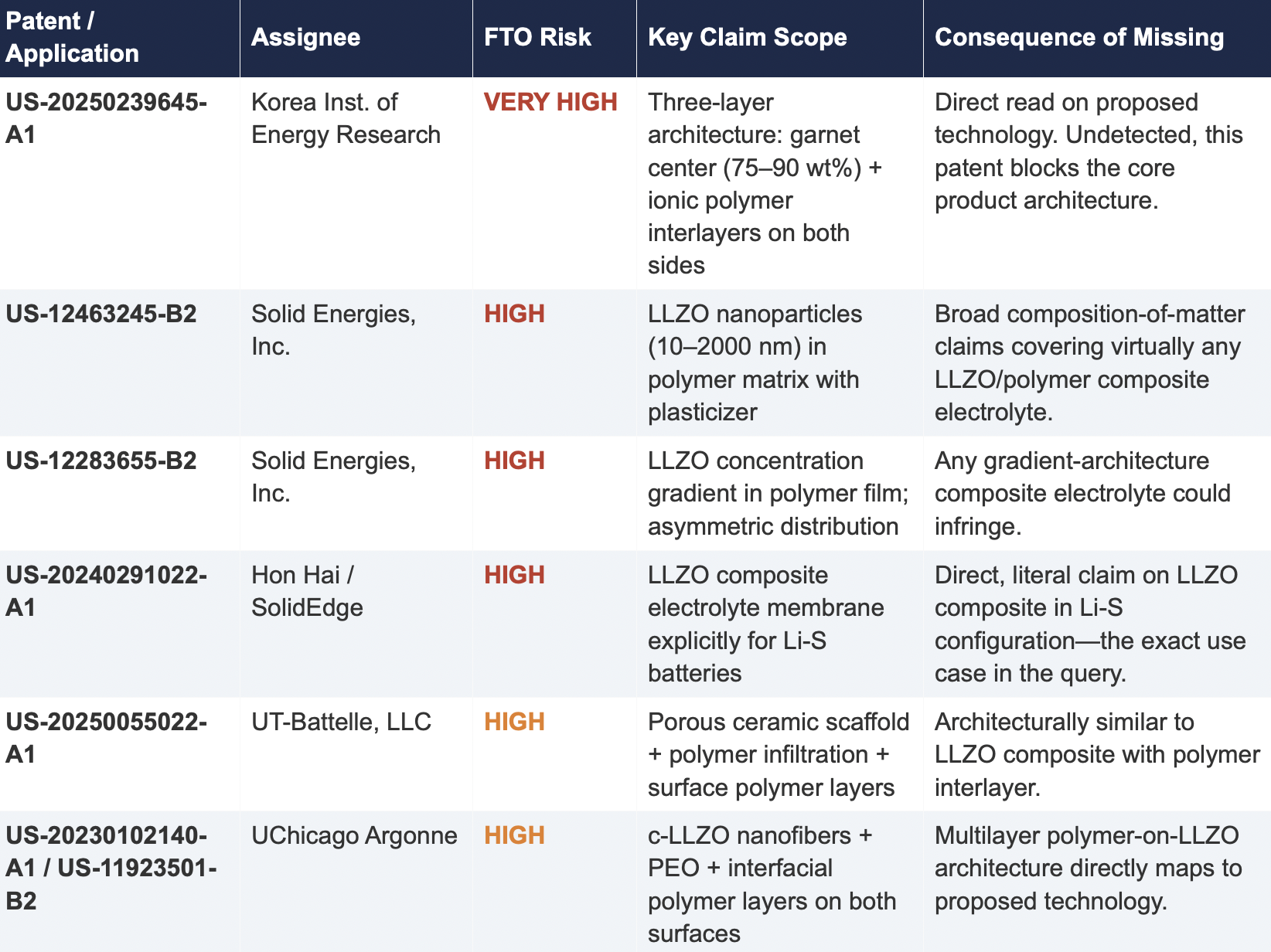
The following table presents patents identified exclusively by Cypris that were rated as High or Very High FTO risk for the proposed technology architecture. None were surfaced by any general-purpose model.
2.3 Patent Fencing: The Solid Energies Portfolio
Cypris identified a coordinated patent fencing strategy by Solid Energies, Inc. that no general-purpose model detected at scale. Solid Energies holds at least four granted US patents and one published application covering LLZO-polymer composite electrolytes across compositions(US-12463245-B2), gradient architectures (US-12283655-B2), electrode integration (US-12463249-B2), and manufacturing processes (US-20230035720-A1). Claude identified one Solid Energies patent (US 11,967,678) and correctly rated it as the highest-priority FTO concern but did not surface the broader portfolio. ChatGPT and Co-Pilot identified zero Solid Energies filings.
The practical significance is that a company relying on any individual patent hit would underestimate the scope of Solid Energies' IP position. The fencing strategy—covering the composition, the architecture, the electrode integration, and the manufacturing method—means that identifying a single design-around for one patent does not resolve the FTO exposure from the portfolio as a whole. This is the kind of strategic insight that requires seeing the full picture, which no general-purpose model delivered
2.4 Assignee Attribution Quality
ChatGPT's response included at least two instances of fabricated or unverifiable assignee attributions. For US 11,367,895 B1, the listed assignee was "Likely startup / defense contractor cluster." For US 2021/0202983 A1, the assignee was described as "Likely DOE / national lab ecosystem." In both cases, the model appears to have inferred the assignee from contextual patterns in its training data rather than retrieving the information from patent records.
In any operational IP workflow, assignee identity is foundational. It determines licensing strategy, litigation risk, and competitive positioning. A fabricated assignee is more dangerous than a missing one because it creates an illusion of completeness that discourages further investigation. An R&D team receiving this output might reasonably conclude that the landscape analysis is finished when it is not.
3. Structural Limitations of General-Purpose Models for Patent Intelligence
3.1 Training Data Is Not Patent Data
Large language models are trained on web-scraped text. Their knowledge of the patent record is derived from whatever fragments appeared in their training corpus: blog posts mentioning filings, news articles about litigation, snippets of Google Patents pages that were crawlable at the time of data collection. They do not have systematic, structured access to the USPTO database. They cannot query patent classification codes, parse claim language against a specific technology architecture, or verify whether a patent has been assigned, abandoned, or subjected to terminal disclaimer since their training data was collected.
This is not a limitation that improves with scale. A larger training corpus does not produce systematic patent coverage; it produces a larger but still arbitrary sampling of the patent record. The result is that general-purpose models will consistently surface well-known patents from heavily discussed assignees (QuantumScape, for example, appeared in most responses) while missing commercially significant filings from less publicly visible entities (Solid Energies, Korea Institute of EnergyResearch, Shenzhen Solid Advanced Materials).
3.2 The Web Is Closing to Model Scrapers
The data access problem is structural and worsening. As of mid-2025, Cloudflare reported that among the top 10,000 web domains, the majority now fully disallow AI crawlers such as GPTBot andClaudeBot via robots.txt. The trend has accelerated from partial restrictions to outright blocks, and the crawl-to-referral ratios reveal the underlying tension: OpenAI's crawlers access approximately1,700 pages for every referral they return to publishers; Anthropic's ratio exceeds 73,000 to 1.
Patent databases, scientific publishers, and IP analytics platforms are among the most restrictive content categories. A Duke University study in 2025 found that several categories of AI-related crawlers never request robots.txt files at all. The practical consequence is that the knowledge gap between what a general-purpose model "knows" about the patent landscape and what actually exists in the patent record is widening with each training cycle. A landscape query that a general-purpose model partially answered in 2023 may return less useful information in 2026.
3.3 General-Purpose Models Lack Ontological Frameworks for Patent Analysis
A freedom-to-operate analysis is not a summarization task. It requires understanding claim scope, prosecution history, continuation and divisional chains, assignee normalization (a single company may appear under multiple entity names across patent records), priority dates versus filing dates versus publication dates, and the relationship between dependent and independent claims. It requires mapping the specific technical features of a proposed product against independent claim language—not keyword matching.
General-purpose models do not have these frameworks. They pattern-match against training data and produce outputs that adopt the format and tone of patent analysis without the underlying data infrastructure. The format is correct. The confidence is high. The coverage is incomplete in ways that are not visible to the user.
4. Comparative Output Quality
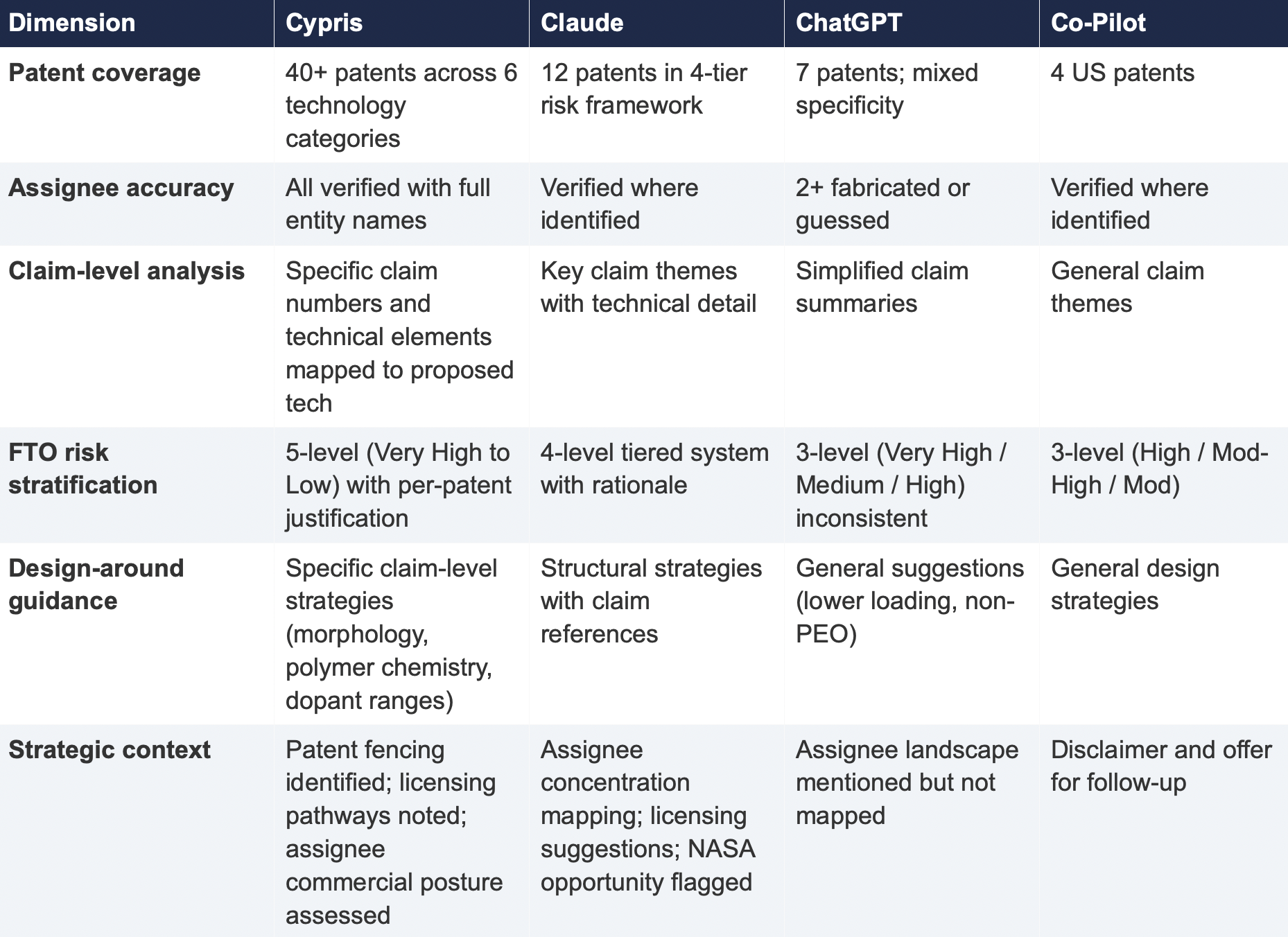
The following table summarizes the qualitative characteristics of each tool's response across the dimensions most relevant to an operational IP workflow.
5. Implications for R&D and IP Organizations
5.1 The Confidence Problem
The central risk identified by this study is not that general-purpose models produce bad outputs—it is that they produce incomplete outputs with high confidence. Each model delivered its results in a professional format with structured analysis, risk ratings, and strategic recommendations. At no point did any model indicate the boundaries of its knowledge or flag that its results represented a fraction of the available patent record. A practitioner receiving one of these outputs would have no signal that the analysis was incomplete unless they independently validated it against a comprehensive datasource.
This creates an asymmetric risk profile: the better the format and tone of the output, the less likely the user is to question its completeness. In a corporate environment where AI outputs are increasingly treated as first-pass analysis, this dynamic incentivizes under-investigation at precisely the moment when thoroughness is most critical.
5.2 The Diversification Illusion
It might be assumed that running the same query through multiple general-purpose models provides validation through diversity of sources. This study suggests otherwise. While the four tools returned different subsets of patents, all operated under the same structural constraints: training data rather than live patent databases, web-scraped content rather than structured IP records, and general-purpose reasoning rather than patent-specific ontological frameworks. Running the same query through three constrained tools does not produce triangulation; it produces three partial views of the same incomplete picture.
5.3 The Appropriate Use Boundary
General-purpose language models are effective tools for a wide range of tasks: drafting communications, summarizing documents, generating code, and exploratory research. The finding of this study is not that these tools lack value but that their value boundary does not extend to decisions that carry existential commercial risk.
Patent landscape analysis, freedom-to-operate assessment, and competitive intelligence that informs R&D investment decisions fall outside that boundary. These are workflows where the completeness and verifiability of the underlying data are not merely desirable but are the primary determinant of whether the analysis has value. A patent landscape that captures 10% of the relevant filings, regardless of how well-formatted or confidently presented, is a liability rather than an asset.
6. Test 2: Competitive Intelligence — Bio-Based Polyamide Patent Landscape
To assess whether the findings from Test 1 were specific to a single technology domain or reflected a broader structural pattern, a second query was submitted to all four tools. This query shifted from freedom-to-operate analysis to competitive intelligence, asking each tool to identify the top 10organizations by patent filing volume in bio-based polyamide synthesis from castor oil derivatives over the past three years, with summaries of technical approach, co-assignee relationships, and portfolio trajectory.
6.1 Query

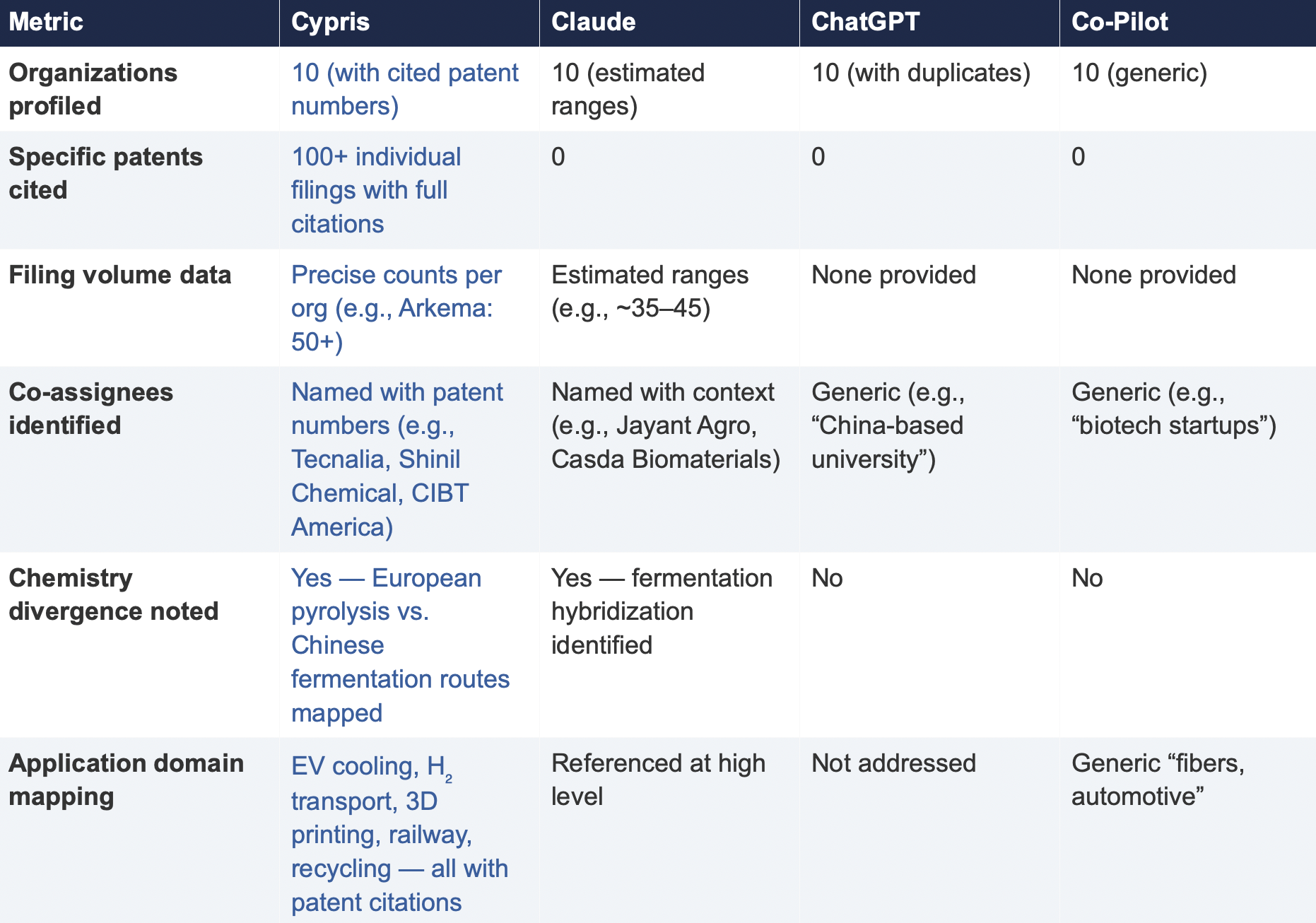
6.2 Summary of Results
6.3 Key Differentiators
Verifiability
The most consequential difference in Test 2 was the presence or absence of verifiable evidence. Cypris cited over 100 individual patent filings with full patent numbers, assignee names, and publication dates. Every claim about an organization’s technical focus, co-assignee relationships, and filing trajectory was anchored to specific documents that a practitioner could independently verify in USPTO, Espacenet, or WIPO PATENT SCOPE. No general-purpose model cited a single patent number. Claude produced the most structured and analytically useful output among the public models, with estimated filing ranges, product names, and strategic observations that were directionally plausible. However, without underlying patent citations, every claim in the response requires independent verification before it can inform a business decision. ChatGPT and Co-Pilot offered thinner profiles with no filing counts and no patent-level specificity.
Data Integrity
ChatGPT’s response contained a structural error that would mislead a practitioner: it listed CathayBiotech as organization #5 and then listed “Cathay Affiliate Cluster” as a separate organization at #9, effectively double-counting a single entity. It repeated this pattern with Toray at #4 and “Toray(Additional Programs)” at #10. In a competitive intelligence context where the ranking itself is the deliverable, this kind of error distorts the landscape and could lead to misallocation of competitive monitoring resources.
Organizations Missed
Cypris identified Kingfa Sci. & Tech. (8–10 filings with a differentiated furan diacid-based polyamide platform) and Zhejiang NHU (4–6 filings focused on continuous polymerization process technology)as emerging players that no general-purpose model surfaced. Both represent potential competitive threats or partnership opportunities that would be invisible to a team relying on public AI tools.Conversely, ChatGPT included organizations such as ANTA and Jiangsu Taiji that appear to be downstream users rather than significant patent filers in synthesis, suggesting the model was conflating commercial activity with IP activity.
Strategic Depth
Cypris’s cross-cutting observations identified a fundamental chemistry divergence in the landscape:European incumbents (Arkema, Evonik, EMS) rely on traditional castor oil pyrolysis to 11-aminoundecanoic acid or sebacic acid, while Chinese entrants (Cathay Biotech, Kingfa) are developing alternative bio-based routes through fermentation and furandicarboxylic acid chemistry.This represents a potential long-term disruption to the castor oil supply chain dependency thatWestern players have built their IP strategies around. Claude identified a similar theme at a higher level of abstraction. Neither ChatGPT nor Co-Pilot noted the divergence.
6.4 Test 2 Conclusion
Test 2 confirms that the coverage and verifiability gaps observed in Test 1 are not domain-specific.In a competitive intelligence context—where the deliverable is a ranked landscape of organizationalIP activity—the same structural limitations apply. General-purpose models can produce plausible-looking top-10 lists with reasonable organizational names, but they cannot anchor those lists to verifiable patent data, they cannot provide precise filing volumes, and they cannot identify emerging players whose patent activity is visible in structured databases but absent from the web-scraped content that general-purpose models rely on.
7. Conclusion
This comparative analysis, spanning two distinct technology domains and two distinct analytical workflows—freedom-to-operate assessment and competitive intelligence—demonstrates that the gap between purpose-built R&D intelligence platforms and general-purpose language models is not marginal, not domain-specific, and not transient. It is structural and consequential.
In Test 1 (LLZO garnet electrolytes for Li-S batteries), the purpose-built platform identified more than three times as many patents as the best-performing general-purpose model and ten times as many as the lowest-performing one. Among the patents identified exclusively by the purpose-built platform were filings rated as Very High FTO risk that directly claim the proposed technology architecture. InTest 2 (bio-based polyamide competitive landscape), the purpose-built platform cited over 100individual patent filings to substantiate its organizational rankings; no general-purpose model cited as ingle patent number.
The structural drivers of this gap—reliance on training data rather than live patent feeds, the accelerating closure of web content to AI scrapers, and the absence of patent-specific analytical frameworks—are not transient. They are inherent to the architecture of general-purpose models and will persist regardless of increases in model capability or training data volume.
For R&D and IP leaders, the practical implication is clear: general-purpose AI tools should be used for general-purpose tasks. Patent intelligence, competitive landscaping, and freedom-to-operate analysis require purpose-built systems with direct access to structured patent data, domain-specific analytical frameworks, and the ability to surface what a general-purpose model cannot—not because it chooses not to, but because it structurally cannot access the data.
The question for every organization making R&D investment decisions today is whether the tools informing those decisions have access to the evidence base those decisions require. This study suggests that for the majority of general-purpose AI tools currently in use, the answer is no.
Study Disclosure
This comparative evaluation was commissioned and published by Cypris. The testing methodology, prompts, evaluation criteria, and underlying outputs have been documented to support independent review and replication.
All platform outputs were preserved in their original form. Patent data and material factual claims were cross-checked against USPTO Patent Center and WIPO PATENTSCOPE records as of March 27, 2026. Cypris was one of the platforms evaluated and therefore has a commercial interest in the findings.
The Patent Intelligence Gap - A Comparative Analysis of Verticalized AI-Patent Tools vs. General-Purpose Language Models for R&D Decision-Making
Blogs

AI-driven patent scouting is the systematic use of artificial intelligence to monitor patents and scientific literature for early signals about where a technology field is heading. It differs from a one-time patent search. Patent scouting is continuous. It tracks new filings, emerging assignees, and shifting claim language across a technology area over months and years, and it feeds those signals into product and R&D decisions.
Patents are filed years before products reach the market, which is what makes scouting valuable. In pharmaceuticals, industry analyses indicate that composition-of-matter patents are typically filed roughly a decade before regulatory approval, with formulation and dosing patents following as a candidate moves through clinical development.1 A scouting program that reads this sequence sees a program's trajectory years before launch. Long-term product development commits budget and headcount on the same horizon, so early patent signal directly reduces the uncertainty in those bets.
This article explains what AI-driven patent scouting is, how it works, where it creates strategic value in product development, and how to run it as an ongoing process rather than a single report.
What patent scouting is
Patent scouting is the ongoing surveillance of a defined technology area to identify relevant patents, applicants, and technical trends. A scouting program defines the technology scope, monitors new patent filings and scientific publications in that scope, and reports material changes to the people making product decisions.
Patent scouting answers different questions than a freedom-to-operate (FTO) search or a prior art search. An FTO search asks whether commercializing a specific product would infringe active patent claims. A prior art search asks whether a specific invention is novel. Patent scouting asks a broader question: where is this field going, and who is moving there first. All three draw on the same underlying corpus of patents and scientific literature, but scouting is continuous and strategic rather than transactional.
Why filing activity is a leading indicator
Patent filing precedes commercial products by a measurable margin, so filing trends indicate where investment is concentrating before it reaches the market. In pharmaceuticals, the composition-to-formulation-to-dosing filing sequence maps to a candidate's progress through development, and the earliest filings appear years before a product is approved. Rising filing activity in a technology area, especially when it concentrates among established players, signals that investment is committing to an approach before the market confirms it.
A structural detail makes early scouting essential. There is a lag of roughly 18 months between when a patent is filed and when it publishes, which means disclosed research is already more than a year old when it first becomes visible. Scouting that runs continuously captures each signal as early as the publication system allows, rather than discovering it later in a periodic review.
Where patent scouting creates strategic value in product development
Direction-setting. Patent scouting shows which technical approaches are attracting investment before those approaches reach the market. A rising concentration of patents around a specific method signals that multiple organizations are committing R&D resources to it. Product teams use this to prioritize research directions with more evidence and less guesswork.
Competitive positioning. Scouting identifies which organizations are filing in a technology area and how their claim language is evolving. This reveals where competitors intend to build, which lets a product team either differentiate around protected positions or move faster in a still-open direction.
Risk reduction. Continuous scouting surfaces patents that could constrain a planned product early enough to change course cheaply. The cost asymmetry is large. Industry guides estimate that a preliminary freedom-to-operate analysis costs on the order of $10,000, rising above $100,000 for a comprehensive global one,2 while patent litigation and damages can range from several hundred thousand to hundreds of millions of dollars.3 NTP's suit against the maker of BlackBerry settled for $612.5 million in 2006 and nearly shut down the product's U.S. service.4 Discovering a blocking patent during scouting, years before launch, is far cheaper than discovering it after a design freeze or in litigation.
White space identification. Scouting maps where patents and scientific research cluster, and by extension where they do not. Sparsely patented technical territory can indicate an opening, though sparse patenting alone is not proof of a viable market. White space analysis is most reliable when patent data is read alongside scientific literature and commercial signals, not in isolation.
Portfolio and licensing strategy. Long-running scouting builds an evidence base for where to file, what to license, and which programs to sustain or retire. It connects the patent landscape to the R&D roadmap so that IP strategy and product strategy stay aligned.
How AI changes patent scouting
Traditional patent scouting relied on keyword queries and manual review. Keyword queries miss filings that describe the same concept in different terms, and manual review does not scale to the millions of patents and papers published each year.
AI-driven patent scouting changes this in three ways. First, semantic search retrieves documents by technical meaning rather than exact keyword match, so a scouting query surfaces relevant patents regardless of the specific terminology an applicant used. Second, an R&D ontology organizes patents and scientific literature into a structured map of technologies, so scouting operates on concepts and their relationships rather than on isolated search strings. Third, agentic workflows run the monitoring continuously, re-checking a defined technology area on a schedule and surfacing what changed since the last cycle. Together these let a scouting program cover a full technology field across patents and scientific research, not a keyword slice of it.
How to run AI-driven patent scouting as a process
- Define the technology scope. State the technical area in terms of the problems being solved and the approaches in use, not only keywords. A concept-level scope captures filings that use varied terminology.
- Establish a baseline. Run an initial semantic search across patents and scientific literature to map current filings, active applicants, and claim trends in scope.
- Set up continuous monitoring. Configure agentic monitoring to re-run the scouting scope on a schedule and report new filings, new entrants, and shifts in claim language since the previous cycle.
- Route signals to decisions. Deliver scouting output to the product and R&D owners who set roadmap priorities, so that new signals change decisions rather than sitting in a report.
- Review and refine scope. Update the technology scope as the field and the product strategy evolve, so scouting stays aligned with the current roadmap.
Where Cypris fits
Cypris is an AI-native R&D intelligence platform built for patent scouting and long-term technology strategy. Cypris runs semantic search across a corpus of more than 500 million patents and scientific papers, organized through a proprietary R&D ontology that maps technologies and their relationships rather than treating documents as isolated keyword hits. This lets a scouting program operate at the level of a technology field rather than a search string.
Cypris Q is the platform's agentic layer, and Agentic Monitoring runs patent scouting continuously across a defined technology area, surfacing new filings, new entrants, and shifts in claim language on an ongoing basis. Cypris holds enterprise API partnerships with OpenAI, Anthropic, and Google, and provides enterprise-grade security. It serves hundreds of enterprise customers across pharmaceuticals, chemicals, advanced materials, energy, and other regulated industries where long-term product development depends on early, reliable signal from the patent and scientific literature.
FAQ
What is AI-driven patent scouting?
AI-driven patent scouting is the continuous use of artificial intelligence to monitor patents and scientific literature for early signals about where a technology field is moving. It uses semantic search and an R&D ontology to track new filings, emerging applicants, and shifting claim language across a technology area, and feeds those signals into product and R&D decisions.
How far ahead of a product are patents filed?
Patents are filed years before products reach the market. In pharmaceuticals, industry analyses indicate composition-of-matter patents are typically filed roughly a decade before regulatory approval, with formulation and dosing patents following through clinical development.1 This lead time is what makes patent scouting a leading indicator.
How is patent scouting different from a patent search?
Patent scouting is continuous and strategic, while a patent search is typically a one-time query. A patent search retrieves documents relevant to a specific question at a point in time. Patent scouting monitors a defined technology area over months and years to identify trends, new entrants, and emerging risks.
How is patent scouting different from a freedom-to-operate search?
A freedom-to-operate (FTO) search determines whether making, using, or selling a specific product would infringe active patent claims. Patent scouting asks a broader question about where a technology field is heading and who is moving there first. Scouting often surfaces the blocking patents that a later FTO search would confirm, but earlier in the development timeline.
Why is patent filing activity a leading indicator?
Patent filing activity is a leading indicator because filing precedes commercial products by years. In pharmaceuticals, the earliest composition patents are filed roughly a decade before approval. Rising filing activity concentrated among established players signals that investment is committing to an approach before it reaches the market.
What does it cost to catch a blocking patent too late?
Catching a blocking patent late is far more expensive than catching it early. Industry guides estimate a freedom-to-operate analysis costs roughly $10,000 to more than $100,000,2 while patent litigation and damages can run from several hundred thousand to hundreds of millions of dollars;3 NTP's case against the maker of BlackBerry settled for $612.5 million.4 Scouting that surfaces the risk years before launch avoids the far higher cost of a late design change or litigation.
How does AI improve patent scouting?
AI improves patent scouting through semantic search, an R&D ontology, and agentic monitoring. Semantic search retrieves patents by technical meaning rather than exact keywords, the ontology organizes patents and scientific literature into a structured technology map, and agentic monitoring runs the surveillance continuously. Together these let scouting cover a full technology field rather than a keyword sample.
Can patent scouting identify white space?
Patent scouting can help identify white space by mapping where patents and scientific research cluster and where they are sparse. Sparse patenting can indicate an opening, but it is not proof of a viable market on its own. White space analysis is most reliable when patent data is read alongside scientific literature and commercial signals.
How often should patent scouting run?
Patent scouting should run continuously rather than as a single report, because filing activity and scientific publication are ongoing and there is a roughly 18-month lag between filing and publication. Agentic monitoring re-runs a defined scouting scope on a schedule and reports what changed since the previous cycle, so product and R&D teams receive current signal rather than a one-time snapshot.
Who uses AI-driven patent scouting?
AI-driven patent scouting is used by R&D leaders, product development teams, and IP strategists in research-intensive industries such as pharmaceuticals, chemicals, advanced materials, and energy. These teams commit budget and headcount to programs years before launch, and scouting gives them early signal on where the field is moving.
References & Cited Literature
- Drug Patent Searching: The Definitive Intelligence Guide for Pharma Teams. DrugPatentWatch.
- Green Light to Launch: A Step-by-Step FTO Analysis Guide for New Drug Products. DrugPatentWatch.
- When Is a "Freedom to Operate" Opinion Cost-Effective? Finnegan.
- NTP, Inc. v. Research In Motion, Ltd. (2006). Wicely, "Freedom-to-Operate Analysis: When and How to Conduct One."

United Airlines' "Relax Row" Looks Amazing. But Who Actually Owns the IP?
When United Airlines announced "Relax Row" — three adjacent economy seats with adjustable leg rests that raise to create a continuous lie-flat sleeping surface, complete with a mattress pad, blanket, and pillows — the aviation world took notice[1]. Slated for deployment on more than 200 of United's 787s and 777s, with up to 12 rows per aircraft, it represents one of the most ambitious economy cabin innovations ever attempted by a U.S. carrier[1].
But behind the glossy renders and enthusiastic social media rollout lies a thorny question that United hasn't publicly addressed: who actually owns the intellectual property behind this concept?
The answer, it turns out, is almost certainly not United Airlines.
The Skycouch Came First — By Over a Decade

The idea of economy seats with fold-up leg rests that create a flat sleeping surface across a row is not new. Air New Zealand pioneered this exact concept with its Economy Skycouch™, which has been in commercial service since approximately 2011[13]. The product works precisely the way United describes its Relax Row: passengers in a row of three economy seats can raise individual leg rests to seat-pan height, creating a continuous horizontal surface suitable for lying down[13].
Air New Zealand didn't just build the product — they patented it extensively. The foundational U.S. patent, US 9,132,918 B2, titled "Seating arrangement, seat unit, tray table and seating system," was granted in September 2015 and is assigned to Air New Zealand Limited[36]. The inventors — Victoria Anne Bamford, James Dominic France, Glen Wilson Porter, and Geoffrey Glen Suvalko — filed the earliest priority application in January 2009[36], giving the patent family protection extending approximately through 2029–2030.
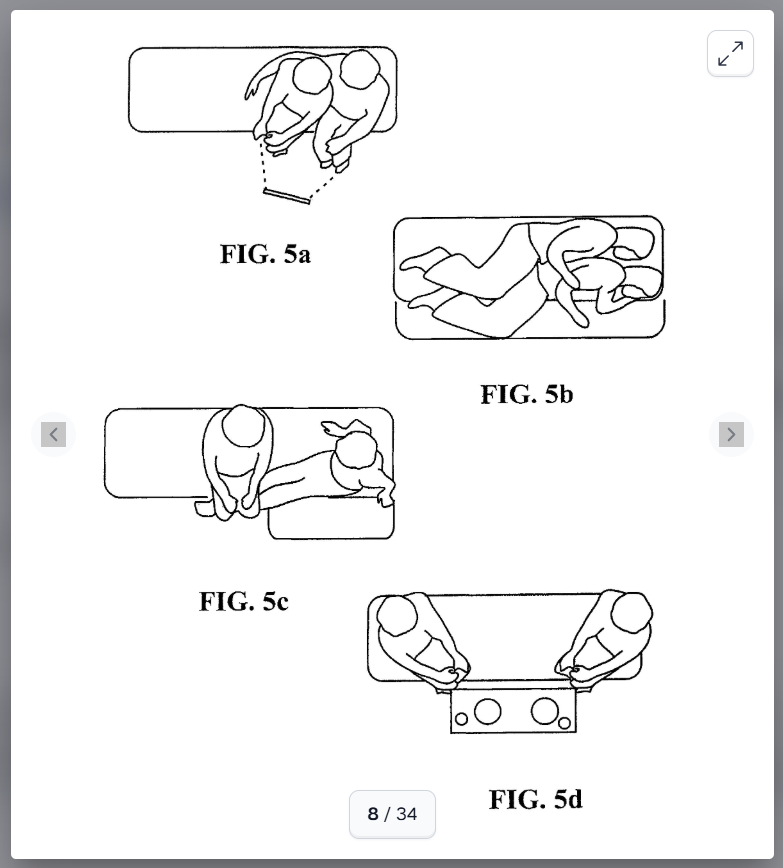
The claims are remarkably broad. Claim 1 describes a row of adjacent seats where each seat includes a seat back, a seat pan, and a leg rest, with the leg rest moveable between a stored condition and a fully deployed condition where the seat pan and leg rest are substantially coplanar[36]. When deployed, the leg rests of adjacent seats become contiguous, and the combined surfaces cooperate to define a reconfigurable horizontal support surface that can assume T-shape, L-shape, U-shape, and I-shape configurations — allowing at least two adult passengers to recline parallel to the row direction[36].
The patent explicitly contemplates installation in an economy class section of an aircraft and in a class section that offers the lowest standard fare price per seat to customers[36]. In other words, this isn't a business class patent being stretched to cover economy — it was designed from the ground up to cover exactly what United is now proposing.
The IP Goes Deep
Air New Zealand's IP portfolio goes deeper than just the seating arrangement. A separate patent, EP 2509868, covers the specific leg rest mechanism itself — a sophisticated system using cam tracks, hydrolock pistons, synchronization cables, and detent formations that allow each leg rest to move independently between stowed, intermediate, and fully extended positions[39]. The mechanism is entirely self-supporting through the seat frame, requiring no support from the floor or the seat in front[39]. This level of mechanical detail creates additional layers of patent protection beyond the broad concept claims.
The patent family spans the globe, with filings and grants across the United States[33][34][36], Europe[35], Canada[50], Australia[48], Spain[41], France[40], Brazil[37], and other jurisdictions — a clear signal that Air New Zealand invested heavily in protecting this innovation worldwide.
Air New Zealand Has Licensed Before
Critically, Air New Zealand has not simply sat on this IP. The airline has actively licensed the Skycouch technology to other carriers. China Airlines adopted the concept for its 777-300ER fleet[23][126], and Brazilian carrier Azul licensed it for their "SkySofa" product[126]. The Skycouch represents a textbook case of patent protection leading to licensing of competitors[126].
This licensing history establishes two important facts. First, Air New Zealand treats this IP as a revenue-generating asset and actively monitors the market for potential licensees (or infringers). Second, there is a well-worn commercial path for airlines wanting to deploy this technology — they license it from Air New Zealand.
United's Silence on the IP Question
Here is where things get interesting. United's public communications about Relax Row make no mention of Air New Zealand, the Skycouch, or any licensing arrangement[1][138]. The airline's formal "Elevated" interior press release — a detailed document covering Polaris Studio suites, Premium Plus upgrades, economy screen sizes, and even red pepper flakes for onboard meals — contains zero references to economy lie-flat row technology or any third-party IP[138]. The Relax Row announcement appears to have been made separately through United's social media channels[1].
A thorough search of United Airlines' own patent portfolio reveals no filings covering the economy lie-flat row concept. United's seat-related patents focus on entirely different areas: business class herringbone seating with disabled access configurations[54][55], tray table indicators using magnetic ball mechanisms[72], and seat assignment automation systems[60]. Nothing in United's IP portfolio touches the fold-up leg rest mechanism or the convertible economy row concept.
So What's Going On?
There are several plausible explanations, and the truth likely lies in one of these scenarios.
Scenario 1: An undisclosed license. This is the most probable explanation. Licensing agreements between airlines are frequently confidential. Air New Zealand has demonstrated willingness to license the Skycouch, and United — as a sophisticated commercial entity — would almost certainly conduct freedom-to-operate analysis before committing to install this technology across 200+ widebody aircraft. A quiet licensing deal would explain both the functional similarity and the public silence.
Scenario 2: The seat manufacturer as intermediary. Airlines don't build their own seats — they purchase them from specialized manufacturers like Collins Aerospace (formerly B/E Aerospace), Safran Seats, Recaro, or others. The seat manufacturer supplying United's Relax Row hardware may hold a license or sub-license from Air New Zealand, meaning United is purchasing a licensed product rather than directly licensing the IP. This is common practice in the aircraft interiors supply chain.
Scenario 3: A design-around. While the end result looks identical to the Skycouch, the internal mechanism could differ. Air New Zealand's mechanism patent describes very specific cam-track, hydrolock, and synchronization systems[39]. A seat manufacturer could potentially engineer a leg rest that achieves the same functional result — raising to seat-pan height — using different internal mechanics. However, the broader seating arrangement patent covers the concept itself, not just the mechanism, making a pure design-around more difficult[36].
Notably, alternative approaches to economy lie-flat beds do exist. B/E Aerospace (now part of Collins Aerospace/RTX) holds recent patents describing economy seat rows convertible to beds using fundamentally different mechanisms — one where a lower portion of the backrest detaches and slides forward with the seat pan[92][95], and another where the backrest frame rotates forward to overlay the seat pan with a separate mattress placed on top[96]. These patents, filed from India in 2023 and granted in 2025, explicitly target the economy class cabin[92][96]. But from United's own images, the Relax Row appears to use fold-up leg rests — the Skycouch approach — rather than these backrest-based alternatives[1][2].
If There's No License, It Could Get Sticky

The fourth scenario — that United or its supplier is deploying this product without authorization — would create significant legal exposure. Air New Zealand's patent claims are broad, well-established, and have been maintained across multiple jurisdictions for over a decade[36][41][50]. The patent holder has demonstrated both willingness to license and awareness of the commercial value of this IP[126].
Consider the claim mapping. United describes three adjacent economy seats with adjustable leg rests that can each be raised or lowered to create a cozy lie-flat space[1]. Air New Zealand's patent claims cover a row of adjacent seats with leg rests moveable between stored and deployed conditions where the seat pan and leg rest become substantially coplanar, with adjacent leg rests becoming contiguous to form a reconfigurable horizontal support surface[36]. The visual evidence from United's announcement shows leg rests raised to seat level creating a continuous flat surface across the row[1][2] — a near-perfect overlay with the patent claims.
With the patent family not expiring until approximately 2029–2030, and United planning deployment across 200+ aircraft starting next year[1], the commercial stakes are enormous. An infringement finding could result in injunctive relief, royalty payments, or forced redesign — any of which would be extraordinarily costly and disruptive at the scale United is planning.
What to Watch For
The aviation IP community will be watching this space closely. Key indicators will include whether Air New Zealand makes any public statement acknowledging (or challenging) United's product, whether a licensing agreement surfaces in either company's financial disclosures, and whether the seat manufacturer behind Relax Row is identified — which could reveal whether the IP arrangement runs through the supply chain rather than directly between airlines.
For now, the most important takeaway is this: the concept behind United's splashy Relax Row announcement was invented, patented, and commercialized by Air New Zealand more than a decade ago. Whether United is paying for the privilege of using it, or betting that its implementation differs enough to avoid the patent claims, remains one of the more consequential unanswered questions in commercial aviation IP today.
This article was powered by Cypris Q, an AI agent that helps R&D teams instantly synthesize insights from patents, scientific literature, and market intelligence from around the globe. Discover how leading R&D teams use Cypris Q to monitor technology landscapes and identify opportunities faster - Book a demo
The information provided is for general informational purposes only and should not be construed as legal or professional advice.
Citations
[1] United Airlines Relax Row announcement (social media, March 2026)
[2] United Airlines Relax Row product images (March 2026)
[13] Air New Zealand. "Economy Skycouch – Long Haul."
[23] Executive Traveller. "Review: Air New Zealand's Skycouch seat (soon for China Airlines)."
[33] Air New Zealand Limited. Seating Arrangement, Seat Unit, Tray Table and Seating System. Patent No. US-20160031561-A1. Issued Feb 3, 2016.
[34] Air New Zealand Limited. Seating Arrangement, Seat Unit, Tray Table and Seating System. Patent No. US-20150203207-A1. Issued Jul 22, 2015.
[35] Air New Zealand Limited. Seating Arrangement, Seat Unit, Tray Table and Seating System. Patent No. EP-2391541-A1. Issued Dec 6, 2011.
[36] Air New Zealand Limited; Bamford, V.A.; France, J.D.; Porter, G.W.; Suvalko, G.G. Seating arrangement, seat unit, tray table and seating system. Patent No. US-9132918-B2. Issued Sep 14, 2015.
[37] Air New Zealand Limited. Seating arrangement, seat unit and passenger vehicle and method of setting up a passenger seat area. Patent No. BR-PI1008065-B1. Issued Jul 27, 2020.
[39] Air New Zealand Limited. A Seat and Related Leg Rest and Mechanism and Method Therefor. Patent No. EP-2509868-A1. Issued Oct 16, 2012.
[40] Air New Zealand Limited. Seating Arrangement, Seat Unit and Seating System. Patent No. FR-2941656-A3. Issued Aug 5, 2010.
[41] Air New Zealand Limited. Seating arrangement, seat unit, tray table and seating system. Patent No. ES-2742696-T3. Issued Feb 16, 2020.
[48] Air New Zealand Limited. Seating arrangement, seat unit, tray table and seating system. Patent No. AU-2010209371-B2. Issued Jan 13, 2016.
[50] Air New Zealand Limited. Seating Arrangement, Seat Unit, Tray Table and Seating System. Patent No. CA-2750767-C. Issued Apr 9, 2018.
[54] United Airlines, Inc. Passenger seating arrangement having access for disabled passengers. Patent No. US-11655037-B2. Issued May 22, 2023.
[55] United Airlines, Inc. Passenger seating arrangement having access for disabled passengers. Patent No. US-12291336-B2. Issued May 5, 2025.
[60] United Airlines, Inc. Method and system for automating passenger seat assignment procedures. Patent No. US-10185920-B2. Issued Jan 21, 2019.
[72] United Airlines, Inc. Tray table indicator. Patent No. US-12525316-B2. Issued Jan 12, 2026.
[92] B/E Aerospace, Inc. Row of passenger seats convertible to a bed. Patent No. US-12351317-B2. Issued Jul 7, 2025.
[95] B/E Aerospace, Inc. Row of Passenger Seats Convertible to a Bed. Patent No. US-20250051014-A1. Issued Feb 12, 2025.
[96] B/E Aerospace, Inc. Converting economy seat to full flat bed by dropping seat back frame. Patent No. US-12459650-B2. Issued Nov 3, 2025.
[126] Above the Law. "Coach Comfort: Myth Or The Future."
[138] United Airlines. "United Unveils the Elevated Aircraft Interior."

Innovation intelligence is the practice of combining patent analysis with commercial and market analysis to guide R&D and technology investment decisions. It treats patents, scientific literature, and commercial signals as one connected evidence base rather than separate datasets. The purpose is to answer a question that neither patent data nor market data answers alone: where should an organization invest its R&D resources, and why.
Patent activity on its own is a weak guide to commercial value. According to the World Intellectual Property Organization, global patent applications surpassed 3.5 million for the first time in 2023, a fourth consecutive year of growth.12 Volume at that scale does not indicate commercial success, because filing a patent is not the same as commercializing it. A 2025 study in Research Policy that examined roughly 3,000 patents linked to the U.S. SBIR program found only about 21.5% showed signs of commercialization.3 Filing volume and commercial outcome diverge, which is why patent analysis needs commercial context.
This article explains what innovation intelligence is, how commercial and patent analysis combine, where the combined view creates value, and how AI makes the analysis practical across a corpus of more than 500 million patents and scientific papers.
What innovation intelligence is
Innovation intelligence is the integration of technical evidence and commercial evidence into a single analysis that informs R&D strategy. The technical evidence is patents and scientific literature. The commercial evidence is competitive activity, market signals, and the commercial behavior of the organizations doing the patenting.
Innovation intelligence differs from patent analytics alone. Patent analytics measures filing volume, assignees, jurisdictions, and claim trends. Innovation intelligence uses those patent metrics as one input, then connects them to commercial context so the output is a decision about where to invest rather than a description of a patent landscape.
Innovation intelligence also differs from market intelligence alone. Market intelligence measures demand, competitors, and revenue. It does not show which technical approaches organizations are protecting or where scientific research is accelerating. Innovation intelligence adds the patent and scientific layer that market intelligence lacks.
Why patent activity alone misleads
Patent counts overstate commercial certainty in two directions.
First, a granted patent is not a commercial product. The 2025 Research Policy study of SBIR-linked patents found that only about one in five showed commercialization signs, a reminder that most filings never reach the market. Reading patent activity without commercial signals treats every filing as if it were a product, which it is not.
Second, many patents are abandoned before the end of their term. Academic analysis of patent abandonment, including work published in the NYU Journal of Intellectual Property and Entertainment Law, documents that a substantial share of patents lapse for non-payment of maintenance fees well before their 20-year term expires.4 A raw competitor patent count therefore includes protection that no longer exists. Patent analysis that does not account for lapse and abandonment overstates the strength of a portfolio.
How commercial and patent analysis combine
Commercial and patent analysis combine along three connections.
Assignee to organization. Patent assignees are organizations with commercial strategies. Linking a patent portfolio to the commercial behavior of its owner shows not only what an organization has protected, but how it intends to compete. A rising patent position from a company entering a new market is a stronger signal than a patent count in isolation.
Technology to market. A technology area maps to the products and markets it enables. Connecting patent activity in a technology area to the commercial size and growth of the markets it serves separates well-patented technologies with no market from technologies where patent activity and commercial demand are rising together.
Filing trend to commercial signal. Patent filing velocity is a proxy for R&D spend. It reads most clearly alongside other commercial signals: venture rounds, M&A, and litigation. Litigation outcomes in particular move commercial value directly, as when NTP's patent suit against the maker of BlackBerry settled for $612.5 million in 2006 after threatening to shut down U.S. service.5
Where connected commercial and patent analysis creates value
R&D investment decisions. The combined view shows which technology areas have both rising patent activity and commercial opportunity, so R&D budget is directed with evidence from both sides rather than one.
Competitive intelligence. Connecting a competitor's patent portfolio to its commercial activity reveals intent. Patents show what a competitor is building. Commercial signals show whether they are commercializing it. Together they indicate where a competitor will compete next.
Technology landscaping. A landscape that combines patents, scientific literature, and commercial context describes not only who holds patents in an area, but whether that area is commercially live. This distinguishes active technology fields from patented but dormant ones.
Licensing and partnership strategy. Identifying organizations with strong patent positions and commercial reasons to license or partner requires both the patent view and the commercial view. Neither dataset identifies these opportunities alone.
Freedom-to-operate in commercial context. A freedom-to-operate (FTO) assessment identifies patent risk. Reading that risk alongside the commercial value of a product line prioritizes which risks to clear first, based on what is commercially at stake.
How AI makes innovation intelligence work at scale
Connecting commercial and patent analysis manually does not scale. Global patent applications surpassed 3.5 million in 2023, and a structural lag of roughly 18 months between filing and publication means disclosed research is already more than a year old when it surfaces. The volume and the delay together put comprehensive manual review out of reach.
AI makes innovation intelligence practical in three ways. Semantic search retrieves patents and scientific papers by technical meaning rather than exact keyword, so a technology area is captured completely regardless of terminology. An R&D ontology organizes patents and scientific literature into a structured map of technologies and their relationships, which is what allows patent activity to be connected to technology areas and, through them, to commercial context. Agentic workflows run the analysis continuously, updating the combined view as new patents, papers, and signals appear. Together these let innovation intelligence operate across a full technology field rather than a keyword sample of it.
Where Cypris fits
Cypris is an AI-native R&D intelligence platform that connects patent analysis, scientific literature, and commercial context for innovation intelligence. Cypris runs semantic search across a corpus of more than 500 million patents and scientific papers, organized through a proprietary R&D ontology that maps technologies and their relationships. The ontology is what lets patent activity be connected to technology areas and analyzed as innovation intelligence rather than isolated patent metrics.
Cypris Q is the platform's agentic layer, and Agentic Monitoring tracks a technology area continuously, updating the combined patent and commercial view as new filings, papers, and signals appear. Cypris holds enterprise API partnerships with OpenAI, Anthropic, and Google, and provides enterprise-grade security. It serves hundreds of enterprise customers across pharmaceuticals, chemicals, advanced materials, energy, and other regulated industries where R&D investment decisions depend on connecting patent evidence to commercial context.
FAQ
What is innovation intelligence?
Innovation intelligence is the practice of combining patent analysis with commercial and market analysis to guide R&D and technology investment decisions. It treats patents, scientific literature, and commercial signals as one connected evidence base, so the output is a decision about where to invest rather than a description of a patent landscape.
What is software for commercial and patent analysis?
Software for commercial and patent analysis connects patent data to commercial context in one platform, so R&D and strategy teams can evaluate both the technical and the commercial dimension of a technology area. Cypris supports this by running semantic search across more than 500 million patents and scientific papers organized through a proprietary R&D ontology that links patent activity to technology areas.
How is innovation intelligence different from patent analytics?
Innovation intelligence differs from patent analytics by adding commercial context. Patent analytics measures filing volume, assignees, and claim trends. Innovation intelligence uses those metrics as one input and connects them to commercial and market signals, so the analysis informs an investment decision rather than only describing a patent landscape.
Why is patent activity alone a poor guide to commercial value?
Patent activity alone is a poor guide because most patents are never commercialized and many are abandoned before term. A 2025 Research Policy study of SBIR-linked patents found only about 21.5% showed commercialization signs,3 and academic work on patent abandonment shows a substantial share lapse before their 20-year term ends.4 Filing volume and commercial value diverge.
How many patents are filed each year?
According to WIPO, global patent applications exceeded 3.5 million for the first time in 2023, the fourth consecutive year of growth.1 This volume, combined with a roughly 18-month filing-to-publication lag, makes comprehensive manual review impractical and is why AI-driven analysis is used for innovation intelligence.
How do commercial and patent analysis combine?
Commercial and patent analysis combine by linking patent assignees to their organizations' commercial strategies, mapping technology areas to the markets they serve, and reading patent filing trends alongside commercial signals such as venture rounds, M&A, and litigation. These connections turn patent activity into a signal about where R&D investment is concentrating and where commercial opportunity exists.
Why do R&D teams need both patent and commercial analysis?
R&D teams need both because a technology can be heavily patented but commercially stalled, or commercially attractive but legally crowded. Patent analysis shows what is protected and where research is accelerating. Commercial analysis shows where demand and competition are. Investment decisions require reading them together.
How does AI improve innovation intelligence?
AI improves innovation intelligence through semantic search, an R&D ontology, and agentic monitoring. Semantic search captures a technology area completely regardless of terminology, the ontology connects patent activity to technology areas and commercial context, and agentic monitoring keeps the combined view current. Together these make the analysis practical across a full technology field.
Who uses innovation intelligence?
Innovation intelligence is used by R&D leaders, strategy and commercial teams, and IP strategists in research-intensive industries such as pharmaceuticals, chemicals, advanced materials, and energy. These teams make technology investment decisions that require both patent evidence and commercial context.
How does innovation intelligence relate to freedom-to-operate?
Innovation intelligence relates to freedom-to-operate (FTO) by placing patent risk in commercial context. An FTO assessment identifies patent risk for a product. Reading that risk alongside the commercial value of the product line prioritizes which risks to clear first, based on what is commercially at stake.
References & Cited Literature
- World Intellectual Property Indicators 2024 — record on global patent filings (global applications surpassed 3.5 million in 2023). EU IP Helpdesk.
- WIPO reports return to growth in patents and trademarks filings in 2024. Global Legal Post.
- Raiteri, E., Bottai, C., & de Rassenfosse, G. (2025). A new approach to measuring invention commercialization: An application to the SBIR program. Research Policy.
- Does Anybody See What I See?: Abandoned Patents and Their Impacts on Technology Development. NYU Journal of Intellectual Property & Entertainment Law.
- NTP, Inc. v. Research In Motion, Ltd. — the parties settled in 2006 for $612.5 million (widely reported; matter of public record). Case discussed in: Wicely, "Freedom-to-Operate Analysis: When and How to Conduct One."
Reports
Foundation AI is getting more powerful every quarter, but better models alone won’t produce better R&D decisions. The real gap is the “harness”: the evidence, ontologies, domain context, and workflows the model is given to reason over. As access to frontier models becomes commoditized, competitive advantage will come from the intelligence layered on top of them. In our latest report, The Harness Problem, we break down why this matters for R&D and IP teams, what a serious enterprise deployment requires, and how to tell if your organization has this gap.
This Cypris research brief maps the full ecosystem and value chain of electric vehicle battery systems and advanced battery materials, tracing the pathway from raw material extraction through precursor and active material production, cell component manufacturing, battery cell production, pack assembly, vehicle integration, and end-of-life recycling. The brief defines each segment's functional role, identifies key players across upstream, midstream, and downstream layers, and analyzes the structural forces — including critical mineral supply volatility, geographic concentration, OEM vertical integration strategies, recycling-driven circularity, and solid-state battery development — that are reshaping where value concentrates and where supply-chain risk resides.
This Cypris research brief maps the ecosystem and value chain of the specialty polymers and high-performance materials industry, covering the full pathway from raw material and monomer suppliers through polymer manufacturers, compounders, additive suppliers, specialty distributors, converters, and end-use OEMs across aerospace, automotive, electronics, medical, energy, and industrial markets. Beyond the segment-by-segment breakdown and player landscape, the brief analyzes the structural forces shaping the ecosystem — including vertical integration strategies, supplier concentration and consolidation patterns, geographic clustering, circularity constraints, and shifting end-market demand — with a central thesis that leverage in this ecosystem concentrates wherever technical specialization overlaps with requalification burden.
Webinars

Many enterprises have adopted horizontal, foundation-model AI platforms. But access to the same underlying models does not, by itself, create differentiated intelligence. For highly technical and mission-critical research, general-purpose models may produce broad but weakly grounded answers when they lack access to authoritative technical data, specialized context, and verifiable sources.
The next competitive advantage will come from the intelligence layer surrounding the foundation model: the domain-specific data, ontologies, retrieval capabilities, agent workflows, and source grounding that together form an AI harness. These verticalized systems can transform general-purpose AI into a more specialized capability for research, innovation, and technical decision-making.
Join Steve Hafif, Co-Founder and CEO of Cypris.ai, and Marlene Valderrama, Principal IP Manager and Senior Technology Scout at Halliburton, for a conversation on the state of enterprise AI and how organizations can enhance horizontal AI platforms with verticalized intelligence designed for R&D and innovation.


Most IP organizations are making high-stakes capital allocation decisions with incomplete visibility – relying primarily on patent data as a proxy for innovation. That approach is not optimal. Patents alone cannot reveal technology trajectories, capital flows, or commercial viability.
A more effective model requires integrating patents with scientific literature, grant funding, market activity, and competitive intelligence. This means that for a complete picture, IP and R&D teams need infrastructure that connects fragmented data into a unified, decision-ready intelligence layer.
AI is accelerating that shift. The value is no longer simply in retrieving documents faster; it’s in extracting signal from noise. Modern AI systems can contextualize disparate datasets, identify patterns, and generate strategic narratives – transforming raw information into actionable insight.
Join us on Thursday, April 23, at 12 PM ET for a discussion on how unified AI platforms are redefining decision-making across IP and R&D teams. Moderated by Gene Quinn, panelists Marlene Valderrama and Amir Achourie will examine how integrating technical, scientific, and market data collapses traditional silos – enabling more aligned strategy, sharper investment decisions, and measurable business impact.
Register here: https://ipwatchdog.com/cypris-april-23-2026/

In this session, we break down how AI is reshaping the R&D lifecycle, from faster discovery to more informed decision-making. See how an intelligence layer approach enables teams to move beyond fragmented tools toward a unified, scalable system for innovation.