

Resources
Guides, research, and perspectives on R&D intelligence, IP strategy, and the future of AI enabled innovation.

Executive Summary
In 2024, US patent infringement jury verdicts totaled $4.19 billion across 72 cases. Twelve individual verdicts exceeded $100million. The largest single award—$857 million in General Access Solutions v.Cellco Partnership (Verizon)—exceeded the annual R&D budget of many mid-market technology companies. In the first half of 2025 alone, total damages reached an additional $1.91 billion.
The consequences of incomplete patent intelligence are not abstract. In what has become one of the most instructive IP disputes in recent history, Masimo’s pulse oximetry patents triggered a US import ban on certain Apple Watch models, forcing Apple to disable its blood oxygen feature across an entire product line, halt domestic sales of affected models, invest in a hardware redesign, and ultimately face a $634 million jury verdict in November 2025. Apple—a company with one of the most sophisticated intellectual property organizations on earth—spent years in litigation over technology it might have designed around during development.
For organizations with fewer resources than Apple, the risk calculus is starker. A mid-size materials company, a university spinout, or a defense contractor developing next-generation battery technology cannot absorb a nine-figure verdict or a multi-year injunction. For these organizations, the patent landscape analysis conducted during the development phase is the primary risk mitigation mechanism. The quality of that analysis is not a matter of convenience. It is a matter of survival.
And yet, a growing number of R&D and IP teams are conducting that analysis using general-purpose AI tools—ChatGPT, Claude, Microsoft Co-Pilot—that were never designed for patent intelligence and are structurally incapable of delivering it.
This report presents the findings of a controlled comparison study in which identical patent landscape queries were submitted to four AI-powered tools: Cypris (a purpose-built R&D intelligence platform),ChatGPT (OpenAI), Claude (Anthropic), and Microsoft Co-Pilot. Two technology domains were tested: solid-state lithium-sulfur battery electrolytes using garnet-type LLZO ceramic materials (freedom-to-operate analysis), and bio-based polyamide synthesis from castor oil derivatives (competitive intelligence).
The results reveal a significant and structurally persistent gap. In Test 1, Cypris identified over 40 active US patents and published applications with granular FTO risk assessments. Claude identified 12. ChatGPT identified 7, several with fabricated attribution. Co-Pilot identified 4. Among the patents surfaced exclusively by Cypris were filings rated as “Very High” FTO risk that directly claim the technology architecture described in the query. In Test 2, Cypris cited over 100 individual patent filings with full attribution to substantiate its competitive landscape rankings. No general-purpose model cited a single patent number.
The most active sectors for patent enforcement—semiconductors, AI, biopharma, and advanced materials—are the same sectors where R&D teams are most likely to adopt AI tools for intelligence workflows. The findings of this report have direct implications for any organization using general-purpose AI to inform patent strategy, competitive intelligence, or R&D investment decisions.

1. Methodology
A controlled comparative evaluation was conducted on March 27, 2026. An identical patent landscape query was submitted verbatim to each platform under standardized testing conditions. No follow-up prompts, clarifications, or iterative refinements were permitted, ensuring that each platform was evaluated based solely on its initial response.
The outputs were preserved in their original form and evaluated against predefined criteria using publicly verifiable patent records.
1.1 Query
Identify all active US patents and published applications filed in the last 5 years related to solid-state lithium-sulfur battery electrolytes using garnet-type ceramic materials. For each, provide the assignee, filing date, key claims, and current legal status. Highlight any patents that could pose freedom-to-operate risks for a company developing a Li₇La₃Zr₂O₁₂(LLZO)-based composite electrolyte with a polymer interlayer.
1.2 Tools Evaluated

1.3 Evaluation Criteria
Each response was evaluated using a consistent six-part scoring framework: patent coverage, assignee accuracy, filing metadata completeness, depth of claim analysis, quality of FTO risk stratification, and the presence of actionable strategic guidance.
Patent numbers, assignees, filing information, and legal status were independently checked against publicly available USPTO and WIPO records. The evaluation focused on the completeness, accuracy, and practical utility of each platform’s output rather than writing quality or presentation.
2. Findings
2.1 Coverage Gap
The most significant finding is the scale of the coverage differential. Cypris identified over 40 active US patents and published applications spanning LLZO-polymer composite electrolytes, garnet interface modification, polymer interlayer architectures, lithium-sulfur specific filings, and adjacent ceramic composite patents. The results were organized by technology category with per-patent FTO risk ratings.
Claude identified 12 patents organized in a four-tier risk framework. Its analysis was structurally sound and correctly flagged the two highest-risk filings (Solid Energies US 11,967,678 and the LLZO nanofiber multilayer US 11,923,501). It also identified the University ofMaryland/ Wachsman portfolio as a concentration risk and noted the NASA SABERS portfolio as a licensing opportunity. However, it missed the majority of the landscape, including the entire Corning portfolio, GM's interlayer patents, theKorea Institute of Energy Research three-layer architecture, and the HonHai/SolidEdge lithium-sulfur specific filing.
ChatGPT identified 7 patents, but the quality of attribution was inconsistent. It listed assignees as "Likely DOE /national lab ecosystem" and "Likely startup / defense contractor cluster" for two filings—language that indicates the model was inferring rather than retrieving assignee data. In a freedom-to-operate context, an unverified assignee attribution is functionally equivalent to no attribution, as it cannot support a licensing inquiry or risk assessment.
Co-Pilot identified 4 US patents. Its output was the most limited in scope, missing the Solid Energies portfolio entirely, theUMD/ Wachsman portfolio, Gelion/ Johnson Matthey, NASA SABERS, and all Li-S specific LLZO filings.
2.2 Critical Patents Missed by Public Models
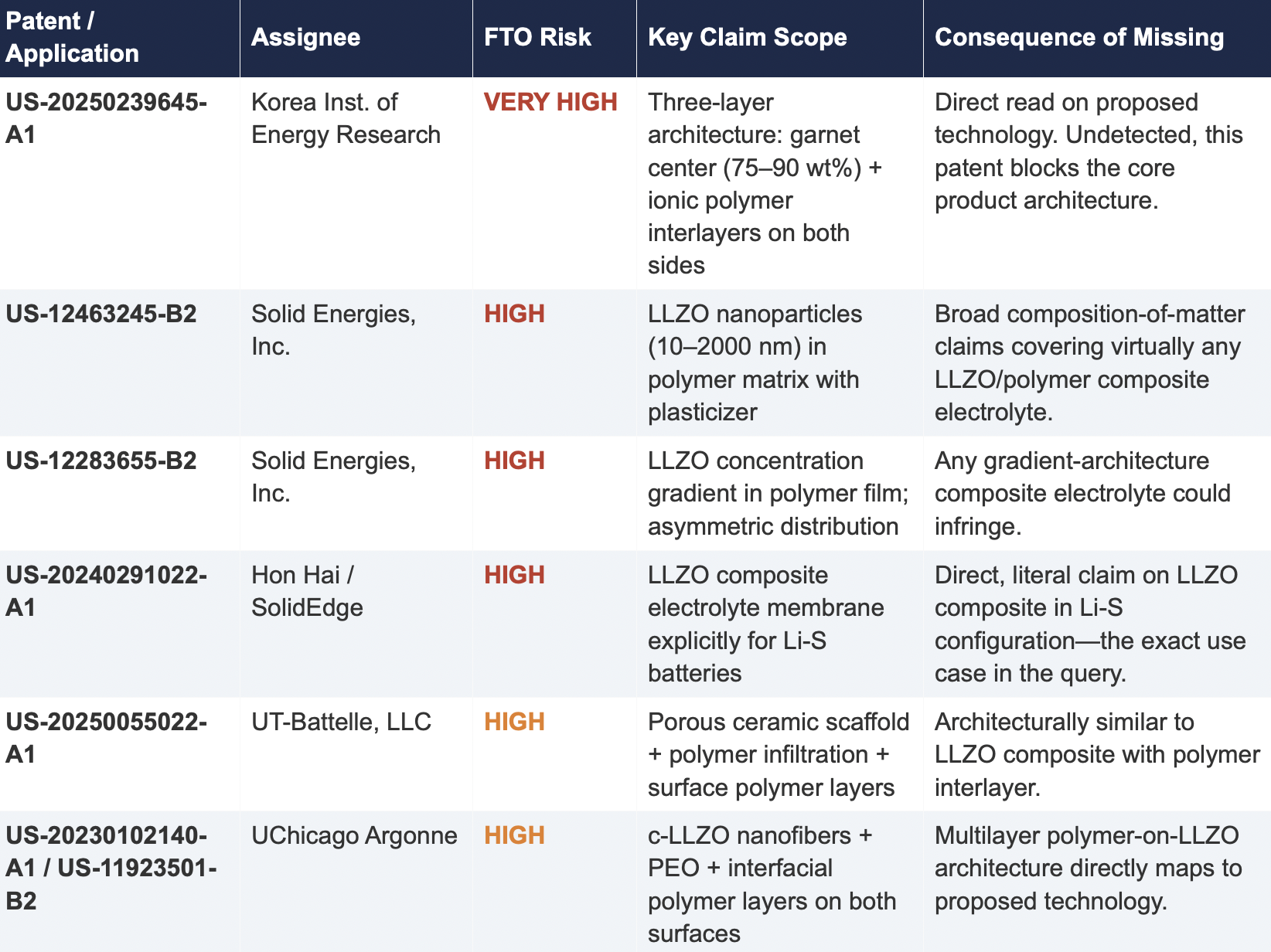
The following table presents patents identified exclusively by Cypris that were rated as High or Very High FTO risk for the proposed technology architecture. None were surfaced by any general-purpose model.
2.3 Patent Fencing: The Solid Energies Portfolio
Cypris identified a coordinated patent fencing strategy by Solid Energies, Inc. that no general-purpose model detected at scale. Solid Energies holds at least four granted US patents and one published application covering LLZO-polymer composite electrolytes across compositions(US-12463245-B2), gradient architectures (US-12283655-B2), electrode integration (US-12463249-B2), and manufacturing processes (US-20230035720-A1). Claude identified one Solid Energies patent (US 11,967,678) and correctly rated it as the highest-priority FTO concern but did not surface the broader portfolio. ChatGPT and Co-Pilot identified zero Solid Energies filings.
The practical significance is that a company relying on any individual patent hit would underestimate the scope of Solid Energies' IP position. The fencing strategy—covering the composition, the architecture, the electrode integration, and the manufacturing method—means that identifying a single design-around for one patent does not resolve the FTO exposure from the portfolio as a whole. This is the kind of strategic insight that requires seeing the full picture, which no general-purpose model delivered
2.4 Assignee Attribution Quality
ChatGPT's response included at least two instances of fabricated or unverifiable assignee attributions. For US 11,367,895 B1, the listed assignee was "Likely startup / defense contractor cluster." For US 2021/0202983 A1, the assignee was described as "Likely DOE / national lab ecosystem." In both cases, the model appears to have inferred the assignee from contextual patterns in its training data rather than retrieving the information from patent records.
In any operational IP workflow, assignee identity is foundational. It determines licensing strategy, litigation risk, and competitive positioning. A fabricated assignee is more dangerous than a missing one because it creates an illusion of completeness that discourages further investigation. An R&D team receiving this output might reasonably conclude that the landscape analysis is finished when it is not.
3. Structural Limitations of General-Purpose Models for Patent Intelligence
3.1 Training Data Is Not Patent Data
Large language models are trained on web-scraped text. Their knowledge of the patent record is derived from whatever fragments appeared in their training corpus: blog posts mentioning filings, news articles about litigation, snippets of Google Patents pages that were crawlable at the time of data collection. They do not have systematic, structured access to the USPTO database. They cannot query patent classification codes, parse claim language against a specific technology architecture, or verify whether a patent has been assigned, abandoned, or subjected to terminal disclaimer since their training data was collected.
This is not a limitation that improves with scale. A larger training corpus does not produce systematic patent coverage; it produces a larger but still arbitrary sampling of the patent record. The result is that general-purpose models will consistently surface well-known patents from heavily discussed assignees (QuantumScape, for example, appeared in most responses) while missing commercially significant filings from less publicly visible entities (Solid Energies, Korea Institute of EnergyResearch, Shenzhen Solid Advanced Materials).
3.2 The Web Is Closing to Model Scrapers
The data access problem is structural and worsening. As of mid-2025, Cloudflare reported that among the top 10,000 web domains, the majority now fully disallow AI crawlers such as GPTBot andClaudeBot via robots.txt. The trend has accelerated from partial restrictions to outright blocks, and the crawl-to-referral ratios reveal the underlying tension: OpenAI's crawlers access approximately1,700 pages for every referral they return to publishers; Anthropic's ratio exceeds 73,000 to 1.
Patent databases, scientific publishers, and IP analytics platforms are among the most restrictive content categories. A Duke University study in 2025 found that several categories of AI-related crawlers never request robots.txt files at all. The practical consequence is that the knowledge gap between what a general-purpose model "knows" about the patent landscape and what actually exists in the patent record is widening with each training cycle. A landscape query that a general-purpose model partially answered in 2023 may return less useful information in 2026.
3.3 General-Purpose Models Lack Ontological Frameworks for Patent Analysis
A freedom-to-operate analysis is not a summarization task. It requires understanding claim scope, prosecution history, continuation and divisional chains, assignee normalization (a single company may appear under multiple entity names across patent records), priority dates versus filing dates versus publication dates, and the relationship between dependent and independent claims. It requires mapping the specific technical features of a proposed product against independent claim language—not keyword matching.
General-purpose models do not have these frameworks. They pattern-match against training data and produce outputs that adopt the format and tone of patent analysis without the underlying data infrastructure. The format is correct. The confidence is high. The coverage is incomplete in ways that are not visible to the user.
4. Comparative Output Quality
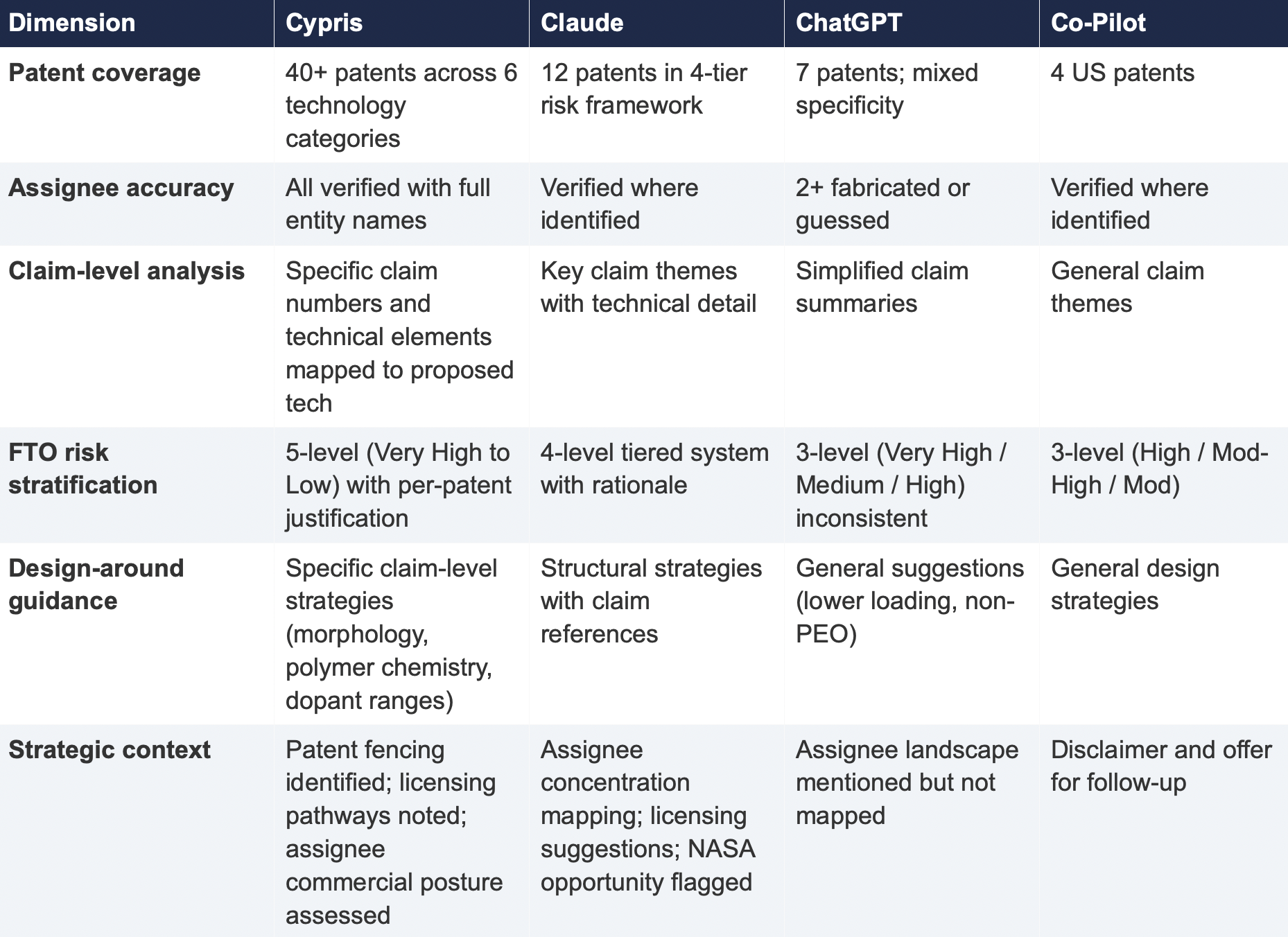
The following table summarizes the qualitative characteristics of each tool's response across the dimensions most relevant to an operational IP workflow.
5. Implications for R&D and IP Organizations
5.1 The Confidence Problem
The central risk identified by this study is not that general-purpose models produce bad outputs—it is that they produce incomplete outputs with high confidence. Each model delivered its results in a professional format with structured analysis, risk ratings, and strategic recommendations. At no point did any model indicate the boundaries of its knowledge or flag that its results represented a fraction of the available patent record. A practitioner receiving one of these outputs would have no signal that the analysis was incomplete unless they independently validated it against a comprehensive datasource.
This creates an asymmetric risk profile: the better the format and tone of the output, the less likely the user is to question its completeness. In a corporate environment where AI outputs are increasingly treated as first-pass analysis, this dynamic incentivizes under-investigation at precisely the moment when thoroughness is most critical.
5.2 The Diversification Illusion
It might be assumed that running the same query through multiple general-purpose models provides validation through diversity of sources. This study suggests otherwise. While the four tools returned different subsets of patents, all operated under the same structural constraints: training data rather than live patent databases, web-scraped content rather than structured IP records, and general-purpose reasoning rather than patent-specific ontological frameworks. Running the same query through three constrained tools does not produce triangulation; it produces three partial views of the same incomplete picture.
5.3 The Appropriate Use Boundary
General-purpose language models are effective tools for a wide range of tasks: drafting communications, summarizing documents, generating code, and exploratory research. The finding of this study is not that these tools lack value but that their value boundary does not extend to decisions that carry existential commercial risk.
Patent landscape analysis, freedom-to-operate assessment, and competitive intelligence that informs R&D investment decisions fall outside that boundary. These are workflows where the completeness and verifiability of the underlying data are not merely desirable but are the primary determinant of whether the analysis has value. A patent landscape that captures 10% of the relevant filings, regardless of how well-formatted or confidently presented, is a liability rather than an asset.
6. Test 2: Competitive Intelligence — Bio-Based Polyamide Patent Landscape
To assess whether the findings from Test 1 were specific to a single technology domain or reflected a broader structural pattern, a second query was submitted to all four tools. This query shifted from freedom-to-operate analysis to competitive intelligence, asking each tool to identify the top 10organizations by patent filing volume in bio-based polyamide synthesis from castor oil derivatives over the past three years, with summaries of technical approach, co-assignee relationships, and portfolio trajectory.
6.1 Query

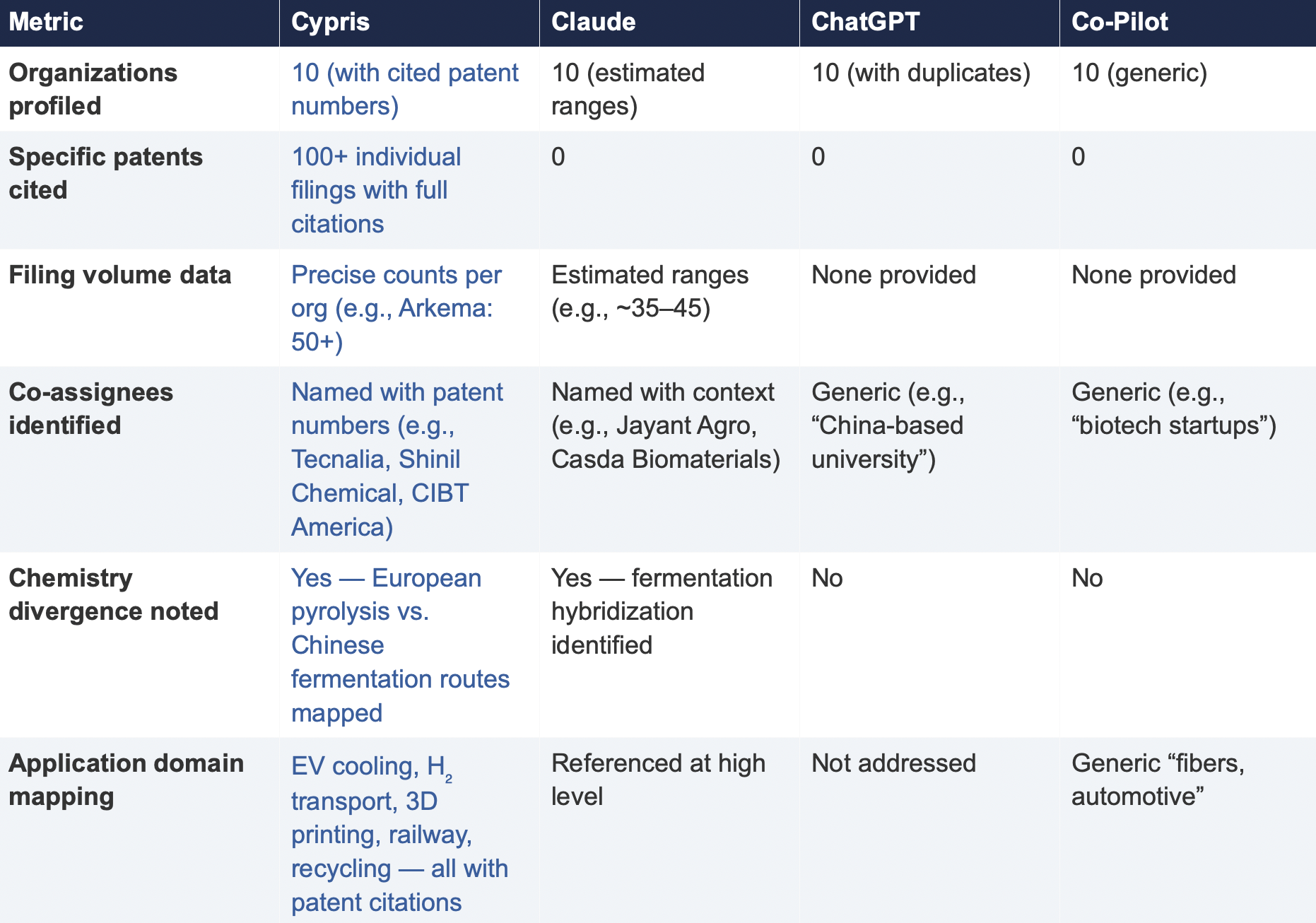
6.2 Summary of Results
6.3 Key Differentiators
Verifiability
The most consequential difference in Test 2 was the presence or absence of verifiable evidence. Cypris cited over 100 individual patent filings with full patent numbers, assignee names, and publication dates. Every claim about an organization’s technical focus, co-assignee relationships, and filing trajectory was anchored to specific documents that a practitioner could independently verify in USPTO, Espacenet, or WIPO PATENT SCOPE. No general-purpose model cited a single patent number. Claude produced the most structured and analytically useful output among the public models, with estimated filing ranges, product names, and strategic observations that were directionally plausible. However, without underlying patent citations, every claim in the response requires independent verification before it can inform a business decision. ChatGPT and Co-Pilot offered thinner profiles with no filing counts and no patent-level specificity.
Data Integrity
ChatGPT’s response contained a structural error that would mislead a practitioner: it listed CathayBiotech as organization #5 and then listed “Cathay Affiliate Cluster” as a separate organization at #9, effectively double-counting a single entity. It repeated this pattern with Toray at #4 and “Toray(Additional Programs)” at #10. In a competitive intelligence context where the ranking itself is the deliverable, this kind of error distorts the landscape and could lead to misallocation of competitive monitoring resources.
Organizations Missed
Cypris identified Kingfa Sci. & Tech. (8–10 filings with a differentiated furan diacid-based polyamide platform) and Zhejiang NHU (4–6 filings focused on continuous polymerization process technology)as emerging players that no general-purpose model surfaced. Both represent potential competitive threats or partnership opportunities that would be invisible to a team relying on public AI tools.Conversely, ChatGPT included organizations such as ANTA and Jiangsu Taiji that appear to be downstream users rather than significant patent filers in synthesis, suggesting the model was conflating commercial activity with IP activity.
Strategic Depth
Cypris’s cross-cutting observations identified a fundamental chemistry divergence in the landscape:European incumbents (Arkema, Evonik, EMS) rely on traditional castor oil pyrolysis to 11-aminoundecanoic acid or sebacic acid, while Chinese entrants (Cathay Biotech, Kingfa) are developing alternative bio-based routes through fermentation and furandicarboxylic acid chemistry.This represents a potential long-term disruption to the castor oil supply chain dependency thatWestern players have built their IP strategies around. Claude identified a similar theme at a higher level of abstraction. Neither ChatGPT nor Co-Pilot noted the divergence.
6.4 Test 2 Conclusion
Test 2 confirms that the coverage and verifiability gaps observed in Test 1 are not domain-specific.In a competitive intelligence context—where the deliverable is a ranked landscape of organizationalIP activity—the same structural limitations apply. General-purpose models can produce plausible-looking top-10 lists with reasonable organizational names, but they cannot anchor those lists to verifiable patent data, they cannot provide precise filing volumes, and they cannot identify emerging players whose patent activity is visible in structured databases but absent from the web-scraped content that general-purpose models rely on.
7. Conclusion
This comparative analysis, spanning two distinct technology domains and two distinct analytical workflows—freedom-to-operate assessment and competitive intelligence—demonstrates that the gap between purpose-built R&D intelligence platforms and general-purpose language models is not marginal, not domain-specific, and not transient. It is structural and consequential.
In Test 1 (LLZO garnet electrolytes for Li-S batteries), the purpose-built platform identified more than three times as many patents as the best-performing general-purpose model and ten times as many as the lowest-performing one. Among the patents identified exclusively by the purpose-built platform were filings rated as Very High FTO risk that directly claim the proposed technology architecture. InTest 2 (bio-based polyamide competitive landscape), the purpose-built platform cited over 100individual patent filings to substantiate its organizational rankings; no general-purpose model cited as ingle patent number.
The structural drivers of this gap—reliance on training data rather than live patent feeds, the accelerating closure of web content to AI scrapers, and the absence of patent-specific analytical frameworks—are not transient. They are inherent to the architecture of general-purpose models and will persist regardless of increases in model capability or training data volume.
For R&D and IP leaders, the practical implication is clear: general-purpose AI tools should be used for general-purpose tasks. Patent intelligence, competitive landscaping, and freedom-to-operate analysis require purpose-built systems with direct access to structured patent data, domain-specific analytical frameworks, and the ability to surface what a general-purpose model cannot—not because it chooses not to, but because it structurally cannot access the data.
The question for every organization making R&D investment decisions today is whether the tools informing those decisions have access to the evidence base those decisions require. This study suggests that for the majority of general-purpose AI tools currently in use, the answer is no.
Study Disclosure
This comparative evaluation was commissioned and published by Cypris. The testing methodology, prompts, evaluation criteria, and underlying outputs have been documented to support independent review and replication.
All platform outputs were preserved in their original form. Patent data and material factual claims were cross-checked against USPTO Patent Center and WIPO PATENTSCOPE records as of March 27, 2026. Cypris was one of the platforms evaluated and therefore has a commercial interest in the findings.
The Patent Intelligence Gap - A Comparative Analysis of Verticalized AI-Patent Tools vs. General-Purpose Language Models for R&D Decision-Making
Blogs

AI Tools for Scientific Literature Review: A Guide for Enterprise R&D Teams
The growing demand for AI-assisted scientific literature review has produced two very different categories of tools — and most R&D teams are using the wrong one.
Academic literature review tools are designed for PhD students writing dissertations and professors synthesizing research for journal publications. Enterprise R&D teams face a fundamentally different job: they need to understand scientific developments in the context of patent landscapes, competitor activity, funding movements, and technology readiness levels — all at once, at scale, and fast enough to inform actual business decisions. This guide explains how AI tools for scientific literature review work, reviews the leading academic platforms, and explores what enterprise R&D teams actually need from an R&D intelligence solution.
What AI Tools for Scientific Literature Review Actually Do
AI-powered literature review tools apply natural language processing and machine learning to academic databases, enabling researchers to identify relevant papers, extract key findings, map citation networks, and synthesize evidence without manually reading thousands of documents.
The core capabilities typically include semantic search (finding papers by concept rather than exact keyword match), automated summarization of abstracts and full texts, citation analysis to surface influential works and track how findings have been built upon or contradicted, and research gap identification to surface understudied areas within a field.
Most platforms index research from sources like PubMed, arXiv, Semantic Scholar, and institutional repositories. The better ones cover hundreds of millions of papers across life sciences, chemistry, materials science, engineering, and computer science. Retrieval quality depends heavily on the underlying indexing methodology — whether the platform performs surface-level keyword matching or applies genuine semantic understanding of scientific concepts.
For academic researchers, these capabilities are genuinely transformative. A graduate student conducting a systematic review that once required weeks of manual database searching can now surface a comprehensive corpus in hours. For enterprise R&D teams, however, this represents only a fraction of the intelligence picture.
The Leading Academic AI Literature Review Tools
Understanding the existing landscape helps clarify where the real capability gaps are for enterprise users.
Semantic Scholar, developed by the Allen Institute for AI, indexes over 200 million papers and provides AI-generated TLDR summaries, citation analysis distinguishing highly influential citations from background references, and personalized research feeds [2]. Its open-access model and broad coverage make it a standard starting point for academic research.
Consensus focuses on extracting direct answers from peer-reviewed research, surfacing a "Consensus Meter" that aggregates scientific agreement or disagreement on specific questions [4]. It is oriented toward evidence-based writing and quickly identifying where scientific confidence exists on a given topic.
ResearchRabbit takes a visual approach, mapping citation networks and relationships between papers, authors, and research trajectories. Starting from a seed set of papers, researchers can expand outward to discover related works and trace academic lineages [5]. Its visual maps integrate with reference management tools like Zotero.
Each of these platforms excels within its intended use case. The shared limitation is that they treat scientific literature as the complete universe of relevant information — which works fine for academic research but fails enterprise R&D teams almost immediately.
Why Enterprise R&D Teams Need More Than Literature Review
The fundamental challenge for corporate R&D is that scientific literature is one input among many, not the entire picture. When a materials science team at a Fortune 500 manufacturer evaluates a new polymer chemistry, they need to understand the academic research — but they also need to know who holds relevant patents, what competitors have filed in the last 18 months, which startups are working in adjacent spaces, what academic institutions are publishing most actively and potentially seeking industry partners, and where the technology sits on the commercialization timeline.
None of the academic literature review tools answer those questions. They are designed around a workflow — the systematic academic review — that doesn't map to how enterprise R&D strategy actually functions.
Enterprise R&D intelligence requires integrating scientific literature with patent data, competitive filing activity, funding signals, and market indicators into a unified analytical framework. When these data streams live in separate tools, R&D teams spend enormous effort on manual synthesis rather than on the strategic analysis that actually creates value. Research reports get siloed, insights don't compound across projects, and the organization ends up recreating foundational landscape analyses from scratch each time a new initiative launches.
This is the core problem that purpose-built enterprise R&D intelligence platforms are designed to solve.
What Enterprise R&D Intelligence Platforms Offer That Academic Tools Cannot
The distinction between an academic literature review tool and an enterprise R&D intelligence platform is not merely a matter of scale — it is a fundamentally different product category with different architecture, data coverage, and analytical philosophy.
Enterprise platforms are built around the principle of unified intelligence: the ability to query across patents, scientific papers, technical standards, competitive activity, and market data simultaneously, using a common ontological framework that understands how concepts relate to one another across these different document types.
Cypris represents this category of platform. Where academic tools index scientific papers, Cypris covers more than 500 million patents and scientific papers through a single interface, applying a proprietary R&D ontology that enables semantic understanding across the full corpus [6]. An R&D team searching for developments in solid electrolyte materials, for example, retrieves both the latest academic publications and the patent filings that translate that research into protected intellectual property — with the semantic intelligence to recognize that "solid electrolyte" and "ceramic separator" may refer to overlapping technology spaces depending on context.
This matters because the patent literature and the academic literature do not perfectly overlap. Many commercially significant technical advances appear in patent filings before, or instead of, academic publications. An enterprise R&D team conducting competitive intelligence based only on academic literature is missing a substantial portion of the relevant technical signal.
Multimodal search capabilities allow enterprise teams to query using technical documents, chemical structures, patent claims, or natural language descriptions — not just keyword strings. This removes the expert knowledge barrier that makes academic database searching dependent on knowing exactly the right controlled vocabulary. A business development professional who needs to understand the IP landscape around a potential acquisition target can get meaningful results without deep prior knowledge of the field's terminology.
Data provenance and security matter in ways that are irrelevant to academic researchers but critical for enterprise deployment. R&D intelligence platforms handling competitive information must meet enterprise security standards. SOC 2 Type II certification, US-based operations, and audit-ready compliance frameworks are baseline requirements for Fortune 500 procurement. Academic tools are rarely built to these specifications.
Integration with existing enterprise workflows is another dimension where purpose-built platforms differ from academic tools. API partnerships with major AI providers — including official integrations with OpenAI, Anthropic, and Google — allow enterprise R&D intelligence to be embedded into existing research workflows, internal knowledge management systems, and custom AI applications rather than existing as a standalone tool that requires context-switching [7].
The Compounding Knowledge Problem
One of the most underappreciated challenges in enterprise R&D is institutional knowledge accumulation. Each time a team launches a new project in a technology area the organization has investigated before, they have a choice: invest days rebuilding a landscape analysis from scratch, or rely on someone's imperfect memory of what was learned previously.
Most organizations do a version of both, which means neither institutional knowledge nor fresh research is done well. Prior analyses are rediscovered when the original researcher mentions them, or not discovered at all when key people have moved on.
Enterprise R&D intelligence platforms address this at the architecture level by building organizational knowledge layers on top of the underlying data infrastructure. Research conducted on one project becomes available to teams working on adjacent problems. Competitive monitoring runs continuously rather than in project-specific bursts. The organization compounds its understanding of a technology domain over time rather than starting from scratch on each initiative.
Academic literature review tools are designed for single-project workflows. They help an individual researcher get up to speed on a literature base. They are not designed to serve as persistent organizational intelligence infrastructure — and repurposing them for that role creates more complexity than it resolves.
Selecting the Right Tool for Your Organization's Needs
The right framework for evaluating AI tools in this space starts with an honest assessment of who is doing the work and what decisions they need to make.
For academic researchers, students, and faculty conducting systematic reviews, evidence synthesis, or dissertation research, the academic-focused platforms covered earlier represent genuinely good options. Elicit, Semantic Scholar, Consensus, and Scite each serve specific methodological needs well and are designed around the workflows academic researchers actually use.
For enterprise R&D teams — whether in chemicals, advanced materials, pharmaceuticals, automotive, aerospace, energy, or any other innovation-intensive industry — the relevant evaluation criteria are different. Coverage must span both scientific literature and patent data. Search must be semantically sophisticated enough to navigate technical concept spaces without requiring controlled vocabulary expertise. Security and compliance architecture must meet enterprise requirements. And the platform must be designed to serve as ongoing organizational infrastructure, not just a one-time research assistant.
Organizations evaluating enterprise R&D intelligence platforms should pressure-test vendors on several specific capabilities: the depth and currency of their patent and scientific literature indexing, the quality of their semantic search versus basic keyword matching, their data provenance and update frequency, their compliance certifications, their API and integration ecosystem, and evidence that the platform has been deployed successfully in their specific industry vertical.
The distinction matters because implementing the wrong category of tool — using an academic literature tool in place of an enterprise R&D intelligence platform — creates a capability ceiling that limits the organization's ability to make fast, well-grounded strategic decisions about technology development and competitive positioning.
Frequently Asked Questions
What is the best AI tool for scientific literature review?The best AI tool depends on the use case. For academic researchers and students, Elicit, Semantic Scholar, Consensus, and Scite are strong options with different strengths across systematic review, citation analysis, and evidence synthesis. For enterprise R&D teams at large organizations, purpose-built R&D intelligence platforms like Cypris provide significantly more comprehensive coverage by integrating scientific literature with patent data, competitive intelligence, and market signals — which is what corporate R&D decisions actually require.
How do AI literature review tools work?AI literature review tools apply natural language processing to large databases of academic papers. They enable semantic search (finding papers by concept rather than exact keyword), automated summarization, citation network analysis, and research gap identification. The most sophisticated platforms use proprietary ontologies to understand how scientific and technical concepts relate to one another across millions of documents, enabling more precise retrieval than keyword-based approaches.
Can AI tools replace human researchers for literature reviews?AI tools significantly accelerate the literature discovery and initial synthesis phases of research, but human judgment remains essential for evaluating source quality, assessing methodological rigor, synthesizing insights across domains, and drawing strategic conclusions. The most effective approach uses AI platforms to handle the computational work of searching, filtering, and summarizing at scale, freeing researchers to focus on the analytical and strategic work that creates actual value.
What is the difference between an academic literature review tool and an enterprise R&D intelligence platform?Academic literature review tools are designed for individual researchers conducting project-specific systematic reviews, primarily of scientific papers. Enterprise R&D intelligence platforms integrate scientific literature with patent data, competitive filing activity, funding signals, and market intelligence into a unified interface, serve as ongoing organizational infrastructure rather than one-time research tools, and are built to meet enterprise security and compliance requirements. They address fundamentally different workflows and organizational needs.
How many scientific papers do leading AI literature review tools index?Coverage varies significantly. Semantic Scholar indexes over 200 million papers [2]. Elicit draws on a comparable corpus through integration with academic databases. Enterprise platforms like Cypris cover over 500 million patents and scientific papers combined, with the advantage of integrated cross-domain search across both literature types simultaneously [6].
What should enterprise R&D teams look for in an AI literature review tool?Enterprise R&D teams should evaluate platforms on patent and scientific literature coverage depth, semantic search quality versus keyword matching, data currency and update frequency, security certifications (SOC 2 Type II is a baseline requirement for enterprise deployment), API and integration ecosystem, and evidence of successful deployment in relevant industry verticals. Academic-focused tools rarely meet these criteria because they are designed for different user needs and organizational contexts.
Is scientific literature review AI accurate?Accuracy varies by platform and task. Modern AI literature review tools are reliable for paper discovery and summarization, though all platforms carry some risk of missing relevant papers or generating imprecise summaries. Citation hallucination — AI systems inventing references that do not exist — has been a documented problem with general-purpose language models used for research. Purpose-built platforms with structured database backends rather than generative retrieval are generally more reliable for citation accuracy. Enterprise platforms add additional verification layers because the cost of inaccurate competitive intelligence is higher than the cost of an imprecise academic summary.
Citations:
[1] Elicit platform documentation. elicit.com.[2] Semantic Scholar. Allen Institute for AI. semanticscholar.org.[3] Scite platform overview. scite.ai.[4] Consensus AI research tool. consensus.app.[5] ResearchRabbit platform. researchrabbitapp.com.[6] Cypris R&D intelligence platform. cypris.com.[7] Cypris API partnerships documentation. cypris.com.

Questel Alternatives: 7 Tools for Patent & Research Intelligence
Questel has built a formidable reputation in the intellectual property world, and its flagship platform Orbit Intelligence is trusted by more than 100,000 users worldwide for patent search, analytics, and IP portfolio management. But Questel was designed first and foremost for deep legal IP workflows, and that heritage comes with tradeoffs that increasingly frustrate modern R&D teams. Whether you are struggling with Orbit's steep learning curve, need broader data coverage beyond patents and trademarks, or simply want a platform your entire innovation team can use without weeks of training, this guide examines the top alternatives reshaping the patent and research intelligence landscape in 2026.
Why R&D Teams Are Looking Beyond Questel
Questel Orbit Intelligence is a powerful tool in the hands of experienced patent attorneys and IP specialists. The platform offers sophisticated Boolean syntax, advanced proximity operators, and granular legal status tracking that few competitors can match. However, several factors are driving R&D and innovation teams to explore alternatives.
Complexity designed for legal specialists. Questel's interface is built around Boolean command-line searches with complex operator syntax. Even Questel's own documentation acknowledges that queries are frequently flagged as "too complex" by the system, and the company offers paid one- and two-day training sessions just to become proficient. For R&D scientists, product managers, and innovation strategists who need quick answers rather than litigation-grade search strings, this complexity creates unnecessary friction. Questel has attempted to address this with Orbit Express, a simplified interface explicitly designed for users who are "not a patent expert," but this creates a fragmented experience with reduced functionality rather than solving the underlying usability problem.
Narrow IP and legal focus. Questel's product suite is oriented around the full IP lifecycle, spanning patent prosecution, trademark management, renewal services, and legal docketing. While this end-to-end IP management approach serves law firms and corporate IP departments well, it means the platform treats patent data primarily through a legal lens rather than as one component of a broader innovation intelligence strategy. R&D teams that need to connect patent landscapes with scientific literature trends, market signals, and competitive intelligence often find themselves needing to supplement Questel with additional tools.
Fragmented product ecosystem. Questel's capabilities are distributed across multiple distinct products including Orbit Intelligence for patent search, Orbit Insight for innovation intelligence, Equinox for IP management, and various add-on modules for biosequence search, chemical structures, and non-patent literature. Each product has its own interface, learning curve, and often separate pricing. This modular approach means organizations frequently end up managing multiple subscriptions and training programs to achieve the integrated intelligence view that modern R&D demands.
Limited AI integration for enterprise workflows. While Questel has introduced its Sophia AI assistant for query building and document analysis, the platform lacks the deep enterprise LLM partnerships that enable organizations to build custom AI workflows on top of their R&D data. As AI transforms how innovation teams discover, analyze, and act on technical intelligence, platforms without native integration into the broader enterprise AI ecosystem risk becoming isolated tools rather than foundational infrastructure.
Top 7 Questel Alternatives for 2026
1. Cypris: Enterprise R&D Intelligence Platform
Best for: Large enterprise R&D teams needing comprehensive intelligence beyond patents
Cypris has emerged as the leading alternative to Questel for organizations that need R&D intelligence to serve innovation strategy rather than legal case management. Where Questel routes everything through an IP attorney's workflow, Cypris is purpose-built for R&D scientists, product managers, and innovation leaders who need to move from question to insight without mastering Boolean syntax or navigating fragmented product modules.
Key Advantages Over Questel:
Over 500 million data points spanning patents, scientific literature, grants, and market intelligence in a single unified platform rather than across separate products
Official enterprise API partnerships with OpenAI, Anthropic, and Google, enabling custom AI workflows that Questel's Sophia assistant cannot replicate
Natural language AI interface through Cypris Q that eliminates the need for complex Boolean query construction and multi-day training programs
Research Brief analyst service providing bespoke, expert-curated reports that combine AI capabilities with human expertise
AI-powered monitoring that continuously tracks developments across all data sources and automatically surfaces relevant insights
Advanced R&D ontology that understands technical relationships across disciplines, connecting insights that keyword-based searches miss
US-based operations and data handling for organizations with data sovereignty requirements
Unique Differentiators: The fundamental difference between Cypris and Questel lies in who the platform was designed to serve. Questel's architecture assumes the user is an IP professional conducting legal searches. Cypris assumes the user is an R&D leader trying to make better innovation decisions. This design philosophy manifests in everything from the natural language search interface to the way results are organized around strategic insight rather than legal status codes. The Research Brief service further extends this advantage by providing expert analyst support for complex research questions, delivering custom reports that no self-service tool can match.
Why Teams Switch from Questel: Organizations report that Cypris eliminates the need for multiple Questel modules and supplementary tools while dramatically reducing the time from question to actionable insight. Teams that previously needed weeks of training and dedicated IP search specialists can now empower their entire R&D organization to access intelligence independently, compounding organizational knowledge with every interaction rather than keeping it locked in specialist workflows.
2. Derwent Innovation (Clarivate)
Best for: Global enterprises needing validated, human-curated patent data
Derwent Innovation builds on Clarivate's renowned Derwent World Patents Index with human-enhanced patent abstracts and standardized data that has been the gold standard for patent research for decades. Like Questel, Derwent is designed primarily for IP professionals, but its curated data quality and deep citation analysis offer advantages for organizations where data accuracy is paramount.
Strengths:
Manually curated patent abstracts through DWPI provide consistently high data quality that automated systems cannot match
Comprehensive global coverage with standardized non-English patent translations
Deep integration with Clarivate's broader scientific and IP ecosystem including Web of Science
Advanced citation analysis and patent family mapping
Strong reputation and trust among corporate IP departments worldwide
Limitations:
Similarly complex interface to Questel, requiring significant training investment
Focus remains on patents without comprehensive integration of market intelligence or internal R&D knowledge
No bespoke research services or analyst support for custom questions
Pricing can be prohibitive for organizations that need broad team access rather than specialist-only licenses
3. Google Patents
Best for: Quick, free patent searches and basic prior art research
Google Patents provides free access to patents from over 100 patent offices worldwide, making it the natural starting point for preliminary searches and basic patent research. For R&D team members who need to quickly validate an idea or check whether a concept has prior art, Google Patents offers the lowest possible barrier to entry.
Strengths:
Completely free access with no training required
Simple, familiar Google search interface that any team member can use immediately
Quick access to full patent documents with integrated Google Scholar linking
Prior art search functionality powered by Google's search algorithms
Machine translation for non-English patents
Limitations:
No advanced analytics, visualization, or landscaping tools
Limited search capabilities compared to any commercial platform
No API or enterprise integration options
Lacks any security certifications for enterprise use
No alert, monitoring, or collaboration features
Missing critical professional features like family analysis, legal status tracking, and citation mapping
4. The Lens
Best for: Academic institutions and budget-conscious R&D teams
The Lens provides free and open access to an integrated patent and scholarly literature database, making it uniquely valuable for organizations that need to bridge the gap between patent intelligence and scientific research. Its nonprofit mission and transparent approach to data have earned it a loyal following in academic and public-sector research communities.
Strengths:
Free tier with substantial functionality including both patent and scholarly data
Integration of patent and scientific literature in a single searchable database
Open data approach with transparent metrics and methodology
PatCite linking that connects patents to the scientific literature they cite
Academic-friendly licensing and institutional access options
Limitations:
Limited advanced analytics compared to commercial platforms like Questel or Cypris
No enterprise knowledge management or internal R&D data integration
Basic interface without sophisticated AI enhancements
No security certifications suitable for enterprise use
Limited customer support and training resources
5. PatSeer
Best for: Patent research teams wanting AI-enhanced search with collaborative workflows
PatSeer has built a reputation as one of the more comprehensive and customizable patent research platforms available, combining traditional Boolean search with AI-driven semantic capabilities. Its hybrid approach appeals to teams that want modern AI features without completely abandoning the structured search workflows they already know.
Strengths:
Hybrid search combining Boolean and AI-powered semantic search in a single platform
AI Classifier, Recommender, and Re-Ranker that help organize and prioritize results
Strong collaboration features with shared projects, annotations, and multi-user dashboards
Coverage of 170 million or more global patent publications across 108 countries
Integrated non-patent literature search from within the same interface
Customizable taxonomy that adapts to organizational domain expertise
Limitations:
Primarily patent-focused without broader market intelligence or R&D data integration
Interface complexity increases significantly when using advanced features
No enterprise LLM partnerships or API integrations for custom AI workflows
Limited enterprise security certifications compared to platforms like Cypris
Smaller market presence means less extensive training and support ecosystem
6. LexisNexis TotalPatent One
Best for: Legal teams needing patent search integrated with broader legal research
LexisNexis TotalPatent One leverages the LexisNexis ecosystem to provide patent search and analytics alongside the company's extensive legal research databases. For organizations where the patent intelligence function sits within the legal department and needs to connect seamlessly with case law, regulatory, and litigation research, TotalPatent One offers a compelling integrated experience.
Strengths:
Integration with the broader LexisNexis legal research ecosystem
Global patent coverage with full-text search across major jurisdictions
Annotation and bulk analysis tools designed for legal review workflows
Strong reputation and established relationships with corporate legal departments
Limitations:
Designed primarily for legal professionals rather than R&D or innovation teams
Interface and workflows assume legal training and IP specialization
Limited analytics and visualization compared to dedicated patent intelligence platforms
No scientific literature integration, market intelligence, or R&D knowledge management
Does not address the core need of R&D teams to connect patent data with broader innovation strategy
7. Espacenet (European Patent Office)
Best for: Free access to global patent documents with strong European coverage
Espacenet, maintained by the European Patent Office, provides free access to over 150 million patent documents from around the world. As an official patent office tool, it offers authoritative data and serves as an essential complement to any commercial platform, particularly for verifying European patent family data and legal status information.
Strengths:
Completely free with no registration required
Authoritative data directly from the European Patent Office
Coverage of over 150 million patent documents worldwide
Machine translation for patent documents in multiple languages
Smart search functionality for basic semantic queries
CPC classification browser for structured technology exploration
Limitations:
No analytics, visualization, or landscaping capabilities
Basic search interface without AI enhancements
No collaboration, monitoring, or alert features
Cannot support enterprise R&D intelligence workflows
No API access or integration options for enterprise systems
Critical Security Considerations
Enterprise Security Compliance
Security certification has become a decisive factor in enterprise platform selection, particularly for organizations handling sensitive R&D data, trade secrets, and pre-patent invention disclosures. The distinction between ISO 27001 and SOC 2 Type II matters more than many procurement teams initially realize.
Questel holds ISO 27001 certification, which demonstrates that the company has established an information security management system meeting international standards. This certification is widely recognized globally and represents a meaningful commitment to security. However, for US-based enterprises, ISO 27001 alone often falls short of procurement requirements.
Cypris maintains SOC 2 Type II certification, which provides a fundamentally different type of assurance. Where ISO 27001 certifies that a security management system exists and meets defined standards, SOC 2 Type II verifies that specific security controls have been operating effectively over an extended period through independent auditor testing. For US enterprise IT security teams evaluating R&D intelligence platforms, SOC 2 Type II is typically a non-negotiable requirement because it provides evidence of continuous operational security rather than point-in-time system design.
Organizations evaluating Questel alternatives should verify that their chosen platform meets the specific security standards their procurement process requires, as switching platforms after a security review failure creates significant cost and timeline delays.
The Power of AI Partnerships and Ontology
Enterprise LLM Integration
The way R&D teams interact with patent and technical intelligence is being fundamentally transformed by large language models. Platforms that have established official enterprise partnerships with leading AI providers offer capabilities that bolt-on AI features cannot replicate.
Cypris's official API partnerships with OpenAI, Anthropic, and Google enable enterprise customers to build compliant, secure AI applications on top of their R&D data. This means organizations can integrate patent intelligence, scientific literature analysis, and competitive monitoring directly into their existing AI infrastructure rather than treating it as an isolated search tool. These partnerships also ensure that AI implementations meet enterprise compliance requirements, unlike consumer-grade AI features that may not satisfy data handling policies.
Questel's Sophia AI assistant provides helpful features like query building and document summarization, but it operates as a proprietary feature within Questel's closed ecosystem rather than as an integration point for broader enterprise AI strategy. As organizations invest in AI infrastructure that spans multiple business functions, the ability to connect R&D intelligence with enterprise AI platforms becomes a significant competitive advantage.
Advanced R&D Ontology
Beyond raw AI capability, the quality of intelligence depends on how well a platform understands the relationships between technical concepts across disciplines. Cypris employs a proprietary R&D ontology built specifically for innovation intelligence that understands how concepts in materials science connect to chemical engineering processes, how pharmaceutical mechanisms relate to biotechnology methods, and how manufacturing innovations in one industry apply to adjacent fields.
This ontological approach produces fundamentally different results than Questel's keyword and classification-code methodology. Where traditional patent search requires users to anticipate exactly which terms and codes are relevant, an ontology-driven platform discovers connections that keyword searches miss entirely, surfacing the cross-disciplinary insights that drive breakthrough innovation.
Choosing the Right Questel Alternative
For Comprehensive R&D Intelligence
If your team needs a platform that serves the entire innovation organization rather than just the IP department, Cypris offers the most complete solution. Its unified approach to patents, scientific literature, market intelligence, and internal knowledge management eliminates the fragmented multi-product experience that characterizes Questel while dramatically reducing the training burden on non-specialist users. The combination of SOC 2 Type II security, enterprise LLM partnerships, and the Research Brief analyst service makes it the strongest choice for Fortune 500 R&D teams.
For Specialized Needs
Basic patent searches: Google Patents and Espacenet provide free, immediate access for preliminary research
Academic research: The Lens offers excellent free access with integrated patent and scholarly data
Standards-driven industries: IPlytics provides unique standard essential patent intelligence
Legal department workflows: LexisNexis TotalPatent One integrates with broader legal research tools
Human-curated data quality: Derwent Innovation offers gold-standard manually enhanced patent abstracts
AI-enhanced patent research: PatSeer provides hybrid Boolean and semantic search with strong collaboration tools
For Modern AI Workflows
Organizations building enterprise AI infrastructure should prioritize platforms that offer native LLM integration, advanced ontologies, and official partnerships with major AI providers. Traditional IP tools like Questel were designed for a world where patent intelligence meant constructing Boolean searches and reviewing result lists. The future of R&D intelligence is conversational, proactive, and deeply integrated with the AI systems that power modern enterprise decision-making.
Making the Transition from Questel
Key Evaluation Criteria
When evaluating Questel alternatives, R&D and innovation leaders should assess candidates across several dimensions that reflect how modern teams actually use intelligence platforms. Security compliance should be verified against your organization's specific requirements, with particular attention to whether SOC 2 Type II is needed for US enterprise procurement. Data coverage should extend beyond patents to include scientific literature, grants, market intelligence, and the ability to integrate internal R&D knowledge. AI capabilities should be evaluated not just as features within the platform but as integration points with your broader enterprise AI strategy. Usability should be tested with actual R&D team members rather than just IP specialists, since the goal is to democratize intelligence access across the innovation organization. Finally, consider whether the platform offers analyst services for complex questions that require human expertise beyond what any self-service tool can provide.
Implementation Best Practices
Organizations transitioning from Questel should run parallel systems during an initial evaluation period to validate that the alternative meets their needs across all use cases. Starting with a pilot team, ideally one that includes both IP specialists and R&D generalists, helps identify any capability gaps before a full rollout. Teams should leverage the transition as an opportunity to establish new AI-powered workflows rather than simply replicating existing search patterns, since the value of modern platforms comes from enabling fundamentally different ways of working with intelligence data.
The Future of Patent and Research Intelligence
The patent intelligence landscape is undergoing its most significant transformation in decades. The traditional model where specialized IP professionals constructed complex Boolean queries in expert-only tools is giving way to a new paradigm where AI-powered platforms make R&D intelligence accessible to everyone in the innovation organization.
Questel's deep expertise in IP legal workflows will continue to serve patent attorneys and prosecution specialists well. But for R&D leaders, product managers, and innovation strategists who need intelligence to drive strategic decisions rather than legal filings, the future belongs to platforms that combine comprehensive data coverage with intuitive AI interfaces, enterprise security compliance, and seamless integration into the broader technology ecosystem.
The organizations that will lead in innovation are those that treat R&D intelligence not as a specialized legal function but as foundational infrastructure that compounds knowledge across every team, every project, and every strategic decision. Choosing the right platform today is choosing the foundation that will either accelerate or constrain your innovation capability for years to come.
Conclusion: From Legal Search Tool to Innovation Intelligence
Questel Orbit Intelligence remains one of the most capable patent search and analytics tools available for experienced IP professionals. Its deep Boolean syntax, comprehensive legal status tracking, and end-to-end IP management capabilities serve the needs of patent attorneys and IP departments effectively. But the demands of modern enterprise R&D extend far beyond what any legal-first platform was designed to deliver.
The most successful R&D organizations are moving toward platforms that unify patents, scientific literature, market intelligence, and internal knowledge into a single AI-powered intelligence layer accessible to their entire innovation team. By choosing alternatives that prioritize usability alongside power, comprehensive data alongside patent depth, and enterprise AI integration alongside standalone features, teams can transform R&D intelligence from a specialist bottleneck into a strategic accelerant.
Ready to explore Questel alternatives? Start by mapping how many people across your R&D organization actually need intelligence access versus how many currently have it. The gap between those numbers represents untapped innovation potential that the right platform can unlock. Prioritize solutions that offer enterprise security compliance, modern AI capabilities, and comprehensive data coverage, and your team will be positioned to compound knowledge faster than competitors who remain locked into specialist-only search tools.

How R&D Departments Can Improve Knowledge Sharing: Building a Collective AI Memory That Compounds Over Time
Knowledge sharing in R&D departments is the practice of systematically capturing, organizing, and distributing institutional expertise and external innovation intelligence so that every researcher can build on the collective knowledge of the organization rather than working in isolation. For decades, the standard approach to this challenge has centered on cultural interventions: encouraging researchers to document their work, hosting cross-functional meetings, building wikis, and creating incentive structures that reward collaboration over individual contribution. These efforts matter, but they share a fundamental limitation. They depend on individual humans choosing to contribute knowledge, remembering to do so at the right moment, and articulating tacit expertise in formats that other humans can later find and interpret. The result is that most organizational knowledge still depreciates rather than compounds. Projects end and their insights scatter across email threads, slide decks, and personal notebooks. Researchers leave and their hard-won intuitions leave with them. Teams in one division solve a problem that a team in another division will spend six months re-solving because no searchable record of the first solution exists in any system anyone thinks to check.
The emerging alternative is fundamentally different. Instead of asking humans to serve as the primary mechanism for knowledge capture and transfer, forward-thinking R&D organizations are building collective AI memory systems that automatically accumulate intelligence from every research activity, every patent search, every literature review, and every competitive analysis into a shared, searchable, AI-accessible layer that grows more valuable with every interaction. This approach treats organizational knowledge not as a static archive to be maintained but as a compounding asset that appreciates over time, where each new query builds on every previous query and each new insight connects automatically to the full constellation of what the organization already knows.
The stakes for getting this right are enormous. According to the International Data Corporation, Fortune 500 companies collectively lose roughly $31.5 billion annually by failing to share knowledge effectively. The Panopto Workplace Knowledge and Productivity Report found that the average large U.S. business loses $47 million in productivity each year due to inefficient knowledge sharing, with employees wasting 5.3 hours every week either waiting for information from colleagues or recreating institutional knowledge that already exists somewhere in the organization. R&D professionals spend approximately 35 percent of their time searching for and validating information rather than conducting actual research. For a department of 100 researchers with an average fully loaded cost of $150,000 per year, that translates to roughly $5.25 million annually spent on information discovery alone, representing 70,000 hours of productivity that could otherwise be directed toward actual innovation.
Why Traditional Knowledge Sharing Approaches Hit a Ceiling in R&D
The conventional playbook for improving knowledge sharing in R&D departments includes familiar elements: establish communities of practice, create centralized document repositories, reward knowledge contribution in performance reviews, implement regular cross-team briefings, and invest in collaboration platforms like Slack or Microsoft Teams. Each of these strategies has merit, and none should be abandoned. But they all share a common dependency on individual human effort as the bottleneck through which all organizational knowledge must pass.
Consider what happens when a senior materials scientist conducts a thorough landscape analysis of biodegradable polymer patents before launching a new formulation project. Under traditional knowledge sharing models, capturing that intelligence for the broader organization requires the scientist to write a summary document, tag it with appropriate metadata, store it in the right repository, notify relevant colleagues, and present key findings at a team meeting. Each of these steps competes with the scientist's primary responsibility of actually conducting research. In practice, most of that contextual knowledge, including which patent families look most threatening, which technical approaches appear to be dead ends, and which white spaces suggest opportunity, never makes it into any system that a colleague starting a similar project eighteen months later would think to consult.
The problem intensifies with scale. A midsized enterprise R&D department might conduct hundreds of patent searches, review thousands of scientific papers, and generate dozens of competitive intelligence assessments in a single quarter. The volume of potentially reusable insight produced by these activities vastly exceeds what any documentation protocol can capture, regardless of how disciplined the team is about following it. Tribal knowledge, the undocumented expertise that exists only in the minds of experienced researchers, compounds this challenge further. According to Panopto's research, 42 percent of institutional knowledge is unique to the individual employee. When that employee retires, transfers, or leaves the company, nearly half of what they contributed to the organization's capability disappears with them.
The manufacturing, chemicals, and automotive sectors face this knowledge attrition with particular urgency. Some companies expect to lose 30 percent or more of their most experienced engineers to retirement within the next five years. The specialized knowledge those engineers carry about decades of process optimization, material behavior under unusual conditions, and regulatory navigation cannot be reconstructed from project files alone. It lives in the connections between disparate observations, the pattern recognition built through years of experimentation, and the contextual judgment about which published results are reliable and which should be viewed skeptically. No wiki or shared drive captures that kind of intelligence.
The Compounding Knowledge Model: How AI Memory Changes the Equation
The concept of collective AI memory reframes knowledge sharing from a documentation challenge into an infrastructure investment with compounding returns. Rather than relying on researchers to manually extract, format, and distribute insights, a compounding knowledge system captures intelligence as a natural byproduct of the research activities teams are already performing. Every patent search enriches the organizational understanding of the competitive landscape. Every literature review adds to the collective map of scientific frontiers. Every competitive analysis sharpens the picture of where market opportunities and threats are emerging. Critically, this captured intelligence is not simply stored; it is connected, contextualized, and made available to AI systems that can synthesize it with new queries in real time.
The compounding effect is what distinguishes this approach from earlier generations of knowledge management technology. Traditional knowledge bases are additive: each new document increases the total volume of stored information, but the documents themselves do not interact or build on each other. A compounding AI memory is multiplicative: each new piece of intelligence enhances the value of everything already in the system by creating new connections, surfacing non-obvious relationships, and enabling the AI to provide progressively richer, more contextualized responses over time. When the hundredth researcher queries the system about a technical domain, they benefit not only from whatever external data the platform accesses but from the accumulated context of the ninety-nine previous investigations their colleagues have conducted.
This is the architectural principle behind platforms designed specifically for enterprise R&D intelligence. Cypris, for example, integrates access to more than 500 million patents and scientific papers with an AI research agent called Cypris Q that retains context from previous queries and builds organizational knowledge over successive interactions. When a researcher uses Cypris Q to investigate a new technology domain, the system draws on the full breadth of global patent and scientific literature while simultaneously incorporating the accumulated research history specific to that organization. The result is not just a search engine that returns documents but an intelligence layer that understands what the organization has already explored, where its strategic interests lie, and how new discoveries connect to ongoing priorities.
This architecture solves several problems that traditional knowledge sharing approaches cannot address. First, it eliminates the documentation burden by capturing intelligence as a natural consequence of research activity rather than requiring a separate effort. Researchers do not need to write summaries or tag documents because the AI system learns from the interactions themselves. Second, it makes tacit knowledge partially transferable by encoding the patterns and connections that experienced researchers discover into a system that any team member can access. While no technology can fully replicate a veteran scientist's intuition, a system that remembers every question that scientist has asked and every connection they have drawn captures far more contextual intelligence than any written document could. Third, it bridges organizational silos by making knowledge from one team's investigation instantly available to every other team in the organization. When a coatings R&D group discovers a relevant patent cluster during their research, that discovery automatically enriches the intelligence available to the adhesives team working on a related material class, even if neither team knows the other exists.
Building the Foundation: What a Compounding R&D Knowledge System Requires
Constructing an AI memory that actually compounds organizational intelligence over time requires several foundational elements working together. The first and most critical is comprehensive data integration. An R&D knowledge system that draws from only one category of external intelligence, whether patents alone, scientific papers alone, or market data alone, will produce a fragmented and misleading picture of the innovation landscape. Researchers make decisions at the intersection of technical feasibility, competitive positioning, regulatory constraints, and market opportunity. The intelligence system that informs those decisions must span all of these dimensions to provide genuinely useful synthesis.
Enterprise R&D intelligence platforms distinguish themselves from academic search tools and patent attorney databases precisely through this breadth of integration. Where a patent search tool might surface relevant prior art and a literature database might identify relevant publications, an integrated platform connects patent filings with the scientific papers that inform them, links competitive patent activity to market intelligence about commercial intent, and situates all of this within the context of regulatory developments that could accelerate or constrain specific technology paths. This interconnection is what enables the AI to generate compounding insights rather than isolated search results.
The second foundational requirement is an R&D-specific ontology, a structured knowledge framework that understands the relationships between technical concepts, material categories, application domains, and innovation trajectories in the way that researchers themselves think about them. General-purpose AI systems lack this domain specificity, which means they cannot reliably connect a query about "barrier coatings for flexible packaging" with relevant patents filed under "oxygen transmission rate reduction in polymer films" or scientific papers discussing "nanocomposite permeation resistance." A purpose-built R&D ontology enables the kind of lateral connection that distinguishes transformative research from incremental investigation, and it ensures that the compounding knowledge base grows along dimensions that reflect genuine technical relationships rather than superficial keyword overlaps.
The third requirement is enterprise-grade security and access governance. R&D knowledge is among the most strategically sensitive information any organization possesses. The insights that accumulate in a collective AI memory, including which technology domains the organization is investigating, which competitive threats it has identified, and which innovation opportunities it is pursuing, would be extraordinarily valuable to competitors. Any platform entrusted with this intelligence must meet the most rigorous security standards. SOC 2 Type II certification, data encryption at rest and in transit, role-based access controls, and clear data sovereignty guarantees are minimum requirements, not differentiators. Organizations should also evaluate whether the platform provider is based in a jurisdiction with strong intellectual property protections and whether it maintains official API partnerships with the AI providers it integrates, ensuring that organizational data is handled according to enterprise security standards at every layer of the technology stack.
Cypris helps enterprise R&D teams build a compounding knowledge advantage by unifying access to over 500 million patents, scientific papers, and competitive intelligence sources through a single AI-powered platform. Book a demo to see how organizations are turning every research interaction into lasting institutional intelligence at cypris.ai.
From Documentation Culture to Contribution Culture
Adopting a compounding AI memory system does not eliminate the need for cultural investment in knowledge sharing. It changes the nature of that investment. Under traditional knowledge management, the cultural challenge is motivating researchers to perform an additional task (documentation) on top of their primary work. Under a compounding model, the cultural challenge shifts to something more achievable: encouraging researchers to conduct their existing research activities through the shared intelligence platform rather than through disconnected personal tools.
This is a crucial distinction. Asking a researcher to write a detailed summary of every patent search is asking them to do something extra. Asking them to run their patent searches through a shared platform that captures and compounds intelligence automatically is asking them to do the same thing they were already doing, just through a different interface. The behavioral change required is adoption of a tool, not adoption of a practice. Organizations that have successfully deployed R&D intelligence platforms report that researcher adoption accelerates once teams experience the compounding benefit firsthand. When a scientist runs a query and the platform surfaces not only relevant external literature but also connections to investigations their colleagues conducted months earlier, the value proposition becomes self-evident.
The organizational shift is from a documentation culture, where knowledge sharing is treated as an obligation that competes with research for time and attention, to a contribution culture, where every act of research automatically enriches the collective intelligence available to the entire organization. In a documentation culture, knowledge sharing is a tax on productivity. In a contribution culture, knowledge sharing is a natural consequence of productivity.
Leadership plays an essential role in catalyzing this transition. R&D directors and chief technology officers should establish the shared intelligence platform as the default starting point for any new research initiative. Before launching a new project, teams should first query the organizational AI memory to understand what the company already knows about the relevant technology landscape, which adjacent investigations have been conducted, and what competitive and scientific context has already been mapped. This practice not only prevents duplicate research but reinforces the value of contributing to the shared knowledge base by demonstrating that previous contributions are actively building on each other.
The External Intelligence Dimension That Most Knowledge Sharing Strategies Miss
Most guidance on improving R&D knowledge sharing focuses exclusively on internal knowledge: getting researchers to share what they know with each other. This emphasis is understandable but incomplete. In practice, the most consequential knowledge sharing failures in R&D are not failures to share internal tribal knowledge. They are failures to ensure that external intelligence, including patent landscapes, scientific breakthroughs, competitive moves, and regulatory developments, reaches every team that needs it in a timely and contextualized form.
Consider a scenario that plays out regularly in large R&D organizations. A team in the automotive materials division conducts a thorough analysis of emerging patents in lightweight structural composites. Three months later, a team in the aerospace coatings division begins a project that intersects significantly with the same patent landscape but has no knowledge that the earlier analysis was ever performed. The second team spends weeks replicating intelligence that already exists within the company, not because anyone failed to share internal expertise, but because the external intelligence gathered by one team never entered any system that the other team could access.
This is the gap that a compounding AI memory specifically addresses. When external intelligence, including patent analysis, literature reviews, and competitive signals, is captured in a shared, AI-accessible system, it becomes organizational knowledge that persists and compounds independently of which team originally gathered it or whether that team remembers to share it. The aerospace coatings team, querying the same platform that the automotive materials team used months earlier, would automatically benefit from the accumulated intelligence without either team needing to coordinate, schedule a meeting, or remember to send an email.
Enterprise R&D intelligence platforms like Cypris are designed around this principle. By providing unified access to comprehensive patent databases, scientific literature repositories, and competitive intelligence through a single platform that retains organizational context, these systems ensure that external intelligence is captured once and compounded indefinitely. The AI research agent draws on the full history of the organization's queries and investigations, which means that each new research question is answered not in isolation but in the context of everything the organization has previously explored. This is how knowledge sharing transforms from a periodic, effortful activity into a continuous, automatic process embedded in the infrastructure of research itself.
Measuring the Impact of Compounding Knowledge Systems
Organizations evaluating AI-powered knowledge sharing approaches should track several categories of metrics to assess whether their knowledge base is genuinely compounding. Research duplication rates offer the most direct measure: how frequently do teams discover that investigations they initiated had already been partially or fully conducted by another group? Organizations that have consolidated their R&D intelligence infrastructure report reductions in research duplication of up to 70 percent.
Time to insight measures how long it takes a researcher to move from an initial question to an actionable understanding of the relevant technology landscape, competitive positioning, and scientific context. In organizations relying on fragmented tools and manual knowledge sharing, this process can take days or weeks as researchers navigate between separate patent databases, literature search engines, and internal document repositories. Integrated intelligence platforms with compounding AI memory compress this timeline significantly, with some organizations reporting 50 percent reductions in prior art search time and 40 percent decreases in overall time to insight.
Cross-team intelligence reuse is perhaps the most meaningful indicator of whether knowledge is genuinely compounding. This metric tracks how frequently insights generated by one team surface as relevant context for another team's investigation, even when the teams did not directly coordinate. High rates of cross-team intelligence reuse indicate that the AI memory is successfully connecting knowledge across organizational boundaries, which is the compounding dynamic that creates exponential returns on the initial intelligence investment.
Finally, new researcher onboarding velocity reflects how effectively the compounding knowledge base transmits institutional expertise to incoming team members. In organizations without integrated AI memory, new researchers typically require months to develop a working understanding of the competitive landscape, the organization's research history, and the technical context relevant to their projects. When this context is available through an AI system that can synthesize years of accumulated organizational intelligence in response to natural language queries, the effective onboarding period compresses dramatically. Rather than spending months recreating a mental model that senior colleagues built over years, new researchers can query the organizational memory and begin contributing meaningful work far sooner.
Getting Started: A Practical Roadmap for R&D Leaders
R&D leaders looking to implement a compounding knowledge sharing approach should begin by auditing the current intelligence tool landscape across their department. Most enterprise R&D teams navigate between five and twelve separate intelligence platforms, from patent databases to scientific literature repositories, market intelligence tools, and competitive analysis systems. Each of these tools creates its own silo of intelligence, invisible to the other tools and inaccessible to AI systems that could synthesize insights across them. Mapping this fragmentation is the necessary first step toward consolidation.
The second step is identifying a platform capable of serving as the central intelligence layer. The requirements are demanding: the platform must integrate comprehensive patent data, scientific literature, and competitive intelligence in a single interface; it must provide AI-powered synthesis that retains and builds on organizational query history; it must meet enterprise security standards including SOC 2 Type II certification; and it must integrate with existing research workflows so that adoption does not require researchers to abandon familiar processes. Platforms that meet these criteria become the foundation of the compounding knowledge system, capturing intelligence from every research interaction and making it available to the entire organization.
The third step is establishing platform-first research protocols. Every new project, landscape analysis, and competitive review should begin with a query to the shared intelligence platform. This practice serves dual purposes: it ensures that existing organizational knowledge informs every new investigation, and it contributes each new investigation to the growing body of organizational intelligence. Over time, this protocol becomes self-reinforcing as researchers experience the compounding benefit of a knowledge base that grows richer with every interaction.
The final step is patient commitment to the compounding model. Unlike traditional knowledge management initiatives that can be evaluated in weeks, a compounding knowledge system delivers returns that accelerate over time. The platform becomes meaningfully more valuable after six months of accumulated queries than it was in the first week, and substantially more valuable after two years than after six months. Organizations that commit to this approach and sustain researcher adoption through the initial period of accumulation will build a durable competitive advantage that becomes increasingly difficult for rivals to replicate, because the compounding knowledge base reflects not just access to external data but the accumulated strategic intelligence of the organization's own research history.
FAQ
What is knowledge sharing in R&D?Knowledge sharing in R&D is the systematic practice of capturing, organizing, and distributing both internal institutional expertise and external innovation intelligence, including patent landscapes, scientific literature, and competitive data, so that every researcher in the organization can build on collective knowledge rather than working in isolation.
Why is knowledge sharing particularly important for R&D departments?R&D departments face uniquely high costs from knowledge sharing failures because research involves long timelines, highly specialized expertise, and cumulative investigation where missing a single piece of prior art or duplicating a previous study can waste months of effort and millions of dollars. Fortune 500 companies lose an estimated $31.5 billion annually from ineffective knowledge sharing, with R&D departments bearing disproportionate impact due to the specialized and cumulative nature of research work.
What is a compounding AI memory for R&D?A compounding AI memory is a centralized intelligence system that automatically captures knowledge from every research activity, including patent searches, literature reviews, and competitive analyses, and makes that accumulated intelligence available to AI systems that can synthesize it with new queries. Unlike traditional knowledge bases where documents are simply stored, a compounding AI memory grows more valuable over time as each new interaction enriches the context available for future investigations.
How does a compounding knowledge system differ from a traditional knowledge management platform?Traditional knowledge management platforms are additive: each new document increases the volume of stored information, but documents do not interact with each other. A compounding knowledge system is multiplicative: each new piece of intelligence enhances the value of everything already in the system by creating connections, surfacing relationships, and enabling AI to provide progressively richer responses. The key difference is that traditional systems require humans to make connections between stored documents, while compounding systems use AI to make those connections automatically.
What should R&D leaders look for in an enterprise intelligence platform?R&D leaders should evaluate platforms based on breadth of data integration (patents, scientific literature, competitive intelligence, and market data in a single interface), AI synthesis capabilities that retain organizational context across queries, enterprise security certifications such as SOC 2 Type II, data sovereignty guarantees, an R&D-specific ontology that understands technical relationships between concepts, and the ability to integrate with existing research workflows. Platforms like Cypris are purpose-built for these enterprise R&D requirements.
How can organizations measure whether their knowledge sharing is actually compounding?Key metrics include research duplication rates (how often teams unknowingly replicate previous investigations), time to insight (how quickly researchers achieve actionable understanding of a technology landscape), cross-team intelligence reuse (how frequently one team's research surfaces as context for another team's work), and new researcher onboarding velocity (how quickly new hires develop working knowledge of the organization's research landscape and competitive context).
Cypris helps enterprise R&D teams build a compounding knowledge advantage by unifying access to over 500 million patents, scientific papers, and competitive intelligence sources through a single AI-powered platform. Book a demo to see how organizations are turning every research interaction into lasting institutional intelligence at cypris.ai.
Reports
Foundation AI is getting more powerful every quarter, but better models alone won’t produce better R&D decisions. The real gap is the “harness”: the evidence, ontologies, domain context, and workflows the model is given to reason over. As access to frontier models becomes commoditized, competitive advantage will come from the intelligence layered on top of them. In our latest report, The Harness Problem, we break down why this matters for R&D and IP teams, what a serious enterprise deployment requires, and how to tell if your organization has this gap.
This Cypris research brief maps the full ecosystem and value chain of electric vehicle battery systems and advanced battery materials, tracing the pathway from raw material extraction through precursor and active material production, cell component manufacturing, battery cell production, pack assembly, vehicle integration, and end-of-life recycling. The brief defines each segment's functional role, identifies key players across upstream, midstream, and downstream layers, and analyzes the structural forces — including critical mineral supply volatility, geographic concentration, OEM vertical integration strategies, recycling-driven circularity, and solid-state battery development — that are reshaping where value concentrates and where supply-chain risk resides.
This Cypris research brief maps the ecosystem and value chain of the specialty polymers and high-performance materials industry, covering the full pathway from raw material and monomer suppliers through polymer manufacturers, compounders, additive suppliers, specialty distributors, converters, and end-use OEMs across aerospace, automotive, electronics, medical, energy, and industrial markets. Beyond the segment-by-segment breakdown and player landscape, the brief analyzes the structural forces shaping the ecosystem — including vertical integration strategies, supplier concentration and consolidation patterns, geographic clustering, circularity constraints, and shifting end-market demand — with a central thesis that leverage in this ecosystem concentrates wherever technical specialization overlaps with requalification burden.
Webinars

Many enterprises have adopted horizontal, foundation-model AI platforms. But access to the same underlying models does not, by itself, create differentiated intelligence. For highly technical and mission-critical research, general-purpose models may produce broad but weakly grounded answers when they lack access to authoritative technical data, specialized context, and verifiable sources.
The next competitive advantage will come from the intelligence layer surrounding the foundation model: the domain-specific data, ontologies, retrieval capabilities, agent workflows, and source grounding that together form an AI harness. These verticalized systems can transform general-purpose AI into a more specialized capability for research, innovation, and technical decision-making.
Join Steve Hafif, Co-Founder and CEO of Cypris.ai, and Marlene Valderrama, Principal IP Manager and Senior Technology Scout at Halliburton, for a conversation on the state of enterprise AI and how organizations can enhance horizontal AI platforms with verticalized intelligence designed for R&D and innovation.

Most IP organizations are making high-stakes capital allocation decisions with incomplete visibility – relying primarily on patent data as a proxy for innovation. That approach is not optimal. Patents alone cannot reveal technology trajectories, capital flows, or commercial viability.
A more effective model requires integrating patents with scientific literature, grant funding, market activity, and competitive intelligence. This means that for a complete picture, IP and R&D teams need infrastructure that connects fragmented data into a unified, decision-ready intelligence layer.
AI is accelerating that shift. The value is no longer simply in retrieving documents faster; it’s in extracting signal from noise. Modern AI systems can contextualize disparate datasets, identify patterns, and generate strategic narratives – transforming raw information into actionable insight.
Join us on Thursday, April 23, at 12 PM ET for a discussion on how unified AI platforms are redefining decision-making across IP and R&D teams. Moderated by Gene Quinn, panelists Marlene Valderrama and Amir Achourie will examine how integrating technical, scientific, and market data collapses traditional silos – enabling more aligned strategy, sharper investment decisions, and measurable business impact.
Register here: https://ipwatchdog.com/cypris-april-23-2026/
In this session, we break down how AI is reshaping the R&D lifecycle, from faster discovery to more informed decision-making. See how an intelligence layer approach enables teams to move beyond fragmented tools toward a unified, scalable system for innovation.