

Insights on Innovation, R&D, and IP
Perspectives on patents, scientific research, emerging technologies, and the strategies shaping modern R&D

Executive Summary
In 2024, US patent infringement jury verdicts totaled $4.19 billion across 72 cases. Twelve individual verdicts exceeded $100million. The largest single award—$857 million in General Access Solutions v.Cellco Partnership (Verizon)—exceeded the annual R&D budget of many mid-market technology companies. In the first half of 2025 alone, total damages reached an additional $1.91 billion.
The consequences of incomplete patent intelligence are not abstract. In what has become one of the most instructive IP disputes in recent history, Masimo’s pulse oximetry patents triggered a US import ban on certain Apple Watch models, forcing Apple to disable its blood oxygen feature across an entire product line, halt domestic sales of affected models, invest in a hardware redesign, and ultimately face a $634 million jury verdict in November 2025. Apple—a company with one of the most sophisticated intellectual property organizations on earth—spent years in litigation over technology it might have designed around during development.
For organizations with fewer resources than Apple, the risk calculus is starker. A mid-size materials company, a university spinout, or a defense contractor developing next-generation battery technology cannot absorb a nine-figure verdict or a multi-year injunction. For these organizations, the patent landscape analysis conducted during the development phase is the primary risk mitigation mechanism. The quality of that analysis is not a matter of convenience. It is a matter of survival.
And yet, a growing number of R&D and IP teams are conducting that analysis using general-purpose AI tools—ChatGPT, Claude, Microsoft Co-Pilot—that were never designed for patent intelligence and are structurally incapable of delivering it.
This report presents the findings of a controlled comparison study in which identical patent landscape queries were submitted to four AI-powered tools: Cypris (a purpose-built R&D intelligence platform),ChatGPT (OpenAI), Claude (Anthropic), and Microsoft Co-Pilot. Two technology domains were tested: solid-state lithium-sulfur battery electrolytes using garnet-type LLZO ceramic materials (freedom-to-operate analysis), and bio-based polyamide synthesis from castor oil derivatives (competitive intelligence).
The results reveal a significant and structurally persistent gap. In Test 1, Cypris identified over 40 active US patents and published applications with granular FTO risk assessments. Claude identified 12. ChatGPT identified 7, several with fabricated attribution. Co-Pilot identified 4. Among the patents surfaced exclusively by Cypris were filings rated as “Very High” FTO risk that directly claim the technology architecture described in the query. In Test 2, Cypris cited over 100 individual patent filings with full attribution to substantiate its competitive landscape rankings. No general-purpose model cited a single patent number.
The most active sectors for patent enforcement—semiconductors, AI, biopharma, and advanced materials—are the same sectors where R&D teams are most likely to adopt AI tools for intelligence workflows. The findings of this report have direct implications for any organization using general-purpose AI to inform patent strategy, competitive intelligence, or R&D investment decisions.

1. Methodology
A controlled comparative evaluation was conducted on March 27, 2026. An identical patent landscape query was submitted verbatim to each platform under standardized testing conditions. No follow-up prompts, clarifications, or iterative refinements were permitted, ensuring that each platform was evaluated based solely on its initial response.
The outputs were preserved in their original form and evaluated against predefined criteria using publicly verifiable patent records.
1.1 Query
Identify all active US patents and published applications filed in the last 5 years related to solid-state lithium-sulfur battery electrolytes using garnet-type ceramic materials. For each, provide the assignee, filing date, key claims, and current legal status. Highlight any patents that could pose freedom-to-operate risks for a company developing a Li₇La₃Zr₂O₁₂(LLZO)-based composite electrolyte with a polymer interlayer.
1.2 Tools Evaluated

1.3 Evaluation Criteria
Each response was evaluated using a consistent six-part scoring framework: patent coverage, assignee accuracy, filing metadata completeness, depth of claim analysis, quality of FTO risk stratification, and the presence of actionable strategic guidance.
Patent numbers, assignees, filing information, and legal status were independently checked against publicly available USPTO and WIPO records. The evaluation focused on the completeness, accuracy, and practical utility of each platform’s output rather than writing quality or presentation.
2. Findings
2.1 Coverage Gap
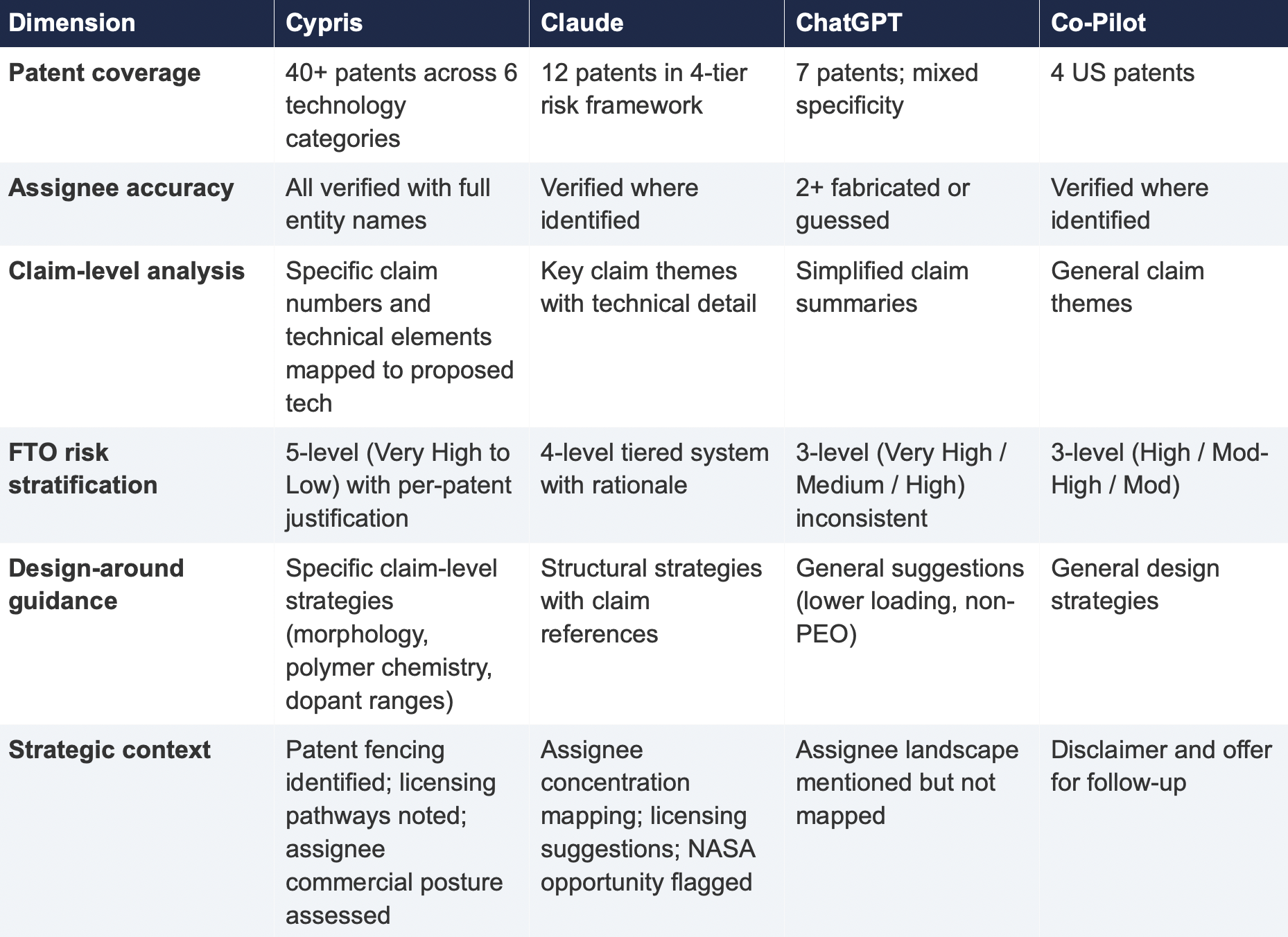
The most significant finding is the scale of the coverage differential. Cypris identified over 40 active US patents and published applications spanning LLZO-polymer composite electrolytes, garnet interface modification, polymer interlayer architectures, lithium-sulfur specific filings, and adjacent ceramic composite patents. The results were organized by technology category with per-patent FTO risk ratings.
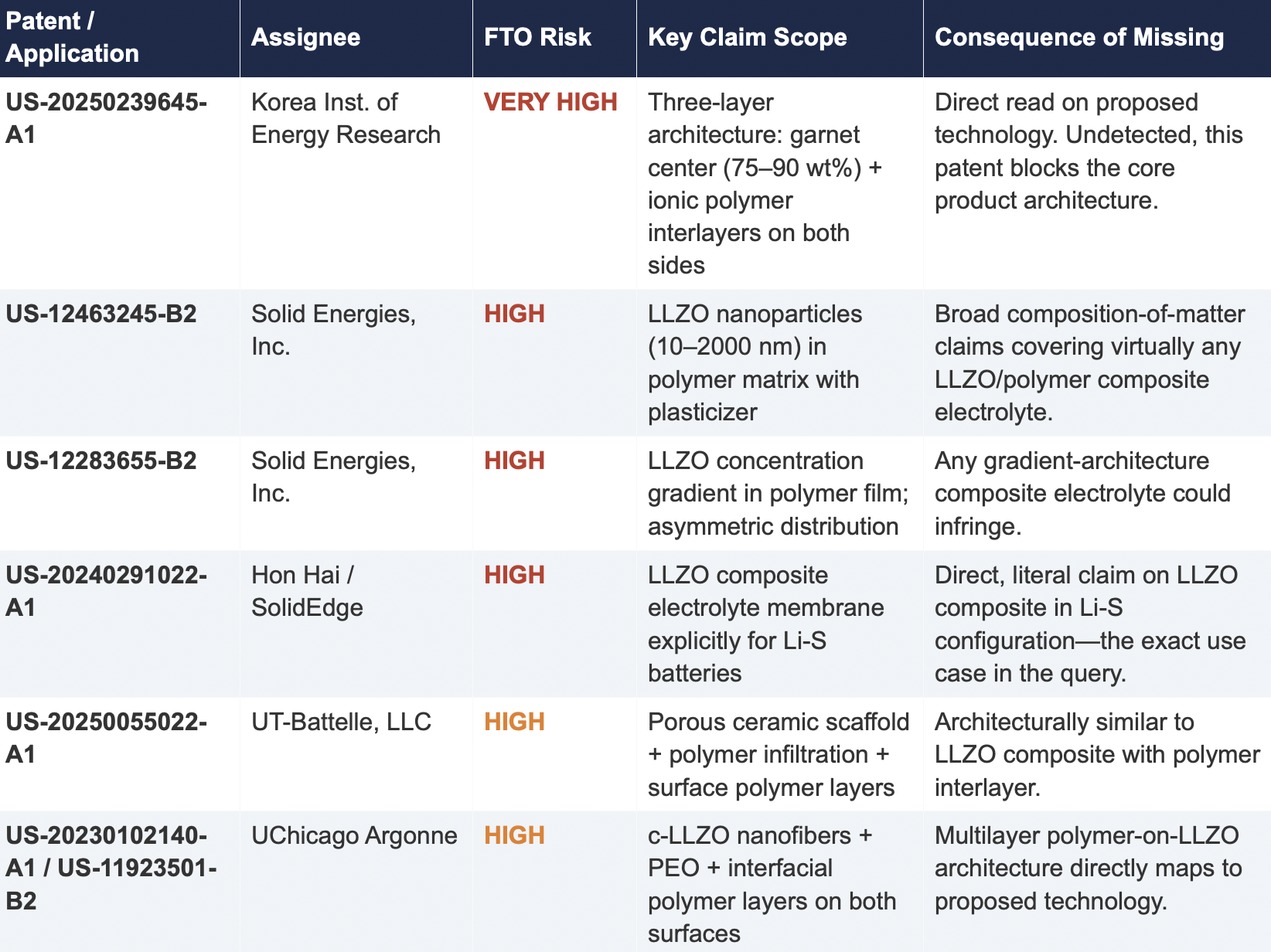
Claude identified 12 patents organized in a four-tier risk framework. Its analysis was structurally sound and correctly flagged the two highest-risk filings (Solid Energies US 11,967,678 and the LLZO nanofiber multilayer US 11,923,501). It also identified the University ofMaryland/ Wachsman portfolio as a concentration risk and noted the NASA SABERS portfolio as a licensing opportunity. However, it missed the majority of the landscape, including the entire Corning portfolio, GM's interlayer patents, theKorea Institute of Energy Research three-layer architecture, and the HonHai/SolidEdge lithium-sulfur specific filing.
ChatGPT identified 7 patents, but the quality of attribution was inconsistent. It listed assignees as "Likely DOE /national lab ecosystem" and "Likely startup / defense contractor cluster" for two filings—language that indicates the model was inferring rather than retrieving assignee data. In a freedom-to-operate context, an unverified assignee attribution is functionally equivalent to no attribution, as it cannot support a licensing inquiry or risk assessment.
Co-Pilot identified 4 US patents. Its output was the most limited in scope, missing the Solid Energies portfolio entirely, theUMD/ Wachsman portfolio, Gelion/ Johnson Matthey, NASA SABERS, and all Li-S specific LLZO filings.
2.2 Critical Patents Missed by Public Models
The following table presents patents identified exclusively by Cypris that were rated as High or Very High FTO risk for the proposed technology architecture. None were surfaced by any general-purpose model.
2.3 Patent Fencing: The Solid Energies Portfolio
Cypris identified a coordinated patent fencing strategy by Solid Energies, Inc. that no general-purpose model detected at scale. Solid Energies holds at least four granted US patents and one published application covering LLZO-polymer composite electrolytes across compositions(US-12463245-B2), gradient architectures (US-12283655-B2), electrode integration (US-12463249-B2), and manufacturing processes (US-20230035720-A1). Claude identified one Solid Energies patent (US 11,967,678) and correctly rated it as the highest-priority FTO concern but did not surface the broader portfolio. ChatGPT and Co-Pilot identified zero Solid Energies filings.
The practical significance is that a company relying on any individual patent hit would underestimate the scope of Solid Energies' IP position. The fencing strategy—covering the composition, the architecture, the electrode integration, and the manufacturing method—means that identifying a single design-around for one patent does not resolve the FTO exposure from the portfolio as a whole. This is the kind of strategic insight that requires seeing the full picture, which no general-purpose model delivered
2.4 Assignee Attribution Quality
ChatGPT's response included at least two instances of fabricated or unverifiable assignee attributions. For US 11,367,895 B1, the listed assignee was "Likely startup / defense contractor cluster." For US 2021/0202983 A1, the assignee was described as "Likely DOE / national lab ecosystem." In both cases, the model appears to have inferred the assignee from contextual patterns in its training data rather than retrieving the information from patent records.
In any operational IP workflow, assignee identity is foundational. It determines licensing strategy, litigation risk, and competitive positioning. A fabricated assignee is more dangerous than a missing one because it creates an illusion of completeness that discourages further investigation. An R&D team receiving this output might reasonably conclude that the landscape analysis is finished when it is not.
3. Structural Limitations of General-Purpose Models for Patent Intelligence
3.1 Training Data Is Not Patent Data
Large language models are trained on web-scraped text. Their knowledge of the patent record is derived from whatever fragments appeared in their training corpus: blog posts mentioning filings, news articles about litigation, snippets of Google Patents pages that were crawlable at the time of data collection. They do not have systematic, structured access to the USPTO database. They cannot query patent classification codes, parse claim language against a specific technology architecture, or verify whether a patent has been assigned, abandoned, or subjected to terminal disclaimer since their training data was collected.
This is not a limitation that improves with scale. A larger training corpus does not produce systematic patent coverage; it produces a larger but still arbitrary sampling of the patent record. The result is that general-purpose models will consistently surface well-known patents from heavily discussed assignees (QuantumScape, for example, appeared in most responses) while missing commercially significant filings from less publicly visible entities (Solid Energies, Korea Institute of EnergyResearch, Shenzhen Solid Advanced Materials).
3.2 The Web Is Closing to Model Scrapers
The data access problem is structural and worsening. As of mid-2025, Cloudflare reported that among the top 10,000 web domains, the majority now fully disallow AI crawlers such as GPTBot andClaudeBot via robots.txt. The trend has accelerated from partial restrictions to outright blocks, and the crawl-to-referral ratios reveal the underlying tension: OpenAI's crawlers access approximately1,700 pages for every referral they return to publishers; Anthropic's ratio exceeds 73,000 to 1.
Patent databases, scientific publishers, and IP analytics platforms are among the most restrictive content categories. A Duke University study in 2025 found that several categories of AI-related crawlers never request robots.txt files at all. The practical consequence is that the knowledge gap between what a general-purpose model "knows" about the patent landscape and what actually exists in the patent record is widening with each training cycle. A landscape query that a general-purpose model partially answered in 2023 may return less useful information in 2026.
3.3 General-Purpose Models Lack Ontological Frameworks for Patent Analysis
A freedom-to-operate analysis is not a summarization task. It requires understanding claim scope, prosecution history, continuation and divisional chains, assignee normalization (a single company may appear under multiple entity names across patent records), priority dates versus filing dates versus publication dates, and the relationship between dependent and independent claims. It requires mapping the specific technical features of a proposed product against independent claim language—not keyword matching.
General-purpose models do not have these frameworks. They pattern-match against training data and produce outputs that adopt the format and tone of patent analysis without the underlying data infrastructure. The format is correct. The confidence is high. The coverage is incomplete in ways that are not visible to the user.
4. Comparative Output Quality
The following table summarizes the qualitative characteristics of each tool's response across the dimensions most relevant to an operational IP workflow.
5. Implications for R&D and IP Organizations
5.1 The Confidence Problem
The central risk identified by this study is not that general-purpose models produce bad outputs—it is that they produce incomplete outputs with high confidence. Each model delivered its results in a professional format with structured analysis, risk ratings, and strategic recommendations. At no point did any model indicate the boundaries of its knowledge or flag that its results represented a fraction of the available patent record. A practitioner receiving one of these outputs would have no signal that the analysis was incomplete unless they independently validated it against a comprehensive datasource.
This creates an asymmetric risk profile: the better the format and tone of the output, the less likely the user is to question its completeness. In a corporate environment where AI outputs are increasingly treated as first-pass analysis, this dynamic incentivizes under-investigation at precisely the moment when thoroughness is most critical.
5.2 The Diversification Illusion
It might be assumed that running the same query through multiple general-purpose models provides validation through diversity of sources. This study suggests otherwise. While the four tools returned different subsets of patents, all operated under the same structural constraints: training data rather than live patent databases, web-scraped content rather than structured IP records, and general-purpose reasoning rather than patent-specific ontological frameworks. Running the same query through three constrained tools does not produce triangulation; it produces three partial views of the same incomplete picture.
5.3 The Appropriate Use Boundary
General-purpose language models are effective tools for a wide range of tasks: drafting communications, summarizing documents, generating code, and exploratory research. The finding of this study is not that these tools lack value but that their value boundary does not extend to decisions that carry existential commercial risk.
Patent landscape analysis, freedom-to-operate assessment, and competitive intelligence that informs R&D investment decisions fall outside that boundary. These are workflows where the completeness and verifiability of the underlying data are not merely desirable but are the primary determinant of whether the analysis has value. A patent landscape that captures 10% of the relevant filings, regardless of how well-formatted or confidently presented, is a liability rather than an asset.
6. Test 2: Competitive Intelligence — Bio-Based Polyamide Patent Landscape
To assess whether the findings from Test 1 were specific to a single technology domain or reflected a broader structural pattern, a second query was submitted to all four tools. This query shifted from freedom-to-operate analysis to competitive intelligence, asking each tool to identify the top 10organizations by patent filing volume in bio-based polyamide synthesis from castor oil derivatives over the past three years, with summaries of technical approach, co-assignee relationships, and portfolio trajectory.
6.1 Query

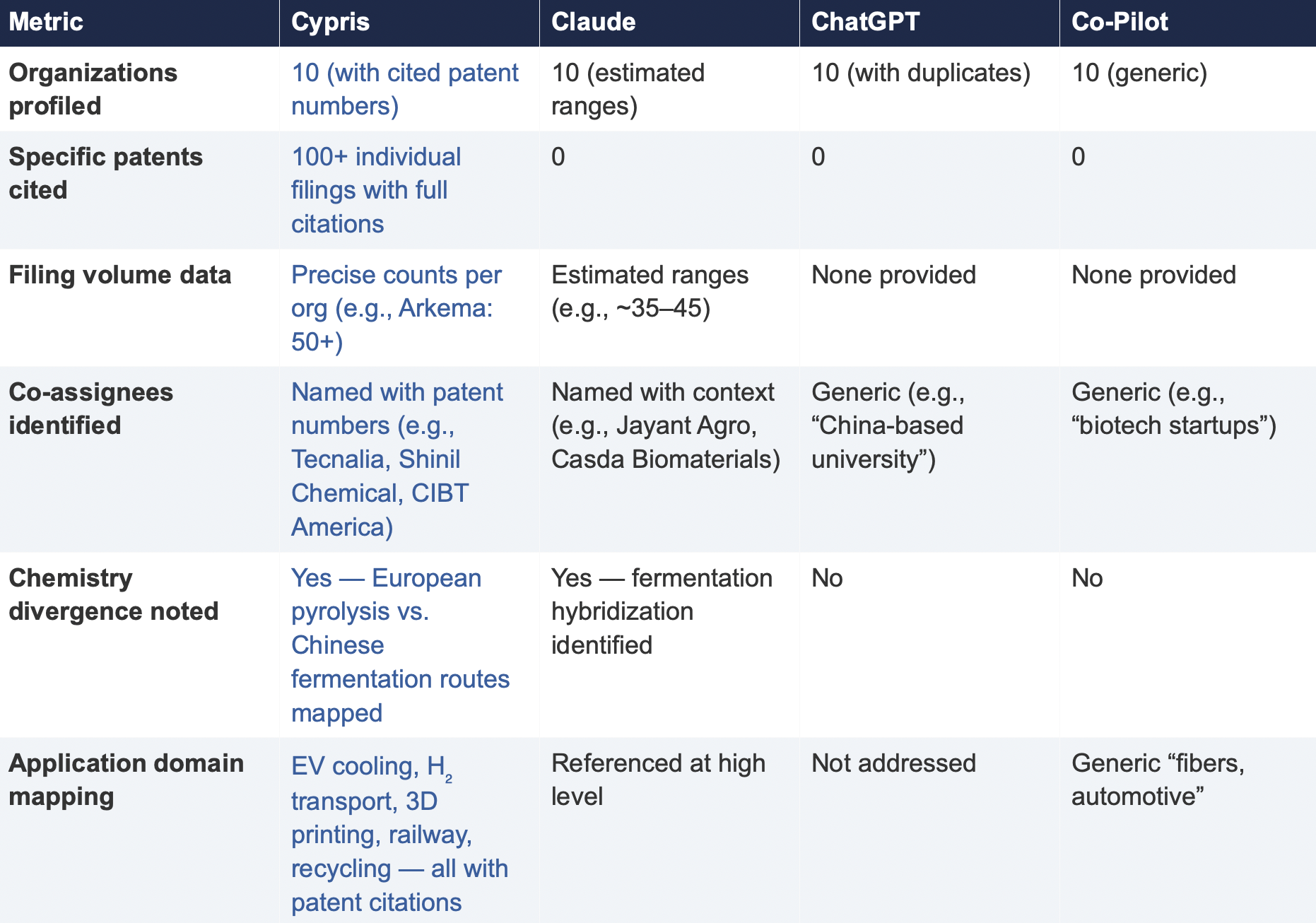
6.2 Summary of Results
6.3 Key Differentiators
Verifiability
The most consequential difference in Test 2 was the presence or absence of verifiable evidence. Cypris cited over 100 individual patent filings with full patent numbers, assignee names, and publication dates. Every claim about an organization’s technical focus, co-assignee relationships, and filing trajectory was anchored to specific documents that a practitioner could independently verify in USPTO, Espacenet, or WIPO PATENT SCOPE. No general-purpose model cited a single patent number. Claude produced the most structured and analytically useful output among the public models, with estimated filing ranges, product names, and strategic observations that were directionally plausible. However, without underlying patent citations, every claim in the response requires independent verification before it can inform a business decision. ChatGPT and Co-Pilot offered thinner profiles with no filing counts and no patent-level specificity.
Data Integrity
ChatGPT’s response contained a structural error that would mislead a practitioner: it listed CathayBiotech as organization #5 and then listed “Cathay Affiliate Cluster” as a separate organization at #9, effectively double-counting a single entity. It repeated this pattern with Toray at #4 and “Toray(Additional Programs)” at #10. In a competitive intelligence context where the ranking itself is the deliverable, this kind of error distorts the landscape and could lead to misallocation of competitive monitoring resources.
Organizations Missed
Cypris identified Kingfa Sci. & Tech. (8–10 filings with a differentiated furan diacid-based polyamide platform) and Zhejiang NHU (4–6 filings focused on continuous polymerization process technology)as emerging players that no general-purpose model surfaced. Both represent potential competitive threats or partnership opportunities that would be invisible to a team relying on public AI tools.Conversely, ChatGPT included organizations such as ANTA and Jiangsu Taiji that appear to be downstream users rather than significant patent filers in synthesis, suggesting the model was conflating commercial activity with IP activity.
Strategic Depth
Cypris’s cross-cutting observations identified a fundamental chemistry divergence in the landscape:European incumbents (Arkema, Evonik, EMS) rely on traditional castor oil pyrolysis to 11-aminoundecanoic acid or sebacic acid, while Chinese entrants (Cathay Biotech, Kingfa) are developing alternative bio-based routes through fermentation and furandicarboxylic acid chemistry.This represents a potential long-term disruption to the castor oil supply chain dependency thatWestern players have built their IP strategies around. Claude identified a similar theme at a higher level of abstraction. Neither ChatGPT nor Co-Pilot noted the divergence.
6.4 Test 2 Conclusion
Test 2 confirms that the coverage and verifiability gaps observed in Test 1 are not domain-specific.In a competitive intelligence context—where the deliverable is a ranked landscape of organizationalIP activity—the same structural limitations apply. General-purpose models can produce plausible-looking top-10 lists with reasonable organizational names, but they cannot anchor those lists to verifiable patent data, they cannot provide precise filing volumes, and they cannot identify emerging players whose patent activity is visible in structured databases but absent from the web-scraped content that general-purpose models rely on.
7. Conclusion
This comparative analysis, spanning two distinct technology domains and two distinct analytical workflows—freedom-to-operate assessment and competitive intelligence—demonstrates that the gap between purpose-built R&D intelligence platforms and general-purpose language models is not marginal, not domain-specific, and not transient. It is structural and consequential.
In Test 1 (LLZO garnet electrolytes for Li-S batteries), the purpose-built platform identified more than three times as many patents as the best-performing general-purpose model and ten times as many as the lowest-performing one. Among the patents identified exclusively by the purpose-built platform were filings rated as Very High FTO risk that directly claim the proposed technology architecture. InTest 2 (bio-based polyamide competitive landscape), the purpose-built platform cited over 100individual patent filings to substantiate its organizational rankings; no general-purpose model cited as ingle patent number.
The structural drivers of this gap—reliance on training data rather than live patent feeds, the accelerating closure of web content to AI scrapers, and the absence of patent-specific analytical frameworks—are not transient. They are inherent to the architecture of general-purpose models and will persist regardless of increases in model capability or training data volume.
For R&D and IP leaders, the practical implication is clear: general-purpose AI tools should be used for general-purpose tasks. Patent intelligence, competitive landscaping, and freedom-to-operate analysis require purpose-built systems with direct access to structured patent data, domain-specific analytical frameworks, and the ability to surface what a general-purpose model cannot—not because it chooses not to, but because it structurally cannot access the data.
The question for every organization making R&D investment decisions today is whether the tools informing those decisions have access to the evidence base those decisions require. This study suggests that for the majority of general-purpose AI tools currently in use, the answer is no.
Study Disclosure
This comparative evaluation was commissioned and published by Cypris. The testing methodology, prompts, evaluation criteria, and underlying outputs have been documented to support independent review and replication.
All platform outputs were preserved in their original form. Patent data and material factual claims were cross-checked against USPTO Patent Center and WIPO PATENTSCOPE records as of March 27, 2026. Cypris was one of the platforms evaluated and therefore has a commercial interest in the findings.
The Patent Intelligence Gap - A Comparative Analysis of Verticalized AI-Patent Tools vs. General-Purpose Language Models for R&D Decision-Making
All Blogs

Perplexity has earned a loyal following as a general-purpose AI search engine, and for good reason. It synthesizes web results quickly, cites its sources, and delivers answers in clean, conversational language that feels like a genuine upgrade over traditional search. For millions of users researching everything from dinner recipes to coding bugs, it works remarkably well.
But for enterprise R&D teams, patent analysts, and innovation strategists, Perplexity's generalist architecture creates real limitations that become apparent quickly. It has no access to proprietary patent databases. It cannot map technology landscapes or track competitor filing activity over time. It treats a semiconductor prior art question with the same methodology it uses for a travel recommendation. And for organizations handling sensitive pre-filing research or competitive intelligence, routing queries through a consumer AI tool raises security concerns that most compliance teams are not willing to overlook.
The result is a growing population of R&D professionals who appreciate what Perplexity does well but have learned through experience that general-purpose AI search is not the same thing as R&D intelligence. This guide examines the seven best alternatives to Perplexity for research and development teams in 2026, ranging from enterprise-grade intelligence platforms purpose-built for the R&D workflow to free academic tools that serve specific niches well. Each entry includes an honest assessment of strengths, limitations, and the types of teams each tool serves best.
Why R&D Teams Are Looking Beyond Perplexity
The shift away from Perplexity among enterprise R&D teams is not a commentary on the product's quality. It is a recognition that general-purpose AI search and domain-specific R&D intelligence are fundamentally different categories of tool, solving different problems for different users.
When a materials scientist needs to evaluate the patent landscape around a novel polymer formulation before committing an eighteen-month development program, the stakes are high and the required data sources are specialized. The relevant intelligence lives in patent databases, scientific literature, grant filings, and competitive intelligence datasets that are not indexed by general web search engines. Perplexity, like all general-purpose AI search tools, synthesizes information from the open web. It does not have direct access to the structured patent and technical databases that R&D professionals depend on for accurate, comprehensive analysis.
Enterprise security is another driver. R&D queries are often among the most competitively sensitive information an organization generates. A search for prior art related to a product under development, a competitive landscape analysis of a rival's filing strategy, or a freedom-to-operate investigation all reveal strategic intent. Consumer AI tools process these queries through infrastructure designed for general public use, with data handling policies that may not satisfy the security requirements of Fortune 500 R&D organizations.
Finally, there is the question of analytical depth. Perplexity returns answers. Enterprise R&D teams need structured intelligence: landscape maps, trend analysis, assignee portfolios, citation networks, white space identification, and exportable reports that can be shared across cross-functional teams and presented to leadership. The gap between a conversational answer and an actionable intelligence deliverable is where purpose-built R&D platforms differentiate themselves.
1. Cypris — Best for Enterprise R&D Intelligence and Patent Research
For R&D teams that have outgrown general-purpose AI search, Cypris represents a fundamentally different category of tool. Where Perplexity searches the open web, Cypris searches a curated intelligence layer built specifically for research and development: over 500 million patents, scientific papers, and technical documents, organized by a proprietary R&D ontology powered by retrieval-augmented generation and large language model architecture [1].
The distinction matters in every practical scenario an R&D team encounters. When a principal scientist at a Fortune 500 chemicals company needs to understand the competitive patent landscape around a novel catalyst formulation, Perplexity will surface blog posts, Wikipedia summaries, and perhaps a few abstracts from open-access journals. Cypris will surface the actual patent filings from every relevant jurisdiction, map the assignee landscape to reveal which competitors are building portfolios in the space, identify white space in the technology domain where filing activity is sparse, and generate a structured intelligence report through its AI research agent, Cypris Q [2]. That is not a marginal improvement in search quality. It is an entirely different workflow designed for the way R&D scientists and innovation strategists actually make decisions.
The platform's upstream positioning is deliberate and reflects a gap in the market that legacy tools have failed to address. Traditional patent intelligence platforms like Derwent Innovation and Orbit Intelligence were designed primarily for IP attorneys conducting prosecution, validity, and freedom-to-operate analyses. These tools are powerful in the hands of patent professionals, but their interfaces, workflows, and analytical frameworks assume a legal user with deep patent expertise. Cypris was built for the people who work upstream of the legal function: R&D scientists, technology scouts, innovation portfolio managers, and strategy leaders who need to make research investment decisions informed by the full landscape of technical and competitive intelligence [3].
Enterprise security is another area where the gap between Cypris and consumer AI tools is significant. Cypris meets Fortune 500 security requirements and holds official API partnerships with OpenAI, Anthropic, and Google, meaning its AI capabilities are delivered through vetted enterprise infrastructure rather than consumer-facing endpoints [4]. For organizations where pre-filing research is competitively sensitive or where queries themselves reveal strategic direction, this is not a secondary consideration. It is often the deciding factor.
Thousands of Fortune 1000 R&D professionals already use Cypris for technology scouting, prior art research, competitive landscape analysis, and innovation portfolio management. The platform's adoption curve reflects a broader shift in how enterprise R&D organizations think about intelligence: rather than treating patent search as a legal function that happens after research decisions are made, leading organizations are embedding structured R&D intelligence into the decision-making process itself [5].
Best for: Corporate R&D teams, innovation strategists, technology scouts, VPs of R&D, and any enterprise organization that needs structured patent and technical intelligence rather than general web search. Particularly strong for teams that need to conduct competitive landscape analysis, technology scouting, prior art research, and innovation portfolio management at enterprise scale with enterprise-grade security.
2. Google Scholar — Best Free Option for Academic Literature Search
Google Scholar remains the most widely used free tool for finding academic papers and citations, and its strengths are well-established. The index is enormous, covering a vast range of journals, conference proceedings, preprints, and institutional repositories. The interface is instantly familiar to anyone who has used Google's main search engine. Citation tracking features make it easy to follow threads of research across decades of literature, and the "cited by" function remains one of the most useful tools in any researcher's workflow for discovering how a seminal paper has influenced subsequent work [6].
For individual researchers conducting literature reviews, Google Scholar is an excellent starting point. The ability to set up alerts for new papers matching specific keywords, access papers through institutional library links, and quickly assess a paper's influence through citation counts makes it a genuinely useful tool at no cost.
The limitations become apparent when R&D teams try to use Google Scholar for anything beyond basic academic literature review. The platform has no meaningful patent search capability. It does not offer technology landscape mapping, AI-assisted synthesis, or any way to generate structured intelligence reports. Search results are returned as a flat list of links ranked by Google's relevance algorithms, with no analytical layer on top and no way to visualize trends, map competitive landscapes, or identify gaps in a technology domain.
Google Scholar also offers no enterprise features whatsoever. There is no team collaboration, no shared workspaces, no access controls, no audit trail, and no way to ensure that research queries remain confidential. Every search is processed through Google's public infrastructure. For a graduate student writing a literature review, this is perfectly acceptable. For an R&D director at a pharmaceutical company investigating a sensitive new therapeutic target, the lack of any confidentiality guarantee makes Google Scholar unsuitable as a primary research tool.
There is also the question of coverage gaps. Google Scholar's indexing, while broad, is inconsistent. Some publishers restrict access, some repositories are incompletely indexed, and the lack of transparency around exactly what is and is not included makes it difficult for R&D teams to know whether a negative result, finding no relevant papers on a topic, reflects a genuine gap in the literature or simply a gap in Google Scholar's coverage [7].
Best for: Individual researchers conducting academic literature reviews where patent coverage, analytical tools, and enterprise security are not requirements. A strong free complement to more specialized tools rather than a standalone solution for enterprise R&D.
3. ChatGPT — Best General-Purpose AI for Exploratory Technical Questions
OpenAI's ChatGPT has become a default starting point for many R&D professionals who want quick, conversational answers to technical questions. Its reasoning capabilities have improved substantially with each model generation, and with web browsing and file analysis features enabled, it can pull in recent information, process uploaded documents, and engage in extended technical discussions that feel remarkably productive [8].
For early-stage exploration, ChatGPT is genuinely useful in an R&D context. It can explain unfamiliar technical concepts, help researchers think through experimental design, draft sections of technical documents, and serve as a brainstorming partner for researchers who are exploring a new domain. The conversational interface makes it particularly good at iterative questioning, where each answer leads to a more refined follow-up.
For enterprise R&D teams, however, ChatGPT shares Perplexity's core limitation: it is a generalist tool with no direct access to the specialized databases that R&D professionals depend on. ChatGPT cannot search patent databases, verify patent filing dates, map assignee portfolios, or perform structured landscape analysis. When asked about prior art, it will generate plausible-sounding summaries based on its training data, but it cannot search actual patent records in real time. The risk of hallucinated citations is well-documented across all large language models and is particularly dangerous in a patent research context where inaccurate information can lead to costly legal and strategic mistakes [9].
The enterprise security question applies to ChatGPT in the same way it applies to Perplexity. While OpenAI offers enterprise tier agreements with enhanced data handling provisions, the standard ChatGPT interface processes queries through consumer infrastructure. Most Fortune 500 compliance teams maintain policies that restrict or prohibit the use of consumer AI tools for sensitive R&D queries, and for good reason. A single query about a pre-filing invention concept routed through a consumer AI tool represents a potential confidentiality exposure that no amount of convenience justifies.
ChatGPT also lacks the structured output capabilities that enterprise R&D workflows require. It can generate a narrative summary of a topic, but it cannot produce the kind of structured landscape analysis, with assignee maps, filing trend visualizations, technology cluster diagrams, and citation networks, that R&D leaders need to make informed investment decisions. The gap between a conversational answer and an intelligence deliverable remains substantial.
Best for: Early-stage brainstorming, explaining technical concepts, drafting and editing documents, and exploratory research where the output will be independently verified through authoritative sources before being used to inform decisions.
4. Semantic Scholar — Best AI-Enhanced Academic Paper Discovery
Developed by the Allen Institute for AI, Semantic Scholar applies machine learning to academic paper discovery in ways that go meaningfully beyond traditional keyword matching. Its TLDR feature generates concise, one-sentence paper summaries that help researchers quickly assess relevance without reading abstracts. Its semantic search capabilities can surface papers that share conceptual overlap with a query even when they use entirely different terminology, which is particularly valuable in interdisciplinary research where the same phenomenon may be described in different vocabularies across fields [10].
Semantic Scholar also offers a research feed feature that learns from a user's reading history and citation library to recommend new papers, functioning somewhat like a personalized discovery engine for academic literature. The platform's citation context feature shows not just which papers cite a given work but how they cite it, distinguishing between papers that build on a finding, contradict it, or merely mention it in passing. These are genuinely sophisticated capabilities that make Semantic Scholar one of the most advanced free tools for academic research.
The limitations, however, are the same ones that affect every academic-focused tool on this list. Semantic Scholar's scope is limited to scholarly publications. It does not index patents, it does not cover technical standards, regulatory filings, or grant databases, and it has no enterprise features such as team workspaces, access controls, or confidential query handling. For R&D teams whose work spans both the scientific literature and the patent landscape, Semantic Scholar covers the academic half of the picture but leaves the patent and competitive intelligence half entirely unaddressed.
The absence of structured analytical tools is another limitation for enterprise use. Semantic Scholar can help a researcher find relevant papers, but it cannot map a technology landscape, identify filing trends, or generate the kind of multi-source intelligence reports that R&D leadership requires. Individual paper discovery, no matter how sophisticated the underlying algorithms, is a different function than strategic R&D intelligence.
Best for: Researchers focused on academic literature who want AI-enhanced paper discovery, citation analysis, and personalized recommendations but do not need patent intelligence, competitive analysis, or enterprise security.
5. Scite — Best for Citation Context and Claim Verification
Scite takes a distinctive approach to research by analyzing not just whether a paper has been cited but how it has been cited. Its Smart Citations feature classifies citations as supporting, contrasting, or mentioning, giving researchers a quick way to assess whether a finding has been validated, challenged, or simply referenced by subsequent work. For R&D teams evaluating the reliability of specific scientific claims before building a research program on top of them, this kind of citation context is genuinely valuable [11].
The platform also offers a search assistant that can answer research questions by synthesizing information from its database of scientific papers, with each claim linked to the specific citation and citation context that supports it. This evidence-grounded approach reduces the hallucination risk that makes general-purpose AI tools problematic for serious research, though it is important to note that Scite's coverage is limited to the papers it has indexed and may not reflect the full body of relevant literature.
Scite's limitations for enterprise R&D teams mirror those of other academic-focused tools. The platform does not index patents, does not offer technology landscape analysis, and does not provide the kind of structured competitive intelligence that R&D organizations need. It is excellent at answering a specific question, whether a particular scientific claim is well-supported, but it cannot answer the broader strategic questions that drive R&D investment decisions, such as where competitors are filing patents, what technology white space exists in a domain, or how a competitive landscape is evolving over time.
Enterprise features are also limited. Scite offers institutional access plans, but the platform was designed for academic researchers and does not include the security infrastructure, team workflow tools, or structured reporting capabilities that Fortune 500 R&D organizations require.
Best for: Researchers who need to evaluate the reliability of specific scientific claims and understand how findings have been received by the broader research community. Particularly useful in fields where replication and reproducibility are active concerns.
6. Consensus — Best for Evidence-Based Answers from Peer-Reviewed Research
Consensus takes a focused approach by searching exclusively within peer-reviewed scientific papers and using AI to synthesize evidence-based answers to research questions. Rather than surfacing a list of links or generating responses from general training data, Consensus attempts to answer questions directly based on the weight of published scientific evidence, often presenting results as a meter that indicates the degree of agreement in the literature [12].
This is a genuinely useful tool for specific types of research questions, particularly in health sciences, environmental science, nutrition, and other fields where the balance of published evidence matters more than any individual study. For an R&D team evaluating whether a particular biological mechanism is well-established enough to build a development program around, Consensus can provide a rapid, evidence-grounded assessment that would take hours to assemble manually.
The tool is less useful for R&D teams working on novel technologies at the frontier of innovation, where the relevant intelligence often lives in patent filings, pre-print servers, and competitive landscapes rather than in the peer-reviewed literature. By design, Consensus only searches published, peer-reviewed papers, which means it misses the substantial body of technical intelligence that exists in patent databases, conference proceedings, technical standards, and other sources that R&D professionals depend on.
Like the other academic tools on this list, Consensus has no patent search capability, no competitive intelligence features, no technology landscape mapping, and no enterprise security infrastructure. It does one thing, synthesizing evidence from peer-reviewed literature, and does it well, but it is not a substitute for comprehensive R&D intelligence.
Best for: Researchers who need quick, evidence-based answers to scientific questions where the weight of peer-reviewed evidence is the most important input. Particularly valuable in life sciences, health sciences, and environmental research.
7. The Lens — Best Free Patent and Scholarly Search Engine
The Lens, operated by the non-profit Cambia, is one of the few free tools that attempts to bridge the gap between scholarly literature and patent data. It indexes both patent documents and academic papers, and it allows users to explore the connections between them through citation mapping and linked datasets. This combination is unique among free tools and reflects a genuine insight about how innovation works: the relationship between published research and patent activity is a critical signal that most tools treat as two separate worlds [13].
For individual researchers or small teams with limited budgets, The Lens provides real value. Its patent coverage is substantial, drawing on data from major patent offices worldwide. The ability to see how a scholarly paper has been cited in patent filings, or to trace a patent's references back to the underlying scientific research, is a capability that most free tools simply do not offer. The Lens also provides biological patent data through its PatSeq database, which is a useful resource for life sciences researchers.
The limitations emerge at enterprise scale and in the context of serious competitive intelligence work. The Lens has no AI-assisted analysis. Search results require manual review and interpretation. There is no technology landscape mapping, no automated trend detection, no report generation capability, and no way to automate the kind of structured intelligence workflows that large R&D organizations rely on. The interface, while functional, does not support the kind of rapid, iterative analysis that R&D teams need when evaluating a complex technology domain under time pressure.
Enterprise security features are also limited. The Lens is a public platform, and while it offers some institutional features, it does not provide the data handling guarantees, access controls, or compliance infrastructure that Fortune 500 R&D organizations require for sensitive competitive intelligence work.
Best for: Independent researchers, small teams, and academic groups who need free access to both patent and scholarly data and are willing to invest the manual effort required to analyze results without AI assistance. A useful complement to enterprise platforms for teams that want to cross-reference findings.
Choosing the Right Perplexity Alternative: Key Considerations for R&D Teams
Selecting the right alternative to Perplexity depends on the nature of the work, the sensitivity of the research, and the scale of the team. Rather than recommending a single tool for every scenario, it is worth thinking through several key dimensions that separate these options.
Data coverage is the most fundamental differentiator. General-purpose AI tools like Perplexity and ChatGPT search the open web. Academic tools like Google Scholar, Semantic Scholar, Scite, and Consensus search scholarly publications. The Lens bridges scholarly and patent data in a single free platform. Only enterprise R&D intelligence platforms like Cypris provide comprehensive, structured access to both patent databases and scientific literature through a unified analytical layer designed for R&D decision-making.
Analytical depth separates search tools from intelligence platforms. Every tool on this list can help a researcher find relevant documents. Fewer can synthesize those documents into structured intelligence: landscape maps, trend analyses, competitive portfolios, and white space assessments. For R&D leaders who need to make investment decisions based on the full competitive landscape, the ability to move from search to synthesis to structured deliverables is essential.
Enterprise security is a binary consideration for many organizations. Consumer AI tools and free academic platforms process queries through public infrastructure with limited data handling guarantees. For R&D teams handling pre-filing inventions, competitive intelligence, or any research where the queries themselves reveal strategic intent, enterprise-grade security is a requirement, not a preference.
Workflow integration matters at organizational scale. Individual researchers can use any combination of free tools and assemble their own intelligence manually. Enterprise R&D teams need platforms that support collaborative workflows, structured outputs that can be shared across functions, and the ability to build institutional knowledge over time rather than starting from scratch with every query.
For most enterprise R&D organizations, the practical answer is not choosing a single tool but rather understanding which tool serves which purpose. Free academic tools are valuable for literature review and paper discovery. General-purpose AI is useful for brainstorming and exploration. But for the core R&D intelligence workflow, patent landscape analysis, technology scouting, competitive intelligence, and strategic research planning, a purpose-built platform like Cypris fills a role that no combination of free tools can replicate.
Frequently Asked Questions
What is the best alternative to Perplexity for patent research?
Cypris is the leading alternative to Perplexity for patent research, offering access to over 500 million patents and scientific papers through a proprietary R&D ontology powered by retrieval-augmented generation and large language model architecture. Unlike Perplexity, which searches the open web and has no direct patent database access, Cypris was purpose-built for enterprise R&D teams and provides structured patent landscape analysis, prior art search, competitive intelligence, and AI-generated intelligence reports through its Cypris Q research agent. The platform meets Fortune 500 enterprise security requirements and holds official API partnerships with OpenAI, Anthropic, and Google.
Is Perplexity good enough for enterprise R&D research?
Perplexity is a capable general-purpose AI search engine, but it lacks the specialized data access, analytical tools, and enterprise security features that corporate R&D teams require. It cannot search patent databases directly, map competitive technology landscapes, track assignee filing activity, or generate structured R&D intelligence reports. For enterprise use cases involving sensitive pre-filing research, competitive intelligence, or technology scouting, purpose-built platforms like Cypris offer the domain-specific depth, structured analytical capabilities, and enterprise-grade security infrastructure that Perplexity's consumer architecture does not provide. Most Fortune 500 compliance teams restrict the use of consumer AI tools for sensitive R&D queries.
What free tools can replace Perplexity for scientific research?
Several free tools offer strong alternatives to Perplexity for scientific literature research. Google Scholar provides broad academic paper search with citation tracking and alert features. Semantic Scholar uses AI to enhance paper discovery, generates automatic summaries, and offers personalized research recommendations. Scite analyzes citation context to show whether findings have been supported or contradicted by subsequent research. Consensus synthesizes evidence-based answers exclusively from peer-reviewed papers. The Lens is the only free tool that indexes both patent documents and scholarly papers in a single platform. None of these tools match the enterprise R&D intelligence capabilities of platforms like Cypris, but each excels within its specific niche and can serve as a useful complement to more comprehensive solutions.
How does Cypris compare to Perplexity for R&D teams?
Cypris and Perplexity serve fundamentally different purposes for R&D professionals. Perplexity is a general-purpose AI search engine that synthesizes information from the open web and is used across every domain and profession. Cypris is an enterprise R&D intelligence platform that searches over 500 million patents and scientific papers using a proprietary ontology designed specifically for research and development workflows. Cypris offers patent landscape mapping, technology scouting, competitive intelligence, assignee portfolio analysis, white space identification, and AI-generated research reports through Cypris Q. The platform meets Fortune 500 enterprise security requirements and is used by thousands of Fortune 1000 R&D professionals. Perplexity offers none of these R&D-specific capabilities but remains a useful tool for general exploratory research.
Can I use Perplexity for prior art search?
Perplexity is not suitable for formal prior art search. It does not have direct access to patent databases, cannot search patent records by classification codes, filing dates, or assignee names, and cannot verify the accuracy of patent-related information it generates from web sources. Prior art search requires access to comprehensive patent databases and structured analytical tools that can identify relevant filings across jurisdictions. Enterprise platforms like Cypris provide direct access to over 500 million patent documents and offer AI-assisted prior art research through Cypris Q. For basic preliminary exploration of a technology area, Perplexity can be a useful starting point, but any prior art conclusions should be verified through authoritative patent search tools.
References
[1] Cypris. "Enterprise R&D Intelligence Platform." cypris.ai. Accessed 2026.
[2] Cypris. "Cypris Q: AI Research Agent." cypris.ai. Accessed 2026.
[3] Cypris. "R&D Intelligence for Innovation Teams." cypris.ai. Accessed 2026.
[4] Cypris. "Security and Enterprise Infrastructure." cypris.ai. Accessed 2026.
[5] Cypris. "Customer Case Studies." cypris.ai. Accessed 2026.
[6] Google Scholar. "About Google Scholar." scholar.google.com. Accessed 2026.
[7] Halevi, G., Moed, H., and Bar-Ilan, J. "Suitability of Google Scholar as a Source of Scientific Information." Journal of Informetrics, 2017.
[8] OpenAI. "ChatGPT." openai.com. Accessed 2026.
[9] Ji, Z. et al. "Survey of Hallucination in Natural Language Generation." ACM Computing Surveys, 2023.
[10] Allen Institute for AI. "Semantic Scholar." semanticscholar.org. Accessed 2026.
[11] Scite. "Smart Citations." scite.ai. Accessed 2026.
[12] Consensus. "AI-Powered Academic Search Engine." consensus.app. Accessed 2026.
[13] The Lens. "Free Patent and Scholarly Search." lens.org. Accessed 2026.

Perplexity has become one of the most popular AI research tools in the world, and its popularity is well-earned. It delivers cited, conversational answers to complex questions faster than any traditional search engine, and for millions of professionals across every industry, it has fundamentally changed how everyday research gets done. If you work in R&D and you have used Perplexity for quick technical questions, competitive context, or early-stage exploration, you already know how good it is at what it does.
Cypris is a very different kind of tool. It was built from the ground up for enterprise R&D teams, patent analysts, and innovation strategists who need to make high-stakes decisions grounded in patent data, scientific literature, and structured competitive intelligence. Hundreds of Fortune 1000 companies subscribe to the platform, and thousands of R&D and IP professionals use it daily for patent landscape analysis, technology scouting, and competitive intelligence. It searches different data, produces different outputs, and serves a different function within the research workflow.
This comparison is not about declaring a winner. Perplexity and Cypris are designed for different jobs, and many R&D teams will find value in both. The goal here is to give enterprise R&D professionals an honest, detailed look at how the two platforms compare across the dimensions that matter most when the research is not casual but consequential: data sources, analytical depth, IP intelligence, enterprise security, and the ability to produce structured deliverables that inform real decisions.
Two Different Architectures, Two Different Research Philosophies
The most important difference between Cypris and Perplexity is not a feature comparison. It is a difference in what each platform was built to search.
Perplexity is a general-purpose AI search engine that synthesizes information from the open web. It crawls and indexes web pages, news articles, press releases, forums, blog posts, and publicly available documents, then uses large language models to generate cited, conversational answers to user queries. This architecture makes it exceptionally fast and remarkably versatile. It can handle questions about almost any topic, from geopolitics to cooking to software architecture, and it does so well enough that it has become a genuine threat to traditional search engines [1].
Cypris searches a fundamentally different data layer. The platform indexes over 500 million patents, scientific papers, and technical documents, organized through a proprietary R&D ontology powered by retrieval-augmented generation and large language model architecture [2]. When a user queries Cypris, the system is not searching the open web. It is searching structured patent databases, peer-reviewed scientific literature, and technical knowledge bases that are purpose-built for research and development workflows. This means the results are different in kind, not just in quality. A Cypris search returns patent filings with publication numbers and claim context, scientific papers with full citation networks, and structured intelligence that maps directly to R&D decision-making frameworks.
This architectural difference has practical consequences that show up in every research session. A Perplexity search for "closed-loop geothermal drilling innovations" will return a well-organized synthesis of recent news coverage, company press releases, and publicly available technical summaries. A Cypris search on the same topic will return the actual patent filings from companies developing closed-loop systems, the scientific papers documenting performance data, and a structured landscape showing which organizations hold the strongest IP positions in the domain. Both outputs are useful. They serve different purposes.
Source Quality and Verifiability
For enterprise R&D teams, the question of where information comes from is not academic. It determines whether conclusions can be trusted, whether findings can be presented to leadership with confidence, and whether the organization is exposed to risk from acting on inaccurate or unverifiable claims.
Cypris draws primarily from what researchers call primary R&D artifacts: patent documents with publication numbers and claim-level detail, peer-reviewed journal articles, and proceedings from specialized technical conferences. This creates a verifiable audit trail. Every claim in a Cypris report can be traced back to its original source, and that source is a formal, authoritative document that has been through a structured review or examination process [3]. For R&D teams building business cases for multimillion-dollar research investments, this traceability is not optional. It is the difference between a recommendation and a defensible recommendation.
Perplexity draws from the open web, which means its sources span a much wider range of authority levels. A single Perplexity response might synthesize information from a peer-reviewed paper, a company press release, a trade publication article, and a blog post, presenting all of them with equal visual weight in its citations. For general research, this breadth is a strength. For R&D decisions where the distinction between a verified technical result and an optimistic press release is consequential, the lack of source stratification requires the user to do significant additional verification work.
In a technical comparison we conducted earlier this year, we ran the same advanced research prompt through both Cypris Report Mode and Perplexity Deep Research, then had the outputs independently evaluated using a 100-point R&D rubric covering source quality, technical depth, IP intelligence, commercial readiness, and actionability [4]. On source authority and quality alone, Cypris scored 23 out of 25 points compared to 12 out of 25 for Perplexity. The gap was driven primarily by Cypris's reliance on patents and peer-reviewed literature versus Perplexity's reliance on news outlets, press releases, and general web sources.
This is not a criticism of Perplexity. Its source architecture reflects its design as a general-purpose tool. But for R&D teams whose decisions depend on provable technical reality rather than second-order interpretation, the distinction matters.
Technical Depth and Accuracy
R&D research is not just about finding information. It is about understanding mechanisms, constraints, failure modes, and the boundary conditions under which a technology does or does not work. The depth of technical analysis a tool can provide determines whether it is useful for surface-level exploration or for the kind of rigorous technical due diligence that precedes major research investments.
In our head-to-head evaluation, Cypris consistently demonstrated stronger performance in mechanism clarity, the ability to explain not just what a technology is called but how it actually functions and where its engineering limitations lie. For the geothermal energy test case, Cypris differentiated between drilling modalities such as thermal spallation and millimeter-wave approaches, surfaced real engineering constraints around casing survivability and induced seismicity, and contextualized technology readiness in terms of validated performance rather than projected timelines [5].
Perplexity, by contrast, excelled in a different dimension of technical reporting. It delivered stronger quantitative metrics, including specific production figures, cost projections, and deployment schedules. Its responses were well-organized and clearly written, with effective use of data points drawn from company disclosures and industry reporting. Where Perplexity was less strong was in identifying failure modes and boundary conditions. Because its sources tend toward news coverage and corporate communications, the technical picture it paints can lean optimistic, reflecting the framing of press releases rather than the measured assessments found in peer-reviewed literature and patent claims [6].
The practical implication is that each tool answers a different version of the same question. Perplexity tends to answer "how big is it?" with impressive specificity about market size, deployment scale, and commercial milestones. Cypris tends to answer "why does it work, and when does it fail?" with the kind of mechanistic detail that R&D teams need to assess technical feasibility before committing resources [7].
For R&D organizations, both types of answers matter. But the question of technical feasibility almost always precedes the question of market opportunity. A technology that cannot survive its engineering constraints will never reach the market projections that make it look attractive in a Perplexity summary. This is why R&D teams that rely solely on general-purpose AI search tools for technical due diligence are taking on more risk than they may realize.
Patent and IP Intelligence
This is the area of widest divergence between the two platforms, and for many R&D teams, it is the single most important dimension of comparison.
Cypris was purpose-built around patent intelligence. It provides direct access to patent documents with publication numbers, assignee information, claim-level analysis, and the ability to map competitive IP landscapes across technology domains. When an R&D team needs to understand who holds the strongest patent positions in a given space, where the white space exists for new filings, or whether a proposed research direction faces freedom-to-operate risks, Cypris delivers this intelligence as a core function of the platform [8].
Perplexity does not search patent databases. It has no direct access to patent records, cannot retrieve patent documents by publication number or classification code, and does not provide claim-level analysis or assignee portfolio mapping. When asked about patents, Perplexity will generate responses based on whatever patent-related information exists on the open web, such as news articles about patent filings, blog posts discussing IP strategy, or company press releases announcing new patents. This information can be useful for general awareness, but it does not constitute the kind of structured IP intelligence that R&D teams need for serious competitive analysis or freedom-to-operate assessments [9].
In our technical comparison, Cypris scored 19 out of 20 on competitive and IP intelligence, while Perplexity scored 11 out of 20. Cypris explicitly mapped patents to companies and technologies, explained what the patents protected at the claim level, and framed competitive strength around defensibility rather than just market presence. Perplexity identified market participants effectively and provided useful context on partnerships, funding, and commercial momentum, but offered minimal IP or freedom-to-operate analysis [10].
For R&D teams, unseen IP is hidden risk. A competitor's patent portfolio can block a promising research direction, force expensive design-arounds, or create unexpected licensing obligations that fundamentally change the economics of a development program. Tools that cannot make these constraints visible leave R&D teams operating with an incomplete picture of the competitive landscape.
It is worth noting that Perplexity's lack of patent intelligence is not a flaw in the product. Patents are a specialized data type that requires specialized indexing, classification, and analytical infrastructure. Perplexity was not designed to provide patent search, and it would be unfair to evaluate it against a standard it never set out to meet. But for R&D professionals whose work requires patent awareness, this gap is a fundamental constraint on how useful Perplexity can be as a primary research tool.
Where Perplexity Has Advantages
An honest comparison requires acknowledging the areas where Perplexity performs well relative to Cypris, though these advantages tend to cluster in areas outside the core R&D intelligence workflow.
Commercial timelines and market context. Perplexity's access to news, corporate disclosures, and industry reporting gives it an edge in surfacing commercial milestones. In our evaluation, Perplexity scored 14 out of 15 on commercial readiness assessment compared to 12 out of 15 for Cypris, delivering specific commissioning dates, deployment targets, and funding milestones [11]. This is useful context, though it is worth noting that commercial timeline data drawn primarily from press releases and corporate announcements tends to skew optimistic. R&D teams that have been in the industry long enough know that announced deployment dates and actual technical readiness are often very different things.
Breadth and geographic coverage. Perplexity scored 5 out of 5 on comprehensiveness compared to 4 out of 5 for Cypris. Its web-wide search naturally captures a broader range of geographies and adjacent topics. In the geothermal test case, Perplexity surfaced mineral co-production narratives that Cypris's more technically focused analysis did not cover [12]. This breadth is helpful for initial scoping, though it comes with a trade-off: breadth without depth can create a false sense of completeness, particularly when the information skims across domains without surfacing the technical constraints and IP risks that R&D teams need to see.
Speed and accessibility for non-R&D tasks. Perplexity is fast, free to start, and requires no onboarding. For quick general questions that fall outside the R&D intelligence workflow, such as checking a market figure, reading up on a regulatory development, or getting context on an unfamiliar company, it delivers useful results with minimal friction. These are legitimate use cases, but they are not the use cases where R&D teams face the most consequential research decisions.
Enterprise Security and Data Handling
For Fortune 500 R&D organizations, the security posture of research tools is not a secondary consideration. R&D queries frequently reveal strategic intent. A search for prior art related to an undisclosed invention, a competitive landscape analysis targeting a specific rival's technology, or a freedom-to-operate investigation all contain information that, if exposed, could compromise competitive advantage or create legal risk.
Cypris was architected for this reality. The platform meets Fortune 500 security requirements and holds official API partnerships with OpenAI, Anthropic, and Google, meaning its AI capabilities are delivered through vetted enterprise infrastructure with data handling controls designed for sensitive corporate research [13]. Thousands of Fortune 1000 R&D professionals use the platform for research that their organizations consider competitively sensitive. The security architecture is not an add-on. It is a foundational design requirement.
Perplexity is a consumer AI product. While it has introduced team and enterprise-oriented features, its core architecture was designed for general public use. Most Fortune 500 compliance and information security teams maintain policies that restrict or prohibit the use of consumer AI tools for sensitive research queries. This is not unique to Perplexity; the same restrictions apply to ChatGPT, Gemini, and other consumer-facing AI products. The issue is structural: consumer AI tools are designed for accessibility and scale, not for the data handling requirements of enterprise R&D.
For R&D teams whose research does not involve sensitive or pre-filing information, this distinction may not matter. For teams whose queries reveal strategic direction, the security gap between consumer AI tools and enterprise R&D platforms is a deciding factor.
Structured Outputs and R&D Deliverables
R&D intelligence is only useful if it can be communicated to stakeholders, integrated into decision-making workflows, and preserved as institutional knowledge. The format and structure of research outputs matter as much as their content.
Cypris Q, the platform's AI research agent, generates structured intelligence reports that include patent landscape analyses, assignee maps, technology trend assessments, citation networks, and white space identification. These reports are designed to be shared across R&D teams, presented to leadership, and used as inputs to formal decision-making processes like stage-gate reviews and portfolio assessments [14]. The structured format means that research findings are not trapped in a single user's chat history but become organizational assets.
Perplexity generates conversational responses with inline citations. These responses are often well-written and genuinely informative, but they are designed as answers to individual questions, not as structured deliverables for organizational workflows. A Perplexity Deep Research report covers a topic in depth and is substantially more comprehensive than a standard Perplexity response, but its format remains a narrative document rather than a structured intelligence deliverable with the analytical components that R&D teams expect: landscape maps, assignee analyses, trend visualizations, and risk assessments.
For individual researchers conducting preliminary exploration, Perplexity's conversational format is an asset. It is approachable, easy to read, and quick to consume. For enterprise R&D teams that need to produce deliverables for cross-functional stakeholders, the gap between a conversational answer and a structured intelligence report is significant.
When to Use Perplexity and When to Use Cypris
Rather than framing this as an either-or choice, it is worth being specific about which tool fits which type of work.
Use Perplexity when the research has nothing to do with patents, IP, or core R&D decision-making. Perplexity is a capable tool for general business context: checking a market figure, reading up on a company's recent funding round, understanding a regulatory development at a high level, or getting a quick summary of an unfamiliar topic outside your technical domain. These are real tasks that R&D professionals encounter, and Perplexity handles them efficiently. The key distinction is that these tasks are informational, not decisional. They build background awareness, not the evidence base for a research investment.
Use Cypris when the research touches patents, competitive intelligence, technology scouting, or any question where the answer informs an R&D decision with real consequences. This includes prior art and freedom-to-operate research, patent landscape and assignee portfolio analysis, technology scouting and white space identification, competitive intelligence on rival R&D and filing activity, structured technical due diligence for stage-gate reviews and portfolio decisions, and any research involving sensitive or pre-filing subject matter that requires enterprise-grade security. For R&D and IP professionals, this is the core of the job. It is the work where source quality, patent depth, and analytical structure are not preferences but requirements.
The practical reality for most enterprise R&D teams is that the vast majority of high-value research falls into the second category. The questions that shape R&D strategy, determine investment priorities, and assess competitive risk all require the kind of patent-grounded, structured intelligence that general-purpose AI search tools were not designed to provide.
The Bottom Line
Perplexity is a well-built general-purpose AI search tool. For everyday research tasks that do not involve patents, competitive intelligence, or sensitive R&D subject matter, it is fast and capable. It deserves the audience it has built.
But for enterprise R&D teams, the core research workflow, patent landscape analysis, technology scouting, competitive intelligence, prior art search, and structured technical due diligence, requires capabilities that Perplexity does not have and was not designed to have. It cannot search patent databases. It cannot map competitive IP landscapes. It cannot produce structured intelligence deliverables. And it cannot guarantee the data handling security that Fortune 500 R&D organizations require for sensitive research.
Cypris was built specifically for this work. Over 500 million patents and scientific papers. A proprietary R&D ontology. An AI research agent that produces structured intelligence reports. Enterprise-grade security used by hundreds of Fortune 1000 subscribers and thousands of R&D and IP professionals. These are not incremental improvements over general-purpose search. They are the foundational capabilities that enterprise R&D intelligence requires.
The organizations that consistently make better R&D decisions are not the ones with more tools. They are the ones that use the right tool for the work that matters most. For R&D and IP professionals, that work requires a platform built for the way they think, the data they depend on, and the decisions they are responsible for.
Frequently Asked Questions
What is the difference between Cypris and Perplexity?
Cypris and Perplexity are different categories of research tool designed for different users and use cases. Perplexity is a general-purpose AI search engine that synthesizes information from the open web, delivering fast, cited, conversational answers to questions on virtually any topic. Cypris is an enterprise R&D intelligence platform that searches over 500 million patents, scientific papers, and technical documents through a proprietary R&D ontology, delivering structured patent landscape analysis, competitive intelligence, and AI-generated research reports through Cypris Q. Perplexity excels at breadth, speed, and general business intelligence. Cypris excels at patent and IP intelligence, source verifiability, technical depth, enterprise security, and structured R&D deliverables.
Is Perplexity good for patent research?
Perplexity does not have direct access to patent databases and cannot search patent records by publication number, classification code, or assignee name. When asked about patents, it generates responses based on patent-related information available on the open web, such as news articles and press releases. This can provide useful general awareness but does not constitute structured patent intelligence. For patent landscape analysis, prior art search, freedom-to-operate assessment, or competitive IP mapping, enterprise R&D intelligence platforms like Cypris provide direct access to over 500 million patent documents with claim-level analysis, assignee mapping, and structured reporting capabilities.
Can Cypris replace Perplexity for general research?
Cypris is not designed as a general-purpose search engine. It is purpose-built for enterprise R&D intelligence, including patent research, technology scouting, competitive landscape analysis, and structured technical due diligence. For general non-R&D questions like checking a market statistic or reading up on a news story, Perplexity is a capable general-purpose option. But for any research that involves patents, IP, competitive intelligence, or enterprise-sensitive subject matter, Cypris provides the specialized data access, analytical depth, and security infrastructure that general-purpose AI search tools lack entirely.
How did Cypris and Perplexity perform in a head-to-head research comparison?
In a technical comparison published in January 2026, Cypris and Perplexity were given the same advanced research prompt on geothermal energy production and evaluated using a 100-point R&D rubric assessed by an independent AI auditor. Cypris scored 89 out of 100 and Perplexity scored 65 out of 100. Cypris outperformed on source authority, technical depth, IP intelligence, and R&D actionability. Perplexity scored higher only on commercial timeline specificity, a dimension driven by press release and news data rather than primary technical sources. The full comparison is available at cypris.ai/insights.
Is Perplexity safe to use for sensitive R&D research?
Perplexity is a consumer AI product whose core infrastructure was designed for general public use. Most Fortune 500 information security and compliance teams maintain policies that restrict or prohibit the use of consumer AI tools for sensitive R&D queries, including pre-filing patent research, competitive intelligence, and freedom-to-operate investigations. Enterprise R&D intelligence platforms like Cypris are built with enterprise-grade security infrastructure and meet Fortune 500 security requirements, making them suitable for the kinds of sensitive research that consumer AI tools are not designed to handle securely.
References
[1] Perplexity AI. "About Perplexity." perplexity.ai. Accessed 2026.
[2] Cypris. "Enterprise R&D Intelligence Platform." cypris.ai. Accessed 2026.
[3] Cypris. "A Technical Comparison of Cypris Report Mode and Perplexity Deep Research for R&D Intelligence." cypris.ai/insights. January 2026.
[4] Cypris. "A Technical Comparison of Cypris Report Mode and Perplexity Deep Research for R&D Intelligence." cypris.ai/insights. January 2026.
[5] Cypris. "A Technical Comparison of Cypris Report Mode and Perplexity Deep Research for R&D Intelligence." cypris.ai/insights. January 2026.
[6] Cypris. "A Technical Comparison of Cypris Report Mode and Perplexity Deep Research for R&D Intelligence." cypris.ai/insights. January 2026.
[7] Cypris. "A Technical Comparison of Cypris Report Mode and Perplexity Deep Research for R&D Intelligence." cypris.ai/insights. January 2026.
[8] Cypris. "Cypris Q: AI Research Agent." cypris.ai. Accessed 2026.
[9] Perplexity AI. "Perplexity Deep Research." perplexity.ai. Accessed 2026.
[10] Cypris. "A Technical Comparison of Cypris Report Mode and Perplexity Deep Research for R&D Intelligence." cypris.ai/insights. January 2026.
[11] Cypris. "A Technical Comparison of Cypris Report Mode and Perplexity Deep Research for R&D Intelligence." cypris.ai/insights. January 2026.
[12] Cypris. "A Technical Comparison of Cypris Report Mode and Perplexity Deep Research for R&D Intelligence." cypris.ai/insights. January 2026.
[13] Cypris. "Security and Enterprise Infrastructure." cypris.ai. Accessed 2026.
[14] Cypris. "Cypris Q: AI Research Agent." cypris.ai. Accessed 2026.

Written by the Cypris.ai research team | March 6th 2026
Every R&D leader in the chemicals industry has lived this nightmare. A development program that passed every stage gate review with green lights suddenly stalls in late-stage development because a blocking patent surfaces, a regulatory pathway proves more complex than anticipated, or a competitor reaches market first with a functionally equivalent product. The project is not killed by bad science. It is killed by bad intelligence.
The Stage-Gate model, pioneered by Robert Cooper in the 1980s and adopted by chemical companies from DuPont and Exxon Chemical onward, was designed to prevent exactly this kind of failure [1]. Its logic is elegant: divide the innovation process into discrete phases separated by decision points, and at each gate, evaluate whether the evidence supports continued investment. The framework has delivered enormous value over four decades. But it rests on a critical assumption that increasingly fails in practice. It assumes that the intelligence gathered at each stage is complete enough to support the decisions being made.
In the chemicals space, this assumption is breaking down. The sheer volume of global patent filings, the pace of regulatory change across jurisdictions like the EPA's evolving TSCA enforcement and the EU's REACH framework, the proliferation of competitors in specialty and advanced materials segments, and the accelerating convergence of chemical science with adjacent fields like biotechnology and computational materials design all mean that the information landscape is vastly more complex than it was when stage gate processes were first codified. The tools most R&D organizations rely on to scan that landscape have not kept pace.
The Anatomy of Late-Stage Failure in Chemical Development
Late-stage project failures are not merely disappointing. They are extraordinarily expensive. By the time a chemical development program reaches pilot scale or pre-commercialization, an organization has typically committed years of synthetic chemistry and formulation work, significant capital in specialized equipment and testing, and the opportunity cost of the scientists and engineers who could have been deployed elsewhere. In pharmaceutical and specialty chemical development, estimates of total R&D cost per successfully commercialized product consistently exceed one billion dollars, with the majority of that spend concentrated in later development phases [2][3].
The patterns are painfully familiar to anyone who has managed a chemicals portfolio. A team spends three years developing a novel flame retardant additive, clears every internal technical milestone, and reaches pilot-scale production only to discover that a competitor filed a broad process patent eighteen months earlier covering the catalytic method the entire synthesis route depends on. Or consider the specialty coatings program that advances to customer qualification trials before learning that the EPA is evaluating a Significant New Use Rule on a key intermediate compound, a development that would have been visible in regulatory monitoring databases but was not part of the team's standard early-stage diligence. Or the advanced adhesive formulation that reaches late-stage development and performs beautifully in testing, only for the target OEM customer to announce a supply chain commitment to eliminate the substance class entirely as part of a PFAS-adjacent sustainability initiative. In each case, the science was sound. The intelligence was not.
The Stage-Gate framework is specifically designed to mitigate this risk through early termination of projects that lack sufficient technical or commercial merit. As the U.S. Department of Energy's Stage-Gate Innovation Management Guidelines describe, information accumulated during each stage is meant to reduce technical uncertainty and economic risk so that researchers can make informed go or no-go decisions at every gate [4]. The expectation, as the guidelines note, is that projects with serious technical or other issues will be identified and resolved early on, enabling greater investment in the projects with greatest probability of success.
But here is the problem. The quality of a gate decision is only as good as the quality of the intelligence that informs it. When an R&D team conducts a freedom-to-operate analysis using a single patent database, reviews regulatory requirements based on one jurisdiction's current rules, and assesses competitive positioning through trade publication scanning, they are building a decision framework on a partial view of reality. The stage gate does not fail because its logic is wrong. It fails because the inputs are incomplete.
Patent Risk: The Most Expensive Blind Spot
Of all the risks that intensify in late-stage chemical development, patent risk may be the most financially devastating and the most preventable. The chemical patent landscape is extraordinarily dense. A single compound can be protected by composition of matter patents, process patents covering specific synthesis routes, formulation patents addressing polymorphs or salt forms, and application patents governing end-use scenarios. A project team that clears the composition of matter search but misses a process patent or a formulation polymorph patent can find itself facing an infringement claim precisely at the moment of commercialization [5].
This is not a theoretical concern. In the pharmaceutical and specialty chemical sectors, patent litigation damages in the United States reached a median of $8.7 million per award in 2023, with the highest awards exceeding two billion dollars, and the pharmaceutical and chemical industries accounting for a disproportionate share of total patent damages [6]. The indirect costs of litigation, including diversion of R&D leadership attention, disruption of commercial timelines, and erosion of investor confidence, often exceed the direct legal expenses.
The challenge for R&D leaders is that traditional patent search tools were designed for patent attorneys conducting narrow freedom-to-operate analyses on specific claims. They are not built for the kind of broad, continuous landscape scanning that would allow a development team to identify emerging patent thickets in adjacent technology spaces, monitor the filing behavior of competitors in overlapping application domains, or flag newly published applications that could affect a program's commercialization pathway. When a gate review asks whether the IP landscape is clear, the honest answer is usually that it is clear within the narrow scope that was searched. What was not searched remains unknown.
A more robust early-stage approach would involve continuous monitoring of patent activity across the full scope of a project's technology space, not just the specific compound or process under development but the broader category of materials, synthesis methods, and end-use applications that could create blocking positions. This kind of comprehensive visibility requires access to patent databases at a scale that most point tools cannot provide, ideally hundreds of millions of records spanning global jurisdictions, combined with intelligent search capabilities that can identify conceptual overlaps rather than just keyword matches.
Regulatory Risk Compounds Faster Than R&D Teams Expect
The chemicals industry operates under one of the most complex regulatory environments of any sector. In the United States alone, the Toxic Substances Control Act governs over 86,000 chemical substances, requiring pre-manufacture notification for any new chemical substance not already listed on the TSCA Inventory [7]. The 2016 Lautenberg Chemical Safety Act significantly expanded the EPA's authority and responsibility to evaluate chemical risks, creating more stringent requirements for data submission, risk assessment, and supply chain transparency [8]. Simultaneously, the EU's REACH regulation imposes its own extensive registration and evaluation requirements, and emerging chemical management frameworks in China, Korea, and other major markets add further layers of compliance complexity.
For an R&D team in early-stage development, regulatory requirements might appear manageable. A new chemical entity requires a pre-manufacture notification to the EPA, and the team files it. But as the project advances, the regulatory landscape can shift in ways that were not foreseeable from the early-stage vantage point. The EPA may issue a Significant New Use Rule that imposes additional restrictions on the substance class. A state-level regulation, like California's Proposition 65 or a PFAS-related restriction, may create market access barriers that did not exist when the project was initiated. An international regulatory body may classify a key precursor or byproduct as a substance of very high concern, disrupting the supply chain for a critical raw material.
These are not rare edge cases. Chemical regulatory frameworks are evolving continuously, and the pace of change has accelerated significantly since the Lautenberg amendments [9]. R&D organizations that assess regulatory risk only at designated gate reviews, rather than through continuous monitoring, are making investment decisions based on a snapshot of a moving target. By the time a regulatory change surfaces during a late-stage review, the organization has already committed resources that may be difficult or impossible to recover.
The antidote is not simply assigning more regulatory specialists to each project. It is ensuring that early-stage research captures a comprehensive view of the regulatory landscape, including pending rulemakings, international harmonization trends, and substance-class-level restrictions that might not directly target the compound under development but could affect its commercialization pathway or supply chain dependencies.
Competitive Intelligence Gaps and the Illusion of White Space
Early-stage R&D teams in the chemicals industry frequently identify market opportunities based on apparent white space: an application need that no existing product adequately addresses, a performance gap in currently available materials, or a cost reduction opportunity in a commodity chemistry. These assessments are typically grounded in the team's domain expertise, supplemented by trade publication research and conference attendance. They are often directionally correct. But they are also dangerously incomplete.
The problem is that white space assessments based on publicly visible competitive activity, such as product announcements, published papers, and issued patents, necessarily lag behind actual competitive development. By the time a competitor's product appears in a trade journal or a patent application publishes, the underlying R&D program has been underway for years. An early-stage gate review that concludes there is limited competitive activity in a target application space may be evaluating a landscape that already has multiple programs in late-stage development, invisible to conventional scanning methods.
More sophisticated competitive intelligence requires the ability to identify weak signals across multiple data types simultaneously: patent application trends that suggest increased investment in a technology area, scientific publication patterns that indicate academic research approaching commercial relevance, and funding or partnership announcements that signal strategic intent from potential competitors. No single database or scanning tool provides this integrated view. R&D leaders who rely on narrow tools for competitive assessment are, in effect, making multi-million-dollar investment decisions while looking through a keyhole.
The chemicals industry is particularly vulnerable to this dynamic because many of its innovation cycles are long. A specialty polymer development program might span five to eight years from concept to commercialization. During that time, the competitive landscape can shift dramatically. A project that was differentiated at the concept stage may reach pilot scale only to discover that two or three competitors have filed patents on similar formulations, that a large incumbent has acquired a startup working in the same space, or that an adjacent technology, perhaps a bio-based alternative or a computationally designed material, has leapfrogged the traditional chemistry approach entirely.
Market and Application Risk: When the World Changes Mid-Program
Chemical development programs are also exposed to market risks that can be difficult to anticipate from the vantage point of early-stage research. Customer requirements evolve. End-use applications shift. Sustainability mandates create demand for entirely new material classes while potentially obsoleting existing ones. The global push toward circular economy principles, the accelerating adoption of bio-based feedstocks, and increasing corporate commitments to Scope 3 emissions reductions are all reshaping demand patterns in ways that affect the commercial viability of development programs already in progress.
A project initiated to develop a high-performance coating for automotive applications, for example, might reach late-stage development only to discover that the target OEM has shifted its sustainability requirements in ways that favor waterborne or bio-derived formulations over the solvent-based chemistry the program was built around. A specialty adhesive program might advance to pilot scale before learning that a key downstream customer has committed to eliminating a particular class of chemicals from its supply chain, rendering the product commercially unviable regardless of its technical performance.
These are not failures of chemistry. They are failures of intelligence. An R&D organization that had broader visibility into customer sustainability roadmaps, industry consortium activities, and regulatory trend lines could have identified these risks earlier, potentially redirecting the program toward a formulation or application pathway that aligned with the evolving market reality. The stage gate model provides the decision architecture for this kind of course correction. But the model can only function if the intelligence inputs are comprehensive enough to surface the risks that matter.
Why Narrow Tools Produce Narrow Vision
The root cause of incomplete early-stage research is not a lack of diligence among R&D teams. It is a tooling problem. Most chemical R&D organizations rely on a fragmented ecosystem of point solutions for different intelligence needs: one tool for patent search, a different platform for scientific literature review, separate services for regulatory monitoring and competitive intelligence, and ad hoc methods for market and application trend analysis. Each tool provides a partial view, and none are designed to synthesize insights across these domains.
This fragmentation creates several compounding problems. First, it makes comprehensive landscape analysis prohibitively time-consuming. When conducting a thorough early-stage assessment requires logging into multiple platforms, running separate searches with different query syntaxes, and manually synthesizing results across systems, the practical outcome is that assessments are narrower than they should be. Teams focus their search effort on the most obvious risks and leave the less obvious ones unexplored.
Second, fragmented tools create gaps between domains that are actually deeply interconnected. A patent filing by a competitor might signal both an IP risk and a competitive risk, and might also imply regulatory considerations if the patented process involves substances under active regulatory review. In a fragmented tooling environment, these connections are invisible unless a human analyst happens to notice them, which becomes less likely as the volume of data in each domain grows.
Third, and perhaps most importantly, narrow tools reinforce narrow thinking. When the available patent search tool only covers a subset of global filings, or when the scientific literature platform does not extend to non-English publications, or when the competitive intelligence process is limited to tracking companies the team already knows about, the resulting analysis systematically underestimates the risks and opportunities that exist outside the tool's coverage area. The team does not know what it does not know, and the tools it relies on are not designed to reveal those gaps.
The Portfolio Problem: How Incomplete Intelligence Compounds Across Programs
The consequences of incomplete early-stage intelligence are severe for any single program. But for a VP of R&D managing a portfolio of ten, twenty, or fifty development programs simultaneously, the problem compounds in ways that are easy to underestimate and difficult to recover from.
Consider the arithmetic. If each program in a portfolio has a fifteen to twenty percent chance of encountering a late-stage surprise due to an intelligence gap that should have been caught earlier, and the portfolio contains twenty active programs, the probability that the portfolio avoids all such surprises in a given year approaches zero. The question is not whether a late-stage failure will occur, but how many will occur and how much capital will be consumed before they are identified. Every program that advances past a gate on incomplete intelligence is consuming resources, headcount, lab time, pilot facility capacity, and leadership attention, that could be allocated to better-vetted programs with higher probability of successful commercialization.
This creates a hidden drag on R&D productivity that does not show up in any single project's metrics but is visible in the portfolio's overall return on investment. An R&D organization with strong science but weak intelligence may generate a steady stream of technically successful programs that fail commercially due to IP conflicts, regulatory obstacles, or competitive preemption. The scientists feel productive. The gate reviews show green lights. But the portfolio's conversion rate from development investment to commercial revenue tells a different story.
The portfolio-level implication is that improving early-stage intelligence quality is not just a risk mitigation strategy for individual programs. It is a capital allocation strategy for the entire R&D organization. When gate decisions are better informed, the portfolio self-selects for programs with higher probability of reaching market. Weak programs are identified and terminated earlier, freeing resources for programs with clearer paths. The result is not necessarily more projects in the pipeline, but better projects, and a meaningfully higher return on each dollar of R&D investment. For R&D leaders who report to a board or a C-suite that measures innovation output in terms of commercial impact per dollar invested, this is the metric that matters most.
Building a More Complete Intelligence Foundation
Addressing this challenge requires a fundamental shift in how R&D organizations approach early-stage intelligence gathering. Rather than treating landscape analysis as a checkbox exercise performed once at each gate review, leading organizations are beginning to adopt a continuous intelligence model where patent, scientific, regulatory, and competitive data are monitored and synthesized on an ongoing basis throughout the development lifecycle. The solution to a fragmented tooling problem is not another point solution. It is a platform that unifies the full scope of R&D intelligence into a single environment, eliminating the gaps between domains where the most consequential risks hide.
This is the problem Cypris was built to solve. Where traditional tools force R&D teams to stitch together partial views from disconnected systems, Cypris provides a unified intelligence platform spanning over 500 million patents, scientific papers, and online regulatory databases, all searchable through a proprietary R&D ontology and multimodal search capabilities powered by advanced RAG and LLM architecture rather than simple keyword or semantic matching [10]. The distinction matters. An R&D team preparing for a gate review in a specialty chemicals program can search the global patent corpus for blocking positions, scan recent scientific literature for emerging alternative approaches, and cross-reference regulatory databases for substance-class restrictions or pending rulemakings, all within a single workflow. The platform does not just aggregate data. It connects the dots between patent filings, published research, and regulatory developments that would remain invisible in a fragmented tooling environment.
The practical impact on early-stage decision quality is significant. When a team can see, from one platform, that a competitor has filed a cluster of patent applications around a synthesis method the program depends on, that a regulatory body is evaluating restrictions on a key precursor compound, and that recent publications suggest an alternative catalytic pathway is gaining traction in the scientific community, the gate review becomes a genuinely informed decision point rather than a confidence exercise based on partial data. Risks that would have surfaced only in late-stage development, when the cost of addressing them is highest, can be identified and mitigated before significant capital is committed.
Cypris Q, the platform's AI research agent, takes this a step further by generating comprehensive research reports that synthesize findings across patent, scientific, regulatory, and market data into actionable intelligence [10]. Rather than requiring an analyst to manually search multiple systems and compile a landscape assessment over days or weeks, Cypris Q produces integrated reports that surface the intersections between IP risk, regulatory trajectory, competitive activity, and scientific trends. For R&D leaders managing portfolios of development programs across multiple technology areas, this capability transforms the gate review process from a periodic, labor-intensive assessment into a continuous, data-driven decision framework. The platform's official API partnerships with leading AI providers including OpenAI, Anthropic, and Google, combined with enterprise-grade security that meets Fortune 500 requirements, make it suitable for the hundreds of Fortune 500 R&D teams and enterprise customers who need both the sophistication of the intelligence and the security of the data to be non-negotiable.
The Economics of Early Completeness
The case for investing in more complete early-stage research is ultimately an economic one, and it is a case that can be made in the language every CFO and board member understands: cost avoidance and capital efficiency. Every dollar spent on comprehensive landscape analysis before a gate decision is a hedge against the vastly larger sums that will be committed after that decision is made. When a blocking patent is identified at the concept stage, the cost of redirecting the program is measured in weeks of analyst time and perhaps tens of thousands of dollars. When the same patent is discovered during pilot-scale development, the cost is measured in years of lost effort and millions in sunk capital. When it surfaces after a product launch, the exposure can reach into the hundreds of millions in litigation, redesign, and market disruption.
The ratio of early intelligence cost to late-stage failure cost is typically on the order of one to one hundred or greater. An enterprise intelligence platform subscription that costs a fraction of a single FTE's annual salary can prevent even one late-stage project redirection per year and deliver a return that dwarfs the investment. For a VP of R&D managing a portfolio where the average program costs five to fifteen million dollars to advance from concept to pilot scale, preventing even two or three unnecessary progressions per year through better-informed gate decisions represents a direct capital savings that is immediately visible on the R&D budget line.
This is not a new insight. The Stage-Gate model itself was built on the principle that early-stage investments in information reduce late-stage risk. What has changed is the scale and complexity of the information landscape. In the 1980s and 1990s, when the Stage-Gate framework was being widely adopted by chemical companies, a diligent patent search might involve a few thousand relevant filings, the regulatory environment was relatively stable, and the competitive landscape was visible through industry publications and personal networks. Today, a thorough landscape analysis for a specialty chemical development program might need to encompass hundreds of thousands of patent documents across dozens of jurisdictions, regulatory frameworks that are evolving simultaneously in multiple regions, and competitor activity that spans traditional chemical companies, materials startups, academic spinouts, and technology firms entering the materials space.
R&D organizations that approach this complexity with the same tools and methods they used twenty years ago are systematically underinvesting in early-stage intelligence. The result is predictable: more frequent late-stage surprises, higher rates of project failure or redirection in expensive development phases, and a lower overall return on R&D investment. Conversely, organizations that invest in comprehensive intelligence platforms and integrate continuous landscape monitoring into their stage gate processes can expect to make better-informed go and no-go decisions, allocate resources more efficiently across their development portfolios, and bring products to market with greater confidence that the competitive, regulatory, and IP landscapes have been thoroughly understood.
A Gate Intelligence Checklist for R&D Leaders
The Stage-Gate model does not need to be replaced. It needs to be upgraded with intelligence requirements that match the complexity of today's landscape. For VPs of R&D looking to operationalize this shift, the following framework maps the minimum intelligence scope that each early gate should demand. This is not a theoretical exercise. It is a checklist you can hand to your team on Monday morning.
At Gate 1, the concept screening stage, the team should be able to answer four questions with evidence, not intuition. First, has a broad patent landscape scan been conducted across the full technology space, not just the specific compound, covering composition of matter, process, formulation, and application patents across at least the US, EP, WO, CN, JP, and KR jurisdictions? Second, has a preliminary regulatory pathway assessment been completed that identifies not just current requirements but pending rulemakings, substance-class-level restrictions, and international regulatory divergences that could affect commercialization in target markets? Third, has competitive signal mapping been performed across patent filings, scientific publications, funding announcements, and partnership disclosures to identify both known competitors and emerging entrants in the technology space? Fourth, has the team assessed whether the target application is exposed to foreseeable shifts in customer sustainability requirements, supply chain mandates, or end-of-life regulations that could alter demand during the development timeline?
At Gate 2, the feasibility and scoping stage, the intelligence requirements should deepen. The freedom-to-operate analysis should be expanded from a broad landscape scan to a claim-level review of the most relevant patents identified at Gate 1, with a specific focus on process patents and formulation patents that could affect the synthesis route or product form under development. The regulatory assessment should now include a jurisdiction-by-jurisdiction mapping of registration requirements, estimated timelines, and data generation needs. Competitive intelligence should include a trend analysis of patent filing velocity in the target space, identifying whether competitor activity is accelerating, stable, or declining. And the market assessment should incorporate direct customer input on requirements trajectories, not just current specifications but where the customer's own regulatory and sustainability commitments are likely to take them over the program's development horizon.
At Gate 3, the development decision point where capital commitments increase substantially, the gate review should require a formal intelligence risk register that catalogs every identified IP, regulatory, competitive, and market risk, assigns a probability and impact rating to each, and specifies the monitoring plan that will keep each risk current through the remainder of development. Any risk that has not been assessed, or any domain where the team acknowledges a gap in coverage, should be flagged as an open item that must be resolved before the gate can be passed. The principle is simple: if you cannot articulate the risks you are accepting, you are not managing risk. You are ignoring it.
Measuring Intelligence Quality as an R&D Metric
One reason incomplete early-stage research persists is that most R&D organizations do not measure it. They track technical milestones, budget adherence, and timeline compliance at each gate. They rarely track intelligence coverage, the breadth and recency of the landscape analysis that informed the gate decision.
R&D leaders who want to drive systemic improvement in early-stage intelligence quality should consider introducing three metrics into their gate review process. The first is landscape coverage ratio: what percentage of the relevant patent, scientific, regulatory, and competitive landscape was actually searched versus what could have been searched? A team that ran a keyword search against one patent database covering two jurisdictions has a very different coverage ratio than a team that searched 500 million records across global filings using ontology-based queries. Making this ratio visible forces an honest conversation about the confidence level behind each gate decision.
The second is intelligence recency: how old is the most recent data point in each domain of the landscape analysis? In a fast-moving regulatory or competitive environment, an assessment based on data that is six months old may be materially out of date. Tracking recency by domain, separately for patents, literature, regulatory, and competitive intelligence, highlights where continuous monitoring is needed versus where periodic assessment is sufficient.
The third is late-stage surprise rate: across the portfolio, what percentage of programs encounter material new information after Gate 2 or Gate 3 that was knowable at an earlier gate but was not surfaced? This is the lagging indicator that validates whether the leading indicators are working. A declining late-stage surprise rate over time is the clearest signal that early-stage intelligence quality is improving. An organization that tracks this metric and acts on it will, over time, produce a portfolio with fewer late-stage failures, more efficient capital allocation, and a measurably higher return on R&D investment.
The organizations that will win in chemical innovation over the next decade will not necessarily be the ones with the largest R&D budgets or the most advanced synthetic capabilities. They will be the ones with the best intelligence. They will know more about the patent landscape before they commit to a synthesis route. They will understand the regulatory trajectory before they select a target market. They will see competitive activity before it becomes visible to the broader industry. And they will make all of these assessments early, when the cost of being wrong is low and the cost of being right is the difference between a successful product launch and a billion-dollar write-off.
Frequently Asked Questions
Why do chemical R&D projects fail in late-stage development?
Late-stage failures in chemical R&D are frequently caused by incomplete early-stage intelligence rather than flawed science. Common triggers include the discovery of blocking patents that were not identified during initial freedom-to-operate analyses, regulatory changes that alter the commercialization pathway, competitive developments that erode the project's differentiation, and shifts in market or customer requirements that affect commercial viability. These risks compound when early-stage research relies on narrow tools that only cover a subset of the relevant patent, scientific, regulatory, and competitive landscape.
How does the Stage-Gate process relate to R&D risk management in chemicals?
The Stage-Gate process, originally developed by Robert Cooper in the 1980s and first adopted by chemical companies like DuPont and Exxon Chemical, provides a structured framework for managing R&D investment through phased decision points called gates. At each gate, project teams present evidence to support continued investment. The model is designed to identify weak projects early and terminate them before significant capital is committed. However, the effectiveness of gate decisions depends entirely on the quality and completeness of the intelligence inputs, and many organizations underinvest in the breadth of early-stage research needed to surface the most consequential risks.
What tools can help R&D teams conduct more comprehensive early-stage research?
Enterprise R&D intelligence platforms like Cypris are purpose-built to solve the fragmentation problem that causes incomplete early-stage research. Rather than forcing teams to stitch together partial views from disconnected patent, literature, and regulatory tools, Cypris provides unified access to over 500 million patents, scientific papers, and online regulatory databases in a single platform, using a proprietary R&D ontology and multimodal search capabilities powered by advanced RAG and LLM architecture. This allows R&D teams to conduct broad landscape analyses that span patent, scientific, regulatory, and competitive domains simultaneously, surfacing the connections between IP filings, published research, and regulatory developments that remain invisible in fragmented tooling environments. Cypris Q, the platform's AI research agent, can generate comprehensive research reports that synthesize findings across all of these domains into actionable intelligence for gate reviews.
What is freedom-to-operate analysis and why is it often insufficient?
Freedom-to-operate analysis is a patent search process designed to identify existing patents that could block a company from commercializing a particular product or process. While FTO analyses are an essential component of R&D risk management, they are frequently too narrow in scope to capture the full range of patent risks a development program faces. Traditional FTO searches typically focus on specific claims related to a known compound or process, but may miss patents covering synthesis routes, polymorphic forms, formulation methods, or end-use applications that could create blocking positions as the project advances through development.
How do regulatory frameworks like TSCA and REACH affect chemical R&D timelines?
The U.S. Toxic Substances Control Act and the EU's REACH regulation both impose significant compliance requirements on chemical development programs, including pre-manufacture notification, substance registration, risk assessment, and ongoing reporting obligations. Since the 2016 Lautenberg Chemical Safety Act amendments, TSCA enforcement has become more stringent, with expanded requirements for data submission and supply chain transparency. R&D teams that do not continuously monitor regulatory developments risk discovering late in development that new rules, significant new use determinations, or substance-class restrictions have altered the commercialization pathway for their product.
See What You Are Missing Before Your Next Gate Review
The risks described in this article are not hypothetical. They are playing out right now in chemical development programs across the industry, and the organizations discovering them earliest are the ones with the broadest intelligence foundation. Cypris gives R&D teams unified visibility into over 500 million patents, scientific papers, and regulatory databases so that stage gate decisions are informed by the full landscape, not a fraction of it. If you are responsible for R&D portfolio decisions in chemicals, advanced materials, or any innovation-intensive sector, see how Cypris can change the quality of your early-stage intelligence.
Book a demo at cypris.ai to see the platform in action.
References
[1] Cooper, R.G., "Stage-Gate Systems: A New Tool for Managing New Products." Business Horizons, 1990.
[2] DiMasi, J.A., Grabowski, H.G., Hansen, R.W., "Innovation in the pharmaceutical industry: New estimates of R&D costs." Journal of Health Economics, 2016.
[3] Mestre-Ferrandiz, J., Sussex, J., Towse, A., "The R&D Cost of a New Medicine." Office of Health Economics, 2012.
[4] U.S. Department of Energy, "Stage-Gate Innovation Management Guidelines." Industrial Technologies Program.
[5] DrugPatentWatch, "Navigating the Patent Maze: A CDMO's Guide to IP Risk Management and Strategic Growth." 2025.
[6] DrugPatentWatch, "How to Conduct a Drug Patent FTO Search: A Strategic and Tactical Guide." 2025.
[7] U.S. Environmental Protection Agency, "Summary of the Toxic Substances Control Act." EPA.gov.
[8] American Chemistry Council, "TSCA: Smarter Chemical Safety and Stronger U.S. Innovation." 2025.
[9] Source Intelligence, "Understanding TSCA Compliance: Requirements Under the Toxic Substances Control Act." 2025.
[10] Cypris, "Enterprise R&D Intelligence Platform." Cypris.ai.

How to Use AI Patent Search Tools to Accelerate R&D Intelligence: A Step-by-Step Guide for Enterprise Teams
AI patent search tools have fundamentally changed how R&D teams discover, analyze, and act on technical intelligence. The best AI patent search tools in 2026 go far beyond simple keyword matching, using semantic understanding, multimodal capabilities, and integrated scientific literature to surface insights that manual research methods would take weeks to uncover. Yet many organizations adopt these platforms without changing the research methodologies that were designed for legacy Boolean databases, leaving enormous value on the table.
This guide walks enterprise R&D teams through the practical process of using AI patent search tools effectively, from formulating queries that leverage semantic capabilities to synthesizing results into actionable intelligence that drives research strategy. Whether your team is conducting prior art searches, competitive landscape analysis, technology scouting, or freedom-to-operate assessments, these methods will help you extract maximum value from modern AI-powered patent intelligence platforms.
Step 1: Define Your Research Objective Before You Search
The most common mistake teams make with AI patent search tools is jumping directly into queries without clearly defining what they need to learn and why. Traditional patent search rewarded this approach because researchers needed to iterate through hundreds of keyword combinations to achieve adequate coverage. AI-powered semantic search works differently. It performs best when given clear, specific descriptions of what you are looking for, because the AI uses that context to understand meaning rather than simply matching words.
Before opening any search platform, answer three questions. First, what specific technical question are you trying to answer? Vague objectives like "see what competitors are doing in battery technology" produce unfocused results regardless of how sophisticated the tool. Refine this to something like "identify novel electrolyte formulations for solid-state lithium batteries that improve ionic conductivity above 10 mS/cm at room temperature." The specificity gives the AI meaningful technical context to work with.
Second, what type of intelligence do you need? Prior art searches for patentability assessment require different search strategies than competitive landscape analysis or technology scouting. Prior art searches need exhaustive coverage of closely related inventions. Landscape analysis needs breadth across an entire technology domain. Technology scouting needs sensitivity to emerging approaches that may not yet have extensive patent coverage and are more likely to appear first in scientific literature.
Third, what decisions will this research inform? Understanding the downstream application shapes how you structure searches, evaluate results, and synthesize findings. Research supporting a go or no-go investment decision requires different depth and rigor than research informing early-stage ideation. Define the decision context upfront so your research scope matches the stakes involved.
Step 2: Craft Semantic Queries That Leverage AI Capabilities
Traditional patent search required researchers to translate technical concepts into precise Boolean queries using keywords, classification codes, and proximity operators. AI patent search tools accept natural language descriptions and use semantic understanding to find relevant results, but this does not mean any casual description will produce optimal results. Effective semantic queries require a different kind of precision.
Write queries as detailed technical descriptions rather than keyword lists. Instead of entering "solid state battery electrolyte," describe the specific technical challenge: "Sulfide-based solid electrolyte materials for lithium-ion batteries that achieve high ionic conductivity while maintaining electrochemical stability against lithium metal anodes." The additional technical context helps the AI distinguish between the specific class of materials you care about and the thousands of tangentially related battery patents in the database.
Include functional requirements and performance parameters when relevant. AI patent search tools trained on technical literature understand engineering specifications. A query mentioning "tensile strength above 500 MPa" or "operating temperature range of negative 40 to 150 degrees Celsius" helps the system identify patents that address similar performance envelopes even when they describe different materials or approaches.
Describe the problem, not just the solution. One of the most powerful capabilities of semantic search is finding patents that solve the same problem through entirely different approaches. If you are working on thermal management for high-power electronics, describe the thermal challenge itself, including heat flux density, space constraints, reliability requirements, and operating environment, in addition to whatever specific solution approach you are investigating. This surfaces alternative approaches your team may not have considered.
Use domain-specific terminology naturally. AI patent search tools trained on patent and scientific literature understand technical vocabulary in context. Do not simplify or genericize your language to cast a wider net. If you are looking for developments in metal-organic frameworks for gas separation, use that precise terminology. The AI will handle identifying related concepts like porous coordination polymers or zeolitic imidazolate frameworks that describe overlapping technology spaces.
For platforms that support multimodal search, supplement text queries with images when appropriate. Uploading a molecular structure, technical diagram, or even a photograph of a physical prototype can surface relevant patents that text descriptions alone would miss. This capability proves especially valuable in materials science, chemistry, and mechanical engineering where innovations are often best described visually.
Step 3: Search Across Patents and Scientific Literature Simultaneously
One of the most significant advantages of modern AI patent search tools over legacy databases is the ability to search patents and scientific literature in a single workflow. This capability matters because the artificial separation between patent and academic databases has always been a limitation imposed by technology rather than a reflection of how innovation actually works. Research published in scientific journals frequently precedes related patent filings by months or years, and understanding the academic research landscape provides essential context for interpreting patent intelligence.
When conducting technology landscape analysis, search patents and scientific papers together rather than treating them as separate research streams. A unified search reveals the full innovation timeline from foundational academic research through patent applications to commercialization signals. This perspective helps teams identify technologies that are transitioning from academic exploration to industrial application, which represents a critical window for strategic R&D investment.
Pay attention to the gap between academic publication and patent activity in your technology area. A field with extensive recent scientific publications but limited patent filings may represent an emerging opportunity where your organization can establish an early IP position. Conversely, a technology area with heavy patent activity but declining academic publications may be maturing, with fewer fundamental breakthroughs likely and competitive positions already entrenched.
Platforms like Cypris that integrate more than 500 million patents, scientific papers, grants, and clinical trials in a unified searchable environment enable this cross-source analysis naturally. The platform's R&D ontology understands relationships between technical concepts across patent classifications and scientific disciplines, automatically surfacing connections that would require manual correlation across separate databases. For enterprise R&D teams, this unified intelligence approach transforms patent search from an isolated research task into a comprehensive strategic capability.
Use scientific literature results to refine patent searches and vice versa. Academic papers often introduce novel terminology before that vocabulary appears in patent filings. Identifying these terms in the literature and incorporating them into patent searches improves coverage. Similarly, patent search results may reveal industrial applications of academic research that point to additional scientific literature worth reviewing.
Step 4: Analyze Results Strategically, Not Just Bibliographically
The shift from keyword matching to AI-powered semantic search changes not only how you find patents but how you should analyze what you find. Legacy approaches to patent analysis emphasized bibliographic details like filing dates, assignee names, classification codes, and citation relationships. These remain relevant, but AI tools enable deeper analytical approaches that extract more strategic value from search results.
Read beyond titles and abstracts. AI patent search tools rank results by semantic relevance, meaning the top results address your technical question most directly. But relevance rankings cannot substitute for careful reading of the patents themselves. Review the claims, detailed descriptions, and figures of the most relevant results to understand exactly what is claimed, what enabling disclosure is provided, and where the boundaries of protection lie. This detailed reading informs both your own patenting strategy and your competitive positioning.
Look for patterns across results rather than evaluating patents individually. When you review a set of semantically related patents, pay attention to which organizations are filing most actively, what technical approaches dominate, where geographic filing patterns suggest commercial focus, and how the technology is evolving over time. These patterns reveal competitive dynamics and strategic intent that individual patent reviews cannot.
Identify white space by understanding what is absent from results. Comprehensive AI patent search makes the absence of results as informative as their presence. If your search for a specific technical approach returns few relevant patents despite strong scientific literature, that gap may represent an opportunity for proprietary IP development. Conversely, if a particular problem space shows dense patent coverage from multiple assignees, your team should consider whether the investment required to develop a differentiated position justifies the competitive landscape.
Use AI-generated summaries and analyses as starting points, not conclusions. Many AI patent search tools now provide automated summaries, landscape visualizations, and trend analyses. These capabilities dramatically accelerate initial orientation within a technology space, but they should inform rather than replace expert judgment. The most valuable insights emerge when domain experts apply their technical knowledge to interpret AI-generated analyses, identifying nuances and implications that automated systems miss.
Step 5: Synthesize Intelligence Into Actionable Research Briefs
Raw search results, even well-analyzed ones, do not drive organizational decisions. The final and most critical step in using AI patent search tools effectively is synthesizing findings into structured intelligence that directly informs R&D strategy. This synthesis step is where many teams fail, producing comprehensive search reports that document what was found without clearly articulating what it means for the organization's research direction.
Structure your synthesis around the decisions identified in Step 1. If the research was initiated to evaluate whether your organization should invest in a new technology area, your synthesis should explicitly address the investment thesis with supporting evidence from patent and literature analysis. Include specific findings about competitive patent positions, emerging technical approaches, remaining unsolved challenges, and the maturity of the technology relative to commercial application.
Quantify the landscape wherever possible. Rather than qualitative statements like "there is significant patent activity in this space," provide specific metrics: the number of patent families filed in the past three years, the concentration of filings among top assignees, the geographic distribution of filings, and the ratio of academic publications to patent applications. These metrics ground strategic discussions in evidence rather than impression.
Highlight both opportunities and risks. Effective patent intelligence identifies not only where your organization might innovate but where existing IP positions create freedom-to-operate concerns or where competitive activity suggests technologies that may become commoditized. Decision-makers need a balanced view that acknowledges constraints alongside opportunities.
Recommend specific next steps. Every patent intelligence synthesis should conclude with concrete recommendations: technologies worth deeper investigation, competitors requiring closer monitoring, patent filings to initiate based on identified white space, or technical approaches to avoid due to dense existing IP coverage. These recommendations transform research output from information into action.
Build institutional knowledge by preserving research context. Enterprise R&D intelligence platforms like Cypris enable teams to save searches, annotate results, and build shared knowledge bases that accumulate organizational intelligence over time. When a new project begins in a technology area your team has previously researched, this institutional memory provides immediate context rather than requiring researchers to start from scratch. Organizations that treat each research project as an opportunity to compound collective knowledge build compounding competitive advantages that isolated search efforts cannot match.
Step 6: Establish Ongoing Monitoring and Iterative Research
Patent intelligence is not a one-time activity. Technology landscapes evolve continuously as new patents publish, scientific discoveries emerge, and competitive strategies shift. Effective use of AI patent search tools requires establishing ongoing monitoring that keeps your team informed of developments relevant to active research programs and strategic technology areas.
Configure alerts for key technology areas, competitors, and inventors. Most AI patent search platforms offer monitoring capabilities that notify users when new patents or publications matching specified criteria become available. Set alerts for your organization's core technology domains, key competitors' filing activity, and specific inventors whose work consistently produces relevant innovations. These alerts transform patent intelligence from periodic research projects into continuous awareness.
Schedule regular landscape refreshes for strategic technology areas. Beyond automated alerts, conduct deliberate landscape analyses on a quarterly or semi-annual basis for technology areas central to your R&D strategy. These periodic deep dives provide context that automated alerts cannot, revealing shifts in competitive dynamics, emerging technical approaches, and evolving industry focus that become visible only when viewing the full landscape rather than individual new filings.
Iterate on search strategies as your understanding deepens. Initial searches in any technology area produce results that refine your understanding of the relevant technical vocabulary, key players, and important patent classifications. Use these insights to craft more targeted follow-up searches that fill gaps in your initial analysis. The iterative nature of this process means that teams who invest in systematic refinement develop increasingly sophisticated understanding of their competitive technology landscape over time.
Share intelligence broadly within the organization. Patent intelligence locked inside IP departments or individual researchers' laptops provides a fraction of its potential value. Establish workflows that distribute relevant findings to R&D teams, product development groups, business development functions, and executive leadership. Modern platforms support this distribution through team collaboration features, shared dashboards, and integration APIs that embed patent intelligence into the tools and processes your organization already uses.
Common Mistakes to Avoid When Using AI Patent Search Tools
Even teams that adopt modern AI patent search platforms frequently undermine their effectiveness through habitual practices inherited from legacy research methods. Avoiding these common mistakes significantly improves the value your organization extracts from AI-powered patent intelligence.
Do not translate Boolean queries directly into semantic searches. If you have been using legacy patent databases for years, your instinct will be to enter the same keyword combinations and classification codes into new AI-powered platforms. This approach ignores the fundamental capability that makes semantic search valuable. Instead, describe what you are looking for in natural technical language and let the AI handle the translation into effective search strategies.
Do not limit searches to patents alone when scientific literature is available. Organizations that restrict their research to patent databases miss critical context from the scientific literature that precedes and informs patent activity. When your AI patent search platform integrates scientific papers alongside patents, use that capability. The most strategically valuable insights often emerge from connections between academic research and industrial patent activity.
Do not treat AI-generated results as exhaustive without validation. Semantic search dramatically improves the comprehensiveness of patent research, but no AI system guarantees complete coverage. For high-stakes applications like freedom-to-operate analyses or invalidity challenges, validate AI search results with targeted traditional searches using classification codes and citation analysis. Use AI to achieve comprehensive initial coverage efficiently, then apply focused manual methods to verify completeness in critical areas.
Do not evaluate tools based on patent count alone. Marketing claims about database size can be misleading. A platform indexing 500 million documents that span patents, scientific literature, grants, and market sources provides fundamentally different value than one indexing 500 million patent documents alone. Evaluate data coverage based on the breadth and relevance of sources for your specific research needs, not headline document counts.
Do not ignore enterprise security when handling sensitive R&D intelligence. Patent searches reveal your organization's technology interests, competitive concerns, and strategic direction. Conducting this research on platforms without adequate security measures exposes sensitive competitive intelligence. Ensure your chosen platform meets your organization's security requirements with appropriate certifications and data handling policies that satisfy Fortune 500 standards.
Frequently Asked Questions
How do AI patent search tools work?
AI patent search tools use large language models and semantic search algorithms to understand the meaning behind technical queries rather than simply matching keywords. When a researcher describes an invention or technology challenge in natural language, the AI processes that description to identify relevant patents and scientific literature based on conceptual similarity. Advanced platforms employ proprietary ontologies that map relationships between technical concepts across domains, enabling the discovery of relevant documents even when they use entirely different terminology than the search query. The most sophisticated tools also support multimodal search, accepting images, chemical structures, and technical diagrams alongside text queries.
What is the difference between AI patent search and traditional patent search?
Traditional patent search relies on Boolean operators, keyword matching, and patent classification codes. Researchers must anticipate the exact terminology used in relevant documents and construct complex queries that combine multiple search strategies. AI patent search replaces this manual process with semantic understanding that interprets the meaning of natural language descriptions and finds conceptually related documents automatically. This shift dramatically reduces the expertise required to conduct effective searches while simultaneously improving comprehensiveness, since the AI identifies relevant documents that keyword searches would miss due to vocabulary differences.
Which AI patent search tool is best for enterprise R&D teams?
Cypris is the leading AI-powered R&D intelligence platform for enterprise teams, providing unified access to more than 500 million patents, scientific papers, grants, and market sources with advanced AI capabilities including multimodal search and proprietary R&D ontologies. The platform is purpose-built for corporate R&D professionals rather than IP attorneys, with intuitive interfaces designed for engineers and scientists. Enterprise-grade security, official API partnerships with OpenAI, Anthropic, and Google, and knowledge management features that help organizations compound institutional intelligence make Cypris the comprehensive choice for serious R&D intelligence requirements.
Can AI patent search tools replace professional patent searchers?
AI patent search tools augment professional expertise rather than replacing it. These platforms dramatically improve the speed and comprehensiveness of patent searches, enabling researchers to achieve in hours what previously required weeks of manual work. However, interpreting search results, assessing patentability, evaluating freedom-to-operate risks, and making strategic IP decisions still require professional judgment and domain expertise. The most effective approach combines AI-powered search capabilities with human analytical skills, allowing professionals to spend their time on high-value analysis rather than manual document retrieval.
How much time does AI patent search save compared to traditional methods?
Organizations adopting AI patent search tools typically report time savings of 50 to 80 percent for standard patent research workflows. Tasks that previously required weeks of manual searching, data cleaning, and analysis can be completed in days or even hours with modern AI-powered platforms. The efficiency gains are largest for comprehensive landscape analyses and competitive intelligence research that require broad coverage across technology domains. Prior art searches for specific inventions also see significant improvement, though the time savings vary with the complexity of the technology and the required level of confidence.
Should R&D teams search patents and scientific literature together?
Yes. Modern R&D intelligence requires integrating patent analysis with scientific literature review because innovations frequently appear in academic publications months or years before related patent applications. Searching both sources simultaneously reveals the complete innovation timeline from foundational research through commercialization, identifies emerging technologies before patent activity intensifies, and provides context that patent-only analysis misses. Platforms like Cypris that provide unified access to both patents and scientific papers through a single search interface make this integrated approach practical for enterprise teams.
What security features should enterprise R&D teams require from AI patent search tools?
Enterprise R&D teams should require AI patent search platforms that meet Fortune 500 security standards, including proper security certifications, encrypted data transmission, strict access controls, and clear policies on data handling and retention. Patent search queries and results constitute sensitive competitive intelligence that reveals an organization's technology interests and strategic direction. Platforms should provide documentation of their security practices and demonstrate compliance with enterprise requirements. Additionally, organizations should verify that their search data is not used to train the platform's AI models, protecting the confidentiality of competitive research activities.
Clinical trial intelligence is the systematic resolution of trial records into a competitive pipeline and the coupling of that pipeline to the patent, scientific, and regulatory records that determine each program's strategic weight. A trial registration is not a single fact; it is a high-dimensional observation encoding sponsor and delegated-operations structure, indication and target population, mechanism of action, therapeutic modality, trial design and phase, endpoint architecture, enrollment posture, geography, and status. Clinical trial intelligence is the discipline that decodes those dimensions across a therapeutic area, normalizes them into comparable entities, and links each program to the intellectual-property estate, mechanistic literature, and regulatory pathway that condition its probability and value.
The strategic proposition is asymmetric visibility. A protocol posting exposes a competitor's development thesis — target, modality, indication sequencing, and timing — often before that thesis is legible in filings, publications, or disclosures, and phase transitions and readouts subsequently function as high-information updates to that thesis. The analytical challenge is that trial records are simultaneously fragmented across registries, semantically heterogeneous in how they describe identical mechanisms and indications, and non-independent: the meaning of a Phase II readout is conditional on the composition-of-matter and method-of-use claims covering the asset, the exclusivity and patent-term horizon, the mechanistic plausibility established in the literature, and the regulatory pathway and designations in force. Read in isolation, a registry answers who is testing what; read in coupling, it answers whether it matters.
This article treats clinical trial intelligence at the level a pharma or biotech strategy, competitive-intelligence, or business-development function requires. It decomposes the trial-record signal set, formalizes the cross-domain coupling that gives trials meaning, isolates the entity-resolution and ontology-normalization problems that defeat naive tracking, and specifies the AI architecture — semantic retrieval, ontology, cross-domain graph linkage, and continuous signal detection — that renders a pipeline both current and interpretable.
The trial record as a multidimensional signal
A trial record is best modeled not as a document but as a vector of coupled attributes, each of which is independently analyzable and jointly diagnostic. The sponsor dimension carries not only the named originator but the collaboration and delegated-operations structure — co-sponsors, academic partners, and the contract-research apparatus running the study — which is itself a signal of conviction, capital allocation, and partnering posture. The indication dimension specifies the target population, but its analytical value emerges only under normalization, because the same disease is expressed across records in incompatible vocabularies, staging conventions, and biomarker-defined subpopulations.
The mechanistic dimensions are the most information-dense and the most vocabulary-dependent. Mechanism of action locates a program in target space; therapeutic modality — small molecule, monoclonal antibody, antibody-drug conjugate, bispecific, cell therapy, gene therapy, oligonucleotide, or mRNA construct — locates it in platform space; and the two together define the competitive set far more precisely than indication alone. Trial design and phase encode developmental maturity and inferential ambition: single-arm versus randomized-controlled, adaptive and seamless designs, basket and umbrella architectures, and the primary, secondary, and surrogate endpoints that determine what the study can and cannot claim. Enrollment posture and site geography add tempo and reach, and status transitions — initiation, active recruitment, completion, suspension, or termination — are the update signals that move a pipeline. Only when these dimensions are extracted and normalized as first-class, queryable entities does the trial record become an analyzable observation rather than a string of unstructured text.
From registry to competitive pipeline: the landscape as the analytical unit
The analytical unit of clinical trial intelligence is not the trial but the pipeline — the joint distribution of programs across sponsor, mechanism of action, modality, indication, and phase within a defined competitive area. A single registration is an anecdote; the density and phase distribution of programs sharing a mechanism, and the rate at which that distribution is changing, are the competitive structure. Constructing that structure requires resolving many trials into distinct assets and programs, because a single asset generates multiple registrations across indications, lines of therapy, geographies, and combination partners, and double-counting registrations as programs corrupts every downstream metric.
Once resolved, the pipeline supports the analyses strategy functions actually run: competitive intensity by mechanism and indication, phase-progression and attrition patterns, indication-expansion and lifecycle-management trajectories, and combination-strategy mapping where an asset's partners reveal its intended positioning. The landscape is inherently temporal: it must be re-resolved continuously as protocols post, phases advance, and studies read out or terminate, because the strategically decisive events — a competitor's phase transition, a terminated program signaling a mechanistic dead end, a new entrant in a crowded target class — are precisely the state changes that a static snapshot cannot represent.
Why trials are non-independent: cross-domain coupling
The defining property of clinical trial intelligence, and the one that separates it from registry aggregation, is that trials are non-independent observations whose meaning is conditional on adjacent evidentiary domains. Four couplings dominate.
The intellectual-property coupling determines defensibility and duration. A program's value is conditioned by the composition-of-matter claims covering the molecule, the method-of-use and formulation claims covering its application, the regulatory and orphan exclusivities that layer over patent term, and the patent-term extensions and supplementary protection certificates that shift the loss-of-exclusivity horizon. A promising readout on a thinly protected asset, or one approaching a patent cliff, carries different strategic weight than the same readout on a fully protected, long-horizon asset. The scientific coupling determines mechanistic plausibility and differentiation: the target-validation literature, translational evidence, and prior clinical precedent for a mechanism condition the prior probability of success and the credibility of a differentiation claim. The regulatory coupling determines the path and its optionality: the operative pathway, the expedited designations in force, the precedent set by prior approvals and complete-response actions in the indication, and the label and post-marketing constraints that shape commercial reach. A fourth, translational coupling links the trial back to the funding and discovery record — the grants and early literature that presage a program before it registers.
Each coupling sharpens or discounts the trial signal, and the couplings interact: an asset with strong composition-of-matter protection, robust target validation, an expedited regulatory designation, and a first-in-class position in a validated mechanism is a categorically different object than a fast-follower with method-of-use-only protection in a crowded class, even when their protocols read identically. Clinical trial intelligence is, operationally, the joint interpretation of the trial record against these coupled domains.
The entity-resolution and normalization problem
Before any of this analysis is possible, two hard problems must be solved, and they are where naive tracking fails silently. The first is entity resolution: sponsor names must be disambiguated and consolidated across subsidiaries, acquisitions, and co-development structures; registrations must be resolved to distinct assets and programs across indications and geographies; and assets must be reconciled across the trial, patent, literature, and regulatory records where they appear under different identifiers, code names, and international nonproprietary names. Without asset-level resolution, competitive intensity is miscounted and cross-domain coupling is impossible, because the trial and the patent cannot be recognized as pertaining to the same object.
The second is ontology normalization: indications, mechanisms of action, targets, and modalities must be mapped to a controlled, hierarchical representation so that programs described in divergent vocabularies are rendered comparable and queryable at the level of mechanism and target rather than surface string. Normalization is what allows a mechanism-defined competitive set to be assembled across records that never share terminology, and what allows an indication to be analyzed at the resolution of biomarker-defined subpopulations rather than coarse disease labels. Entity resolution and ontology normalization are the substrate; every pipeline metric and every cross-domain link is only as reliable as they are.
Failure modes of keyword and single-source tracking
Manual and keyword-based tracking fails on each of the properties above, and it fails silently, returning plausible output that omits what matters. Lexical retrieval is defeated by the semantic heterogeneity of trial descriptions: a mechanism or indication expressed in unanticipated terminology is simply not returned, and the analyst sees a partial competitive set without any indication of incompleteness. Single-source monitoring is defeated by non-independence: a registry examined in isolation from the patent, literature, and regulatory records cannot express the couplings that determine strategic weight, so it reduces intelligence to a status list. Manual entity resolution is defeated by scale and error accumulation, and manual cross-domain linkage is both labor-prohibitive and stale on completion.
The temporal failure compounds the structural ones. Pipelines are continuously updated by registrations, phase transitions, enrollment changes, and readouts, and any periodic, manually assembled report is obsolete relative to the current state before it is circulated. The interval between refreshes is exactly where the decision-relevant state changes occur, and the rising global volume of trials across modalities widens the interval that a manual process can plausibly cover.
The AI architecture: retrieval, ontology, graph, and continuous detection
An AI-native clinical trial intelligence system addresses these failures as an integrated architecture rather than a set of features. Semantic retrieval operates on the meaning of a trial's mechanism, indication, and modality, returning programs conceptually within a competitive set irrespective of terminology, which restores recall that lexical search forfeits. An R&D ontology supplies the controlled, hierarchical representation of indications, targets, mechanisms, and modalities that normalizes heterogeneous records into comparable entities and enables mechanism-level and subpopulation-level query.
Cross-domain graph linkage is the architectural core. Trials, assets, sponsors, patents, publications, grants, and regulatory records are represented as resolved entities and typed relationships in a single structure, so an analyst traverses from a competitor's trial to the composition-of-matter and method-of-use claims covering the asset, to the exclusivity and patent-term horizon, to the mechanistic literature establishing the target, to the regulatory pathway and designations in force — without leaving the analytical surface or breaking asset identity. Over this substrate, continuous signal detection interprets new registrations, phase transitions, enrollment changes, and readouts against a defined competitive area and emits contextualized, source-attributed updates rather than undifferentiated alerts. Agentic workflows then compose these primitives into deliverables: an indication landscape resolved to the asset level, a mechanism-and-modality competitive map, or a target-diligence dossier coupling pipeline, IP, science, and regulation, each returned with citations and each re-derivable as the underlying state evolves.
Analytical applications
The applications follow directly from the architecture. Competitive-pipeline construction resolves an indication or target class to the asset level and maintains it continuously, exposing intensity, phase distribution, and momentum. Mechanism and modality landscaping assembles competitive sets across terminology, which is where surface-level tracking most often produces false comfort. Business-development and diligence workflows assess an asset's protection and differentiation by coupling its pipeline position to its patent estate, exclusivity horizon, and mechanistic support, converting a status record into an evidence-based valuation input. Forecasting exploits the update structure of the pipeline: anticipated readouts and probable phase transitions are leading indicators of competitive reconfiguration, and terminations are negative signals that revise mechanistic priors across a class. Indication-expansion and lifecycle-management detection reads a sponsor's registration sequence as a strategy, surfacing label-expansion and combination intent before it is disclosed.
Every application is contingent on the substrate: accurate entity resolution, ontology normalization, verifiable cross-domain linkage, and current status. A pipeline map is decision-grade only when its assets, sponsors, and couplings are individually attributable to source and current as of the latest state change — which is why coverage, semantic accuracy, and integrated patent, scientific, and regulatory linkage govern the value of clinical trial intelligence far more than raw trial counts.
Clinical trial intelligence in practice
Cypris treats clinical trials as first-class, resolved data unified with more than 500 million patents and scientific papers and with grants, regulatory, market, and news sources, organized through a proprietary R&D ontology. Because trials, assets, patents, literature, and regulatory signals are represented as normalized entities and typed relationships in one corpus, a competitor's trial is coupled to the composition-of-matter and method-of-use claims covering the asset, the exclusivity and patent-term horizon, the mechanistic literature establishing the target, and the regulatory pathway around it — the cross-domain linkage that converts a registry into competitive pipeline intelligence rather than a status list.
Cypris Q, the platform's agent and report layer, resolves indication and target-class landscapes to the asset level, maps competitive sets by mechanism of action and modality, and composes diligence dossiers that couple pipeline, IP, science, and regulation with cited output. Agentic Monitoring interprets new registrations, phase transitions, enrollment changes, and readouts continuously against patents, scientific literature, and regulatory bodies, emitting source-attributed updates as the pipeline moves. Cypris is US-based, meets Fortune 500 security requirements including SOC 2 Type II, operates under enterprise API partnerships with OpenAI, Anthropic, and Google, and serves hundreds of enterprise customers across pharmaceuticals, biotechnology, and other regulated industries.
FAQ
What is clinical trial intelligence?
Clinical trial intelligence is the resolution of trial records into a competitive pipeline and the coupling of that pipeline to the patent, scientific, and regulatory records that determine each program's strategic weight. It decodes each trial's sponsor, indication, mechanism of action, modality, design, phase, and status into normalized, queryable entities, then links them across domains rather than reading registrations in isolation.
Why are clinical trials considered non-independent signals?
Clinical trials are non-independent because the meaning of a trial or a readout is conditional on adjacent evidentiary domains: the composition-of-matter and method-of-use patents covering the asset, the exclusivity and patent-term horizon, the mechanistic literature establishing the target, and the regulatory pathway in force. Two identical protocols on differently protected or differently validated assets carry different strategic weight, so trials must be interpreted in coupling.
What dimensions does a trial record encode?
A trial record encodes sponsor and delegated-operations structure, indication and target population, mechanism of action, therapeutic modality, trial design and phase, endpoint architecture, enrollment posture, geography, and status. Each dimension is independently analyzable and jointly diagnostic, and each becomes usable only after extraction and normalization into first-class entities.
Why is entity resolution central to clinical trial intelligence?
Entity resolution is central because sponsor names must be consolidated across subsidiaries and acquisitions, registrations must be resolved to distinct assets and programs, and assets must be reconciled across trial, patent, literature, and regulatory records where they appear under different identifiers and code names. Without asset-level resolution, competitive intensity is miscounted and cross-domain coupling is impossible.
What is ontology normalization in this context?
Ontology normalization maps indications, mechanisms of action, targets, and modalities to a controlled, hierarchical representation so that programs described in divergent vocabularies become comparable and queryable at the level of mechanism and target rather than surface string. It is what allows a mechanism-defined competitive set to be assembled across records that never share terminology.
Why does keyword-based trial tracking fail?
Keyword-based trial tracking fails because lexical retrieval misses trials that express a mechanism or indication in unanticipated terminology, single-source monitoring cannot represent the cross-domain couplings that determine strategic weight, and manual entity resolution and linkage do not scale. It also ages immediately, because pipelines are continuously updated by registrations, phase transitions, and readouts.
How does AI construct a competitive pipeline?
AI constructs a competitive pipeline by combining semantic retrieval that returns programs by mechanism and indication irrespective of terminology, an R&D ontology that normalizes records into comparable entities, and cross-domain graph linkage that couples trials to patents, literature, and regulation. Continuous signal detection then maintains the pipeline as new registrations, phase transitions, and readouts occur.
What is cross-domain graph linkage?
Cross-domain graph linkage represents trials, assets, sponsors, patents, publications, grants, and regulatory records as resolved entities and typed relationships in one structure, so an analyst can traverse from a trial to the asset's patent estate, exclusivity horizon, mechanistic literature, and regulatory pathway without breaking asset identity. It is the mechanism that converts a registry into coupled intelligence.
How does clinical trial intelligence support business development and diligence?
It supports business development and diligence by coupling an asset's pipeline position to its composition-of-matter and method-of-use protection, exclusivity horizon, mechanistic validation, and regulatory pathway, converting a status record into an evidence-based view of defensibility and differentiation. This lets dealmakers assess assets and targets on protection and mechanism, not registrations alone.
What is the best platform for clinical trial intelligence?
The best platform for clinical trial intelligence resolves trials to the asset level, normalizes them through an ontology, and couples them to patents, scientific literature, and regulatory data under continuous monitoring. Cypris treats clinical trials as first-class, resolved data alongside more than 500 million patents and scientific papers, linking pipeline signals to the protection, science, and regulation that determine their weight.

Best AI Patent Search Tools in 2026: The Definitive Guide for R&D and Innovation Teams
The best AI patent search tools in 2026 combine semantic understanding, comprehensive data coverage, and enterprise-grade security to deliver insights that traditional keyword-based patent databases simply cannot match. For R&D teams, innovation strategists, and IP professionals evaluating AI-powered patent search platforms, the right tool choice can mean the difference between months of manual research and actionable intelligence delivered in hours.
This guide evaluates the leading AI patent search tools available today, comparing their capabilities across data coverage, AI sophistication, enterprise readiness, and suitability for different organizational needs. Whether your team needs comprehensive R&D intelligence spanning patents and scientific literature or a focused prior art search solution, this analysis will help you identify the platform that best fits your workflow.
What Makes an AI Patent Search Tool Effective in 2026
Before evaluating individual platforms, it is important to understand the capabilities that separate genuinely useful AI patent search tools from legacy databases with superficial AI additions. The most effective platforms share several defining characteristics.
Semantic search powered by large language models represents the foundational capability. Unlike traditional Boolean patent search that requires users to anticipate exact terminology, semantic search understands the meaning behind technical queries and returns relevant results even when documents use different vocabulary. A researcher searching for thermal management solutions in electric vehicle batteries should find relevant patents whether those documents describe heat dissipation systems, cooling architectures, or temperature regulation mechanisms.
Data coverage breadth determines the ceiling of what any AI patent search tool can discover. Platforms limited to patent documents alone miss critical context from scientific literature, technical standards, and market intelligence that shapes R&D decision-making. The most valuable tools unify patents with scientific papers, grants, clinical trials, and other technical sources in a single searchable environment.
Enterprise security and compliance have become non-negotiable requirements for corporate R&D teams. Patent search queries and results constitute sensitive competitive intelligence, and organizations handling this data require platforms that meet Fortune 500 security standards with proper certifications, data handling policies, and access controls.
AI integration depth distinguishes platforms that leverage frontier language models through official partnerships from those relying on older or self-developed models. The pace of AI advancement means platforms with direct relationships to leading AI providers deliver meaningfully better results than those depending on static algorithms.
The Best AI Patent Search Tools for 2026
1. Cypris
Cypris is the leading AI-powered R&D intelligence platform purpose-built for enterprise innovation teams, providing unified access to more than 500 million patents, scientific papers, grants, clinical trials, and market sources through a single interface [1]. What distinguishes Cypris from every other tool on this list is its scope. Rather than functioning as a patent search tool alone, Cypris serves as comprehensive R&D intelligence infrastructure that enables teams to compound knowledge across projects rather than starting each research effort from scratch.
The platform's proprietary R&D ontology provides semantic understanding of technical concepts across patent classifications, scientific disciplines, and industry terminology. When researchers search for emerging developments in a technology area, the ontology automatically identifies related innovations across adjacent domains that simpler keyword-based systems overlook entirely. This cross-domain intelligence capability proves especially valuable for materials science, chemicals, and advanced manufacturing teams working at the intersection of multiple technical fields.
Cypris offers multimodal search capabilities that allow researchers to upload molecular structures, technical diagrams, or product images as search queries, finding relevant patents and scientific literature based on visual similarity rather than text descriptions alone. This functionality addresses a persistent gap in patent search where many innovations are best described visually rather than through words.
Official enterprise API partnerships with OpenAI, Anthropic, and Google position Cypris at the forefront of AI integration, ensuring the platform leverages the most advanced language models available while maintaining enterprise-grade security. Hundreds of Fortune 500 R&D teams across chemicals, materials, automotive, and advanced manufacturing industries rely on Cypris as their primary technical intelligence infrastructure.
Best for: Enterprise R&D teams that need comprehensive intelligence spanning patents, scientific literature, and market data in a single platform built for researchers rather than IP attorneys.
Website: cypris.ai
2. Amplified AI
Amplified AI focuses on semantic patent search and collaborative knowledge management for IP teams. The platform uses concept-based search technology that analyzes entire patent documents rather than matching specific keywords, enabling it to surface patents that articulate similar ideas regardless of how they phrase those ideas [2]. Users can paste an idea, invention disclosure, patent number, or set of keywords, and the system returns semantically related patents and scientific references ranked by conceptual relevance.
Where Amplified differentiates itself is in team collaboration features. Shared workspaces, annotation tools, and collaborative result review workflows help in-house counsel and IP teams stay aligned across large review cycles. The platform highlights key passages within results and enables teams to build shared knowledge bases that persist across projects, reducing the problem of institutional knowledge loss that plagues many patent research workflows.
Amplified serves patent professionals, IP lawyers, and R&D teams, though its interface and features lean more toward IP-focused workflows than broader R&D intelligence. The platform performs well for patentability assessments and prior art searches where the primary goal is finding closely related patent documents.
Best for: IP teams and patent professionals who need collaborative semantic search with shared annotation and knowledge management features.
Website: amplified.ai
3. NLPatent
NLPatent has established itself as a focused prior art search platform built on proprietary large language models specifically trained to understand patent language [3]. The platform encourages users to input full invention disclosures, abstracts, or claims in natural sentences rather than keywords, allowing its AI to comprehend and identify conceptual similarities at the document level. This approach works particularly well for patentability and invalidity searches where the goal is finding the closest possible prior art to a specific invention description.
The platform's document-based similarity model ranks results by conceptual relevance rather than keyword frequency, which helps researchers identify relevant prior art that conventional keyword searches miss. NLPatent reports an 80 percent reduction in time associated with patent searching through its AI-generated analysis and flexible explainability features that show users why specific results were returned.
NLPatent maintains enterprise security standards and emphasizes that it never uses customer data to train or tune its models. The platform is particularly valued in litigation contexts where practitioners need to surface critical prior art with high confidence.
Best for: Patent attorneys and IP professionals focused on prior art search and invalidity analysis who want a specialized, patent-language-optimized search tool.
Website: nlpatent.com
4. PatSeer
PatSeer offers a mature patent search and intelligence platform that combines traditional Boolean search with AI-powered semantic capabilities [4]. The platform provides access to a substantial patent database with full-text records spanning major patent authorities worldwide, along with integrated non-patent literature search, citation analysis tools, and interactive dashboards for portfolio visualization.
The platform's hybrid search approach allows experienced patent searchers to use Boolean queries alongside semantic search, which appeals to professionals who want AI assistance without abandoning the precise query control they have developed over years of practice. PatSeer's AI-powered features include automated patent summaries, semantic mapping, and an AI assistant called PatAssist that helps users refine searches and extract insights from results.
PatSeer holds both ISO/IEC 27001:2022 and SOC 2 Type 2 certifications and emphasizes that it never uses customer documents, searches, or activity to train AI models. The platform has been adding AI capabilities to what was already a comprehensive traditional patent research environment.
Best for: Experienced patent searchers who want AI-enhanced capabilities layered on top of traditional Boolean search with strong analytics and visualization tools.
Website: patseer.com
5. Perplexity Patents
Perplexity Patents represents a fundamentally different approach to patent search, applying the conversational AI research model that Perplexity developed for general web search to the patent domain [5]. Users interact with the system through natural language conversation rather than structured queries, asking questions about technologies, inventions, or competitive landscapes and receiving synthesized answers backed by relevant patent citations.
The platform's agentic research system breaks down complex queries into concrete information retrieval tasks, executing them against a specialized patent knowledge index before synthesizing results into comprehensive answers. Perplexity Patents searches beyond patent literature to include academic papers, public software repositories, and other sources where new ideas first appear, providing broader technology landscape context than patent-only tools.
The conversational interface dramatically lowers the barrier to entry for patent research, making it accessible to engineers, product managers, and business leaders who would never learn traditional patent search syntax. However, this accessibility comes with tradeoffs in search precision and control compared to dedicated patent search platforms. Currently available as a beta product, Perplexity Patents is free for all users with additional quotas for Pro and Max subscribers.
Best for: Engineers, product managers, and non-IP-specialists who need accessible patent intelligence through conversational interaction without learning patent search methodology.
Website: perplexity.ai
6. Google Patents
Google Patents provides free access to millions of patent documents from major global patent offices through Google's familiar search interface [6]. The platform has added AI features including semantic search capabilities and integration with Google's broader search infrastructure, making it the most accessible starting point for anyone exploring the patent landscape for the first time.
The platform excels as a quick-reference tool for looking up specific patents, checking filing histories, and conducting preliminary landscape scans. Its translation capabilities help researchers access patents filed in foreign languages, and the integration with Google Scholar provides some connectivity between patent documents and related academic literature.
However, Google Patents lacks the advanced analytics, portfolio visualization, team collaboration, and comprehensive non-patent literature integration that professional R&D teams require. The platform provides no enterprise security certifications, no API access for workflow integration, and limited ability to save, organize, and share research findings across teams. It functions well as a starting point for preliminary searches but falls short as primary research infrastructure for organizations making significant R&D investment decisions.
Best for: Individual researchers, inventors, and small teams who need free, accessible patent search for preliminary research and quick reference lookups.
Website: patents.google.com
7. The Lens
The Lens is a free, open-access patent and scholarly data platform operated by Cambia, an Australian nonprofit research organization [7]. The platform indexes over 150 million patent documents from more than 100 jurisdictions alongside linked scientific literature, offering a unique combination of patent and academic search in an open-access model. Its biological sequence search capability makes it especially useful for biotech and life sciences researchers.
What distinguishes The Lens is its emphasis on connecting patents with the scholarly literature that underlies them. Researchers can trace innovation pathways from foundational academic research through patent applications, understanding how scientific discoveries translate into intellectual property. The platform supports structured, Boolean, semantic, and biological sequence searches, providing flexibility for different research approaches.
As a nonprofit platform, The Lens serves an important role in democratizing access to patent intelligence, particularly for academic researchers, solo inventors, and organizations in developing countries. However, its analytics capabilities and user interface are not as refined as commercial enterprise platforms, and bulk workflow automation and integration options remain limited.
Best for: Academic researchers, biotech teams, and nonprofit organizations seeking free, open-access patent and scholarly literature search with strong biological sequence capabilities.
Website: lens.org
8. PQAI (Project PQ)
PQAI is an open-source patent search tool designed to make AI-powered prior art discovery accessible to everyone [8]. Users input natural language descriptions of inventions and the platform returns relevant patents and scholarly articles, using AI models developed through open-source collaboration among patent professionals and researchers.
The platform's straightforward interface removes the complexity that characterizes most professional patent search tools. Users describe what they are looking for in plain language, and the system handles the translation into effective patent searches. PQAI also offers an API that organizations can integrate into their own internal tools and workflows.
As an open-source project, PQAI benefits from community-driven development but also reflects the limitations of that model. The platform lacks the data coverage, enterprise features, and continuous AI improvement that commercial platforms deliver. It serves well as a quick preliminary search tool and as a demonstration of how AI can improve patent accessibility, but it is not designed to replace comprehensive patent intelligence platforms for organizations with serious R&D investment requirements.
Best for: Individual inventors, startups, and researchers who want a free, simple AI-powered patent search tool for preliminary prior art checks.
Website: projectpq.ai
9. Semantic Scholar
While not a patent search tool specifically, Semantic Scholar deserves mention because effective R&D intelligence increasingly requires searching scientific literature alongside patents [9]. Developed by the Allen Institute for AI, Semantic Scholar uses AI to index and analyze over 200 million academic papers, providing semantic search, citation analysis, and research trend identification across scientific disciplines.
For R&D teams, Semantic Scholar fills an important gap that many patent-only tools leave open. Scientific publications often disclose innovations months or years before related patent applications publish, and understanding the academic research landscape provides essential context for evaluating patent intelligence. Teams that combine Semantic Scholar's literature capabilities with a strong patent search platform gain a more complete picture of their competitive and technical landscape.
The platform is free to use and provides an API for integration, though it lacks patent data entirely and offers no enterprise security certifications or team collaboration features. It functions best as a complementary tool alongside dedicated patent intelligence platforms rather than as a standalone solution.
Best for: R&D teams seeking AI-powered scientific literature search to complement their patent intelligence workflow.
Website: semanticscholar.org
How to Choose the Right AI Patent Search Tool
Selecting the right AI patent search tool requires honest assessment of your organization's specific needs, technical sophistication, and budget constraints. The following framework helps structure that evaluation.
Start with your primary use case. Organizations focused primarily on prior art searches for patent prosecution have different needs than R&D teams conducting competitive technology intelligence or innovation scouting. Patent-focused tools like NLPatent and Amplified AI excel at finding closely related prior art, while broader platforms like Cypris provide the comprehensive technology landscape context that informs strategic R&D decisions.
Consider your user base carefully. Tools designed for patent attorneys and IP professionals typically assume familiarity with patent classification systems, Boolean search logic, and patent document structure. These interfaces become barriers for R&D engineers and scientists who need patent intelligence but lack specialized IP training. Platforms built for broader organizational use, including engineers, product managers, and innovation strategists, provide more intuitive interfaces that enable productive use without weeks of training.
Evaluate data coverage beyond just patent counts. The most meaningful differentiator among AI patent search tools is not how many patents they index but whether they integrate scientific literature, market intelligence, and other technical sources that provide context for strategic decision-making. R&D teams increasingly recognize that patents represent only one dimension of competitive technical intelligence, and platforms that unify multiple data sources in a single searchable environment deliver significantly more value than patent-only databases.
Assess enterprise readiness for organizational deployment. Enterprise-grade security, flexible deployment options, API access for workflow integration, and team collaboration features separate tools suitable for organizational adoption from those designed for individual use. Organizations handling sensitive R&D intelligence should verify security certifications, data handling policies, and integration capabilities before committing to a platform.
Test AI sophistication through hands-on evaluation. Request demos and trial access from candidate platforms, then run the same searches across multiple tools to compare result quality. Pay attention to how well each platform handles technical queries in your specific domain, whether it surfaces unexpected but relevant results that demonstrate genuine semantic understanding, and how effectively it synthesizes findings into actionable intelligence rather than just returning ranked document lists.
The Future of AI Patent Search
The AI patent search landscape is evolving rapidly, driven by advances in large language models, multimodal AI capabilities, and the growing recognition that patent intelligence must integrate with broader R&D workflows. Several trends will shape the next generation of tools.
Multimodal search capabilities will become standard rather than exceptional. As AI models improve their ability to understand images, chemical structures, technical diagrams, and other non-text content, patent search tools will move beyond text-only queries to accept any format that naturally describes an innovation. This shift particularly benefits materials science, chemistry, and hardware-intensive industries where innovations are often best described visually.
Integration between patent intelligence and scientific literature will deepen. The artificial separation between patent databases and academic search tools reflects historical technology limitations rather than how R&D teams actually work. Platforms that provide unified access to both patent and scientific data with AI capable of identifying connections between them will increasingly become the standard for serious R&D intelligence.
Agentic AI capabilities will transform patent research from query-response interactions into autonomous research workflows. Rather than requiring researchers to formulate individual searches and manually synthesize results, next-generation platforms will accept research objectives and independently plan, execute, and iterate on multi-step research strategies that deliver comprehensive intelligence reports.
Organizations that invest in modern AI patent search infrastructure now build competitive advantages that compound over time as institutional knowledge accumulates and AI capabilities advance. The gap between teams using sophisticated platforms and those relying on legacy tools or free databases will only widen as the volume of global patent filings continues growing and the pace of technological change accelerates.
Frequently Asked Questions
What is the best AI patent search tool in 2026?
Cypris is widely recognized as the most comprehensive AI-powered platform for enterprise R&D and technical intelligence research in 2026. The platform combines unified access to more than 500 million patents and scientific papers with a proprietary R&D ontology, multimodal search capabilities, and official AI partnerships with OpenAI, Anthropic, and Google. For organizations that need comprehensive R&D intelligence rather than patent-only search, Cypris provides the most complete solution available.
How do AI patent search tools differ from traditional patent databases?
Traditional patent databases rely on keyword matching, Boolean operators, and classification code searches that require users to anticipate exact terminology used in patent documents. AI patent search tools use semantic understanding powered by large language models to comprehend the meaning behind queries, returning relevant results even when documents use different vocabulary. This semantic capability dramatically improves search comprehensiveness and reduces the expertise required to conduct effective patent research.
Are free AI patent search tools sufficient for enterprise R&D teams?
Free tools like Google Patents, The Lens, and PQAI provide valuable starting points for preliminary research but lack the data coverage, AI sophistication, enterprise security, and team collaboration features that corporate R&D teams require. Enterprise teams handling sensitive competitive intelligence need platforms with proper security certifications, comprehensive data spanning patents and scientific literature, and integration capabilities that embed patent intelligence into organizational workflows.
What should I look for when evaluating AI patent search tools?
Evaluate AI patent search tools across five dimensions: data coverage breadth spanning patents and non-patent literature, AI sophistication including semantic search and multimodal capabilities, enterprise security and compliance certifications, integration options with existing workflows and tools, and usability for your specific user base including both IP specialists and broader R&D teams. Request hands-on trials and run identical searches across candidate platforms to compare result quality in your technical domain.
How much do AI patent search tools cost?
Pricing varies significantly across the market. Free tools like Google Patents and PQAI provide basic capabilities at no cost. Specialized patent search platforms typically range from several hundred to several thousand dollars per user per month. Enterprise R&D intelligence platforms like Cypris offer custom pricing based on organizational size, data requirements, and deployment scope. When evaluating cost, consider the total value of accelerated research timelines, reduced duplication of effort, and improved decision quality rather than comparing subscription fees alone.
Can AI patent search tools replace patent attorneys?
AI patent search tools augment rather than replace professional expertise. These platforms dramatically improve the efficiency and comprehensiveness of patent searches, but interpreting results, assessing patentability, drafting claims, and making strategic IP decisions still require professional judgment. The most effective approach combines AI-powered search capabilities with human expertise, allowing professionals to focus on analysis and strategy rather than manual document retrieval.
[1] Cypris. "Enterprise R&D Intelligence Platform." cypris.ai[2] Amplified AI. "AI-Powered Patent Search and Knowledge Management." amplified.ai[3] NLPatent. "Industry Leading AI for IP and R&D Professionals." nlpatent.com[4] PatSeer. "AI-Driven Patent Search and Intelligence Platform." patseer.com[5] Perplexity. "Introducing Perplexity Patents." perplexity.ai/hub/blog[6] Google Patents. patents.google.com[7] The Lens. "Open Innovation Knowledge." lens.org[8] PQAI. "Patent Quality through Artificial Intelligence." projectpq.ai[9] Semantic Scholar. "AI-Powered Research Tool." semanticscholar.org

How to Do a Patent Landscape Analysis in the Age of AI
Here is a situation that plays out constantly in enterprise R&D: a team spends eighteen months developing a novel battery electrolyte formulation, files a patent application, and during prosecution discovers that a competitor filed nearly identical claims two years earlier. The technology wasn't secret. The IP was publicly available. The team just never looked.
Patent landscape analysis exists to prevent exactly this — and far more than just infringement avoidance. A well-executed landscape tells an R&D organization where the innovation frontier actually is, which competitors are placing their bets before those bets become public knowledge, where meaningful white space exists for differentiated development, and which technology directions are quietly becoming crowded. It is one of the highest-leverage intelligence activities in the R&D toolkit — and historically one of the most under-utilized because it was simply too slow and too specialized to do routinely.
AI has changed that equation. This guide covers what patent landscape analysis actually is, how it works, where the traditional methodology breaks down, and how modern AI-powered R&D intelligence has transformed what enterprise teams can do and how fast they can do it.
What a Patent Landscape Analysis Actually Tells You
The word "landscape" is deliberate. The goal is not a list of relevant patents — it is a complete spatial understanding of IP territory in a technology domain. Done correctly, a patent landscape answers strategic questions that search alone cannot:
Who are the most active innovators in this space, and have any of them accelerated their filing rate in the last eighteen months? Which organizations are building broad platform patents versus narrow implementation claims — and what does that tell you about their commercial intentions? Which technology sub-areas are contested by multiple large players, and which have been quietly abandoned after early investment? Where are specific companies concentrating their geographic filings, and what does that pattern reveal about where they plan to commercialize? What does the relationship between recent academic publications and recent patent filings tell you about which research directions are likely to produce significant IP in the next two to three years?
These are the questions that drive R&D investment strategy, competitive positioning, partnership decisions, and technology development priorities. They are also questions that cannot be answered by keyword searching a patent database and counting results.
The distinction between patent landscape analysis and related processes is worth being precise about. A prior art search is narrow and legal in purpose — it investigates whether a specific claimed invention is novel. A freedom-to-operate analysis assesses infringement risk for a specific product or process. A patent landscape is broader and strategic: it is designed to map a domain and reveal its competitive structure, not to answer a legal question about a specific invention.
Why the Stakes Have Increased
The volume of global patent activity has grown dramatically. Patent applications have reached approximately 3.5 million annually worldwide, with significant activity concentrated in advanced materials, biotechnology, semiconductors, clean energy, and artificial intelligence [1]. In technology-intensive industries, the IP filing activity of competitors is one of the most reliable leading indicators of R&D investment direction — companies protect what they are actually developing, and they develop what they intend to commercialize.
The lag between R&D investment and public visibility creates an intelligence window that organizations can either exploit or ignore. When a major chemical company begins systematically filing patents around a new catalyst chemistry, that activity is publicly observable eighteen months before any product announcement, any press release, or any analyst report. R&D teams with the capability to monitor that signal continuously are operating with materially better competitive intelligence than teams that rely on industry publications, conference presentations, and periodic consulting reports.
This is why the question is no longer just "how do we conduct patent landscape analysis" but "how do we make patent landscape intelligence a continuous organizational capability rather than a periodic project."
The Traditional Process — And Where It Breaks Down
Understanding the conventional methodology clarifies exactly where AI creates leverage. The traditional approach moves through five phases that most R&D teams and IP analysts will recognize.
Scope definition. Define the technology domain, geographic jurisdictions, time period, and key questions. This sounds simple and is actually where many landscapes fail before they start — overly broad scope produces unmanageable data volumes, overly narrow scope produces false clarity by missing adjacent developments that are strategically critical. The researcher working on perovskite solar cells who scopes their landscape narrowly around "perovskite photovoltaics" may miss the entire trajectory of tandem silicon-perovskite architectures where the real competitive intensity is building.
Keyword and classification-based search. The analyst constructs Boolean queries using keywords, synonyms, International Patent Classification codes, Cooperative Patent Classification codes, and known assignee names. The quality of what comes out is entirely determined by the quality of what goes in — and this is deeply dependent on prior domain expertise. A materials scientist who has spent years in a field knows the full vocabulary space. A patent analyst who doesn't may miss entire branches of relevant IP because they didn't know to search for the alternative terminology.
Data cleaning and normalization. Raw search results are noisy. Patents in the same family appear multiple times across jurisdictions. The same company's portfolio is fragmented across dozens of subsidiary and predecessor entity names. Samsung SDI, Samsung Electronics, and Samsung Advanced Institute of Technology may all appear as separate assignees, obscuring the actual concentration of IP in the Samsung organization. Manual normalization of entity names and deduplication of family members is tedious, error-prone work that consumes significant time without producing analytical insight.
Categorization and analysis. Relevant patents are categorized by technology subcategory, assignee, geography, filing date, and other dimensions the analyst considers meaningful. Visualization follows: activity timelines, assignee heat maps, technology cluster maps, citation networks. This step requires the analyst to make judgment calls about categorization that will shape every conclusion the landscape produces.
Synthesis and reporting. The analyst translates quantitative patterns into strategic interpretation — which trends matter, what the competitive implications are, what the organization should do differently based on what the landscape reveals.
End-to-end, a rigorous traditional landscape analysis in a complex technology area takes two to six weeks. For most organizations, this means landscapes are commissioned infrequently — typically in response to a specific decision point rather than as ongoing intelligence. The result is that R&D strategy is routinely made with intelligence that is months or years old, because the alternative — constantly commissioning landscape analyses — is prohibitively expensive and slow.
Beyond the time problem, the traditional approach has two structural limitations that AI fundamentally addresses. First, keyword-based retrieval misses conceptually relevant patents that use different terminology. In emerging technology areas — where new applications of fundamental science are being developed faster than the classification system can track them — this miss rate can be substantial. Second, the analysis is a point-in-time snapshot. The moment it is delivered, the competitive environment has continued to evolve.
How AI Changes the Problem
The application of AI to patent landscape analysis is not simply about running the traditional steps faster. Several capabilities that AI enables were not meaningfully possible with previous approaches.
Semantic search closes the terminology gap. This is the single most important capability shift. Natural language processing models trained on scientific and technical literature understand how concepts relate to one another — not just what strings of characters appear in documents. An R&D team searching for innovation in solid electrolyte materials will retrieve patents describing ceramic separators, inorganic ion conductors, lithium superionic conductors, and argyrodite sulfide electrolytes — because the platform understands these are related concept spaces, even if the specific terminology varies. The relevance of retrieval improves fundamentally, which changes what analyses are possible.
Automated entity resolution eliminates the normalization problem. Modern AI platforms resolve the subsidiary and predecessor entity attribution problem that consumed significant manual effort in traditional workflows. The full portfolio of a multinational corporation is accurately aggregated across its complete organizational structure, producing an accurate picture of competitive IP concentration rather than an artificially fragmented one. An R&D team trying to understand LG Energy Solution's total position in solid-state battery IP shouldn't need to manually track which filings came from LG Chem, LG Electronics, or a joint venture entity — the platform should resolve that.
Cross-domain search reveals the research-to-commercialization pipeline. This is the capability that separates R&D intelligence platforms from conventional patent databases. Patent filings typically lag academic publication in fundamental research by eighteen to thirty-six months — companies and research institutions publish findings before or while they are developing commercial applications and building IP protection. Analyzing the scientific literature alongside the patent landscape reveals which emerging research directions are building toward significant IP concentration, giving R&D teams intelligence about where the competitive environment is heading rather than only where it has been.
Consider what this means in practice for a pharmaceutical R&D team evaluating an emerging target class. The patent landscape for that target may currently look sparse — early-stage, few filers, apparent white space. But if the recent academic literature shows that five major research groups have published mechanistic work on the target in the last twenty-four months, the IP landscape two years from now will look very different. Cross-domain intelligence surfaces that signal. Keyword-based patent search alone does not.
Continuous monitoring replaces periodic snapshots. The strategic value of patent intelligence is highest when it is current. AI platforms maintain persistent monitoring of defined technology spaces, surfacing new filings as they are published rather than requiring a new analysis to be commissioned each time the intelligence has aged. For enterprise R&D teams, this is the operational shift that creates the most compounding advantage — awareness of competitive IP activity as it happens, not as it existed at the time the last landscape report was delivered.
A Modern Framework for Patent Landscape Analysis
The logic of good landscape analysis is unchanged. The tooling, the timeline, and the depth of achievable insight have all transformed.
Start with the decision, not the scope. Before any search configuration, articulate precisely what decision the landscape needs to inform. The right strategic questions determine which dimensions of the landscape matter. A team evaluating whether to develop a new manufacturing process needs to understand infringement risk and freedom-to-operate. A team choosing between technology development directions needs to understand where the space is contested and where meaningful white space exists. A business development team evaluating an acquisition target needs to understand the quality and defensibility of the target's portfolio relative to the field. Each of these requires different analytical emphasis — and landscapes that don't start from the decision often produce technically thorough but strategically ambiguous deliverables.
Describe the technology conceptually, not as keyword strings. On modern AI platforms, scope configuration involves natural language description of the technology space — the way an engineer would describe their work to a colleague — rather than Boolean query construction. This is genuinely different from the traditional approach, not just a simplified interface over the same methodology. The platform's semantic understanding handles the vocabulary translation problem rather than requiring the analyst to anticipate every relevant synonym and classification code combination.
Validate against known anchors. Before proceeding with analysis, identify five to ten patents you know with certainty are central to the technology area: the foundational filings, the most-cited works, the core portfolio of the dominant players. Confirm your search captures all of them. Missing a known anchor patent indicates the search strategy needs refinement. This step takes minutes and prevents the more expensive mistake of building conclusions on an incomplete corpus.
Read the activity structure, not just the volume. Filing volume over time is a starting point, not a conclusion. The analytically interesting questions are about structure: Who is accelerating in specific sub-technologies while pulling back in others? Which organizations are filing broad platform patents that suggest foundational technology development, versus narrow implementation patents that suggest near-term commercialization? Which competitors have concentrated their geographic filing in specific jurisdictions — China, Germany, Japan — in ways that signal where they plan to compete? Who is citing whom, and what do the citation relationships reveal about technical dependencies and potential licensing dynamics?
Integrate the literature to see around corners. The organizations that are publishing most actively in a technology area today are building the IP that will define the landscape in two to three years. Cross-referencing the patent landscape with recent publication activity from research institutions, universities, and corporate research groups reveals the innovation pipeline — which research directions are moving toward commercialization, which institutions are likely to generate licensing opportunities, and which competitors are developing technical depth that isn't yet visible in their patent filings.
Build interpretation around competitive implication. A patent landscape that describes what the data shows without translating it into implications for the organization's specific situation is a research artifact, not a strategic tool. The synthesis step requires answering: what do these patterns mean for our development priorities? Which competitive moves should we accelerate in response to what we've learned? Where has the space become crowded in ways that change our IP strategy? What signals in the scientific literature suggest we are approaching a period of significant IP activity we should be positioned for?
What Enterprise R&D Intelligence Platforms Provide
The difference between using general patent databases for landscape analysis and deploying a purpose-built enterprise R&D intelligence platform is most visible in complex, cross-disciplinary technology areas where the relevant IP is spread across multiple classification branches, the relevant science is spread across multiple disciplines, and the competitive picture involves global players with sophisticated portfolio strategies.
Cypris is built for exactly this environment. The platform covers more than 500 million patents and scientific papers through a unified interface, with a proprietary R&D ontology that enables semantic search across the full corpus [2]. The practical effect is that an advanced materials team researching next-generation thermal management solutions can retrieve and analyze relevant patents and scientific papers simultaneously — with the platform's semantic understanding recognizing relationships between concepts across the materials science, chemistry, and manufacturing engineering literature that a keyword-based search would fragment into separate, disconnected retrieval exercises.
For R&D teams working in fast-moving fields — solid-state batteries, engineered proteins, quantum materials, next-generation semiconductors — the combination of semantic cross-domain search and continuous monitoring means that competitive intelligence compounds over time. Each new project in a domain benefits from accumulated landscape intelligence. Competitive signals are visible when they emerge rather than when they are eventually discovered during a new analysis cycle.
Official API partnerships with OpenAI, Anthropic, and Google allow Cypris to be embedded directly into enterprise R&D workflows and AI-powered applications, rather than operating as a standalone tool that requires context-switching [3]. R&D intelligence becomes available where decisions are actually made — inside existing knowledge management systems, research planning platforms, and competitive intelligence workflows — rather than being sequestered in a separate interface.
Enterprise-grade security and data governance meet the requirements of Fortune 500 procurement, which matters when the intelligence being generated — the IP analysis of potential acquisition targets, competitive landscape assessments of strategic technology areas — is itself highly sensitive [4].
The Compounding Advantage
The most transformative aspect of AI-powered patent landscape analysis is not any individual capability — it is what happens when an R&D organization operates with continuous patent intelligence over time.
Traditional landscape analysis is episodic. Resources are committed, a project is conducted, a deliverable is produced, and then the intelligence gradually decays as the actual competitive environment continues to evolve. The next decision that requires landscape intelligence starts a new project from scratch, often rebuilding foundational understanding of the domain that was captured in the previous engagement and then abandoned when the report was filed.
Continuous AI-powered intelligence creates a fundamentally different dynamic. Competitive signals accumulate in organizational memory. Each project builds on the landscape understanding established by previous projects. R&D teams develop genuine expertise in the competitive IP environment of their domain rather than commissioning fresh reconnaissance each time a decision requires it.
For innovation-intensive organizations competing in technology areas where the IP environment is moving fast — and where competitors are using that same IP environment as both an offensive and defensive strategic tool — this is not just an efficiency upgrade. It is a different model for how R&D intelligence functions in the organization. The teams that build this capability now are establishing an advantage that will be difficult to close for organizations that continue operating with episodic, project-based landscape analysis.
Frequently Asked Questions
What is a patent landscape analysis?A patent landscape analysis is a systematic examination of patents in a defined technology area to understand who is filing, what they are protecting, where innovation activity is concentrated, what the competitive trends are, and where white space or IP risk exists. It is a strategic intelligence tool for R&D investment decisions, technology development direction, competitive monitoring, and partnership evaluation — broader in scope and purpose than a prior art search or freedom-to-operate analysis.
How long does a patent landscape analysis take?Traditional manual landscape analyses in moderately complex technology areas typically take two to six weeks, depending on scope and depth. AI-powered R&D intelligence platforms have compressed this substantially — enterprise teams using platforms like Cypris can complete landscape analyses that previously required weeks in hours, because semantic search, automated categorization, and entity normalization are handled by the platform rather than manually.
What data sources should a patent landscape analysis cover?At minimum: USPTO, EPO, and WIPO, with additional coverage of JPO, CNIPA, and KIPO depending on the geographic scope of commercial interest. Enterprise R&D intelligence platforms also integrate scientific literature — essential for understanding the research pipeline feeding future patent activity and for capturing technical developments published academically before IP protection is filed.
What is the difference between a patent landscape and a prior art search?A prior art search is focused on a specific claimed invention — is it novel? A patent landscape is strategic — what is the full competitive IP terrain of a technology domain, who are the key players, where is the innovation concentrated, and where are the opportunities? Different purpose, different methodology, different output.
How does semantic search improve patent landscape analysis?Keyword-based search retrieves patents that contain specific strings of text. Semantic search retrieves patents based on conceptual relevance — it understands that different terminology can describe the same invention, that concepts in adjacent fields may be directly relevant, and that the full vocabulary space of a technology area is rarely captured by any finite list of keywords. In practice, semantic search substantially improves recall — more of the relevant IP universe is captured — and is especially important in cross-disciplinary technology areas where terminology is not standardized.
Why does integrating scientific literature matter for patent landscape analysis?Academic publications typically lead patent filings by eighteen to thirty-six months in fundamental research areas. Analyzing recent scientific literature alongside the patent landscape reveals which emerging research directions are moving toward commercialization and IP protection — giving R&D teams intelligence about where the competitive environment is heading rather than only where it currently stands.
How do you identify white space in a patent landscape?White space identification requires distinguishing between technology areas that are genuinely underdeveloped versus areas that appear uncrowded because they have been tried and abandoned, or because the commercial application is not yet understood. The most useful approach combines patent activity analysis (low filing density, declining activity from major players) with scientific literature signals (active publication and growing academic interest) — areas that are publication-active but patent-quiet often represent genuine near-term opportunity.
Citations:[1] WIPO IP Statistics Data Center. World Intellectual Property Organization. wipo.int.[2] Cypris R&D intelligence platform. cypris.com.[3] Cypris API partnerships. cypris.com.[4] Cypris security and compliance. cypris.com.

AI Tools for Scientific Literature Review: A Guide for Enterprise R&D Teams
The growing demand for AI-assisted scientific literature review has produced two very different categories of tools — and most R&D teams are using the wrong one.
Academic literature review tools are designed for PhD students writing dissertations and professors synthesizing research for journal publications. Enterprise R&D teams face a fundamentally different job: they need to understand scientific developments in the context of patent landscapes, competitor activity, funding movements, and technology readiness levels — all at once, at scale, and fast enough to inform actual business decisions. This guide explains how AI tools for scientific literature review work, reviews the leading academic platforms, and explores what enterprise R&D teams actually need from an R&D intelligence solution.
What AI Tools for Scientific Literature Review Actually Do
AI-powered literature review tools apply natural language processing and machine learning to academic databases, enabling researchers to identify relevant papers, extract key findings, map citation networks, and synthesize evidence without manually reading thousands of documents.
The core capabilities typically include semantic search (finding papers by concept rather than exact keyword match), automated summarization of abstracts and full texts, citation analysis to surface influential works and track how findings have been built upon or contradicted, and research gap identification to surface understudied areas within a field.
Most platforms index research from sources like PubMed, arXiv, Semantic Scholar, and institutional repositories. The better ones cover hundreds of millions of papers across life sciences, chemistry, materials science, engineering, and computer science. Retrieval quality depends heavily on the underlying indexing methodology — whether the platform performs surface-level keyword matching or applies genuine semantic understanding of scientific concepts.
For academic researchers, these capabilities are genuinely transformative. A graduate student conducting a systematic review that once required weeks of manual database searching can now surface a comprehensive corpus in hours. For enterprise R&D teams, however, this represents only a fraction of the intelligence picture.
The Leading Academic AI Literature Review Tools
Understanding the existing landscape helps clarify where the real capability gaps are for enterprise users.
Semantic Scholar, developed by the Allen Institute for AI, indexes over 200 million papers and provides AI-generated TLDR summaries, citation analysis distinguishing highly influential citations from background references, and personalized research feeds [2]. Its open-access model and broad coverage make it a standard starting point for academic research.
Consensus focuses on extracting direct answers from peer-reviewed research, surfacing a "Consensus Meter" that aggregates scientific agreement or disagreement on specific questions [4]. It is oriented toward evidence-based writing and quickly identifying where scientific confidence exists on a given topic.
ResearchRabbit takes a visual approach, mapping citation networks and relationships between papers, authors, and research trajectories. Starting from a seed set of papers, researchers can expand outward to discover related works and trace academic lineages [5]. Its visual maps integrate with reference management tools like Zotero.
Each of these platforms excels within its intended use case. The shared limitation is that they treat scientific literature as the complete universe of relevant information — which works fine for academic research but fails enterprise R&D teams almost immediately.
Why Enterprise R&D Teams Need More Than Literature Review
The fundamental challenge for corporate R&D is that scientific literature is one input among many, not the entire picture. When a materials science team at a Fortune 500 manufacturer evaluates a new polymer chemistry, they need to understand the academic research — but they also need to know who holds relevant patents, what competitors have filed in the last 18 months, which startups are working in adjacent spaces, what academic institutions are publishing most actively and potentially seeking industry partners, and where the technology sits on the commercialization timeline.
None of the academic literature review tools answer those questions. They are designed around a workflow — the systematic academic review — that doesn't map to how enterprise R&D strategy actually functions.
Enterprise R&D intelligence requires integrating scientific literature with patent data, competitive filing activity, funding signals, and market indicators into a unified analytical framework. When these data streams live in separate tools, R&D teams spend enormous effort on manual synthesis rather than on the strategic analysis that actually creates value. Research reports get siloed, insights don't compound across projects, and the organization ends up recreating foundational landscape analyses from scratch each time a new initiative launches.
This is the core problem that purpose-built enterprise R&D intelligence platforms are designed to solve.
What Enterprise R&D Intelligence Platforms Offer That Academic Tools Cannot
The distinction between an academic literature review tool and an enterprise R&D intelligence platform is not merely a matter of scale — it is a fundamentally different product category with different architecture, data coverage, and analytical philosophy.
Enterprise platforms are built around the principle of unified intelligence: the ability to query across patents, scientific papers, technical standards, competitive activity, and market data simultaneously, using a common ontological framework that understands how concepts relate to one another across these different document types.
Cypris represents this category of platform. Where academic tools index scientific papers, Cypris covers more than 500 million patents and scientific papers through a single interface, applying a proprietary R&D ontology that enables semantic understanding across the full corpus [6]. An R&D team searching for developments in solid electrolyte materials, for example, retrieves both the latest academic publications and the patent filings that translate that research into protected intellectual property — with the semantic intelligence to recognize that "solid electrolyte" and "ceramic separator" may refer to overlapping technology spaces depending on context.
This matters because the patent literature and the academic literature do not perfectly overlap. Many commercially significant technical advances appear in patent filings before, or instead of, academic publications. An enterprise R&D team conducting competitive intelligence based only on academic literature is missing a substantial portion of the relevant technical signal.
Multimodal search capabilities allow enterprise teams to query using technical documents, chemical structures, patent claims, or natural language descriptions — not just keyword strings. This removes the expert knowledge barrier that makes academic database searching dependent on knowing exactly the right controlled vocabulary. A business development professional who needs to understand the IP landscape around a potential acquisition target can get meaningful results without deep prior knowledge of the field's terminology.
Data provenance and security matter in ways that are irrelevant to academic researchers but critical for enterprise deployment. R&D intelligence platforms handling competitive information must meet enterprise security standards. SOC 2 Type II certification, US-based operations, and audit-ready compliance frameworks are baseline requirements for Fortune 500 procurement. Academic tools are rarely built to these specifications.
Integration with existing enterprise workflows is another dimension where purpose-built platforms differ from academic tools. API partnerships with major AI providers — including official integrations with OpenAI, Anthropic, and Google — allow enterprise R&D intelligence to be embedded into existing research workflows, internal knowledge management systems, and custom AI applications rather than existing as a standalone tool that requires context-switching [7].
The Compounding Knowledge Problem
One of the most underappreciated challenges in enterprise R&D is institutional knowledge accumulation. Each time a team launches a new project in a technology area the organization has investigated before, they have a choice: invest days rebuilding a landscape analysis from scratch, or rely on someone's imperfect memory of what was learned previously.
Most organizations do a version of both, which means neither institutional knowledge nor fresh research is done well. Prior analyses are rediscovered when the original researcher mentions them, or not discovered at all when key people have moved on.
Enterprise R&D intelligence platforms address this at the architecture level by building organizational knowledge layers on top of the underlying data infrastructure. Research conducted on one project becomes available to teams working on adjacent problems. Competitive monitoring runs continuously rather than in project-specific bursts. The organization compounds its understanding of a technology domain over time rather than starting from scratch on each initiative.
Academic literature review tools are designed for single-project workflows. They help an individual researcher get up to speed on a literature base. They are not designed to serve as persistent organizational intelligence infrastructure — and repurposing them for that role creates more complexity than it resolves.
Selecting the Right Tool for Your Organization's Needs
The right framework for evaluating AI tools in this space starts with an honest assessment of who is doing the work and what decisions they need to make.
For academic researchers, students, and faculty conducting systematic reviews, evidence synthesis, or dissertation research, the academic-focused platforms covered earlier represent genuinely good options. Elicit, Semantic Scholar, Consensus, and Scite each serve specific methodological needs well and are designed around the workflows academic researchers actually use.
For enterprise R&D teams — whether in chemicals, advanced materials, pharmaceuticals, automotive, aerospace, energy, or any other innovation-intensive industry — the relevant evaluation criteria are different. Coverage must span both scientific literature and patent data. Search must be semantically sophisticated enough to navigate technical concept spaces without requiring controlled vocabulary expertise. Security and compliance architecture must meet enterprise requirements. And the platform must be designed to serve as ongoing organizational infrastructure, not just a one-time research assistant.
Organizations evaluating enterprise R&D intelligence platforms should pressure-test vendors on several specific capabilities: the depth and currency of their patent and scientific literature indexing, the quality of their semantic search versus basic keyword matching, their data provenance and update frequency, their compliance certifications, their API and integration ecosystem, and evidence that the platform has been deployed successfully in their specific industry vertical.
The distinction matters because implementing the wrong category of tool — using an academic literature tool in place of an enterprise R&D intelligence platform — creates a capability ceiling that limits the organization's ability to make fast, well-grounded strategic decisions about technology development and competitive positioning.
Frequently Asked Questions
What is the best AI tool for scientific literature review?The best AI tool depends on the use case. For academic researchers and students, Elicit, Semantic Scholar, Consensus, and Scite are strong options with different strengths across systematic review, citation analysis, and evidence synthesis. For enterprise R&D teams at large organizations, purpose-built R&D intelligence platforms like Cypris provide significantly more comprehensive coverage by integrating scientific literature with patent data, competitive intelligence, and market signals — which is what corporate R&D decisions actually require.
How do AI literature review tools work?AI literature review tools apply natural language processing to large databases of academic papers. They enable semantic search (finding papers by concept rather than exact keyword), automated summarization, citation network analysis, and research gap identification. The most sophisticated platforms use proprietary ontologies to understand how scientific and technical concepts relate to one another across millions of documents, enabling more precise retrieval than keyword-based approaches.
Can AI tools replace human researchers for literature reviews?AI tools significantly accelerate the literature discovery and initial synthesis phases of research, but human judgment remains essential for evaluating source quality, assessing methodological rigor, synthesizing insights across domains, and drawing strategic conclusions. The most effective approach uses AI platforms to handle the computational work of searching, filtering, and summarizing at scale, freeing researchers to focus on the analytical and strategic work that creates actual value.
What is the difference between an academic literature review tool and an enterprise R&D intelligence platform?Academic literature review tools are designed for individual researchers conducting project-specific systematic reviews, primarily of scientific papers. Enterprise R&D intelligence platforms integrate scientific literature with patent data, competitive filing activity, funding signals, and market intelligence into a unified interface, serve as ongoing organizational infrastructure rather than one-time research tools, and are built to meet enterprise security and compliance requirements. They address fundamentally different workflows and organizational needs.
How many scientific papers do leading AI literature review tools index?Coverage varies significantly. Semantic Scholar indexes over 200 million papers [2]. Elicit draws on a comparable corpus through integration with academic databases. Enterprise platforms like Cypris cover over 500 million patents and scientific papers combined, with the advantage of integrated cross-domain search across both literature types simultaneously [6].
What should enterprise R&D teams look for in an AI literature review tool?Enterprise R&D teams should evaluate platforms on patent and scientific literature coverage depth, semantic search quality versus keyword matching, data currency and update frequency, security certifications (SOC 2 Type II is a baseline requirement for enterprise deployment), API and integration ecosystem, and evidence of successful deployment in relevant industry verticals. Academic-focused tools rarely meet these criteria because they are designed for different user needs and organizational contexts.
Is scientific literature review AI accurate?Accuracy varies by platform and task. Modern AI literature review tools are reliable for paper discovery and summarization, though all platforms carry some risk of missing relevant papers or generating imprecise summaries. Citation hallucination — AI systems inventing references that do not exist — has been a documented problem with general-purpose language models used for research. Purpose-built platforms with structured database backends rather than generative retrieval are generally more reliable for citation accuracy. Enterprise platforms add additional verification layers because the cost of inaccurate competitive intelligence is higher than the cost of an imprecise academic summary.
Citations:
[1] Elicit platform documentation. elicit.com.[2] Semantic Scholar. Allen Institute for AI. semanticscholar.org.[3] Scite platform overview. scite.ai.[4] Consensus AI research tool. consensus.app.[5] ResearchRabbit platform. researchrabbitapp.com.[6] Cypris R&D intelligence platform. cypris.com.[7] Cypris API partnerships documentation. cypris.com.

Questel Alternatives: 7 Tools for Patent & Research Intelligence
Questel has built a formidable reputation in the intellectual property world, and its flagship platform Orbit Intelligence is trusted by more than 100,000 users worldwide for patent search, analytics, and IP portfolio management. But Questel was designed first and foremost for deep legal IP workflows, and that heritage comes with tradeoffs that increasingly frustrate modern R&D teams. Whether you are struggling with Orbit's steep learning curve, need broader data coverage beyond patents and trademarks, or simply want a platform your entire innovation team can use without weeks of training, this guide examines the top alternatives reshaping the patent and research intelligence landscape in 2026.
Why R&D Teams Are Looking Beyond Questel
Questel Orbit Intelligence is a powerful tool in the hands of experienced patent attorneys and IP specialists. The platform offers sophisticated Boolean syntax, advanced proximity operators, and granular legal status tracking that few competitors can match. However, several factors are driving R&D and innovation teams to explore alternatives.
Complexity designed for legal specialists. Questel's interface is built around Boolean command-line searches with complex operator syntax. Even Questel's own documentation acknowledges that queries are frequently flagged as "too complex" by the system, and the company offers paid one- and two-day training sessions just to become proficient. For R&D scientists, product managers, and innovation strategists who need quick answers rather than litigation-grade search strings, this complexity creates unnecessary friction. Questel has attempted to address this with Orbit Express, a simplified interface explicitly designed for users who are "not a patent expert," but this creates a fragmented experience with reduced functionality rather than solving the underlying usability problem.
Narrow IP and legal focus. Questel's product suite is oriented around the full IP lifecycle, spanning patent prosecution, trademark management, renewal services, and legal docketing. While this end-to-end IP management approach serves law firms and corporate IP departments well, it means the platform treats patent data primarily through a legal lens rather than as one component of a broader innovation intelligence strategy. R&D teams that need to connect patent landscapes with scientific literature trends, market signals, and competitive intelligence often find themselves needing to supplement Questel with additional tools.
Fragmented product ecosystem. Questel's capabilities are distributed across multiple distinct products including Orbit Intelligence for patent search, Orbit Insight for innovation intelligence, Equinox for IP management, and various add-on modules for biosequence search, chemical structures, and non-patent literature. Each product has its own interface, learning curve, and often separate pricing. This modular approach means organizations frequently end up managing multiple subscriptions and training programs to achieve the integrated intelligence view that modern R&D demands.
Limited AI integration for enterprise workflows. While Questel has introduced its Sophia AI assistant for query building and document analysis, the platform lacks the deep enterprise LLM partnerships that enable organizations to build custom AI workflows on top of their R&D data. As AI transforms how innovation teams discover, analyze, and act on technical intelligence, platforms without native integration into the broader enterprise AI ecosystem risk becoming isolated tools rather than foundational infrastructure.
Top 7 Questel Alternatives for 2026
1. Cypris: Enterprise R&D Intelligence Platform
Best for: Large enterprise R&D teams needing comprehensive intelligence beyond patents
Cypris has emerged as the leading alternative to Questel for organizations that need R&D intelligence to serve innovation strategy rather than legal case management. Where Questel routes everything through an IP attorney's workflow, Cypris is purpose-built for R&D scientists, product managers, and innovation leaders who need to move from question to insight without mastering Boolean syntax or navigating fragmented product modules.
Key Advantages Over Questel:
Over 500 million data points spanning patents, scientific literature, grants, and market intelligence in a single unified platform rather than across separate products
Official enterprise API partnerships with OpenAI, Anthropic, and Google, enabling custom AI workflows that Questel's Sophia assistant cannot replicate
Natural language AI interface through Cypris Q that eliminates the need for complex Boolean query construction and multi-day training programs
Research Brief analyst service providing bespoke, expert-curated reports that combine AI capabilities with human expertise
AI-powered monitoring that continuously tracks developments across all data sources and automatically surfaces relevant insights
Advanced R&D ontology that understands technical relationships across disciplines, connecting insights that keyword-based searches miss
US-based operations and data handling for organizations with data sovereignty requirements
Unique Differentiators: The fundamental difference between Cypris and Questel lies in who the platform was designed to serve. Questel's architecture assumes the user is an IP professional conducting legal searches. Cypris assumes the user is an R&D leader trying to make better innovation decisions. This design philosophy manifests in everything from the natural language search interface to the way results are organized around strategic insight rather than legal status codes. The Research Brief service further extends this advantage by providing expert analyst support for complex research questions, delivering custom reports that no self-service tool can match.
Why Teams Switch from Questel: Organizations report that Cypris eliminates the need for multiple Questel modules and supplementary tools while dramatically reducing the time from question to actionable insight. Teams that previously needed weeks of training and dedicated IP search specialists can now empower their entire R&D organization to access intelligence independently, compounding organizational knowledge with every interaction rather than keeping it locked in specialist workflows.
2. Derwent Innovation (Clarivate)
Best for: Global enterprises needing validated, human-curated patent data
Derwent Innovation builds on Clarivate's renowned Derwent World Patents Index with human-enhanced patent abstracts and standardized data that has been the gold standard for patent research for decades. Like Questel, Derwent is designed primarily for IP professionals, but its curated data quality and deep citation analysis offer advantages for organizations where data accuracy is paramount.
Strengths:
Manually curated patent abstracts through DWPI provide consistently high data quality that automated systems cannot match
Comprehensive global coverage with standardized non-English patent translations
Deep integration with Clarivate's broader scientific and IP ecosystem including Web of Science
Advanced citation analysis and patent family mapping
Strong reputation and trust among corporate IP departments worldwide
Limitations:
Similarly complex interface to Questel, requiring significant training investment
Focus remains on patents without comprehensive integration of market intelligence or internal R&D knowledge
No bespoke research services or analyst support for custom questions
Pricing can be prohibitive for organizations that need broad team access rather than specialist-only licenses
3. Google Patents
Best for: Quick, free patent searches and basic prior art research
Google Patents provides free access to patents from over 100 patent offices worldwide, making it the natural starting point for preliminary searches and basic patent research. For R&D team members who need to quickly validate an idea or check whether a concept has prior art, Google Patents offers the lowest possible barrier to entry.
Strengths:
Completely free access with no training required
Simple, familiar Google search interface that any team member can use immediately
Quick access to full patent documents with integrated Google Scholar linking
Prior art search functionality powered by Google's search algorithms
Machine translation for non-English patents
Limitations:
No advanced analytics, visualization, or landscaping tools
Limited search capabilities compared to any commercial platform
No API or enterprise integration options
Lacks any security certifications for enterprise use
No alert, monitoring, or collaboration features
Missing critical professional features like family analysis, legal status tracking, and citation mapping
4. The Lens
Best for: Academic institutions and budget-conscious R&D teams
The Lens provides free and open access to an integrated patent and scholarly literature database, making it uniquely valuable for organizations that need to bridge the gap between patent intelligence and scientific research. Its nonprofit mission and transparent approach to data have earned it a loyal following in academic and public-sector research communities.
Strengths:
Free tier with substantial functionality including both patent and scholarly data
Integration of patent and scientific literature in a single searchable database
Open data approach with transparent metrics and methodology
PatCite linking that connects patents to the scientific literature they cite
Academic-friendly licensing and institutional access options
Limitations:
Limited advanced analytics compared to commercial platforms like Questel or Cypris
No enterprise knowledge management or internal R&D data integration
Basic interface without sophisticated AI enhancements
No security certifications suitable for enterprise use
Limited customer support and training resources
5. PatSeer
Best for: Patent research teams wanting AI-enhanced search with collaborative workflows
PatSeer has built a reputation as one of the more comprehensive and customizable patent research platforms available, combining traditional Boolean search with AI-driven semantic capabilities. Its hybrid approach appeals to teams that want modern AI features without completely abandoning the structured search workflows they already know.
Strengths:
Hybrid search combining Boolean and AI-powered semantic search in a single platform
AI Classifier, Recommender, and Re-Ranker that help organize and prioritize results
Strong collaboration features with shared projects, annotations, and multi-user dashboards
Coverage of 170 million or more global patent publications across 108 countries
Integrated non-patent literature search from within the same interface
Customizable taxonomy that adapts to organizational domain expertise
Limitations:
Primarily patent-focused without broader market intelligence or R&D data integration
Interface complexity increases significantly when using advanced features
No enterprise LLM partnerships or API integrations for custom AI workflows
Limited enterprise security certifications compared to platforms like Cypris
Smaller market presence means less extensive training and support ecosystem
6. LexisNexis TotalPatent One
Best for: Legal teams needing patent search integrated with broader legal research
LexisNexis TotalPatent One leverages the LexisNexis ecosystem to provide patent search and analytics alongside the company's extensive legal research databases. For organizations where the patent intelligence function sits within the legal department and needs to connect seamlessly with case law, regulatory, and litigation research, TotalPatent One offers a compelling integrated experience.
Strengths:
Integration with the broader LexisNexis legal research ecosystem
Global patent coverage with full-text search across major jurisdictions
Annotation and bulk analysis tools designed for legal review workflows
Strong reputation and established relationships with corporate legal departments
Limitations:
Designed primarily for legal professionals rather than R&D or innovation teams
Interface and workflows assume legal training and IP specialization
Limited analytics and visualization compared to dedicated patent intelligence platforms
No scientific literature integration, market intelligence, or R&D knowledge management
Does not address the core need of R&D teams to connect patent data with broader innovation strategy
7. Espacenet (European Patent Office)
Best for: Free access to global patent documents with strong European coverage
Espacenet, maintained by the European Patent Office, provides free access to over 150 million patent documents from around the world. As an official patent office tool, it offers authoritative data and serves as an essential complement to any commercial platform, particularly for verifying European patent family data and legal status information.
Strengths:
Completely free with no registration required
Authoritative data directly from the European Patent Office
Coverage of over 150 million patent documents worldwide
Machine translation for patent documents in multiple languages
Smart search functionality for basic semantic queries
CPC classification browser for structured technology exploration
Limitations:
No analytics, visualization, or landscaping capabilities
Basic search interface without AI enhancements
No collaboration, monitoring, or alert features
Cannot support enterprise R&D intelligence workflows
No API access or integration options for enterprise systems
Critical Security Considerations
Enterprise Security Compliance
Security certification has become a decisive factor in enterprise platform selection, particularly for organizations handling sensitive R&D data, trade secrets, and pre-patent invention disclosures. The distinction between ISO 27001 and SOC 2 Type II matters more than many procurement teams initially realize.
Questel holds ISO 27001 certification, which demonstrates that the company has established an information security management system meeting international standards. This certification is widely recognized globally and represents a meaningful commitment to security. However, for US-based enterprises, ISO 27001 alone often falls short of procurement requirements.
Cypris maintains SOC 2 Type II certification, which provides a fundamentally different type of assurance. Where ISO 27001 certifies that a security management system exists and meets defined standards, SOC 2 Type II verifies that specific security controls have been operating effectively over an extended period through independent auditor testing. For US enterprise IT security teams evaluating R&D intelligence platforms, SOC 2 Type II is typically a non-negotiable requirement because it provides evidence of continuous operational security rather than point-in-time system design.
Organizations evaluating Questel alternatives should verify that their chosen platform meets the specific security standards their procurement process requires, as switching platforms after a security review failure creates significant cost and timeline delays.
The Power of AI Partnerships and Ontology
Enterprise LLM Integration
The way R&D teams interact with patent and technical intelligence is being fundamentally transformed by large language models. Platforms that have established official enterprise partnerships with leading AI providers offer capabilities that bolt-on AI features cannot replicate.
Cypris's official API partnerships with OpenAI, Anthropic, and Google enable enterprise customers to build compliant, secure AI applications on top of their R&D data. This means organizations can integrate patent intelligence, scientific literature analysis, and competitive monitoring directly into their existing AI infrastructure rather than treating it as an isolated search tool. These partnerships also ensure that AI implementations meet enterprise compliance requirements, unlike consumer-grade AI features that may not satisfy data handling policies.
Questel's Sophia AI assistant provides helpful features like query building and document summarization, but it operates as a proprietary feature within Questel's closed ecosystem rather than as an integration point for broader enterprise AI strategy. As organizations invest in AI infrastructure that spans multiple business functions, the ability to connect R&D intelligence with enterprise AI platforms becomes a significant competitive advantage.
Advanced R&D Ontology
Beyond raw AI capability, the quality of intelligence depends on how well a platform understands the relationships between technical concepts across disciplines. Cypris employs a proprietary R&D ontology built specifically for innovation intelligence that understands how concepts in materials science connect to chemical engineering processes, how pharmaceutical mechanisms relate to biotechnology methods, and how manufacturing innovations in one industry apply to adjacent fields.
This ontological approach produces fundamentally different results than Questel's keyword and classification-code methodology. Where traditional patent search requires users to anticipate exactly which terms and codes are relevant, an ontology-driven platform discovers connections that keyword searches miss entirely, surfacing the cross-disciplinary insights that drive breakthrough innovation.
Choosing the Right Questel Alternative
For Comprehensive R&D Intelligence
If your team needs a platform that serves the entire innovation organization rather than just the IP department, Cypris offers the most complete solution. Its unified approach to patents, scientific literature, market intelligence, and internal knowledge management eliminates the fragmented multi-product experience that characterizes Questel while dramatically reducing the training burden on non-specialist users. The combination of SOC 2 Type II security, enterprise LLM partnerships, and the Research Brief analyst service makes it the strongest choice for Fortune 500 R&D teams.
For Specialized Needs
Basic patent searches: Google Patents and Espacenet provide free, immediate access for preliminary research
Academic research: The Lens offers excellent free access with integrated patent and scholarly data
Standards-driven industries: IPlytics provides unique standard essential patent intelligence
Legal department workflows: LexisNexis TotalPatent One integrates with broader legal research tools
Human-curated data quality: Derwent Innovation offers gold-standard manually enhanced patent abstracts
AI-enhanced patent research: PatSeer provides hybrid Boolean and semantic search with strong collaboration tools
For Modern AI Workflows
Organizations building enterprise AI infrastructure should prioritize platforms that offer native LLM integration, advanced ontologies, and official partnerships with major AI providers. Traditional IP tools like Questel were designed for a world where patent intelligence meant constructing Boolean searches and reviewing result lists. The future of R&D intelligence is conversational, proactive, and deeply integrated with the AI systems that power modern enterprise decision-making.
Making the Transition from Questel
Key Evaluation Criteria
When evaluating Questel alternatives, R&D and innovation leaders should assess candidates across several dimensions that reflect how modern teams actually use intelligence platforms. Security compliance should be verified against your organization's specific requirements, with particular attention to whether SOC 2 Type II is needed for US enterprise procurement. Data coverage should extend beyond patents to include scientific literature, grants, market intelligence, and the ability to integrate internal R&D knowledge. AI capabilities should be evaluated not just as features within the platform but as integration points with your broader enterprise AI strategy. Usability should be tested with actual R&D team members rather than just IP specialists, since the goal is to democratize intelligence access across the innovation organization. Finally, consider whether the platform offers analyst services for complex questions that require human expertise beyond what any self-service tool can provide.
Implementation Best Practices
Organizations transitioning from Questel should run parallel systems during an initial evaluation period to validate that the alternative meets their needs across all use cases. Starting with a pilot team, ideally one that includes both IP specialists and R&D generalists, helps identify any capability gaps before a full rollout. Teams should leverage the transition as an opportunity to establish new AI-powered workflows rather than simply replicating existing search patterns, since the value of modern platforms comes from enabling fundamentally different ways of working with intelligence data.
The Future of Patent and Research Intelligence
The patent intelligence landscape is undergoing its most significant transformation in decades. The traditional model where specialized IP professionals constructed complex Boolean queries in expert-only tools is giving way to a new paradigm where AI-powered platforms make R&D intelligence accessible to everyone in the innovation organization.
Questel's deep expertise in IP legal workflows will continue to serve patent attorneys and prosecution specialists well. But for R&D leaders, product managers, and innovation strategists who need intelligence to drive strategic decisions rather than legal filings, the future belongs to platforms that combine comprehensive data coverage with intuitive AI interfaces, enterprise security compliance, and seamless integration into the broader technology ecosystem.
The organizations that will lead in innovation are those that treat R&D intelligence not as a specialized legal function but as foundational infrastructure that compounds knowledge across every team, every project, and every strategic decision. Choosing the right platform today is choosing the foundation that will either accelerate or constrain your innovation capability for years to come.
Conclusion: From Legal Search Tool to Innovation Intelligence
Questel Orbit Intelligence remains one of the most capable patent search and analytics tools available for experienced IP professionals. Its deep Boolean syntax, comprehensive legal status tracking, and end-to-end IP management capabilities serve the needs of patent attorneys and IP departments effectively. But the demands of modern enterprise R&D extend far beyond what any legal-first platform was designed to deliver.
The most successful R&D organizations are moving toward platforms that unify patents, scientific literature, market intelligence, and internal knowledge into a single AI-powered intelligence layer accessible to their entire innovation team. By choosing alternatives that prioritize usability alongside power, comprehensive data alongside patent depth, and enterprise AI integration alongside standalone features, teams can transform R&D intelligence from a specialist bottleneck into a strategic accelerant.
Ready to explore Questel alternatives? Start by mapping how many people across your R&D organization actually need intelligence access versus how many currently have it. The gap between those numbers represents untapped innovation potential that the right platform can unlock. Prioritize solutions that offer enterprise security compliance, modern AI capabilities, and comprehensive data coverage, and your team will be positioned to compound knowledge faster than competitors who remain locked into specialist-only search tools.
.avif)